
Learning Theories Constructivism Behaviorism Cognitivism Lauren Conover 1099
Learning Theories Constructivism • Behaviorism • Cognitivism • Lauren Conover 1099 -5651
Constructivism Theory proposed by J. Bruner learning is an active process in which learners construct new ideas or concepts based upon their current/past knowledge Characteristics of Constructivism: n n n n Problem oriented activities Visual formats and mental models Rich, complex environments Cooperative learning Explorartion Authentic assessment Project based learning Alternative assessment Tutorial: Constructivism in the Classroom
Behaviorism Internal process not visible, so cause and effect relationships become the focus, because they can be observed through behavior. Behavior can be modified through contingencies of reinforcement whereby a learn can be conditioned to exert the desired response. Types of reinforcement: n n n Positive reinforcement- reward, praise, grades Negative reinforcement- leaving early to avoid traffic Punishment- failing grade for cheating Link: Behaviorism Tutorial
Cognitivism (Information Processing Theory) Uses the analogy of a computer to illustrate how the mind processes information. Focuses on the internal processes instead of strictly external events. Proposes that the mind has three different memory stores that work in succession to register, process, store and retrieve information. Additional Information Processing Theory Information
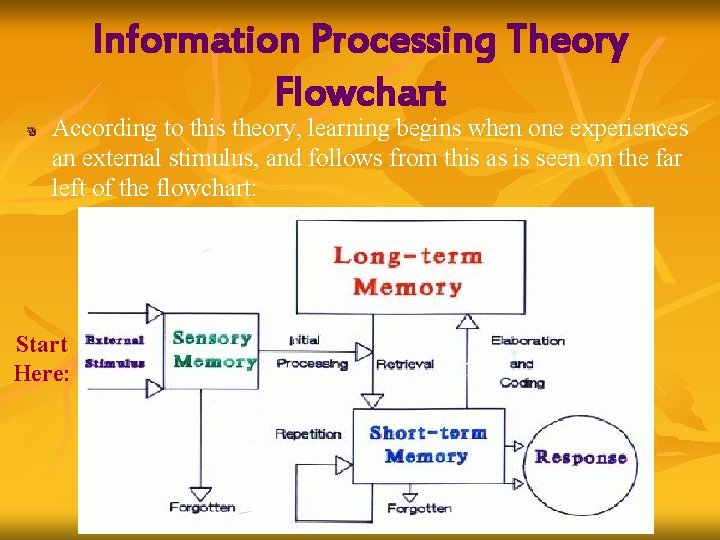
Information Processing Theory Flowchart According to this theory, learning begins when one experiences an external stimulus, and follows from this as is seen on the far left of the flowchart: Start Here:
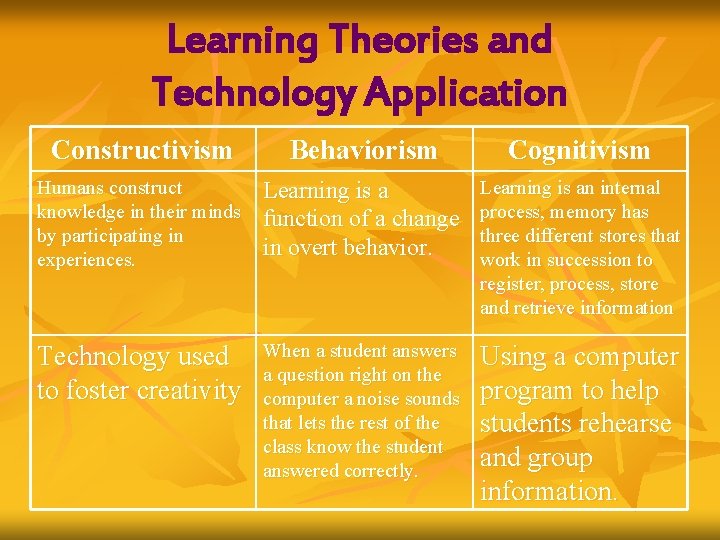
Learning Theories and Technology Application Constructivism Behaviorism Cognitivism Humans construct knowledge in their minds by participating in experiences. Learning is a function of a change in overt behavior. Learning is an internal process, memory has three different stores that work in succession to register, process, store and retrieve information Technology used to foster creativity When a student answers a question right on the computer a noise sounds that lets the rest of the class know the student answered correctly. Using a computer program to help students rehearse and group information.
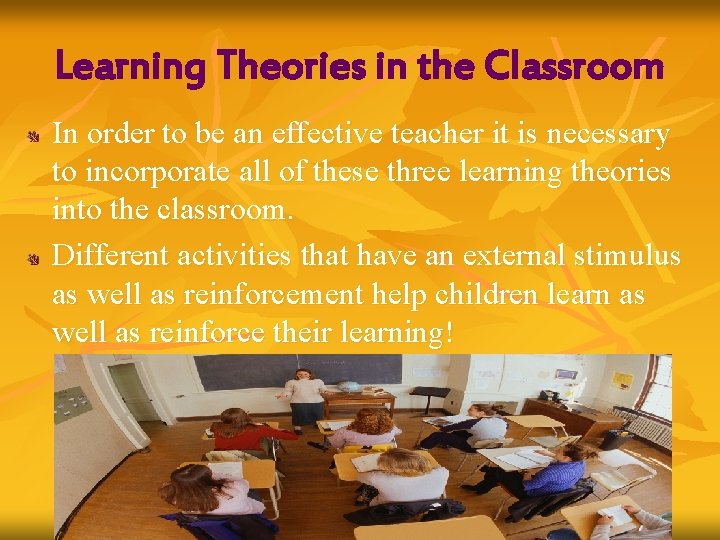
Learning Theories in the Classroom In order to be an effective teacher it is necessary to incorporate all of these three learning theories into the classroom. Different activities that have an external stimulus as well as reinforcement help children learn as well as reinforce their learning!
- Slides: 7