
Learning Theories By Susana Orduna Cognitive Theorist Swiss
Learning Theories By Susana Orduna
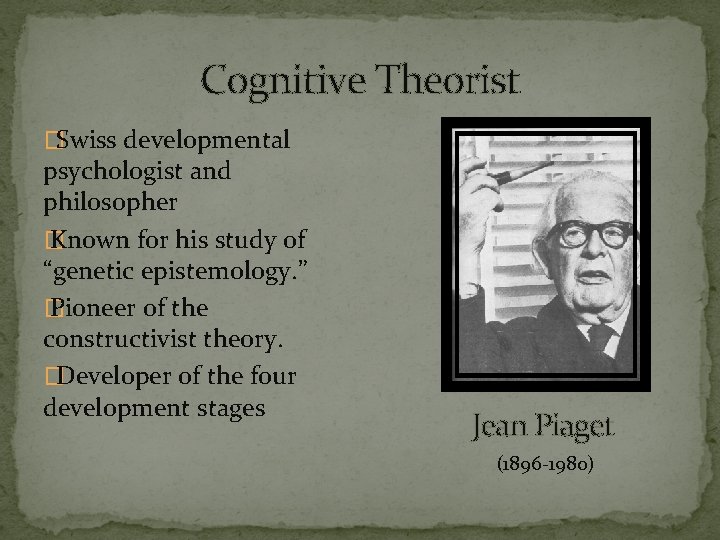
Cognitive Theorist �Swiss developmental psychologist and philosopher � Known for his study of “genetic epistemology. ” � Pioneer of the constructivist theory. �Developer of the four development stages Jean Piaget (1896 -1980)
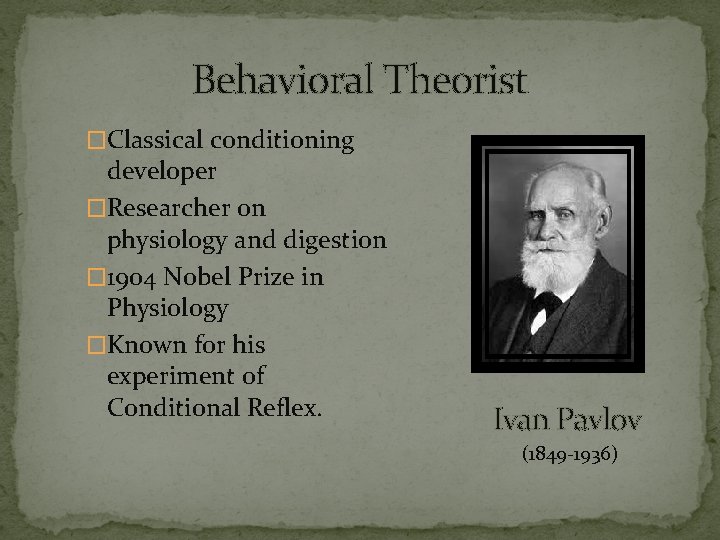
Behavioral Theorist �Classical conditioning developer �Researcher on physiology and digestion � 1904 Nobel Prize in Physiology �Known for his experiment of Conditional Reflex. Ivan Pavlov (1849 -1936)
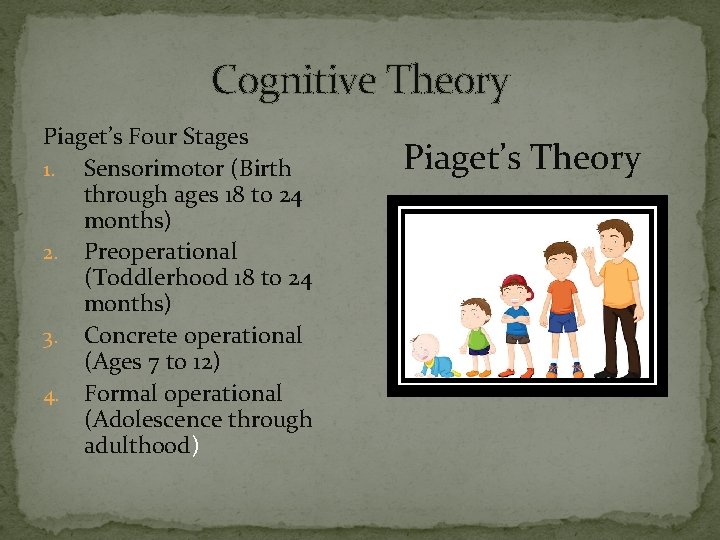
Cognitive Theory Piaget’s Four Stages 1. Sensorimotor (Birth through ages 18 to 24 months) 2. Preoperational (Toddlerhood 18 to 24 months) 3. Concrete operational (Ages 7 to 12) 4. Formal operational (Adolescence through adulthood) Piaget’s Theory
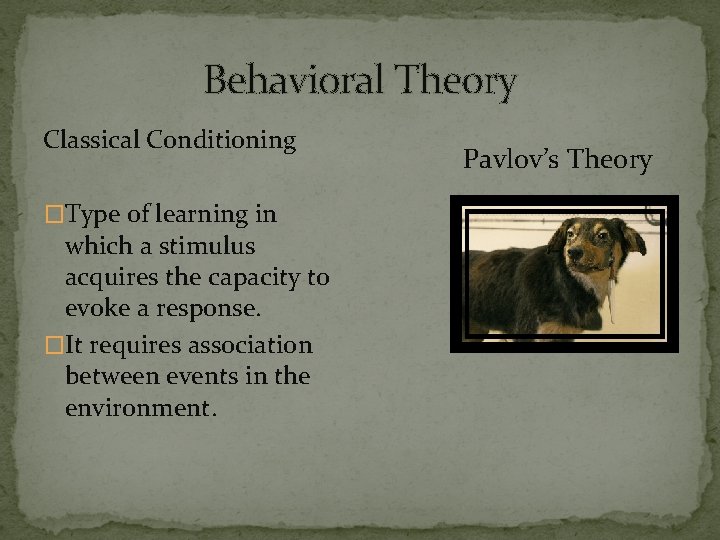
Behavioral Theory Classical Conditioning �Type of learning in which a stimulus acquires the capacity to evoke a response. �It requires association between events in the environment. Pavlov’s Theory
Piaget’s Four Stages Impact in Teaching �Our grade levels are based by this theory. �Is used to measure the level of knowledge of a child. �Is the bases of child development instruction.
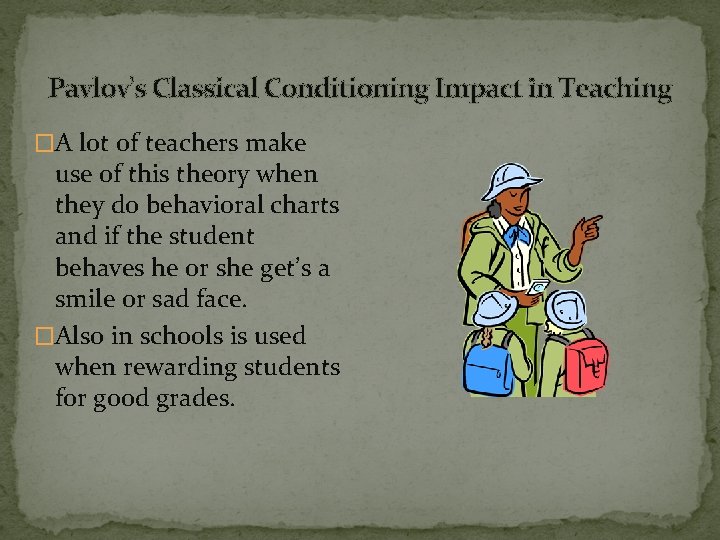
Pavlov's Classical Conditioning Impact in Teaching �A lot of teachers make use of this theory when they do behavioral charts and if the student behaves he or she get’s a smile or sad face. �Also in schools is used when rewarding students for good grades.
Piaget’s Four Stages in Adult Education �This four stages in adult education are not that useful but they can still be used as a margin. �It also helps to understand at what level or stages our audience is on.
Pavlov's Classical Conditioning in the Adult Education �The student is instructed on how to do an assignment after that he or she is rewarded with a grade which shows their level of understanding. �The student is condition to do assignments over and over again on its own.

References Brown, A. , & Green, T. (2011). The essentials of instructional design. (2 nd ed. , Vol. ed. ). Boston, MA: Pearson Education. Mc. Leod, S. (n. d. ). Retrieved from http: //www. simplypsychology. org/piaget. html Lautenheiser, M. (n. d. ). Retrieved from http: //muskingum. edu/~psych/psycweb/history/pavlov. htm
- Slides: 10