
Learning Theories Behaviorism Information Processing Constructivism Retro Learning
Learning Theories • Behaviorism • Information Processing • Constructivism
Retro Learning o In the past, technology was the introduction of the scantron machine and overhead projectors. o Homework was handwritten and blackboards were adequate mediums for education.
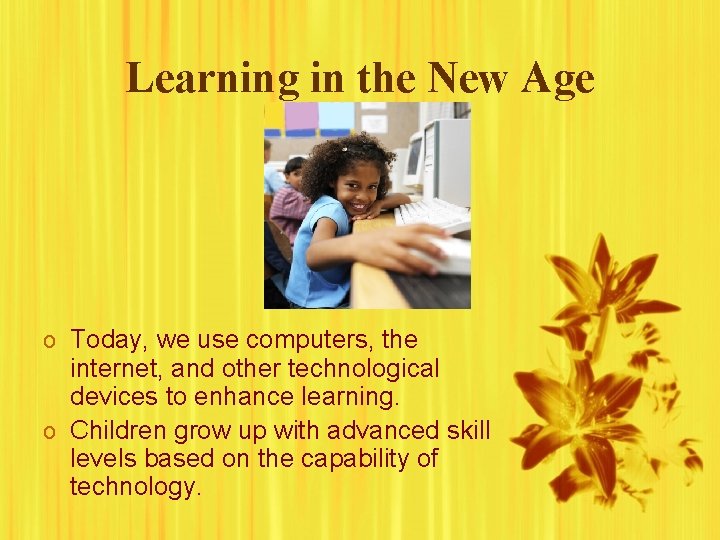
Learning in the New Age o Today, we use computers, the internet, and other technological devices to enhance learning. o Children grow up with advanced skill levels based on the capability of technology.
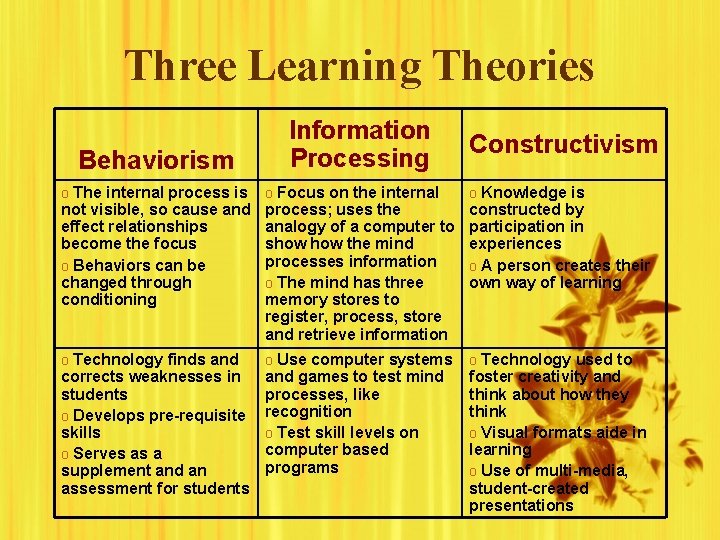
Three Learning Theories Behaviorism Information Processing Constructivism o The internal process is o Focus on the internal o Knowledge is o Technology finds and o Use computer systems o Technology used to not visible, so cause and effect relationships become the focus o Behaviors can be changed through conditioning corrects weaknesses in students o Develops pre-requisite skills o Serves as a supplement and an assessment for students process; uses the analogy of a computer to show the mind processes information o The mind has three memory stores to register, process, store and retrieve information and games to test mind processes, like recognition o Test skill levels on computer based programs constructed by participation in experiences o A person creates their own way of learning foster creativity and think about how they think o Visual formats aide in learning o Use of multi-media, student-created presentations
Behaviorism o Theory based on observable changes in behavior o Notable Behaviorist Theorists: o Pavlov (classical conditioning) o John Watson (classical conditioning to emotional reactions) o Edward Thorndike (stimuli and voluntary behaviors) o B. F. Skinner (operant conditioning) http: //web. syr. edu/~walker/BEHAVIORISTTHEORIES. htm
Information Processing o A developmental theory used through the study of memory and how to retrieve memory o George A. Miller found information is formed into small “chunks” stored in working memory, and the brain can only hold 5 -7 chunks of information at a time o The key to Information Processing is that short-term memory we remember goes into long-term memory, which has an unlimited capacity to store knowledge. http: //chd. gse. gmu. edu/immersion/knowledgebase/strategies/cogn itivism/informationprocessing. htm
Constructivism o The idea that we build our understanding from our experiences o Learning is the process of adjusting ourselves to new experiences o How it impacts learning: o Curriculum (adjusting for each students needs) o Instruction (making connections between facts and experiences) o Assessment (no standardized grading) http: //www. funderstanding. com/constructivism. cfm
- Slides: 7