
Learning Theories and Technology Implications Study Source For
- Slides: 6
Learning Theories and Technology Implications
Study Source For more detailed information on learning theories and technology implication, please study Integrating Educational Technology into Teaching by Roblyer and Doering (2013) chapter 2, pages 34 -69
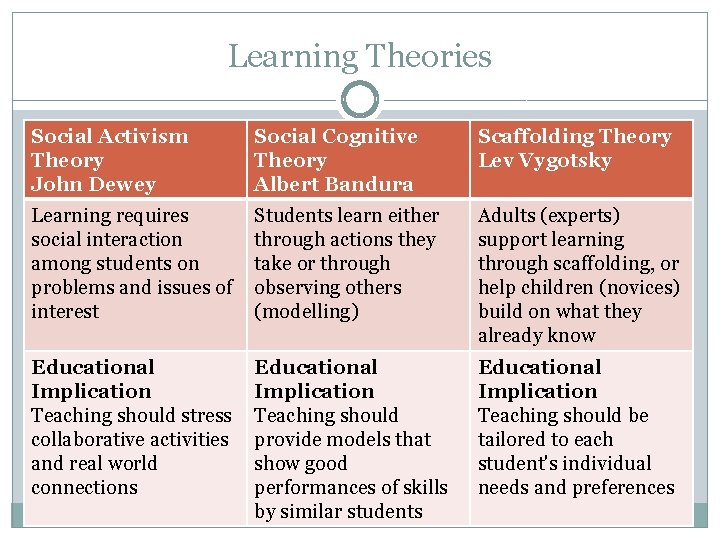
Learning Theories Social Activism Theory John Dewey Social Cognitive Theory Albert Bandura Scaffolding Theory Lev Vygotsky Learning requires social interaction among students on problems and issues of interest Students learn either through actions they take or through observing others (modelling) Adults (experts) support learning through scaffolding, or help children (novices) build on what they already know Educational Implication Teaching should stress collaborative activities and real world connections Educational Implication Teaching should provide models that show good performances of skills by similar students Educational Implication Teaching should be tailored to each student's individual needs and preferences
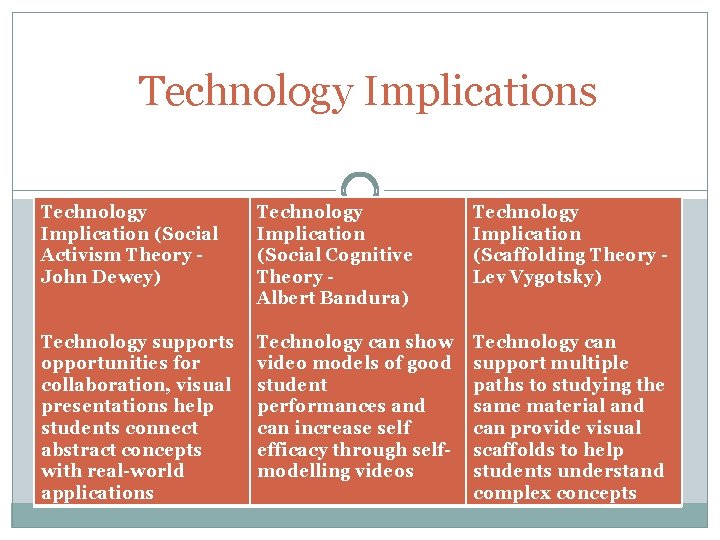
Technology Implications Technology Implication (Social Activism Theory John Dewey) Technology Implication (Social Cognitive Theory Albert Bandura) Technology Implication (Scaffolding Theory Lev Vygotsky) Technology supports opportunities for collaboration, visual presentations help students connect abstract concepts with real-world applications Technology can show video models of good student performances and can increase self efficacy through selfmodelling videos Technology can support multiple paths to studying the same material and can provide visual scaffolds to help students understand complex concepts
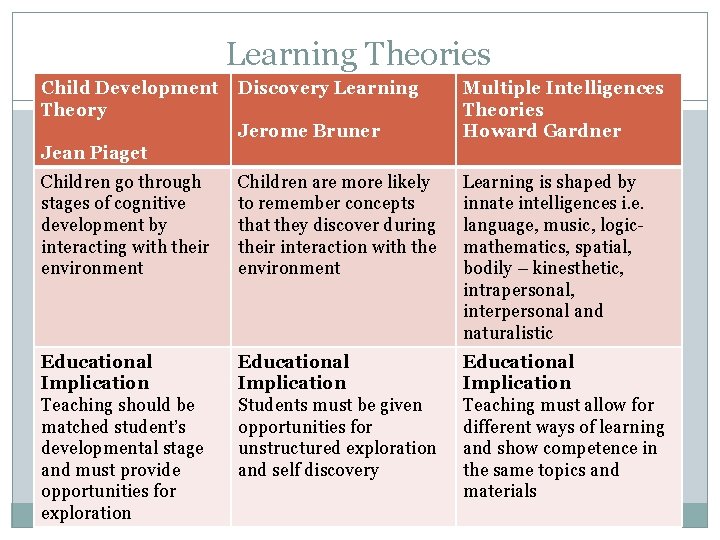
Learning Theories Child Development Theory Discovery Learning Jerome Bruner Multiple Intelligences Theories Howard Gardner Jean Piaget Children go through stages of cognitive development by interacting with their environment Children are more likely to remember concepts that they discover during their interaction with the environment Learning is shaped by innate intelligences i. e. language, music, logicmathematics, spatial, bodily – kinesthetic, intrapersonal, interpersonal and naturalistic Educational Implication Teaching should be matched student’s developmental stage and must provide opportunities for exploration Educational Implication Students must be given opportunities for unstructured exploration and self discovery Educational Implication Teaching must allow for different ways of learning and show competence in the same topics and materials
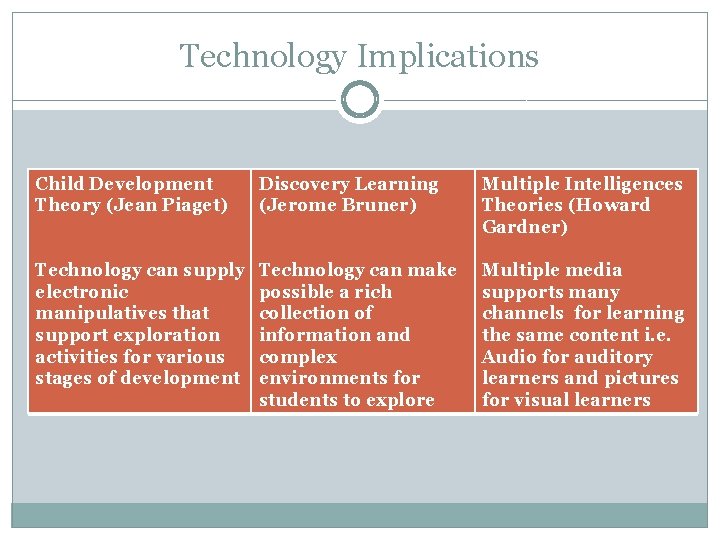
Technology Implications Child Development Theory (Jean Piaget) Discovery Learning (Jerome Bruner) Multiple Intelligences Theories (Howard Gardner) Technology can supply electronic manipulatives that support exploration activities for various stages of development Technology can make possible a rich collection of information and complex environments for students to explore Multiple media supports many channels for learning the same content i. e. Audio for auditory learners and pictures for visual learners