
Learning Targets Origins of the Civil War political
- Slides: 29
Learning Targets • Origins of the Civil War: political issues, states’ rights, modernization, sectionalism, the nullification crisis, economic differences between North and South • Abolitionist debate: ideologies and arguments for and against slavery and their impact • Reasons for, and effects of, westward expansion and the sectional debates; the crisis of the 1850 s; the Kansas–Nebraska problem; the Ostend Manifesto; the Lincoln–Douglas debates; the impact of the election of Abraham Lincoln and the Emancipation Proclamation; Jefferson Davis and the Confederacy
Mexican American War Discussion Prompts • Was the Mexican-American War an exercise in Imperialism? • Was the Mexican-American War a “Just War? ” • Was the war part of a conspiracy by Southerners to acquire more territory for the “peculiar institution” of slavery?
Road to the Civil War
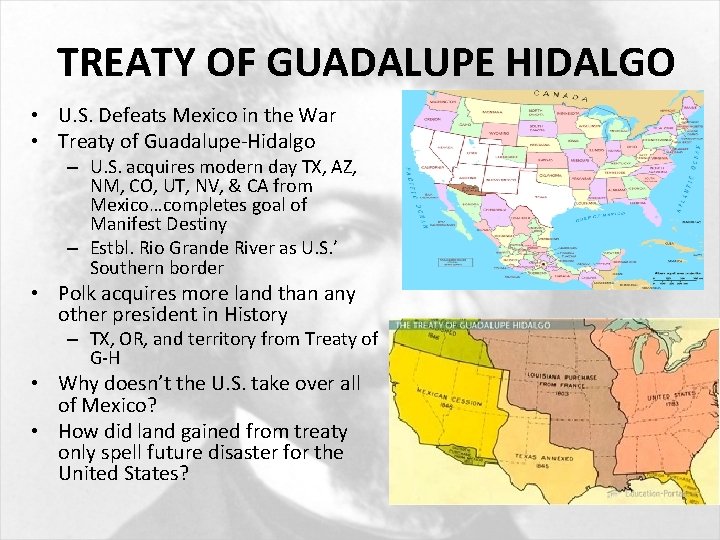
TREATY OF GUADALUPE HIDALGO • U. S. Defeats Mexico in the War • Treaty of Guadalupe-Hidalgo – U. S. acquires modern day TX, AZ, NM, CO, UT, NV, & CA from Mexico…completes goal of Manifest Destiny – Estbl. Rio Grande River as U. S. ’ Southern border • Polk acquires more land than any other president in History – TX, OR, and territory from Treaty of G-H • Why doesn’t the U. S. take over all of Mexico? • How did land gained from treaty only spell future disaster for the United States?
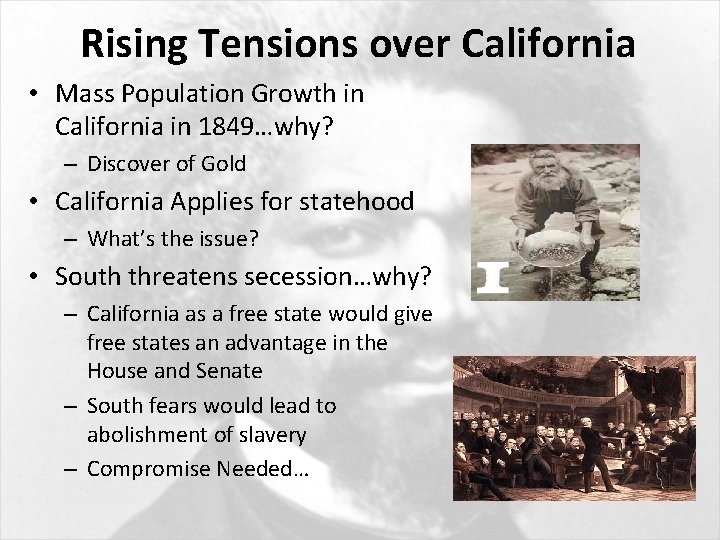
Rising Tensions over California • Mass Population Growth in California in 1849…why? – Discover of Gold • California Applies for statehood – What’s the issue? • South threatens secession…why? – California as a free state would give free states an advantage in the House and Senate – South fears would lead to abolishment of slavery – Compromise Needed…
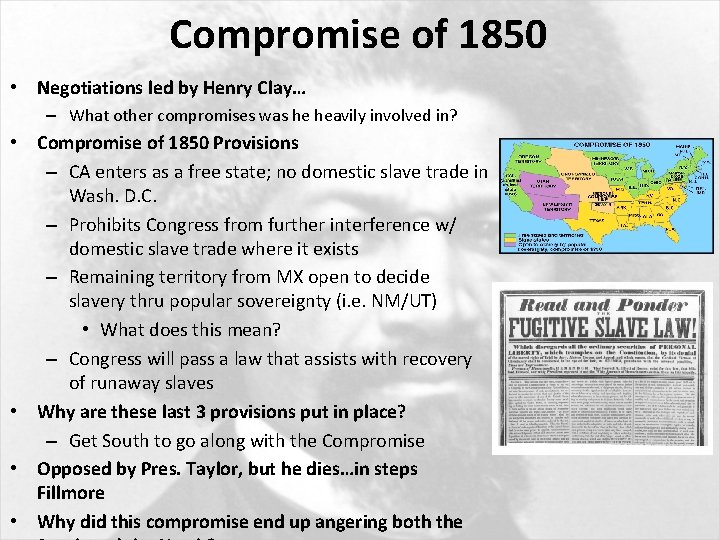
Compromise of 1850 • Negotiations led by Henry Clay… – What other compromises was he heavily involved in? • Compromise of 1850 Provisions – CA enters as a free state; no domestic slave trade in Wash. D. C. – Prohibits Congress from further interference w/ domestic slave trade where it exists – Remaining territory from MX open to decide slavery thru popular sovereignty (i. e. NM/UT) • What does this mean? – Congress will pass a law that assists with recovery of runaway slaves • Why are these last 3 provisions put in place? – Get South to go along with the Compromise • Opposed by Pres. Taylor, but he dies…in steps Fillmore • Why did this compromise end up angering both the
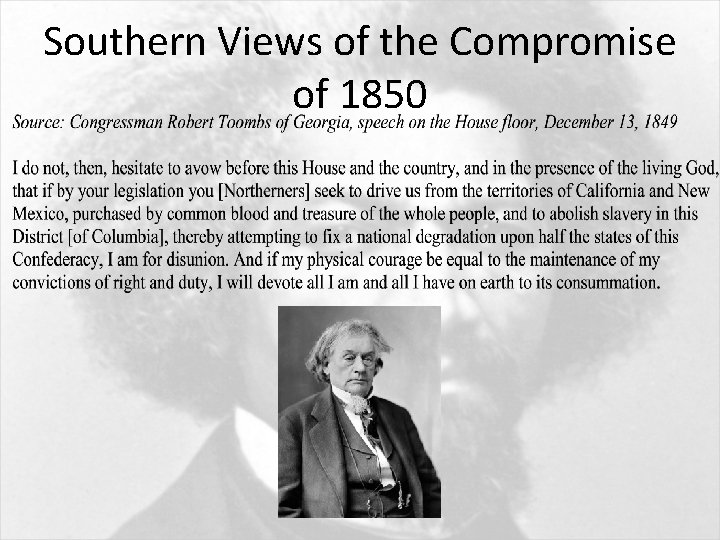
Southern Views of the Compromise of 1850
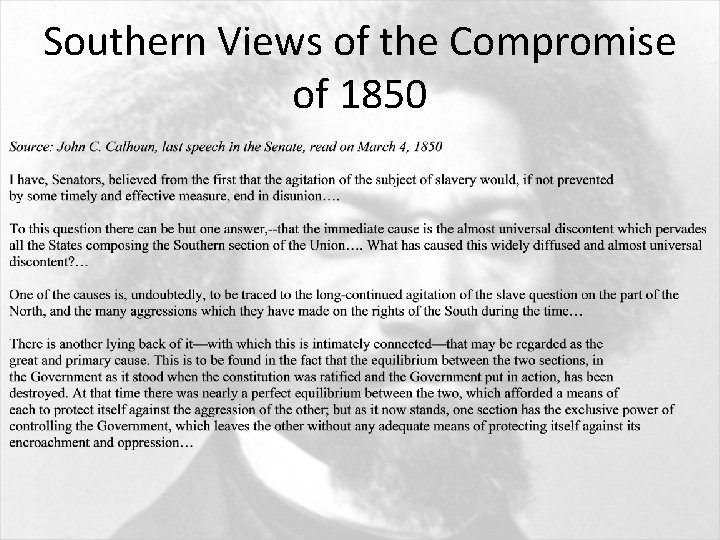
Southern Views of the Compromise of 1850
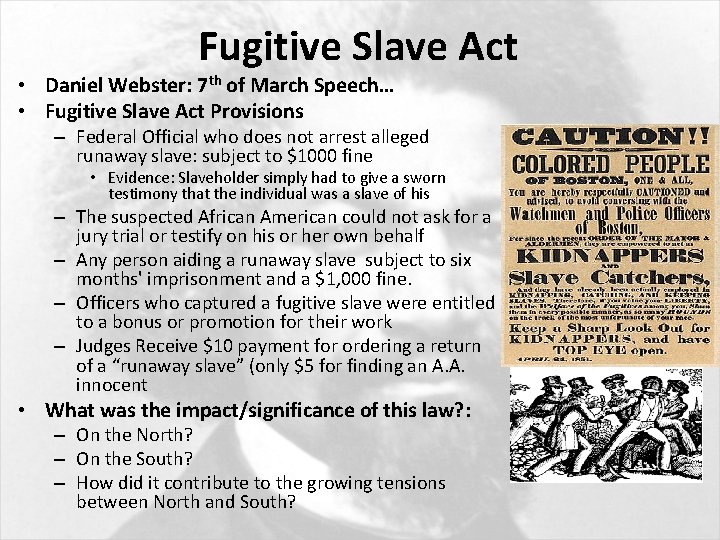
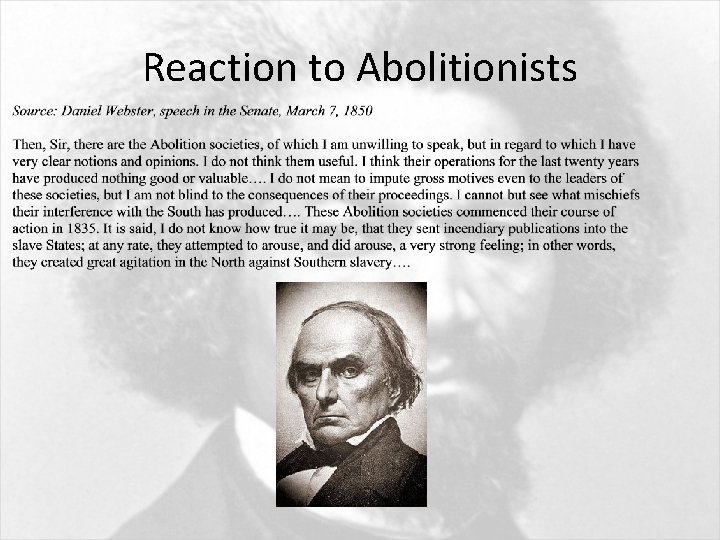
Fugitive Slave Act • Daniel Webster: 7 th of March Speech… • Fugitive Slave Act Provisions – Federal Official who does not arrest alleged runaway slave: subject to $1000 fine • Evidence: Slaveholder simply had to give a sworn testimony that the individual was a slave of his – The suspected African American could not ask for a jury trial or testify on his or her own behalf – Any person aiding a runaway slave subject to six months' imprisonment and a $1, 000 fine. – Officers who captured a fugitive slave were entitled to a bonus or promotion for their work – Judges Receive $10 payment for ordering a return of a “runaway slave” (only $5 for finding an A. A. innocent • What was the impact/significance of this law? : – On the North? – On the South? – How did it contribute to the growing tensions between North and South?
Growing Abolitionism • Abolitionist Movement – Fight to ban slavery in the U. S. – Took Multiple forms/Motivations • Garrisonians • Religious Abolitionists • Political Abolitionists – Liberty Party – Free Soil Party…what was their true intent? • Radical/Military Abolitionists – John Brown • Why did the Fugitive Slave Act lead to a surge in Abolitionism in the North? – Yet, still was not a majority movement
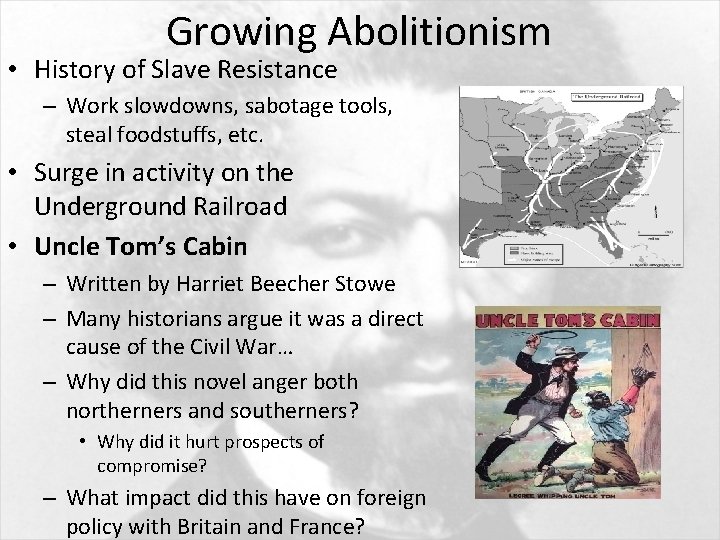
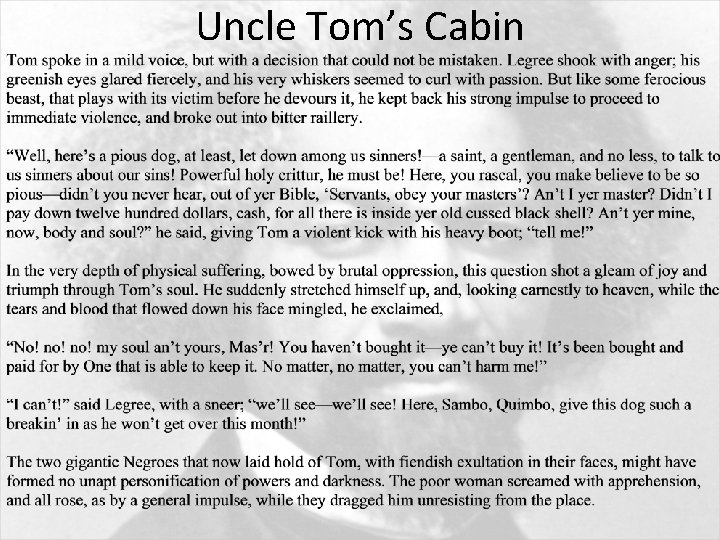
Growing Abolitionism • History of Slave Resistance – Work slowdowns, sabotage tools, steal foodstuffs, etc. • Surge in activity on the Underground Railroad • Uncle Tom’s Cabin – Written by Harriet Beecher Stowe – Many historians argue it was a direct cause of the Civil War… – Why did this novel anger both northerners and southerners? • Why did it hurt prospects of compromise? – What impact did this have on foreign policy with Britain and France?
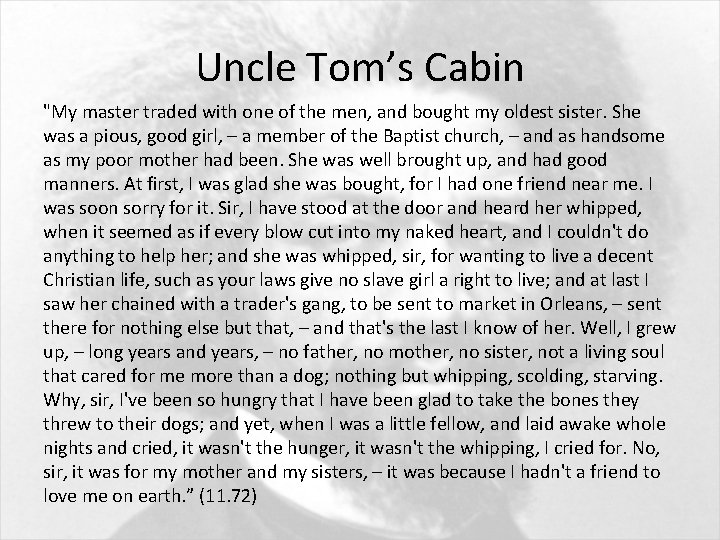
Uncle Tom’s Cabin "My master traded with one of the men, and bought my oldest sister. She was a pious, good girl, – a member of the Baptist church, – and as handsome as my poor mother had been. She was well brought up, and had good manners. At first, I was glad she was bought, for I had one friend near me. I was soon sorry for it. Sir, I have stood at the door and heard her whipped, when it seemed as if every blow cut into my naked heart, and I couldn't do anything to help her; and she was whipped, sir, for wanting to live a decent Christian life, such as your laws give no slave girl a right to live; and at last I saw her chained with a trader's gang, to be sent to market in Orleans, – sent there for nothing else but that, – and that's the last I know of her. Well, I grew up, – long years and years, – no father, no mother, no sister, not a living soul that cared for me more than a dog; nothing but whipping, scolding, starving. Why, sir, I've been so hungry that I have been glad to take the bones they threw to their dogs; and yet, when I was a little fellow, and laid awake whole nights and cried, it wasn't the hunger, it wasn't the whipping, I cried for. No, sir, it was for my mother and my sisters, – it was because I hadn't a friend to love me on earth. ” (11. 72)
Uncle Tom’s Cabin
Reaction to Abolitionists
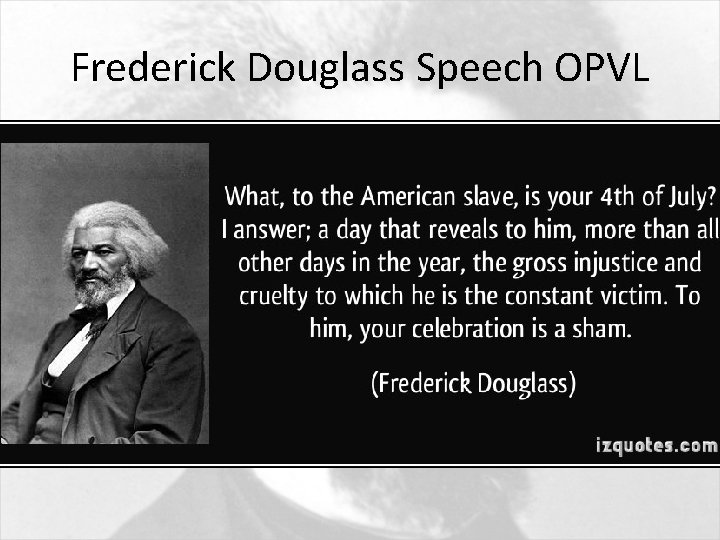
Frederick Douglass Speech OPVL
Election of 1852: Changing of the Tides • Candidates: – Democrats: Franklin Pierce – Whigs: Winfield Scott – Free Soilers: John Hale • Impact – Pierce: Pro-Slavery, Expansionist – Collapse of the Whig Party… • Death of Henry Clay and Daniel Webster…symbolic • Why was the death of these two individuals so important? – Led to Rise of the Republican Party…and sectional parties
Ostend Manifesto (1854) • Pierce Administration: – American ministers in Europe: • Pierre Soulé for Spain • James Buchanan for Great Britain • John Y. Mason for France – Plan for the United States to purchase Cuba from Spain • implied U. S. should declare war if Spain refused • What motivations would the U. S. have for acquiring Cuba? Who would oppose? • Impact…
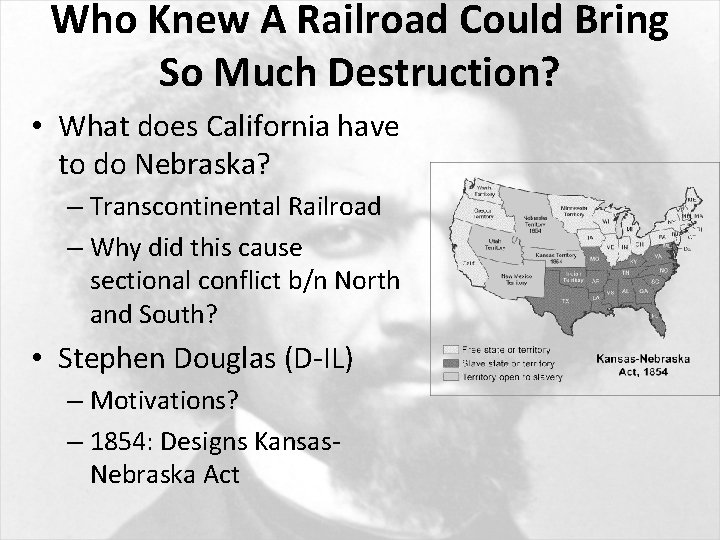
Who Knew A Railroad Could Bring So Much Destruction? • What does California have to do Nebraska? – Transcontinental Railroad – Why did this cause sectional conflict b/n North and South? • Stephen Douglas (D-IL) – Motivations? – 1854: Designs Kansas. Nebraska Act
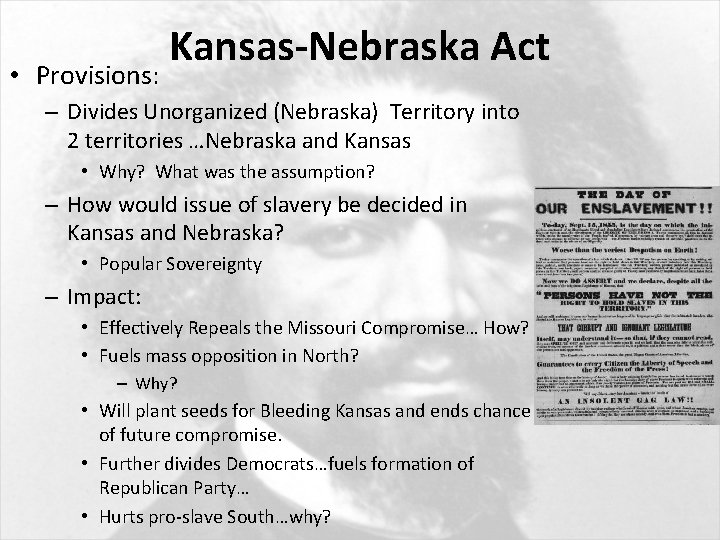
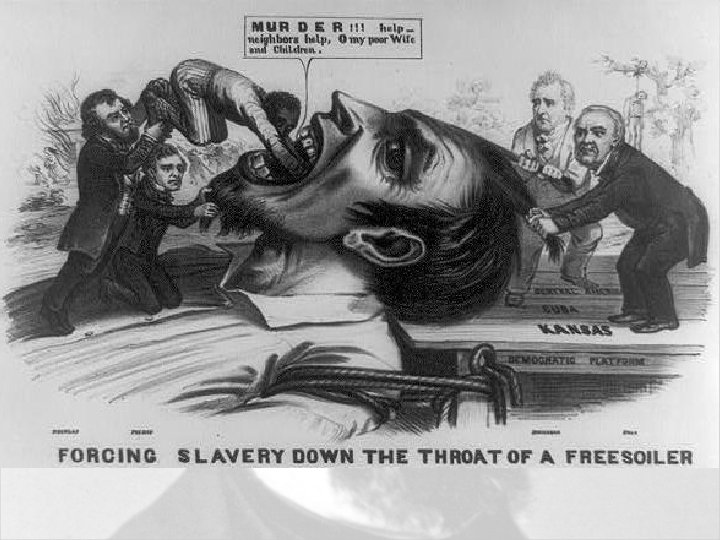
• Provisions: Kansas-Nebraska Act – Divides Unorganized (Nebraska) Territory into 2 territories …Nebraska and Kansas • Why? What was the assumption? – How would issue of slavery be decided in Kansas and Nebraska? • Popular Sovereignty – Impact: • Effectively Repeals the Missouri Compromise… How? • Fuels mass opposition in North? – Why? • Will plant seeds for Bleeding Kansas and ends chance of future compromise. • Further divides Democrats…fuels formation of Republican Party… • Hurts pro-slave South…why?
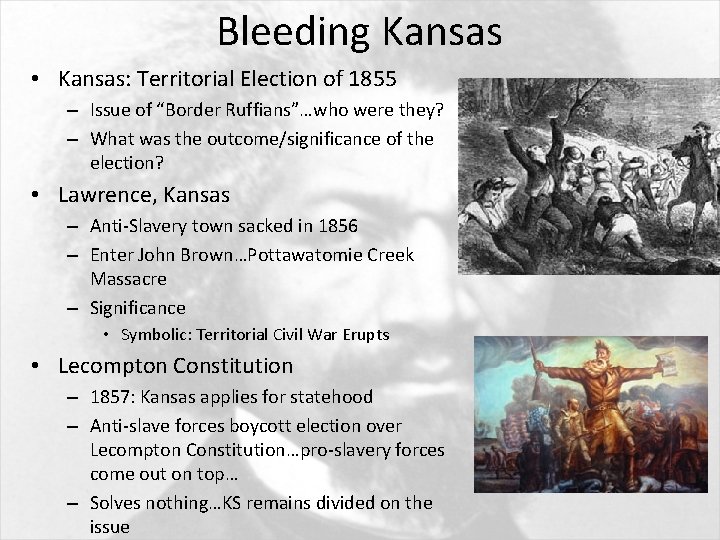
Bleeding Kansas • Kansas: Territorial Election of 1855 – Issue of “Border Ruffians”…who were they? – What was the outcome/significance of the election? • Lawrence, Kansas – Anti-Slavery town sacked in 1856 – Enter John Brown…Pottawatomie Creek Massacre – Significance • Symbolic: Territorial Civil War Erupts • Lecompton Constitution – 1857: Kansas applies for statehood – Anti-slave forces boycott election over Lecompton Constitution…pro-slavery forces come out on top… – Solves nothing…KS remains divided on the issue
Election of 1856 & Lecompton Constitution • Election of 1856 – James Buchanan (Democrat) v. John Fremont (Republican) v. Millard Fillmore (Know. Nothing) • Outcome – President James Buchanan wins, takes over for Pierce – Strong showing for the emerging Republican party who took a strong position against the expansion of slavery into the western territories. • Election of 1856 and Bleeding Kansas – Pro-southerner, Buchanan supported the Lecompton Constitution – Action splits Democratic party along sectional lines • Stephen Douglas intervenes – Champion of pop. Sovereignty, he blocks Lecompton Constitution (signifies further division Democratic Party – Kansas remains a territory, denied statehood until 1861 (outbreak of C. W. )
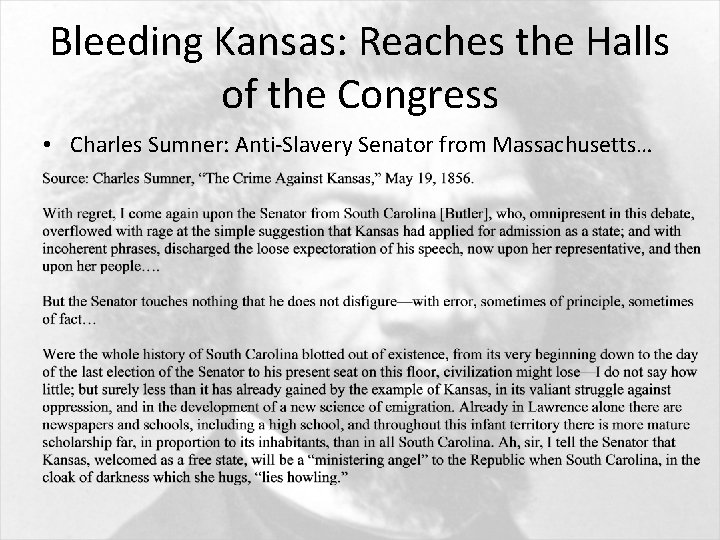
Bleeding Kansas: Reaches the Halls of the Congress • Charles Sumner: Anti-Slavery Senator from Massachusetts…
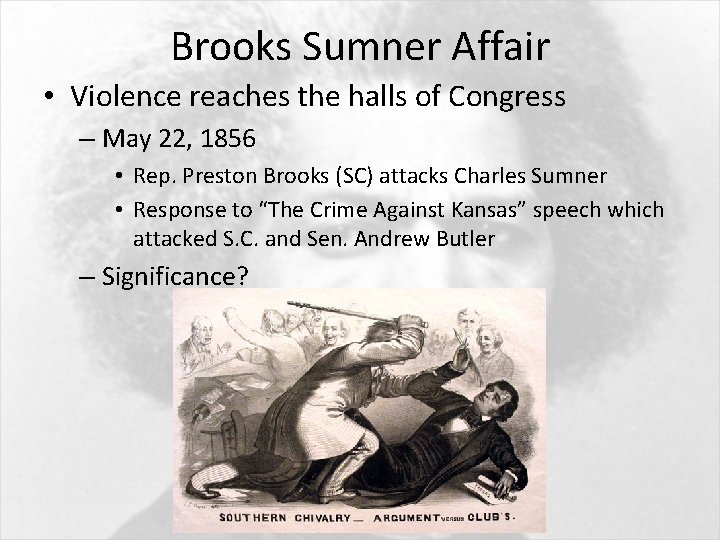
Brooks Sumner Affair • Violence reaches the halls of Congress – May 22, 1856 • Rep. Preston Brooks (SC) attacks Charles Sumner • Response to “The Crime Against Kansas” speech which attacked S. C. and Sen. Andrew Butler – Significance?
Dred Scott v. Sandford • March 6, 1857: Supreme Court Drops a Bomb Shell! • Court Ruling (Chief Justice: Roger Taney) – African Americans were not citizens, thus Dred Scott could not sue in federal court – Slaves=Property; thus not free even if in free territory – Missouri Compromise (36/30 line) ruled unconstitutional • Declared Congress did not have jurisdiction to ban slavery in the territories; nor did popular sovereignty matter • Impact: – Further splits N. /S. elements of Democratic Party – Fuels further division between North and South… why?
John Brown’s Raid: Harper’s Ferry • The Point of No Return… – October 1859: Brown seizes Federal Arsenal at Harper’s Ferry – What were his motivations? • Abolitionist Response – Anger over his execution • Southern Response – Viewed as Northern abolitionist conspiracy – Fuels calls for secession
Lincoln-Douglas Debates (1858) • What were the Lincoln-Douglas Debates? • Who was Stephen Douglas? What major piece of legislation did he help push through the Congress? • What was the Freeport Question during the debates? • What was the Freeport Doctrine? Why did this cause further sectional division in the Democratic Party? – Concept of Nullification and Road to Civil War: • • VA/KY Resolutions Nullification Crisis Compromise of 1850/Fugitive Slave Act Freeport Doctrine
Election of 1860 • Democratic Party Officially Splits – Northern Democrats: Stephen Douglas • Popular Sovereignty – Southern Democrats: John C. Breckinridge • Expand Slavery; Manifest Destiny into Latin America • Republican Platform—Broad Appeal to North – Economic protectionism – Free Homesteads – Internal Improvements thru Fed. Financing • Transcontinental Railroad – Oppose Expansion of Slavery • Republican Candidate: Abe Lincoln
Election of 1860 • Lincoln Wins – Lincoln won the 1860 Presidential election despite not receiving one electoral vote from 10 states— he was the most sectionally elected President, ever. – “I know it’s an awful thing for me to say, but I already wish someone else was here in my place. ” • Confederate States of America Established (Feb. 1861) – SC, AL, MS, FL, GA, LA, TX (eventually VA, NC, TN, & AK, as well)