
Learning Targets Module 68 Schizophrenia 68 1 Describe
Learning Targets Module 68 Schizophrenia 68 -1 Describe the patterns of perceiving, thinking, and feeling that characterize schizophrenia. 68 -2 Contrast chronic schizophrenia and acute schizophrenia. 68 -3 Discuss the brain abnormalities associated with schizophrenia. 68 -4 Discuss the prenatal events associated with increased risk of developing schizophrenia. 68 -5 Discuss how genes influence schizophrenia, and identify the factors that may be early warning signs of

Consider this quote “ Now consider this: The regulator that funnels certain information to you and filters out other information suddenly shuts off. Immediately, every sight, every sound, every smell coming at you carries equal weight; every thought, feeling, memory, and idea presents itself to you with an equally strong and demanding intensity. ” ~Elyn R. Saks, The Center Cannot Hold, 2007
What is schizophrenia? a disorder characterized by delusions, hallucinations, disorganized speech, and/or diminished, inappropriate emotional expression During their most severe periods, people with schizophrenia live in a private inner world, preoccupied with the strange ideas and images that haunt them. The word itself means “split” (schizo) “mind” (phrenia). It refers not to a multiple personality split but rather to the mind’s split from reality.

What are some positive and negative symptoms of schizophrenia? positive symptoms negative symptoms Those with positive symptoms may experience hallucinations, talk in disorganized and deluded ways, and exhibit inappropriate laughter, tears, or rage. Those with negative symptoms may exhibit an absence of emotion in their voices, expressionless faces, or unmoving—mute and rigid—bodies.
AP® Exam Tip When psychologists refer to “positive” and “negative” schizophrenia symptoms, the terms positive and negative don’t mean “good” and “bad. ” Symptoms are positive and negative in a mathematical sense (adding or subtracting behaviors). In the case of schizophrenia, positive symptoms are inappropriate behaviors that are present and negative symptoms are appropriate behaviors that are not present.
What is a hallucination? false sensory experiences, or perceptions, such as seeing something in the absence of an external visual stimulus People with schizophrenia sometimes have hallucinations—they see, feel, taste, or smell things that exist only in their minds. The auditory hallucinations tend to be voices, which sometimes make insulting remarks or give orders. For instance, the voices may tell the person that she is bad or that she must burn herself with a cigarette lighter.

What is a delusion? a false belief, often of persecution or grandeur, that may accompany psychotic disorders People with schizophrenia also have disorganized, fragmented thinking, often distorted by false beliefs called delusions. If they have paranoid tendencies, they may believe they are being threatened or pursued.
Quick check… Are auditory and visual hallucinations positive or negative symptoms of schizophrenia? Are delusions positive or negative symptoms of schizophrenia? Explain your answer to your classmate.
How might selective attention be a factor in schizophrenia? One cause of disorganized thinking may be a breakdown in selective attention. Recall from Module 16 that we normally we have a remarkable capacity to give our undivided attention to one set of sensory stimuli while filtering out others. People with schizophrenia are easily distracted by tiny unrelated stimuli, such as the grooves on a brick or tones in a voice. (Reichenberg & Harvey, 2007)
Consider the case of Maxine… Maxine, a young woman with schizophrenia, believed she was Mary Poppins. Communicating with Maxine was difficult because her thoughts spilled out in no logical order. Her biographer, Susan Sheehan observed her saying aloud to no one in particular, “This morning, when I was at Hillside [Hospital], I was making a movie. I was surrounded by movie stars. . Is this room painted blue to get me upset? My grandmother died four weeks after my eighteenth birthday. ”
What is disorganized speech? Disorganized speech is a positive symptom of schizophrenia. As with Maxine in the previous slide, jumbled ideas may make no sense even within sentences, forming what is known as word salad. For instance, one young man begged for “a little more allegro in the treatment, ” and suggested that “liberationary movement with a view to the widening of the horizon” will “ergo extort some wit in lectures. ”
How are emotions inappropriately expressed in schizophrenia? The expressed emotions of schizophrenia are often utterly inappropriate, split off from reality. (Kring & Caponigro, 2010) Maxine laughed after recalling her grandmother’s death. On other occasions, she cried when others laughed, or became angry for no apparent reason.
How are emotions diminished in schizophrenia? Some people diagnosed with schizophrenia lapse into an emotionless flat affect state of no apparent feeling. Most people with schizophrenia have an impaired theory of mind—they have difficulty perceiving facial expressions and reading others’ states of mind. (Bora & Pantelis, 2016) Unable to understand others’ mental states, those with schizophrenia struggle to feel sympathy and compassion. (Bonfils et al. , 2016).
How might motor behavior be inappropriate and disruptive? Those with schizophrenia may experience catatonia, characterized by motor behaviors ranging from a physical stupor—remaining motionless for hours—to senseless, compulsive actions, such as continually rocking or rubbing an arm, to severe and dangerous agitation.
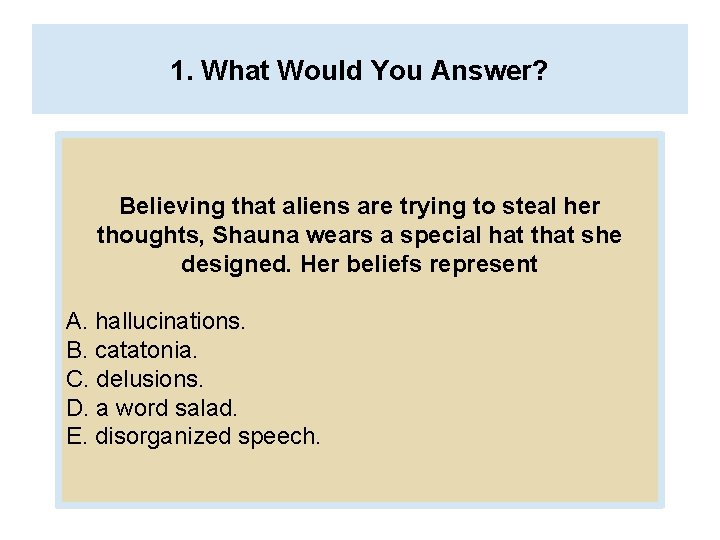
1. What Would You Answer? Believing that aliens are trying to steal her thoughts, Shauna wears a special hat that she designed. Her beliefs represent A. hallucinations. B. catatonia. C. delusions. D. a word salad. E. disorganized speech.
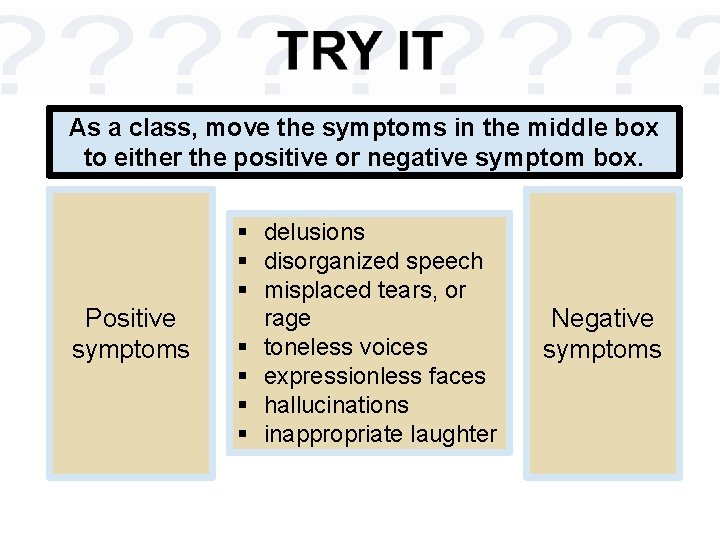
As a class, move the symptoms in the middle box to either the positive or negative symptom box. Positive symptoms § delusions § disorganized speech § misplaced tears, or rage § toneless voices § expressionless faces § hallucinations § inappropriate laughter Negative symptoms
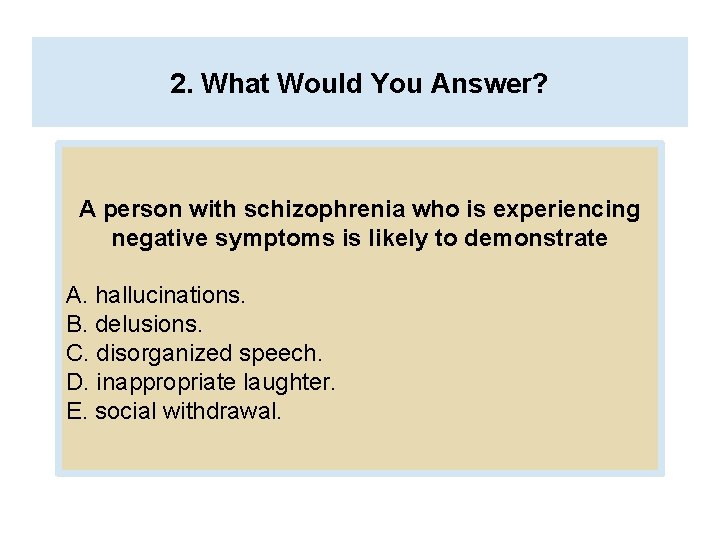
2. What Would You Answer? A person with schizophrenia who is experiencing negative symptoms is likely to demonstrate A. hallucinations. B. delusions. C. disorganized speech. D. inappropriate laughter. E. social withdrawal.
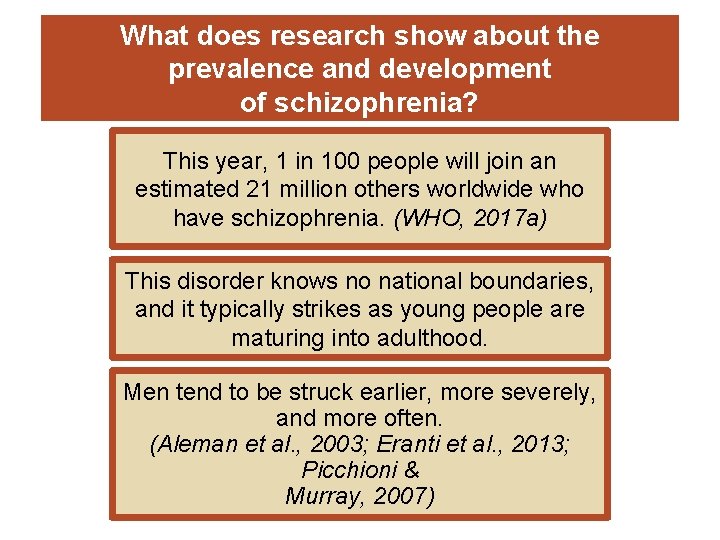
What does research show about the prevalence and development of schizophrenia? This year, 1 in 100 people will join an estimated 21 million others worldwide who have schizophrenia. (WHO, 2017 a) This disorder knows no national boundaries, and it typically strikes as young people are maturing into adulthood. Men tend to be struck earlier, more severely, and more often. (Aleman et al. , 2003; Eranti et al. , 2013; Picchioni & Murray, 2007)
What is chronic schizophrenia? form of schizophrenia in which symptoms usually appear by late adolescence or early adulthood As people age, psychotic episodes last longer and recovery periods shorten. Social withdrawal, a negative symptom, is often found among those with chronic schizophrenia. (Kirkpatrick et al. , 2006) Men, whose schizophrenia develops on average four years earlier than women’s, more often exhibit negative symptoms and chronic schizophrenia. (Räsänen et al. , 2000)
What is acute schizophrenia? form of schizophrenia that can begin at any age; frequently occurs in response to a traumatic event When previously well-adjusted people develop schizophrenia rapidly following particular life stresses, this is called acute schizophrenia, and recovery is likely. People with acute schizophrenia more often have positive symptoms that respond to drug therapy. (Fenton & Mc. Glashan, 1991, 1994; Fowles, 1992)
3. What Would You Answer? Over several years, Charles gradually developed schizophrenia. Because of this, the prognosis for recovery is poor. His type of schizophrenia would be referred to as A. acute. B. chronic. C. maternal. D. catatonic. E. positive.
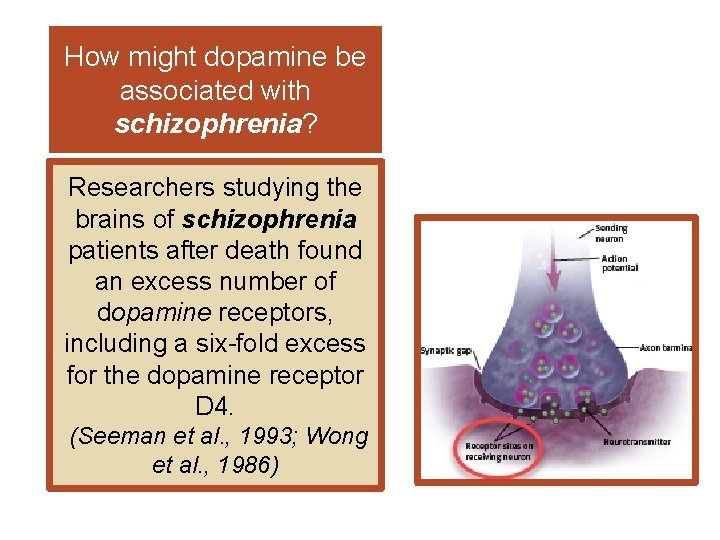
How might dopamine be associated with schizophrenia? Researchers studying the brains of schizophrenia patients after death found an excess number of dopamine receptors, including a six-fold excess for the dopamine receptor D 4. (Seeman et al. , 1993; Wong et al. , 1986)
What else is known about dopamine and its relationship to schizophrenia? A hyper-responsive dopamine system may intensify brain signals in schizophrenia, creating positive symptoms such as hallucinations and paranoia. (Maia & Frank, 2017) Drugs that block dopamine receptors (antagonists) often lessen these symptoms. Drugs that increase dopamine levels (agonists), such as amphetamines and cocaine, sometimes intensify them. (Basu & Basu, 2015; Farnia et al. , 2014)
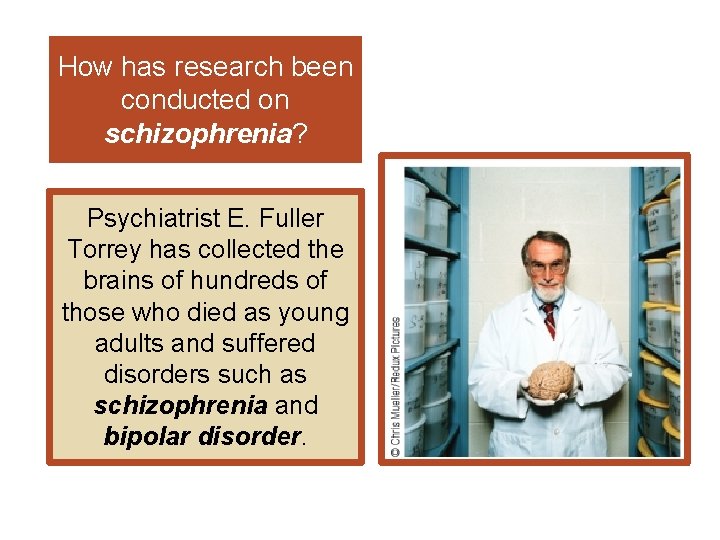
How has research been conducted on schizophrenia? Psychiatrist E. Fuller Torrey has collected the brains of hundreds of those who died as young adults and suffered disorders such as schizophrenia and bipolar disorder.
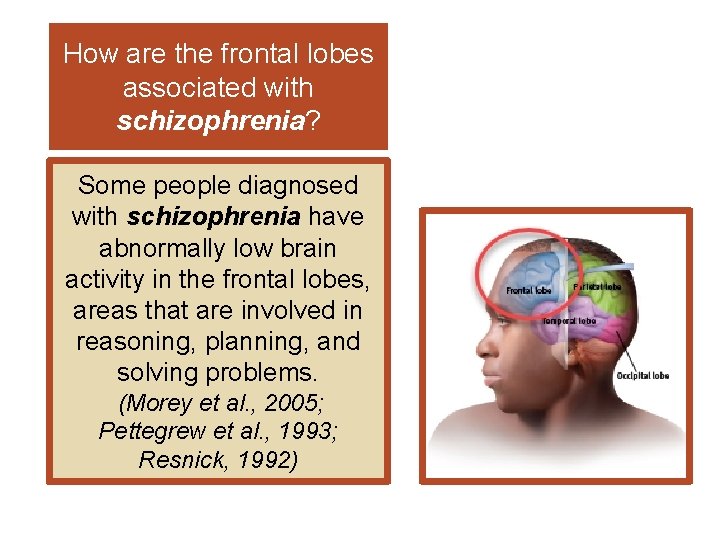
How are the frontal lobes associated with schizophrenia? Some people diagnosed with schizophrenia have abnormally low brain activity in the frontal lobes, areas that are involved in reasoning, planning, and solving problems. (Morey et al. , 2005; Pettegrew et al. , 1993; Resnick, 1992)
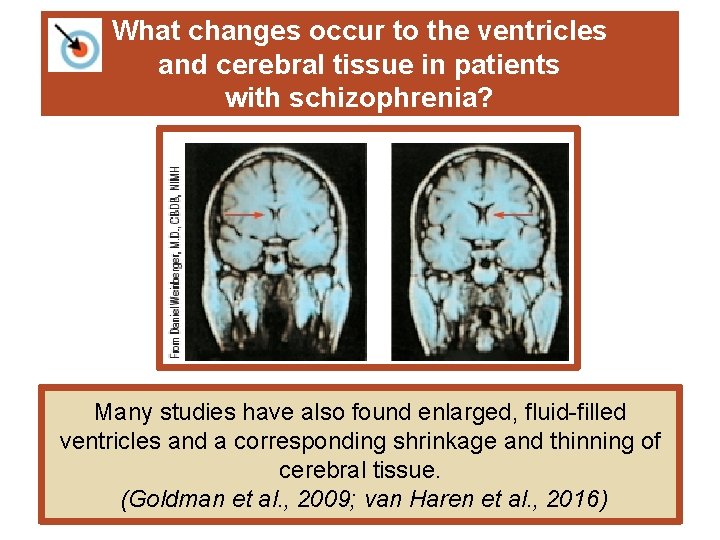
What changes occur to the ventricles and cerebral tissue in patients with schizophrenia? Many studies have also found enlarged, fluid-filled ventricles and a corresponding shrinkage and thinning of cerebral tissue. (Goldman et al. , 2009; van Haren et al. , 2016)
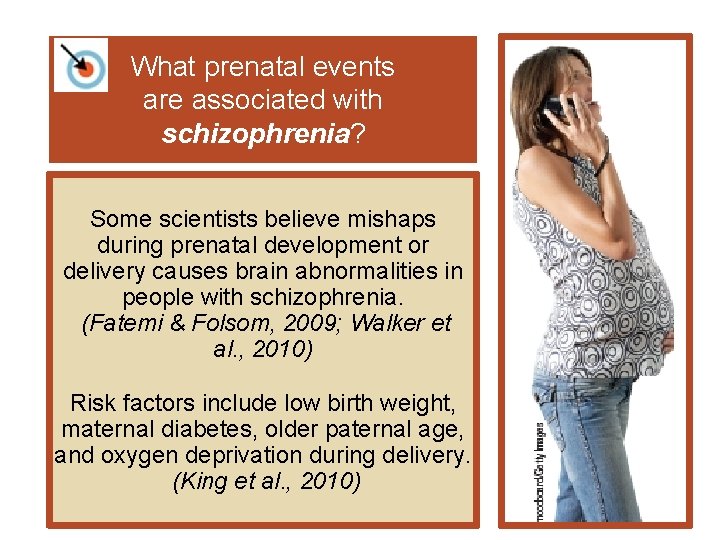
What prenatal events are associated with schizophrenia? Some scientists believe mishaps during prenatal development or delivery causes brain abnormalities in people with schizophrenia. (Fatemi & Folsom, 2009; Walker et al. , 2010) Risk factors include low birth weight, maternal diabetes, older paternal age, and oxygen deprivation during delivery. (King et al. , 2010)
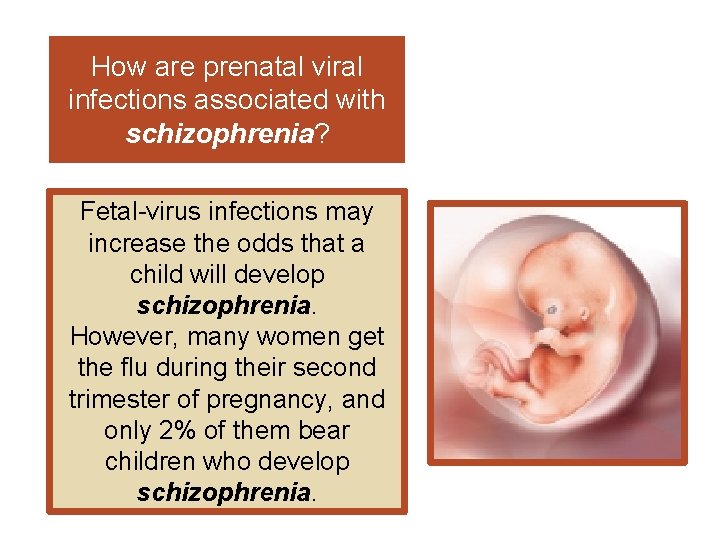
How are prenatal viral infections associated with schizophrenia? Fetal-virus infections may increase the odds that a child will develop schizophrenia. However, many women get the flu during their second trimester of pregnancy, and only 2% of them bear children who develop schizophrenia.
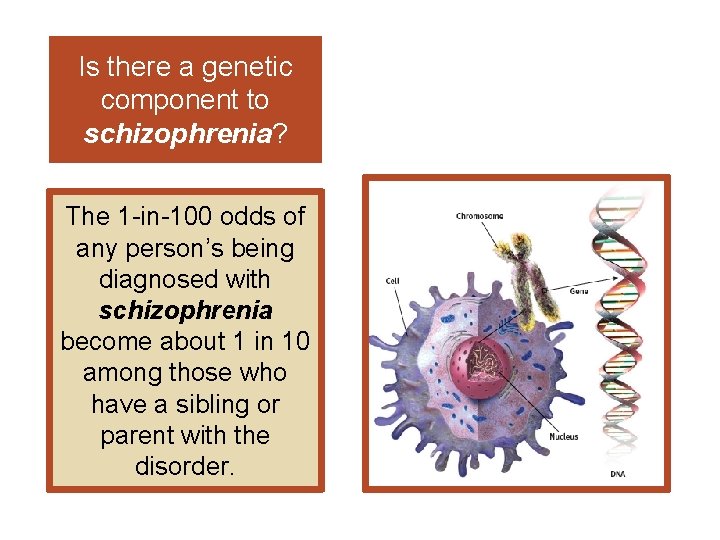
Is there a genetic component to schizophrenia? The 1 -in-100 odds of any person’s being diagnosed with schizophrenia become about 1 in 10 among those who have a sibling or parent with the disorder.
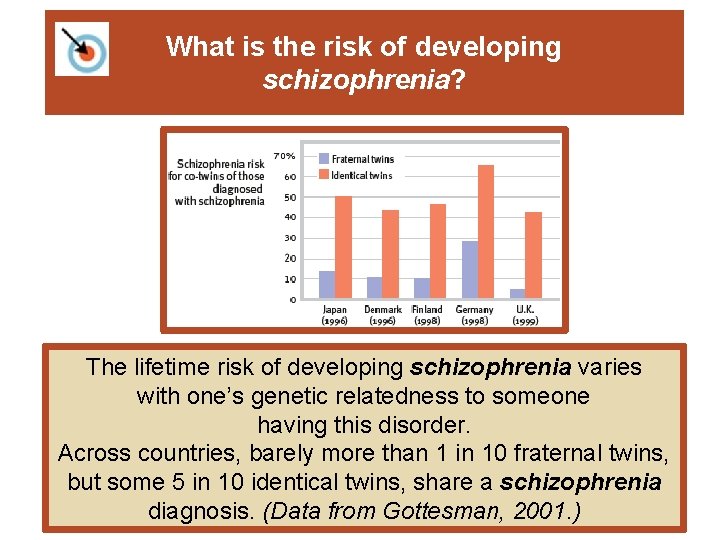
What is the risk of developing schizophrenia? The lifetime risk of developing schizophrenia varies with one’s genetic relatedness to someone having this disorder. Across countries, barely more than 1 in 10 fraternal twins, but some 5 in 10 identical twins, share a schizophrenia diagnosis. (Data from Gottesman, 2001. )
So, genes matter, but what about the prenatal environment? About two-thirds of identical twins also share a placenta and the blood it supplies; the other third have separate placentas. If the co-twin of an identical twin with schizophrenia shared the placenta, the chances of developing the disorder are 6 in 10. If the identical twins had separate placentas, the co-twin’s chances of developing schizophrenia drop to 1 in 10. (Davis et al. , 1995; Davis & Phelps, 1995; Phelps et al. , 1997)
genes + viruses Twins who share a placenta are more likely to share the same prenatal viruses. So, perhaps shared germs as well as shared genes produce identical twin similarities.
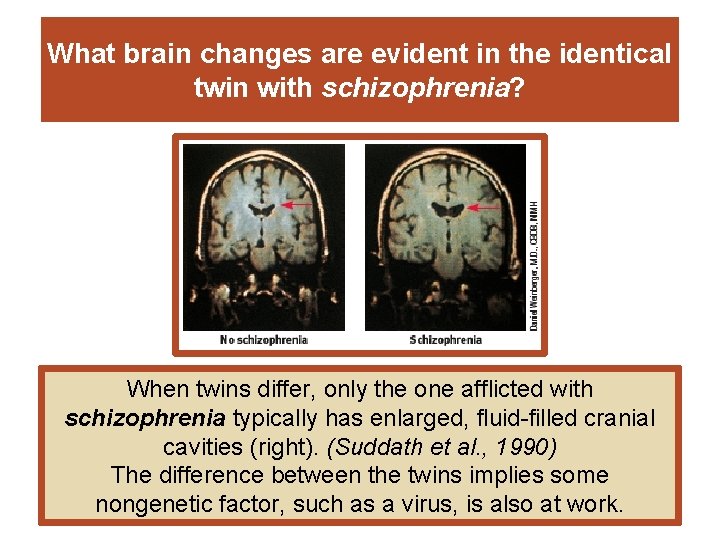
What brain changes are evident in the identical twin with schizophrenia? When twins differ, only the one afflicted with schizophrenia typically has enlarged, fluid-filled cranial cavities (right). (Suddath et al. , 1990) The difference between the twins implies some nongenetic factor, such as a virus, is also at work.
How do adoption studies inform the discussion? Adoption studies help untangle genetic (nature) and environmental (nurture) influences. Children adopted by someone who develops schizophrenia do not “catch” the disorder. Rather, adopted children have an elevated risk if a biological parent is diagnosed with schizophrenia. (Gottesman, 1991) Genes matter.
Genes matter, but environment does as well. Schizophrenia is a group of disorders influenced by many genes, each with very small effects. (Arnedo et al. , 2015; Darby et al. , 2016; International Schizophrenia Consortium, 2009) And, as so often seen, nature and nurture interact.
What is the relationship between smoking and schizophrenia? Most people with schizophrenia smoke. Smoking increases vulnerability to schizophrenia and contributes to people with schizophrenia having a 14. 5 -year shorter-than-average life expectancy (Gurillo et al. , 2015; Hjorthøj et al. , 2017; Olfson et al. , 2015)
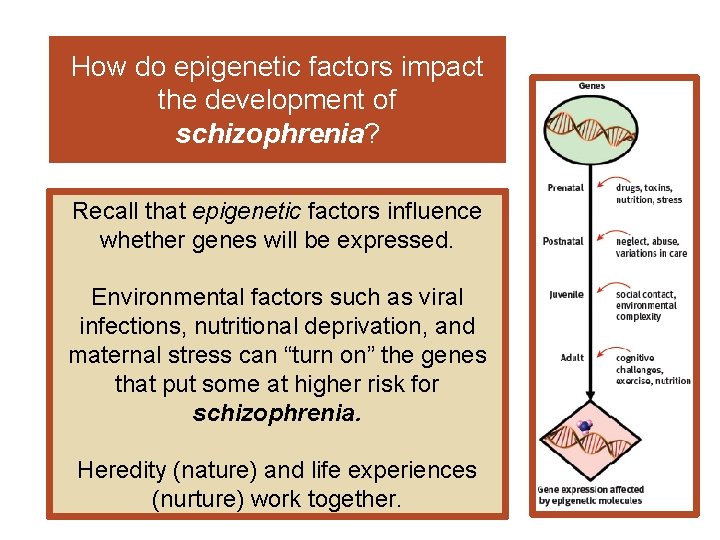
How do epigenetic factors impact the development of schizophrenia? Recall that epigenetic factors influence whether genes will be expressed. Environmental factors such as viral infections, nutritional deprivation, and maternal stress can “turn on” the genes that put some at higher risk for schizophrenia. Heredity (nature) and life experiences (nurture) work together.
What are early warning signs of schizophrenia? Hoping to identify environmental triggers of schizophrenia, researchers have compared the experiences of high-risk children (for example, those with relatives with schizophrenia) and low-risk children. In one 2. 5 -year study that followed 163 teens and early-twenties adults who had two relatives with schizophrenia, the 20% of participants who developed schizophrenia showed social withdrawal or other abnormal behavior before the onset of the disorder. (Johnstone et al. , 2005)
What additional warning signs may be present? Researchers identified other possible early warning signs, including a mother whose schizophrenia was severe and long-lasting; birth complications; separation from parents; short attention span and poor muscle coordination; disruptive or withdrawn behavior; emotional unpredictability; poor peer relations and solo play; and childhood physical, sexual, or emotional abuse. (Abel et al. , 2010; Freedman et al. , 1998; Schiffman et al. , 2001; Susser, 1999; Welham et al. , 2009)
4. What Would You Answer? Schizophrenia has been linked to brain and neurotransmitter abnormalities as well as genetics. Explain research findings related to two features of brain anatomy, one neurotransmitter, and one genetic factor that could cause someone to develop schizophrenia.
Learning Target 68 -1 Review Describe the patterns of perceiving, thinking, and feeling that characterize schizophrenia. § People with schizophrenia display symptoms that are positive (inappropriate behaviors are present) or negative (appropriate behaviors are absent). § Positive symptoms may include hallucinations, delusions, talking in a disorganized way, and inappropriate laughter, tears, or rage. § Negative symptoms may include toneless voices, expressionless faces, or mute and rigid bodies.
Learning Target 68 -2 Review Contrast chronic schizophrenia and acute schizophrenia. § In chronic (or process) schizophrenia, the disorder develops gradually and recovery is doubtful. § In acute (or reactive) schizophrenia, the onset is sudden, it develops in reaction to stress, and the prospects for recovery are brighter.
Learning Target 68 -3 Review Discuss the brain abnormalities associated with schizophrenia. § People with schizophrenia have increased dopamine receptors, which may intensify brain signals, creating positive symptoms such as hallucinations and paranoia. § Brain abnormalities associated with schizophrenia include enlarged, fluid-filled areas and corresponding shrinkage and thinning of cerebral tissue. § Brain scans reveal abnormal activity in the frontal lobes, thalamus, and amygdala, as well as a loss of neural connections across the brain network.
Learning Target 68 -4 Review Discuss the prenatal events associated with increased risk of developing schizophrenia. § Possible contributing factors include maternal diabetes, older paternal age, viral infections, or famine conditions during the mother’s pregnancy, and low weight or oxygen deprivation at birth.
Learning Target 68 -5 Review Discuss how genes influence schizophrenia. § Twin and adoption studies indicate that the predisposition to schizophrenia is inherited. § Schizophrenia is influenced by many genes, each with very small effects. Environmental factors— including those present in the prenatal environment —may influence gene expression to enable this disorder.
Learning Target 68 -5 Review cont. Identify the factors that may be early warning signs of schizophrenia in children. § While no environmental causes invariably produce schizophrenia, possible early warning signs of later development of schizophrenia include: § biological factors (a mother with severe and long-lasting schizophrenia, birth complications, short attention span, and poor muscle coordination) and § psychological factors (disruptive or withdrawn behavior, emotional unpredictability, poor peer relations and solo play, separation from parents, and childhood abuse).
- Slides: 47