
Learning Targets Module 5 The Scientific Method and
- Slides: 44
Learning Targets Module 5 The Scientific Method and Description 5 -1 Describe how theories advance psychological science. 5 -2 Explain how psychologists use case studies, naturalistic observations, and surveys to observe and describe behavior, and why random sampling is important.
In Module 1 we discussed the three elements of the scientific attitude. curiosity skepticism humility
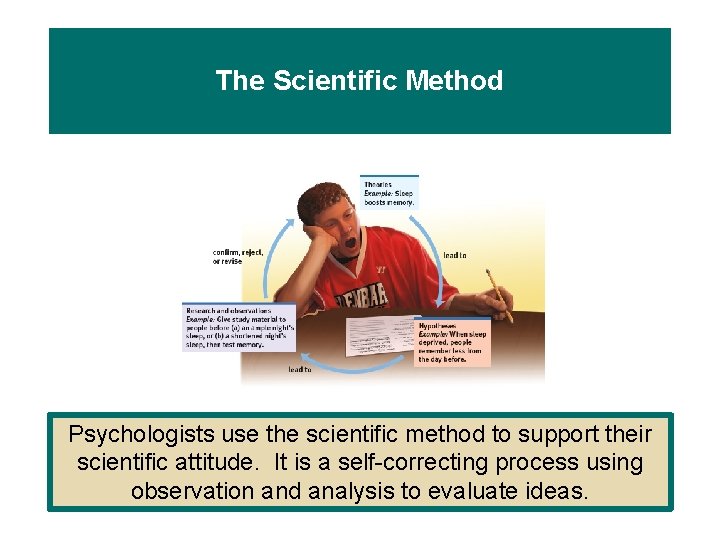
The Scientific Method Psychologists use the scientific method to support their scientific attitude. It is a self-correcting process using observation and analysis to evaluate ideas.
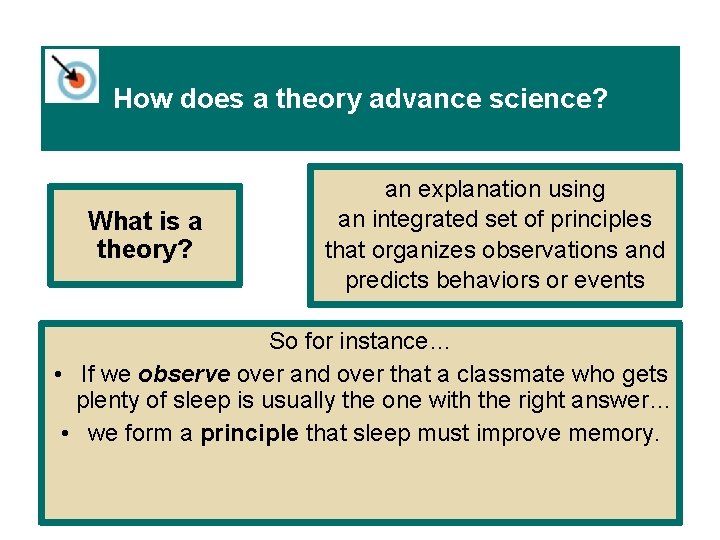
How does a theory advance science? What is a theory? an explanation using an integrated set of principles that organizes observations and predicts behaviors or events So for instance… • If we observe over and over that a classmate who gets plenty of sleep is usually the one with the right answer… • we form a principle that sleep must improve memory.
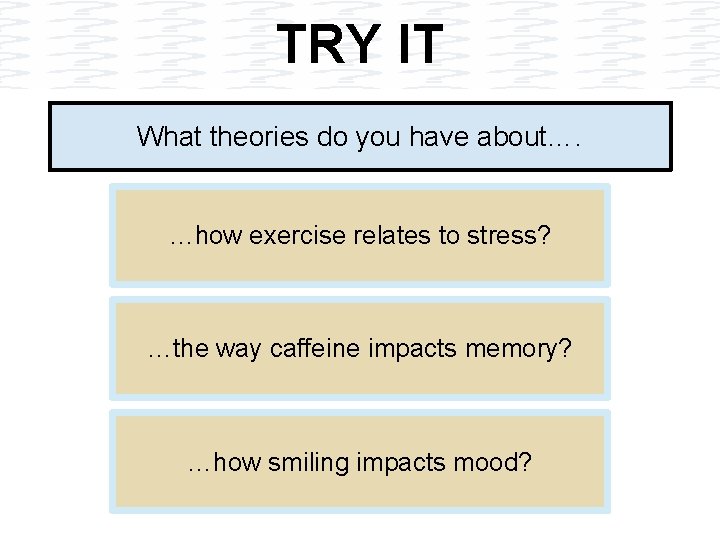
TRY IT What theories do you have about…. …how exercise relates to stress? …the way caffeine impacts memory? …how smiling impacts mood?
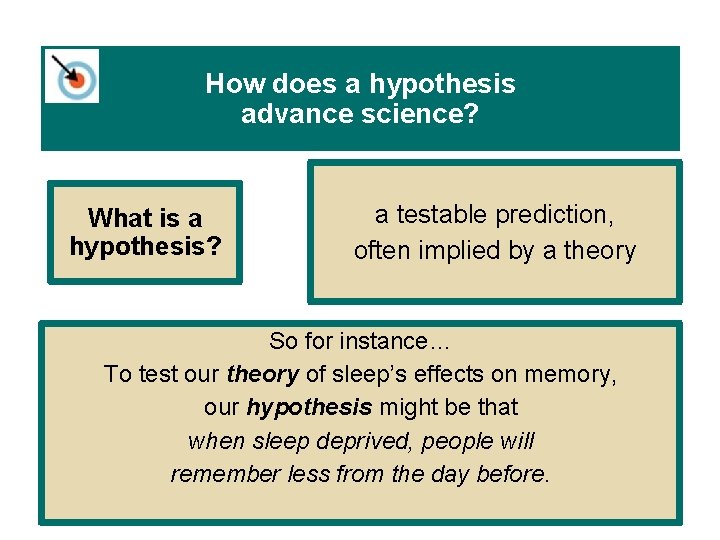
How does a hypothesis advance science? What is a hypothesis? a testable prediction, often implied by a theory So for instance… To test our theory of sleep’s effects on memory, our hypothesis might be that when sleep deprived, people will remember less from the day before.
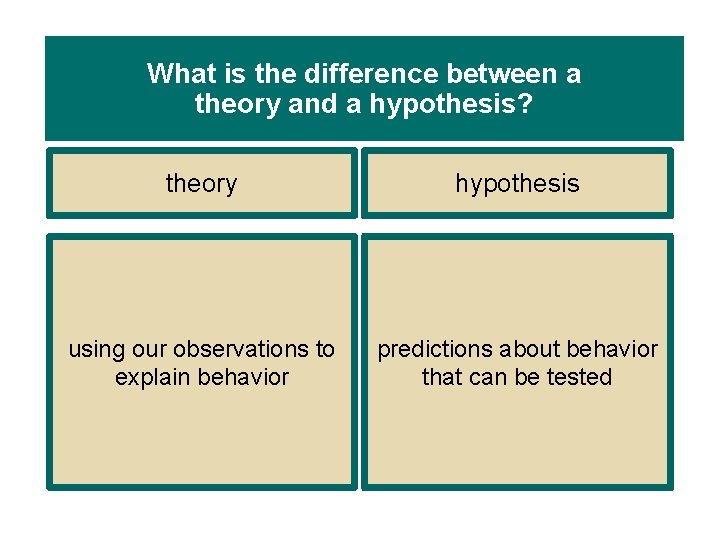
What is the difference between a theory and a hypothesis? theory hypothesis using our observations to explain behavior predictions about behavior that can be tested
1. What Would You Answer? A testable prediction that drives research is known as a(n) A. B. C. D. E. theory. hypothesis. operational definition. guess. random sample.
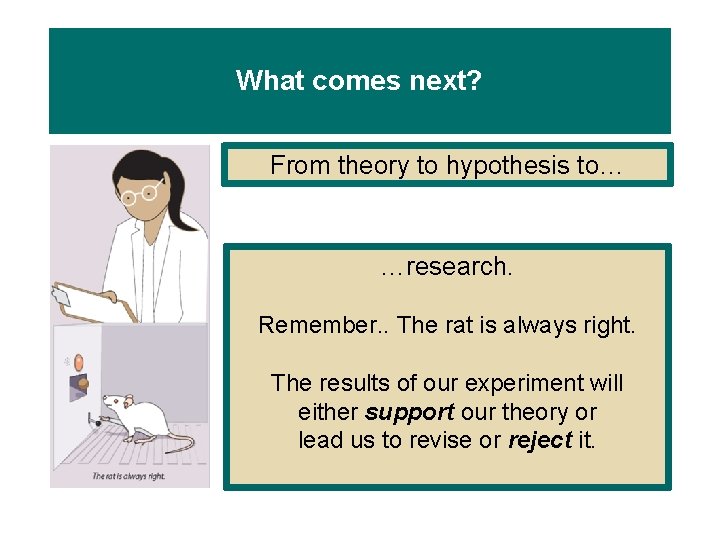
What comes next? From theory to hypothesis to… …research. Remember. . The rat is always right. The results of our experiment will either support our theory or lead us to revise or reject it.
Let’s consider this hypothesis: When sleep deprived, people will remember less from the day before. What do we mean by sleep deprived? 2 hours fewer than usual? No sleep at all for a week? How will we know someone “remembers less”? Less than what? Less than whom?
What is an operational definition? A carefully worded statement of the exact procedures (operations) used in a research study. For example, human intelligence may be operationally defined as what an intelligence test measures. The variable would then need to be quantified…so in this instance, human intelligence would be the score on an intelligence test.
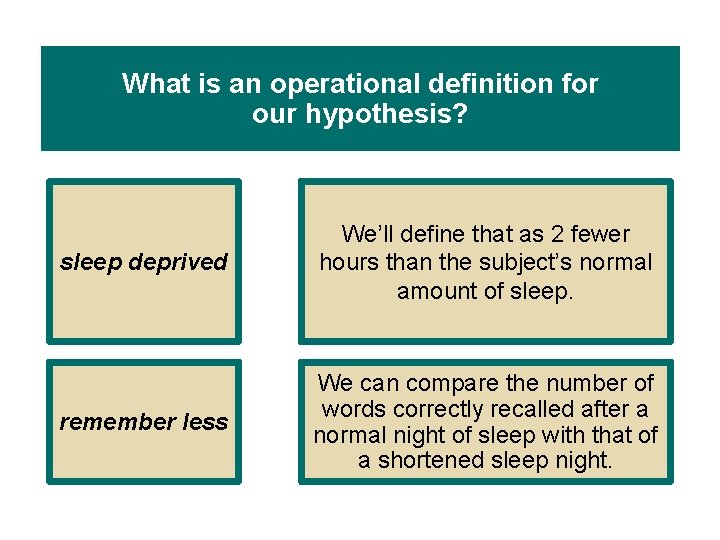
What is an operational definition for our hypothesis? sleep deprived We’ll define that as 2 fewer hours than the subject’s normal amount of sleep. remember less We can compare the number of words correctly recalled after a normal night of sleep with that of a shortened sleep night.
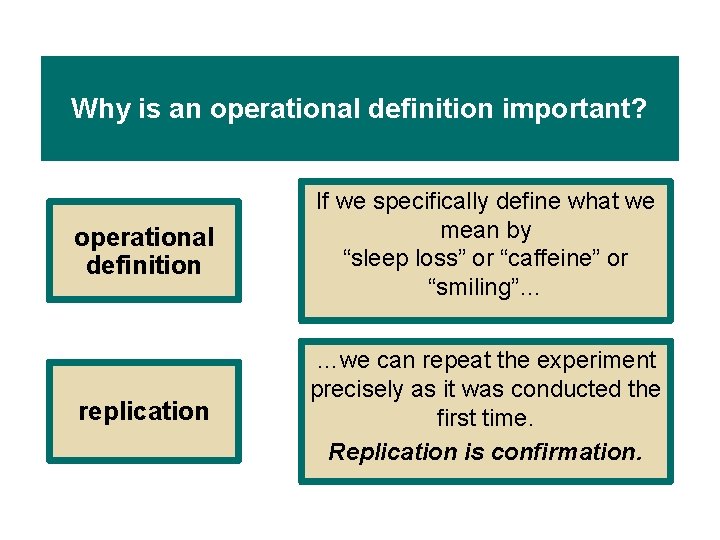
Why is an operational definition important? operational definition If we specifically define what we mean by “sleep loss” or “caffeine” or “smiling”… replication …we can repeat the experiment precisely as it was conducted the first time. Replication is confirmation.
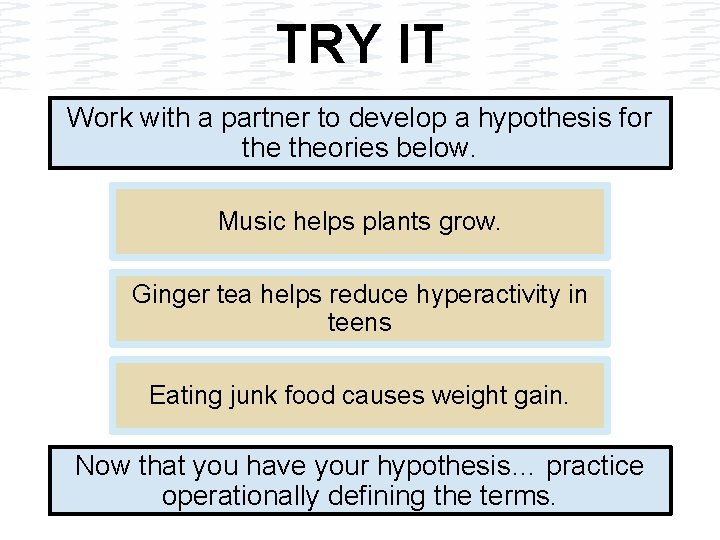
TRY IT Work with a partner to develop a hypothesis for theories below. Music helps plants grow. Ginger tea helps reduce hyperactivity in teens Eating junk food causes weight gain. Now that you have your hypothesis… practice operationally defining the terms.
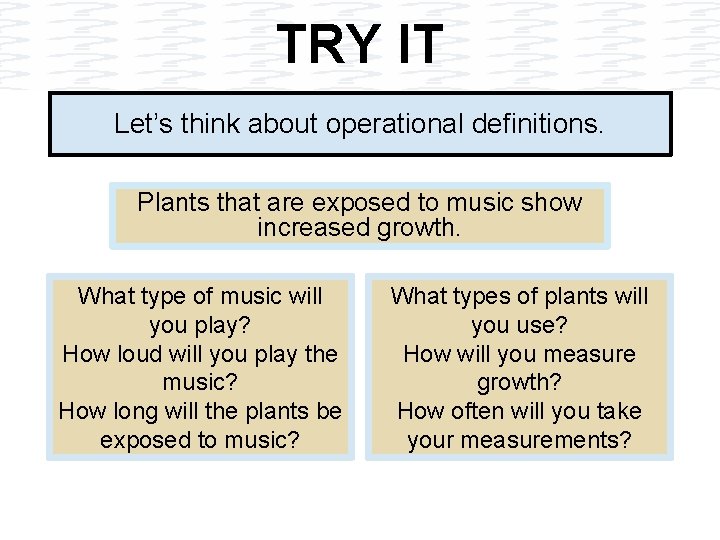
TRY IT Let’s think about operational definitions. Plants that are exposed to music show increased growth. What type of music will you play? How loud will you play the music? How long will the plants be exposed to music? What types of plants will you use? How will you measure growth? How often will you take your measurements?
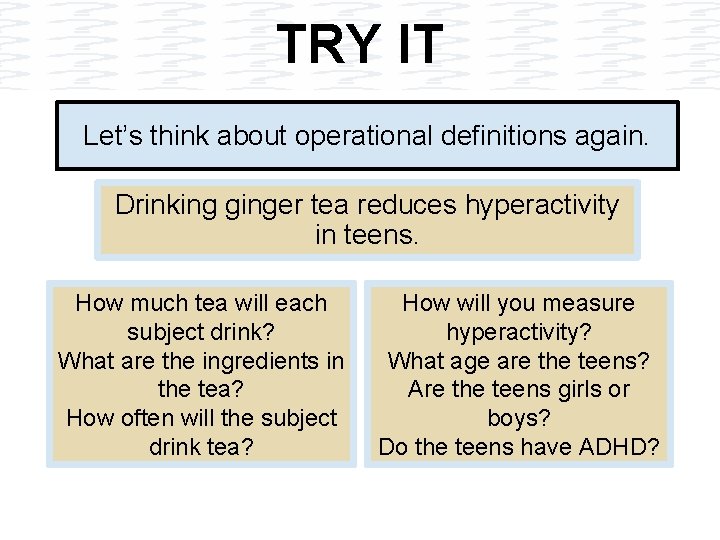
TRY IT Let’s think about operational definitions again. Drinking ginger tea reduces hyperactivity in teens. How much tea will each subject drink? What are the ingredients in the tea? How often will the subject drink tea? How will you measure hyperactivity? What age are the teens? Are the teens girls or boys? Do the teens have ADHD?
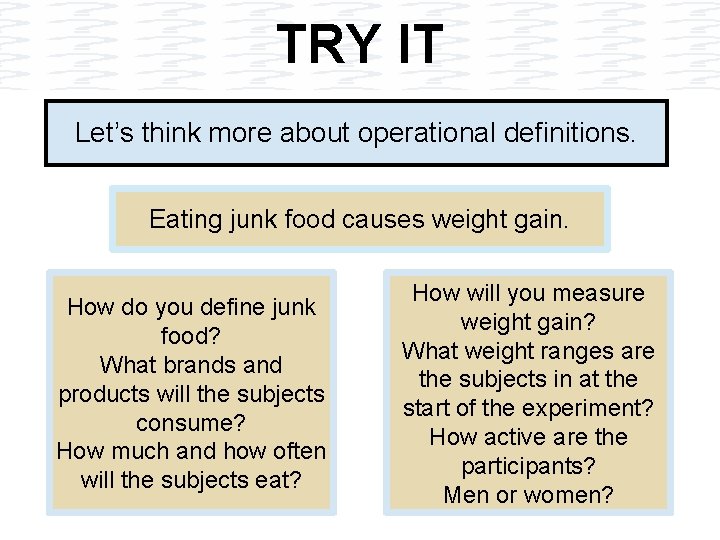
TRY IT Let’s think more about operational definitions. Eating junk food causes weight gain. How do you define junk food? What brands and products will the subjects consume? How much and how often will the subjects eat? How will you measure weight gain? What weight ranges are the subjects in at the start of the experiment? How active are the participants? Men or women?
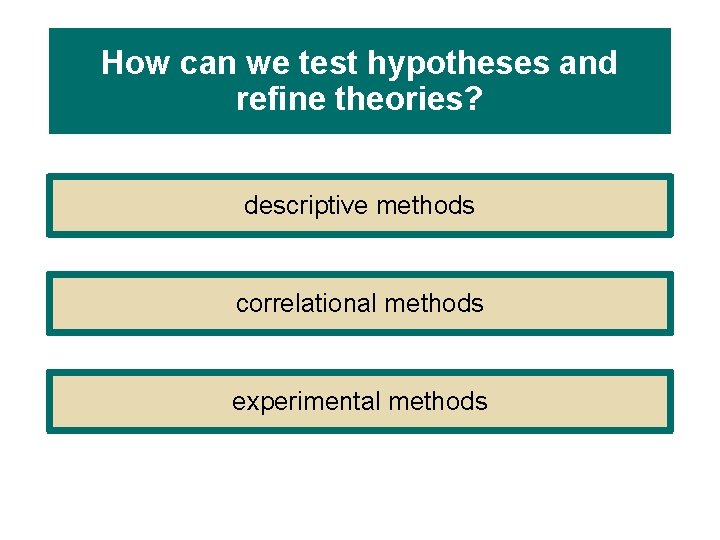
How can we test hypotheses and refine theories? descriptive methods correlational methods experimental methods
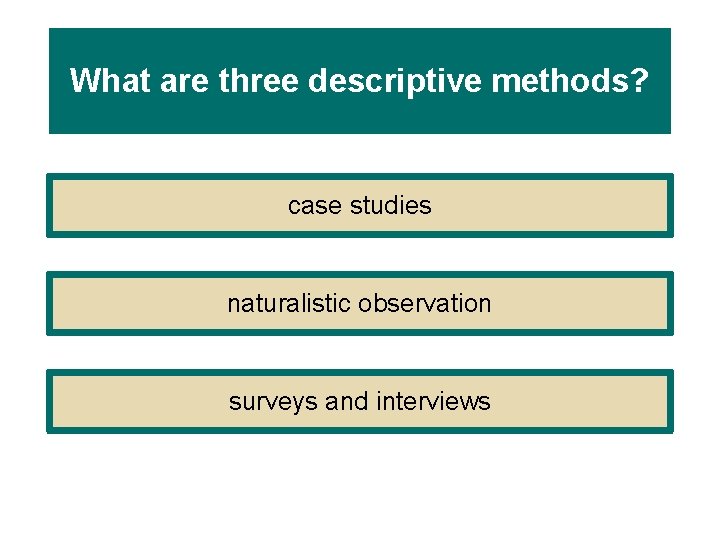
What are three descriptive methods? case studies naturalistic observation surveys and interviews
What is a case study? A descriptive technique in which one individual or group is studied in depth in the hope of revealing universal principles.
How do psychologists use case studies to observe and describe behavior? one individual § Patient H. M. § Little Hans § Genie (the feral child) one group § University of Tennessee women’s basketball team § Prison inmates in a group therapy study
What are the strengths and limitations of the case study method? strengths limitations § Allow for examination of rare or unusual behavior. § Atypical case studies can be misleading. § Provide a large amount of qualitative data. § Results from one study may not be generalizable to the larger group. § Suggest directions for further study. § Cannot determine cause and effect.
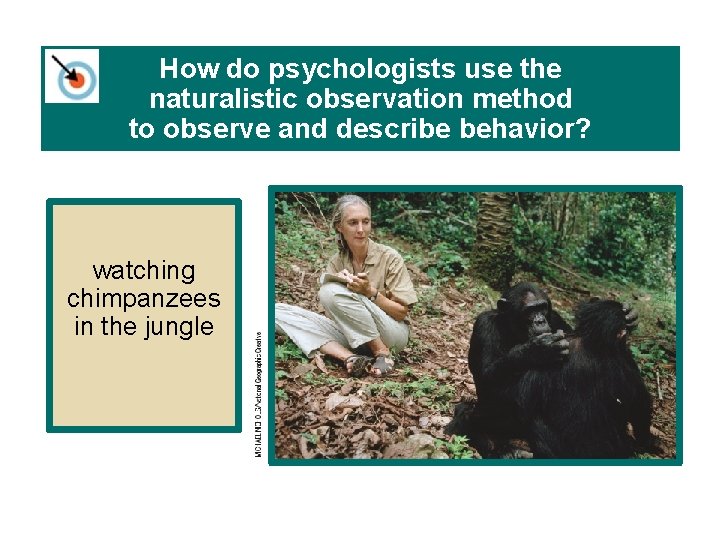
What is naturalistic observation? A descriptive technique of observing and recording behavior in naturally occurring situations without trying to manipulate or control the situation.
How do psychologists use the naturalistic observation method to observe and describe behavior? watching chimpanzees in the jungle
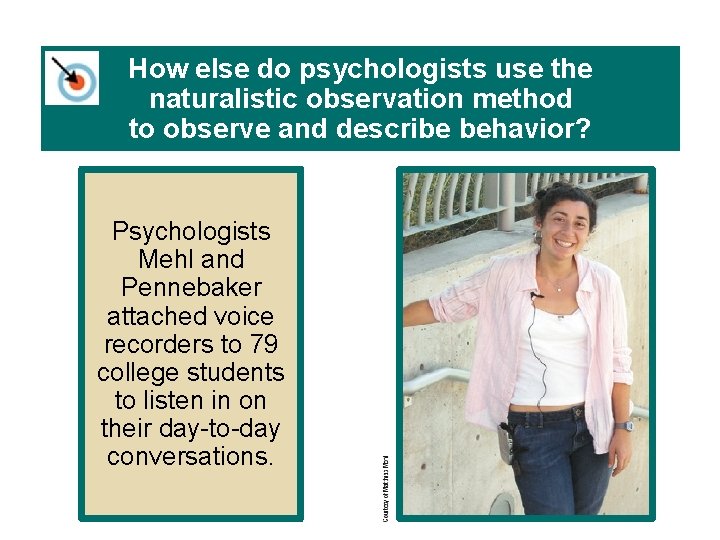
How else do psychologists use the naturalistic observation method to observe and describe behavior? Psychologists Mehl and Pennebaker attached voice recorders to 79 college students to listen in on their day-to-day conversations.
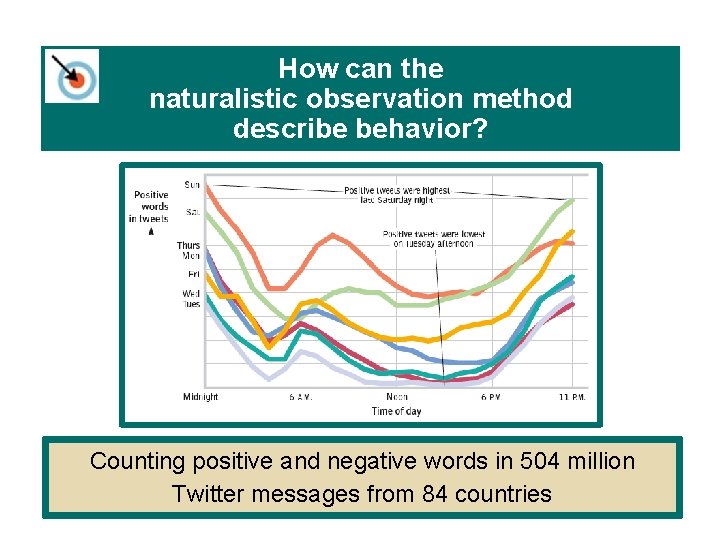
How can the naturalistic observation method describe behavior? Counting positive and negative words in 504 million Twitter messages from 84 countries
What are the strengths and limitations of the naturalistic observation method? strengths § Subjects behave “normally” outside of a lab setting. § Data collection is unobtrusive (doesn’t disturb the subject). limitations § Independent variable cannot be isolated. § Cannot determine cause and effect. § Observations by researchers may be subjective.
What is a survey? a descriptive technique for obtaining the self-reported attitudes or behaviors of a particular group, usually by questioning a representative, random sample of the group.
How do psychologists use the survey method to observe and describe behavior? half of all Americans reported experiencing more happiness and enjoyment than worry and stress on the previous day (Gallup, 2010). 1 in 5 people across 22 countries report believing that alien beings have come to Earth and now walk among us disguised as humans (Ipsos, 2010). 68 percent of all humans—some 5 billion people—say that religion is important in their daily lives (Diener et al. , 2011).
2. What Would You Answer? Which of the following questions is best investigated by means of a survey? A. Are people more likely to vote Republican or Democrat in the next election? B. Are violent criminals genetically different from nonviolent criminals? C. Does extra sleep improve memory? D. What is the best study technique for AP® exams? E. What role does exercise play in weight loss?
What are the strengths and limitations of the survey method? strengths § able to take a “quick pulse” of people’s beliefs, behaviors or opinions § able to include many cases limitations § response bias § wording effects can skew the outcomes § acquiring a random sample is difficult § cannot determine cause and effect
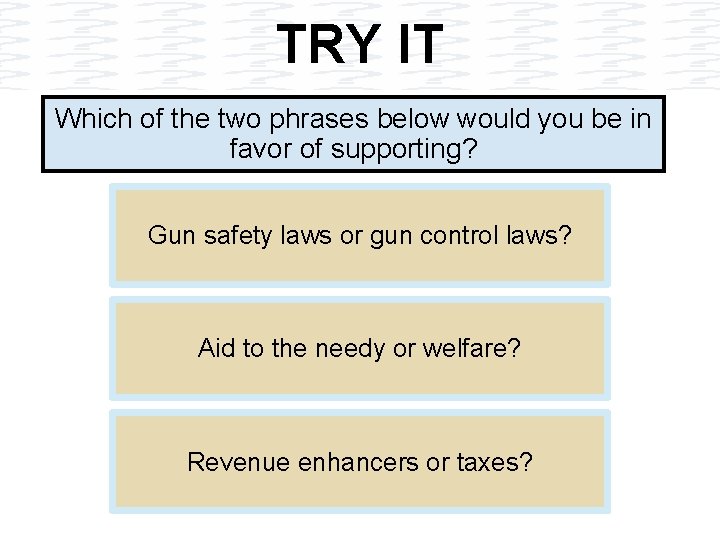
TRY IT Which of the two phrases below would you be in favor of supporting? Gun safety laws or gun control laws? Aid to the needy or welfare? Revenue enhancers or taxes?
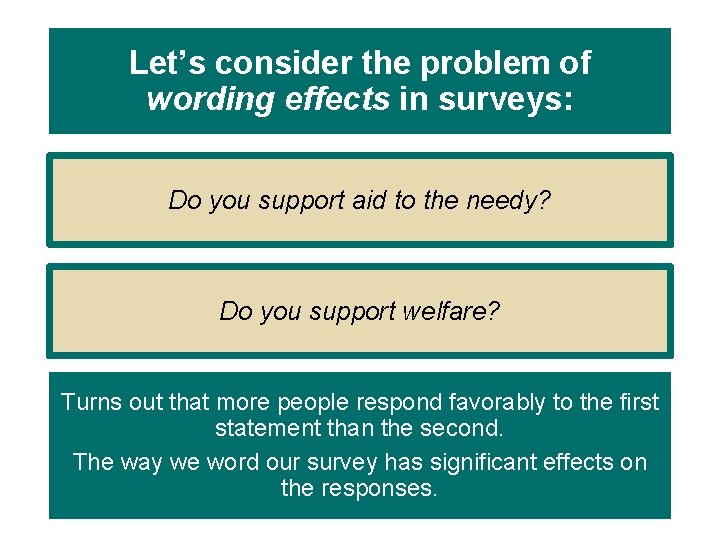
Let’s consider the problem of wording effects in surveys: Do you support aid to the needy? Do you support welfare? Turns out that more people respond favorably to the first statement than the second. The way we word our survey has significant effects on the responses.
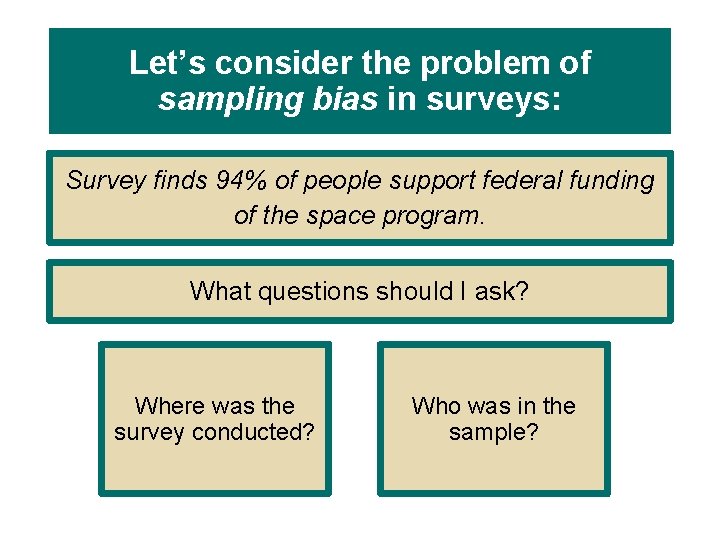
Let’s consider the problem of sampling bias in surveys: Survey finds 94% of people support federal funding of the space program. What questions should I ask? Where was the survey conducted? Who was in the sample?
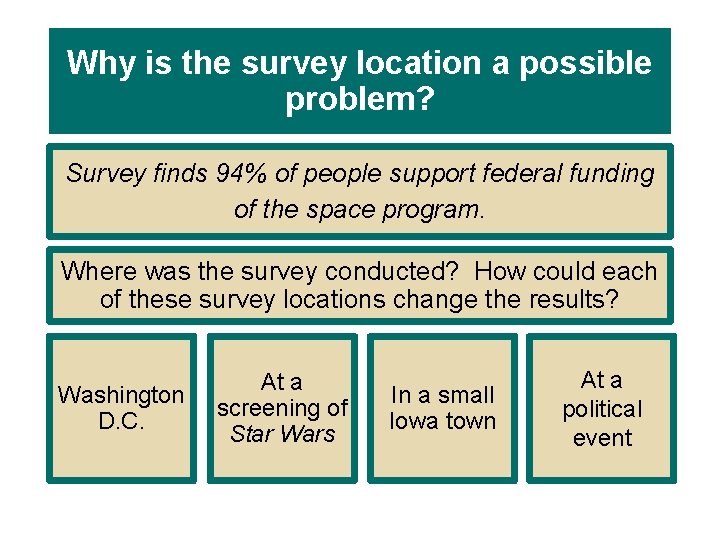
Why is the survey location a possible problem? Survey finds 94% of people support federal funding of the space program. Where was the survey conducted? How could each of these survey locations change the results? Washington D. C. At a screening of Star Wars In a small Iowa town At a political event
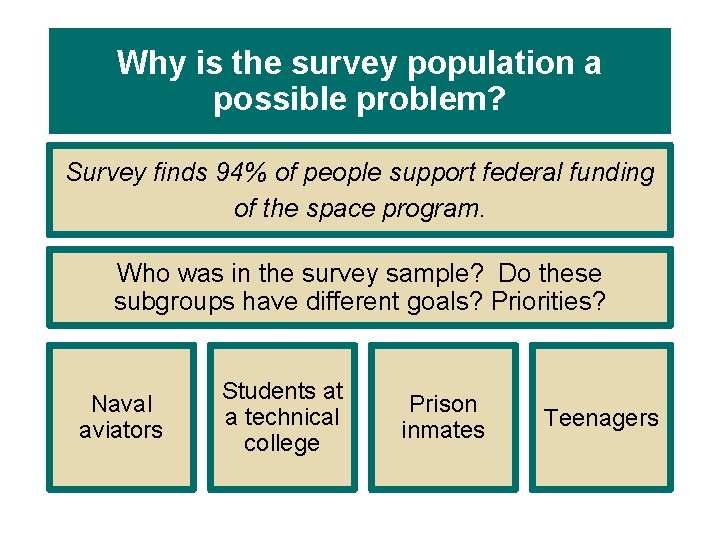
Why is the survey population a possible problem? Survey finds 94% of people support federal funding of the space program. Who was in the survey sample? Do these subgroups have different goals? Priorities? Naval aviators Students at a technical college Prison inmates Teenagers
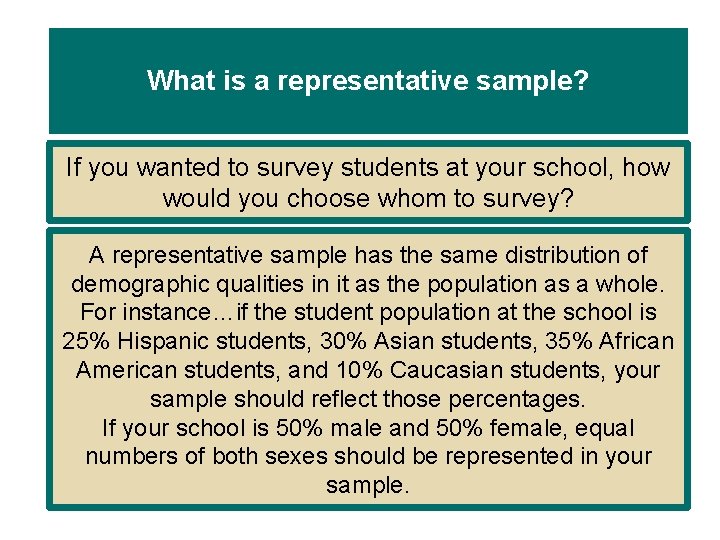
What is a representative sample? If you wanted to survey students at your school, how would you choose whom to survey? A representative sample has the same distribution of demographic qualities in it as the population as a whole. For instance…if the student population at the school is 25% Hispanic students, 30% Asian students, 35% African American students, and 10% Caucasian students, your sample should reflect those percentages. If your school is 50% male and 50% female, equal numbers of both sexes should be represented in your sample.
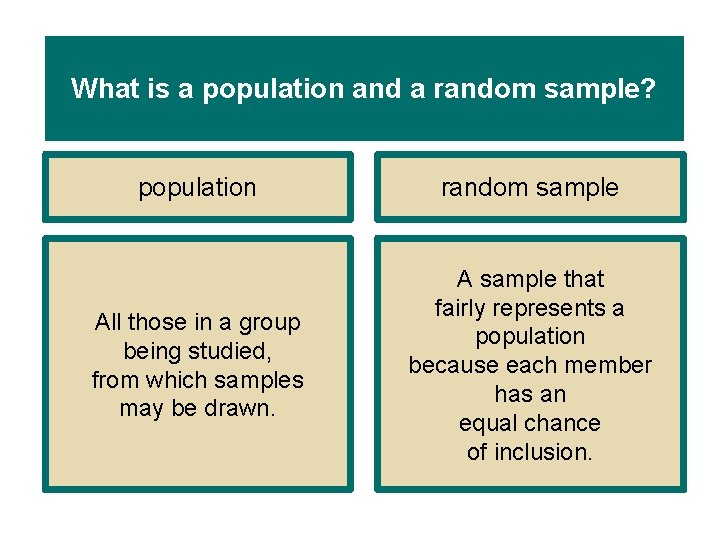
What is a population and a random sample? population random sample All those in a group being studied, from which samples may be drawn. A sample that fairly represents a population because each member has an equal chance of inclusion.
TRY IT If you wanted to survey high school students about drug use… How would you identify your population? How would you create a random sample?
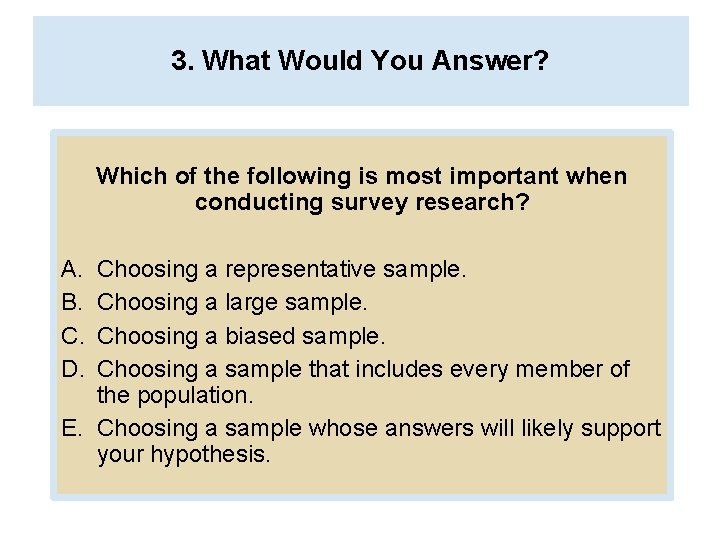
3. What Would You Answer? Which of the following is most important when conducting survey research? A. B. C. D. Choosing a representative sample. Choosing a large sample. Choosing a biased sample. Choosing a sample that includes every member of the population. E. Choosing a sample whose answers will likely support your hypothesis.
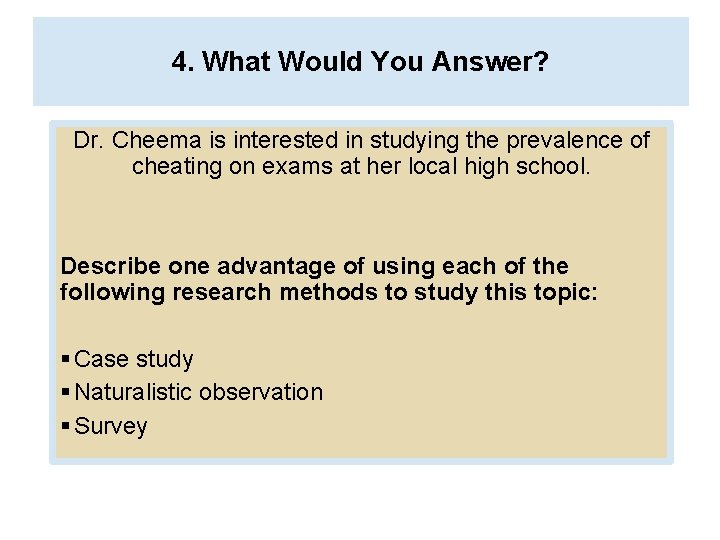
4. What Would You Answer? Dr. Cheema is interested in studying the prevalence of cheating on exams at her local high school. Describe one advantage of using each of the following research methods to study this topic: § Case study § Naturalistic observation § Survey
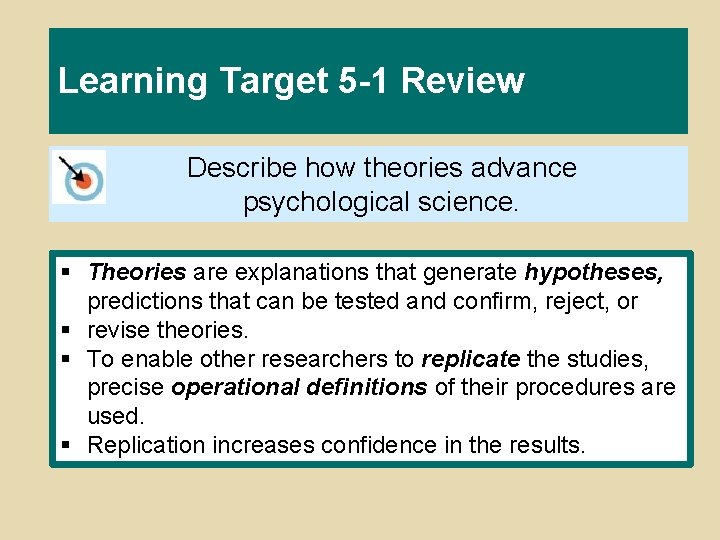
Learning Target 5 -1 Review Describe how theories advance psychological science. § Theories are explanations that generate hypotheses, predictions that can be tested and confirm, reject, or § revise theories. § To enable other researchers to replicate the studies, precise operational definitions of their procedures are used. § Replication increases confidence in the results.
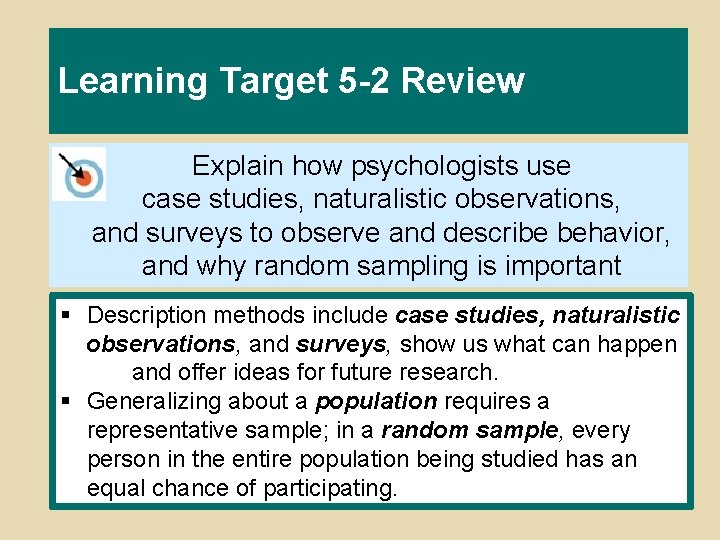
Learning Target 5 -2 Review Explain how psychologists use case studies, naturalistic observations, and surveys to observe and describe behavior, and why random sampling is important § Description methods include case studies, naturalistic observations, and surveys, show us what can happen and offer ideas for future research. § Generalizing about a population requires a representative sample; in a random sample, every person in the entire population being studied has an equal chance of participating.