
Learning Targets Module 30 30 1 Differentiate observational
Learning Targets Module 30 30 -1 Differentiate observational learning from associative learning, and explain how observational learning may be enabled by neural mirroring. 30 -2 Discuss the impact of prosocial modeling and of antisocial modeling. Observational Learning 30 -3 Discuss the violence-viewing effect.
Talk with your partner. Who has been a significant role model for you? In what ways? What have you learned from them? For whom are you a model? In what ways? What do you model for others?
What is observational learning? Higher animals, especially humans, learn without direct experience, by watching and imitating others. We learn our native languages and various other specific behaviors by observing and imitating others, a process called modeling. For instance, a child who sees his sister burn her fingers on a hot stove learns not to touch it.
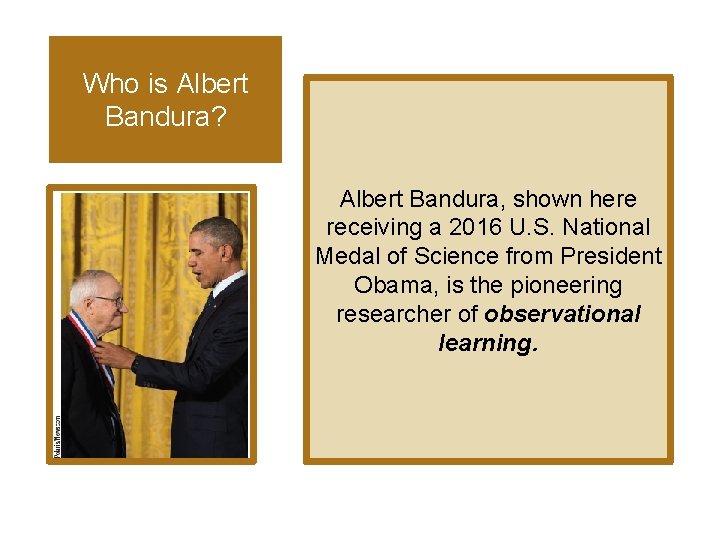
Who is Albert Bandura? Albert Bandura, shown here receiving a 2016 U. S. National Medal of Science from President Obama, is the pioneering researcher of observational learning.
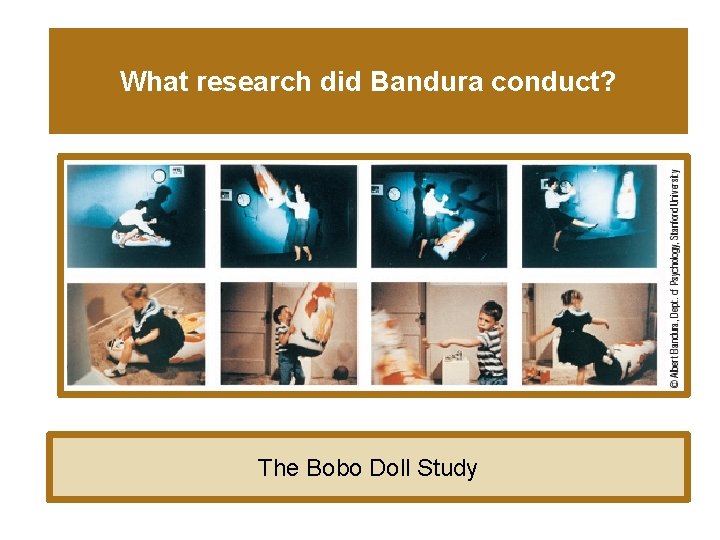
What research did Bandura conduct? The Bobo Doll Study
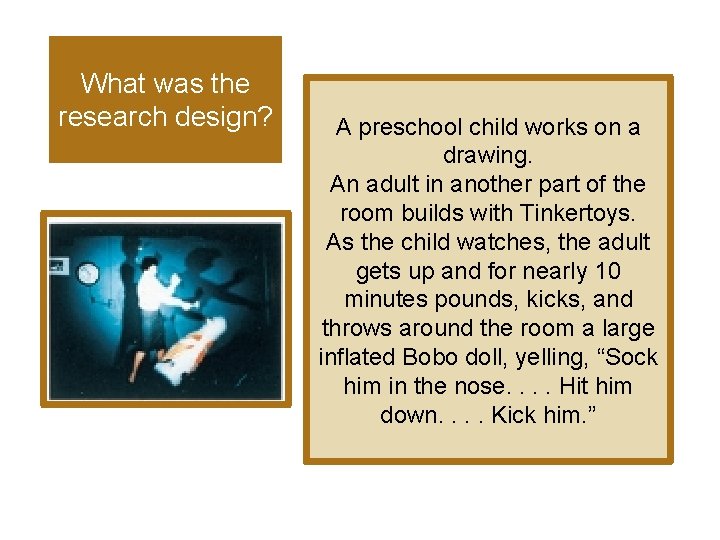
What was the research design? A preschool child works on a drawing. An adult in another part of the room builds with Tinkertoys. As the child watches, the adult gets up and for nearly 10 minutes pounds, kicks, and throws around the room a large inflated Bobo doll, yelling, “Sock him in the nose. . Hit him down. . Kick him. ”
What happened next? The child is then taken to another room filled with appealing toys. Soon the experimenter returns and tells the child she has decided to save these good toys “for the other children. ” She takes the now-frustrated child to a third room containing a few toys, including a Bobo doll. Left alone, what does the child do?
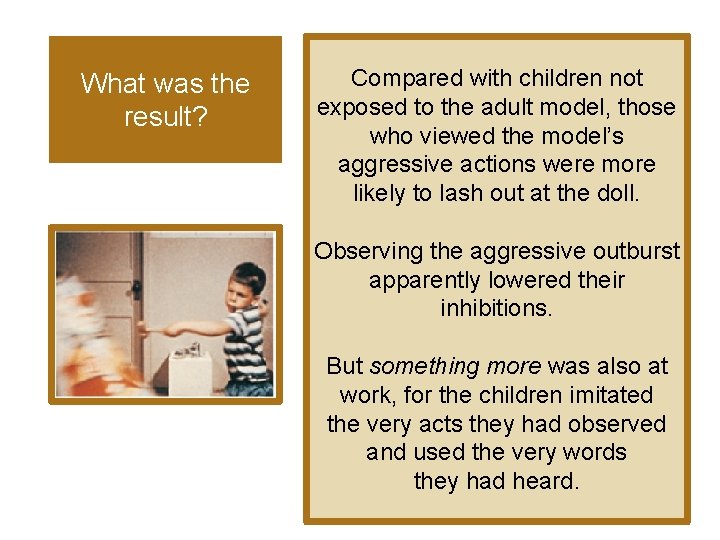
What was the result? Compared with children not exposed to the adult model, those who viewed the model’s aggressive actions were more likely to lash out at the doll. Observing the aggressive outburst apparently lowered their inhibitions. But something more was also at work, for the children imitated the very acts they had observed and used the very words they had heard.
What is the take away? By watching models, we experience vicarious reinforcement or vicarious punishment, and we learn to anticipate a behavior’s consequences in situations like those we are observing. We are especially likely to learn from people we perceive as similar to ourselves, as successful, or as admirable.
1. What Would You Answer? Bandura’s famous Bobo doll experiment is most closely associated with which of the following? A. latent learning B. classical conditioning C. operant conditioning. D. cognitive maps E. observational learning
Think about your earlier responses. Who has been a significant role model for you? In what ways? What have you learned from them? For whom are you a model? In what ways? What do you model for others? In what ways have you experienced vicarious reinforcement or punishment by watching your role model?
So we learn by observation, but how? Mirror neurons are frontal lobe neurons that some scientists believe fire when we perform certain actions or observe another’s actions. The brain’s mirroring of another’s action may enable imitation and empathy.
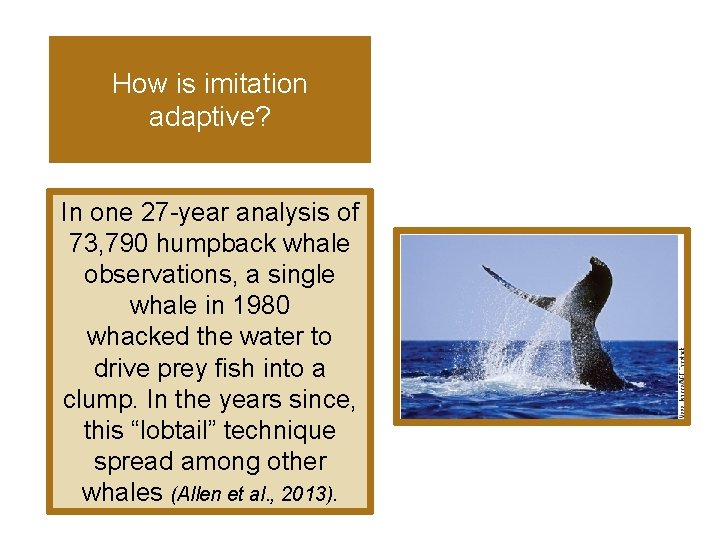
How is imitation adaptive? In one 27 -year analysis of 73, 790 humpback whale observations, a single whale in 1980 whacked the water to drive prey fish into a clump. In the years since, this “lobtail” technique spread among other whales (Allen et al. , 2013).
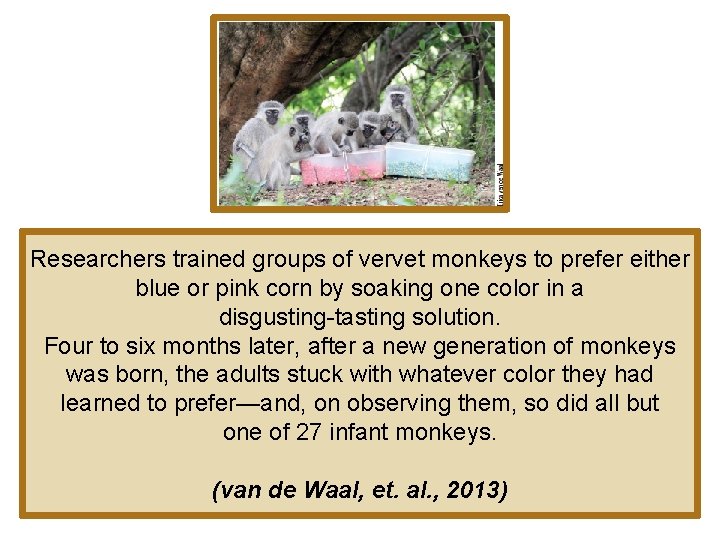
Researchers trained groups of vervet monkeys to prefer either blue or pink corn by soaking one color in a disgusting-tasting solution. Four to six months later, after a new generation of monkeys was born, the adults stuck with whatever color they had learned to prefer—and, on observing them, so did all but one of 27 infant monkeys. (van de Waal, et. al. , 2013)
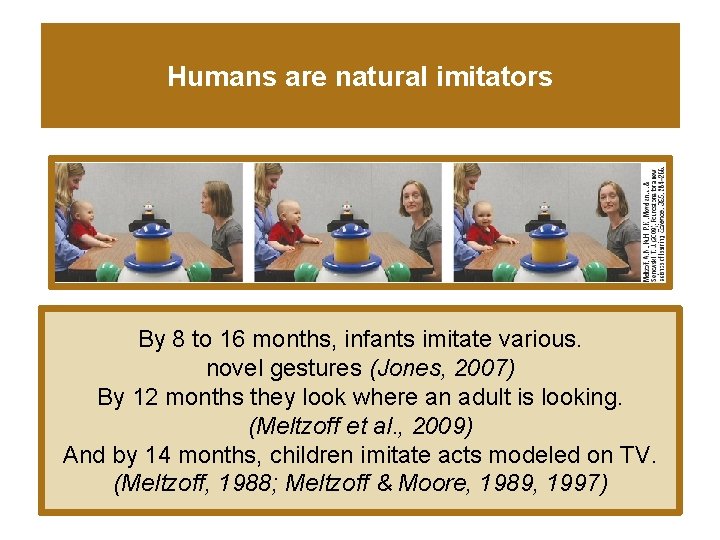
Humans are natural imitators By 8 to 16 months, infants imitate various. novel gestures (Jones, 2007) By 12 months they look where an adult is looking. (Meltzoff et al. , 2009) And by 14 months, children imitate acts modeled on TV. (Meltzoff, 1988; Meltzoff & Moore, 1989, 1997)
Do we imitate emotions as well? YES! We find ourselves yawning when others yawn, smiling when others smile, laughing when others laugh. Observing others’ postures, faces, voices, and writing styles, we unconsciously synchronize our own to theirs—which helps us feel what they are feeling. (Bernieri et al. , 1994; Ireland & Pennebaker, 2010) Imitation helps us gain friends, leading us to mimic those we like. (Chartrand & Lakin, 2013)
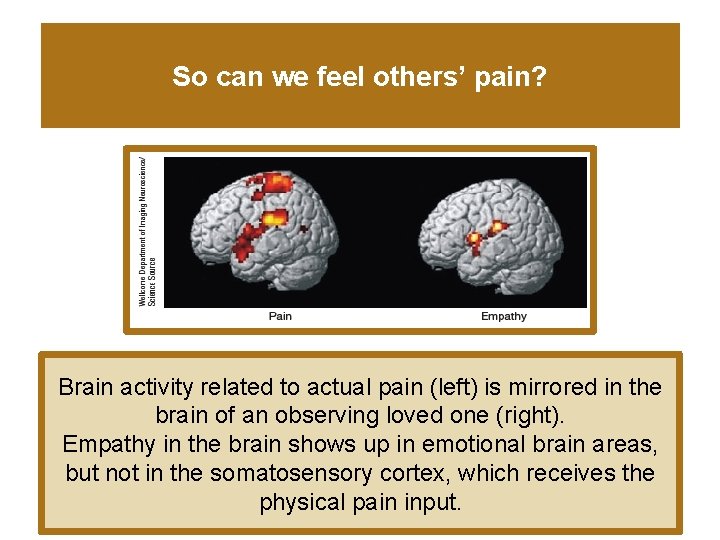
So can we feel others’ pain? Brain activity related to actual pain (left) is mirrored in the brain of an observing loved one (right). Empathy in the brain shows up in emotional brain areas, but not in the somatosensory cortex, which receives the physical pain input.
What is prosocial modeling and what is its impact? Prosocial modeling is positive, constructive, helpful behavior. People who exemplify nonviolent, helpful behavior can also prompt similar behavior in others. Watching others help pick up spilled books or coins, or viewing positively-themed television programming can produce positive helping behaviors in others.
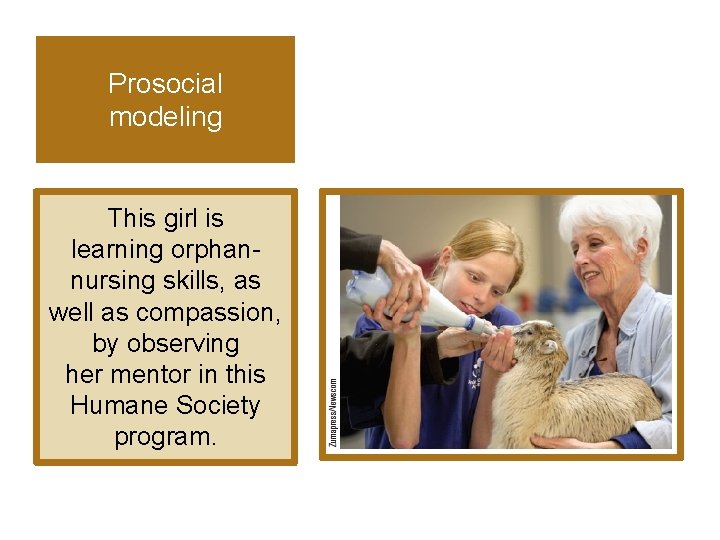
Prosocial modeling This girl is learning orphannursing skills, as well as compassion, by observing her mentor in this Humane Society program.
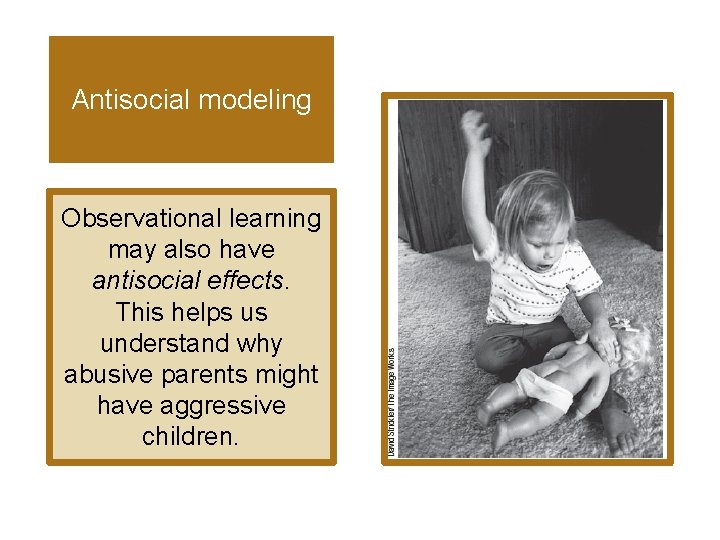
Antisocial modeling Observational learning may also have antisocial effects. This helps us understand why abusive parents might have aggressive children.
TV shows, movies, and online videos are sources of observational learning. During their first 18 years, most children in developed countries spend more time watching TV than they spend in school. The average teen watches more than 4 hours a day; the average adult, 3 hours. (Robinson & Martin, 2009; Strasburger et al. , 2010)
How violent is television programming? Between 1998 and 2006, prime-time violence on TV reportedly increased 75 percent (PTC, 2007). An analysis of more than 3000 network and cable programs aired during one closely studied year revealed: § nearly 6 in 10 featured violence § 74 percent of the violence went unpunished.
What is depicted in violent programming? In addition, research showed: § 58 percent of violent shows did not depict the victims’ pain, § nearly half the incidents involved “justified” violence, § nearly half involved an attractive perpetrator.
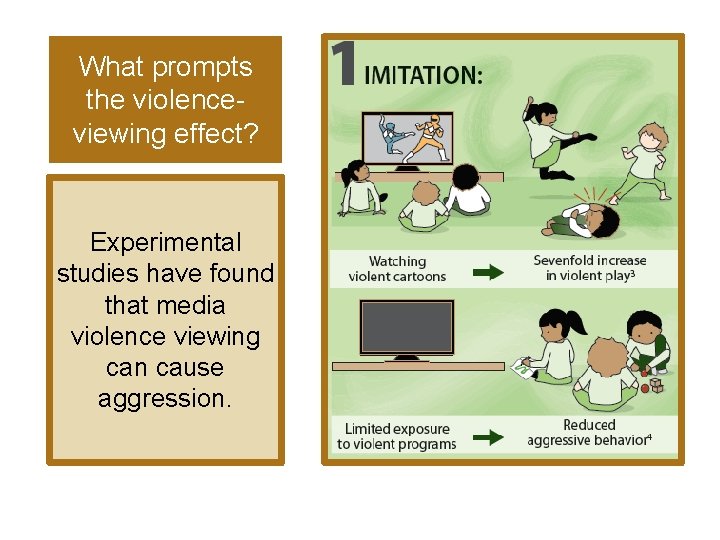
What prompts the violenceviewing effect? Experimental studies have found that media violence viewing can cause aggression.
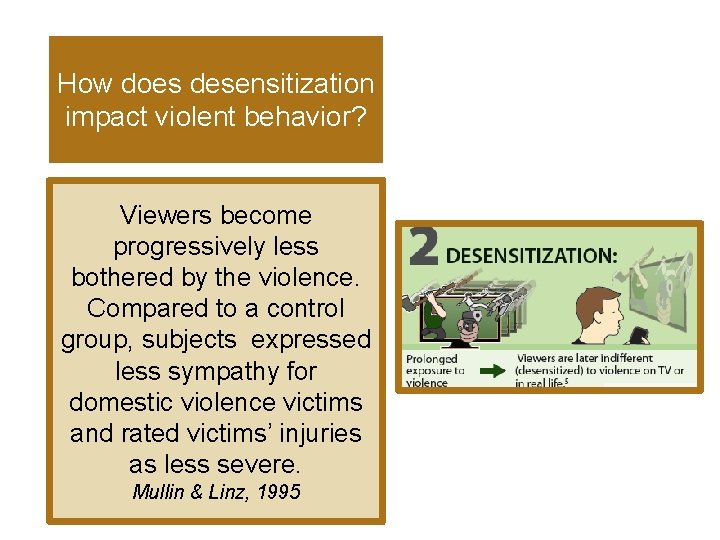
How does desensitization impact violent behavior? Viewers become progressively less bothered by the violence. Compared to a control group, subjects expressed less sympathy for domestic violence victims and rated victims’ injuries as less severe. Mullin & Linz, 1995
What does the research show? The American Psychological Association (APA) Task Force on Violent Media (2015) found that the “research demonstrates a consistent relation between violent video game use and increases in aggressive behavior, aggressive cognitions, and aggressive affect, and decreases in prosocial behavior, empathy, and sensitivity to aggression. ”
How does exposure to media violence impact children? The American Academy of Pediatrics (2009) has advised pediatricians that “media violence can contribute to aggressive behavior, desensitization to violence, nightmares, and fear of being harmed. ”

Let’s pause for a quote… “ Thirty seconds worth of glorification of a soap bar sells soap. Twenty-five minutes worth of glorification of violence sells violence. ” ~U. S. Senator Paul Simon, Remarks to the Communitarian Network, 1993
2. What Would You Answer? Briefly explain how the concepts below could be used to help a child stop throwing temper tantrums. • Extinction (operant conditioning) • Positive reinforcement • Modeling • Negative reinforcement • Shaping • Extinction (classical conditioning)
Learning Target 30 -1 Review Differentiate observational learning from associative learning. § Observational learning involves learning by watching and imitating, rather than learning associations between different events. § We learn to anticipate a behavior’s consequences, because we experience vicarious reinforcement or vicarious punishment.
Learning Target 30 -1 Review cont. Explain how observational learning may be enabled by neural mirroring. § Our brain’s frontal lobes have a shown ability to mirror the activity of another’s brain. § The same areas fire when we perform certain actions, as when we observe someone else performing those actions. Some psychologists believe mirror neurons enable this process.
Learning Target 30 -2 Review Discuss the impact of prosocial modeling and of antisocial modeling. § Children tend to imitate what a model does and says, whether the behavior being modeled is prosocial behavior (positive, constructive, and helpful) or antisocial behavior. § If a model’s actions and words are inconsistent, children may imitate the hypocrisy they observe.
Learning Target 30 -3 Review Discuss the violence-viewing effect. § Media violence can contribute to aggression. This violence-viewing effect may be prompted by imitation and desensitization. § Correlation does not equal causation, but study participants have reacted more cruelly when they have viewed violence (instead of entertaining nonviolence).
- Slides: 34