
Learning Targets 29 1 Explain how biological constraints
Learning Targets 29 -1 Explain how biological constraints affect classical and operant conditioning. Module 29 Biology, Cognition and Learning 29 -2 Explain how cognitive processes affect classical and operant conditioning. 29 -3 Identify the two ways people learn to cope with personal problems. 29 -4 Describe how a perceived lack of control can affect people’s behavior and health. 29 -5 Explain why self-control is important, and discuss whether it can be depleted.
How do biological constraints affect classical conditioning? In 1956, learning researcher Gregory Kimble proclaimed, “Just about any activity of which the organism is capable can be conditioned and. . . these responses can be conditioned to any stimulus that the organism can perceive” Twenty-five years later, he humbly acknowledged that “half a thousand” scientific reports had proven him wrong. (Kimble, 1981)

So we can’t teach any organism any thing? More than the early behaviorists realized, an animal’s capacity for conditioning is limited by biological constraints. For example, each species’ predispositions prepare it to learn the associations that enhance its survival—a evolutionary phenomenon called preparedness. Environments are not the whole story. Biology matters.
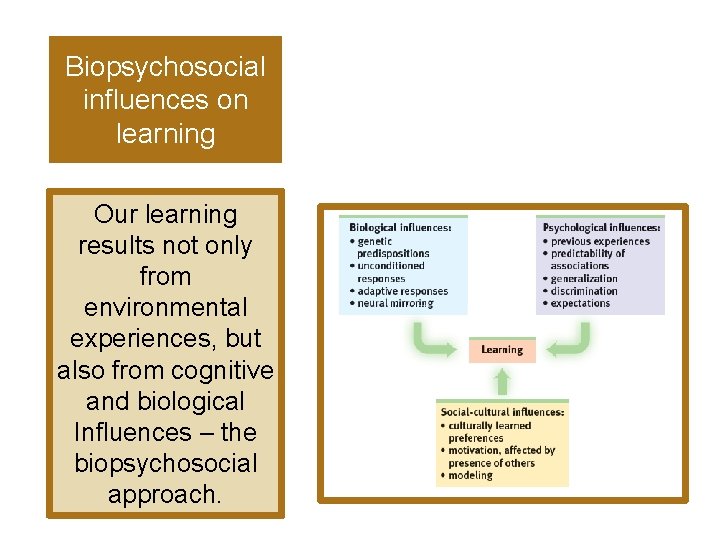
Biopsychosocial influences on learning Our learning results not only from environmental experiences, but also from cognitive and biological Influences – the biopsychosocial approach.
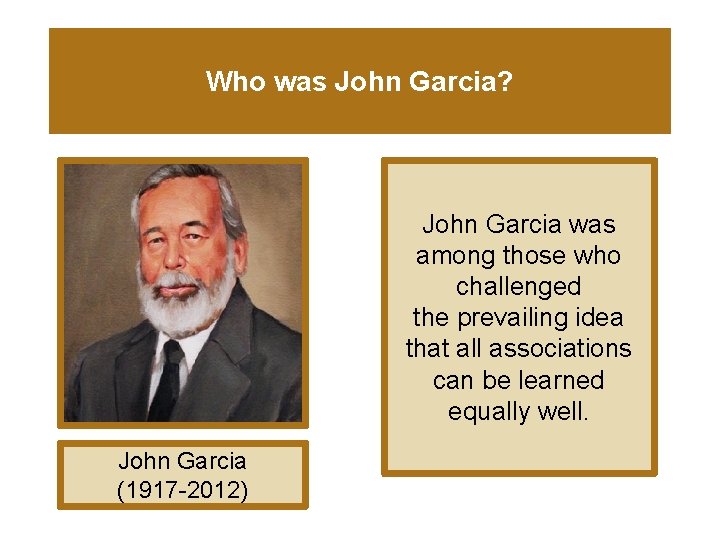
Who was John Garcia? John Garcia was among those who challenged the prevailing idea that all associations can be learned equally well. John Garcia (1917 -2012)
What experiments were conducted? John Garcia and Robert Koelling exposed a group of rats to a particular taste, sight, or sound and later also to radiation or drugs that led to nausea and vomiting.
Can you identify the US, CS, UR and CR in Garcia and Koelling’s experiment? John Garcia and Robert Koelling exposed a group of rats to a particular taste, sight, or sound and later also to radiation or drugs that led to nausea and vomiting.
What were two findings in Garcia and Koelling’s study? First, even if sickened as late as several hours after tasting a particular novel flavor, the rats thereafter avoided that flavor. Second, the sickened rats developed conditioned aversions to tastes but not to sights or sounds. This made adaptive sense. For rats, the easiest way to identify tainted food is to taste it; if sickened after sampling a new food, they thereafter avoid it. This response is called taste aversion.
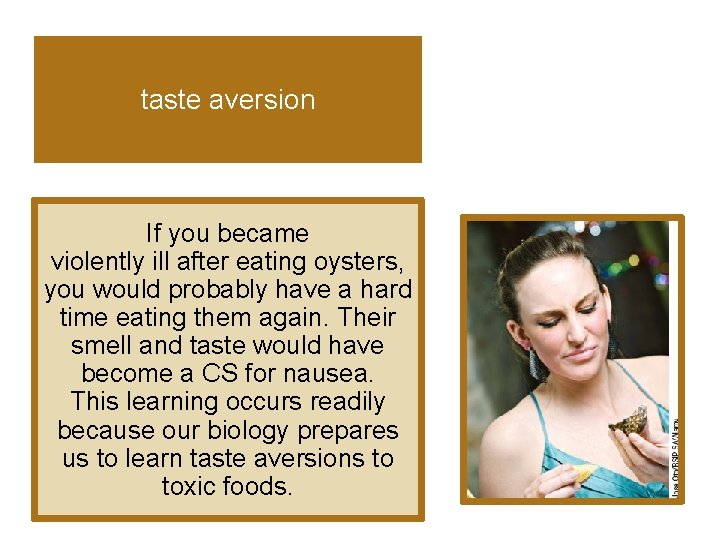
taste aversion If you became violently ill after eating oysters, you would probably have a hard time eating them again. Their smell and taste would have become a CS for nausea. This learning occurs readily because our biology prepares us to learn taste aversions to toxic foods.
Talk with your partner. What different foods or beverages have you eventually grown to like—or dislike—since you were a child? Has falling ill after enjoying a special treat ever changed a one-time like to a definite dislike? Practice by identifying the classical conditioning components of your taste aversion.
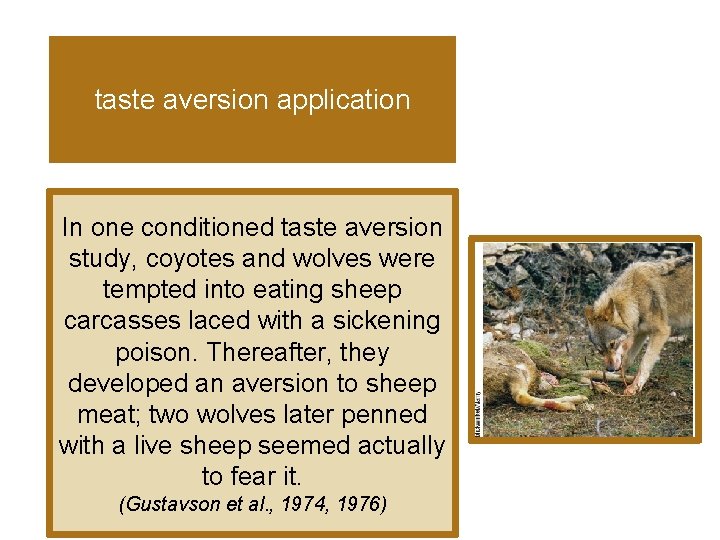
taste aversion application In one conditioned taste aversion study, coyotes and wolves were tempted into eating sheep carcasses laced with a sickening poison. Thereafter, they developed an aversion to sheep meat; two wolves later penned with a live sheep seemed actually to fear it. (Gustavson et al. , 1974, 1976)
Can you identify the US, CS, UR and CR? In one conditioned taste-aversion study, coyotes and wolves were tempted into eating sheep carcasses laced with a sickening poison. Thereafter, they developed an aversion to sheep meat.
1. What Would You Answer? How did Garcia and Koelling’s taste aversion studies help disprove Gregory Kimble’s early claim that “just about any activity of which the organism is capable can be conditioned. . . to any stimulus that the organism can perceive”? Talk about it.
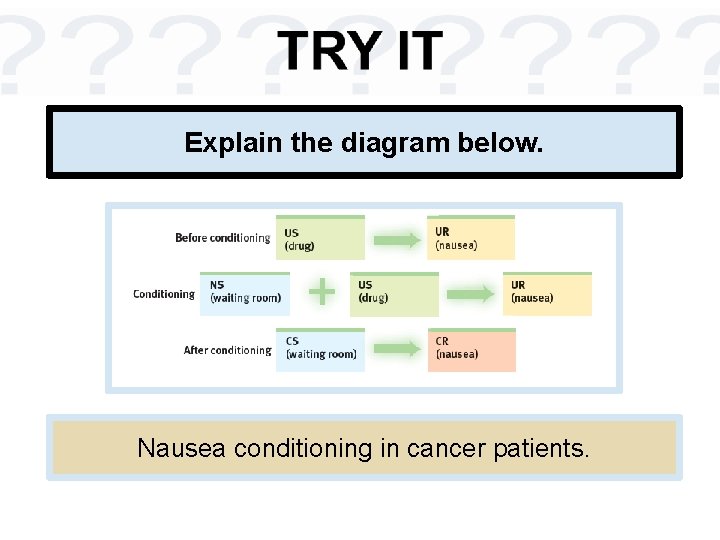
Explain the diagram below. Nausea conditioning in cancer patients.
How do biological constraints affect operant conditioning? Science fiction writer Robert Heinlein said it well: “Never try to teach a pig to sing; it wastes your time and annoys the pig. ” Biological constraints predispose organisms to learn associations that are naturally adaptive.
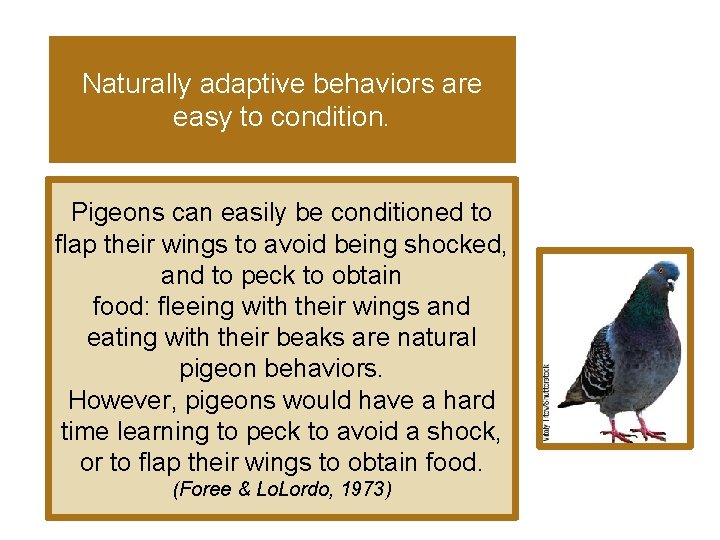
Naturally adaptive behaviors are easy to condition. Pigeons can easily be conditioned to flap their wings to avoid being shocked, and to peck to obtain food: fleeing with their wings and eating with their beaks are natural pigeon behaviors. However, pigeons would have a hard time learning to peck to avoid a shock, or to flap their wings to obtain food. (Foree & Lo. Lordo, 1973)
What is instinctive drift? the tendency of learned behavior to gradually revert to biologically predisposed patterns Pigs conditioned to pick up large wooden “dollars” and deposit them in a piggy bank began to drift back to their natural ways. They dropped the coin, pushed it with their snouts as pigs are prone to do, picked it up again, and then repeated the sequence—delaying their food Reinforcement.
How do cognitive processes affect classical conditioning? In their dismissal of “mentalistic” concepts such as consciousness, Pavlov and Watson underestimated the importance of the effects of cognitive processes (thoughts, perceptions, expectations).
What did Rescorla and Wagner show? Robert Rescorla and Allan Wagner (1972) showed that an animal can learn the predictability of an event. The more predictable the association, the stronger the conditioned response. It’s as if the animal learns an expectancy, an awareness of how likely it is that the US will occur.
How do associations influence attitudes? When British children viewed novel cartoon characters alongside either ice cream (Yum!) or brussels sprouts (Yuck!), they came to prefer the ice-cream-associated characters. (Field, 2006)
How are associations limited in their influence on attitudes? People receiving therapy for alcohol use disorder may be given alcohol spiked with a nauseating drug. Will they then associate alcohol with sickness? If classical conditioning were merely a matter of “stamping in” stimulus associations, we might hope so, and to some extent this does occur.
So, our cognitions matter? Knowing that the nausea is induced by the drug, not the alcohol, often weakens the association between drinking alcohol and feeling sick, reducing the treatment’s effectiveness. So, even in classical conditioning, it is—especially with humans—not simply the CS-US association, but also the thought that counts.
How do cognitive processes affect operant conditioning? In their dismissal of “mentalistic” concepts such as consciousness, Pavlov and Watson underestimated the importance of the effects of cognitive processes (thoughts, perceptions, expectations).
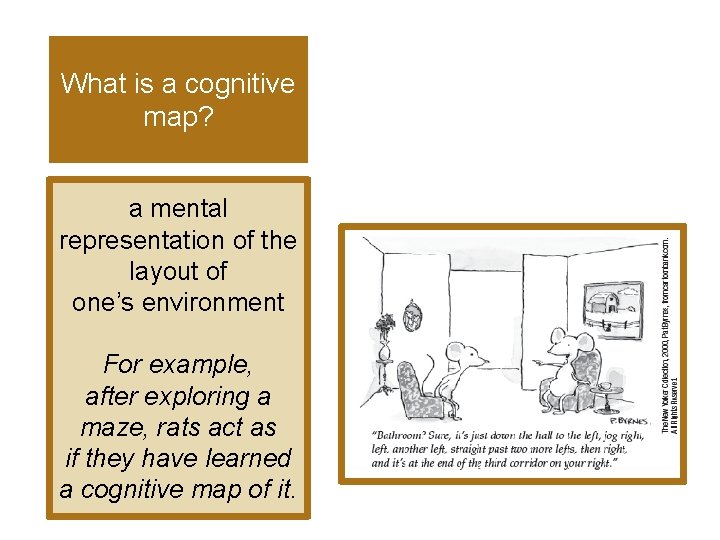
What is a cognitive map? a mental representation of the layout of one’s environment For example, after exploring a maze, rats act as if they have learned a cognitive map of it.
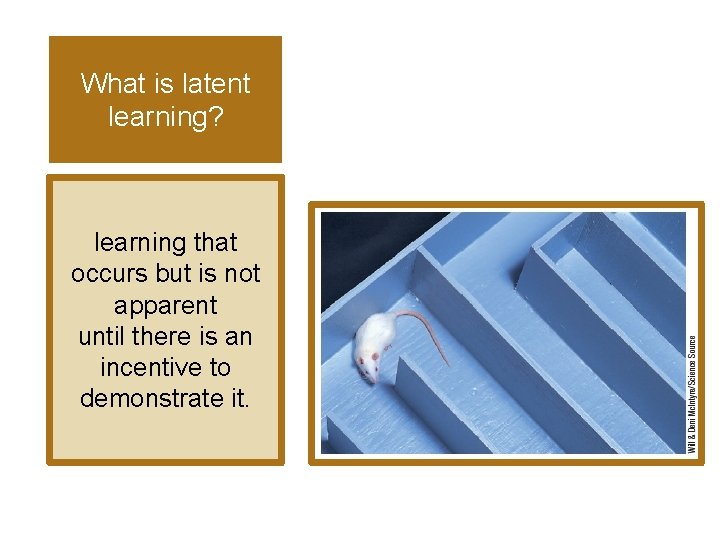
What is latent learning? learning that occurs but is not apparent until there is an incentive to demonstrate it.
How did Tolman and Honzik research latent learning? In a classic experiment, rats in one group repeatedly explored a maze, always with a food reward at the end. Rats in another group explored the maze with no food reward. But once given a food reward at the end, rats in the second group thereafter ran the maze as quickly as the always-rewarded rats. (Tolman & Honzik, 1930).
Latent learning involves cognition. The point to remember: There is more to learning than associating a response with a consequence; there is also cognition.
What is insight learning? a sudden realization of a problem’s solution; contrasts with strategy-based solutions
Consider this… Ten-year-old Johnny Appleton’s insight solved a problem that had stumped construction workers: how to rescue a young robin from a narrow 30 -inch-deep hole in a cement-block wall. Johnny’s solution: Slowly pour in sand, giving the bird enough time to keep its feet on top of the constantly rising pile (Ruchlis, 1990).
2. What Would You Answer? A woman had been pondering a problem for days and was about to give up when, suddenly, the solution came to her. Her experience can be best described as what? A. cognitive mapping B. insight C. operant conditioning D. classical conditioning E. unconscious associative learning
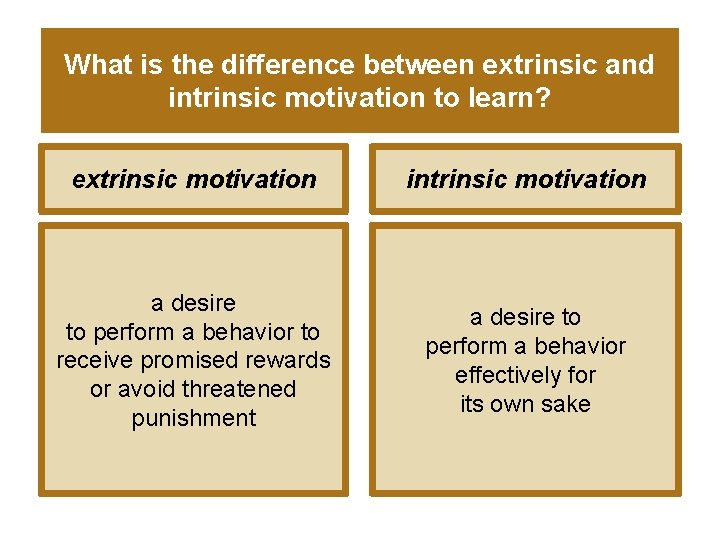
What is the difference between extrinsic and intrinsic motivation to learn? extrinsic motivation intrinsic motivation a desire to perform a behavior to receive promised rewards or avoid threatened punishment a desire to perform a behavior effectively for its own sake
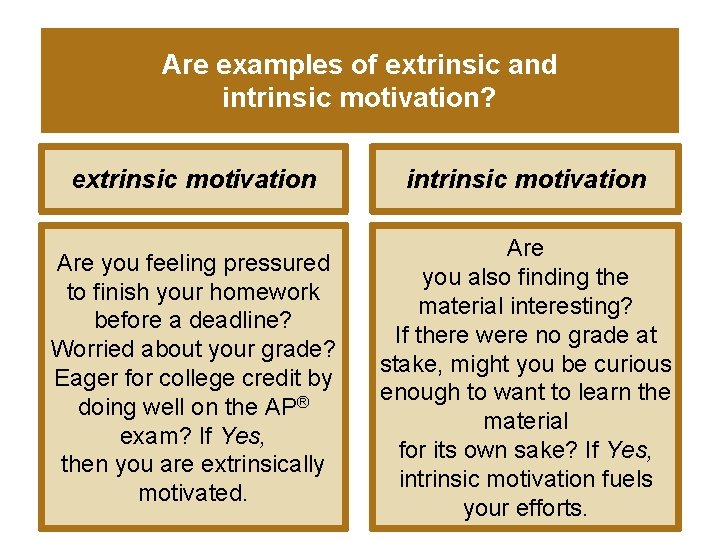
Are examples of extrinsic and intrinsic motivation? extrinsic motivation intrinsic motivation Are you feeling pressured to finish your homework before a deadline? Worried about your grade? Eager for college credit by doing well on the AP® exam? If Yes, then you are extrinsically motivated. Are you also finding the material interesting? If there were no grade at stake, might you be curious enough to want to learn the material for its own sake? If Yes, intrinsic motivation fuels your efforts.
How does the cognitive perspective show us the limits of rewards? Promising people a reward for a task they already enjoy can backfire. This is called the overjustification effect. Excessive rewards can destroy intrinsic motivation —the desire to perform a behavior effectively and for its own sake.
AP® Exam Tip Although you didn’t read about the overjustification effect in your text, it is likely it will appear on the AP® exam. The overjustification effect occurs when an expected external incentive such as money or prizes decreases a person's intrinsic motivation to perform a task.
Let’s look at the research on how cognition impacts extrinsic motivation. In experiments, children have been promised a payoff for playing with an interesting puzzle or toy. Later, they played with the toy less than did unpaid children. (Deci et al. , 1999; Tang & Hall, 1995) Likewise, rewarding children with toys or candy for reading diminishes the time they spend reading. (Marinak & Gambrell, 2008)
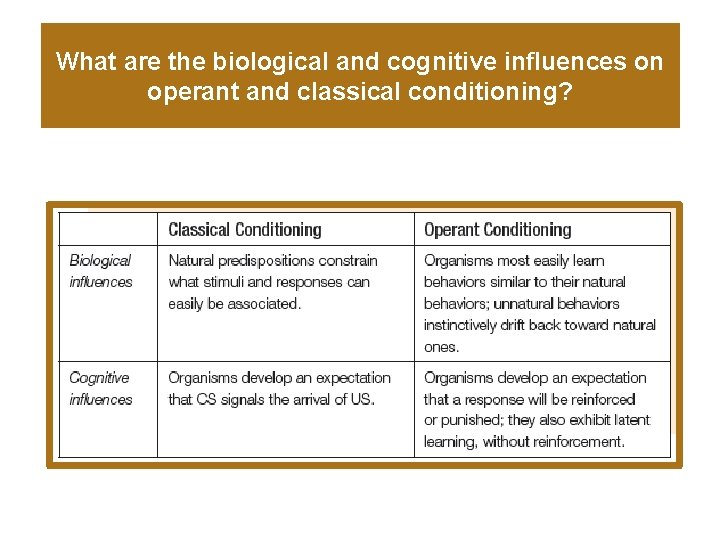
What are the biological and cognitive influences on operant and classical conditioning?
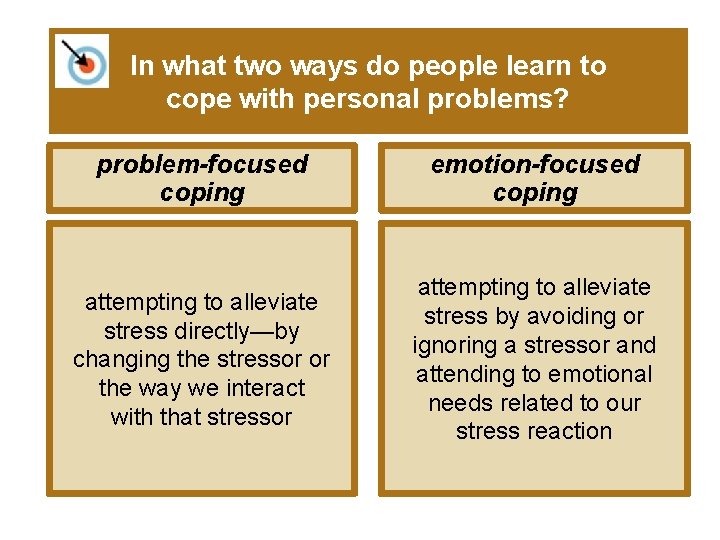
In what two ways do people learn to cope with personal problems? problem-focused coping emotion-focused coping attempting to alleviate stress directly—by changing the stressor or the way we interact with that stressor attempting to alleviate stress by avoiding or ignoring a stressor and attending to emotional needs related to our stress reaction
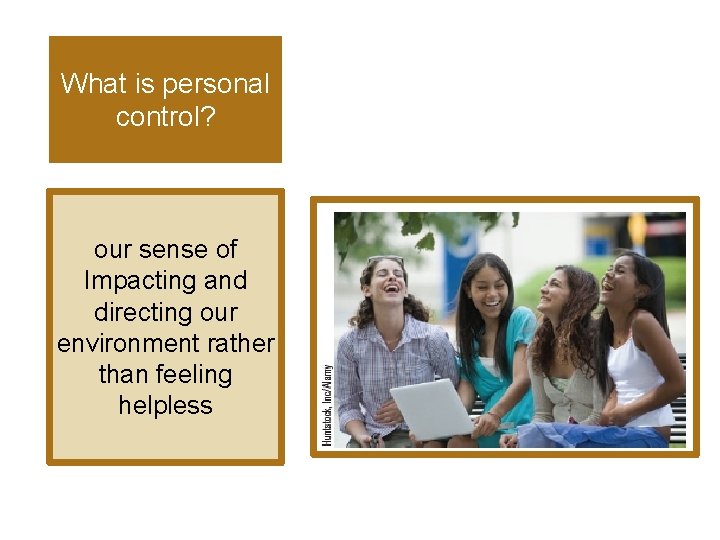
What is personal control? our sense of Impacting and directing our environment rather than feeling helpless
How does a perceived lack of control affect people’s behavior and health? Two rats receive simultaneous shocks. One can turn a wheel to stop the shocks. The helpless rat, but not the wheel turner, becomes more susceptible to ulcers and lowered immunity to disease. (Laudenslager & Reite, 1984) In humans, too, uncontrollable threats trigger the strongest stress responses. (Dickerson & Kemeny, 2004)
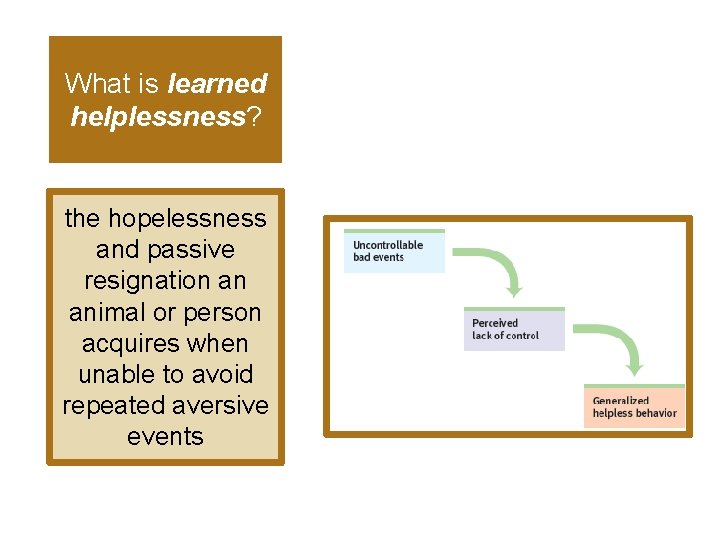
What is learned helplessness? the hopelessness and passive resignation an animal or person acquires when unable to avoid repeated aversive events
What research has been conducted on learned helplessness? In experiments, dogs were strapped in a harness and given repeated shocks, with no opportunity to avoid them. Later, when placed in another situation where they could escape the punishment by simply leaping a hurdle, the dogs displayed learned helplessness; they cowered as if without hope. Other dogs that had been able to escape the first shocks reacted differently. They had learned they were in control and easily escaped the shocks in the new situation. (Seligman & Maier, 1967)
Why does perceived loss of control predict health problems? Losing control provokes an outpouring of stress hormones. When rats cannot control shock or when humans or other primates feel unable to control their environment, stress hormone levels rise, blood pressure increases, and immune responses drop. (Rodin, 1986; Sapolsky, 2005)
Let’s look at the research on stress and control. Captive animals experience more stress and are more vulnerable to disease than their wild counterparts. (Roberts, 1988) The greater nurses’ workload, the higher their cortisol level and blood pressure— but only among nurses who reported little control over their environment (Fox et al. , 1993) The crowding in high-density neighborhoods, prisons, and college and university dorms is another source of diminished feelings of control—and of elevated levels of stress hormones and blood pressure. (Fleming et al. , 1987; Ostfeld et al. , 1987)
Julian Rotter’s loci of control external locus of control internal locus of control the perception that chance or outside forces beyond our personal direction determine our fate the perception that we direct and create our own fate
What has research shown about internal locus of control? “Internals” have achieved more in school and work, acted more independently, enjoyed better health, and felt less depressed than did the “externals”. (Lefcourt, 1982; Ng et al. , 2006) People with an internal locus of control at age 10 exhibited less obesity, lower blood pressure, and less distress at age 30. (Gale et al. , 2008) Compared with nonleaders, military and business leaders have lower-than-average levels of stress hormones and report less anxiety, thanks to their greater sense of control. (Sherman et al. , 2012)
3. What Would You Answer? Which ability is likely to predict good adjustment, better grades, and social success? A. B. C. D. E. low self-control an external locus of control problem-focused coping learned helplessness emotion-focused coping
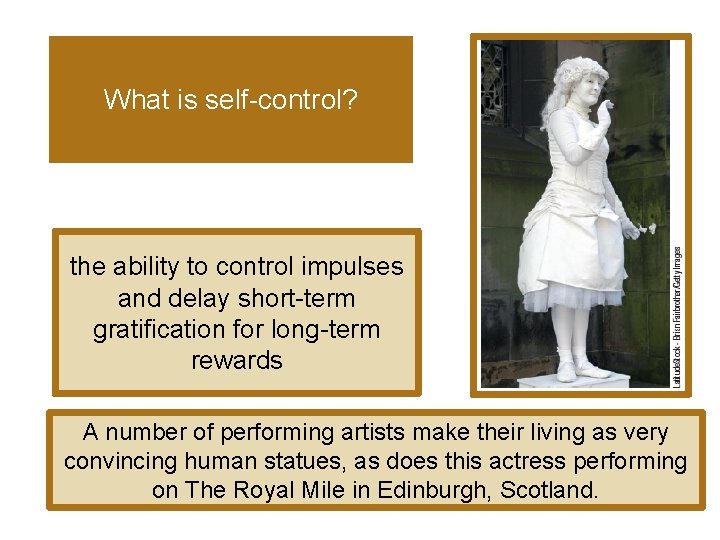
What is self-control? the ability to control impulses and delay short-term gratification for long-term rewards A number of performing artists make their living as very convincing human statues, as does this actress performing on The Royal Mile in Edinburgh, Scotland.
Why is self-control important? Self-control predicts good health, higher income, and better school performance. (Bub et al. , 2016; Keller et al. , 2016; Moffitt et al. , 2011) In studies of American, Asian, and New Zealander children, self-control outdid intelligence test scores in predicting future academic and life success. (Duckworth & Seligman, 2005; Poulton et al. , 2015; Wu et al. , 2016)
How can our self-control be depleted? Self-control varies over time. Like a muscle, it tends to weaken after use, recover after rest, and grow stronger with exercise. In one famous experiment, hungry people who had spent some of their willpower resisting the temptation to eat chocolate chip cookies then abandoned a tedious task sooner than did others. (Baumeister et al. , 1998)
Learning Target 29 -1 Review How do biological constraints affect classical and operant conditioning? § Conditioning is limited by biological constraints. § Learning is adaptive: each species learns behaviors that aid its survival—a phenomenon called preparedness. § Our preparedness to associate a CS with a US that follows predictably and immediately is often (but not always) adaptive. § During operant training, animals may display instinctive drift by reverting to biologically predisposed patterns.
Learning Target 29 -2 Review How do cognitive processes affect classical and operant conditioning? § In classical conditioning, animals may learn when to expect a US and may be aware of the link between stimuli and responses. § In operant conditioning, cognitive mapping and latent learning research demonstrate the importance of cognitive processes in learning. § Learning can occur after little or no systematic interaction with our environment (insight learning), and excessive rewards (driving extrinsic motivation) can undermine intrinsic motivation.
Learning Target 29 -3 Review In what two ways do people learn to cope with personal problems? § We use direct, problem-focused coping when we feel a sense of control over a situation to change the stressor or the way we interact with it. § We use emotion-focused coping when unable to avoid stressors and attend to emotional needs related to stress reactions. These strategies can be harmful if misused.
Learning Target 29 -4 Review How does a perceived lack of control affect people’s behavior and health? § We may feel helpless, hopeless, and depressed when experiencing bad events beyond our personal control. Being unable to avoid repeated aversive events can lead to learned helplessness. § People who perceive an internal locus of control achieve more, enjoy better health, and are happier than those who perceive an external locus of control. A perceived lack of control provokes an outpouring of hormones that put people’s health at risk.
Learning Target 29 -5 Review Explain why self-control is important, and discuss whether it can be depleted. § Self-control requires attention and energy, but it predicts good health, higher income, and better school performance. § Studies have shown self-control to be a better predictor of future academic and life success than intelligence test score. § Self-control varies over time, and while researchers disagree about the factors influencing it, strengthening self-control can lead to a healthier, happier, and more successful life.
- Slides: 55