
Learning Targets 1 Define and identify asset liability

Learning Targets 1. Define and identify asset, liability, and owner’s equity accounts 2. Record a group of business transactions, in column form, involving changes in assets, liabilities, and owner’s equity 3. Define and identify revenue and expense accounts 4. Record a group of business transactions, in column form, involving all five elements of the fundamental accounting equation 1 -2
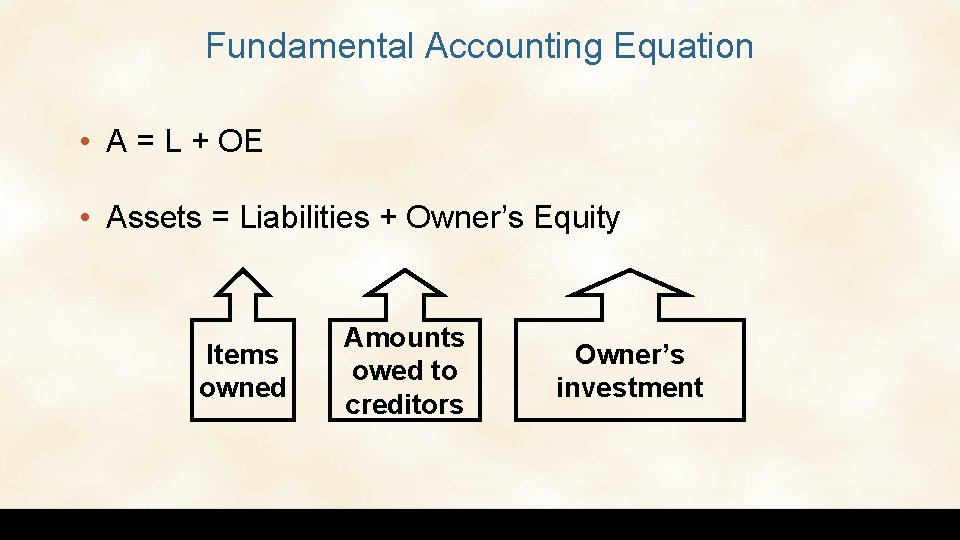
Fundamental Accounting Equation • A = L + OE • Assets = Liabilities + Owner’s Equity Items owned Amounts owed to creditors Owner’s investment 1 -3
Define Asset • Asset – Cash, properties, and other things of value owned by an economic unit or business entity 1 -4

Identify Assets • Examples of assets: – Cash – Trucks – Buildings – Shoes in a shoe store – Kites in a kite store – Accounts Receivable • The amount owed to you or the business 1 -5
Define Accounts Receivable • Accounts Receivable – An account used or record of the amounts owed by charge customers (legal claims against charge customers) • Look for the words: – “Sold on account” 1 -6
Define Liability • Liability – Debts or amounts owed to creditors • In one word: – Debt 1 -7

Identify Liabilities • Examples of Debts/Liabilities – Loans (borrowing money) – Accounts Payable account • Buy goods/services on credit • Receive a bill, but don’t pay until later • Buy supplies from a store, but pay for them later 1 -8
Define Accounts Payable • Accounts Payable – A liability account used for short-term liabilities or charge accounts, usually due within thirty days • Look for the words: – “Bought/purchased on account” 1 -9

Define Owner’s Equity • The owner’s right to or investment in the business • A – L = OE 1 - 10
Identify Owner’s Equity • What is left over for the owner after all the debts have been paid – Remember: Creditors must be paid before the owners are paid • The Capital account 1 - 11

Fundamental Accounting Equation • A = L + OE • Assets = Liabilities + Owner’s Equity – The equals sign means that one side must always equal the other side – We’ll use this equation later to determine whether we have recorded our business transactions correctly 1 - 12
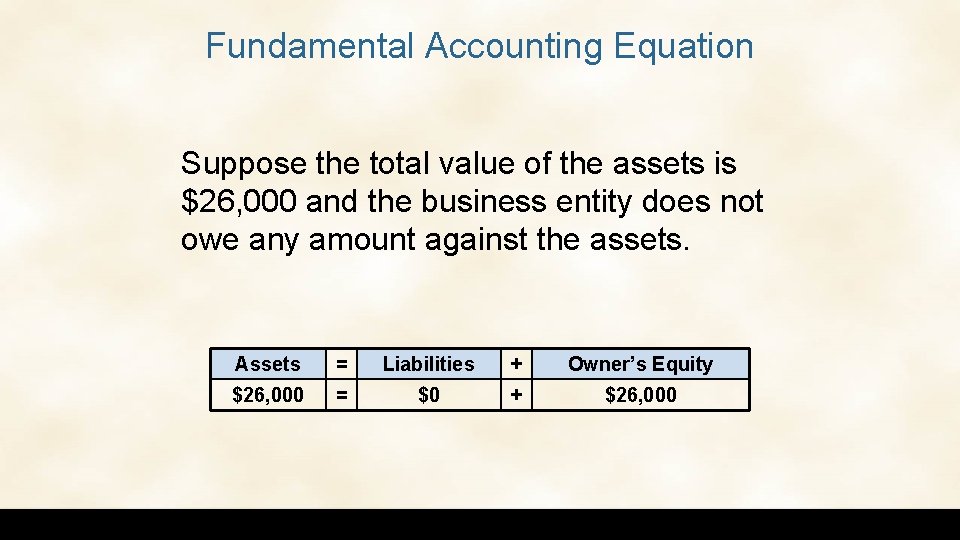
Fundamental Accounting Equation Suppose the total value of the assets is $26, 000 and the business entity does not owe any amount against the assets. Assets = Liabilities + Owner’s Equity $26, 000 = $0 + $26, 000 1 - 13
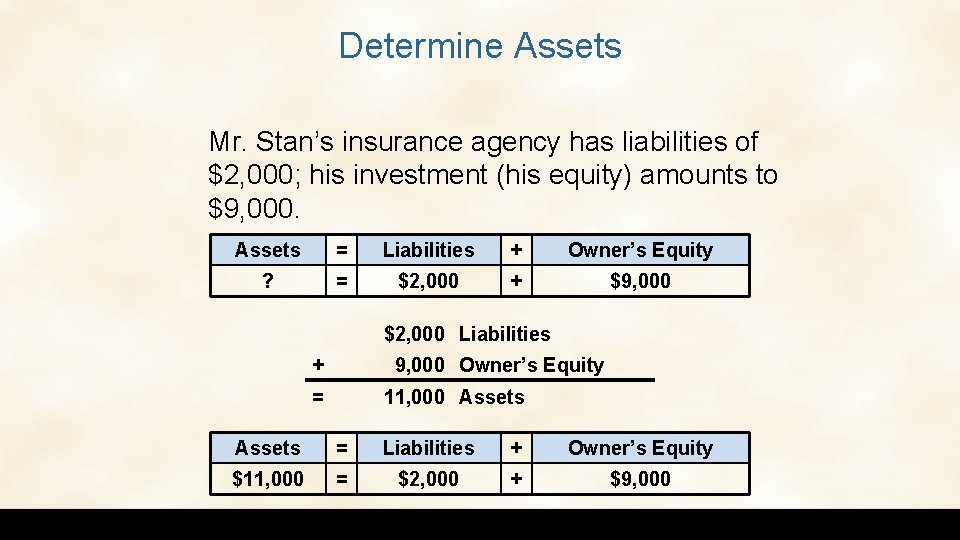
Determine Assets Mr. Stan’s insurance agency has liabilities of $2, 000; his investment (his equity) amounts to $9, 000. Assets = Liabilities + Owner’s Equity ? = $2, 000 + $9, 000 $2, 000 Liabilities + 9, 000 Owner’s Equity = 11, 000 Assets = Liabilities + Owner’s Equity $11, 000 = $2, 000 + $9, 000 Copyright © Houghton Mifflin Company. All rights reserved. 1 - 14
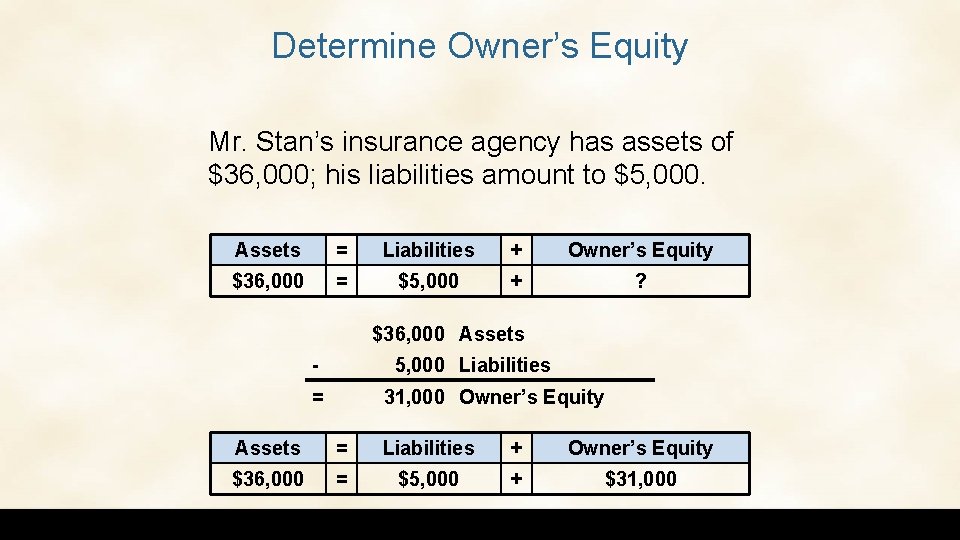
Determine Owner’s Equity Mr. Stan’s insurance agency has assets of $36, 000; his liabilities amount to $5, 000. Assets = Liabilities + Owner’s Equity $36, 000 = $5, 000 + ? $36, 000 Assets - 5, 000 Liabilities = 31, 000 Owner’s Equity Assets = Liabilities + Owner’s Equity $36, 000 = $5, 000 + $31, 000 Copyright © Houghton Mifflin Company. All rights reserved. 1 - 15
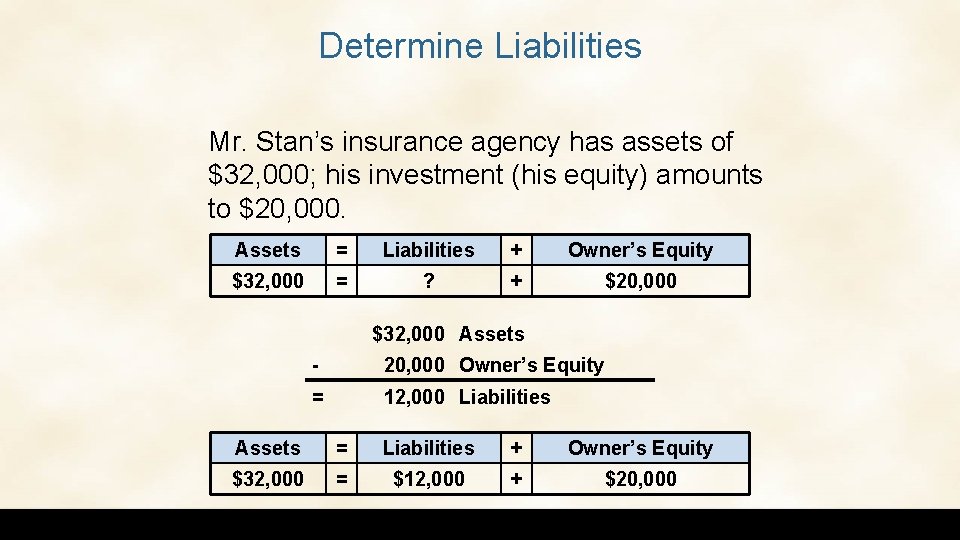
Determine Liabilities Mr. Stan’s insurance agency has assets of $32, 000; his investment (his equity) amounts to $20, 000. Assets = Liabilities + Owner’s Equity $32, 000 = ? + $20, 000 $32, 000 Assets - 20, 000 Owner’s Equity = 12, 000 Liabilities Assets = Liabilities + Owner’s Equity $32, 000 = $12, 000 + $20, 000 Copyright © Houghton Mifflin Company. All rights reserved. 1 - 16
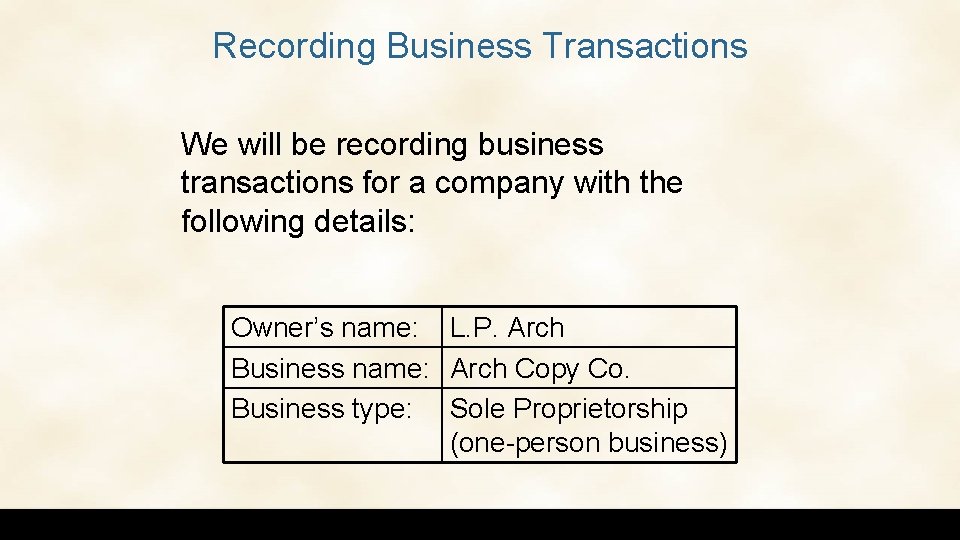
Recording Business Transactions We will be recording business transactions for a company with the following details: Owner’s name: L. P. Arch Business name: Arch Copy Co. Business type: Sole Proprietorship (one-person business) 1 - 17
Some Definitions • Sole proprietorship – A one-owner business • Separate entity concept – The concept by which a business is treated as a separate economic or accounting entity – The business stands by itself, separate from its owners, creditors, and customers 1 - 18
Some Definitions • Accounts – The categories under the Assets, Liabilities, and Owner’s Equity headings • Double-entry accounting – The system by which each business transaction is recorded in at least two accounts and the accounting equation is kept in balance 1 - 19
Some Definitions • Fair market value – The present worth of an asset or the amount that would be received if the asset were sold to an outsider on the open market • Withdrawal – The taking of cash or other assets out of a business by the owner for his or her own use (also referred to as drawing) – Treated as a temporary decrease in owner’s equity 1 - 20
Steps in Recording a Business Transaction 1. What accounts are involved? 2. What are the classifications of the accounts involved? 3. Are the accounts increased or decreased? 4. Is the equation in balance after the transaction has been recorded? Remember: each business transaction must affect at least two accounts 1 - 21
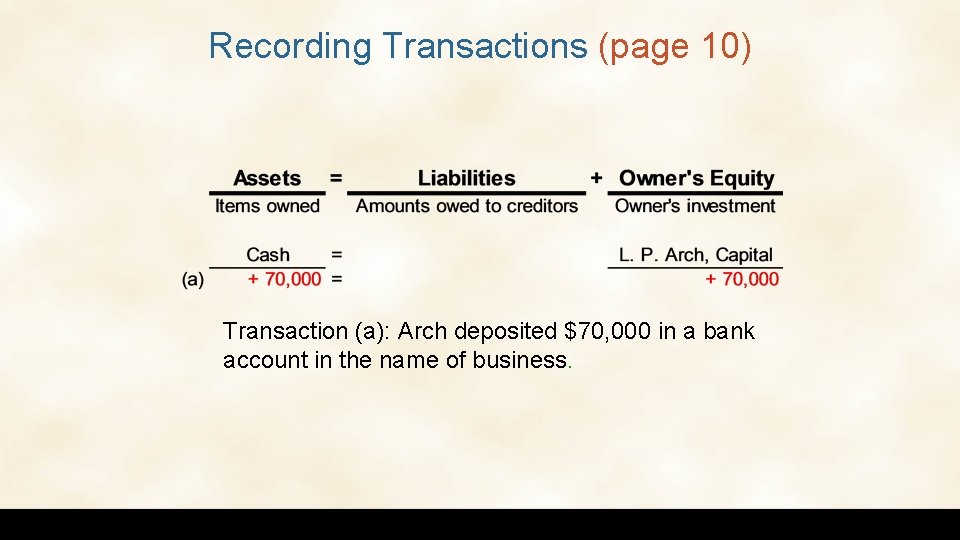
Recording Transactions (page 10) Transaction (a): Arch deposited $70, 000 in a bank account in the name of business. 1 - 22
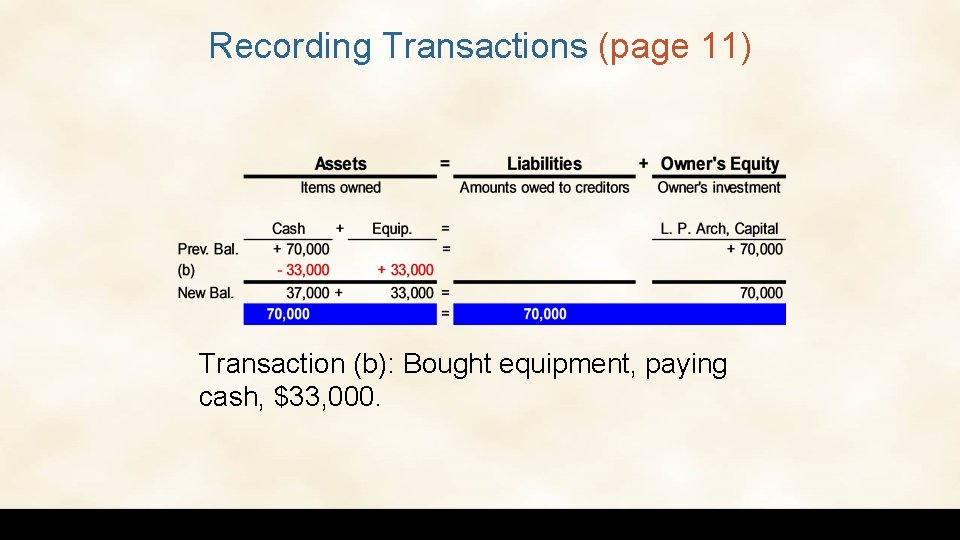
Recording Transactions (page 11) Transaction (b): Bought equipment, paying cash, $33, 000. 1 - 23
Define Revenues (page 13) • The amounts a business earns • Examples – Fees earned for performing services – Sales of merchandise – Rent income, and interest income • May take the form of cash, credit card receipts, or accounts receivable (charge accounts) 1 - 24
Identify Revenue Accounts • • • Fees Earned for performing services Sales Income from selling merchandise Rent Income for the use of property Interest Income for lending money Credit Sales where cash will be received at a later time – Example: Home Depot sells lumber to a customer and lets the customer pay later 1 - 25
Define Expenses (page 14) • The costs that relate to earning revenue (the costs of doing business) • Examples – Wages – Rent – Interest – Advertising • May be paid in cash, immediately or at a future time (accounts payable) 1 - 26
Identify Expense Accounts • • • Wages Expense for labor performed Rent Expense for the use of property Interest Expense for the use of money Advertising Expenses may be paid in cash when incurred (immediately) or at a later time • Expense incurred but not paid until later – Example: Received a bill for a newspaper ad you took out last week – Cash will be paid at a later time – involves Accounts Payable 1 - 27
Owner’s Equity • Revenues and expenses are under the umbrella of owner’s equity • Revenue Add to Capital account • Expenses Subtract from Capital account 1 - 28
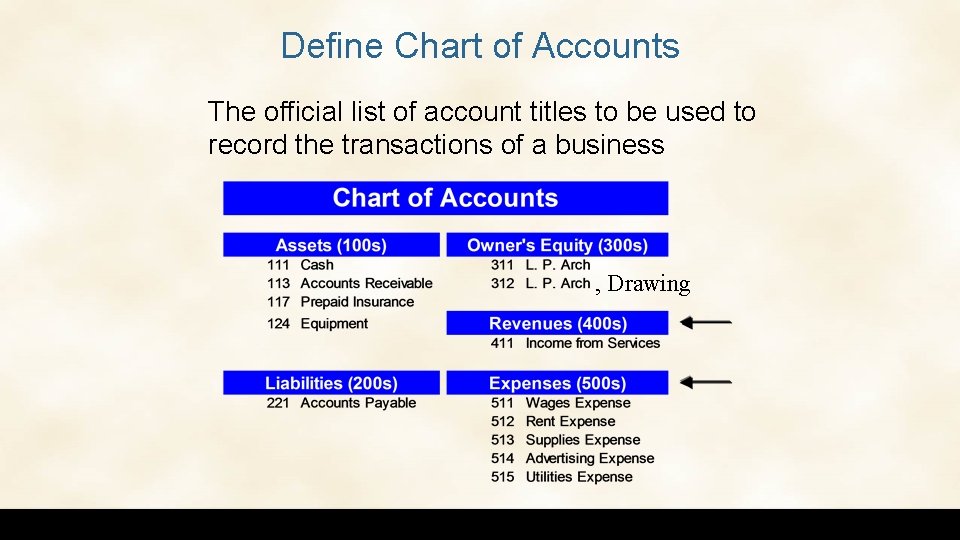
Define Chart of Accounts The official list of account titles to be used to record the transactions of a business , Drawing Copyright © Houghton Mifflin Company. All rights reserved. 1 - 29
- Slides: 29