
Learning Target 0 2 Writing a CER Statement


- Slides: 15
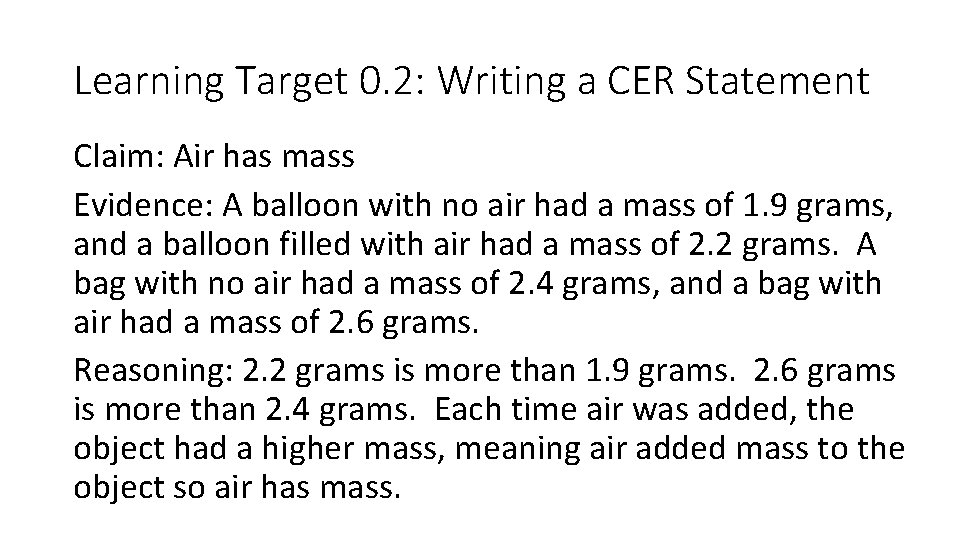
Learning Target 0. 2: Writing a CER Statement Claim: Air has mass Evidence: A balloon with no air had a mass of 1. 9 grams, and a balloon filled with air had a mass of 2. 2 grams. A bag with no air had a mass of 2. 4 grams, and a bag with air had a mass of 2. 6 grams. Reasoning: 2. 2 grams is more than 1. 9 grams. 2. 6 grams is more than 2. 4 grams. Each time air was added, the object had a higher mass, meaning air added mass to the object so air has mass.
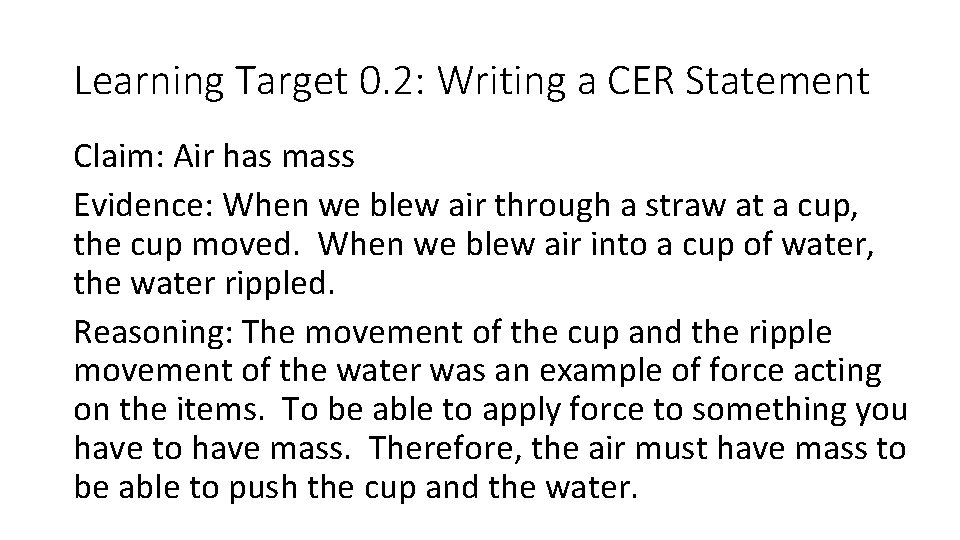
Learning Target 0. 2: Writing a CER Statement Claim: Air has mass Evidence: When we blew air through a straw at a cup, the cup moved. When we blew air into a cup of water, the water rippled. Reasoning: The movement of the cup and the ripple movement of the water was an example of force acting on the items. To be able to apply force to something you have to have mass. Therefore, the air must have mass to be able to push the cup and the water.
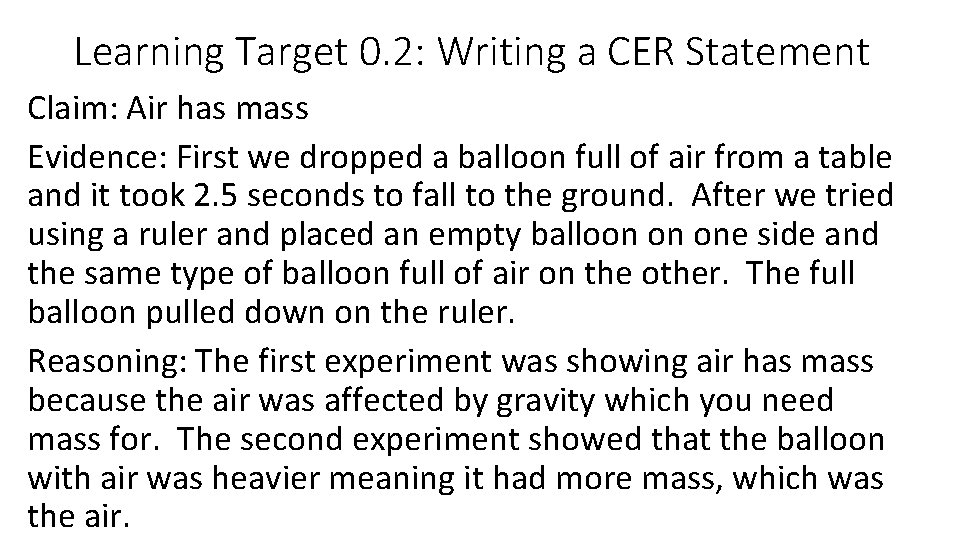
Learning Target 0. 2: Writing a CER Statement Claim: Air has mass Evidence: First we dropped a balloon full of air from a table and it took 2. 5 seconds to fall to the ground. After we tried using a ruler and placed an empty balloon on one side and the same type of balloon full of air on the other. The full balloon pulled down on the ruler. Reasoning: The first experiment was showing air has mass because the air was affected by gravity which you need mass for. The second experiment showed that the balloon with air was heavier meaning it had more mass, which was the air.
t n a c i f i n g i S s e r u g i F
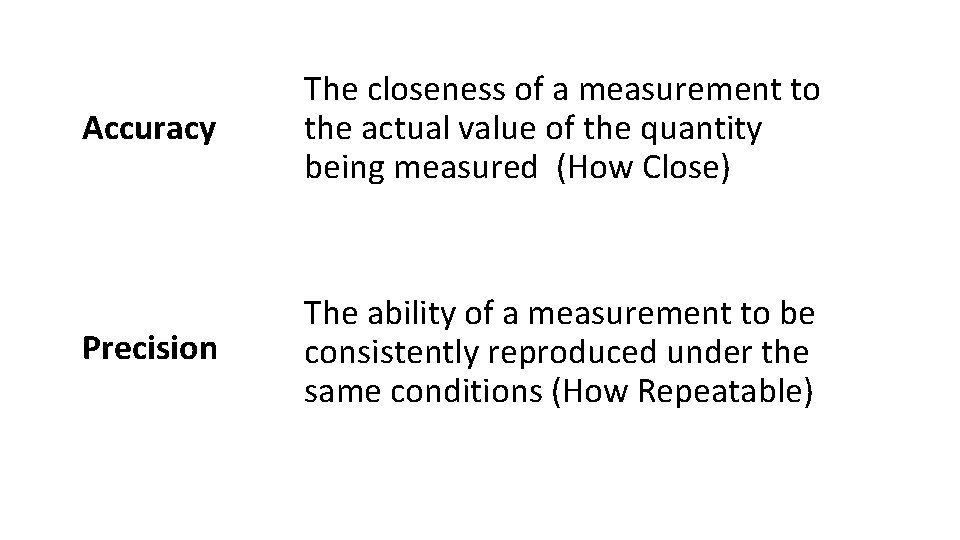
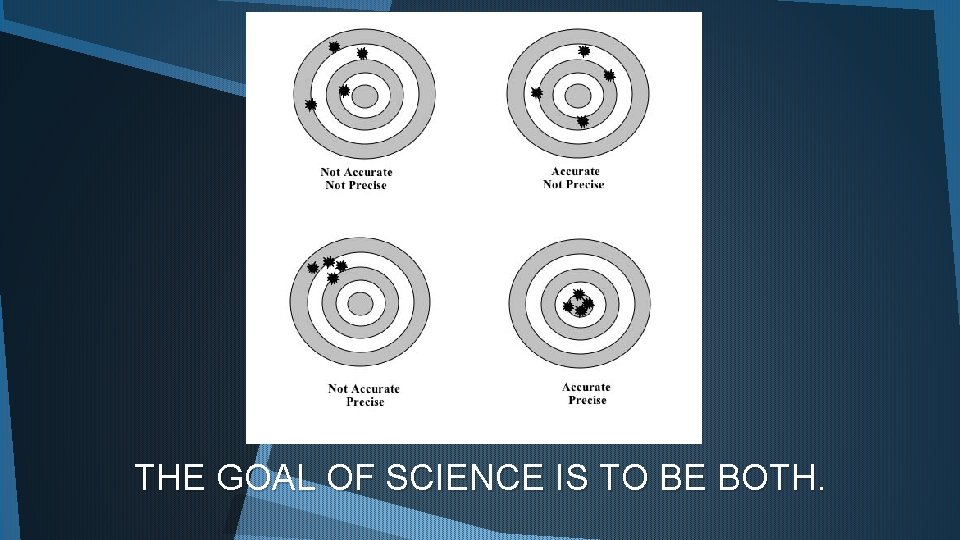
Accuracy The closeness of a measurement to the actual value of the quantity being measured (How Close) Precision The ability of a measurement to be consistently reproduced under the same conditions (How Repeatable)
THE GOAL OF SCIENCE IS TO BE BOTH.
All numbers reported in science give TWO pieces of information: - Value - Accuracy (how carefully it was measured, hundredths, thousandths) The ACCURACY is given by the number of SIGNIFICANT DIGITS. - How reliable is the measurement? - Is there doubt?
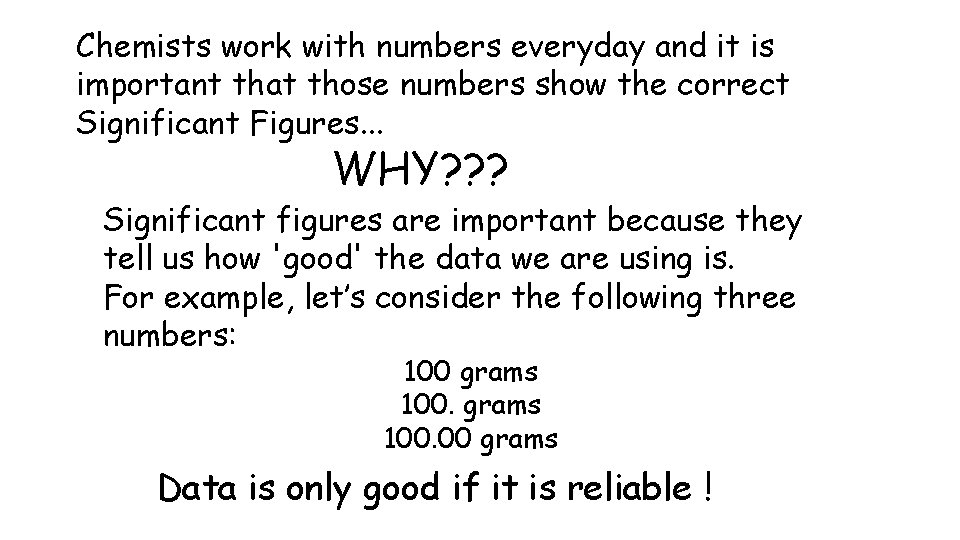
Chemists work with numbers everyday and it is important that those numbers show the correct Significant Figures. . . WHY? ? ? Significant figures are important because they tell us how 'good' the data we are using is. For example, let’s consider the following three numbers: 100 grams 100. 00 grams Data is only good if it is reliable !
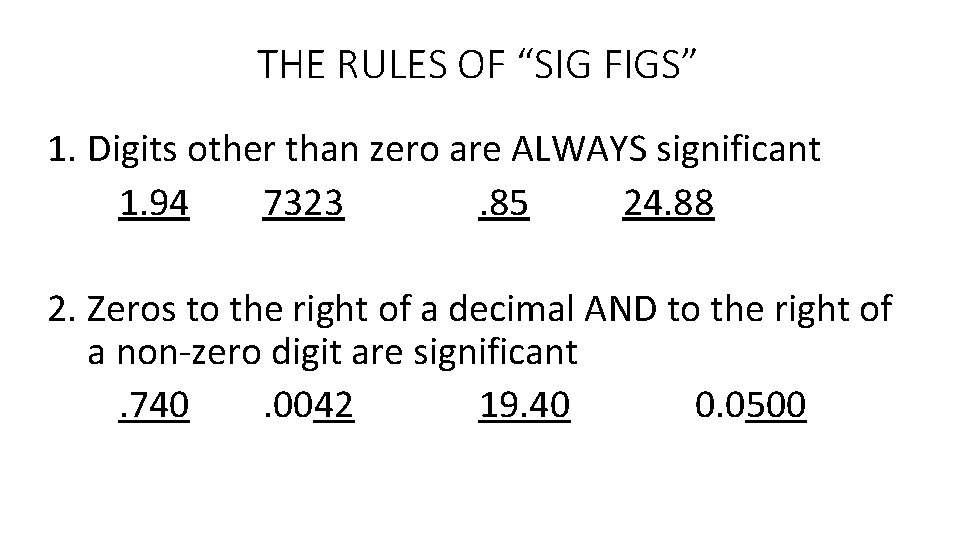
THE RULES OF “SIG FIGS” 1. Digits other than zero are ALWAYS significant 1. 94 7323. 85 24. 88 2. Zeros to the right of a decimal AND to the right of a non-zero digit are significant. 740. 0042 19. 40 0. 0500
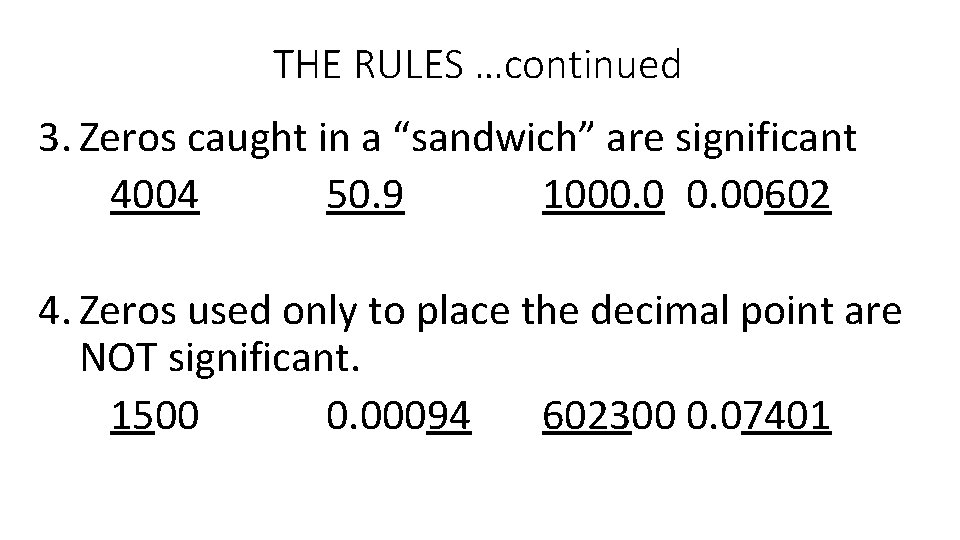
THE RULES …continued 3. Zeros caught in a “sandwich” are significant 4004 50. 9 1000. 00602 4. Zeros used only to place the decimal point are NOT significant. 1500 0. 00094 602300 0. 07401
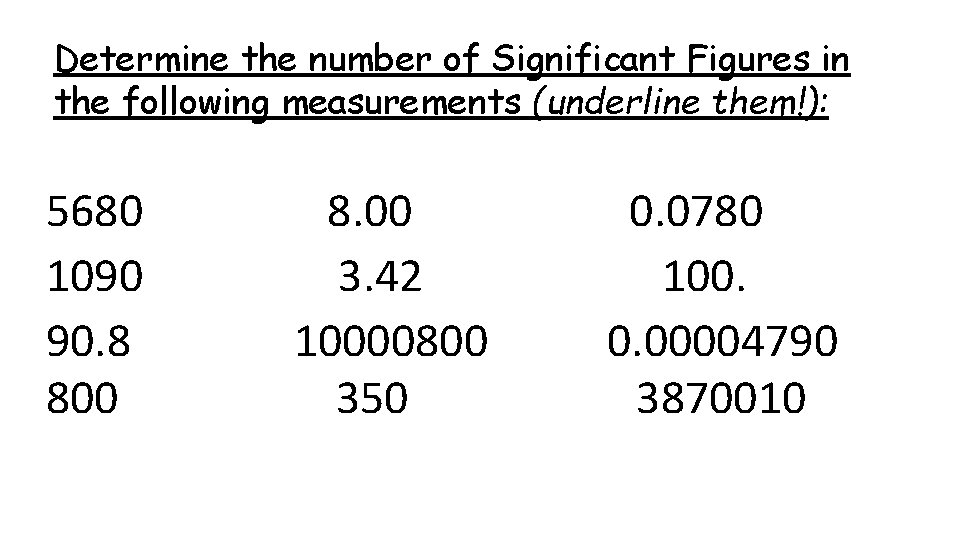
Determine the number of Significant Figures in the following measurements (underline them!): 5680 8. 00 0. 0780 1090 3. 42 100. 90. 8 10000800 0. 00004790 800 350 3870010
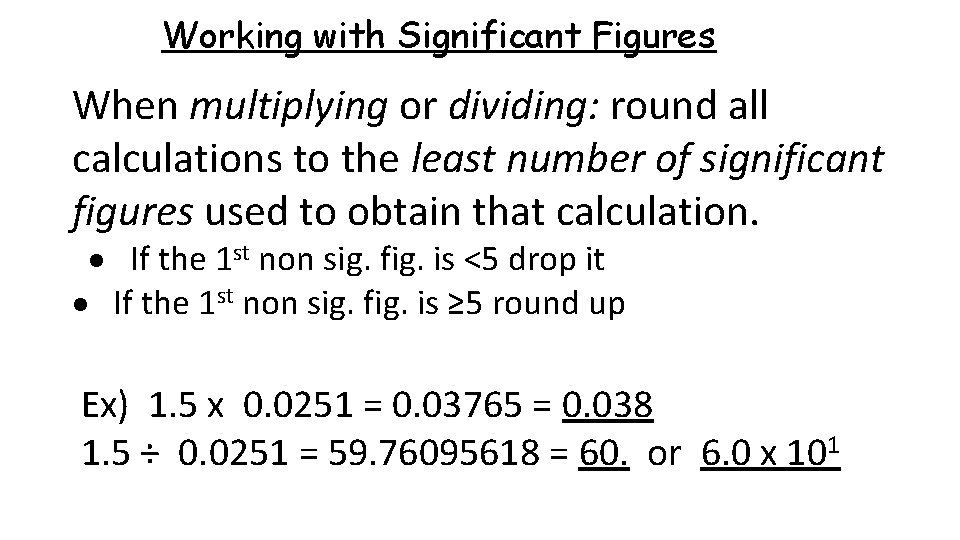
Working with Significant Figures When multiplying or dividing: round all calculations to the least number of significant figures used to obtain that calculation. · If the 1 st non sig. fig. is <5 drop it · If the 1 st non sig. fig. is ≥ 5 round up Ex) 1. 5 x 0. 0251 = 0. 03765 = 0. 038 1. 5 ÷ 0. 0251 = 59. 76095618 = 60. or 6. 0 x 101
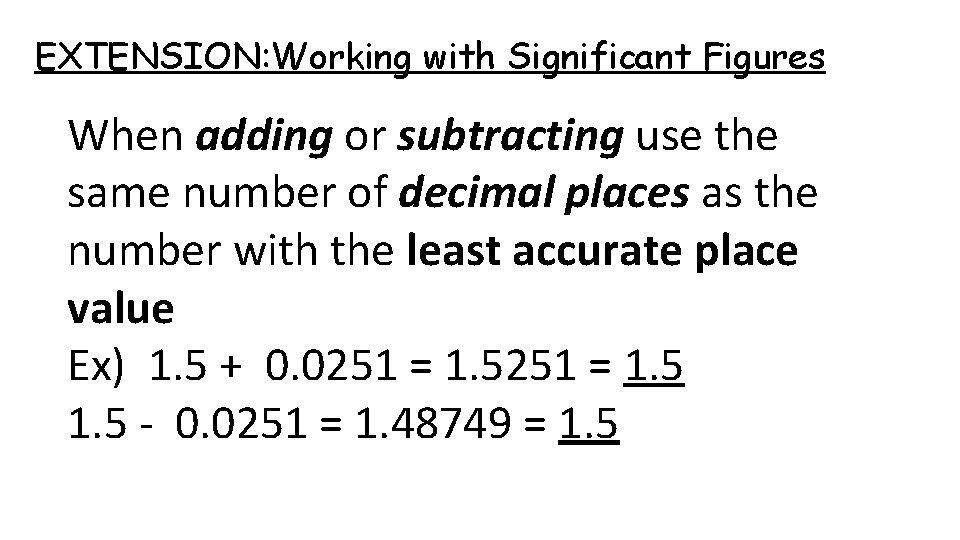
EXTENSION: Working with Significant Figures When adding or subtracting use the same number of decimal places as the number with the least accurate place value Ex) 1. 5 + 0. 0251 = 1. 5 - 0. 0251 = 1. 48749 = 1. 5