
LEARNING STYLES WHAT YOU DO NATURALLY ANSWER THE

- Slides: 19
LEARNING STYLES! WHAT YOU DO NATURALLY!
ANSWER THE FOLLOWING QUESTIONS HONESTLY! • 1. Do you usually set up a schedule for the week? (studying, work, after school activities) • 2. Do you often put off studying until time pressures force you to cram? • 3. Do other students seem to study less than you and do better? • 4. Do you usually spend hours studying 1 subject instead of spreading it out over time? • 5. Do you often have trouble remembering what you just read in a textbook? • 6. Before reading a chapter in a textbook do you usually skim over it by reading the headings and looking at graphs and pictures? • 7. Do you try to predict test questions from you class notes and reading? • 8. Do you usually try to summarize in your own words what you have just finished reading? • 9. Do you find it difficult to concentrate for very long when you study? • 10. Do you often feel that you studied the wrong material for the test?
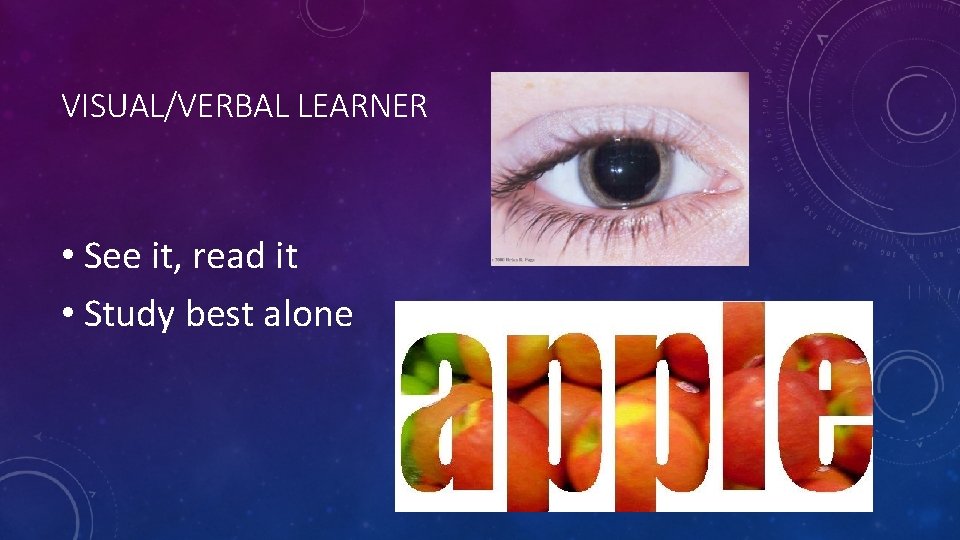
VISUAL/VERBAL LEARNER • See it, read it • Study best alone
STUDY TIPS FOR VISUAL/VERBAL LEARNERS • Use different colored highlighters for each section • Use flash cards • Write out information • Write descriptions of diagrams • Use sticky notes to remind • Visualize words and facts • Rewrite things from memory • Study alone in quiet
VISUAL/NONVERBAL LEARNERS • Learn best by using diagrams, pictures, charts, videos, images • Learns best by studying alone
STUDY TIPS FOR VISUAL/NONVERBAL LEARNERS • Make flash cards with pictures or diagrams • Make charts and sum up information in tables • Use different highlighter colors, but use symbols and pictures too • Visualize charts diagrams and figures • Redraw things from memory • Study alone in a quiet place
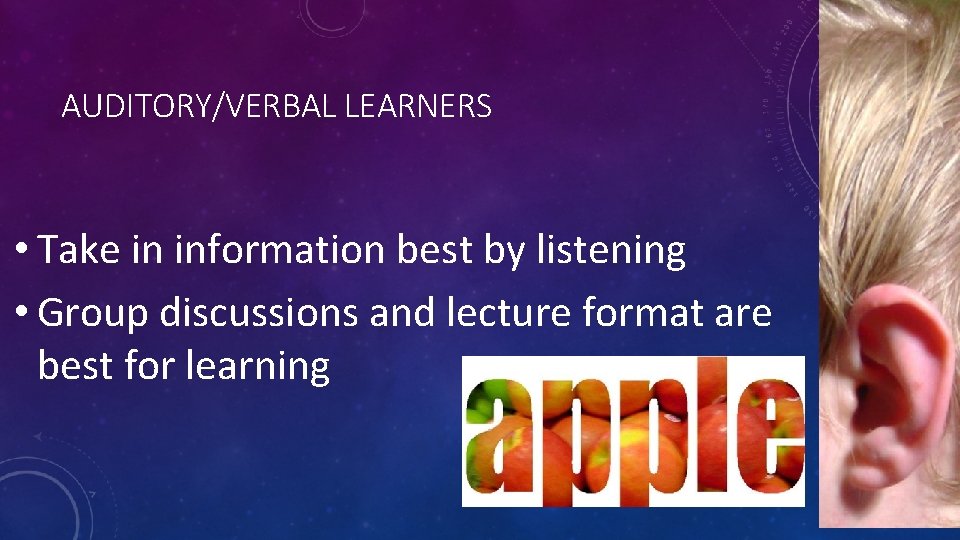
AUDITORY/VERBAL LEARNERS • Take in information best by listening • Group discussions and lecture format are best for learning
STUDY SKILLS FOR AUDITORY/VERBAL LEARNERS • Join or form study groups/study partner to discuss concepts and ideas • Talk out loud while studying/record self • Make speeches • Read back notes to self • State new information in your own words out loud or to a study partner
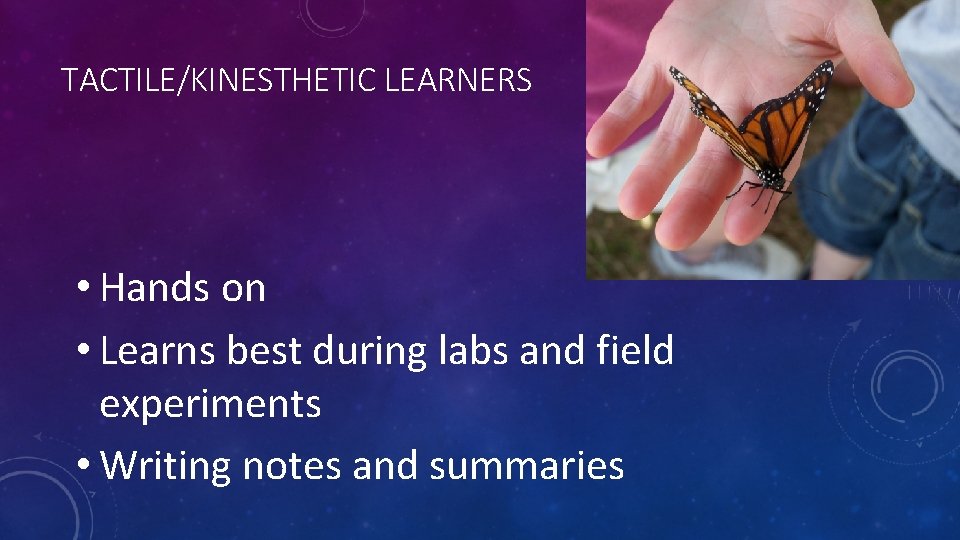
TACTILE/KINESTHETIC LEARNERS • Hands on • Learns best during labs and field experiments • Writing notes and summaries
STUDY TIPS FOR TACTILE/KINESTHETIC LEARNERS • • • Sit near the front of the classroom Write out notes using pictures and charts Read notes out loud while walking around Study with a friend Read or listen to notes while studying Write out key concepts on poster board Use flash cards and place in order on large surface Make 3 dimensional models Spend extra time in lab Go to museums or sites related to subject Trace letters and words to remember key facts Use musical rhythms as memory aids, put information into a
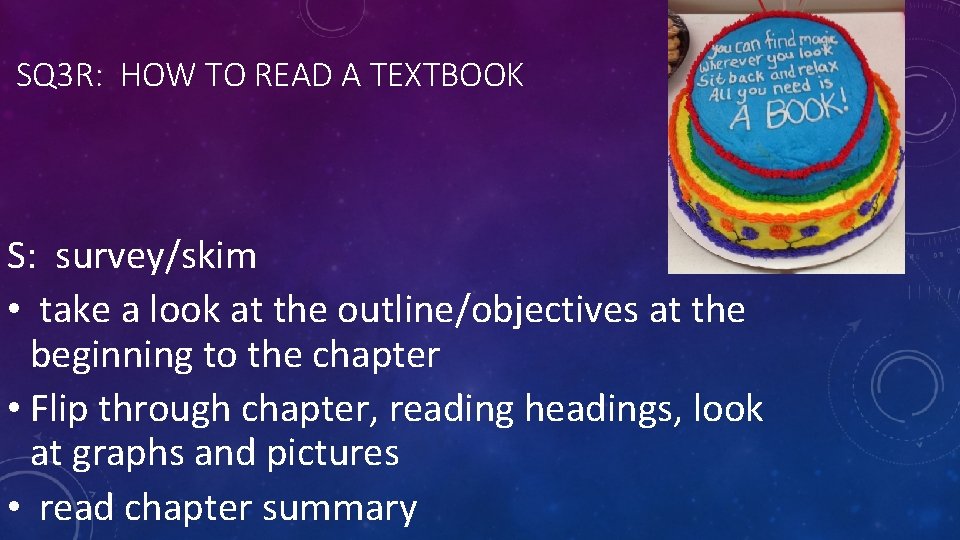
SQ 3 R: HOW TO READ A TEXTBOOK S: survey/skim • take a look at the outline/objectives at the beginning to the chapter • Flip through chapter, reading headings, look at graphs and pictures • read chapter summary
Q: QUESTION st 1 • Read the heading of the section • Think of a question based on the heading • You will be reading to find the answer
R: READ • Read the section looking for the answer • Take notes, make an outline while reading
R: RECITE • Say out loud what you can remember about what you just read • Can you answer the question?
R: RECALL/REVIEW • Take breaks during reading long chapters • When you have finished, take practice quizzes • If you are confused, go back and reread
POWER POINT NOTES • Rewrite them if it helps you • At the bottom of each slide write 3 -4 questions you could ask about the information on that slide • Compare the notes you took while reading with the power point notes, DO NOT COME TO CLASS UNPREPARED!!! • Translate into your own words • Ask questions
STUDYING FOR EXAMS No last minute cramming! Always give yourself more time than you THINK you need! Use a planner to schedule regular study times Know what types of questions will be on the test. Usually there will be some factual: a specific answer, applied: use the information to understand what is going on in a scenario , and conceptual: whole ideas and concepts ___ is to ___ as ____ is to ____. • Take advantage of internet videos and tutorials, practice tests • Practice timing yourself • Don’t forget to take care of yourself: eat, sleep, relax, laugh, get a hug! • •
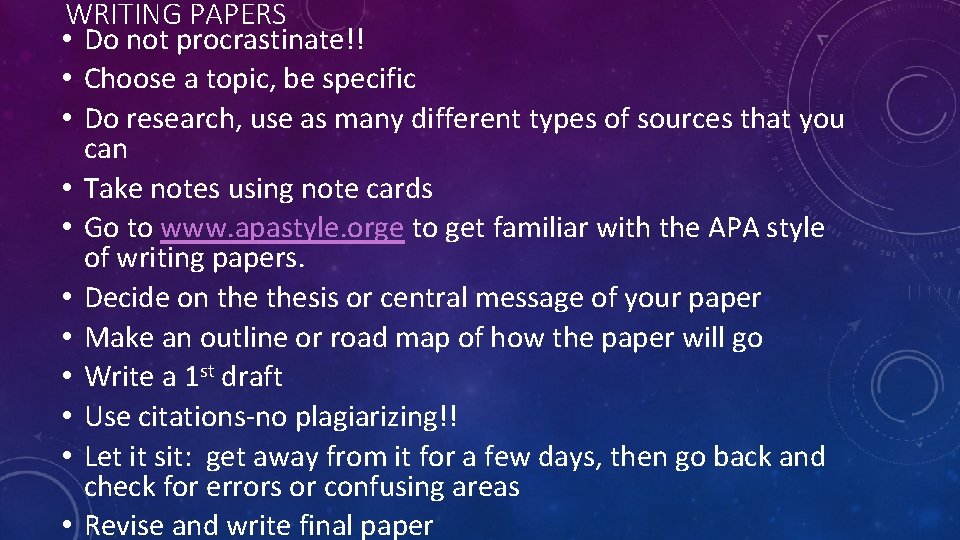
WRITING PAPERS • Do not procrastinate!! • Choose a topic, be specific • Do research, use as many different types of sources that you can • Take notes using note cards • Go to www. apastyle. orge to get familiar with the APA style of writing papers. • Decide on thesis or central message of your paper • Make an outline or road map of how the paper will go • Write a 1 st draft • Use citations-no plagiarizing!! • Let it sit: get away from it for a few days, then go back and check for errors or confusing areas • Revise and write final paper
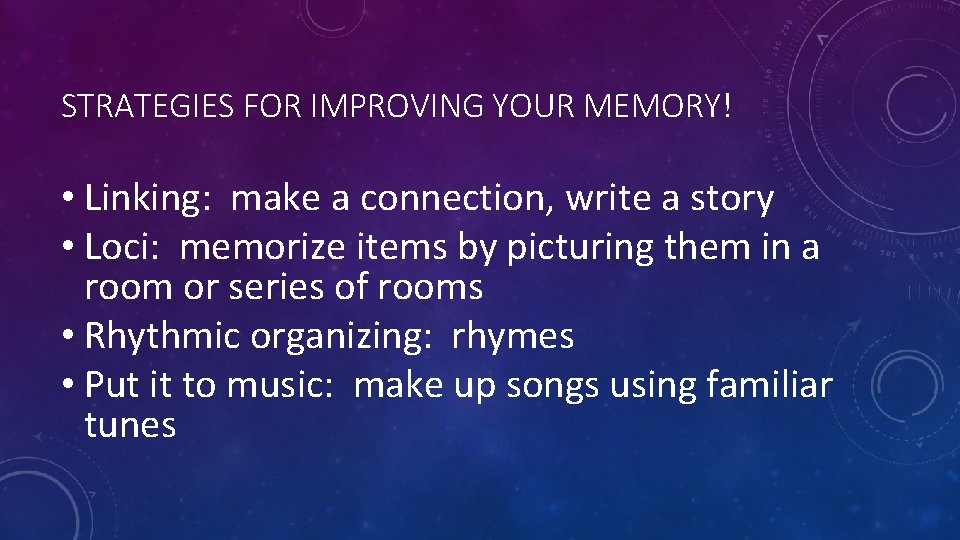
STRATEGIES FOR IMPROVING YOUR MEMORY! • Linking: make a connection, write a story • Loci: memorize items by picturing them in a room or series of rooms • Rhythmic organizing: rhymes • Put it to music: make up songs using familiar tunes