
Learning styles Rates By Ally Taylor Quin Bailey
Learning styles & Rates By: Ally, Taylor, Quin, Bailey, Christina, Kody
The Big Question We asked: How can we accommodate different learning styles and learning rates?
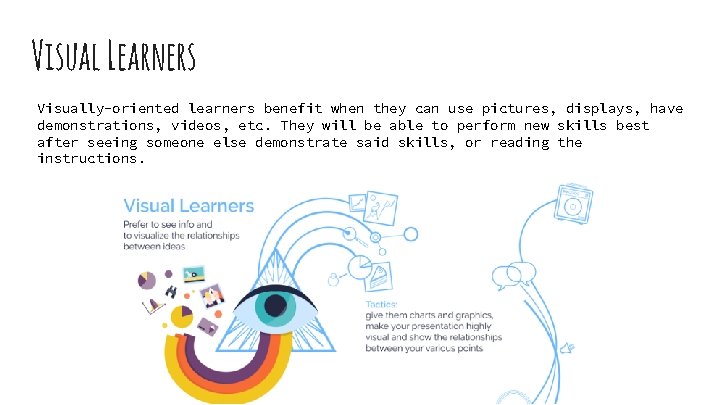
Visual Learners Visually-oriented learners benefit when they can use pictures, displays, have demonstrations, videos, etc. They will be able to perform new skills best after seeing someone else demonstrate said skills, or reading the instructions.
Strategies For Teaching Visual Learners ➔ Semantic Maps and Flowcharts ➔ Pictures, maps, and diagrams ➔ Write important points on board ➔ Flashcards
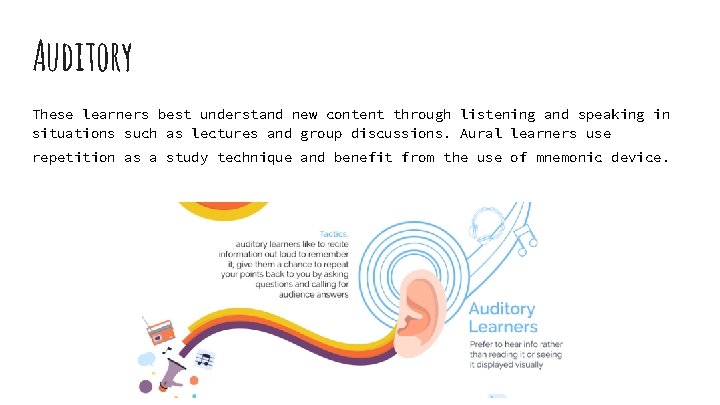
Auditory These learners best understand new content through listening and speaking in situations such as lectures and group discussions. Aural learners use repetition as a study technique and benefit from the use of mnemonic device.
Strategies For Teaching Auditory learners ➔ Go through all instructions and direction verbally ➔ If more direction is required, provide recording of instruction that can be heard and listened to over and over again
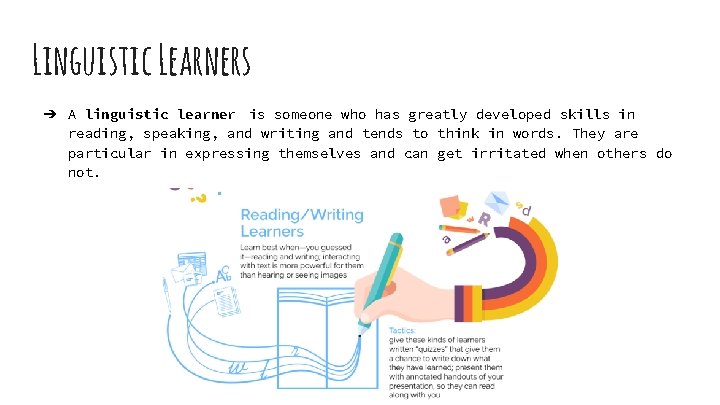
Linguistic Learners ➔ A linguistic learner is someone who has greatly developed skills in reading, speaking, and writing and tends to think in words. They are particular in expressing themselves and can get irritated when others do not.
Strategies for Teaching Linguistic Learners ➔ For those learners who are low functioning they can be read to by another classmate who is a linguistic learner. ➔ Have linguistic learners teach fellow students who need extra help and guidance. ➔ For group presentations give students a variety of options such as auditory (film, podcast, script, poem, story)
Encourage LInguistic Learning ➔ Read aloud ➔ Recite information they need to learn ➔ Use tunes or rhymes as mnemonic devices ➔ Read aloud and record test questions or directions ➔ Dictate to someone else and have that person write down the thoughts ➔ Use verbal analogies and storytelling to demonstrate their point
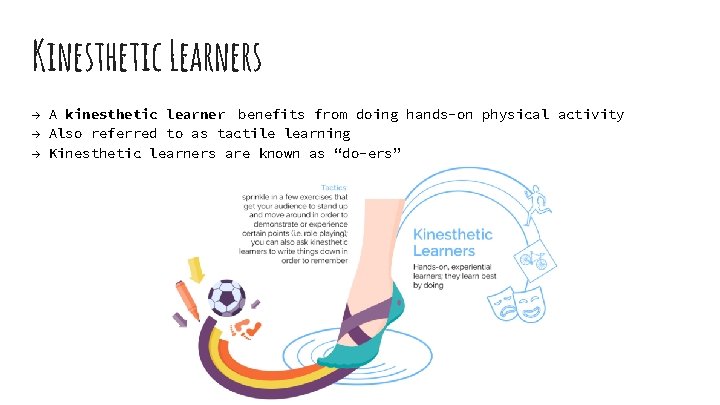
Kinesthetic Learners → A kinesthetic learner benefits from doing hands-on physical activity → Also referred to as tactile learning → Kinesthetic learners are known as “do-ers”
Strategies for Teaching Kinesthetic learners → Kinesthetic learners benefit from field trips, trial and error, laboratories → Real life examples, guest lecturers, demonstrations, role playing → Body breaks → Science experiments → Wobble chairs or exercise balls vs. standard desk chairs to be able to move around during lessons and work time
Fast learning rate Characteristics: ➔ Advanced Vocabulary ➔ Read independently ➔ Excellent reasoning skills ➔ Observant ➔ Ask Questions
Fast Learning rate Learners in the classroom who have a faster learning rate than others should be accommodated by: ➔ Incorporate creative thinking ➔ Levelling assignments ➔ Conduct assessments on a regular basis
Slow Learning Rate Characteristics: ➔ limited attention span ➔ deficiencies in basic skills (reading, writing, and mathematics) ➔ difficulty in comprehending abstract ideas ➔ Work habits seem unsystematic
Slow Learning Rate Learners in the classroom who have a slower learning rate than others should be accommodated by: ➔ special instructional pacing ➔ frequent feedback ➔ Compensatory teaching ➔ modified materials ➔ conditions sufficiently flexible for learning to occur
Developing Lesson plans that incorporate everyone ➔ Incorporate interest, needs, and experiences ➔ Vary instructional technique ➔ Individualized learning ➔ Develop own worksheets
Developing Lesson plans that incorporate everyone ➔ Incorporate interest, needs, and experiences ➔ Vary instructional technique ➔ Individualized learning ➔ Develop own worksheets
Resources ➔Partner Teachers ➔Journal Articles ➔Web Research
Pondering points ➔ Resources to assist teachers with variety of learners in the classroom. ➔ Learning disabilities ➔ Physical disabilities
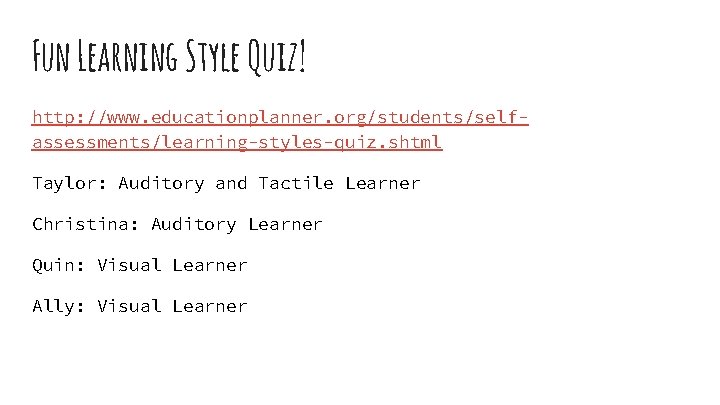
Fun Learning Style Quiz! http: //www. educationplanner. org/students/selfassessments/learning-styles-quiz. shtml Taylor: Auditory and Tactile Learner Christina: Auditory Learner Quin: Visual Learner Ally: Visual Learner
- Slides: 20