
Learning Styles KNOWING THE WAY YOU LEARN BEST
Learning Styles KNOWING THE WAY YOU LEARN BEST CAN MAKE THE DIFFERENCE
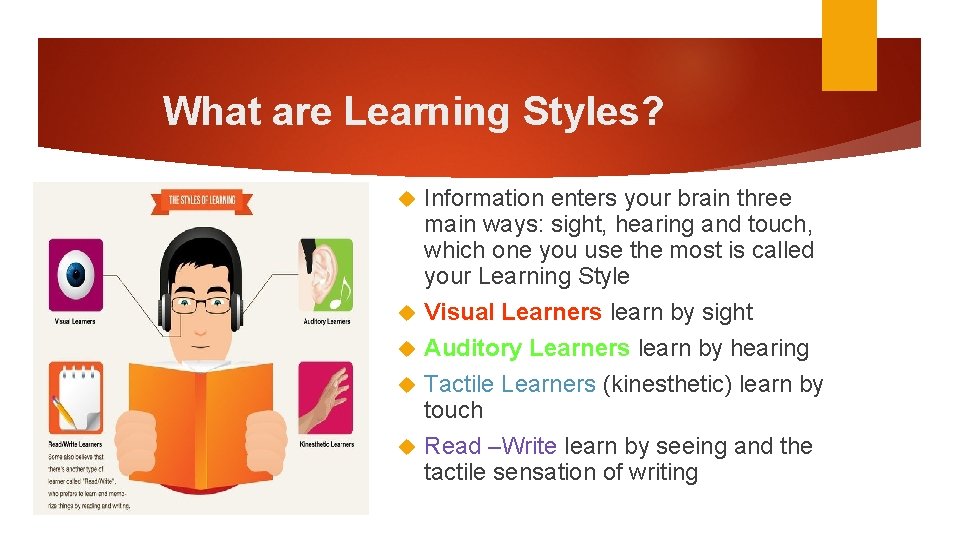
What are Learning Styles? Information enters your brain three main ways: sight, hearing and touch, which one you use the most is called your Learning Style Visual Learners learn by sight Auditory Learners learn by hearing Tactile Learners (kinesthetic) learn by touch Read –Write learn by seeing and the tactile sensation of writing
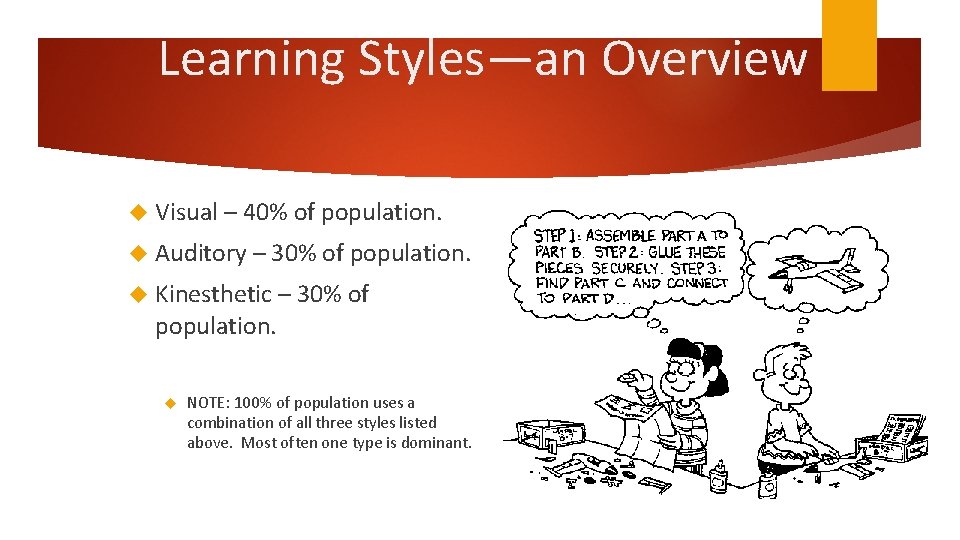
Learning Styles—an Overview Visual – 40% of population. Auditory – 30% of population. Kinesthetic – 30% of population. NOTE: 100% of population uses a combination of all three styles listed above. Most often one type is dominant.
Visual Learners Prefer to see information such as pictures, diagrams, cartoons, demonstrations Picture Easily words and concepts they hear as images distracted in lecture with no visual aids Overwhelmed with intense visuals accompanied by lecture Benefit from using charts, maps, notes, and flash cards when studying
Visual Learners typically… � Remember what was read or seen in a presentation. � Don't retain what they hear over a long period of time. � Think in pictures, use “scenes” to describe. � Have vivid imaginations. � Associate color with information. � Remember faces, but not names. � Like written reports better than verbal ones.
Auditory Learners typically… Remember what they hear in a lecture or presentation. Or even during a conversation. Talk while they write. Are sophisticated speakers. Remember by listening, and therefore get the most out of lectures. Assign little meaning to concepts or information until that information is presented in an audible format.
Auditory Learners Prefer to hear information spoken Need to hear themselves say the information Discussion groups are good study strategies Can absorb a lecture with little effort May not need careful notes to learn. Often avoid eye contact in order to concentrate May read aloud to themselves Like background music when they study
Tactile or Kinesthetic Learners Prefer touch as their primary mode for taking in information In traditional lecture situations, they should write out important facts Create study sheets connected to vivid examples Role-playing can help them learn and remember important ideas Okay, I get it now.
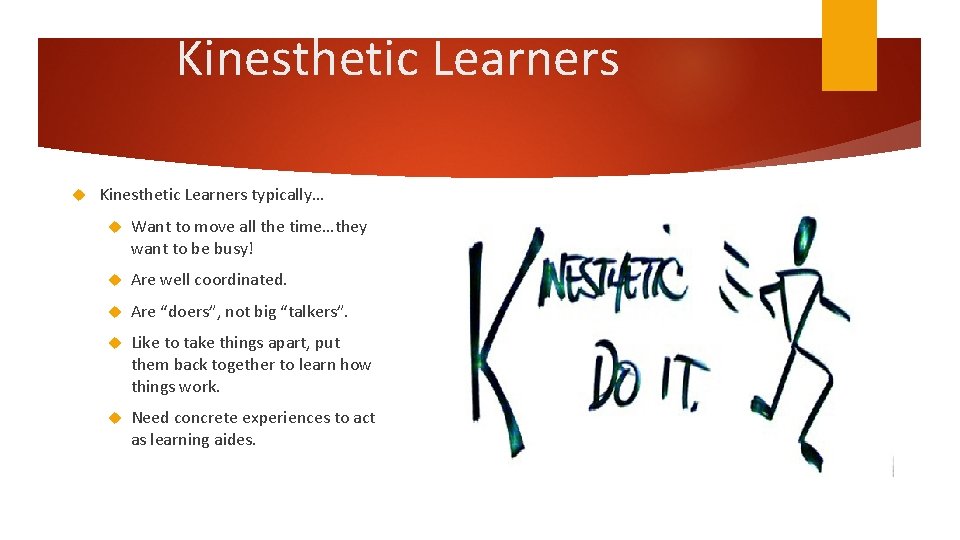
Kinesthetic Learners typically… Want to move all the time…they want to be busy! Are well coordinated. Are “doers”, not big “talkers”. Like to take things apart, put them back together to learn how things work. Need concrete experiences to act as learning aides.
Discovering Your Own Learning Style Take a Learning Styles test Think about your favorite classes in high school or college so far. What do they have in common? Did you like… mastering facts? discussion? or working on your own? lecture? or pairing or grouping? hands-on activities? Do some self-analysis (called metacognition) How do you think you learn?
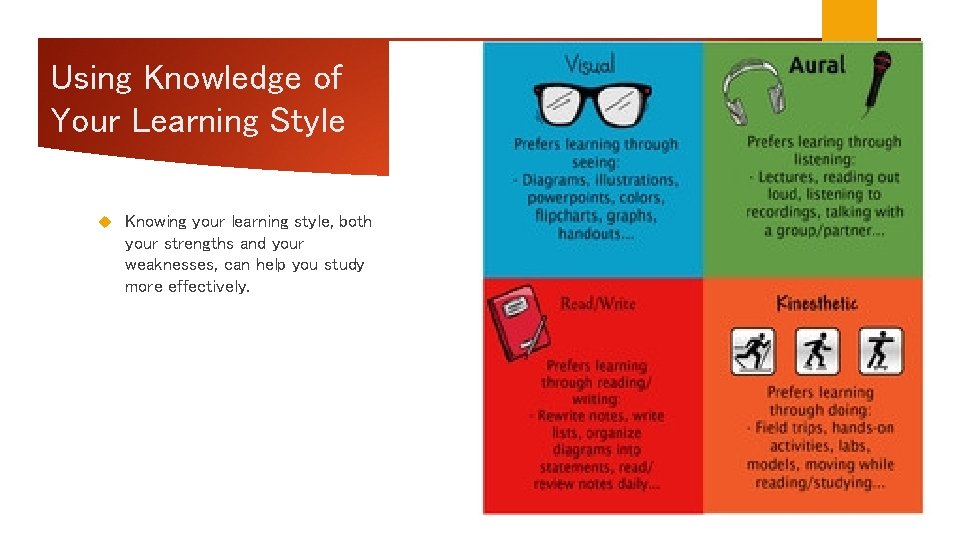
Using Knowledge of Your Learning Style Knowing your learning style, both your strengths and your weaknesses, can help you study more effectively.
Different Teaching Styles Are they compatible with your learning style? Lecture – teacher talks all period Group discussion – teacher talks but encourages discussion Small groups – teacher aids (facilitates) group interaction Visual focus – teacher uses lots of visual aids Verbal focus – words, words & more words Logical sequence – teacher presents material in a step-by-step, reasonable format Random sequence – teacher jumps all over the place
Applied techniques: Visual Learners: �Write out everything for frequent and quick visual review. �Use color coding when learning new concepts and words. �Use outlines of reading assignments which cover key points and guide reading. �Use notes and flash cards for review of material, vocabulary, and terminology for specific course s. �Review textbook during relevant lecture component.
Auditory Learners �The student should position themselves in the classroom or lecture hall so that he/she can hear lectures and review them frequently. �Read written material aloud (restate in your own words). �Verbally review spelling words and lectures with another person - practice verbal repetition. �Record lectures (with instructor permission).
Kinesthetic Learners �Study in short blocks of time rather than extended periods. �Have as many experimental learning opportunities as possible, such as lab and studio courses, as opposed to straight lecture classes - if you have a choice job shadowing, internships, etc. �Use this info when selecting courses. �Use flash cards.
- Slides: 15