
Learning Styles Inventory TEACHING AND LEARNING CENTER Directions

- Slides: 19
Learning Styles Inventory TEACHING AND LEARNING CENTER
Directions • Take out a sheet of paper and number it 1 -30. • You will be answering a series of questions to the best of your ability. • Write a yes or no response on your paper for each question.
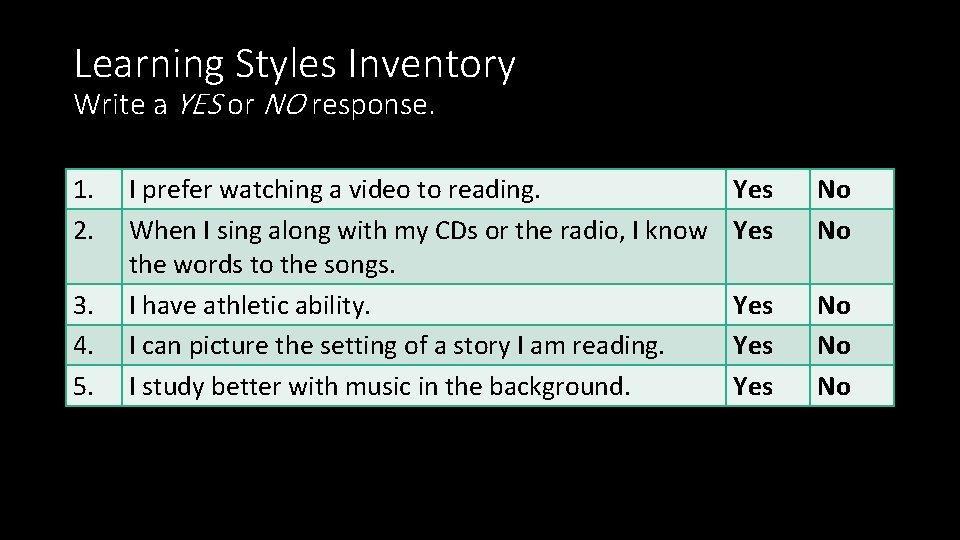
Learning Styles Inventory Write a YES or NO response. 1. 2. 3. 4. 5. I prefer watching a video to reading. When I sing along with my CDs or the radio, I know the words to the songs. I have athletic ability. I can picture the setting of a story I am reading. I study better with music in the background. Yes No No Yes Yes No No No
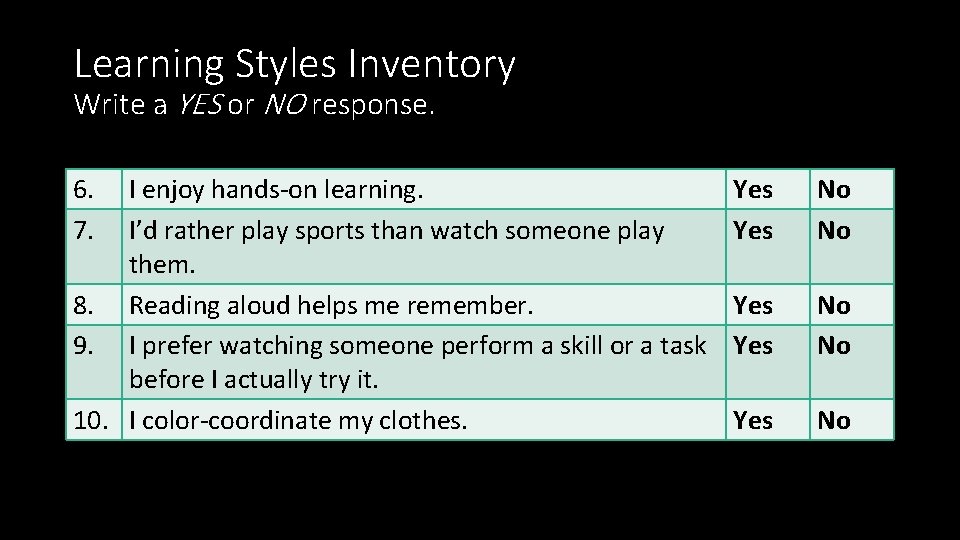
Learning Styles Inventory Write a YES or NO response. 6. 7. I enjoy hands-on learning. I’d rather play sports than watch someone play them. 8. Reading aloud helps me remember. 9. I prefer watching someone perform a skill or a task before I actually try it. 10. I color-coordinate my clothes. Yes Yes No No Yes No
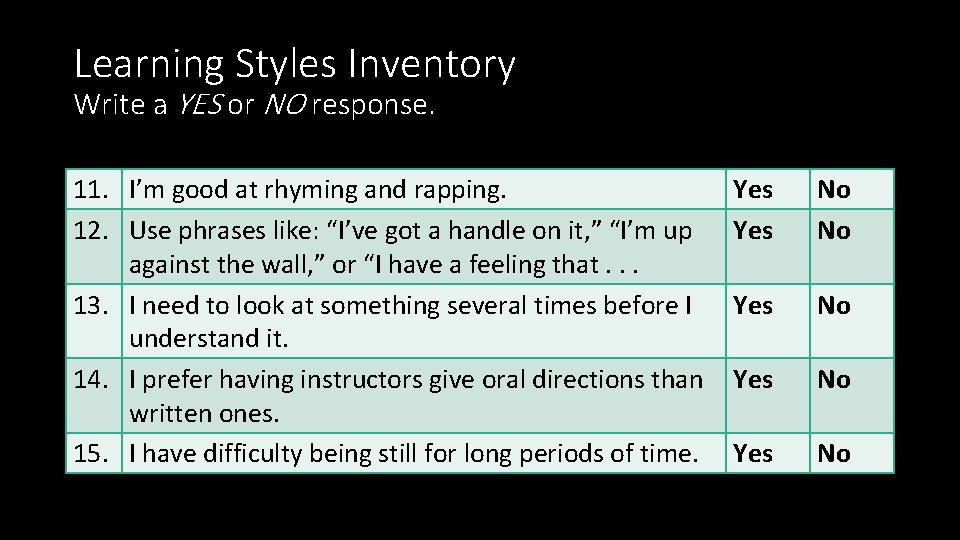
Learning Styles Inventory Write a YES or NO response. 11. I’m good at rhyming and rapping. 12. Use phrases like: “I’ve got a handle on it, ” “I’m up against the wall, ” or “I have a feeling that. . . 13. I need to look at something several times before I understand it. 14. I prefer having instructors give oral directions than written ones. 15. I have difficulty being still for long periods of time. Yes No No Yes No
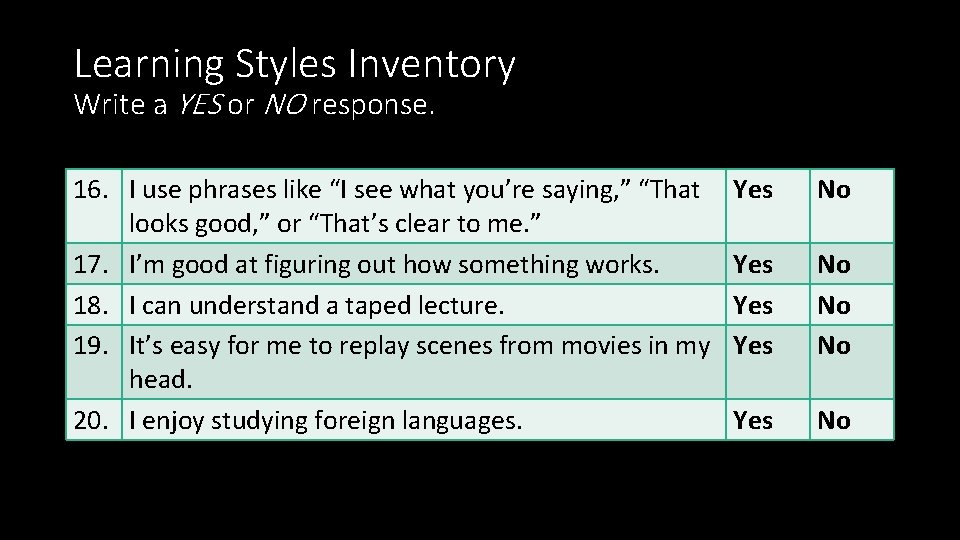
Learning Styles Inventory Write a YES or NO response. 16. I use phrases like “I see what you’re saying, ” “That looks good, ” or “That’s clear to me. ” 17. I’m good at figuring out how something works. 18. I can understand a taped lecture. 19. It’s easy for me to replay scenes from movies in my head. 20. I enjoy studying foreign languages. Yes No Yes Yes No No No Yes No
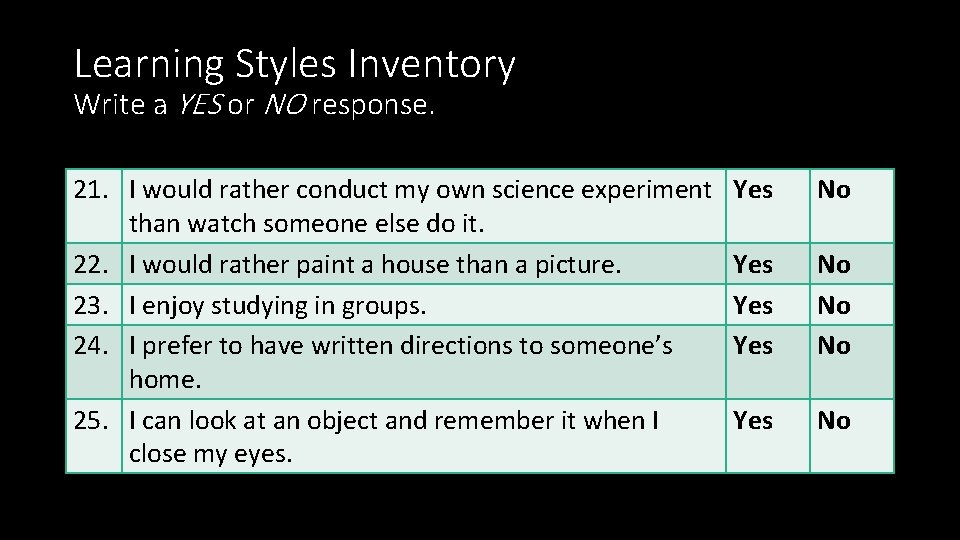
Learning Styles Inventory Write a YES or NO response. 21. I would rather conduct my own science experiment than watch someone else do it. 22. I would rather paint a house than a picture. 23. I enjoy studying in groups. 24. I prefer to have written directions to someone’s home. 25. I can look at an object and remember it when I close my eyes. Yes No Yes Yes No No No Yes No
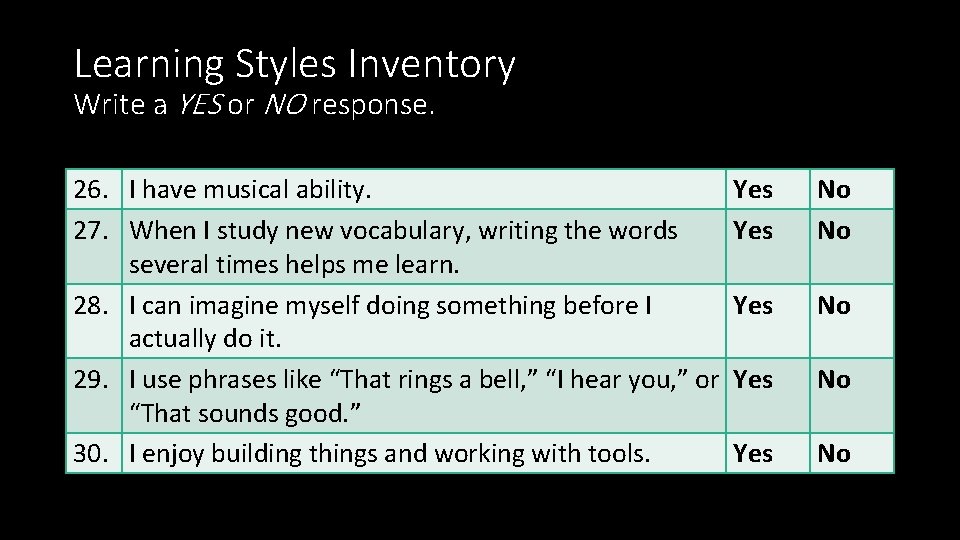
Learning Styles Inventory Write a YES or NO response. 26. I have musical ability. 27. When I study new vocabulary, writing the words several times helps me learn. 28. I can imagine myself doing something before I actually do it. 29. I use phrases like “That rings a bell, ” “I hear you, ” or “That sounds good. ” 30. I enjoy building things and working with tools. Yes No No Yes No
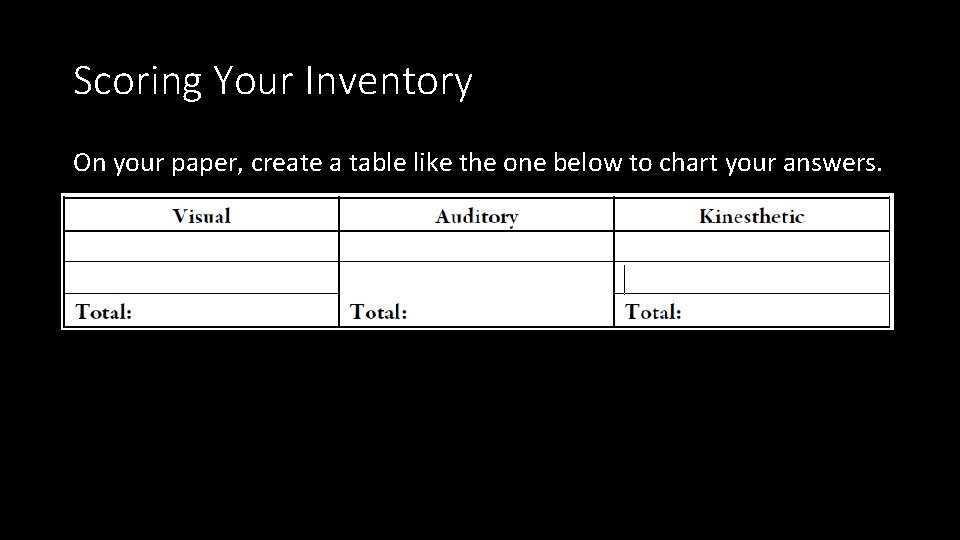
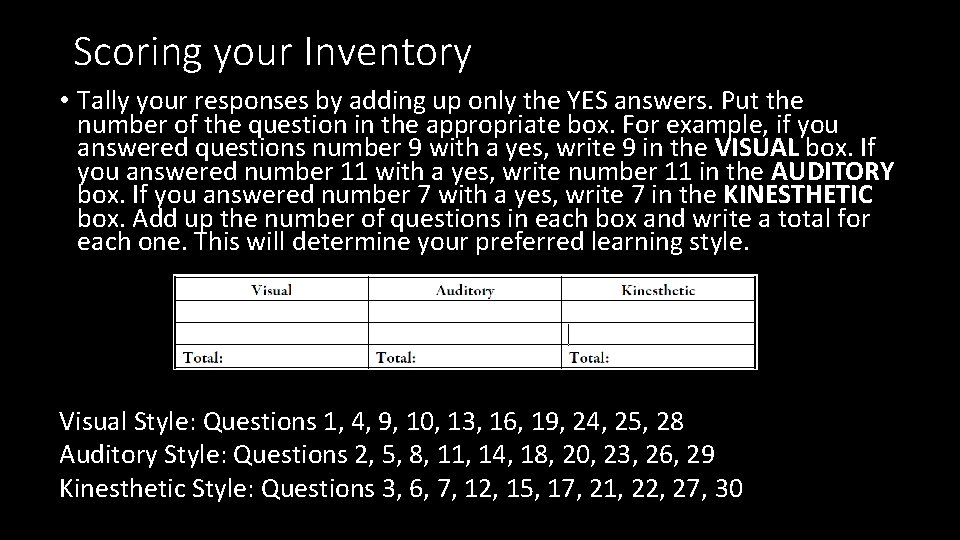
Scoring Your Inventory On your paper, create a table like the one below to chart your answers.
Scoring your Inventory • Tally your responses by adding up only the YES answers. Put the number of the question in the appropriate box. For example, if you answered questions number 9 with a yes, write 9 in the VISUAL box. If you answered number 11 with a yes, write number 11 in the AUDITORY box. If you answered number 7 with a yes, write 7 in the KINESTHETIC box. Add up the number of questions in each box and write a total for each one. This will determine your preferred learning style. Visual Style: Questions 1, 4, 9, 10, 13, 16, 19, 24, 25, 28 Auditory Style: Questions 2, 5, 8, 11, 14, 18, 20, 23, 26, 29 Kinesthetic Style: Questions 3, 6, 7, 12, 15, 17, 21, 22, 27, 30
Scoring Your Inventory • The highest score indicates your preferred learning style. If you have a high score in more than one area, you’re using additional modalities. Remember that there are no wrong answers to this inventory. Everyone is an individual and has her own style of learning. • Don’t worry if a dominant mode doesn’t emerge. You’re a versatile learner! Use the knowledge you gain to create excellent study tools, the ones that are right for you.
Visual Learners • Create mind maps, flow charts, and diagrams using bright colors. Put them where you can view them frequently. • Practice building your visual memory. • Rewrite your notes using different colors.
Auditory Learners • After you read a page in your textbook, summarize the information out loud in your own words. • Tape your instructor’s lecture, and if you are a commuter, listen to the tape on the way home, either in your car, or on the bus or subway. • Discuss the material that you have been learning with a friend or study group.
Kinesthetic Learners • Use your hands. Cut up charts and diagrams. Create flash cards and move them around with large, sweeping movements. • Walk and talk the information. Recite as you move. • Type on a computer keyboard. You are using your muscle memory.
Developing Your Style: Combining Visual, Auditory, & Kinesthetic Modes Additional ways you can use multi-sensory learning: • Use background music (no lyrics to distract you) when you study. Choose a piece of music for a particular subject. Every time you study that subject, play the music. You are creating an association for your subconscious mind. You may be surprised to discover how much of the information you remember when you play the music by itself. You are combining Visual and Auditory modes. • Use rap or rhyme to memorize information. To add Kinesthetic to this Auditory mode, walk, dance, or clap when you sing.
Developing Your Style: Combining Visual, Auditory, & Kinesthetic Modes • If you are athletically inclined, dribble a basketball while you recite information. You are combining Auditory and Kinesthetic modes. • Study with a partner or in a group. Discuss the information. Hold up flash cards diagrams, hierarchies, and mind maps to test each other. This combines Visual and Auditory modes. • Put yourself in the picture. You can do this with a subject like history; participate in a battle or a significant meeting such as the signing of the Declaration of Independence. Ask yourself how you feel. This combines Visual and Kinesthetic modes. • Make up your own strategies. Incorporate multi-sensory learning into your studies.
Additional Strategies • If you are learning a new vocabulary word or math formula, write it in the air using large, sweeping movements. Close your eyes and see it in your mind’s eye. Say the words out loud. You are combining V, A, and K modes. • Use the sense of smell. One student created olfactory (smell) associations by using scented pencils for studying. He used a grape pencil for one subject and a chocolate one for another. When taking an exam, he used the appropriate pencil to help him recall information. He combined V and K and added an additional sensory mode.
Additional Strategies • Use 5 - by 7 -inch flash cards to self-quiz. Use different and bright colors for each side. Lay them on a desk or table. Move them around and put them in different places as you study, or create a game with them. Place them into different categories in a hierarchical fashion such as “don’t know, ” “review, ” and “need to study more. ” • Create your own auditory notes using a tape recorder.
My Personal Learning Style Plan • Choose from the suggestions listed previously 4 -5 techniques you will try this quarter as you study for classes. List them on your paper as an action plan detailing how you will incorporate multi-sensory learning into your study time.