
Learning Styles and Habits of the Mind Mastering
Learning Styles and Habits of the Mind Mastering Your Study Skills System and Methodology
Learning Style Tendencies • Active Learning vs. Reflective Learning • Sensing Learning vs. Intuitive Learning • Visual Learning vs. Verbal Learning • Sequential Learning vs. Global Learning
Using Learning Styles: What to Remember When Completing any Inventory • Use multiple inventories when seeking to get a better understanding of what your tendencies reveal and signify • These “styles” are tendencies and there is always somewhat of a mixture of the styles • Know what your study partners overall learning style tendencies are is important to ensure the best “fit” for a study group
Active vs. Reflective Learning • Use study groups and meet on a regular basis; not just before tests • Develop note taking techniques that work for you • Talk the material and create flash cards and other interactive review systems • Don’t just re-read text; Manipulate it and put it into graphic form, outline form or key questions • Develop summaries and methods to selftest prior to major assessments
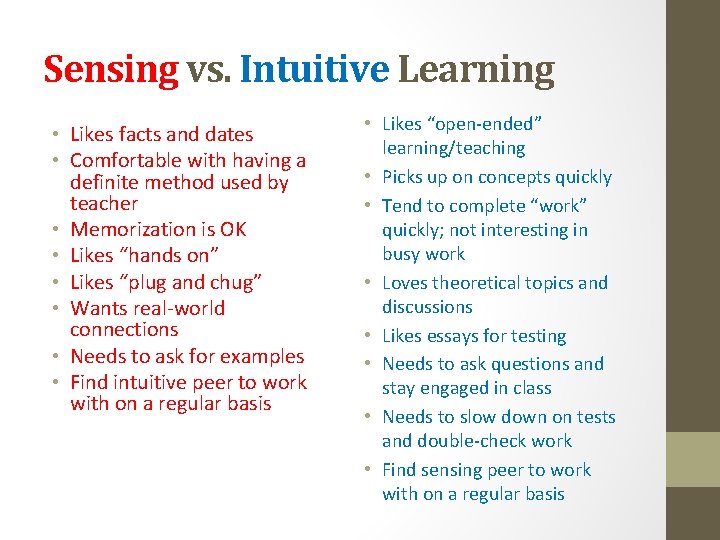
Sensing vs. Intuitive Learning • Likes facts and dates • Comfortable with having a definite method used by teacher • Memorization is OK • Likes “hands on” • Likes “plug and chug” • Wants real-world connections • Needs to ask for examples • Find intuitive peer to work with on a regular basis • Likes “open-ended” learning/teaching • Picks up on concepts quickly • Tend to complete “work” quickly; not interesting in busy work • Loves theoretical topics and discussions • Likes essays for testing • Needs to ask questions and stay engaged in class • Needs to slow down on tests and double-check work • Find sensing peer to work with on a regular basis
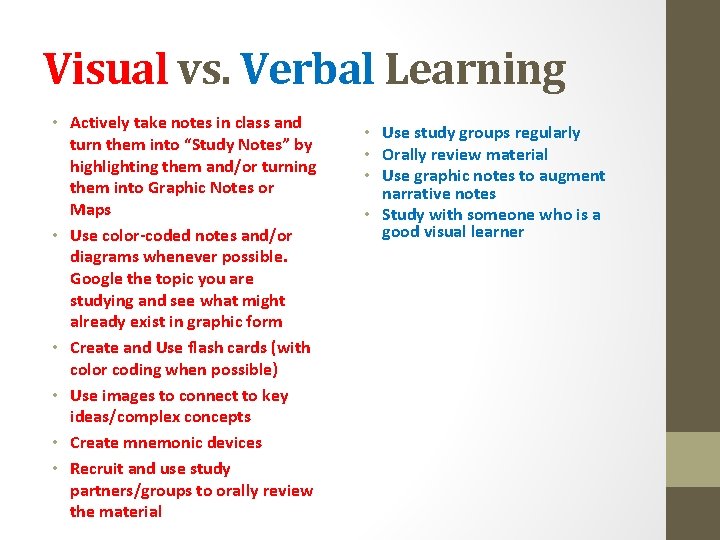
Visual vs. Verbal Learning • Actively take notes in class and turn them into “Study Notes” by highlighting them and/or turning them into Graphic Notes or Maps • Use color-coded notes and/or diagrams whenever possible. Google the topic you are studying and see what might already exist in graphic form • Create and Use flash cards (with color coding when possible) • Use images to connect to key ideas/complex concepts • Create mnemonic devices • Recruit and use study partners/groups to orally review the material • Use study groups regularly • Orally review material • Use graphic notes to augment narrative notes • Study with someone who is a good visual learner
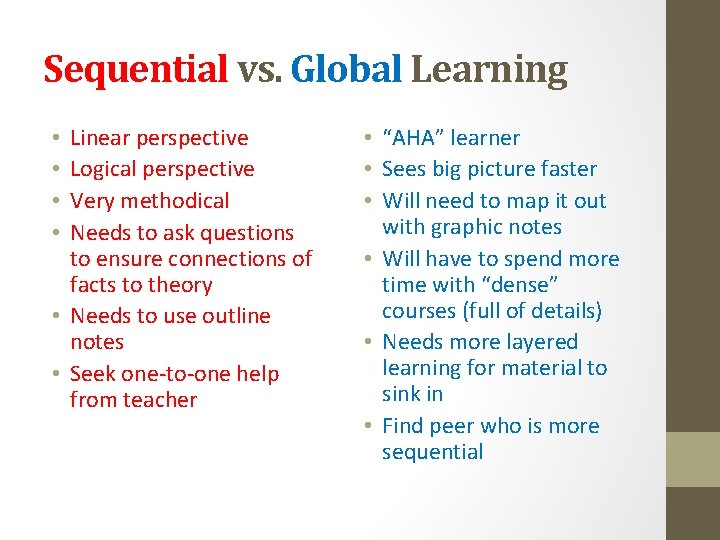
Sequential vs. Global Learning Linear perspective Logical perspective Very methodical Needs to ask questions to ensure connections of facts to theory • Needs to use outline notes • Seek one-to-one help from teacher • • • “AHA” learner • Sees big picture faster • Will need to map it out with graphic notes • Will have to spend more time with “dense” courses (full of details) • Needs more layered learning for material to sink in • Find peer who is more sequential
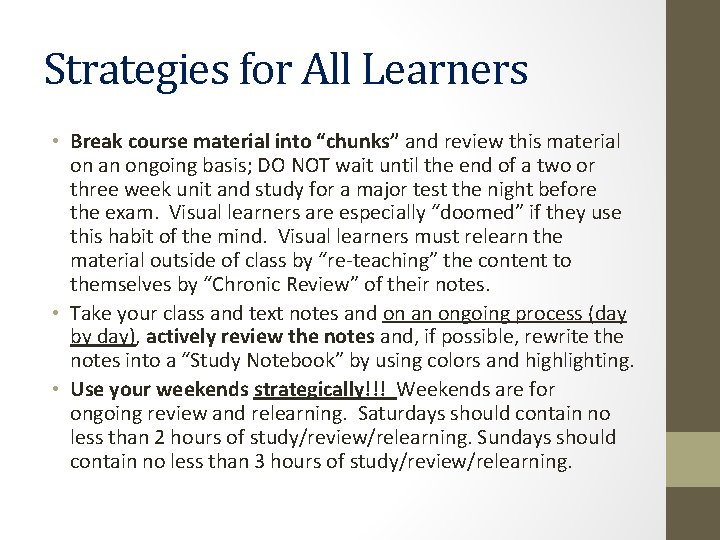
Strategies for All Learners • Break course material into “chunks” and review this material on an ongoing basis; DO NOT wait until the end of a two or three week unit and study for a major test the night before the exam. Visual learners are especially “doomed” if they use this habit of the mind. Visual learners must relearn the material outside of class by “re-teaching” the content to themselves by “Chronic Review” of their notes. • Take your class and text notes and on an ongoing process (day by day), actively review the notes and, if possible, rewrite the notes into a “Study Notebook” by using colors and highlighting. • Use your weekends strategically!!! Weekends are for ongoing review and relearning. Saturdays should contain no less than 2 hours of study/review/relearning. Sundays should contain no less than 3 hours of study/review/relearning.
- Slides: 8