
Learning Strategy Instruction in Higher Education What Do
![Learning Strategies “[A]ctions and processes directed at acquiring information or skill that involve agency,](https://slidetodoc.com/presentation_image_h/27411474b36133128255c61fc5202f07/image-17.jpg "Learning Strategies “[A]ctions and processes directed at acquiring information or skill that involve agency,")
![Results Intervention vs. No Intervention N= [VALUE], [PERCENT AGE] Intervention No Intervention Total N](https://slidetodoc.com/presentation_image_h/27411474b36133128255c61fc5202f07/image-27.jpg "Results Intervention vs. No Intervention N= [VALUE], [PERCENT AGE] Intervention No Intervention Total N")
![Results (cont. ) Disability Category. N = [VALUE], [PERCENT AGE] N= [VALUE], N= [PERCENT](https://slidetodoc.com/presentation_image_h/27411474b36133128255c61fc5202f07/image-28.jpg "Results (cont. ) Disability Category. N = [VALUE], [PERCENT AGE] N= [VALUE], N= [PERCENT")
![Results (cont. ) Method of Instruction N = [VALUE], [PERCENTAGE] Face to Face Phone](https://slidetodoc.com/presentation_image_h/27411474b36133128255c61fc5202f07/image-29.jpg "Results (cont. ) Method of Instruction N = [VALUE], [PERCENTAGE] Face to Face Phone")
- Slides: 37
Learning Strategy Instruction in Higher Education: What Do We Know and Where Could We Go? Adam R. Lalor, Ph. D. Landmark College Lyman L. Dukes, III, Ph. D. University of South Florida, St. Petersburg AHEAD 2018 Albuquerque, NM
Co-Author Acknowledgments: Michael Faggella-Luby, Ph. D. Texas Christian University Joseph W. Madaus, Ph. D. University of Connecticut Allison R. Lombardi, Ph. D. University of Connecticut Nicholas Gelbar, Ph. D. University of Connecticut Health Center
Agenda § Explain the development of the PASS Taxonomy § Introduction to learning strategies § Review a literature analysis on learning strategies for college students § Implications for practice § Discussion of promising practices
Project Background § As of 2012, a comprehensive analysis of the disability and higher education literature had yet to be conducted § This literature is broad in scope and dispersed across a variety of disciplines (e. g. , special education, higher education, psychology, sociology) § Given the 40 -year anniversary of the passage of Section 504 in 2013 and the 25 -year anniversary of the ADA in 2015, it was a suitable occasion to review the field’s literature – And consider the following questions –
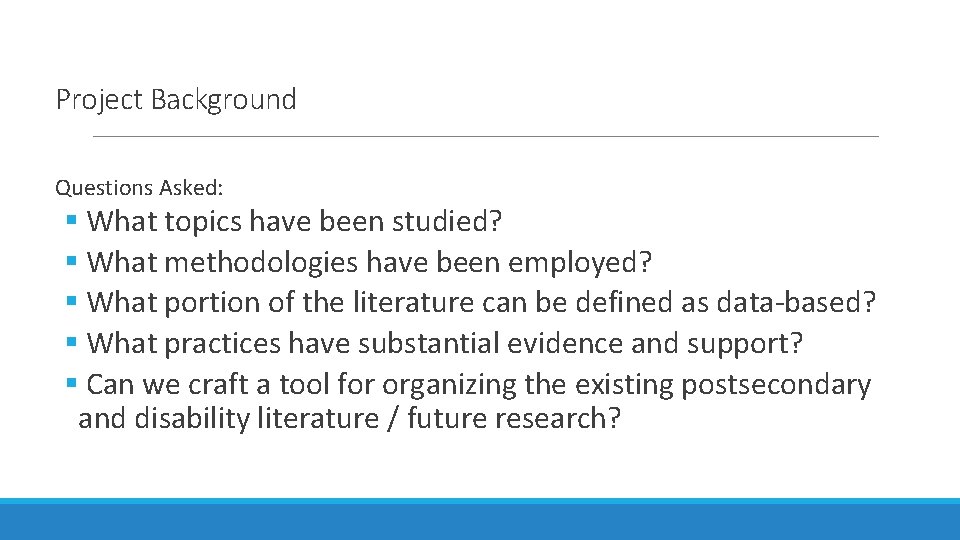
Project Background Questions Asked: § What topics have been studied? § What methodologies have been employed? § What portion of the literature can be defined as data-based? § What practices have substantial evidence and support? § Can we craft a tool for organizing the existing postsecondary and disability literature / future research?
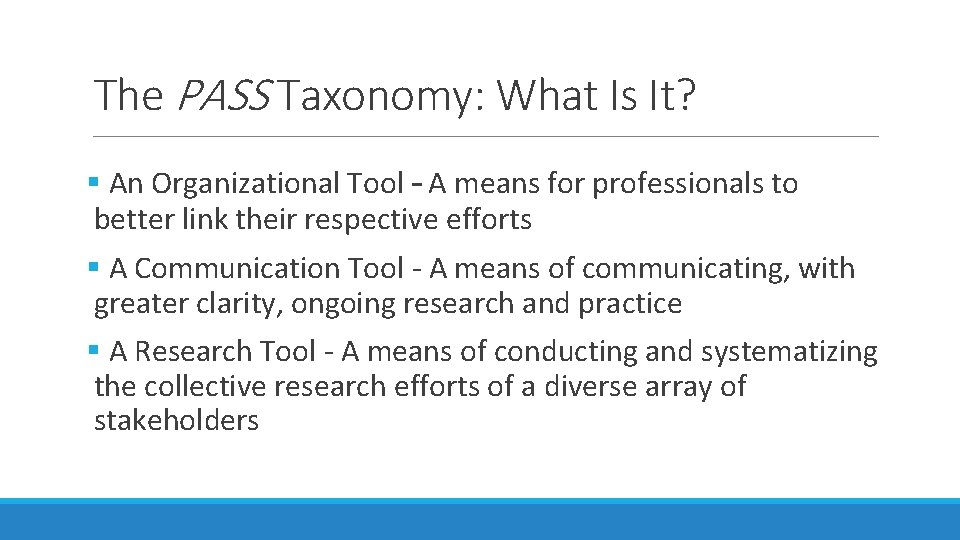
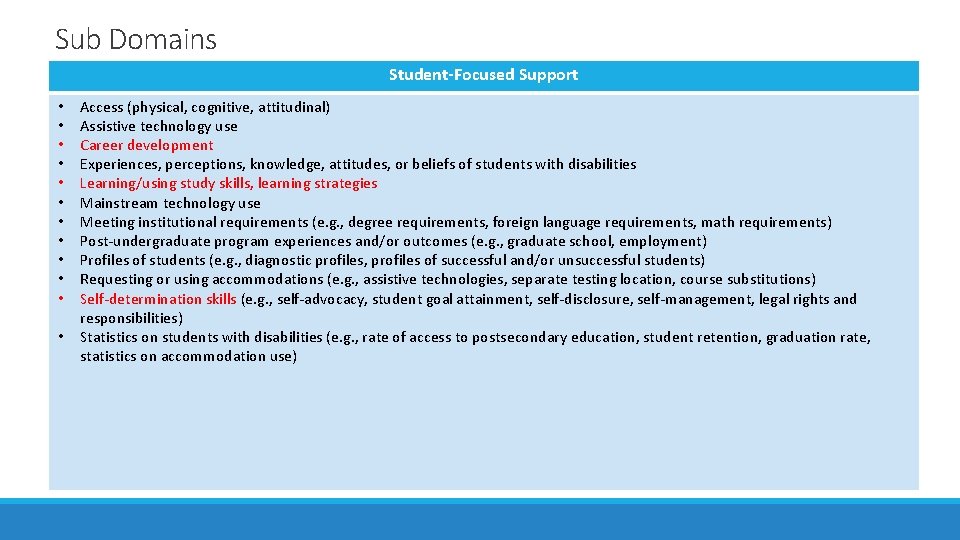
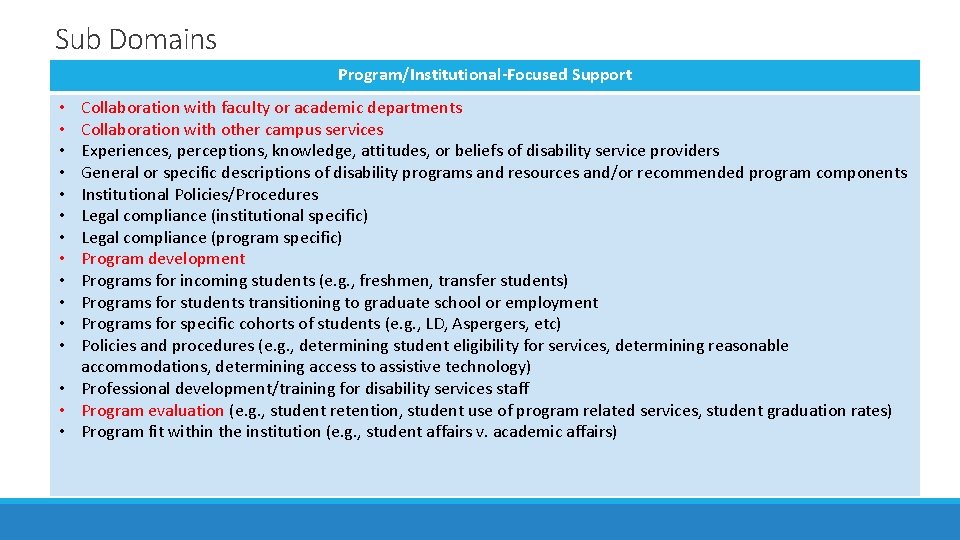
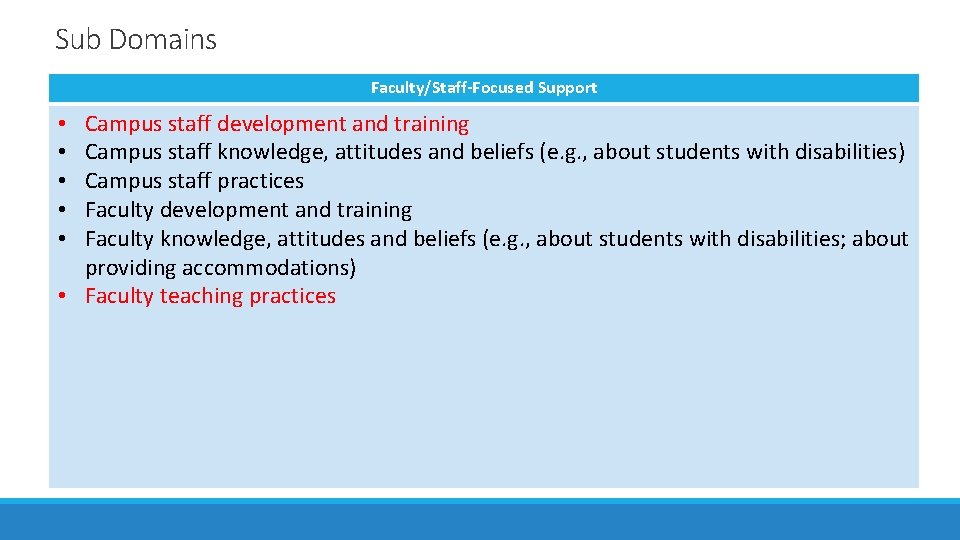
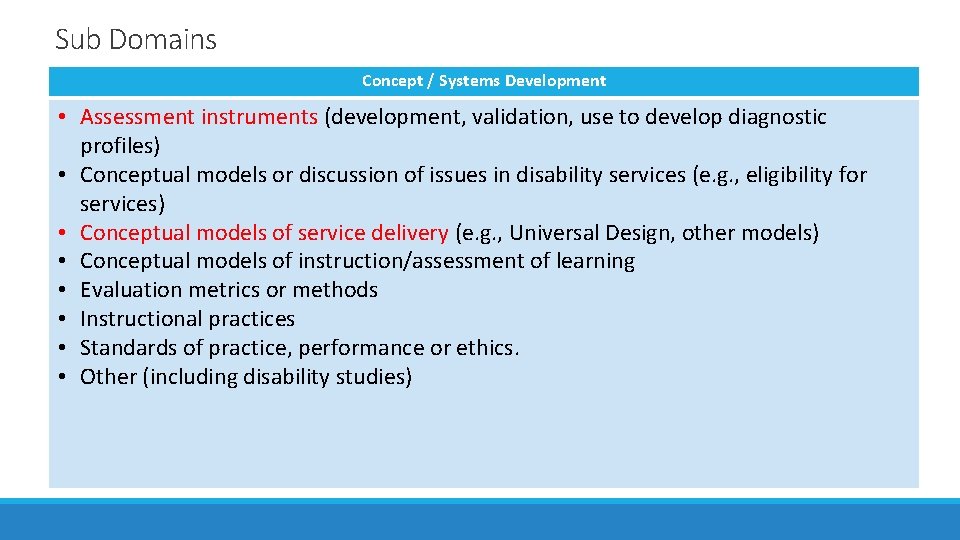
The PASS Taxonomy: What Is It? § An Organizational Tool – A means for professionals to better link their respective efforts § A Communication Tool - A means of communicating, with greater clarity, ongoing research and practice § A Research Tool - A means of conducting and systematizing the collective research efforts of a diverse array of stakeholders
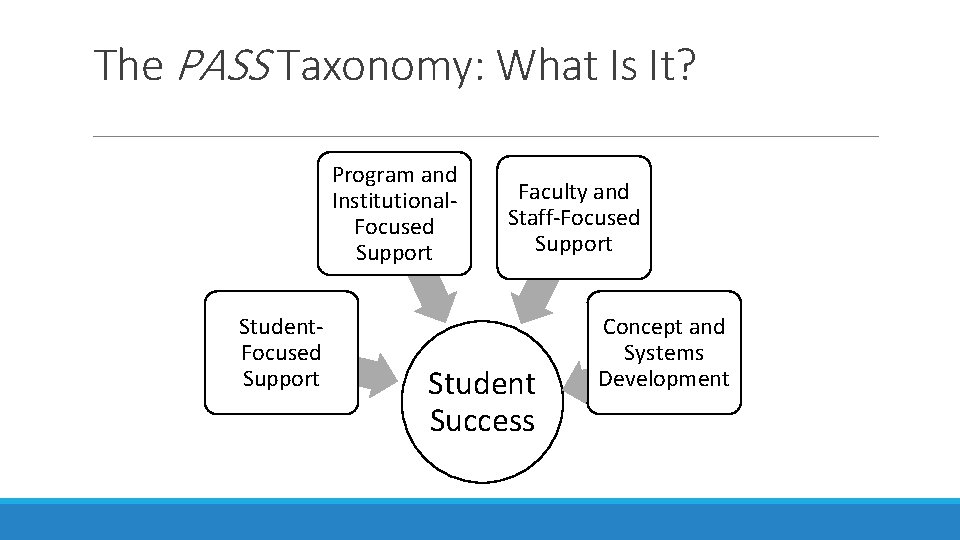
The PASS Taxonomy: What Is It? Program and Institutional. Focused Support Student. Focused Support Faculty and Staff-Focused Support Student Success Concept and Systems Development
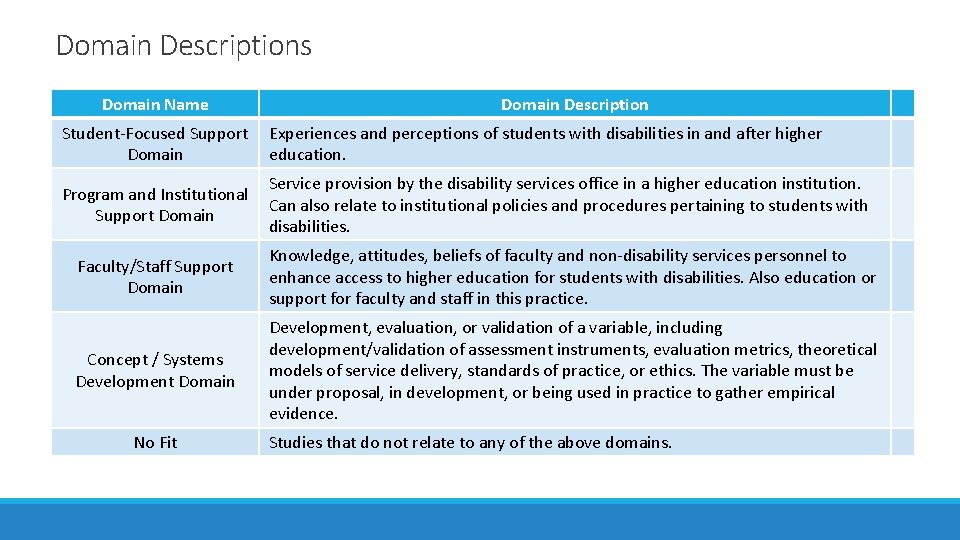
Domain Descriptions Domain Name Domain Description Student-Focused Support Domain Experiences and perceptions of students with disabilities in and after higher education. Program and Institutional Support Domain Service provision by the disability services office in a higher education institution. Can also relate to institutional policies and procedures pertaining to students with disabilities. Faculty/Staff Support Domain Knowledge, attitudes, beliefs of faculty and non-disability services personnel to enhance access to higher education for students with disabilities. Also education or support for faculty and staff in this practice. Concept / Systems Development Domain Development, evaluation, or validation of a variable, including development/validation of assessment instruments, evaluation metrics, theoretical models of service delivery, standards of practice, or ethics. The variable must be under proposal, in development, or being used in practice to gather empirical evidence. No Fit Studies that do not relate to any of the above domains.
Sub Domains Student-Focused Support • • • Access (physical, cognitive, attitudinal) Assistive technology use Career development Experiences, perceptions, knowledge, attitudes, or beliefs of students with disabilities Learning/using study skills, learning strategies Mainstream technology use Meeting institutional requirements (e. g. , degree requirements, foreign language requirements, math requirements) Post-undergraduate program experiences and/or outcomes (e. g. , graduate school, employment) Profiles of students (e. g. , diagnostic profiles, profiles of successful and/or unsuccessful students) Requesting or using accommodations (e. g. , assistive technologies, separate testing location, course substitutions) Self-determination skills (e. g. , self-advocacy, student goal attainment, self-disclosure, self-management, legal rights and responsibilities) Statistics on students with disabilities (e. g. , rate of access to postsecondary education, student retention, graduation rate, statistics on accommodation use)
Sub Domains Program/Institutional-Focused Support Collaboration with faculty or academic departments Collaboration with other campus services Experiences, perceptions, knowledge, attitudes, or beliefs of disability service providers General or specific descriptions of disability programs and resources and/or recommended program components Institutional Policies/Procedures Legal compliance (institutional specific) Legal compliance (program specific) Program development Programs for incoming students (e. g. , freshmen, transfer students) Programs for students transitioning to graduate school or employment Programs for specific cohorts of students (e. g. , LD, Aspergers, etc) Policies and procedures (e. g. , determining student eligibility for services, determining reasonable accommodations, determining access to assistive technology) • Professional development/training for disability services staff • Program evaluation (e. g. , student retention, student use of program related services, student graduation rates) • Program fit within the institution (e. g. , student affairs v. academic affairs) • • •
Sub Domains Faculty/Staff-Focused Support Campus staff development and training Campus staff knowledge, attitudes and beliefs (e. g. , about students with disabilities) Campus staff practices Faculty development and training Faculty knowledge, attitudes and beliefs (e. g. , about students with disabilities; about providing accommodations) • Faculty teaching practices • • •
Sub Domains Concept / Systems Development • Assessment instruments (development, validation, use to develop diagnostic profiles) • Conceptual models or discussion of issues in disability services (e. g. , eligibility for services) • Conceptual models of service delivery (e. g. , Universal Design, other models) • Conceptual models of instruction/assessment of learning • Evaluation metrics or methods • Instructional practices • Standards of practice, performance or ethics. • Other (including disability studies)
How Is PASS Currently Being Used? In the short time since its publication, PASS has been employed to: § Develop and organize an evaluation tool by the Florida Center for Students with Unique Abilities (FCSUA) for inclusive postsecondary education programs designed specifically for students with ID, § Examine the professional literature about students with ID being served in dual enrollment and inclusive postsecondary programs across the United States, and § Update the field of secondary-level transition professionals regarding college-level practices for students with disabilities at the 2018 Capacity Building Institute for the National Technical Assistance Center on Transition
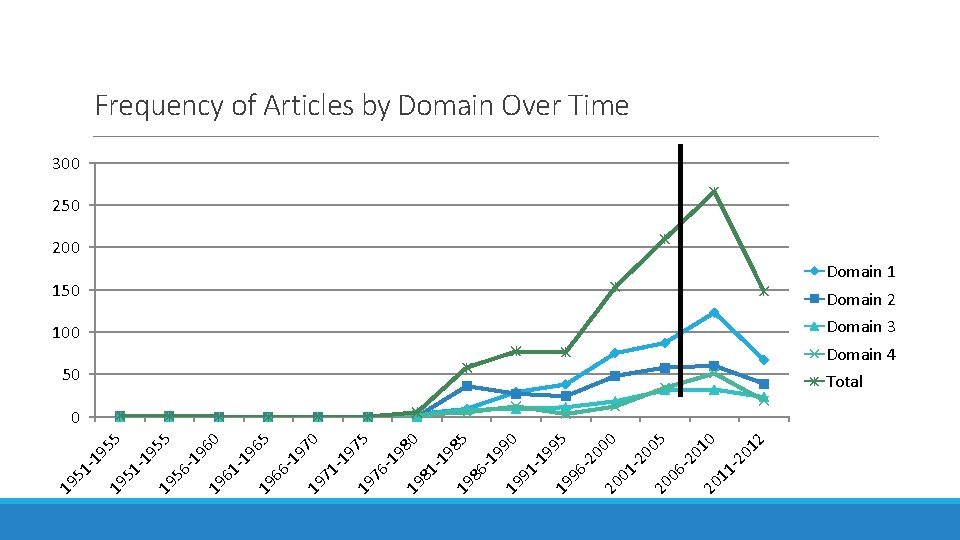
2 01 -2 0 01 5 00 0 00 -2 -2 11 20 06 20 01 20 -2 5 99 0 99 -1 5 98 -1 0 98 5 97 -1 -1 96 19 91 19 86 19 81 19 76 19 -1 5 0 97 -1 71 19 66 19 96 -1 5 0 96 -1 61 19 56 19 95 -1 51 19 Frequency of Articles by Domain Over Time 300 250 200 150 Domain 1 Domain 2 100 Domain 3 50 Domain 4 Total 0
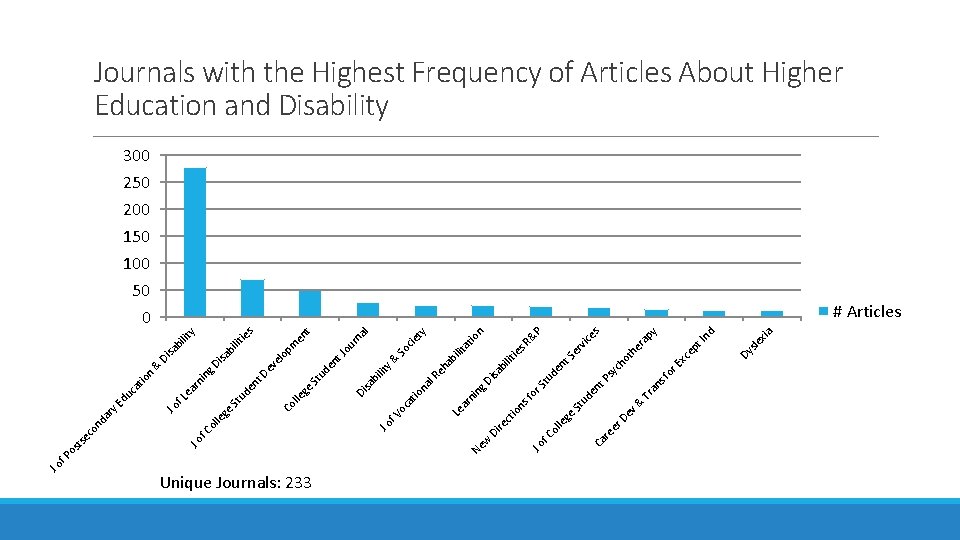
Unique Journals: 233 ng or sf an Tr xia d In sle ce pt Dy Ex y ra p he es rv ic Se ot ch sy t. P en de nt tu &P s. R ie lit n at io cie ty So ilit ab bi sa Di fo r. S ud St v& De ge le er Ca re ol ns io ct re Di f. C Jo w Ne ni Le ar eh y& lit l. R na tio oc a f. V l na ou r en t pm t. J en ud St Di sa bi ge lle lo ie s lit y ilit sa b ev e t. D en ud St Di sa bi Di & ng rn i n ca tio f. L ea Co ge le Jo ol f. C Jo Jo du y. E ar nd co se os t f. P Jo Journals with the Highest Frequency of Articles About Higher Education and Disability 300 250 200 150 100 50 0 # Articles
Setting the Stage: Research-Based Interventions § Increased focus on efficacy of interventions in our work with students (i. e. , what interventions works) § Increased focus on use of scientific, research-based interventions § Improve opportunities for success, retention, and completion § Organizations created to compile evidence regarding scientifically valid practices: § What Works Clearinghouse § National Technical Assistance Center on Transition
Learning Strategies “[A]ctions and processes directed at acquiring information or skill that involve agency, purpose, and instrumentality perceptions by learners” Zimmerman, 1989 (p. 329) NOT teaching strategies… The preparation of the academic environment for achievement ◦ Universal design ◦ Graphic organizers ◦ Rubrics ◦ Guided notes
Research-Based Interventions (K-12) § Robust body of research on learning strategies for adolescents (K 12): § Reading comprehension § Writing § Mathematics § Peer collaboration Scheuermann et al. , 2009
Learning Strategies in College § Importance/benefits of strategies noted: § Researchers/pundits: § College students with LD should be taught learning strategies (Butler, 1988; Mc. Guire, 2002) § Students: § College students with disabilities acknowledge the value of applying learning strategies to their learning challenges (Skinner, 2004)
But what do we know about the efficacy and use of learning strategies?
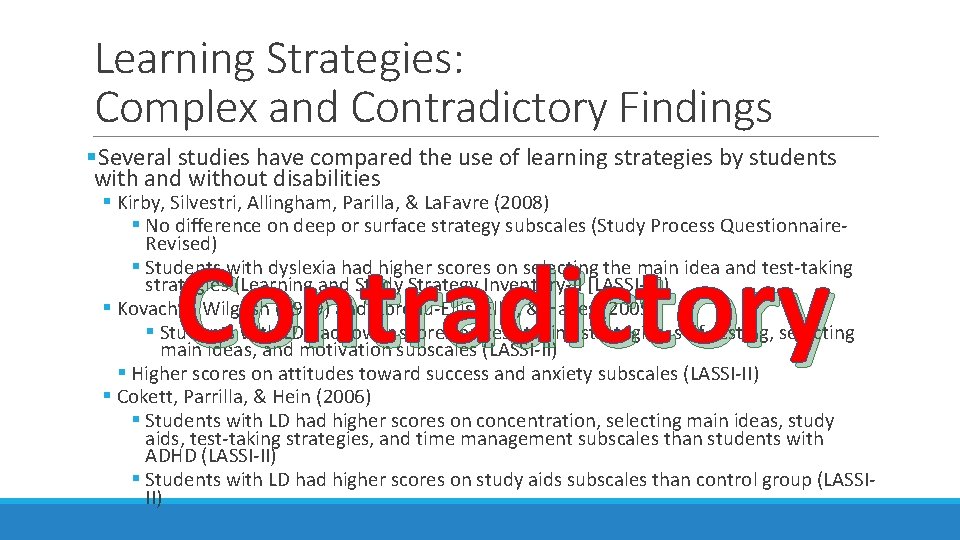
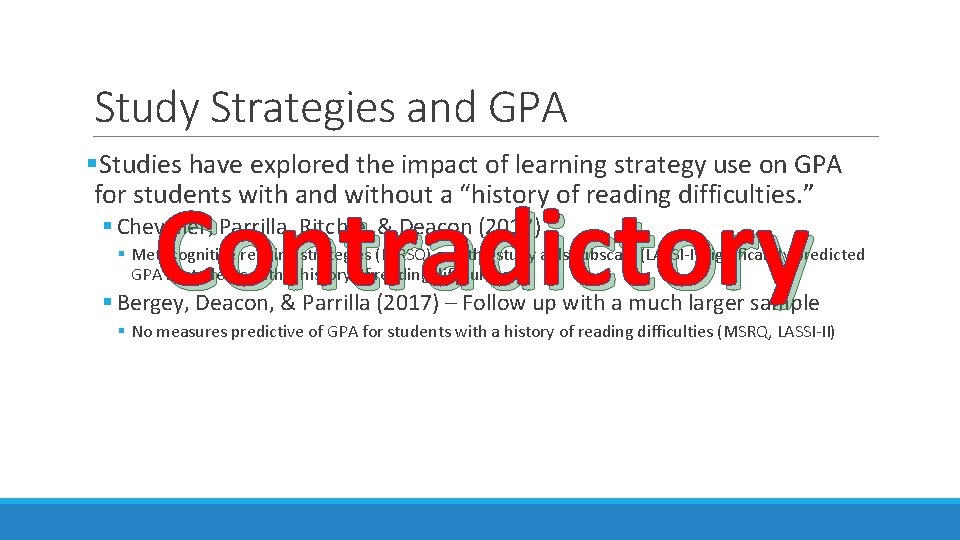
Learning Strategies: Complex and Contradictory Findings §Several studies have compared the use of learning strategies by students with and without disabilities § Kirby, Silvestri, Allingham, Parilla, & La. Favre (2008) § No difference on deep or surface strategy subscales (Study Process Questionnaire. Revised) § Students with dyslexia had higher scores on selecting the main idea and test-taking strategies (Learning and Study Strategy Inventory-II [LASSI-II]) § Kovach & Wilgosh (1999) and Abreau-Ellis, & Hayes (2009) § Students with LD had lower scores on test-taking strategies, self-testing, selecting main ideas, and motivation subscales (LASSI-II) § Higher scores on attitudes toward success and anxiety subscales (LASSI-II) § Cokett, Parrilla, & Hein (2006) § Students with LD had higher scores on concentration, selecting main ideas, study aids, test-taking strategies, and time management subscales than students with ADHD (LASSI-II) § Students with LD had higher scores on study aids subscales than control group (LASSIII) Contradictory
Study Strategies and GPA §Studies have explored the impact of learning strategy use on GPA for students with and without a “history of reading difficulties. ” Contradictory § Chevalier, Parrilla, Ritchie, & Deacon (2017) § Metacognitive reading strategies (MRSQ) and the study aids subscale (LASSI-II)significantly predicted GPA in students with a history of reading difficulties § Bergey, Deacon, & Parrilla (2017) – Follow up with a much larger sample § No measures predictive of GPA for students with a history of reading difficulties (MSRQ, LASSI-II)
Possible Issues with the Research § Methods § Instruments may lack sensitivity to strategy use § May not be reflective of advances in technology § Populations § Mixing students with varied disabilities
Purpose of Our Study Systematically review the literature on interventions related to learning strategy instruction and use at the postsecondary level. Specifically, to examine the types of research methods used, settings, populations and specific strategies studies
Methods § Two literature searches conducted: § Database containing articles about higher education and disability published between 1955 and 2012 (Madaus et al. , 2017; Contained 1, 036 articles) § A search of Academic Search Premiere, ERIC, Psych. Info, Medline (2012 -2015; Resulted in 125 articles) § Only articles about strategies to be used independently by students with disabilities were included § 82 articles included in the study
Coding Procedure § Each article coded by two of the four coders. § Coders met to come to rectify any disagreements. § Articles coded for: § Presentation of original “data” § Methodology (i. e. , qualitative, descriptive quantitative, empirical, mixed methods) § Specific to learning strategy interventions: § Duration and frequency of instructional session § Session setting § Type of interventionist (e. g. , research team member, faculty member) § Type of strategy (i. e. , acquisition, storage, expression, executive function) § Strategy description
Results Intervention vs. No Intervention N= [VALUE], [PERCENT AGE] Intervention No Intervention Total N = 82 Intervention Studies: Study Type N= [VALUE], [PERCENT AGE] Group Design (non-RCT) N= [VALUE], [PERCENT AGE] RCT Total N = 21 N= [VALUE], [PERCENT AGE] Single Subject
Results (cont. ) Disability Category. N = [VALUE], [PERCENT AGE] N= [VALUE], N= [PERCENT [VALUE], N = AGE] [PERCENT [VALUE], AGE] [PERCENT AGE] N= [VALUE], [PERCENT AGE] LD ADHD Visual Impairment Multiple Disabilities Other Disability Without Disabilities Total N = 19 N= Learning Strategy Type [VALUE], [PERCENT AGE] N= [VALUE], [PERCENT AGE] Acquisition Storage Expression Executive Function
Results (cont. ) Method of Instruction N = [VALUE], [PERCENTAGE] Face to Face Phone Online N = 21 Not Described
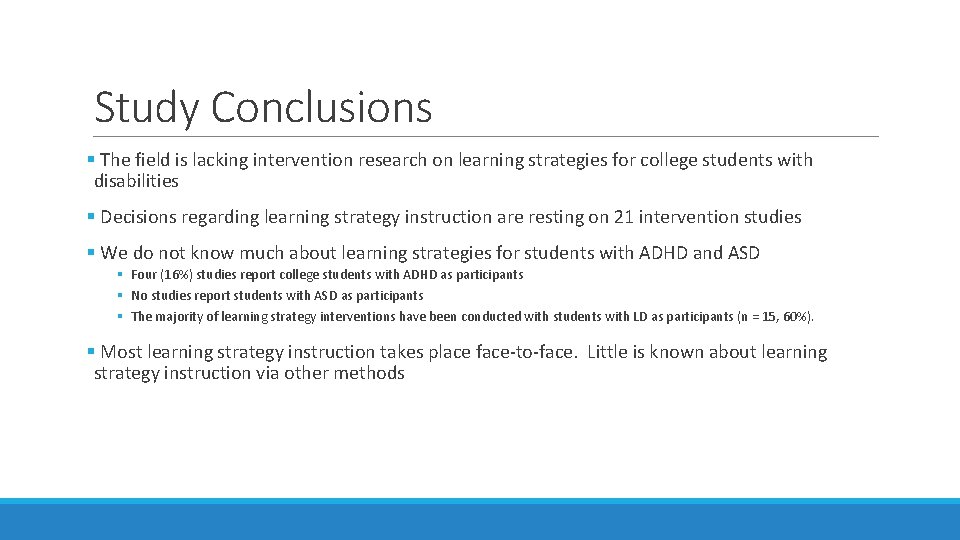
Study Conclusions § The field is lacking intervention research on learning strategies for college students with disabilities § Decisions regarding learning strategy instruction are resting on 21 intervention studies § We do not know much about learning strategies for students with ADHD and ASD § Four (16%) studies report college students with ADHD as participants § No studies report students with ASD as participants § The majority of learning strategy interventions have been conducted with students with LD as participants (n = 15, 60%). § Most learning strategy instruction takes place face-to-face. Little is known about learning strategy instruction via other methods
Implications for Practice § Disability services providers and learning specialists lack information about effective learning strategies for postsecondary students with disabilities
Discussion § What learning strategies are you teaching students currently? Why? § Have you seen any new learning strategies being used? § How can we begin to assess their efficacy? § Who can you collaborate with to assess learning strategies?
What Are The Next Steps? Please share with the session attendees: What do you think should be next steps for advancing the use and research of learning strategies in higher education?
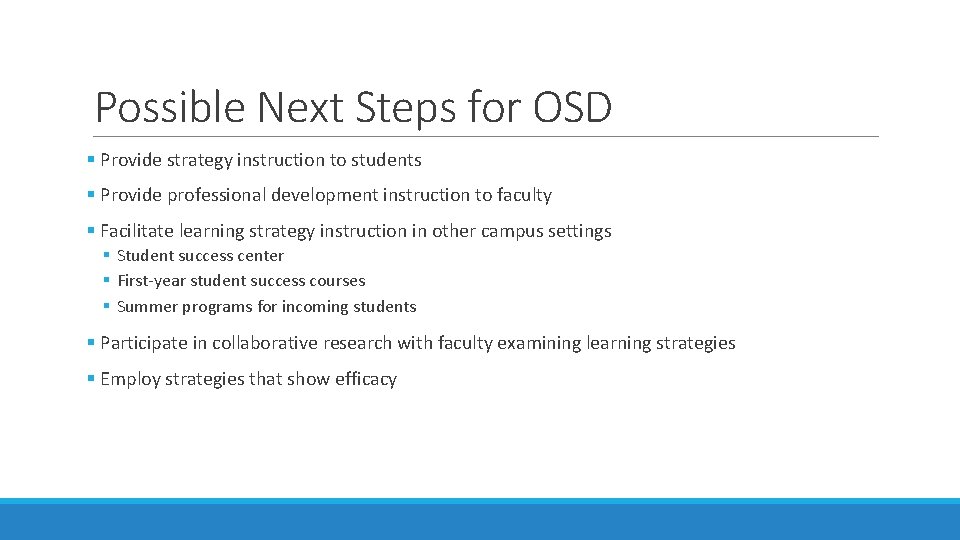
Possible Next Steps for OSD § Provide strategy instruction to students § Provide professional development instruction to faculty § Facilitate learning strategy instruction in other campus settings § Student success center § First-year student success courses § Summer programs for incoming students § Participate in collaborative research with faculty examining learning strategies § Employ strategies that show efficacy
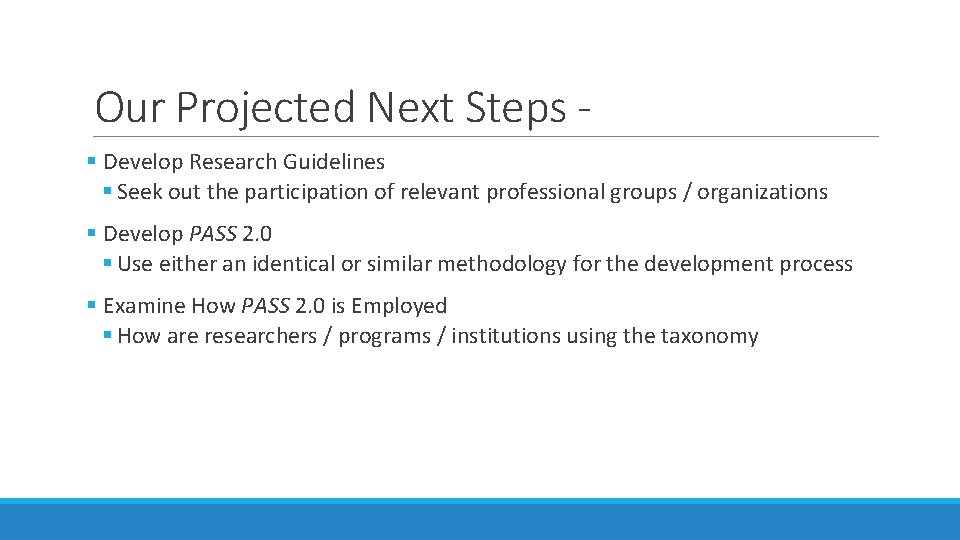
Our Projected Next Steps § Develop Research Guidelines § Seek out the participation of relevant professional groups / organizations § Develop PASS 2. 0 § Use either an identical or similar methodology for the development process § Examine How PASS 2. 0 is Employed § How are researchers / programs / institutions using the taxonomy
Questions? Comments? Observations?
Feel free to contact us… Adam R. Lalor, Ph. D. Landmark College adamlalor@landmark. edu Lyman L. Dukes, III, Ph. D. University of South Florida, St. Petersburg ldukes@mail. usf. edu