
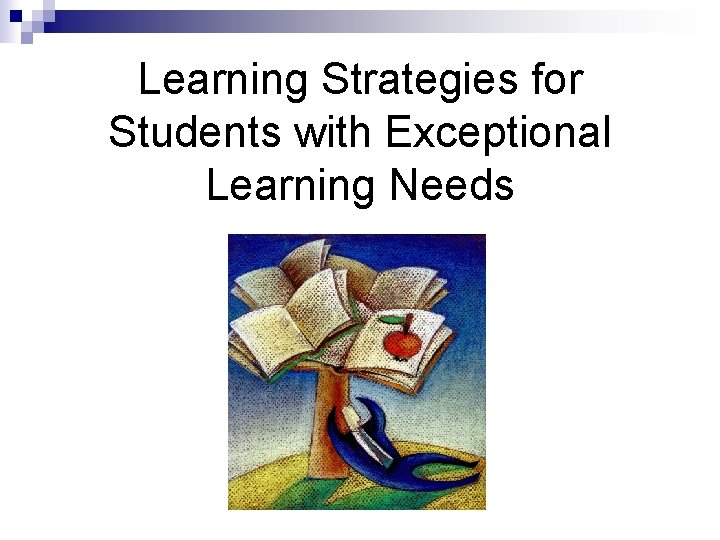
Learning Strategies for Students with Exceptional Learning Needs

- Slides: 36
Learning Strategies for Students with Exceptional Learning Needs
Quote from Barbara n “The success of our schools is up to the people who are there. Outside forces may dictate what needs to happen in schools, but the people at each school make it happen. ” Barbara Pedersen, CLASS Founder
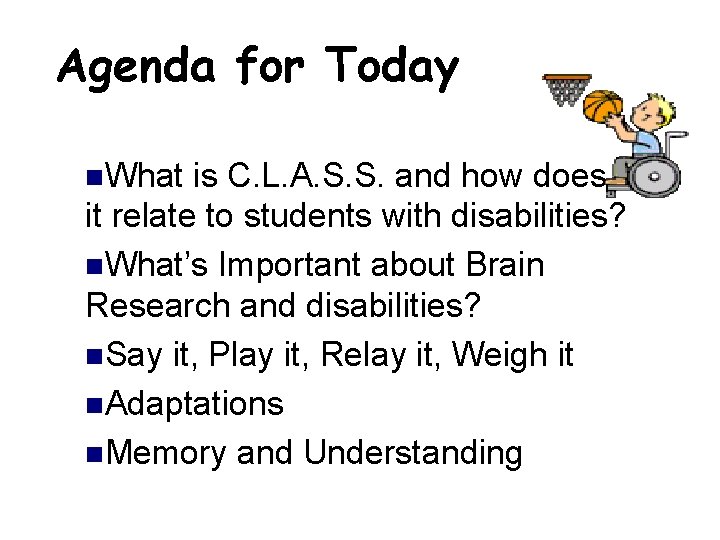
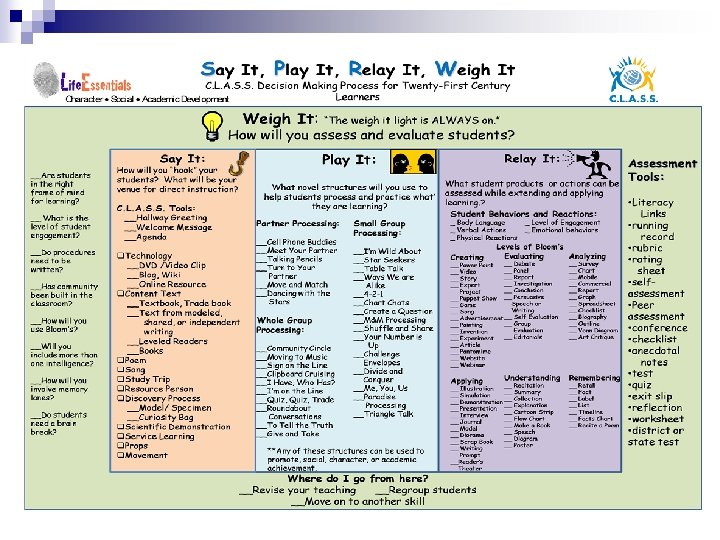
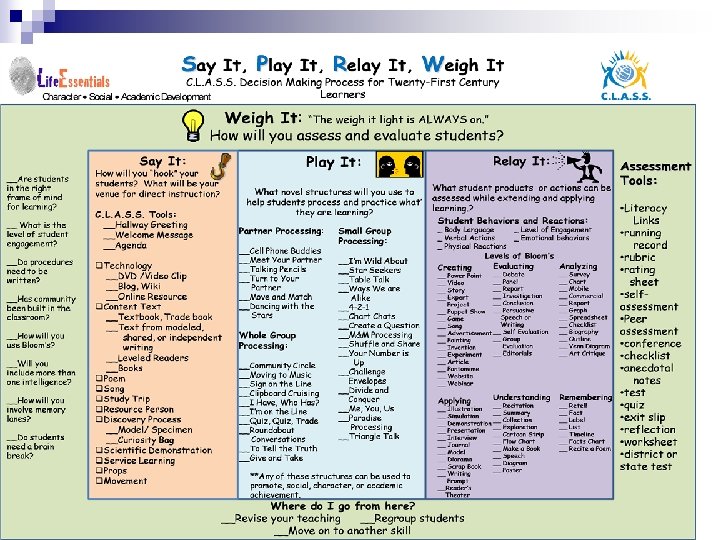
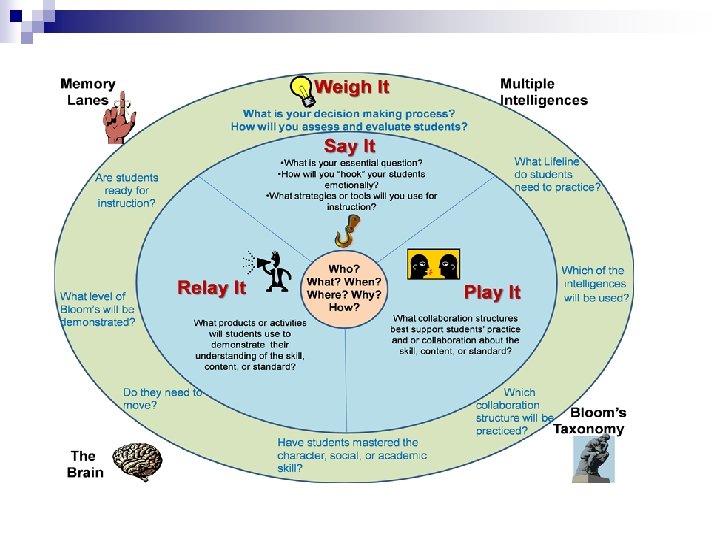
Agenda for Today n. What is C. L. A. S. S. and how does it it relate to students with disabilities? n. What’s Important about Brain Research and disabilities? n. Say it, Play it, Relay it, Weigh it n. Adaptations n. Memory and Understanding
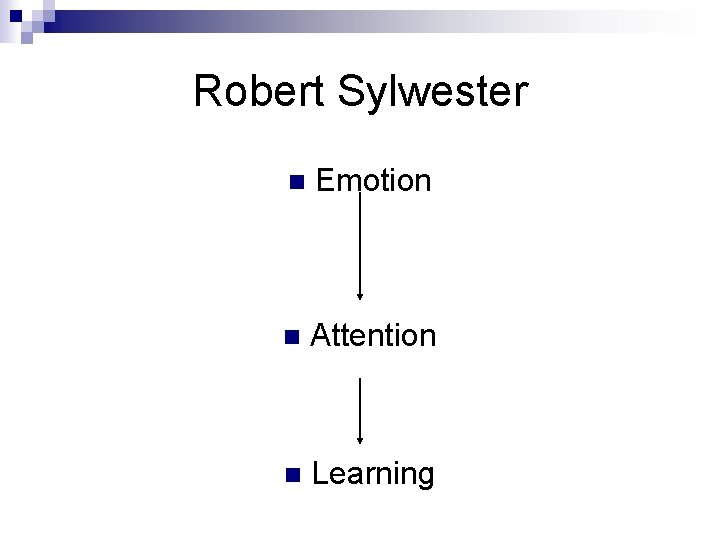
What’s important to understand? n n n n A clean, safe, and clutter free environment is conducive to learning. Everyone deserves respect. C. L. A. S. S. is about how children and adults learn. Emotions determine how much attention a person pays to something. Some code of behavior is necessary for any community of people to live and work together. If we know what the expectations are we are more likely to follow them. Children are intelligent in different ways. Many processing strategies can help children learn and remember.
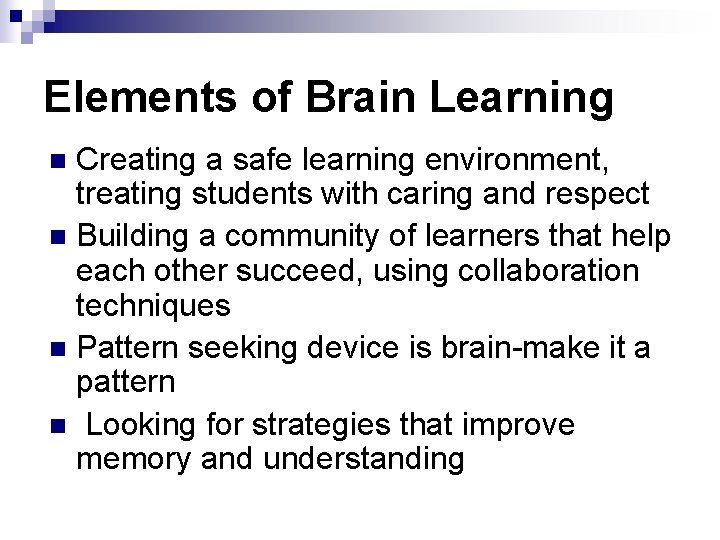
Elements of Brain Learning Creating a safe learning environment, treating students with caring and respect n Building a community of learners that help each other succeed, using collaboration techniques n Pattern seeking device is brain-make it a pattern n Looking for strategies that improve memory and understanding n
Robert Sylwester n Emotion n Attention n Learning
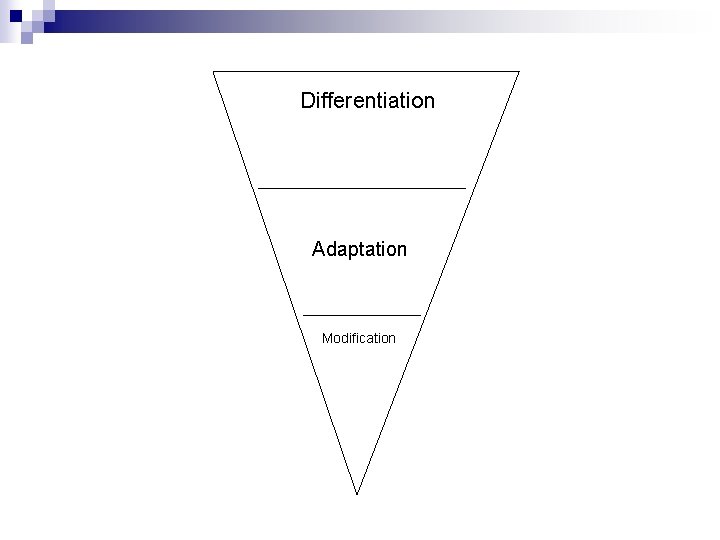
Differentiation Adaptation Modification
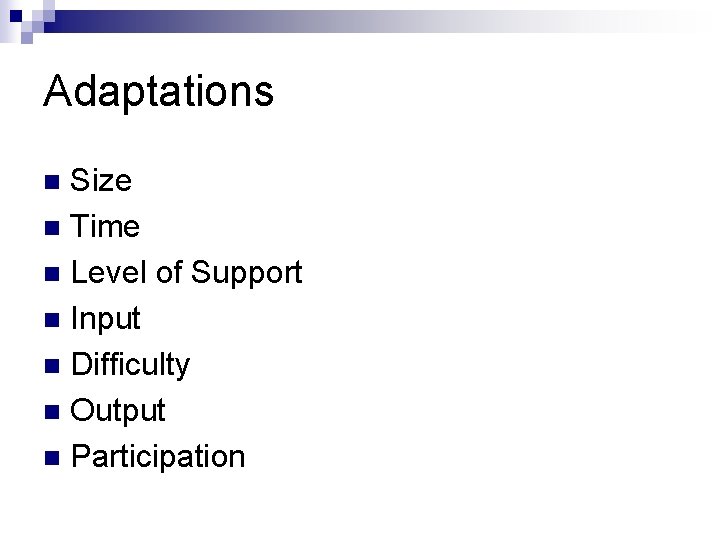
Adaptations Size n Time n Level of Support n Input n Difficulty n Output n Participation n
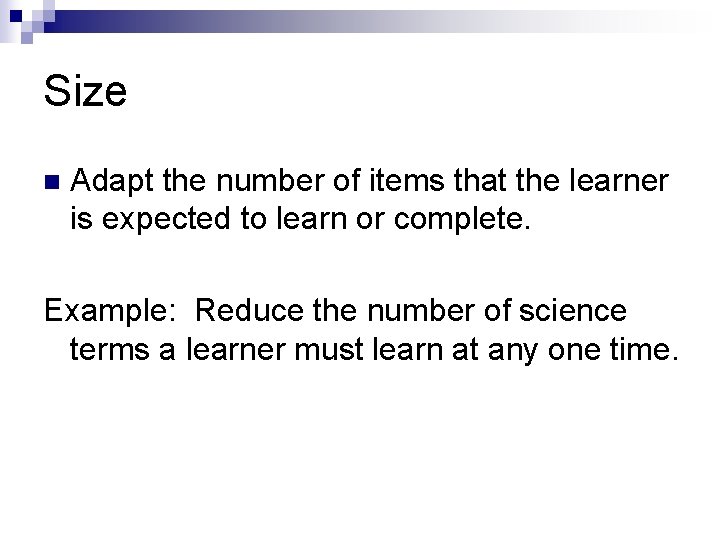
Size n Adapt the number of items that the learner is expected to learn or complete. Example: Reduce the number of science terms a learner must learn at any one time.
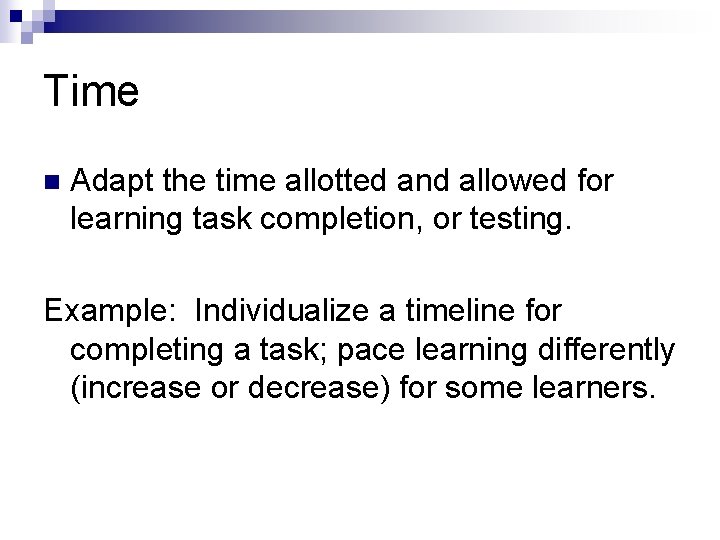
Time n Adapt the time allotted and allowed for learning task completion, or testing. Example: Individualize a timeline for completing a task; pace learning differently (increase or decrease) for some learners.
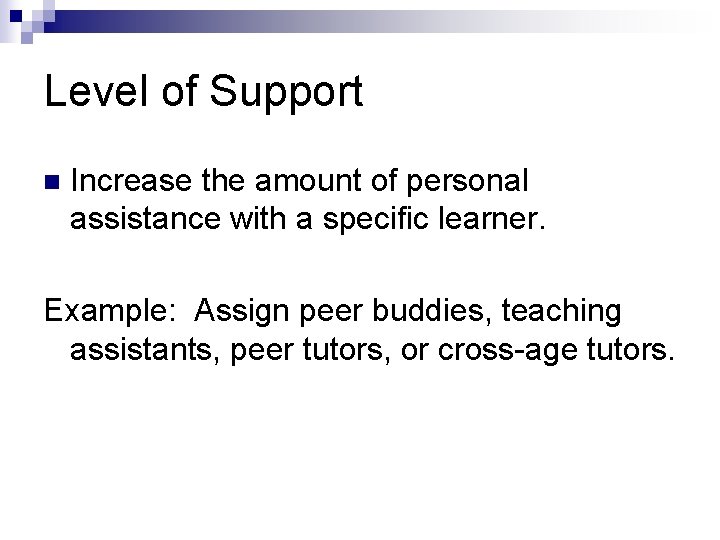
Level of Support n Increase the amount of personal assistance with a specific learner. Example: Assign peer buddies, teaching assistants, peer tutors, or cross-age tutors.
Input n Adapt the way instruction is delivered to the learner. Example: Use different visual aids, plan more concrete examples, provide handson activities, place students in cooperative groups.
Difficulty n Adapt the skill level, problem type, or the rules on how the learner may approach the work. Example: Allow the use of a calculator to figure math problems; simplify task directions; change rules to accommodate learner needs.
Output n Adapt how the student can respond to instruction. Example: Instead of answering questions in writing, allow a verbal response; use a communication book for some students; allow students to show knowledge with hands on materials
Participation n Adapt the extent to which a learner is actively involved in the task. Example: In geography, have a student hold the globe, while others point out locations.
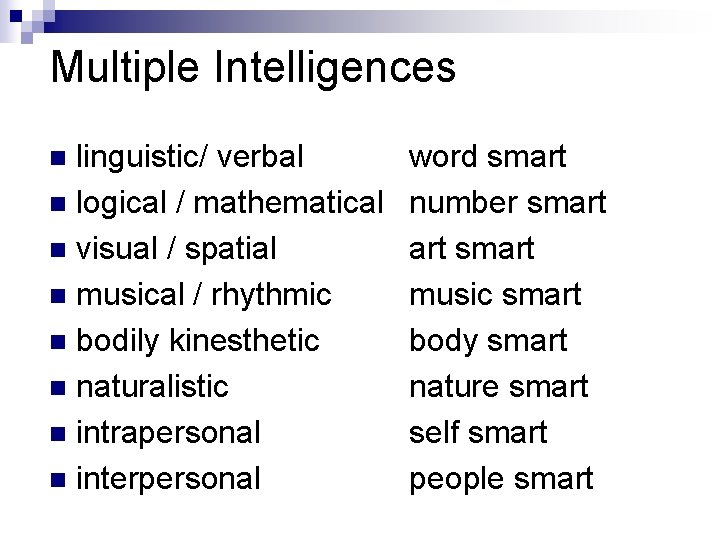
Multiple Intelligences linguistic/ verbal n logical / mathematical n visual / spatial n musical / rhythmic n bodily kinesthetic n naturalistic n intrapersonal n interpersonal n word smart number smart music smart body smart nature smart self smart people smart
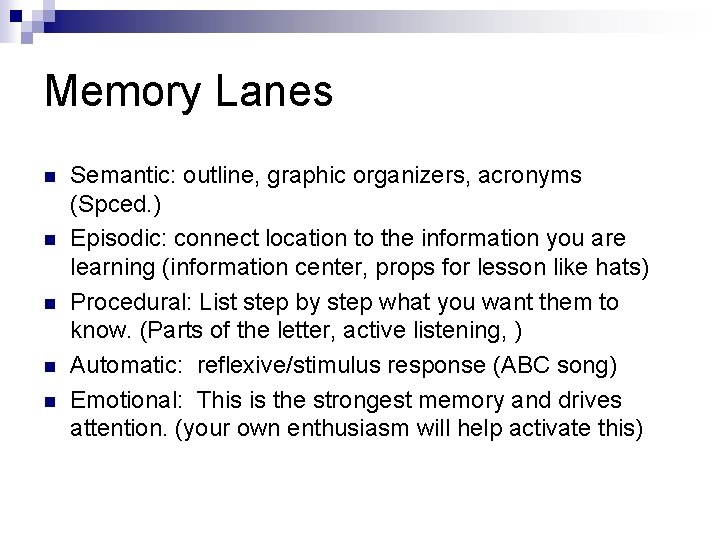
Memory Lanes n n n Semantic: outline, graphic organizers, acronyms (Spced. ) Episodic: connect location to the information you are learning (information center, props for lesson like hats) Procedural: List step by step what you want them to know. (Parts of the letter, active listening, ) Automatic: reflexive/stimulus response (ABC song) Emotional: This is the strongest memory and drives attention. (your own enthusiasm will help activate this)
Adaptation Practice with a Partner n n Pick a Partner Pick a Play it, Say it, Relay it strategy (anyone you want) Adapt the strategy using one of the following adaptations: Size, Time, Level of Support, Input, Difficulty, Output, Participation Try it again till time is called
Brain Basics Check the environment-clutter free, compatible colors, music, lamps, plants n Brain Food-fish, eggs, poultry, nuts, turkey -dark meat, orange juice, tuna, white meat, whole grains, bananas, pears, peaches, apples, yogurt n Pure water 8 -15 glasses per day-Hydrate n
Concerning a Teacher’s Influence: “I have come to the frightening conclusion that I am the decisive element in the classroom. It is my personal approach that creates the weather. As a teacher, I possess a tremendous power to make a child’s life miserable or joyous. I can be a tool of torture or an instrument of inspiration…In all situations it is my response that decides whether a crisis will be escalated or de-escalated and a child humanized or dehumanized. ” Haim Ganott
Theresa Knipstein Meyer tknipste@butler. edu
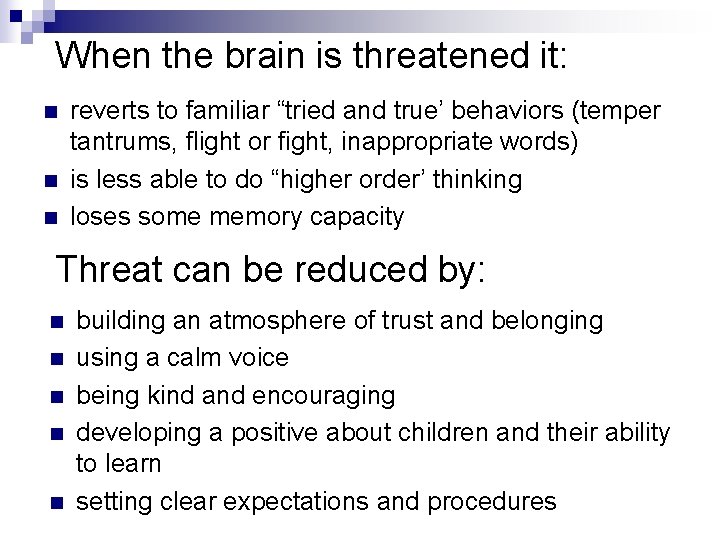
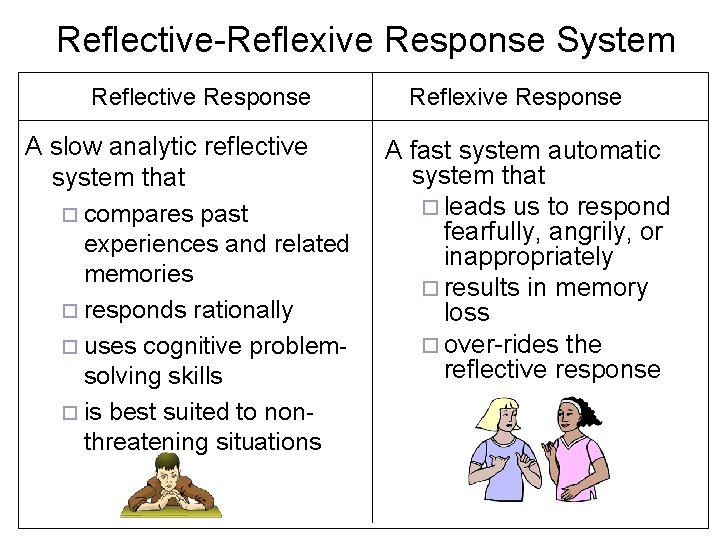
When the brain is threatened it: n n n reverts to familiar “tried and true’ behaviors (temper tantrums, flight or fight, inappropriate words) is less able to do “higher order’ thinking loses some memory capacity Threat can be reduced by: n n n building an atmosphere of trust and belonging using a calm voice being kind and encouraging developing a positive about children and their ability to learn setting clear expectations and procedures
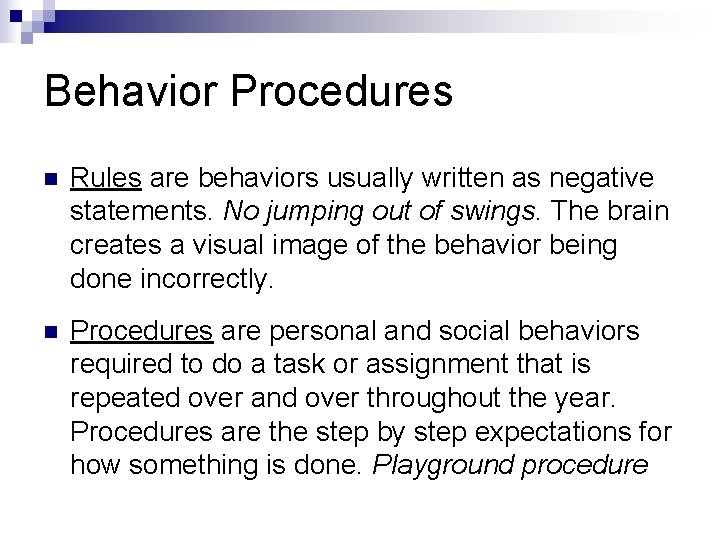
Behavior Procedures n Rules are behaviors usually written as negative statements. No jumping out of swings. The brain creates a visual image of the behavior being done incorrectly. n Procedures are personal and social behaviors required to do a task or assignment that is repeated over and over throughout the year. Procedures are the step by step expectations for how something is done. Playground procedure
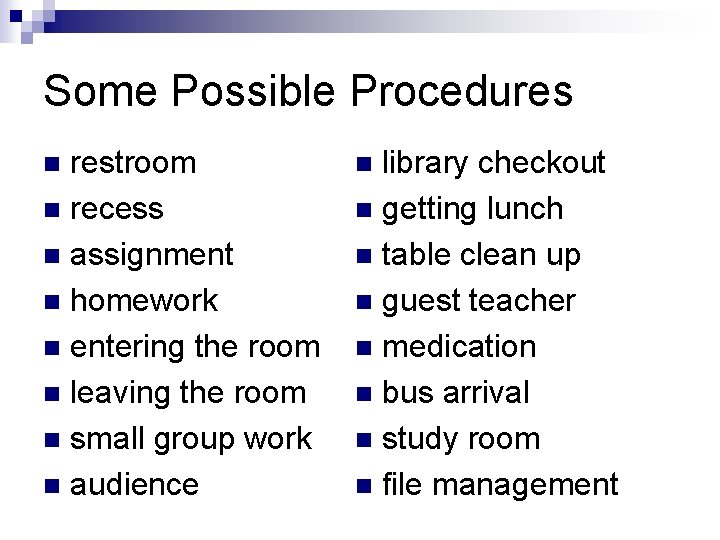
Some Possible Procedures restroom n recess n assignment n homework n entering the room n leaving the room n small group work n audience n library checkout n getting lunch n table clean up n guest teacher n medication n bus arrival n study room n file management n
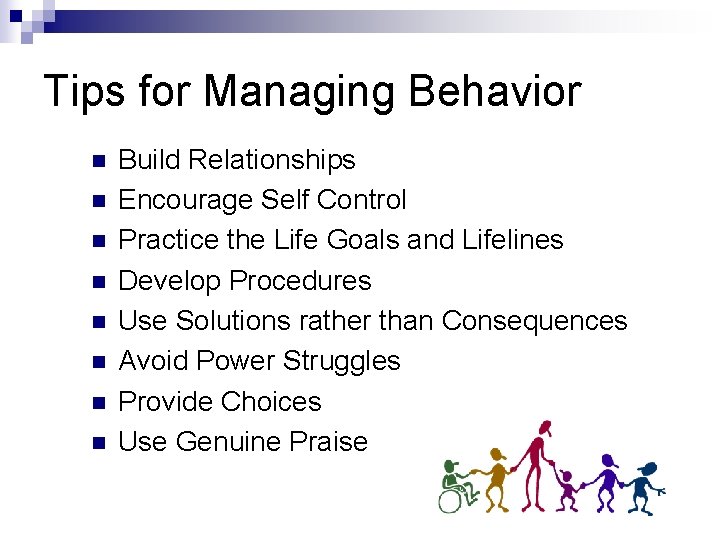
Tips for Managing Behavior n n n n Build Relationships Encourage Self Control Practice the Life Goals and Lifelines Develop Procedures Use Solutions rather than Consequences Avoid Power Struggles Provide Choices Use Genuine Praise
Decide WHAT behavior you most want to target. 1. 2. 3. 4. 5. 6. 7. To start with, you'll want to narrow your focus to one particular behavior to analyze and change. Although it's tempting, don't just choose thing that most annoys you. Give the child a list of two or three things that they need to improve to succeed in school. Then choose one and create a plan with the child. Set goals. While you're working on one behavior, you may need to let others slide, unless it's a matter of safety. Don't try to change everything all at once.
Keep track of WHEN the behaviors occur. 1. 2. 3. 4. 5. 6. Keep a journal – you need a way to get your emotions out! Use a chart -- for noting every incidence of the targeted behavior. Include the time of day the behavior occurred, and what happened before, during and after. Think of what might have happened directly before the behavior, and also earlier in the day. Think, too, of what happened directly after the behavior, and whether it offered the child any reward (even negative attention can be rewarding if the alternative is no attention at all). Ask yourself: Does the behavior tend to be more frequent during a certain time of day? After a certain event? When something happens or doesn't happen? In anticipation of something happening? Around transitions? When routine is disrupted? When things are very noisy or very busy? Keep track over the course of a few weeks and look for patterns.
Brain Compatible Strategies n n n n Welcome Messages Agendas Hall Greetings Community Circles Behavior Procedures Life Goals Emotional Hook n n n Say it, Play it, Relay it, Weigh it Collaboration Structures Literacy Links Multiple Intelligences Memory Lane
Helping Students Learn n n Positive Attitude – Everyone can learn! Relationships – Respect and Caring Clear Expectations - Procedures Using Their Strengths – Multiple Intelligences Memory Tips music n play with words n movement n graphics and pictures n n The Literacy Links
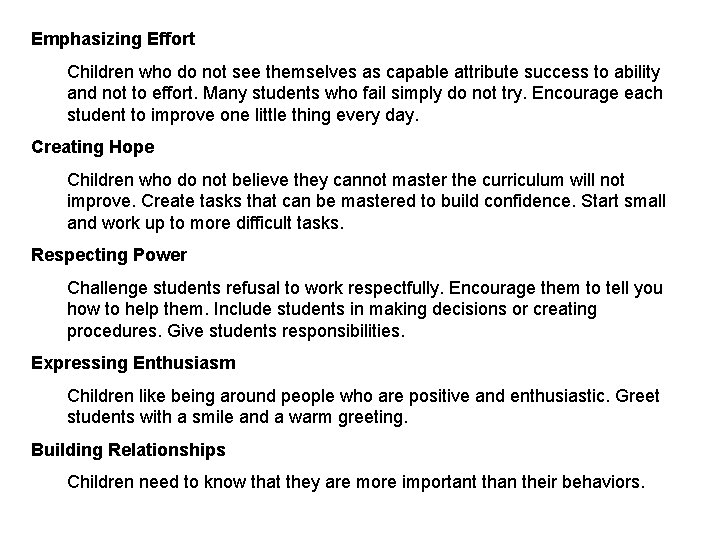
Emphasizing Effort Children who do not see themselves as capable attribute success to ability and not to effort. Many students who fail simply do not try. Encourage each student to improve one little thing every day. Creating Hope Children who do not believe they cannot master the curriculum will not improve. Create tasks that can be mastered to build confidence. Start small and work up to more difficult tasks. Respecting Power Challenge students refusal to work respectfully. Encourage them to tell you how to help them. Include students in making decisions or creating procedures. Give students responsibilities. Expressing Enthusiasm Children like being around people who are positive and enthusiastic. Greet students with a smile and a warm greeting. Building Relationships Children need to know that they are more important than their behaviors.
Reflective-Reflexive Response System Reflective Response A slow analytic reflective system that ¨ compares past experiences and related memories ¨ responds rationally ¨ uses cognitive problemsolving skills ¨ is best suited to nonthreatening situations Reflexive Response A fast system automatic system that ¨ leads us to respond fearfully, angrily, or inappropriately ¨ results in memory loss ¨ over-rides the reflective response
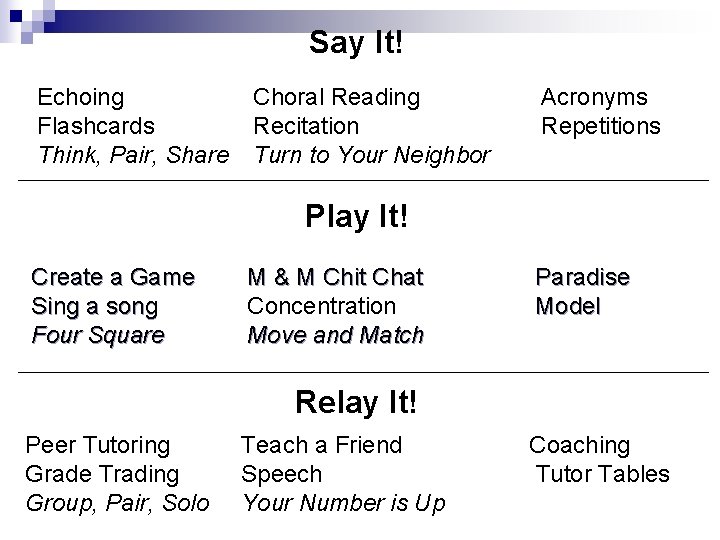
Say It! Echoing Flashcards Think, Pair, Share Choral Reading Recitation Turn to Your Neighbor Acronyms Repetitions Play It! Create a Game Sing a song Four Square M & M Chit Chat Concentration Move and Match Paradise Model Relay It! Peer Tutoring Grade Trading Group, Pair, Solo Teach a Friend Speech Your Number is Up Coaching Tutor Tables