
LEARNING Stage 2 Psychology Information quoted and adapted

- Slides: 89
LEARNING Stage 2 Psychology Information quoted and adapted from ‘Psychology for South Australia Stage 2’ 1 st edition. Spencer & Hartstone. 2007. John Wiley & Sons Australia Ltd
Learning occurs in many areas of the brain, and memories are stored in the brain in a variety of places. We will examine three ways in which animals (including humans) learn, how we can learn to be helpless, as well as behaviour modification and therapies to help learn positive thinking and behaviour. Topic focuses on the Basic Processes level of explanation of behaviour.
LEARNING Definition: to gain knowledge and/or skills by study, experience or being taught. There are learnt and unlearnt behaviours: Unlearnt Behaviours Reflexes - Involuntary response to stimuli Fixed action patterns - Stereotyped pattern of behaviour shown by all members of a species Maturational changes - Behaviour changes that are a result of an organism maturing
LEARNING Three main ways in which human beings learn: 1. Classical Conditioning (learning via association) 2. Operant Conditioning (learning via reward and punishment) 3. Observational Learning (learning via observing)
CLASSICAL CONDITIONING Learning
CLASSICAL CONDITIONING A process of behaviour modification by which a subject comes to respond to a previously neutral stimulus that has been repeatedly presented along with an unconditioned stimulus that produces a response. The association between two stimuli that are normally unrelated, that cause a conditioned response. Discovered by Russian scientist, Ivan Pavlov in 1903. Was originally studying digestion in dogs, however noticed that the dogs started to salivate before the food was presented to them.
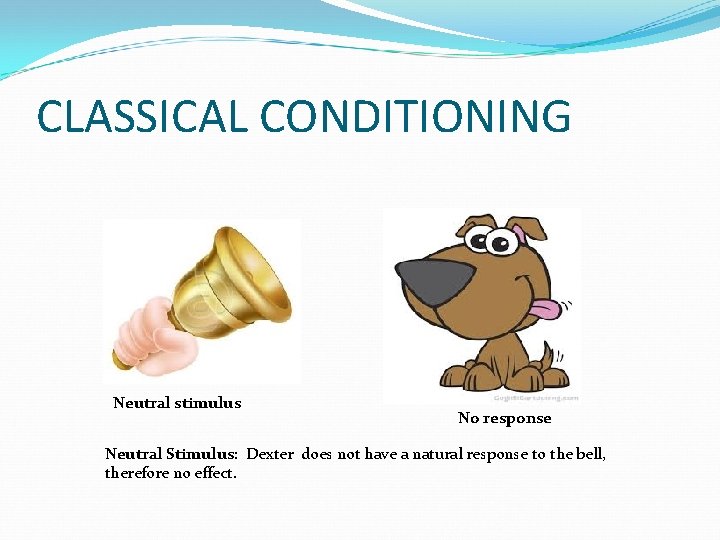
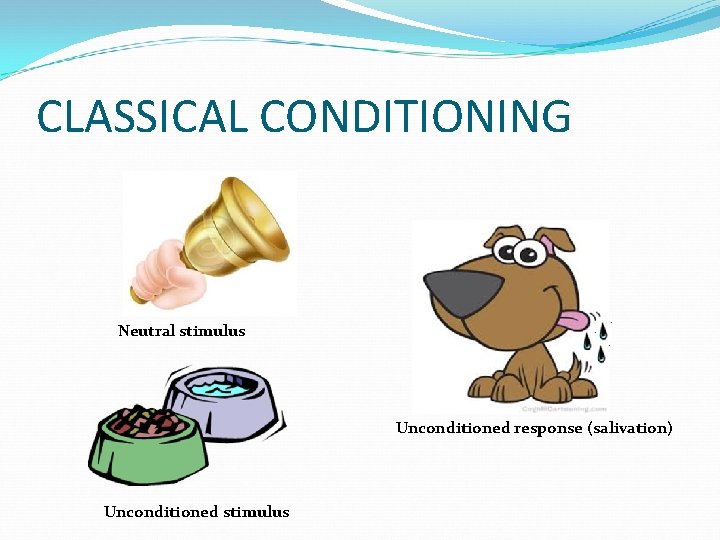
CLASSICAL CONDITIONING Neutral stimulus No response Neutral Stimulus: Dexter does not have a natural response to the bell, therefore no effect.
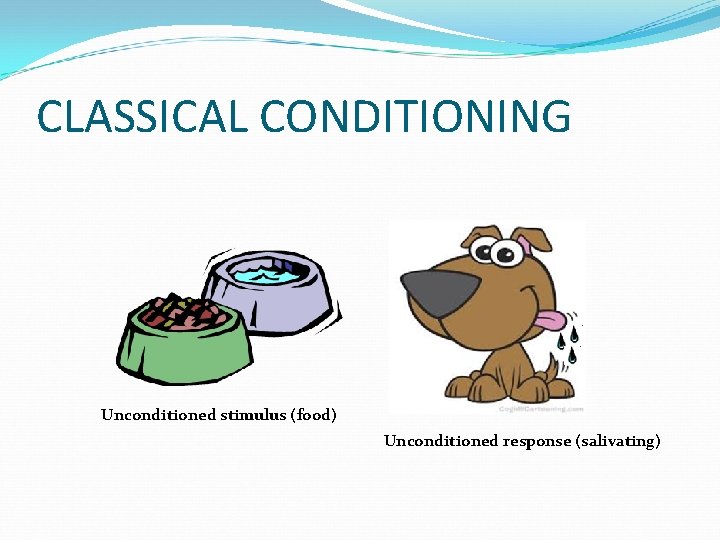
CLASSICAL CONDITIONING Unconditioned stimulus (food) Unconditioned response (salivating)
CLASSICAL CONDITIONING Neutral stimulus Unconditioned response (salivation) Unconditioned stimulus
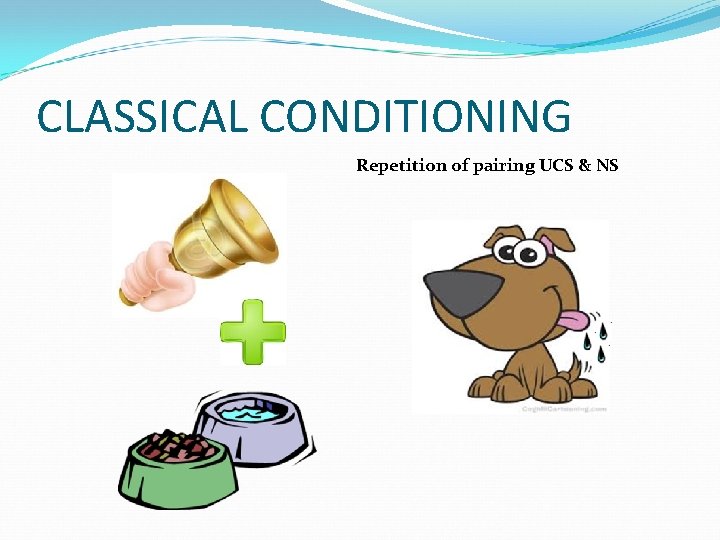
CLASSICAL CONDITIONING Repetition of pairing UCS & NS
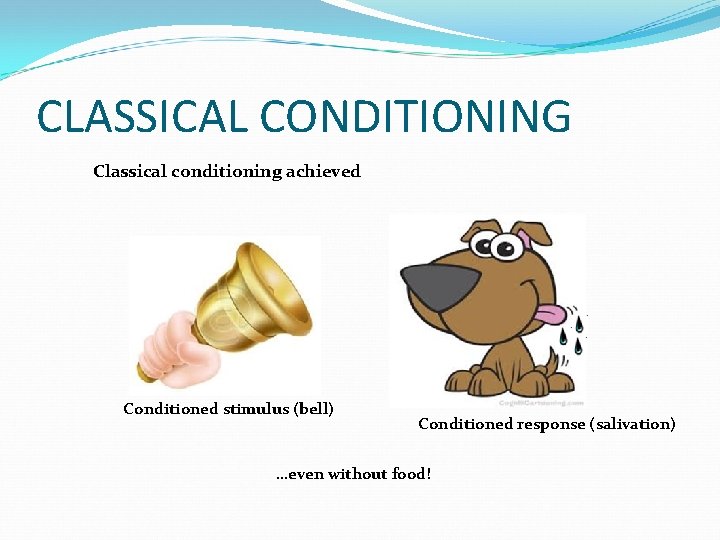
CLASSICAL CONDITIONING Classical conditioning achieved Conditioned stimulus (bell) Conditioned response (salivation) …even without food!
Classical Conditioning - Pavlov Recap Bell started out as a neutral stimulus Food was an unconditioned stimulus When Dexter salivated upon seeing the food, it was an unconditioned response No learning had occurred
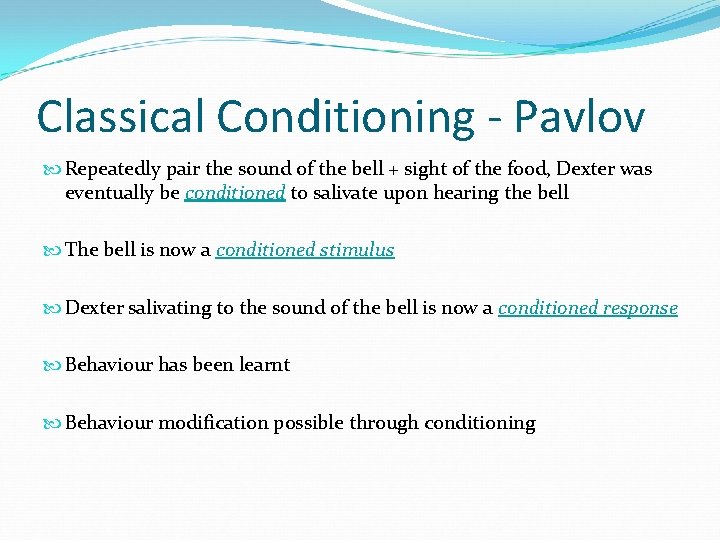
Classical Conditioning - Pavlov Repeatedly pair the sound of the bell + sight of the food, Dexter was eventually be conditioned to salivate upon hearing the bell The bell is now a conditioned stimulus Dexter salivating to the sound of the bell is now a conditioned response Behaviour has been learnt Behaviour modification possible through conditioning
LITTLE ALBERT EXPERIMENT Conducted by John B. Watson in 1920 Wanted to investigate if fear could be controlled and/or manipulated in humans Infant chosen given the nickname ‘Little Albert’
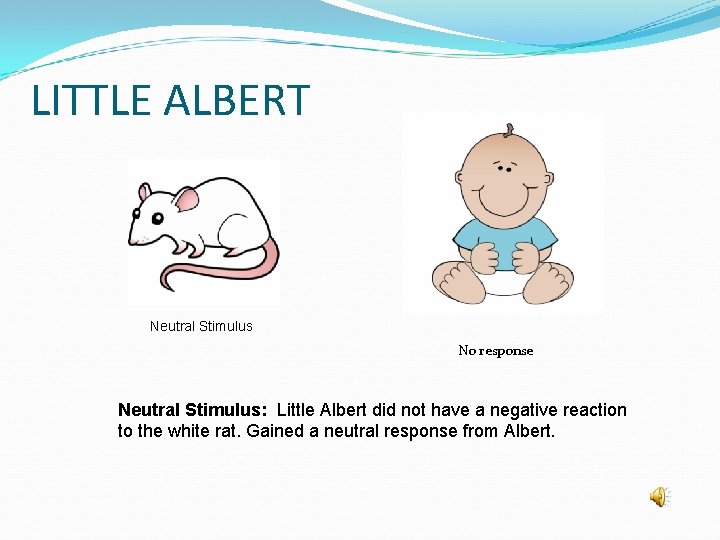
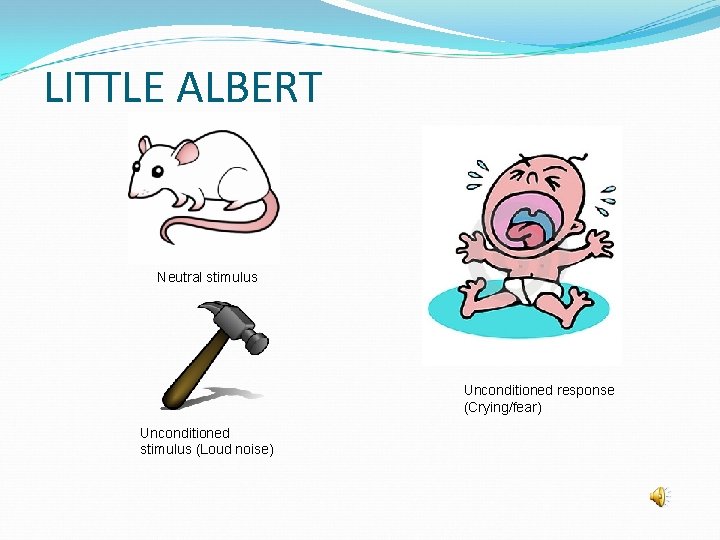
LITTLE ALBERT Neutral Stimulus No response Neutral Stimulus: Little Albert did not have a negative reaction to the white rat. Gained a neutral response from Albert.
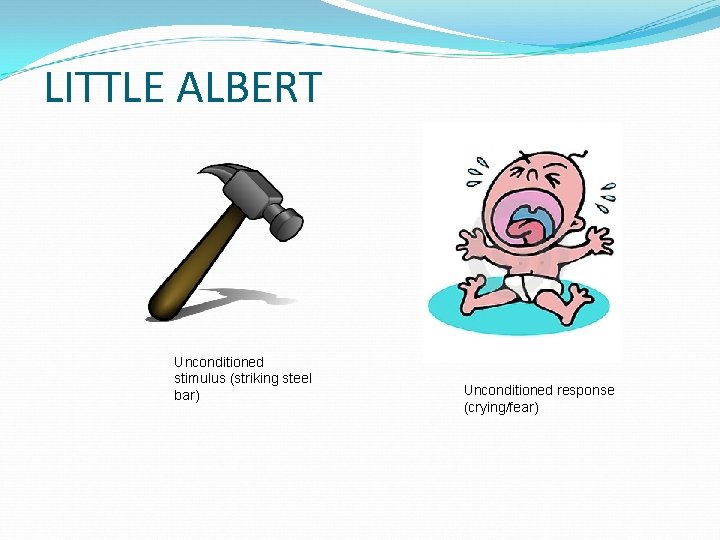
LITTLE ALBERT Unconditioned stimulus (striking steel bar) Unconditioned response (crying/fear)
LITTLE ALBERT Neutral stimulus Unconditioned response (Crying/fear) Unconditioned stimulus (Loud noise)
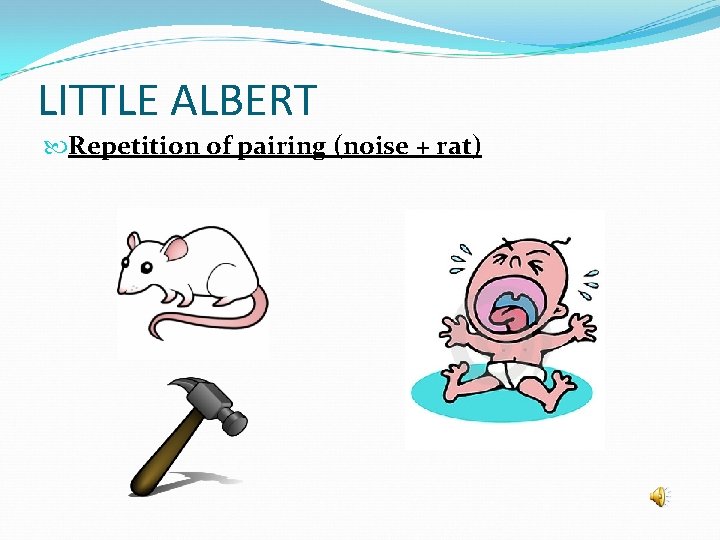
LITTLE ALBERT Repetition of pairing (noise + rat)
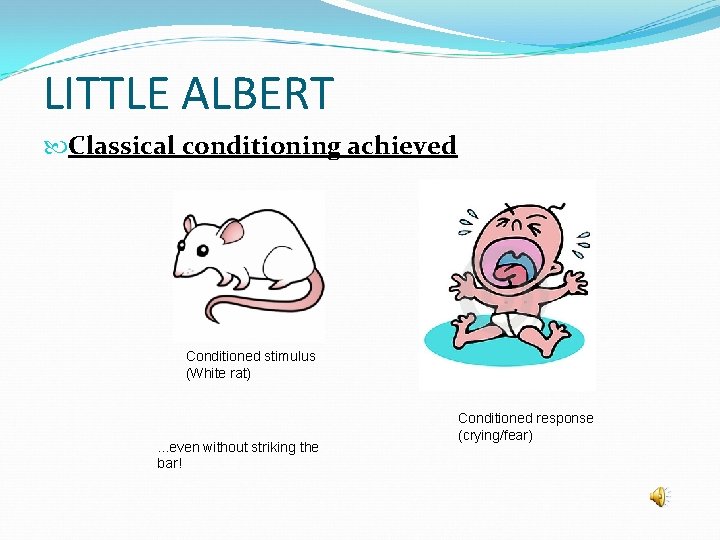
LITTLE ALBERT Classical conditioning achieved Conditioned stimulus (White rat) . . . even without striking the bar! Conditioned response (crying/fear)
LITTLE ALBERT Recap White rat started out as a neutral stimulus Loud noise was an unconditioned stimulus When Albert started crying upon hearing the unpleasant noise, it was an unconditioned response No learning had occurred
LITTLE ALBERT Repeatedly pair the unpleasant sound + sight of white rat, Albert was eventually be conditioned to cry/be fearful upon seeing the white rat The white rat is now a conditioned stimulus Albert crying to the sight of the white rat is now a conditioned response Behaviour has been learnt Behaviour modification possible through conditioning
CLASSICAL CONDITIONING Neutral stimulus (NS) A stimulus that does not evoke a response at first, however becomes a conditioned stimulus through association with the unconditioned stimulus. Unconditioned stimulus (UCS) Any stimulus that can evoke a response without going through any previous learning. Unconditioned response (UCR) A response evoked by an unconditioned stimulus without going through any prior learning. Conditioned stimulus (CS) Formerly neutral stimulus that after association with an unconditioned stimulus, produces a conditioned response. Conditioned response (CR) The learnt response to a conditioned stimulus.
CLASSICAL CONDITIONING PRINCIPLES Classical conditioning is a complex form of learning in animals, however there are other variables that have an impact on the strength and effectiveness of the learning. We will explore the following: Stimulus generalisation Stimulus discrimination Extinction Spontaneous recovery Contiguity Contingency Preparedness
STIMULUS GENERALISATION The transfer of a response learned to one stimulus to another similar stimulus. Example: Dexter salivating to a horn/tone similar to the CS bell – elicits the same CR despite separate CS. Example: Little Albert became fearful of all white, fluffy objects – elicits the same CR despite separate CS.
STIMULUS DISCRIMINATION The process of learning to distinguish a particular stimulus from another stimuli. Opposite of stimulus generalisation Example: Dexter only salivates to the sound of the hand bell, not a horn/tone that sounds similar. Example: Little Albert only becomes fearful at the sight of the white rat – able to discriminate between other white fluffy objects.
EXTINCTION A reduction or loss in the strength or rate of a conditioned response when the UCS is withheld. Example: Dexter’s CR could eventually cease if not continuously paired with the UCS (food). Example: Little Albert’s CR of fear could eventually cease of the UCS (loud noise) is not paired with white rat.
SPONTANEOUS RECOVERY Reappearance, after a rest period, of an extinguished conditioned response. Example: Dexter is presented with pairing of food + bell after extinction > spontaneous recovery of CR (salivation) Example: Little Albert is presented with pairing of white rat + loud noise > spontaneous recovery of CR (fear)
CONTIGUITY The time interval in the UCS-CS pairing. Classical Conditioning is most effective when the time interval is small 0. 5 seconds is ideal If longer, the association between the stimuli won’t be strong enough to elicit strong CR. Example: If food was presented to Dexter one hour after the bell was rung, would not make association. Example: If loud noise occurred one hour after presenting Albert with white rat, would not make association.
CONTINGENCY Predictability of occurrence of one stimulus from the presence of another. In order for strong CR to occur, CS needs to remain predictable and consistent. Example: If Dexter received a different noise each time he was presented with food, CR not as likely to occur. Example: If Little Albert heard different noises of different volumes, CR not as likely to occur.
PREPAREDNESS Associations that are learned more readily/easily than others. Often relate to our survival instincts regarding phobias. i. e. why phobias such as spiders, snakes and heights are more common – more easily learnt due to compromise in survival. Evolutionary history - organisms that learn to fear environmental threats faster had a survival and reproductive advantage. Also explains why taste aversions relating to classical conditioning are learnt so easily – learn that certain foods will cause danger to survival.
ACQUISITION AND PERFORMANCE Acquisition: Classical conditioning – the process of pairing the UCS with the CS Performance: Classical conditioning – CR occurs without the presence of the UCS
OPERANT CONDITIONING Learning
OPERANT CONDITIONING Learning that occurs in the context of experiencing or avoiding, rewards or punishments contingent upon performing a behaviour. Any process that increases the frequency of a behaviour is called reinforcement.
OPERANT CONDITIONING Main pioneer in operant conditioning was B. F. Skinner Through operant conditioning was able to observe pigeons learning via reward through performing desirable behaviours.
OPERANT CONDITIONING Reinforcement Any process that increases the frequency of a targeted behaviour. Operant conditioning is effective when behaviour is reinforced Initially reinforcement can be continuous For long term behaviour modification, reinforcement can not be predicted.
REINFORCEMENT Reinforcers Increases frequency and strength in desired behaviour An increase in the target behaviour must result Positive Reinforcement Pleasant stimulus added after a behaviour E. g. Study hard (behaviour) > getting good grade (pleasant stimulus) > study harder (increased behaviour) Negative Reinforcement Unpleasant stimulus removed by a behaviour E. g. Taking a Panadol (behaviour) to remove headache (unpleasant stimulus) results in taking Panadol next time you have a headache (increased behaviour)
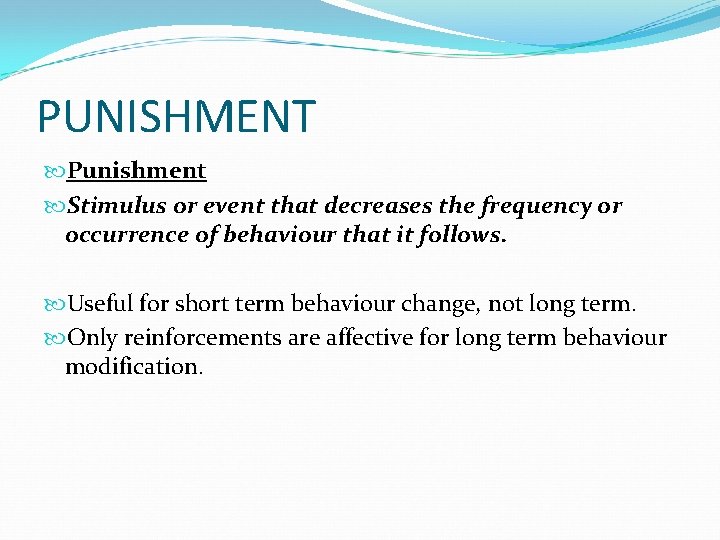
PUNISHMENT Punishment Stimulus or event that decreases the frequency or occurrence of behaviour that it follows. Useful for short term behaviour change, not long term. Only reinforcements are affective for long term behaviour modification.
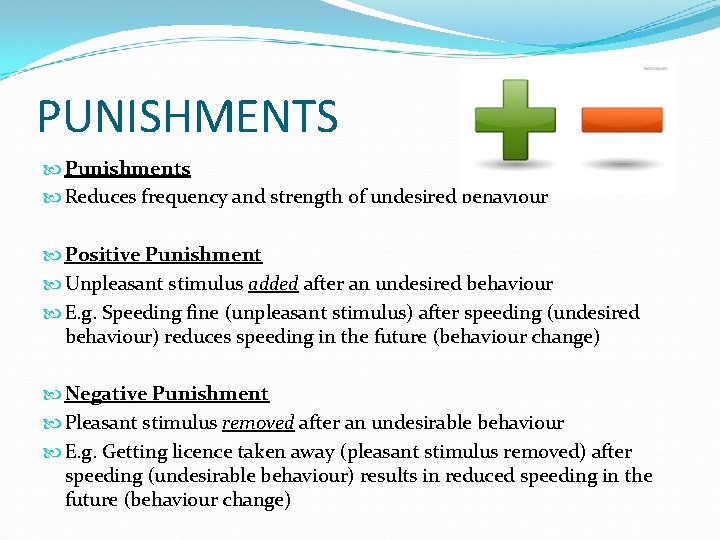
PUNISHMENTS Punishments Reduces frequency and strength of undesired behaviour Positive Punishment Unpleasant stimulus added after an undesired behaviour E. g. Speeding fine (unpleasant stimulus) after speeding (undesired behaviour) reduces speeding in the future (behaviour change) Negative Punishment Pleasant stimulus removed after an undesirable behaviour E. g. Getting licence taken away (pleasant stimulus removed) after speeding (undesirable behaviour) results in reduced speeding in the future (behaviour change)
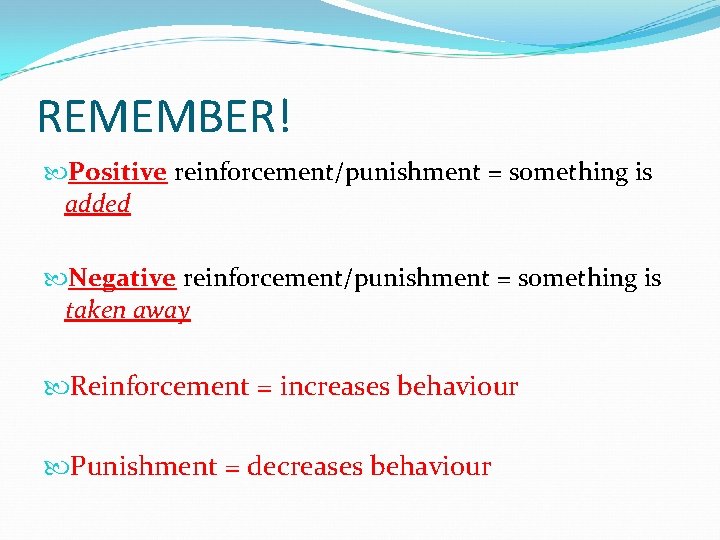
REMEMBER! Positive reinforcement/punishment = something is added Negative reinforcement/punishment = something is taken away Reinforcement = increases behaviour Punishment = decreases behaviour
REMEMBER! Reinforcement = increases behaviour Punishment = decreases behaviour
OPERANT CONDITIONING Let’s do some examples. . . (a) Jenny is a student who performs well in her assignments and tests. As a result of her good work, she is given extra pocket money from her parents when she shows them her results. As a result, Jenny works harder at achieving high grades. State the name of this process Answer: Positive reinforcement
OPERANT CONDITIONING Examples (cont. ) (b) Nick has found that taking a hot water bottle to bed during cold nights helps to keep him warm. As a result, he does this every winter. State the name of this process Answer: Negative reinforcement
OPERANT CONDITIONING Examples (cont. ) (c) Cassandra constantly goes out without telling her parents where she is going and when she will be coming back. As a result, she has been grounded for a month. State the name of this process Answer: Positive punishment
OPERANT CONDITIONING Examples (cont. ) Kate likes to listen to heavy metal music very loudly in her room, even after her father has asked her repeatedly to stop. As a result, Kate’s dad has taken away her CD player. State the name of this process Answer: Negative punishment
SCHEDULES OF REINFORCEMENT Learning
SCHEDULES OF REINFORCEMENT Receiving reinforcement for every behaviour is called continuous reinforcement. Not an everyday occurrence to increase behaviours. Intermittent (or partial) reinforcement much more common. Four schedules of intermittent reinforcement: Fixed interval Fixed ratio Variable interval Variable ratio
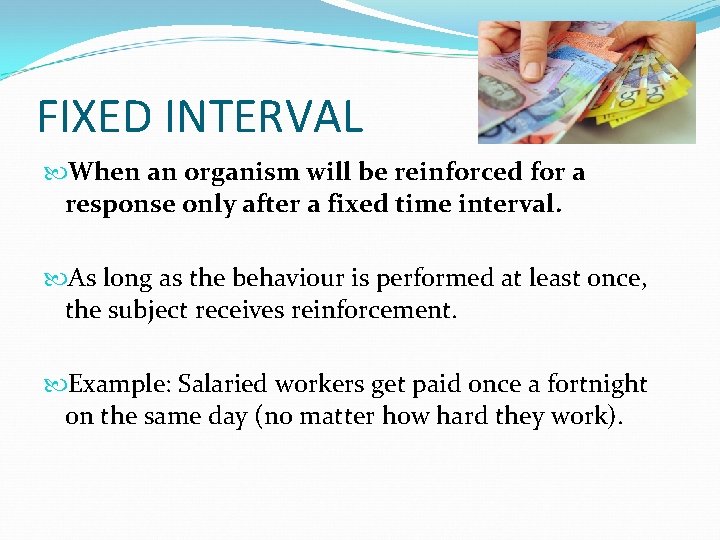
FIXED INTERVAL When an organism will be reinforced for a response only after a fixed time interval. As long as the behaviour is performed at least once, the subject receives reinforcement. Example: Salaried workers get paid once a fortnight on the same day (no matter how hard they work).
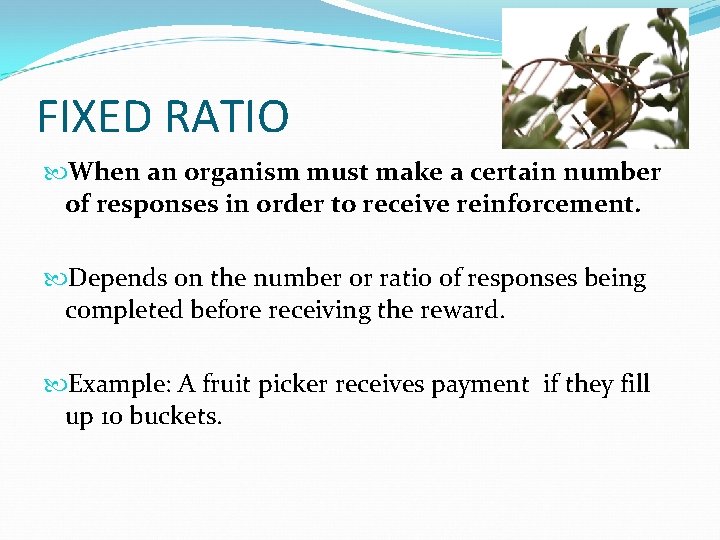
FIXED RATIO When an organism must make a certain number of responses in order to receive reinforcement. Depends on the number or ratio of responses being completed before receiving the reward. Example: A fruit picker receives payment if they fill up 10 buckets.
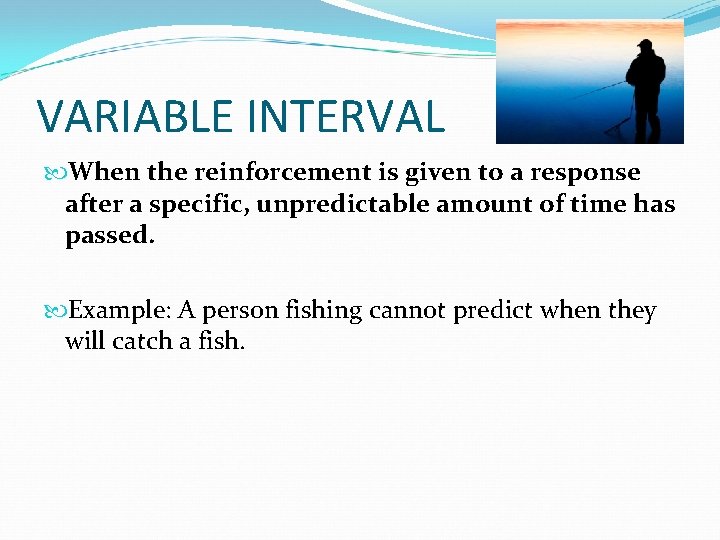
VARIABLE INTERVAL When the reinforcement is given to a response after a specific, unpredictable amount of time has passed. Example: A person fishing cannot predict when they will catch a fish.
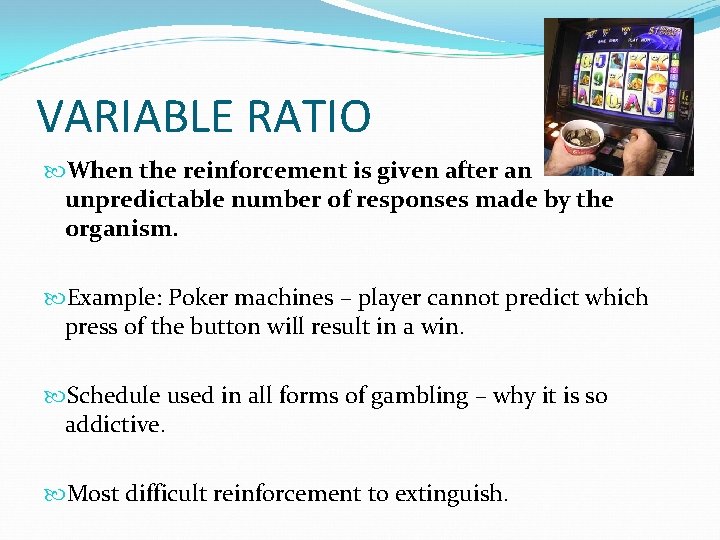
VARIABLE RATIO When the reinforcement is given after an unpredictable number of responses made by the organism. Example: Poker machines – player cannot predict which press of the button will result in a win. Schedule used in all forms of gambling – why it is so addictive. Most difficult reinforcement to extinguish.
REMEMBER! INTERVAL = TIME RATIO = RESPONSES/BEHAVIOURS FIXED = SET
OTHER OPERANT CONDITIONING FACTORS Learning
CONTIGUITY Also important in operant conditioning. Reinforcement needs to be given/received as soon as possible after desired behaviour has been performed for behaviour to continue. Punishment needs to be given/received as soon as possible after undesired behaviour has been performed for behaviour to decline.
CONTINGENCY Also important in operant conditioning. Reinforcer needs to be consistent for behaviour to continue. Punishment needs to be consistent for behaviour to decline.
PREPAREDNESS Some behaviours are ‘shaped’ more easily than others. Reinforcement is shaped more easily than punishment because of the reinforcer being an incentive. Food is a good example for animals and humans > ensures survival/pleasant taste, therefore more likely to continue reinforced behaviour.
ACQUISITION AND PERFORMANCE - OPERANT Acquisition phase: when the reinforcer/punisher is being administered with an increase/decrease in behaviour. Acquiring a new behaviour. Example: Mrs C gives class chocolate when they arrive on time to class/gives class detention for being late. Performance phase: when the subsequent behaviour is performed without the reinforcer/punisher being administered. Performing newly learnt behaviour. Example: Mrs C’s class arrives on time to lesson without her needing to give students chocolate/class stops arriving late.
OBSERVATIONAL LEARNING Learning
OBSERVATIONAL LEARNING Based on principles of learning through observing others perform desired behaviour Learning via observation Pioneers in observational learning were Bandura and Walters in the late 1950 s Interested in aggression in children and how this is developed Were not convinced that conditioning had taken place
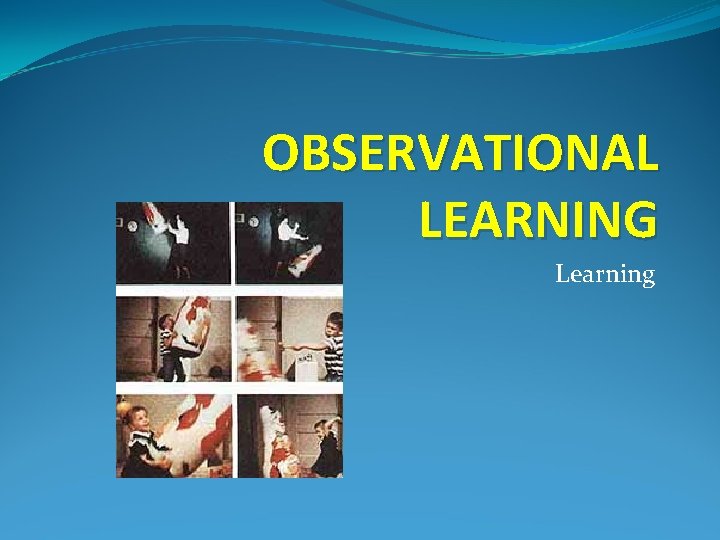
OBSERVATIONAL LEARNING Bandura and Walters developed famous ‘Bobo Doll’ experiment in 1961. Young children between 3 – 6 years of age saw an unknown adult model act aggressively or non aggressively towards an inflatable clown called a ‘Bobo Doll’. The child's subsequent behaviour was evaluated for aggressive and non aggressive behaviour.
OBSERVATIONAL LEARNING Children in the control group > observed adult model playing with children’s construction set, ignoring the Bobo doll. Children in the experimental group witnessed adult model punching, kicking, tossing and verbally abusing Bobo Doll. Results showed that children in the experimental group reproduced significant aggression towards the Bobo doll when presented with it.
OBSERVATIONAL LEARNING Subjects being observed is called ‘model’ Subject observing the model’s behaviour is called ‘observer’ Factors of observational learning (ARRM): Attention Reproduction Motivation
ATTENTION In order for learning to occur, observer must pay attention to the models behaviour. Example: young child paying attention to parent washing the dishes.
RETENTION Observer codes observed behaviour information into long term memory. Example: remembering parents method/process of washing the dishes.
REPRODUCTION Observer must be able to reproduce model’s behaviour. Example: Observer (young child) must be physically and mentally capable of recreating models behaviour of washing dishes.
MOTIVATION Observer expects positive reinforcement for modelled behaviour. Example: model (parent) praises child (observer ) for washing dishes. Reinforcement can be external (object reward) or internal (sense of accomplishment).
OTHER FACTORS OF OBSERVATIONAL LEARNING Gender of model Observers tend to reproduce same sex model Social Status of model The higher the social status, the more their behaviour will be reproduced by observer Relationship between model and observer The closer the relationship, the more the observer wants to impress the model and receive positive reinforcement Consequences after models behaviour If consequence is positive, behaviour will be reproduced by observer more willingly
FEARS AND PHOBIAS Learning
FEARS AND PHOBIAS Fear: an unpleasant emotion caused by the threat of danger, pain, or harm. E. g. Totally rational to have a fear of snakes, but continue functioning normally. Phobia: an extreme and/or irrational fear of or aversion to a stimulus. E. g. living in the CBD/urban area but refuse to go outside in fear of being bitten by a snake. A phobia negatively impacts everyday functioning and/or is irrational (not logical or reasonable).
FEARS AND PHOBIAS How do fears and phobias develop? Mere exposure – being exposed indirectly to the stimulus i. e. watching it on television. Direct experience – having a negative direct interaction with the stimuli – how more serious phobias develop. Observational learning – watching a model have a negative reaction to a stimuli i. e. parents are afraid of spiders so observer (child) fears them too.
PSYCHOLOGICAL INTERVENTIONS FOR PHOBIAS Learning
TREATMENTS FOR PHOBIAS Exposure therapy Psychological treatment to help people confront their phobias. When people are phobic of a stimuli, they tend to avoid it. Short term this reduces fear, but long term it makes phobia worse. Exposure therapy creates a safe environment in which to ‘expose’ individuals to the stimuli they normally try and avoid: Two types we examine in Stage 2 Psychology: Systematic Desensitization (SD) Cognitive Behavioural Therapy (CBT)
SYSTEMATIC DESENSITISATION Form of behaviour therapy used to treat phobias and other behaviour problems involving anxiety. Based on Classical Conditioning Aim is to condition relaxation with feared item/object Three steps involved: 1. Relaxation techniques 2. Developing anxiety hierarchy 3. Pairing
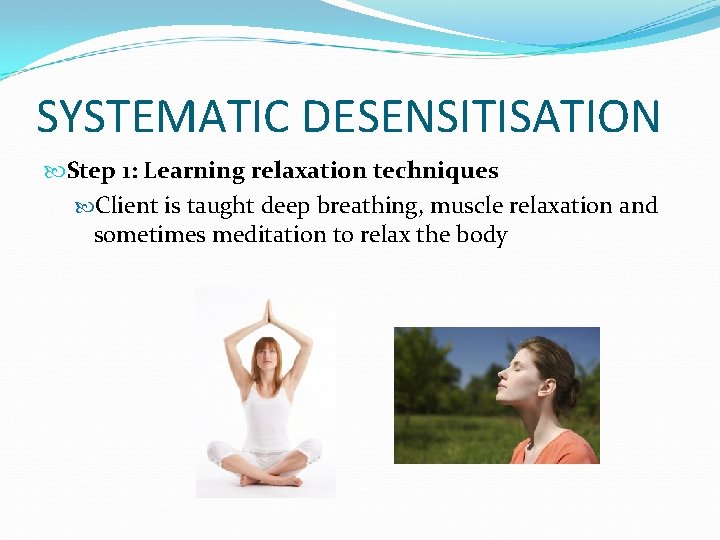
SYSTEMATIC DESENSITISATION Step 1: Learning relaxation techniques Client is taught deep breathing, muscle relaxation and sometimes meditation to relax the body
SYSTEMATIC DESENSITISATION Step 2: Developing an anxiety hierarchy Often a list, which lists the least threatening situation to most threatening situation in relation to fear causing stimulus. Example: Spider hierarchy 1. looking at picture of spider (least) 2. seeing a spider on TV 3. seeing a spider in a pet store 4. holding a glass box with a spider in it 5. holding a spider (most)
SYSTEMATIC DESENSITISATION Step 3: Pairing the relaxation techniques with the items in the anxiety hierarchy. Ultimately, the client will be conditioned to have relaxation instead of fear as conditioned response.
COGNITIVE BEHAVIOUR THERAPY (CBT) Used extensively in the treatment of anxiety and depression Most recognised and effective psychological therapy Teaches client to understand, manage and change their distorted thoughts and actions Helps client become aware of thought distortions if they occur again Improved skills of awareness, introspection and evaluation – coping strategies Reduces likelihood of relapse Often quicker success than systematic desensitisation
BEHAVIOUR MODIFICATION Learning
BEHAVIOUR MODIFICATION The use of conditioning or reinforcement to alter behaviour. Based on operant conditioning Desirable behaviour is reinforced with a reward that is more desirable than the previous, unwanted reinforcer. Example: Someone who wants to give up smoking could reward themselves with a chocolate each time they refuse a cigarette. Chocolate is more desirable than cigarette to this person > behaviour modification going to be effective.
BEHAVIOUR MODIFICATION Example – increasing time spent doing homework Establish desired behaviour goal – spending 2 hours a night on homework Establish reinforcement – one chocolate for every half hour of study Start program After behaviour is established it may be necessary to change to intermittent schedule of reinforcement to continue behaviour and may need to change reinforcement so it doesn’t become predictable Eventually person should be able to perform behaviour continuously without need for reinforcement
BEHAVIOUR MODIFICATION Often used in primary schools to help children learn desirable behaviours. Charts will be made with small reinforcers such as stickers, stamps etc.
LEARNED HELPLESSNESS Learning
LEARNED HELPLESSNESS Results when a person or animal is prevented repeatedly from avoiding some aversive stimulus and becomes passive and depressed. Main researcher was Martin Seligman in the 1970 s. Conducted research on dogs where they were continuously exposed to electric shocks that were unavoidable.
LEARNED HELPLESSNESS Eventually the dogs were given the opportunity to escape the shocks by jumping over a barrier, however most dogs did not and simply lay down and took the shocks. Seligman argued that the dogs had learned to be helpless. Similar observations in humans who have depression > reduced motivation.
METHODS OF ASSESSMENT Learning
METHODS OF ASSESSMENT Objective quantitative: Behaviour counts (how many times a learnt behaviour is demonstrated), Physiological responses (how fearful/nervous someone is) etc. Subjective quantitative: Rating scales, subjective questionnaires etc. Qualitative: Focus groups, Delphi technique, interviews, pictures etc.
ETHICS Learning
ETHICS Important to consider that behaviour is being changed either directly or indirectly. Researchers need to consider the impact of classical, operant and observational learning experiments > Little Albert, Pavlov, Skinner and Bobo doll all had ethical dilemmas. Long term effects may occur due to nature of type of learning/intervention.
BASIC PROCESSES LEVEL OF EXPLANATION Learning
BASIC PROCESSES Remember, Learning is directly linked to the basic processes level of explanation of behaviour. You can use content from this topic to answer test/exam questions on the basic processes level. We will now re-watch the four levels videos we did in week 1, and apply Learning content.