
Learning realistic human actions from movies Ivan Laptev




- Slides: 26
Learning realistic human actions from movies Ivan Laptev*, Marcin Marszałek**, Cordelia Schmid**, Benjamin Rozenfeld*** * INRIA Rennes, France ** INRIA Grenoble, France *** Bar-Ilan University, Israel
Human actions: Motivation Huge amount of video is available and growing Human actions are major events in movies, TV news, personal video … 150, 000 uploads every day Action recognition useful for: • Content-based browsing e. g. fast-forward to the next goal scoring scene • Video recycling e. g. find “Bush shaking hands with Putin” • Human scientists influence of smoking in movies on adolescent smoking
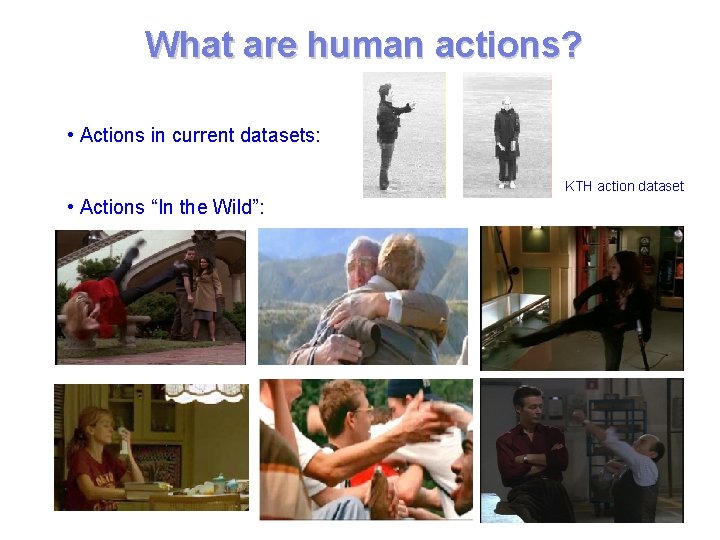
What are human actions? • Actions in current datasets: KTH action dataset • Actions “In the Wild”:
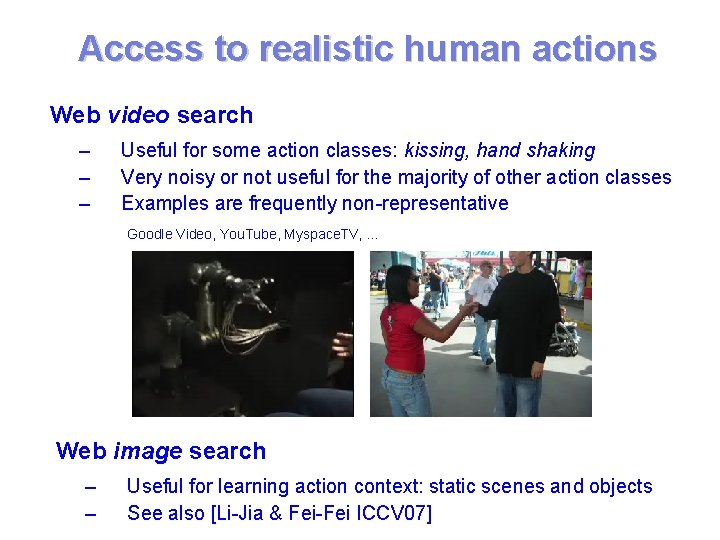
Access to realistic human actions Web video search – – – Useful for some action classes: kissing, hand shaking Very noisy or not useful for the majority of other action classes Examples are frequently non-representative Goodle Video, You. Tube, Myspace. TV, … Web image search – – Useful for learning action context: static scenes and objects See also [Li-Jia & Fei-Fei ICCV 07]
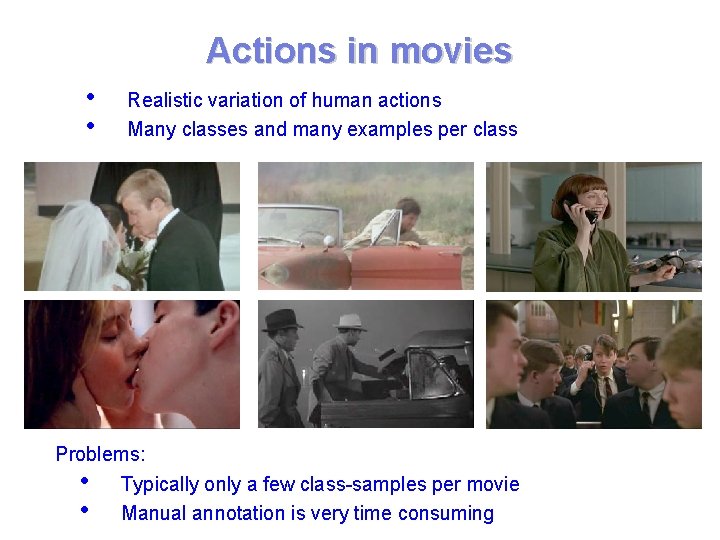
Actions in movies • • Realistic variation of human actions Many classes and many examples per class Problems: • Typically only a few class-samples per movie • Manual annotation is very time consuming
Automatic video annotation using scripts [Everingham et al. BMVC 06] • • • Scripts available for >500 movies (no time synchronization) www. dailyscript. com, www. movie-page. com, www. weeklyscript. com … Subtitles (with time info. ) are available for the most of movies Can transfer time to scripts by text alignment movie script subtitles … 1172 01: 20: 17, 240 --> 01: 20, 437 … Why weren't you honest with me? Why'd you keep your marriage a secret? 1173 01: 20, 640 --> 01: 20: 23, 598 lt wasn't my secret, Richard. Victor wanted it that way. Why weren't you honest with me? Why did you keep your marriage a secret? 01: 20: 17 01: 20: 23 Rick sits down with Ilsa. ILSA 1174 01: 20: 23, 800 --> 01: 20: 26, 189 Not even our closest friends knew about our marriage. … RICK … Oh, it wasn't my secret, Richard. Victor wanted it that way. Not even our closest friends knew about our marriage.
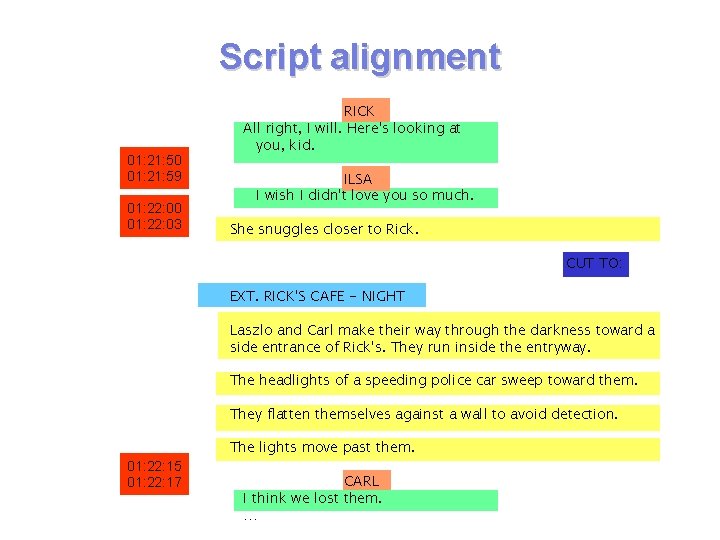
Script alignment 01: 21: 50 01: 21: 59 01: 22: 00 01: 22: 03 RICK All right, I will. Here's looking at you, kid. ILSA I wish I didn't love you so much. She snuggles closer to Rick. CUT TO: EXT. RICK'S CAFE - NIGHT Laszlo and Carl make their way through the darkness toward a side entrance of Rick's. They run inside the entryway. The headlights of a speeding police car sweep toward them. They flatten themselves against a wall to avoid detection. 01: 22: 15 01: 22: 17 The lights move past them. CARL I think we lost them. …
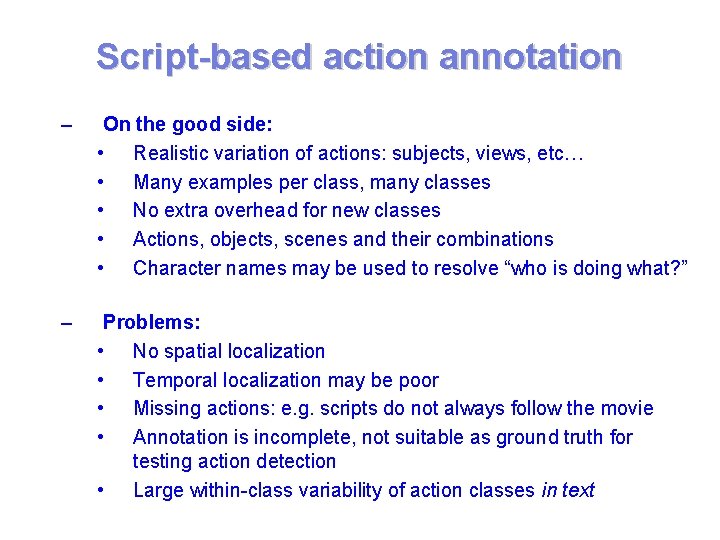
Script-based action annotation – On the good side: • Realistic variation of actions: subjects, views, etc… • Many examples per class, many classes • No extra overhead for new classes • Actions, objects, scenes and their combinations • Character names may be used to resolve “who is doing what? ” – Problems: • No spatial localization • Temporal localization may be poor • Missing actions: e. g. scripts do not always follow the movie • Annotation is incomplete, not suitable as ground truth for testing action detection • Large within-class variability of action classes in text
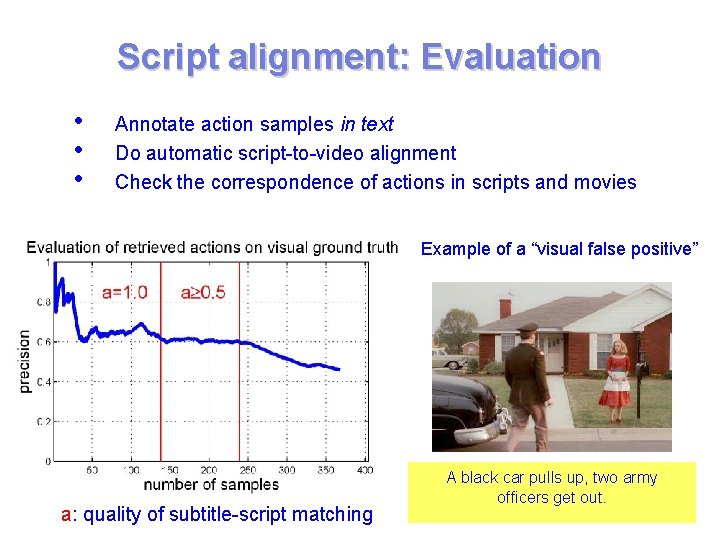
Script alignment: Evaluation • • • Annotate action samples in text Do automatic script-to-video alignment Check the correspondence of actions in scripts and movies Example of a “visual false positive” a: quality of subtitle-script matching A black car pulls up, two army officers get out.
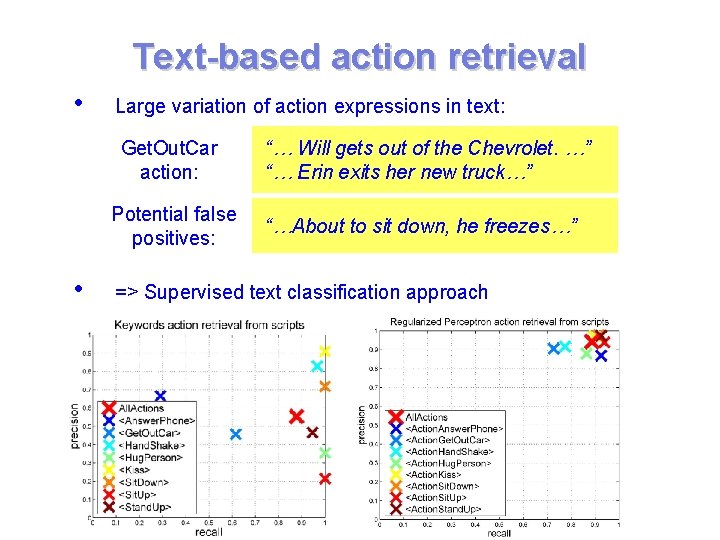
Text-based action retrieval • Large variation of action expressions in text: Get. Out. Car action: Potential false positives: • “… Will gets out of the Chevrolet. …” “… Erin exits her new truck…” “…About to sit down, he freezes…” => Supervised text classification approach
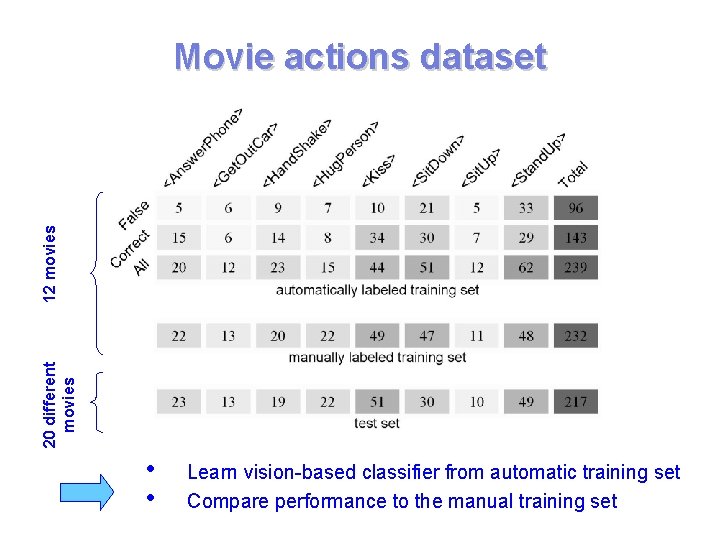
20 different movies 12 movies Movie actions dataset • • Learn vision-based classifier from automatic training set Compare performance to the manual training set
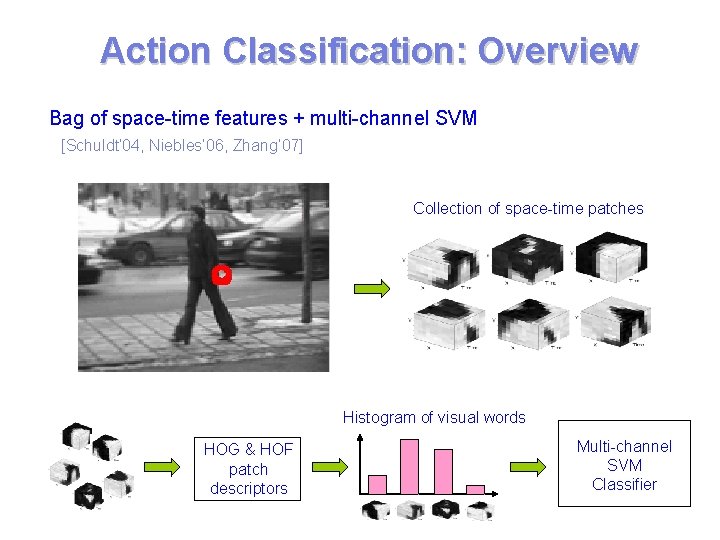
Action Classification: Overview Bag of space-time features + multi-channel SVM [Schuldt’ 04, Niebles’ 06, Zhang’ 07] Collection of space-time patches Histogram of visual words HOG & HOF patch descriptors Multi-channel SVM Classifier
Space-Time Features: Detector Space-time corner detector [Laptev, IJCV 2005] Dense scale sampling (no explicit scale selection)
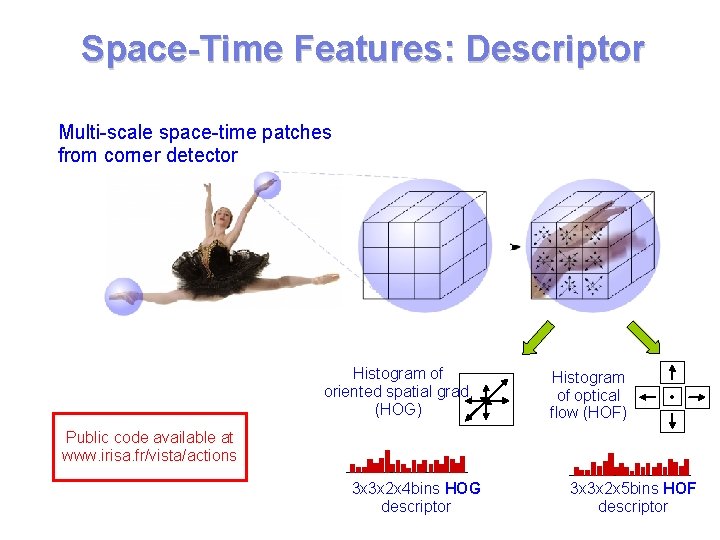
Space-Time Features: Descriptor Multi-scale space-time patches from corner detector Histogram of oriented spatial grad. (HOG) Histogram of optical flow (HOF) Public code available at www. irisa. fr/vista/actions 3 x 3 x 2 x 4 bins HOG descriptor 3 x 3 x 2 x 5 bins HOF descriptor
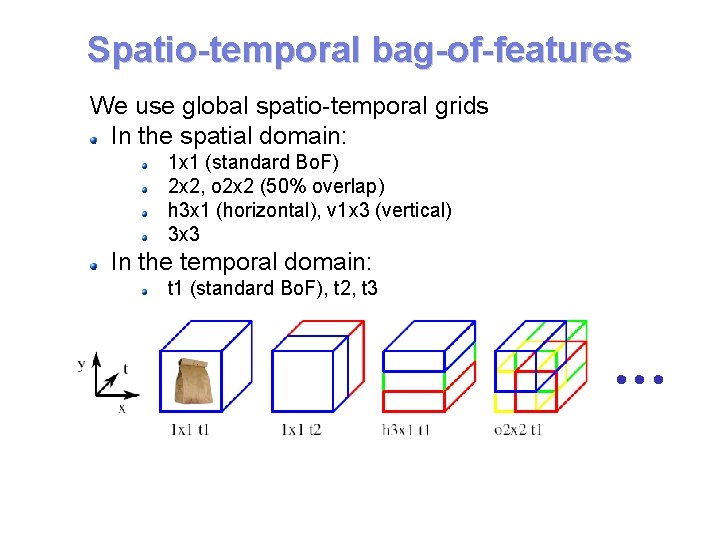
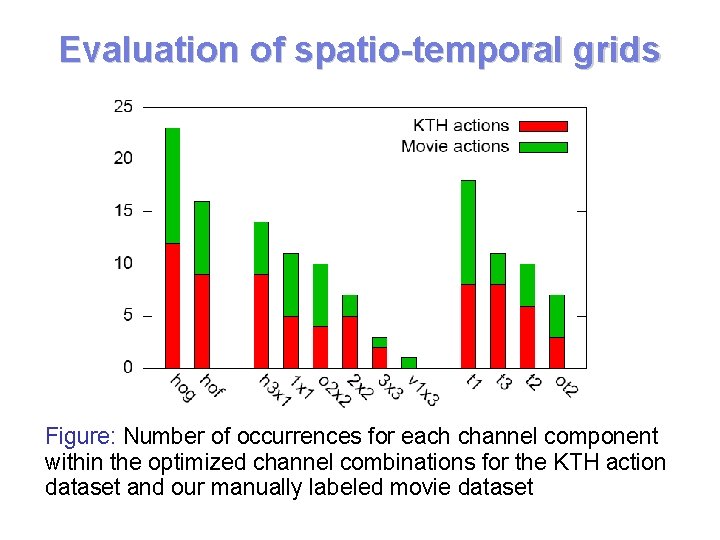
Spatio-temporal bag-of-features We use global spatio-temporal grids In the spatial domain: 1 x 1 (standard Bo. F) 2 x 2, o 2 x 2 (50% overlap) h 3 x 1 (horizontal), v 1 x 3 (vertical) 3 x 3 In the temporal domain: t 1 (standard Bo. F), t 2, t 3
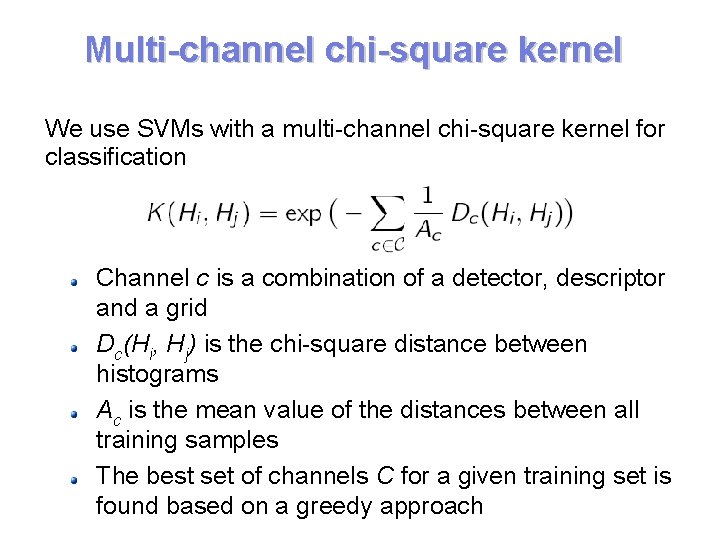
Multi-channel chi-square kernel We use SVMs with a multi-channel chi-square kernel for classification Channel c is a combination of a detector, descriptor and a grid Dc(Hi, Hj) is the chi-square distance between histograms Ac is the mean value of the distances between all training samples The best set of channels C for a given training set is found based on a greedy approach
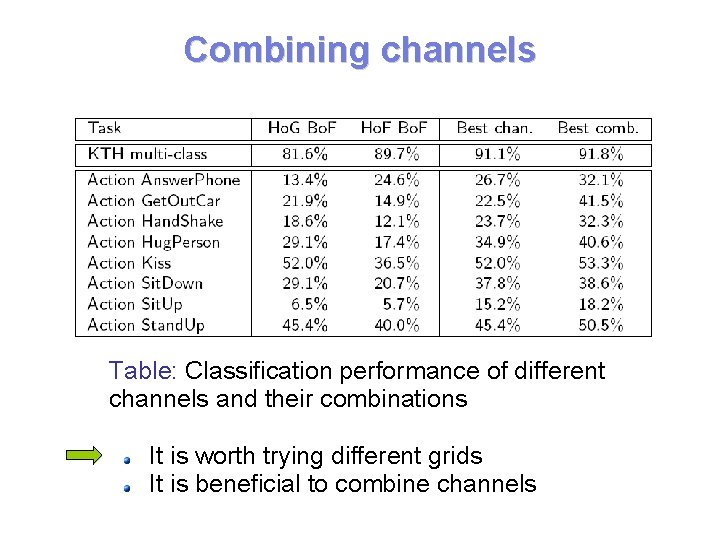
Combining channels Table: Classification performance of different channels and their combinations It is worth trying different grids It is beneficial to combine channels
Evaluation of spatio-temporal grids Figure: Number of occurrences for each channel component within the optimized channel combinations for the KTH action dataset and our manually labeled movie dataset
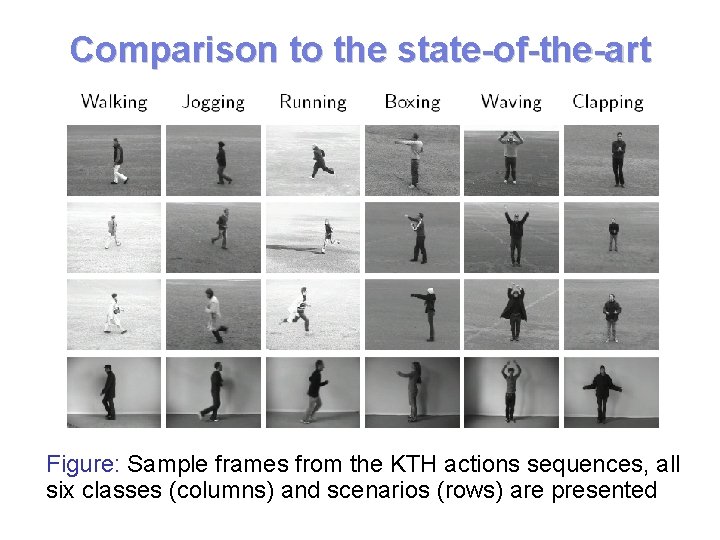
Comparison to the state-of-the-art Figure: Sample frames from the KTH actions sequences, all six classes (columns) and scenarios (rows) are presented
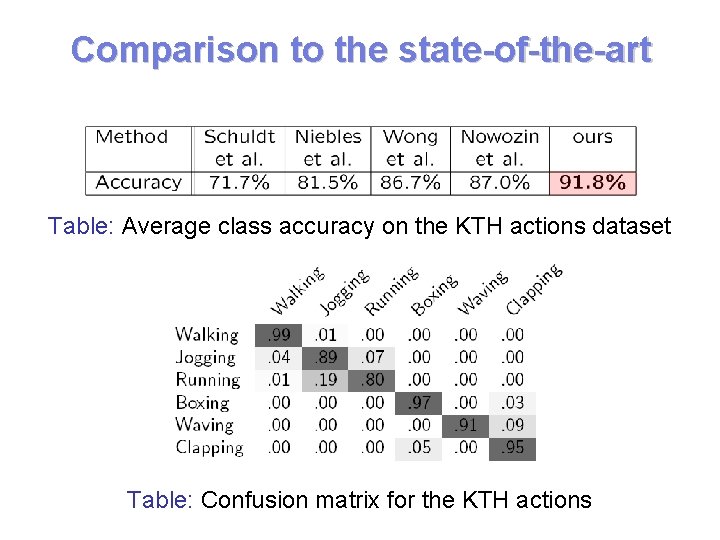
Comparison to the state-of-the-art Table: Average class accuracy on the KTH actions dataset Table: Confusion matrix for the KTH actions
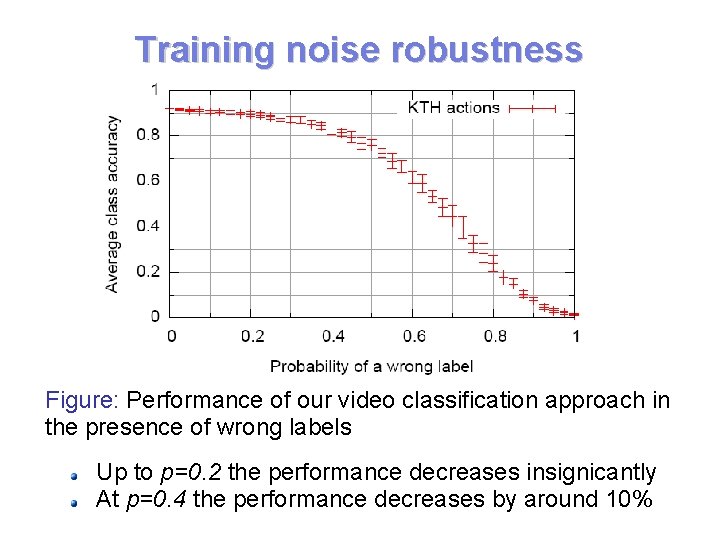
Training noise robustness Figure: Performance of our video classification approach in the presence of wrong labels Up to p=0. 2 the performance decreases insignicantly At p=0. 4 the performance decreases by around 10%
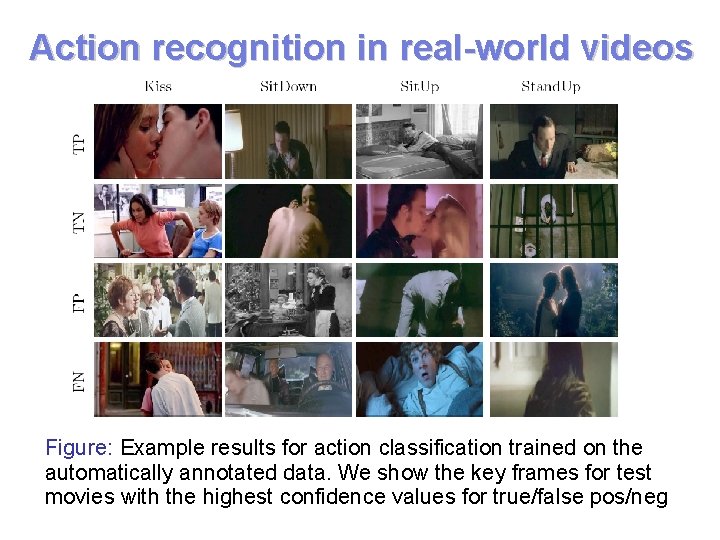
Action recognition in real-world videos Figure: Example results for action classification trained on the automatically annotated data. We show the key frames for test movies with the highest confidence values for true/false pos/neg
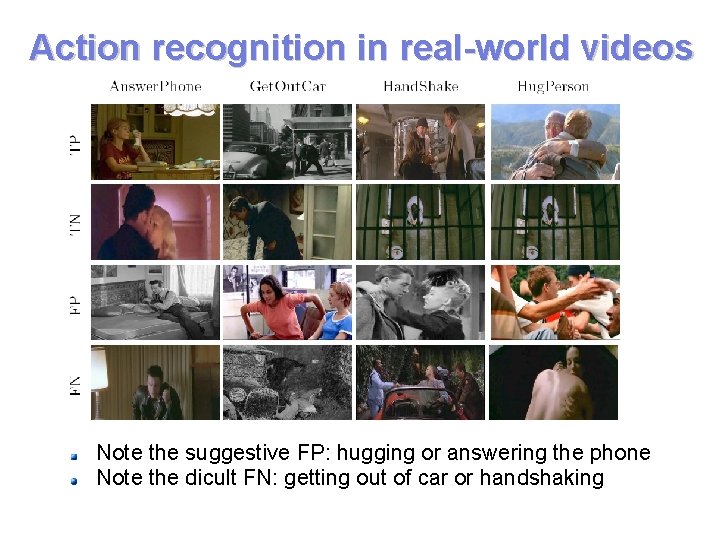
Action recognition in real-world videos Note the suggestive FP: hugging or answering the phone Note the dicult FN: getting out of car or handshaking
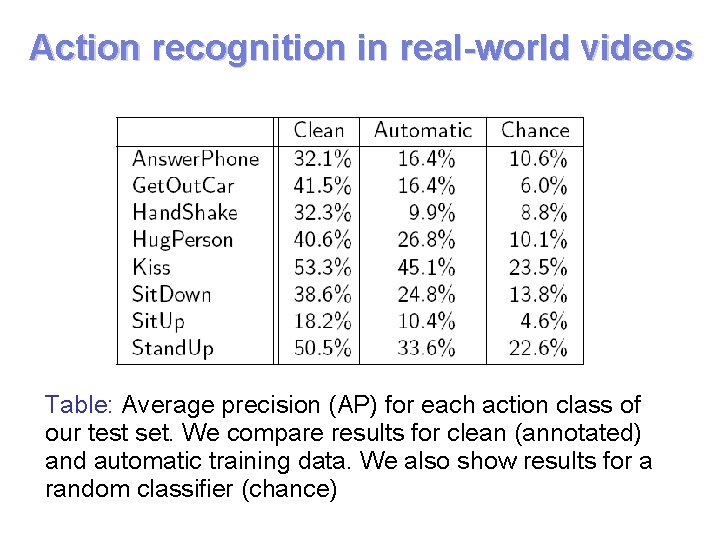
Action recognition in real-world videos Table: Average precision (AP) for each action class of our test set. We compare results for clean (annotated) and automatic training data. We also show results for a random classifier (chance)
Action classification Test episodes from movies “The Graduate”, “It’s a wonderful life”, “Indiana Jones and the Last Crusade”
Conclusions Summary Automatic generation of realistic action samples New action dataset available www. irisa. fr/vista/actions Transfer of recent bag-of-features experience to videos Improved performance on KTH benchmark Promising results for actions in the wild Future directions Automatic action class discovery Internet-scale video search Video+Text+Sound+…