
Learning Progressions in Science KESS 3 5 ESS
- Slides: 28
Learning Progressions in Science K-ESS 3 -5 ESS 3 Earth and Human Activity By Melinda Baer & Michael Suzuki
Slide Narration
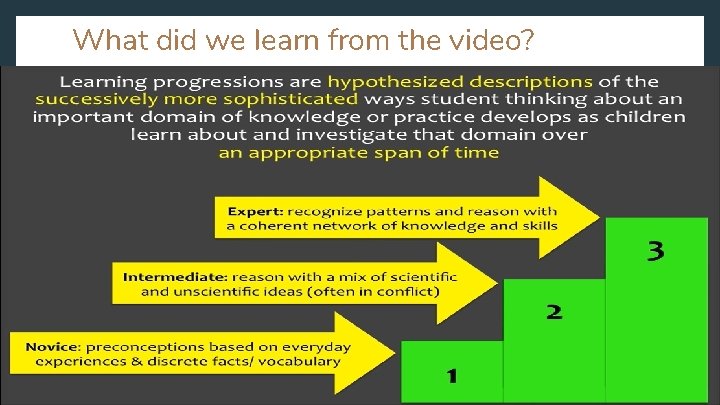
Introduction to Learning Progressions According to Week Two’s Google slideshow in ITL 516, learning progressions are “Narrative documents describing the progression of a topic across a number of grade levels. ” In other words, learning progressions describe the “skills and understandings that students are expected to have at each stage on their path to mastery. ” (ETS 2019)
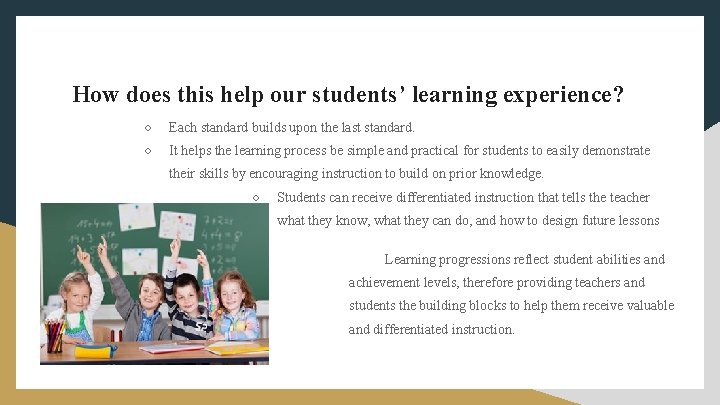
How does this help our students’ learning experience? ○ Each standard builds upon the last standard. ○ It helps the learning process be simple and practical for students to easily demonstrate their skills by encouraging instruction to build on prior knowledge. ○ Students can receive differentiated instruction that tells the teacher what they know, what they can do, and how to design future lessons Learning progressions reflect student abilities and achievement levels, therefore providing teachers and students the building blocks to help them receive valuable and differentiated instruction.
How learning progressions help our teachers teach ● Plan curricula better to meet learning targets ● Teachers can gain information about their students’ progress that can better help them to differentiate instruction ● Learning progression assessments show students precursor skills ● Teachers understand each student’s level of expertise on an individual basis
What Does It Mean To Unpack a Standard? In order for students to understand the Common Core Standards, teachers must make the academic language engaging for students. In other words, teachers are encouraged to “unpack” standards, pulling out important verbs and nouns from the standard, and incorporating student’s prior knowledge on the subject.
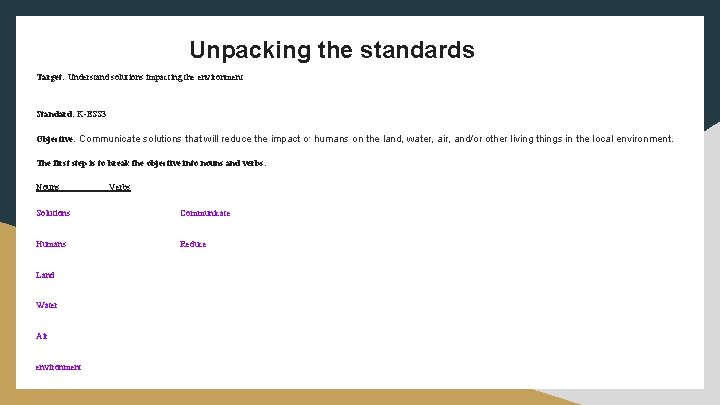
Unpacking the standards Target: Understand solutions impacting the environment Standard: K-ESS 3 Objective: Communicate solutions that will reduce the impact of humans on the land, water, air, and/or other living things in the local environment. The first step is to break the objective into nouns and verbs: Nouns Verbs Solutions Communicate Humans Reduce Land Water Air environment
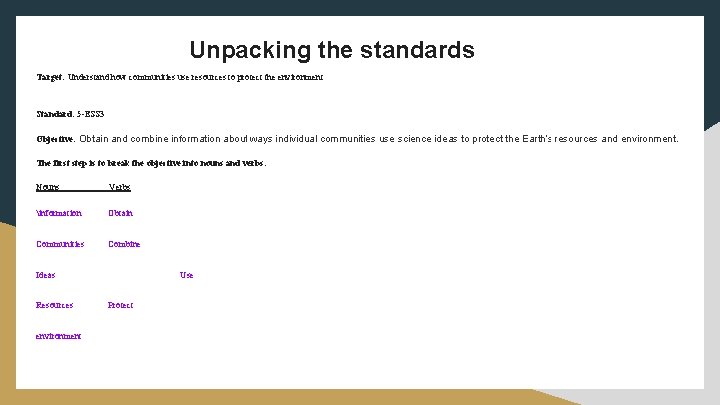
Unpacking the standards Target: Understand how communities use resources to protect the environment Standard: 5 -ESS 3 Objective: Obtain and combine information about ways individual communities use science ideas to protect the Earth’s resources and environment. The first step is to break the objective into nouns and verbs: Nouns Verbs information Obtain Communities Combine Ideas Resources environment Use Protect
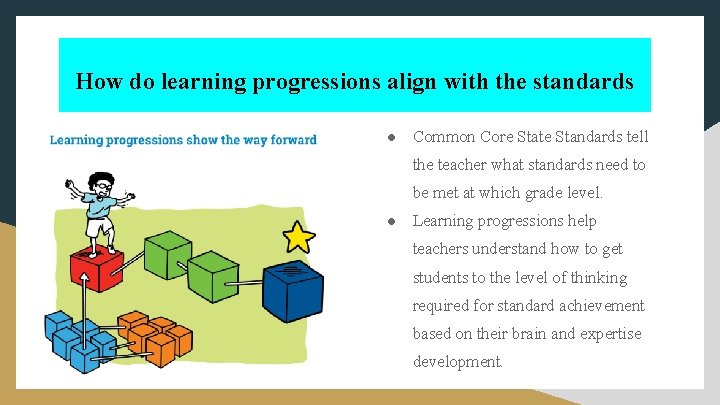
How do learning progressions align with the standards ● Common Core State Standards tell the teacher what standards need to be met at which grade level. ● Learning progressions help teachers understand how to get students to the level of thinking required for standard achievement based on their brain and expertise development.
Types of Progression learning: Questions As they progress across the grades, their questions should become more relevant, focused, and sophisticated. Facilitating such evolution will require a classroom culture that respects and values good questions, that offers students opportunities to refine their questions and questioning strategies, and that incorporates the teaching of effective questioning strategies across all grade levels. As a result, students will become increasingly proficient at posing questions that request relevant empirical evidence; that seek to refine a model, an explanation, or an engineering problem; or that challenge the premise of an argument or the suitability of a design.
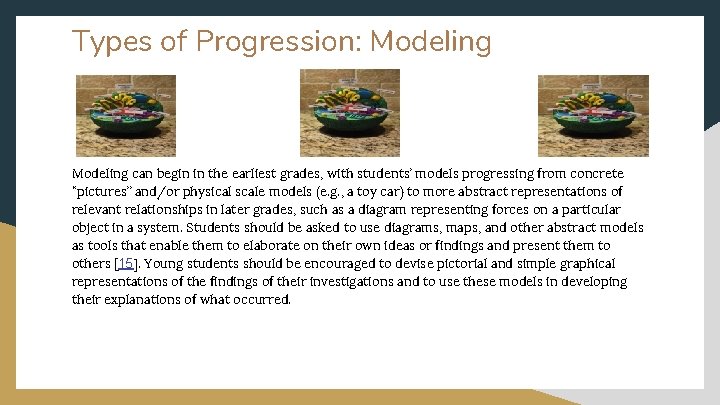
Types of Progression: Modeling can begin in the earliest grades, with students’ models progressing from concrete “pictures” and/or physical scale models (e. g. , a toy car) to more abstract representations of relevant relationships in later grades, such as a diagram representing forces on a particular object in a system. Students should be asked to use diagrams, maps, and other abstract models as tools that enable them to elaborate on their own ideas or findings and present them to others [15]. Young students should be encouraged to devise pictorial and simple graphical representations of the findings of their investigations and to use these models in developing their explanations of what occurred.
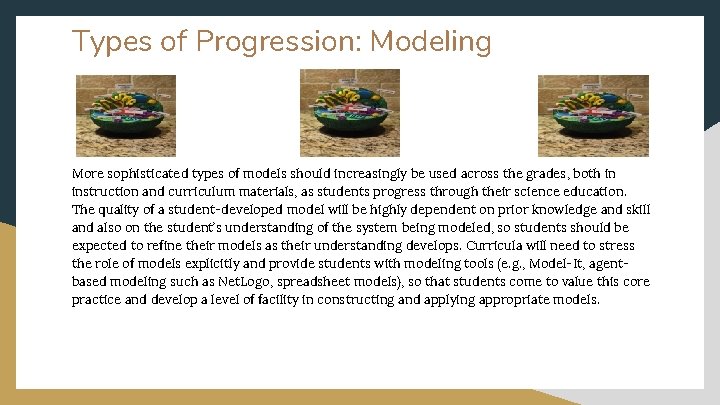
Types of Progression: Modeling More sophisticated types of models should increasingly be used across the grades, both in instruction and curriculum materials, as students progress through their science education. The quality of a student-developed model will be highly dependent on prior knowledge and skill and also on the student’s understanding of the system being modeled, so students should be expected to refine their models as their understanding develops. Curricula will need to stress the role of models explicitly and provide students with modeling tools (e. g. , Model-It, agentbased modeling such as Net. Logo, spreadsheet models), so that students come to value this core practice and develop a level of facility in constructing and applying appropriate models.
Types of Progression: Designing In the elementary years, students’ experiences should be structured to help them learn to define the features to be investigated, such as patterns that suggest causal relationships (e. g. , What features of a ramp affect the speed of a given ball as it leaves the ramp? ). The plan of the investigation, what trials to make and how to record information about them, then needs to be refined iteratively as students recognize from their experiences the limitations of their original plan. These investigations can be enriched and extended by linking them to engineering design projects—for example, how can students apply what they have learned about ramps to design a track that makes a ball travel a given distance, go around a loop, or stop on an uphill slope. From the earliest grades, students should have opportunities to carry out careful and systematic investigations, with appropriately supported prior experiences that develop their ability to observe and measure and to record data using appropriate tools and instruments.
Types of Progression: Designing Students should have opportunities to plan and carry out several different kinds of investigations during their K-12 years. At all levels, they should engage in investigations that range from those structured by the teacher—in order to expose an issue or question that they would be unlikely to explore on their own (e. g. , measuring specific properties of materials)—to those that emerge from students’ own questions. As they become more sophisticated, students also should have opportunities not only to identify questions to be researched but also to decide what data are to be gathered, what variables should be controlled, what tools or instruments are needed to gather and record data in an appropriate format, and eventually to consider how to incorporate measurement error in analyzing data.
Types of Progression: Designing Older students should be asked to develop a hypothesis that predicts a particular and stable outcome and to explain their reasoning and justify their choice. By high school, any hypothesis should be based on a well-developed model or theory. In addition, students should be able to recognize that it is not always possible to control variables and that other methods can be used in such cases—for example, looking for correlations (with the understanding that correlations do not necessarily imply causality).
Types of Progression: Observation At the elementary level, students need support to recognize the need to record observations— whether in drawings, words, or numbers—and to share them with others. As they engage in scientific inquiry more deeply, they should begin to collect categorical or numerical data for presentation in forms that facilitate interpretation, such as tables and graphs. When feasible, computers and other digital tools should be introduced as a means of enabling this practice.
Types of Progression: Observation In middle school, students should have opportunities to learn standard techniques for displaying, analyzing, and interpreting data; such techniques include different types of graphs, the identification of outliers in the data set, and averaging to reduce the effects of measurement error. Students should also be asked to explain why these techniques are needed.
Types of Progression: Observation As students progress through various science classes in high school and their investigations become more complex, they need to develop skill in additional techniques for displaying and analyzing data, such as x-y scatterplots or cross-tabulations to express the relationship between two variables. Students should be helped to recognize that they may need to explore more than one way to display their data in order to identify and present significant features. They also need opportunities to use mathematics and statistics to analyze features of data such as covariation. Also at the high school level, students should have the opportunity to use a greater diversity of samples of scientific data and to use computers or other digital tools to support this kind of analysis.
Types of Progression: Mathematics within Science Increasing students’ familiarity with the role of mathematics in science is central to developing a deeper understanding of how science works. As soon as students learn to count, they can begin using numbers to find or describe patterns in nature. At appropriate grade levels, they should learn to use such instruments as rulers, protractors, and thermometers for the measurement of variables that are best represented by a continuous numerical scale, to apply mathematics to interpolate values, and to identify features—such as maximum, minimum, range, average, and median—of simple data sets.
Types of Progression: Mathematics within Science A significant advance comes when relationships are expressed using equalities first in words and then in algebraic symbols—for example, shifting from distance traveled equals velocity multiplied by time elapsed to s = vt. Students should have opportunities to explore how such symbolic representations can be used to represent data, to predict outcomes, and eventually to derive further relationships using mathematics. Students should gain experience in using computers to record measurements taken with computer-connected probes or instruments, thereby recognizing how this process allows multiple measurements to be made rapidly and recurrently. Likewise, students should gain experience in using computer programs to transform their data between various tabular and graphical forms, thereby aiding in the identification of patterns.
Types of Progression: Mathematics within Science Students should thus be encouraged to explore the use of computers for data analysis, using simple data sets, at an early age. For example, they could use spreadsheets to record data and then perform simple and recurring calculations from those data, such as the calculation of average speed from measurements of positions at multiple times. Later work should introduce them to the use of mathematical relationships to build simple computer models, using appropriate supporting programs or information and computer technology tools. As students progress in their understanding of mathematics and computation, at every level the science classroom should be a place where these tools are progressively exploited.
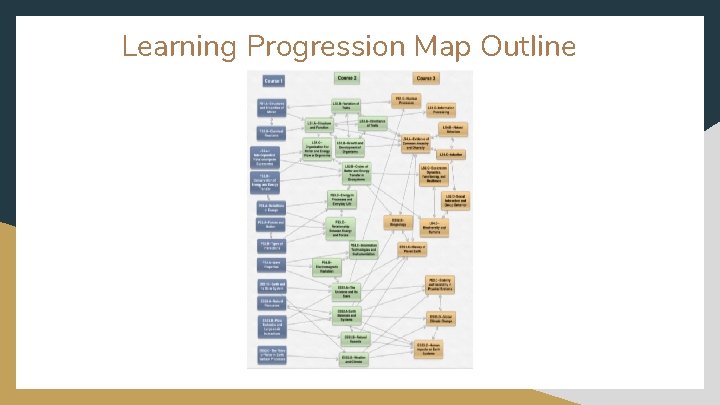
Learning Progression Map Outline
Learning Progressions Explained
What did we learn from the video?
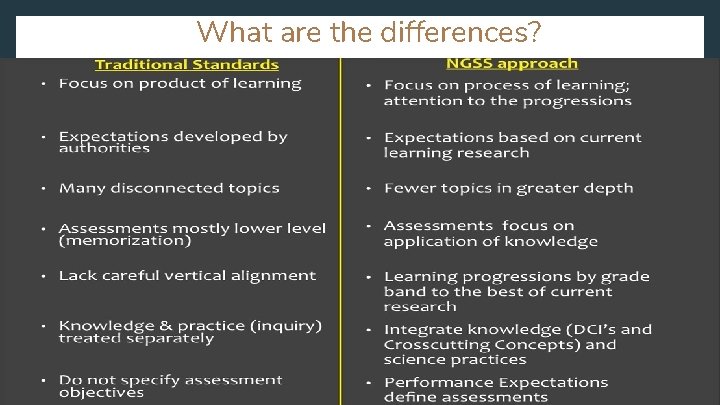
What are the differences?
References Science, M. (2013, August 19). Disciplinary Core Ideas & Learning Progressions (Appendix E). Retrieved from https: //www. youtube. com/watch? time_continue=16&v=Uf. Ke. A 5 Ao 9 EI Next Generation Science Standards. (2019, February 11). Retrieved from https: //www. nextgenscience. org/