
Learning Principles and Applications Exploring Psychology Which Pen

- Slides: 37
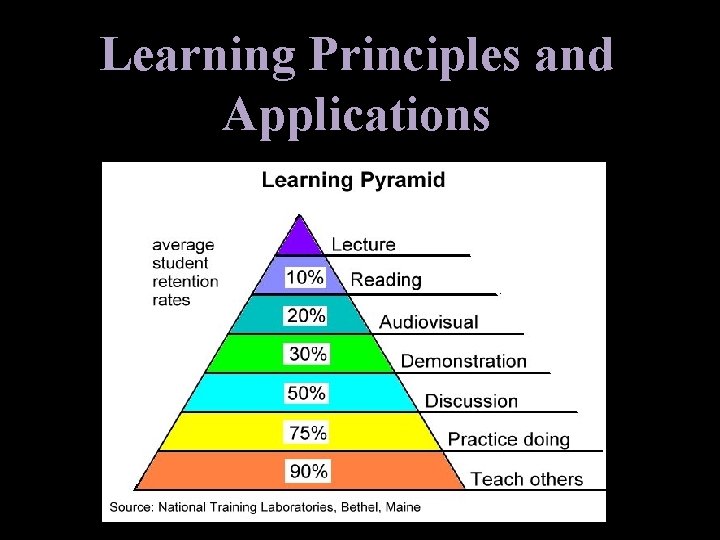
Learning Principles and Applications
Exploring Psychology Which Pen Would You Choose? The researchers placed the participants in a room. In this room the participants first viewed purple pens. As the participants sat staring at the purple pens, pleasant music played in the background. Then the music stopped and the purple pens were taken away. Suddenly green pens appeared. As the participants sat staring at the green pens, they heard unpleasant music in the background. Later, the researchers offered the pens to the participants. The participants could pick a purple or green pen. The participants overwhelmingly chose purple pens. Why? Why did the students choose the purple pens?
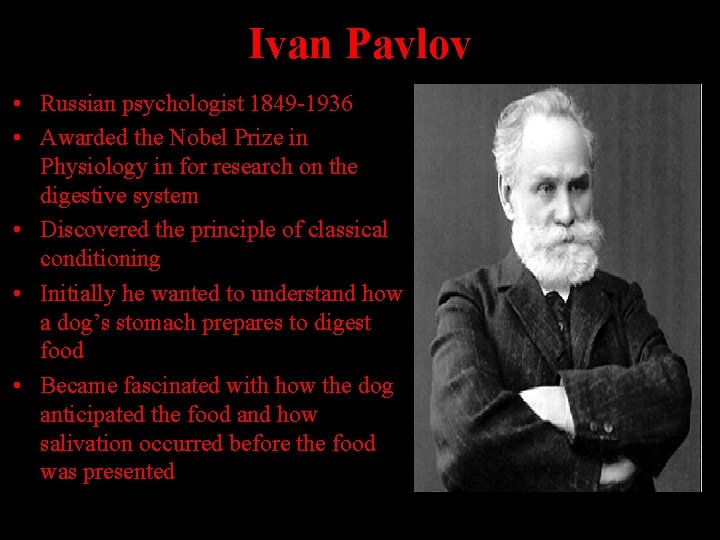
Ivan Pavlov • Russian psychologist 1849 -1936 • Awarded the Nobel Prize in Physiology in for research on the digestive system • Discovered the principle of classical conditioning • Initially he wanted to understand how a dog’s stomach prepares to digest food • Became fascinated with how the dog anticipated the food and how salivation occurred before the food was presented
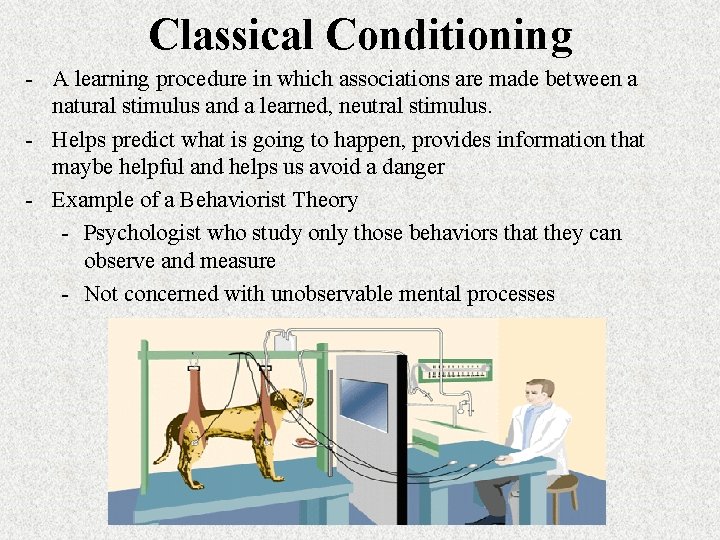
Classical Conditioning - A learning procedure in which associations are made between a natural stimulus and a learned, neutral stimulus. - Helps predict what is going to happen, provides information that maybe helpful and helps us avoid a danger - Example of a Behaviorist Theory - Psychologist who study only those behaviors that they can observe and measure - Not concerned with unobservable mental processes
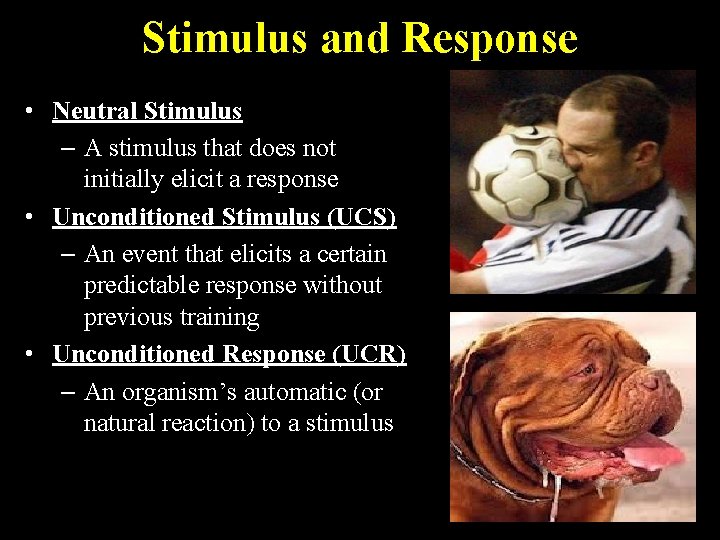
Stimulus and Response • Neutral Stimulus – A stimulus that does not initially elicit a response • Unconditioned Stimulus (UCS) – An event that elicits a certain predictable response without previous training • Unconditioned Response (UCR) – An organism’s automatic (or natural reaction) to a stimulus
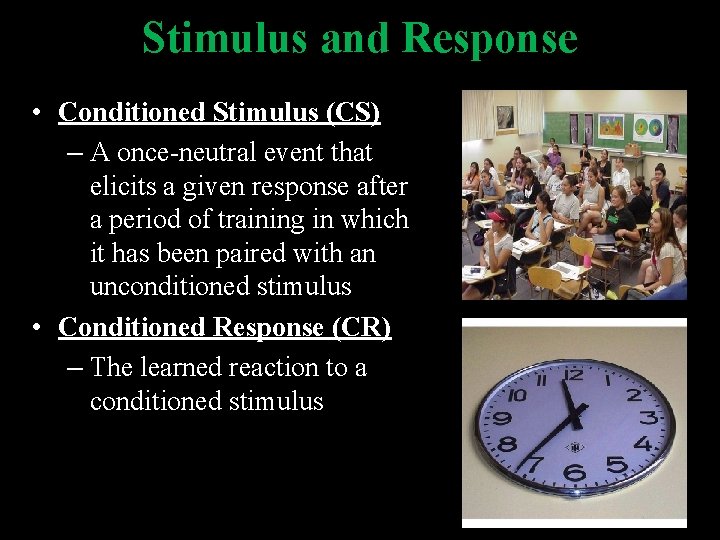
Stimulus and Response • Conditioned Stimulus (CS) – A once-neutral event that elicits a given response after a period of training in which it has been paired with an unconditioned stimulus • Conditioned Response (CR) – The learned reaction to a conditioned stimulus
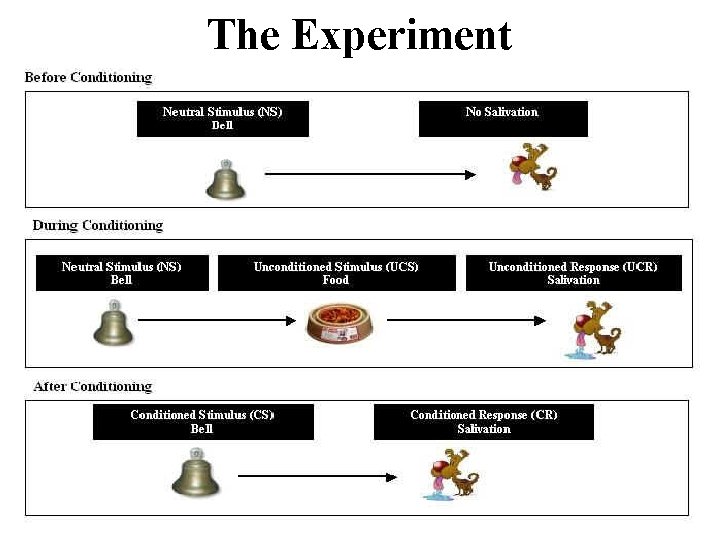
The Experiment
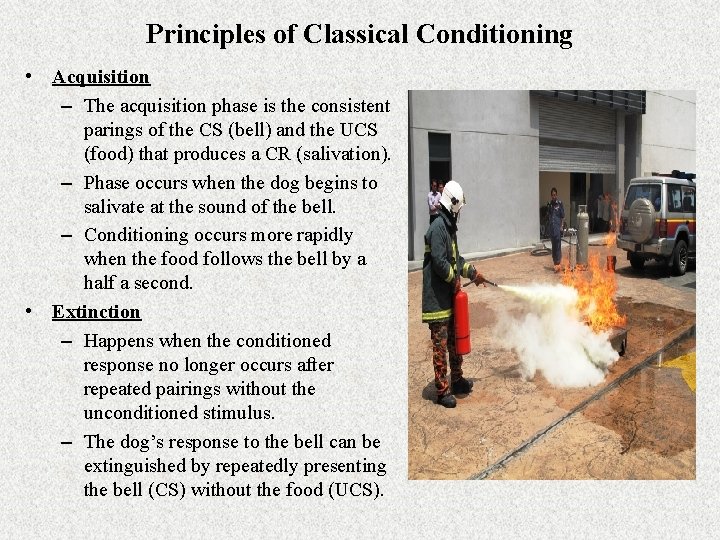
Principles of Classical Conditioning • Acquisition – The acquisition phase is the consistent parings of the CS (bell) and the UCS (food) that produces a CR (salivation). – Phase occurs when the dog begins to salivate at the sound of the bell. – Conditioning occurs more rapidly when the food follows the bell by a half a second. • Extinction – Happens when the conditioned response no longer occurs after repeated pairings without the unconditioned stimulus. – The dog’s response to the bell can be extinguished by repeatedly presenting the bell (CS) without the food (UCS).
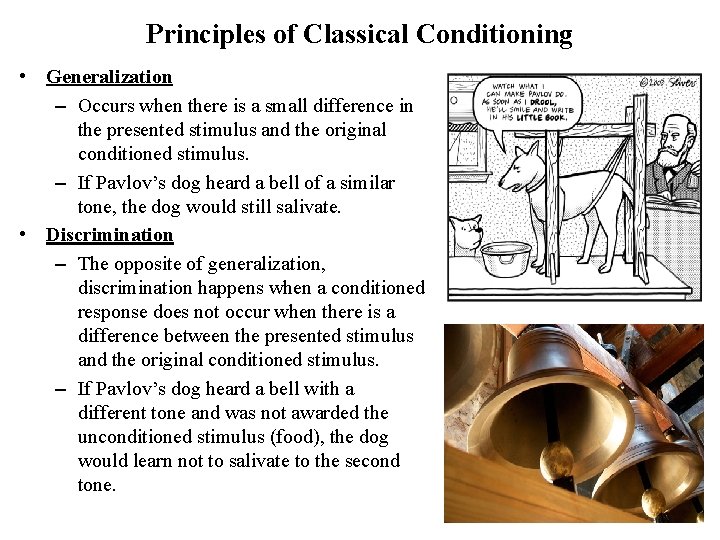
Principles of Classical Conditioning • Generalization – Occurs when there is a small difference in the presented stimulus and the original conditioned stimulus. – If Pavlov’s dog heard a bell of a similar tone, the dog would still salivate. • Discrimination – The opposite of generalization, discrimination happens when a conditioned response does not occur when there is a difference between the presented stimulus and the original conditioned stimulus. – If Pavlov’s dog heard a bell with a different tone and was not awarded the unconditioned stimulus (food), the dog would learn not to salivate to the second tone.
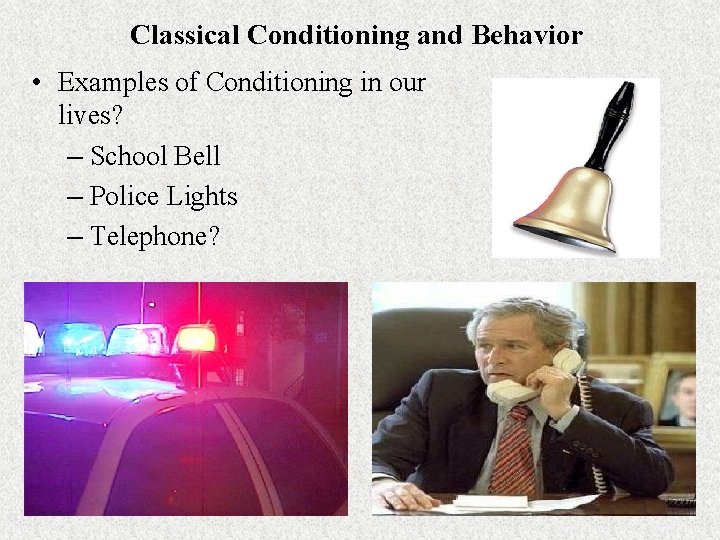
Classical Conditioning and Behavior • Examples of Conditioning in our lives? – School Bell – Police Lights – Telephone?
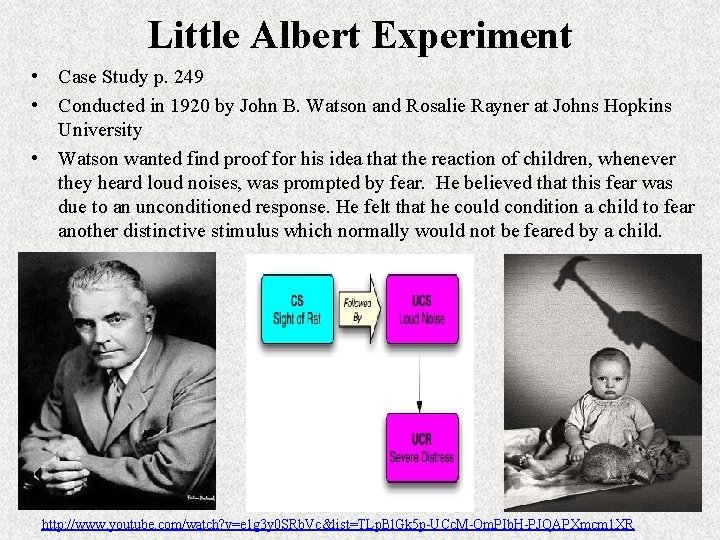
Little Albert Experiment • Case Study p. 249 • Conducted in 1920 by John B. Watson and Rosalie Rayner at Johns Hopkins University • Watson wanted find proof for his idea that the reaction of children, whenever they heard loud noises, was prompted by fear. He believed that this fear was due to an unconditioned response. He felt that he could condition a child to fear another distinctive stimulus which normally would not be feared by a child. http: //www. youtube. com/watch? v=e 1 g 3 y 0 SRb. Vc&list=TLp. Bl. Gk 5 p-UCc. M-Om. PIb. H-PJQAPXmcm 1 XR
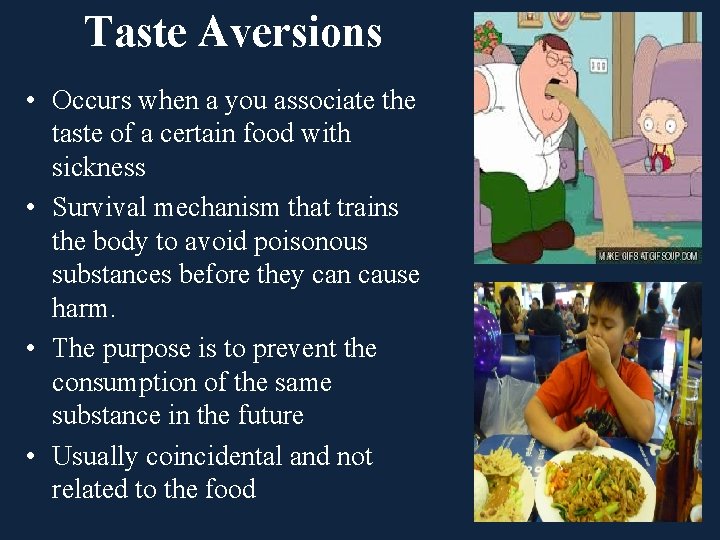
Taste Aversions • Occurs when a you associate the taste of a certain food with sickness • Survival mechanism that trains the body to avoid poisonous substances before they can cause harm. • The purpose is to prevent the consumption of the same substance in the future • Usually coincidental and not related to the food
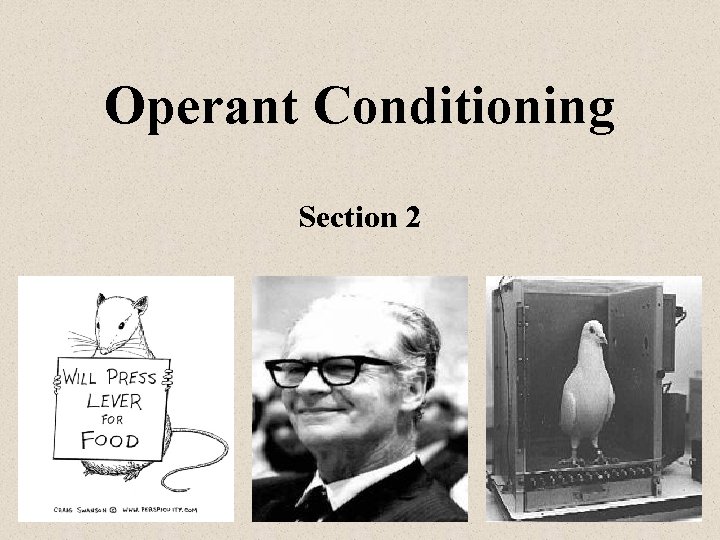
Operant Conditioning Section 2
Exploring Psychology Saved by a theory? The therapists needed that the depressed women did not eat; she was in critical danger of dying of starvation. What should they do? The women did seem to enjoy visitors at the hospital and the TV set, radio, books and magazines, and flowers in her room. The therapists moved her into a room devoid of all these comforts, and put a light meal in front of her; if she ate anything at all, one of the comforts was temporarily restored. The therapists gradually withheld the rewards unless she continued to eat more. Her eating improved, she gained weight. Within months she was released from the hospital. A followup consultation with her 18 months later found her leading a normal life. How did therapist use the comforts to get the women to eat?
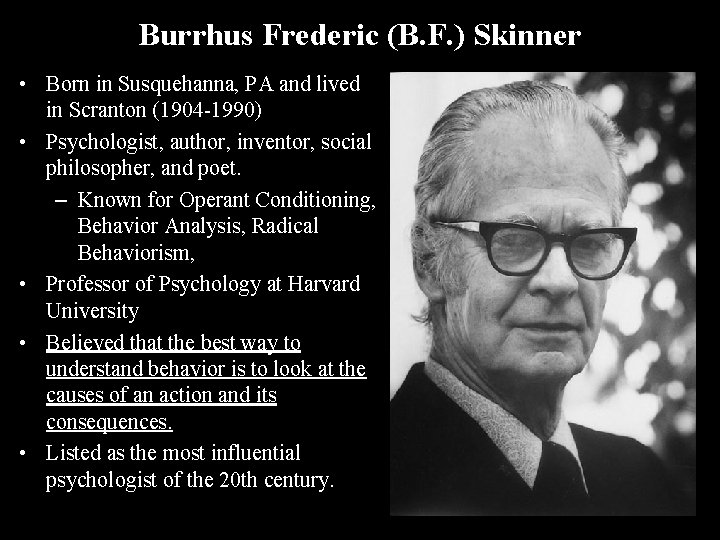
Burrhus Frederic (B. F. ) Skinner • Born in Susquehanna, PA and lived in Scranton (1904 -1990) • Psychologist, author, inventor, social philosopher, and poet. – Known for Operant Conditioning, Behavior Analysis, Radical Behaviorism, • Professor of Psychology at Harvard University • Believed that the best way to understand behavior is to look at the causes of an action and its consequences. • Listed as the most influential psychologist of the 20 th century.
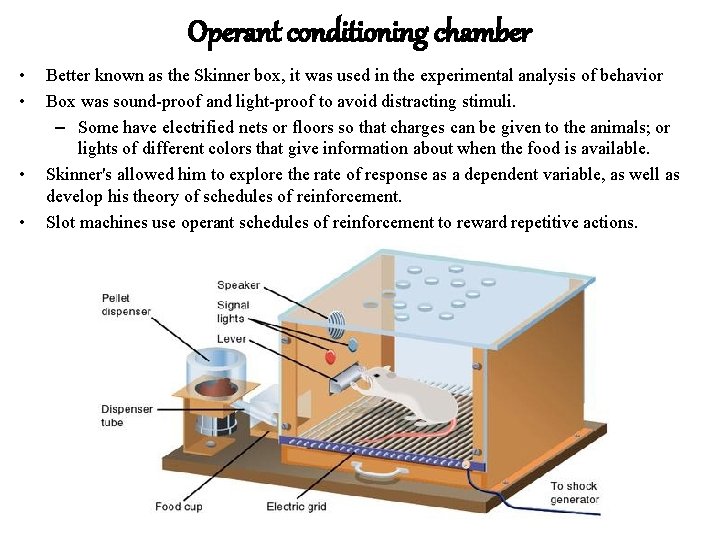
Operant conditioning chamber • • Better known as the Skinner box, it was used in the experimental analysis of behavior Box was sound-proof and light-proof to avoid distracting stimuli. – Some have electrified nets or floors so that charges can be given to the animals; or lights of different colors that give information about when the food is available. Skinner's allowed him to explore the rate of response as a dependent variable, as well as develop his theory of schedules of reinforcement. Slot machines use operant schedules of reinforcement to reward repetitive actions.
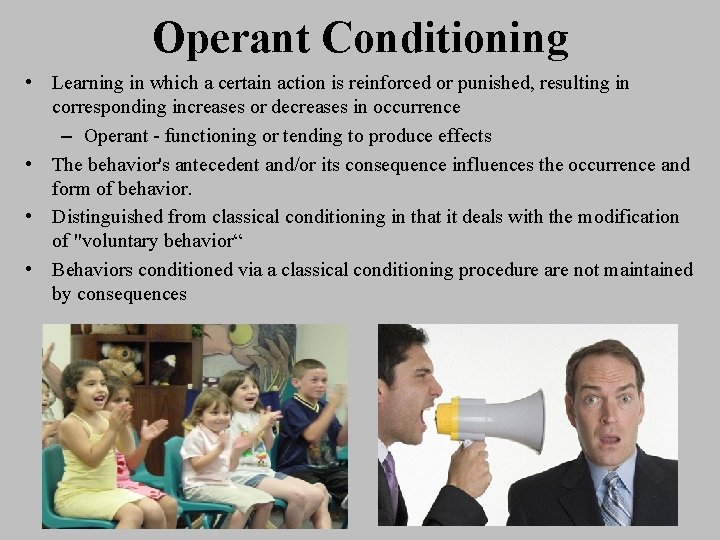
Operant Conditioning • Learning in which a certain action is reinforced or punished, resulting in corresponding increases or decreases in occurrence – Operant - functioning or tending to produce effects • The behavior's antecedent and/or its consequence influences the occurrence and form of behavior. • Distinguished from classical conditioning in that it deals with the modification of "voluntary behavior“ • Behaviors conditioned via a classical conditioning procedure are not maintained by consequences
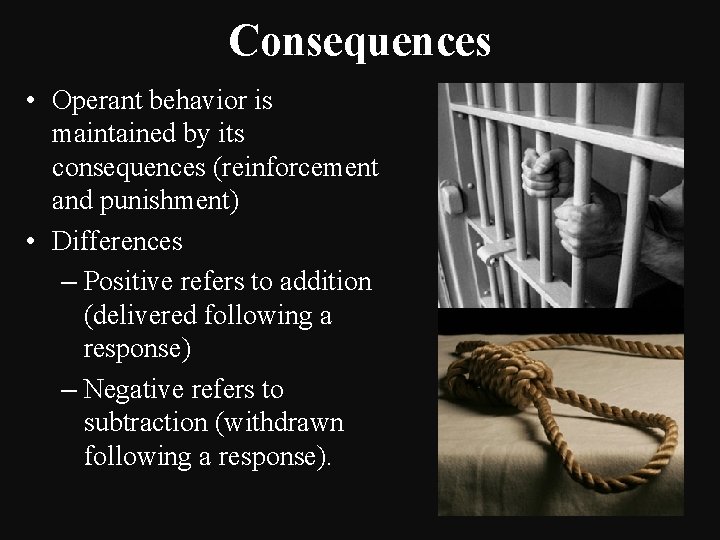
Consequences • Operant behavior is maintained by its consequences (reinforcement and punishment) • Differences – Positive refers to addition (delivered following a response) – Negative refers to subtraction (withdrawn following a response).
Consequences • Procedures following a behavior (response) 1. Positive reinforcement – Rewarding stimulus, increases frequency of that behavior. (money for desired action) 2. Negative reinforcement - Removal of an aversive stimulus, increasing that behavior's frequency. (avoidance of the problem) (Leaving early so you can avoid traffic) 3. Positive punishment - Followed by a negative stimulus, results in a decrease in that behavior. (slapping hand) 4. Negative punishment - Followed by the removal of a stimulus, results in a decrease in that behavior. (take away phone) • Extinction occurs when a behavior (response) that had previously been reinforced is no longer effective.
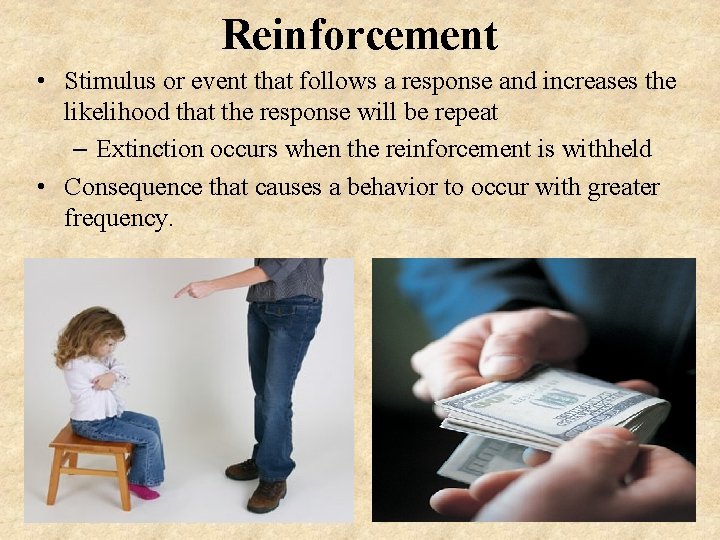
Reinforcement • Stimulus or event that follows a response and increases the likelihood that the response will be repeat – Extinction occurs when the reinforcement is withheld • Consequence that causes a behavior to occur with greater frequency.
Primary and Secondary • Primary Reinforcers – Stimulus that is naturally rewarding, – Satisfies a biological need such as hunger, thirst, or sleep – Food and water • Secondary Reinforcers – Stimulus that has been paired with a primary reinforcer and through classical conditioning has acquired value – Money (Paper? )
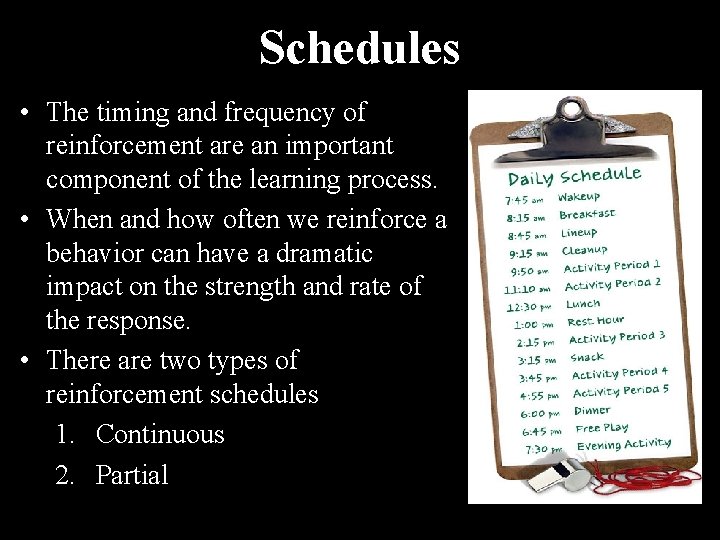
Schedules • The timing and frequency of reinforcement are an important component of the learning process. • When and how often we reinforce a behavior can have a dramatic impact on the strength and rate of the response. • There are two types of reinforcement schedules 1. Continuous 2. Partial
continuous Schedules 1. Continuous – The desired behavior is reinforced every single time it occurs. – Best to be used during the initial stages of learning in order to create a strong association between the behavior and the response. – Once the response if firmly attached, reinforcement is usually switched to a partial reinforcement schedule.
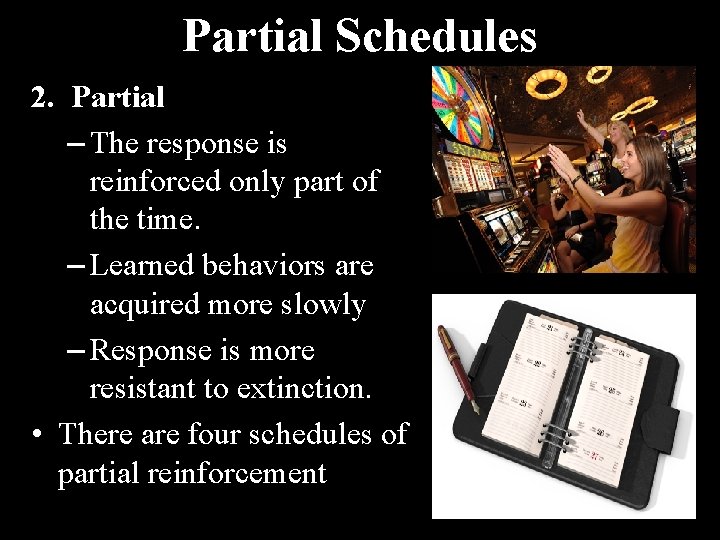
Partial Schedules 2. Partial – The response is reinforced only part of the time. – Learned behaviors are acquired more slowly – Response is more resistant to extinction. • There are four schedules of partial reinforcement
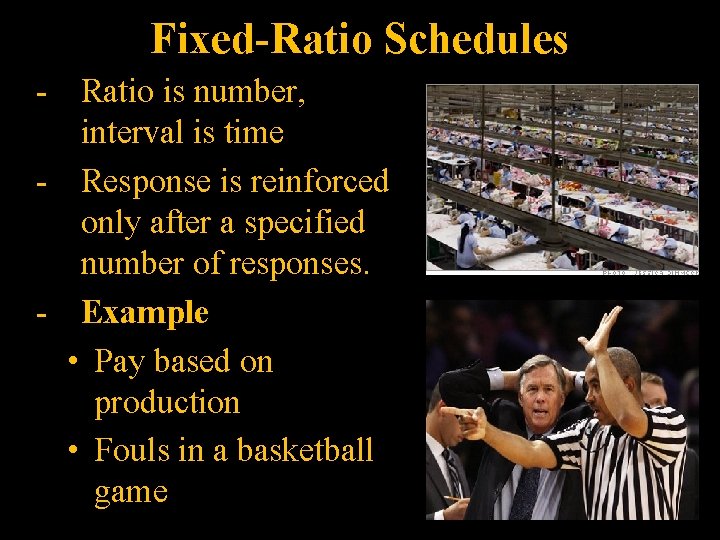
Fixed-Ratio Schedules - Ratio is number, interval is time - Response is reinforced only after a specified number of responses. - Example • Pay based on production • Fouls in a basketball game
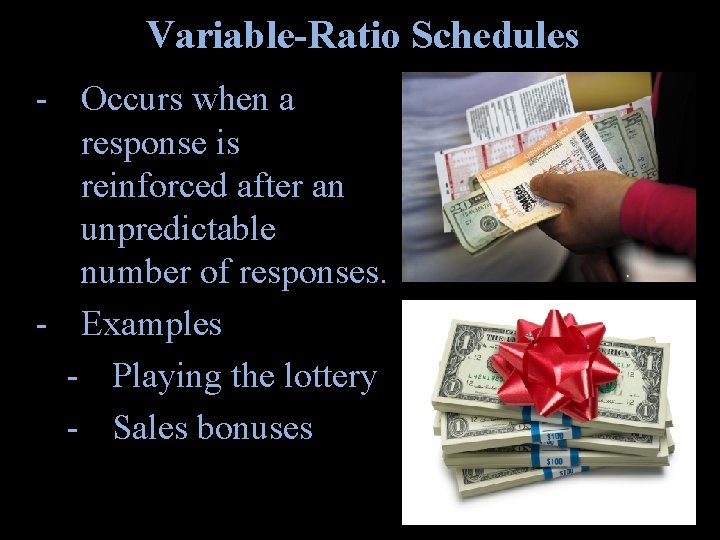
Variable-Ratio Schedules - Occurs when a response is reinforced after an unpredictable number of responses. - Examples - Playing the lottery - Sales bonuses
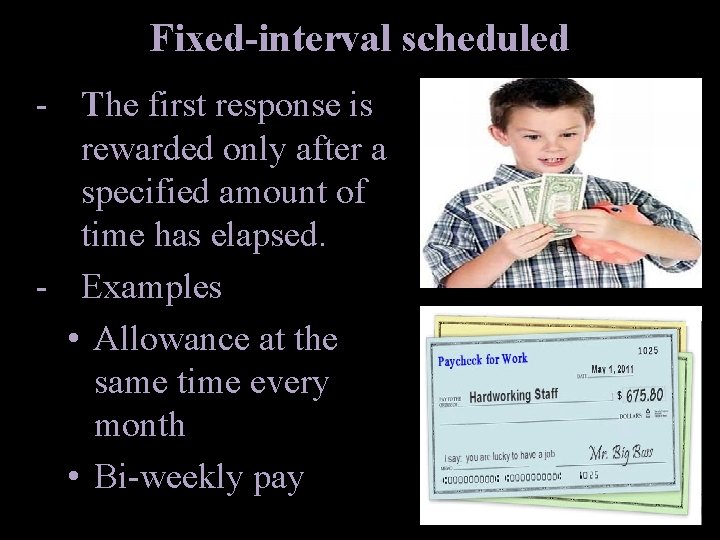
Fixed-interval scheduled - The first response is rewarded only after a specified amount of time has elapsed. - Examples • Allowance at the same time every month • Bi-weekly pay
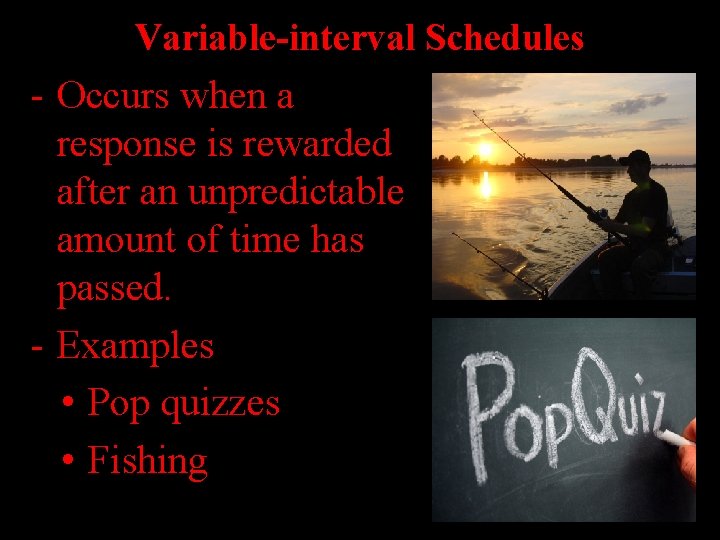
Variable-interval Schedules - Occurs when a response is rewarded after an unpredictable amount of time has passed. - Examples • Pop quizzes • Fishing
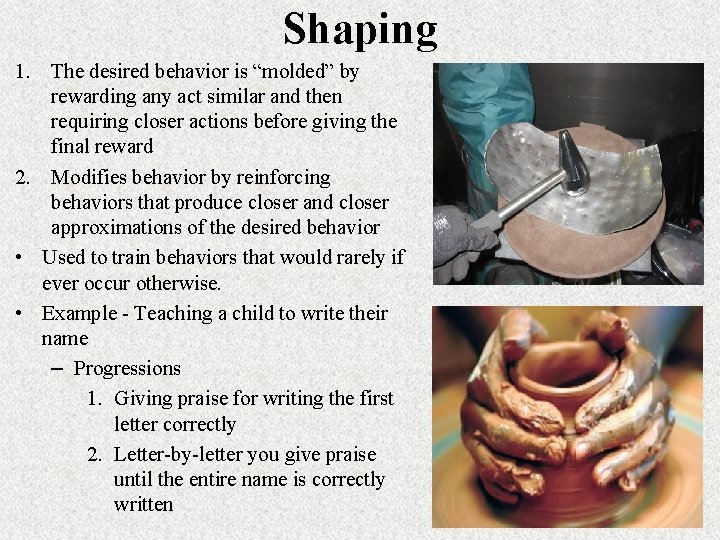
Shaping 1. The desired behavior is “molded” by rewarding any act similar and then requiring closer actions before giving the final reward 2. Modifies behavior by reinforcing behaviors that produce closer and closer approximations of the desired behavior • Used to train behaviors that would rarely if ever occur otherwise. • Example - Teaching a child to write their name – Progressions 1. Giving praise for writing the first letter correctly 2. Letter-by-letter you give praise until the entire name is correctly written
Chaining • In order to learn a skill, a person must be able to put various new responses together. • These new responses are referred to as response chains – Learned reactions that follow one another in sequence, each reaction producing a signal for the next • These chains can be organized into response patterns – Sports
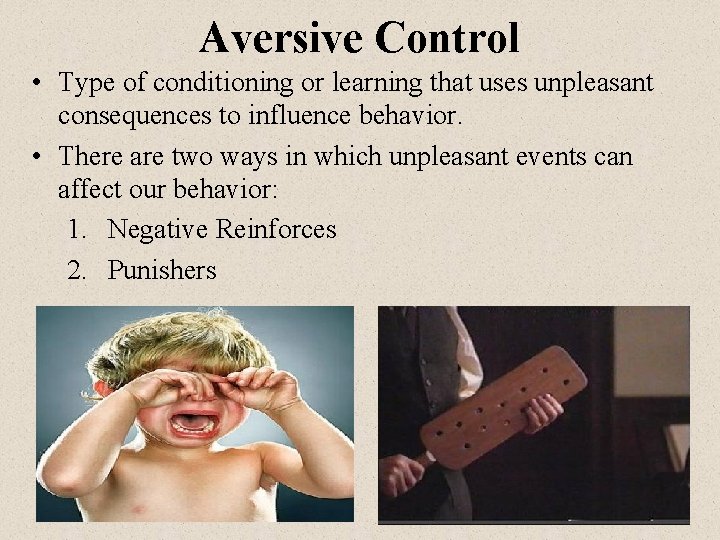
Aversive Control • Type of conditioning or learning that uses unpleasant consequences to influence behavior. • There are two ways in which unpleasant events can affect our behavior: 1. Negative Reinforces 2. Punishers
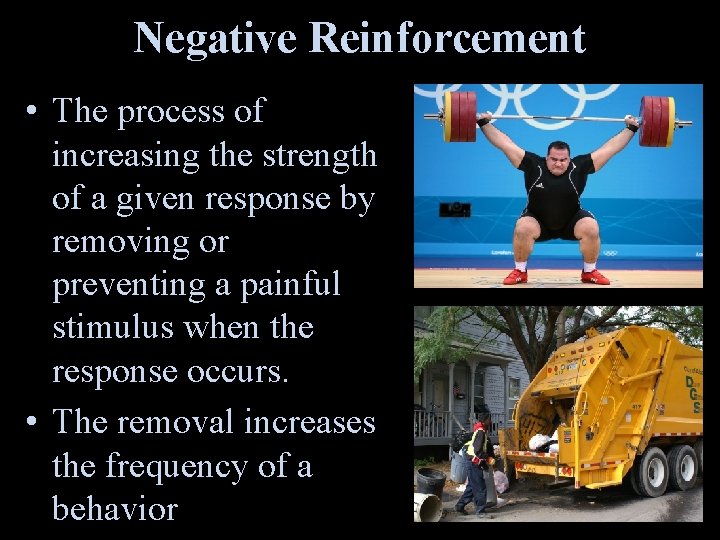
Negative Reinforcement • The process of increasing the strength of a given response by removing or preventing a painful stimulus when the response occurs. • The removal increases the frequency of a behavior
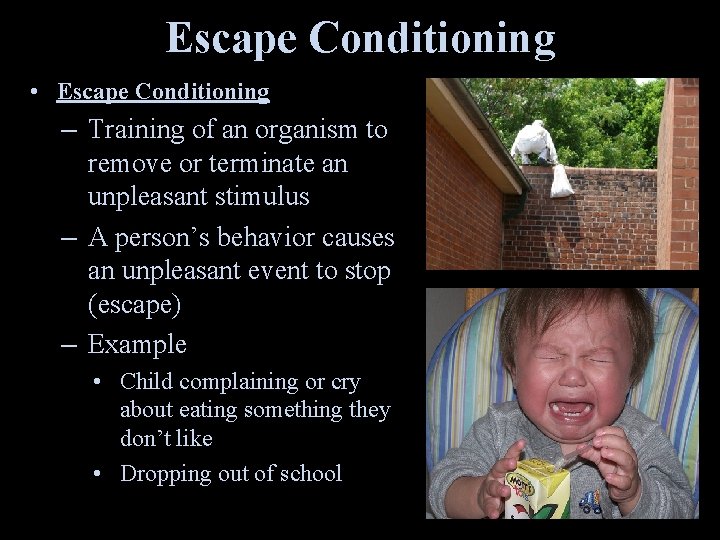
Escape Conditioning • Escape Conditioning – Training of an organism to remove or terminate an unpleasant stimulus – A person’s behavior causes an unpleasant event to stop (escape) – Example • Child complaining or cry about eating something they don’t like • Dropping out of school
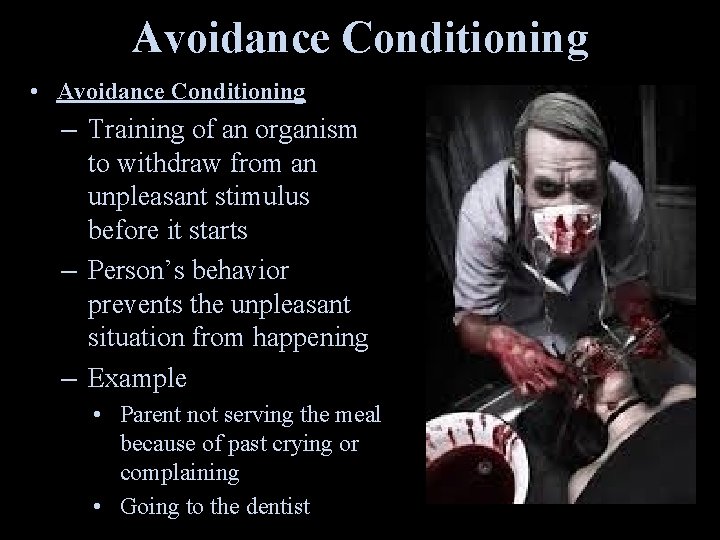
Avoidance Conditioning • Avoidance Conditioning – Training of an organism to withdraw from an unpleasant stimulus before it starts – Person’s behavior prevents the unpleasant situation from happening – Example • Parent not serving the meal because of past crying or complaining • Going to the dentist
Punishment • Using an unpleasant consequence to decrease the probability of the behavior that produced it. (Uses aversive means to make a response unlikely) • For punishment to be effective, it must be intense and immediate
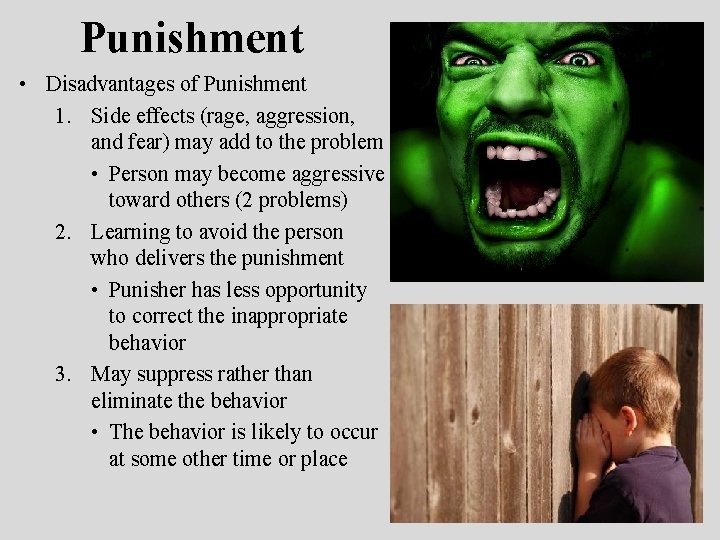
Punishment • Disadvantages of Punishment 1. Side effects (rage, aggression, and fear) may add to the problem • Person may become aggressive toward others (2 problems) 2. Learning to avoid the person who delivers the punishment • Punisher has less opportunity to correct the inappropriate behavior 3. May suppress rather than eliminate the behavior • The behavior is likely to occur at some other time or place
Classical v. Operate Both involve the establishment of relationships between two events, but different procedures to reach their goals. 1. Specific stimulus (UCS) that elicits 1. No stimulus, learner must first respond appropriately, then the desired response behavior is reinforced 2. UCS does not depend upon learner’s 2. Reinforcement depends upon response learner’s behavior 3. Learner responds to its environment 3. Learner actively operates on its 4. Ivan Pavlov environment 4. B. F. Skinner