
Learning Plate Tectonic Geography Brushing up on basic
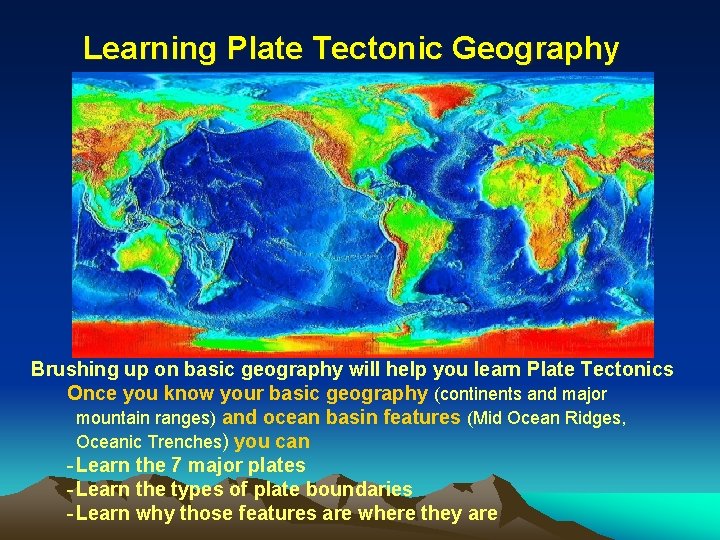
Learning Plate Tectonic Geography Brushing up on basic geography will help you learn Plate Tectonics Once you know your basic geography (continents and major mountain ranges) and ocean basin features (Mid Ocean Ridges, Oceanic Trenches) you can - Learn the 7 major plates - Learn the types of plate boundaries - Learn why those features are where they are
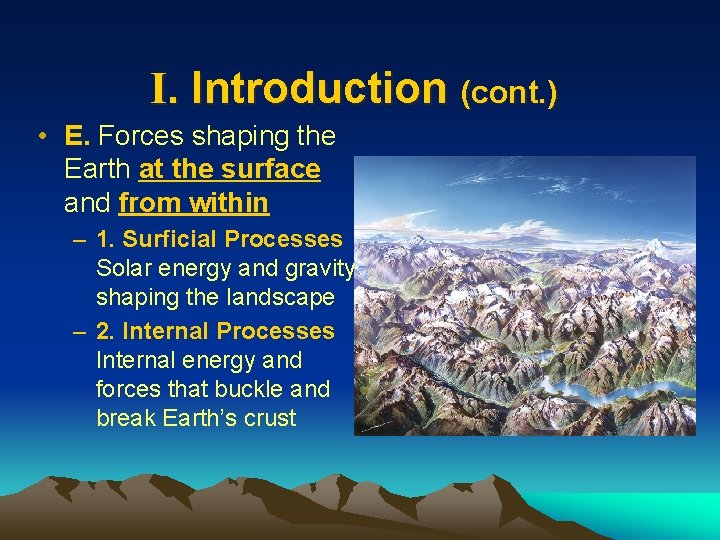
I. Introduction (cont. ) • E. Forces shaping the Earth at the surface and from within – 1. Surficial Processes Solar energy and gravity shaping the landscape – 2. Internal Processes Internal energy and forces that buckle and break Earth’s crust
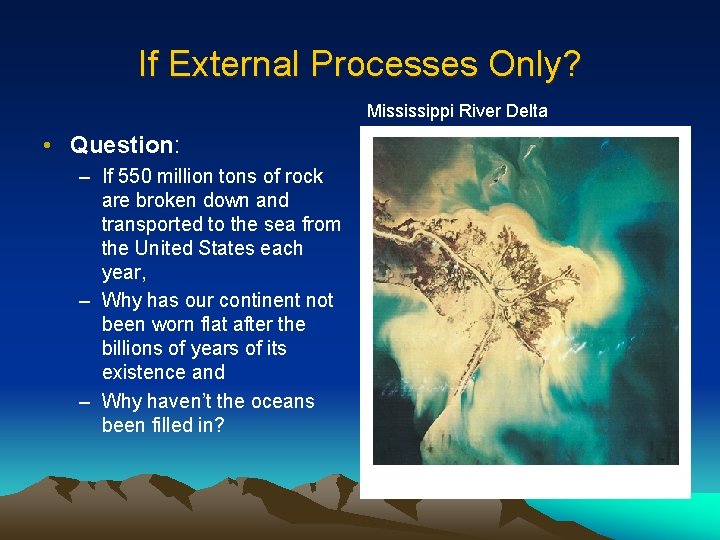
If External Processes Only? Mississippi River Delta • Question: – If 550 million tons of rock are broken down and transported to the sea from the United States each year, – Why has our continent not been worn flat after the billions of years of its existence and – Why haven’t the oceans been filled in?
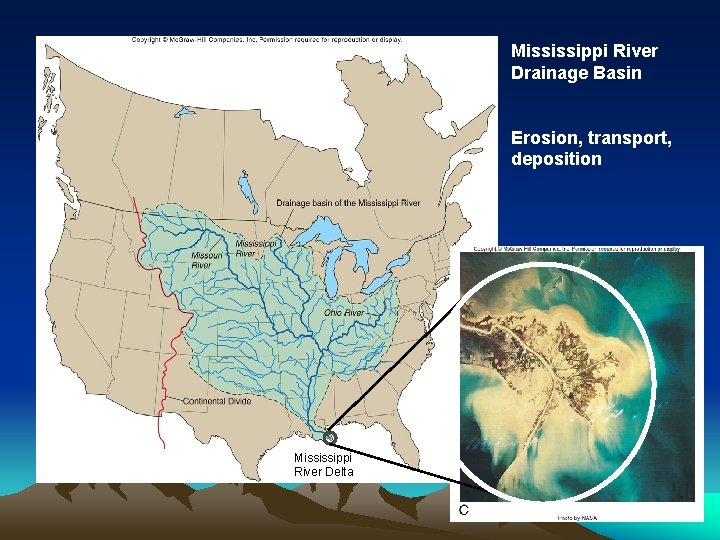
Mississippi River Drainage Basin Erosion, transport, deposition Mississippi River Delta
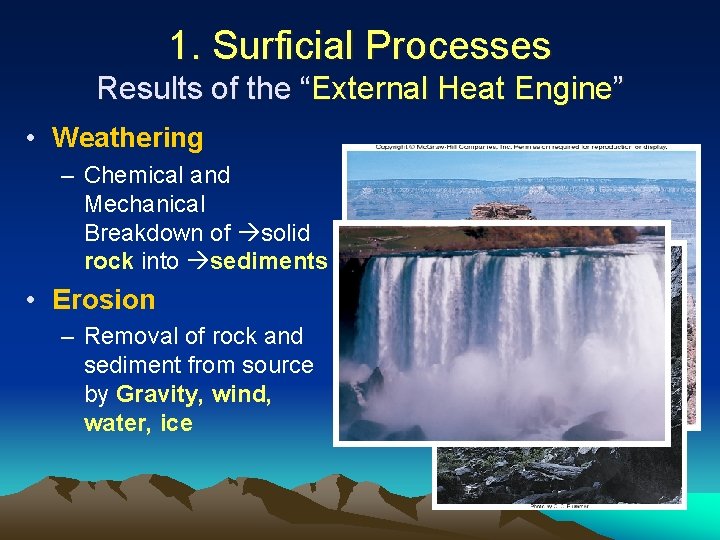
1. Surficial Processes Results of the “External Heat Engine” • Weathering – Chemical and Mechanical Breakdown of solid rock into sediments • Erosion – Removal of rock and sediment from source by Gravity, wind, water, ice
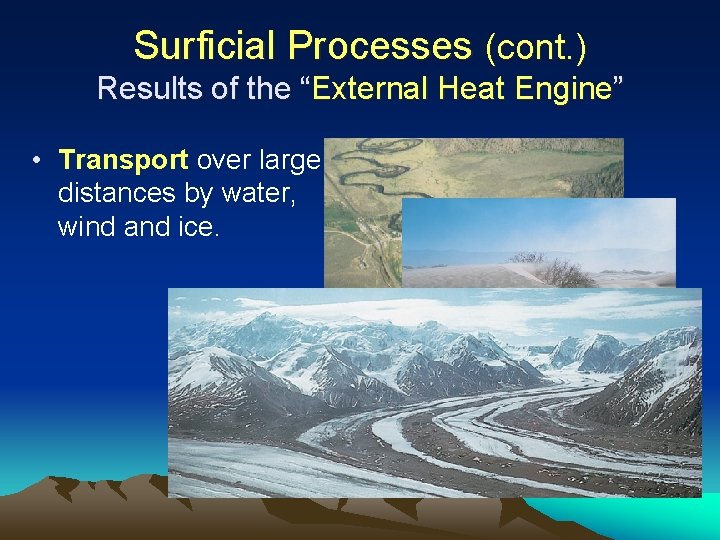
Surficial Processes (cont. ) Results of the “External Heat Engine” • Transport over large distances by water, wind and ice.
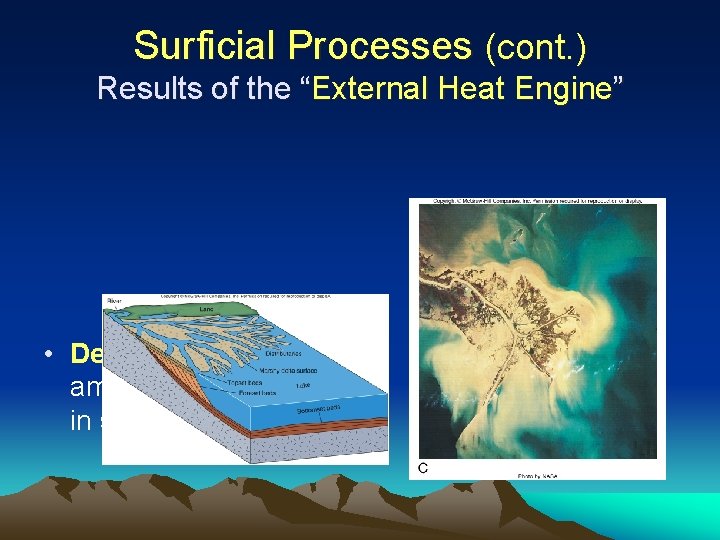
Surficial Processes (cont. ) Results of the “External Heat Engine” • Deposition of large amounts of sediment in seas and oceans
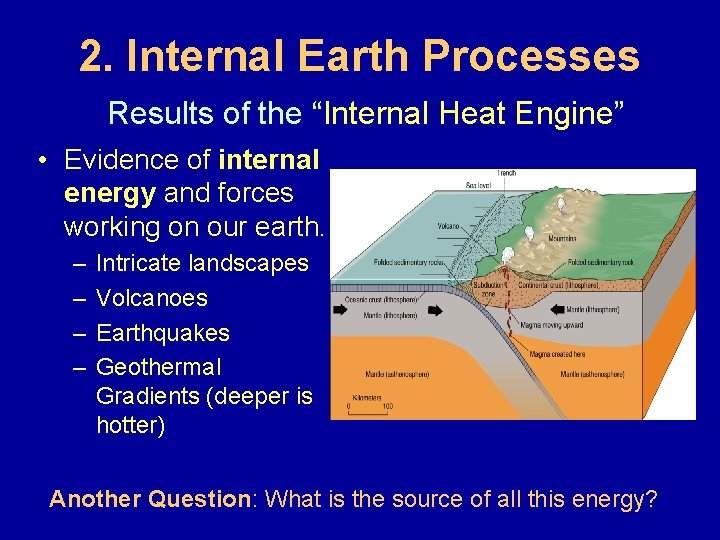
2. Internal Earth Processes Results of the “Internal Heat Engine” • Evidence of internal energy and forces working on our earth. – – Intricate landscapes Volcanoes Earthquakes Geothermal Gradients (deeper is hotter) Another Question: What is the source of all this energy?
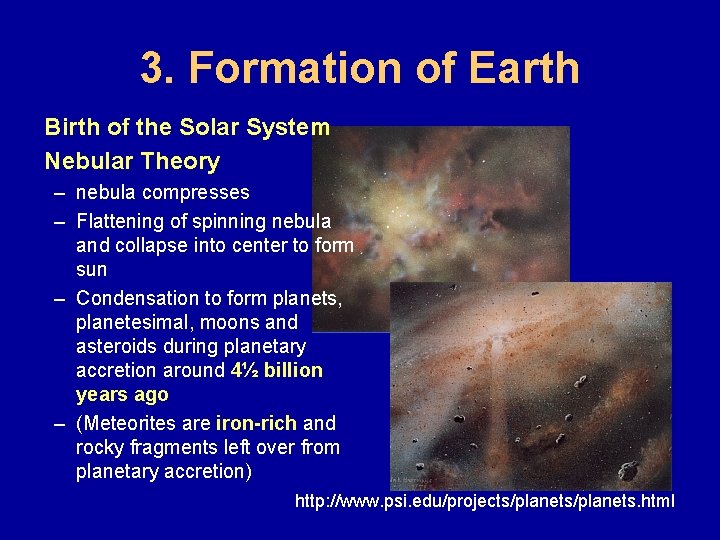
3. Formation of Earth Birth of the Solar System Nebular Theory – nebula compresses – Flattening of spinning nebula and collapse into center to form sun – Condensation to form planets, planetesimal, moons and asteroids during planetary accretion around 4½ billion years ago – (Meteorites are iron-rich and rocky fragments left over from planetary accretion) http: //www. psi. edu/projects/planets. html
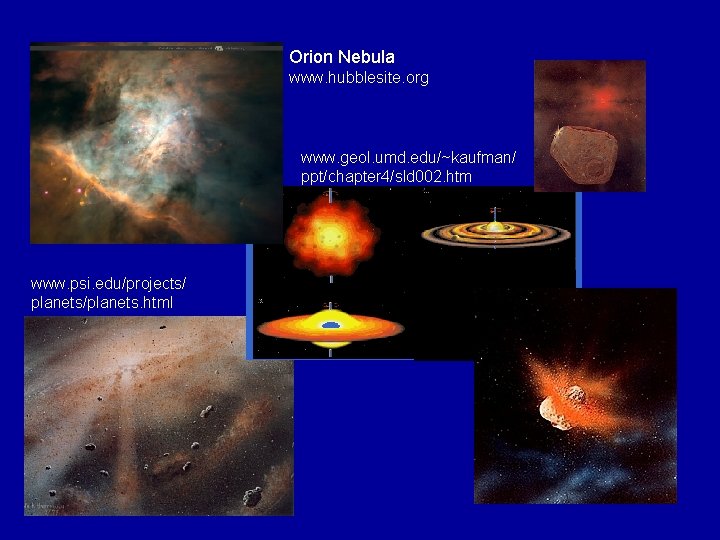
Orion Nebula www. hubblesite. org www. geol. umd. edu/~kaufman/ ppt/chapter 4/sld 002. htm www. psi. edu/projects/ planets/planets. html
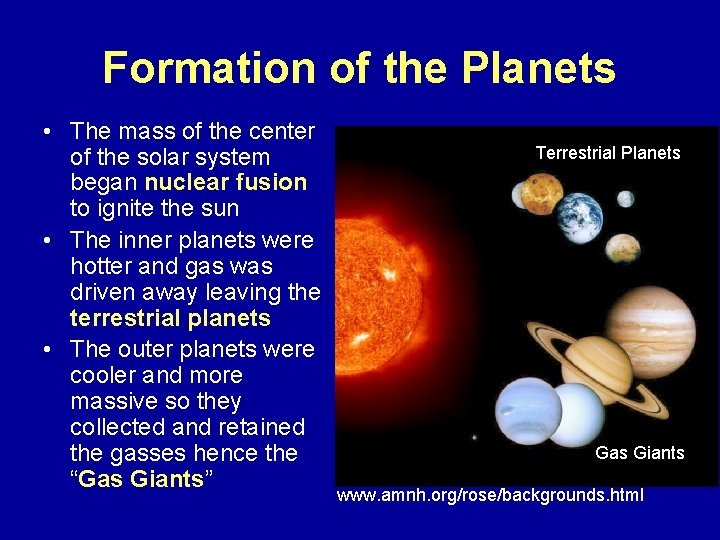
Formation of the Planets • The mass of the center of the solar system began nuclear fusion to ignite the sun • The inner planets were hotter and gas was driven away leaving the terrestrial planets • The outer planets were cooler and more massive so they collected and retained the gasses hence the “Gas Giants” Terrestrial Planets Gas Giants www. amnh. org/rose/backgrounds. html
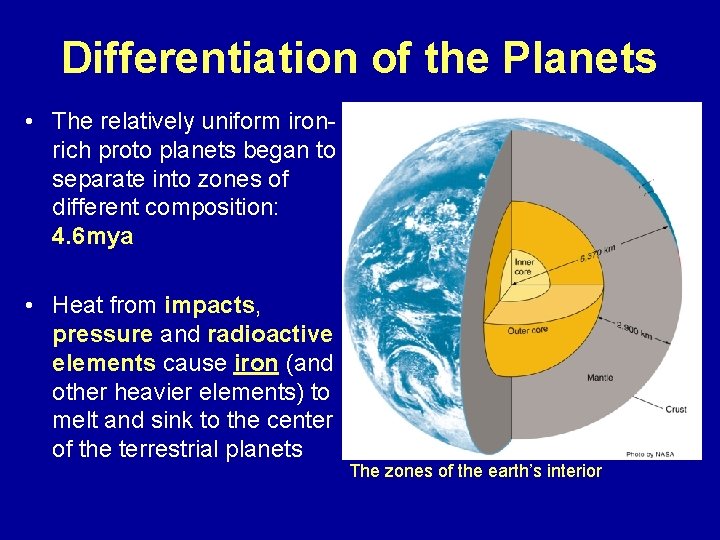
Differentiation of the Planets • The relatively uniform ironrich proto planets began to separate into zones of different composition: 4. 6 mya • Heat from impacts, pressure and radioactive elements cause iron (and other heavier elements) to melt and sink to the center of the terrestrial planets The zones of the earth’s interior
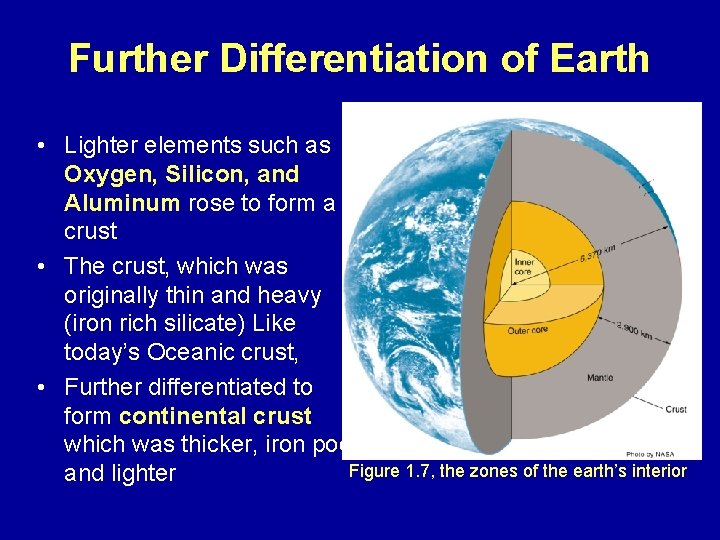
Further Differentiation of Earth • Lighter elements such as Oxygen, Silicon, and Aluminum rose to form a crust • The crust, which was originally thin and heavy (iron rich silicate) Like today’s Oceanic crust, • Further differentiated to form continental crust which was thicker, iron poor Figure 1. 7, the zones of the earth’s interior and lighter
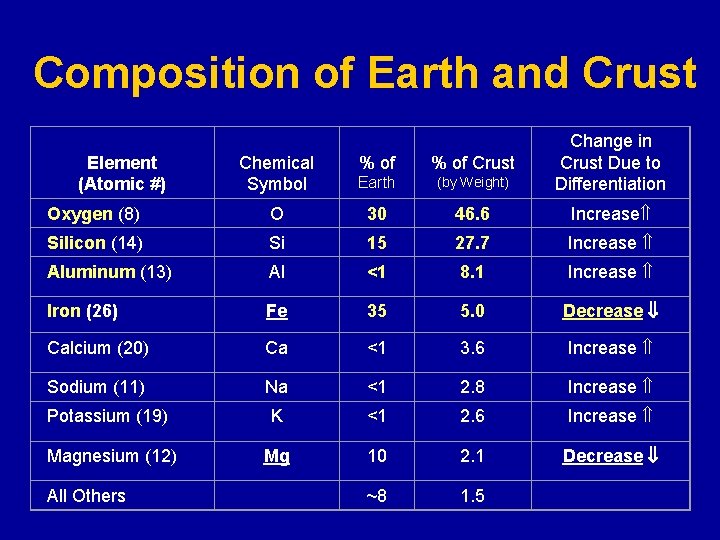
Composition of Earth and Crust Element (Atomic #) Chemical Symbol % of Crust Earth (by Weight) Change in Crust Due to Differentiation Oxygen (8) O 30 46. 6 Increase Silicon (14) Si 15 27. 7 Increase Aluminum (13) Al <1 8. 1 Increase Iron (26) Fe 35 5. 0 Decrease Calcium (20) Ca <1 3. 6 Increase Sodium (11) Na <1 2. 8 Increase Potassium (19) K <1 2. 6 Increase Magnesium (12) Mg 10 2. 1 Decrease ~8 1. 5 All Others
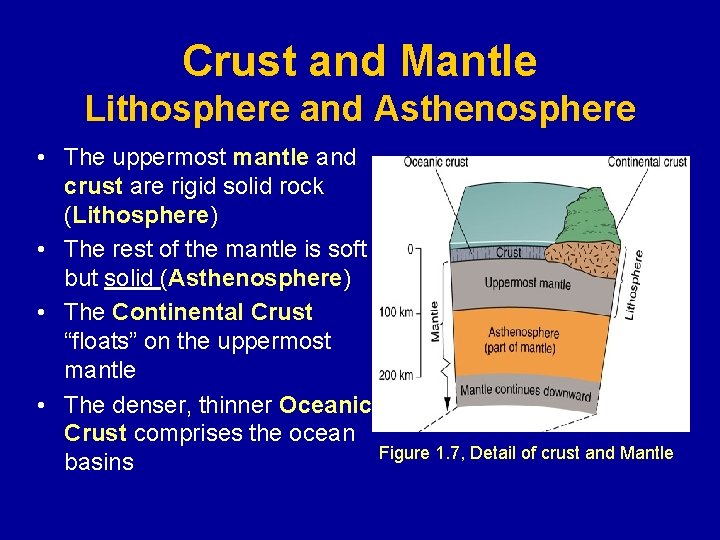
Crust and Mantle Lithosphere and Asthenosphere • The uppermost mantle and crust are rigid solid rock (Lithosphere) • The rest of the mantle is soft but solid (Asthenosphere) • The Continental Crust “floats” on the uppermost mantle • The denser, thinner Oceanic Crust comprises the ocean Figure 1. 7, Detail of crust and Mantle basins
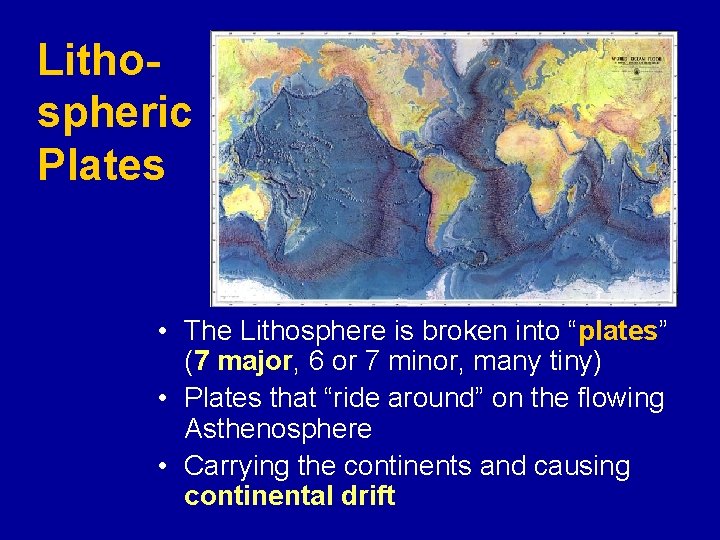
Lithospheric Plates • The Lithosphere is broken into “plates” (7 major, 6 or 7 minor, many tiny) • Plates that “ride around” on the flowing Asthenosphere • Carrying the continents and causing continental drift
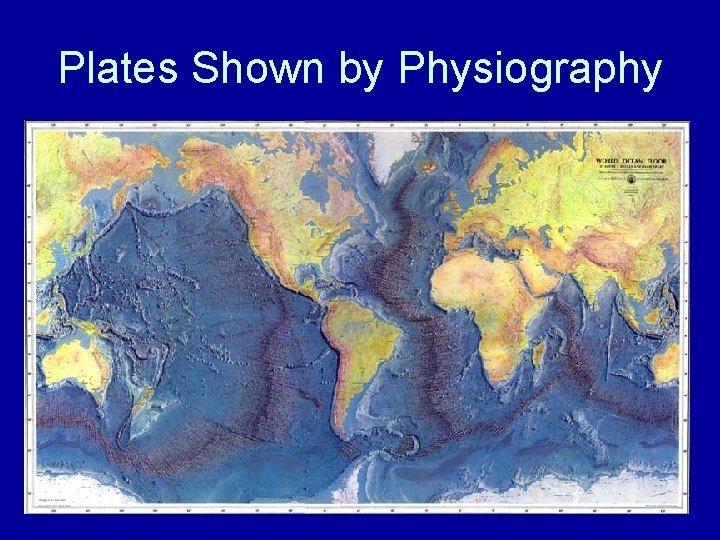
Plates Shown by Physiography
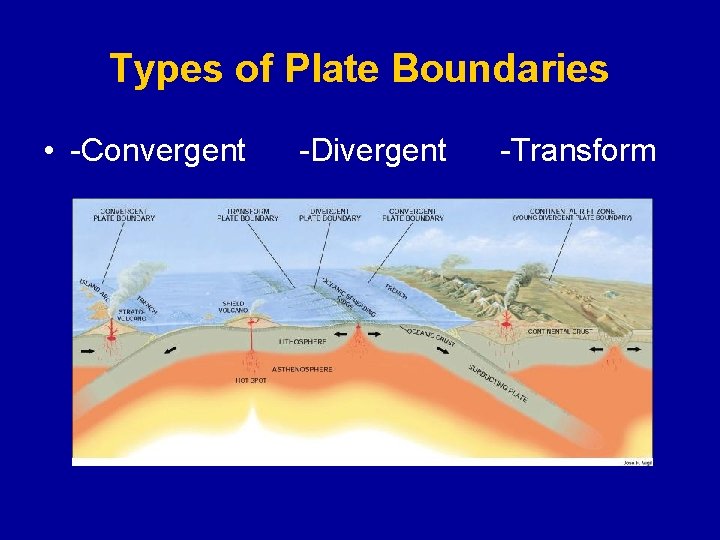
Types of Plate Boundaries • -Convergent -Divergent -Transform
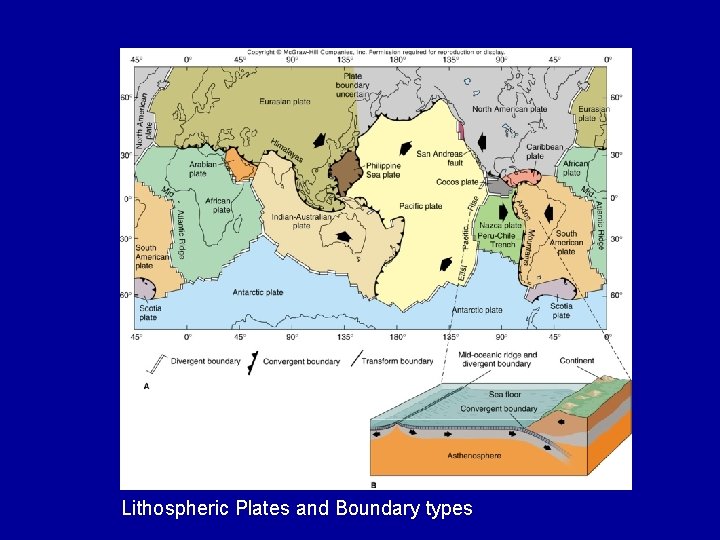
Lithospheric Plates and Boundary types
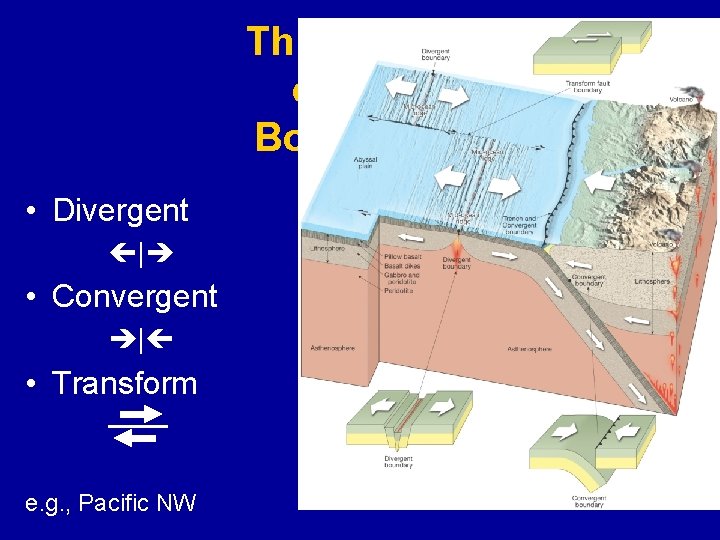
Three Types of Plate Boundaries • Divergent | • Convergent | • Transform e. g. , Pacific NW
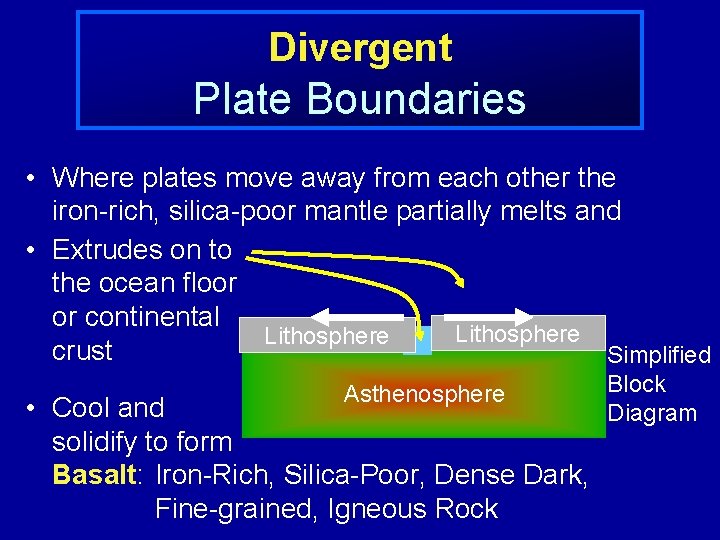
Divergent Plate Boundaries • Where plates move away from each other the iron-rich, silica-poor mantle partially melts and • Extrudes on to the ocean floor or continental Lithosphere crust Simplified Asthenosphere • Cool and solidify to form Basalt: Iron-Rich, Silica-Poor, Dense Dark, Fine-grained, Igneous Rock Block Diagram
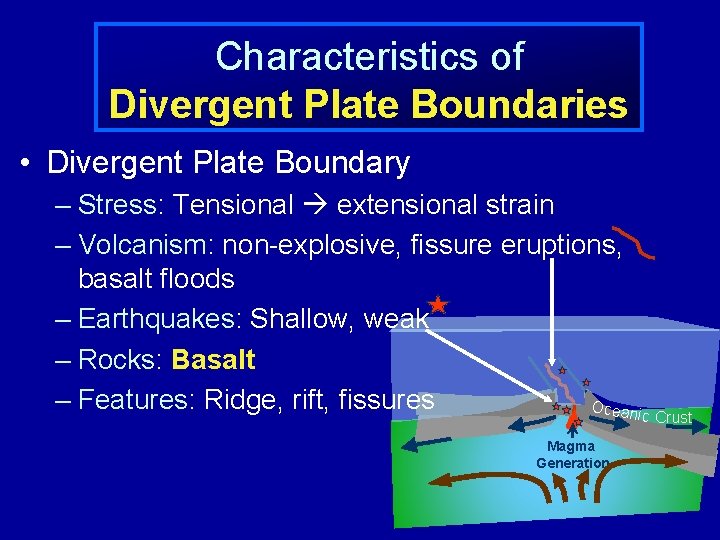
Characteristics of Divergent Plate Boundaries • Divergent Plate Boundary – Stress: Tensional extensional strain – Volcanism: non-explosive, fissure eruptions, basalt floods – Earthquakes: Shallow, weak – Rocks: Basalt – Features: Ridge, rift, fissures Ocean ic Magma Generation Crust
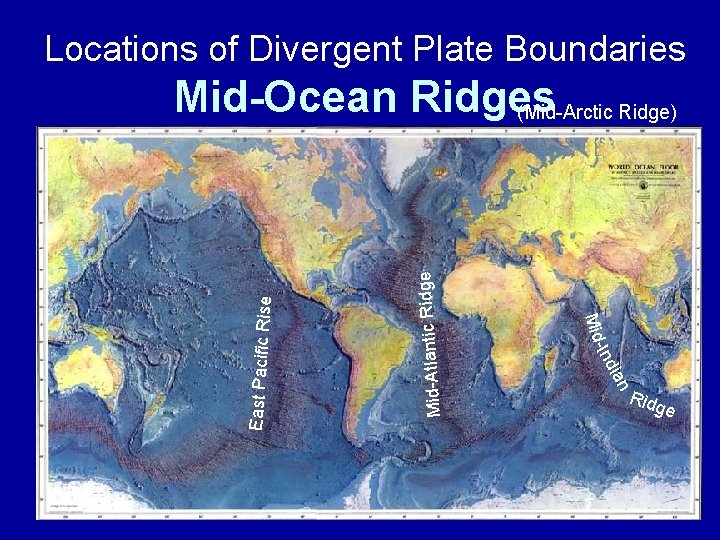
Locations of Divergent Plate Boundaries ian Ind East Pacific Rise Mid- • East Pacific Rise • Mid Atlantic Ridge • Mid Indian Ridge • Mid Arctic Ridge Fig. 1. 10 e Mid-Atlantic Ridg Mid-Ocean Ridges (Mid-Arctic Ridge) Rid ge
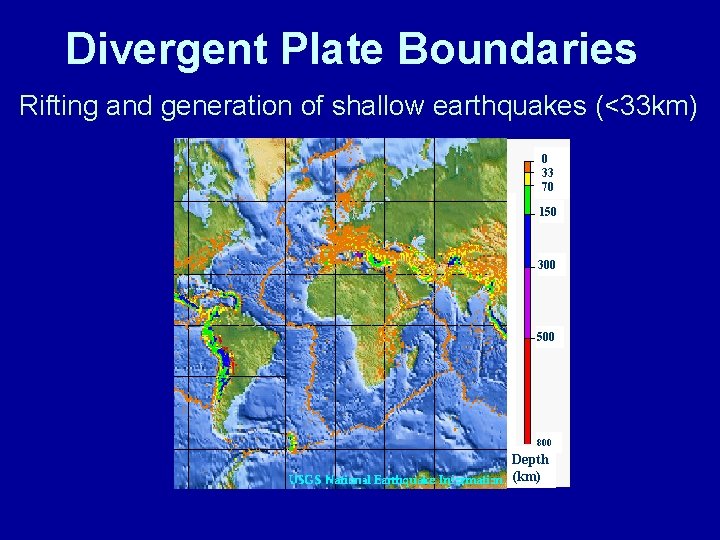
Divergent Plate Boundaries Rifting and generation of shallow earthquakes (<33 km) 0 30 70 150 0 33 70 150 300 500 800 Depth (km)
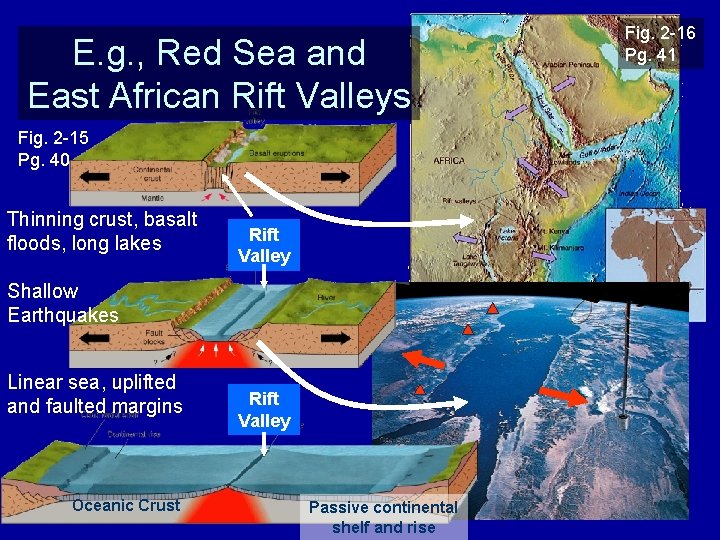
E. g. , Red Sea and East African Rift Valleys Fig. 2 -15 Pg. 40 Thinning crust, basalt floods, long lakes • Fig. 19. 21 • Fig. 19. 22 Rift Valley Shallow Earthquakes Linear sea, uplifted and faulted margins Oceanic Crust Rift Valley Passive continental shelf and rise Fig. 2 -16 Pg. 41
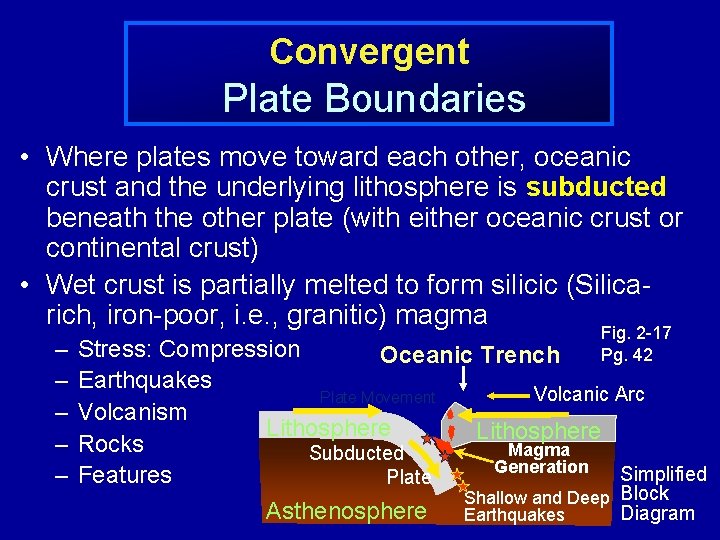
Convergent Plate Boundaries • Where plates move toward each other, oceanic crust and the underlying lithosphere is subducted beneath the other plate (with either oceanic crust or continental crust) • Wet crust is partially melted to form silicic (Silicarich, iron-poor, i. e. , granitic) magma – – – Fig. 2 -17 Pg. 42 Stress: Compression Oceanic Trench Earthquakes Volcanic Arc Plate Movement Volcanism Lithosphere Rocks Magma Subducted Generation Simplified Features Plate Shallow and Deep Block Asthenosphere Diagram Earthquakes
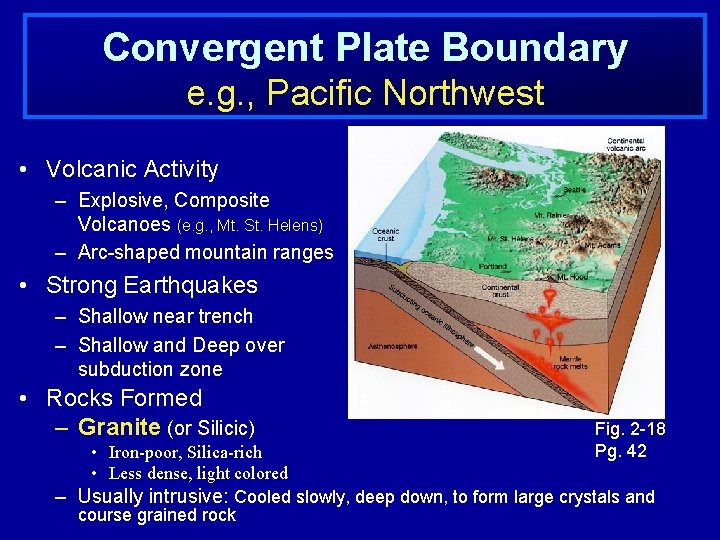
Convergent Plate Boundary e. g. , Pacific Northwest • Volcanic Activity – Explosive, Composite Volcanoes (e. g. , Mt. St. Helens) – Arc-shaped mountain ranges • Strong Earthquakes – Shallow near trench – Shallow and Deep over subduction zone • Rocks Formed – Granite (or Silicic) Fig. 2 -18 Pg. 42 • Iron-poor, Silica-rich • Less dense, light colored – Usually intrusive: Cooled slowly, deep down, to form large crystals and course grained rock
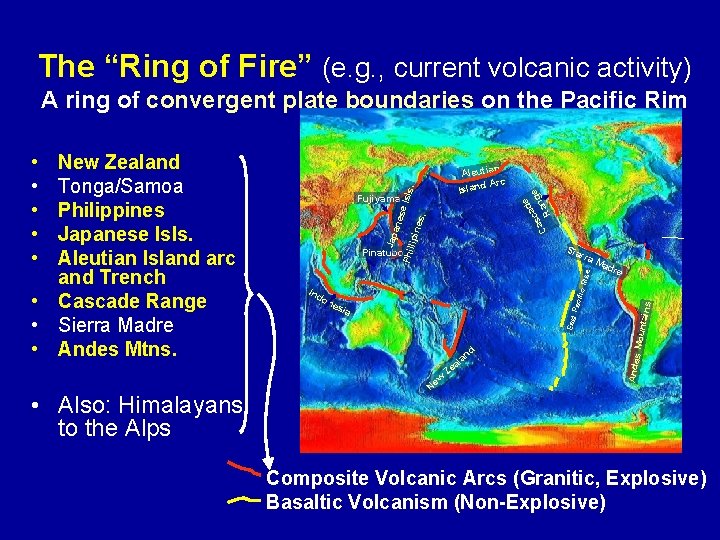
The “Ring of Fire” (e. g. , current volcanic activity) n Aleutia Arc Island sls. nes. Sia rra Ma nd e Z ew • Also: Himalayans to the Alps N a al Moun tains t Pa sia dre Andes cific ne Eas In do Ris e Phi Pinatubo llipi ane se I Fujiyama Jap New Zealand Tonga/Samoa Philippines Japanese Isls. Aleutian Island arc and Trench • Cascade Range • Sierra Madre • Andes Mtns. • • • e ad e c s g Ca Ran A ring of convergent plate boundaries on the Pacific Rim Composite Volcanic Arcs (Granitic, Explosive) Basaltic Volcanism (Non-Explosive)
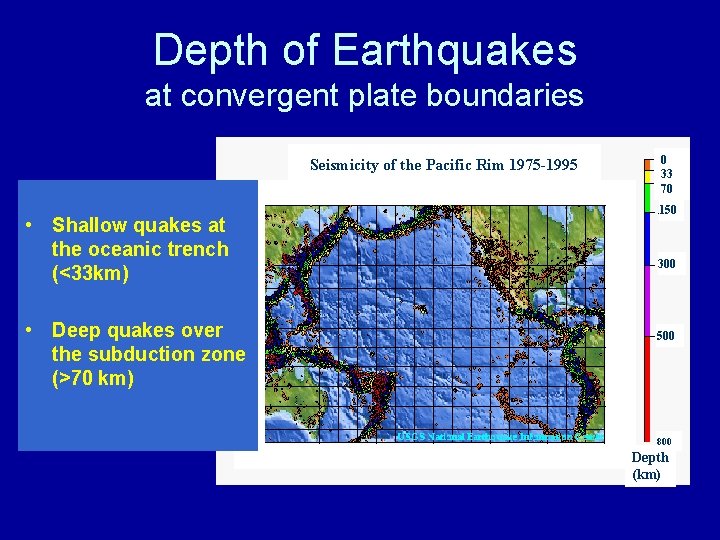
Depth of Earthquakes at convergent plate boundaries Seismicity of the Pacific Rim 1975 -1995 • Shallow quakes at the oceanic trench (<33 km) • Deep quakes over the subduction zone (>70 km) 0 33 70 150 300 500 800 Depth (km)
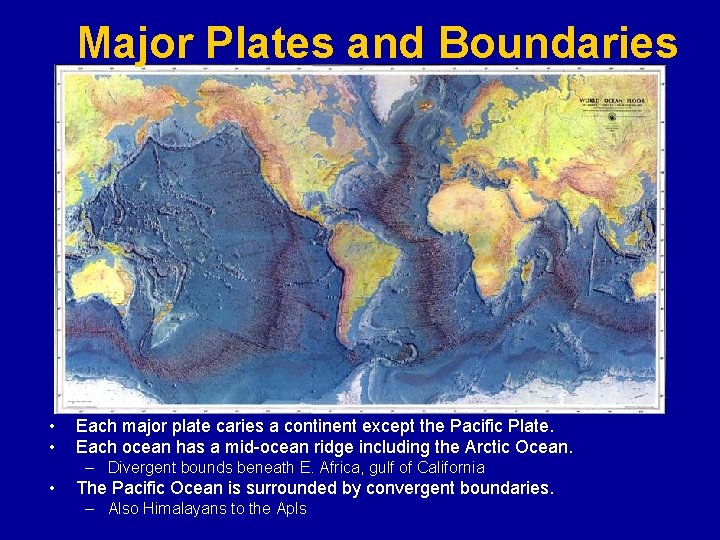
Major Plates and Boundaries • • Each major plate caries a continent except the Pacific Plate. Each ocean has a mid-ocean ridge including the Arctic Ocean. – Divergent bounds beneath E. Africa, gulf of California • The Pacific Ocean is surrounded by convergent boundaries. – Also Himalayans to the Apls
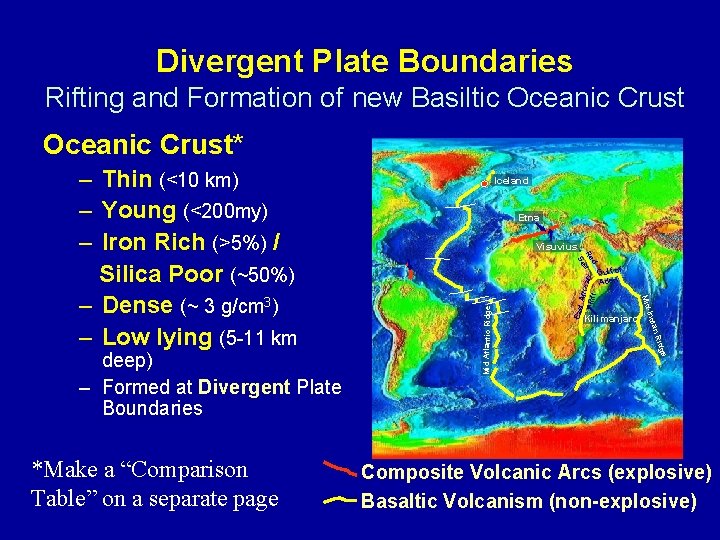
Divergent Plate Boundaries Rifting and Formation of new Basiltic Oceanic Crust* Visuvius Afri can Rift East Kilimanjaro Ridg ian e Mid-Atlantic Ridge Gulf of Aden -Ind *Make a “Comparison Table” on a separate page Etna Mid deep) – Formed at Divergent Plate Boundaries Iceland d Re a Se – Thin (<10 km) – Young (<200 my) – Iron Rich (>5%) / Silica Poor (~50%) – Dense (~ 3 g/cm 3) – Low lying (5 -11 km Composite Volcanic Arcs (explosive) Basaltic Volcanism (non-explosive)
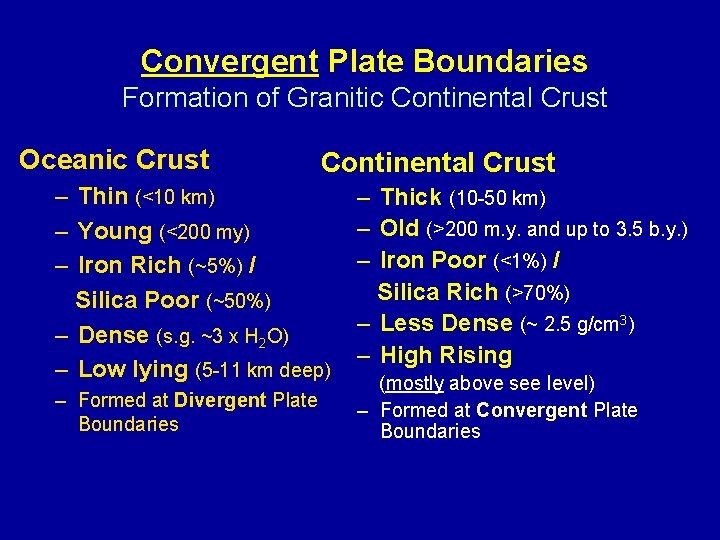
Convergent Plate Boundaries Formation of Granitic Continental Crust Oceanic Crust Continental Crust – Thin (<10 km) – Young (<200 my) – Iron Rich (~5%) / Silica Poor (~50%) – Dense (s. g. ~3 x H 2 O) – Low lying (5 -11 km deep) – Formed at Divergent Plate Boundaries – Thick (10 -50 km) – Old (>200 m. y. and up to 3. 5 b. y. ) – Iron Poor (<1%) / Silica Rich (>70%) – Less Dense (~ 2. 5 g/cm 3) – High Rising (mostly above see level) – Formed at Convergent Plate Boundaries
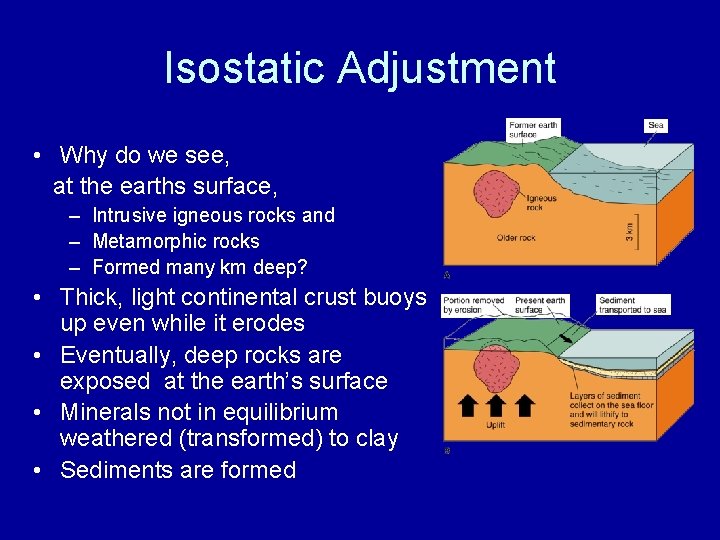
Isostatic Adjustment • Why do we see, at the earths surface, – Intrusive igneous rocks and – Metamorphic rocks – Formed many km deep? • Thick, light continental crust buoys up even while it erodes • Eventually, deep rocks are exposed at the earth’s surface • Minerals not in equilibrium weathered (transformed) to clay • Sediments are formed
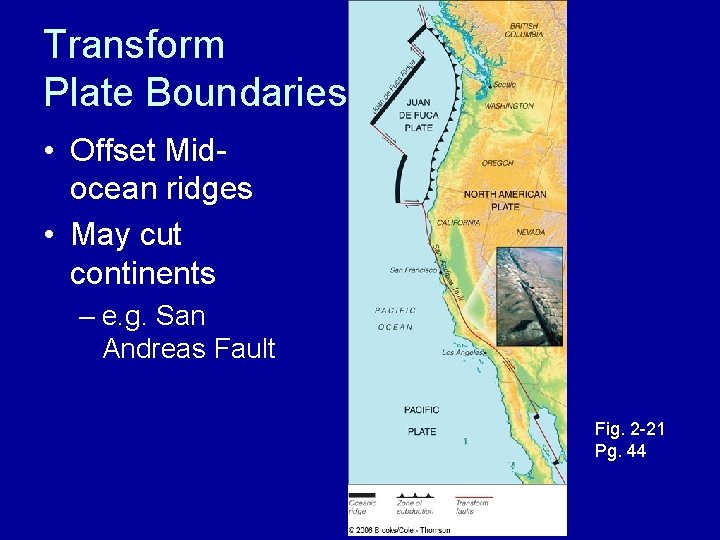
Transform Plate Boundaries • Offset Mid- ocean ridges • May cut continents – e. g. San Andreas Fault Fig. 2 -21 Pg. 44
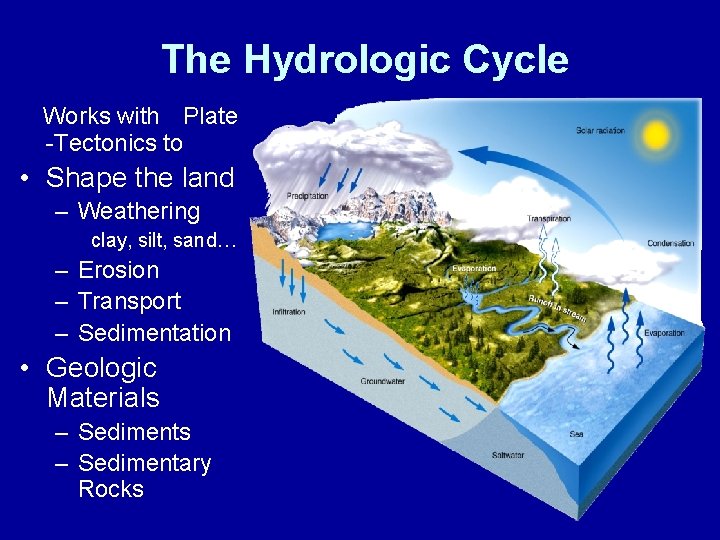
The Hydrologic Cycle Works with Plate -Tectonics to • Shape the land – Weathering clay, silt, sand… – Erosion – Transport – Sedimentation • Geologic Materials – Sedimentary Rocks
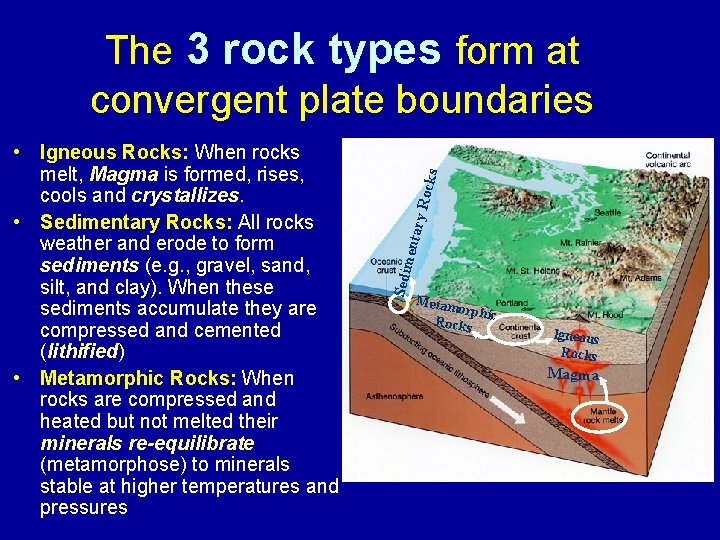
Rock entar y Sedim • Igneous Rocks: When rocks melt, Magma is formed, rises, cools and crystallizes. • Sedimentary Rocks: All rocks weather and erode to form sediments (e. g. , gravel, sand, silt, and clay). When these sediments accumulate they are compressed and cemented (lithified) • Metamorphic Rocks: When rocks are compressed and heated but not melted their minerals re-equilibrate (metamorphose) to minerals stable at higher temperatures and pressures s The 3 rock types form at convergent plate boundaries Metam orphi Rocks c Igneous Rocks Magma
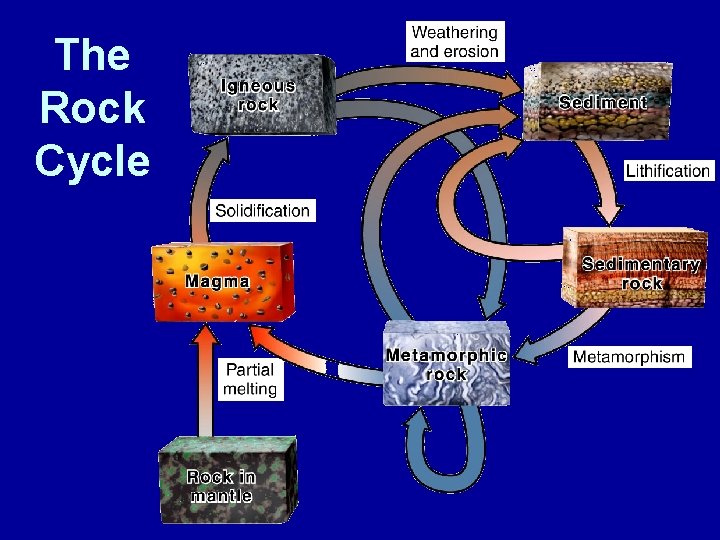
The Rock Cycle
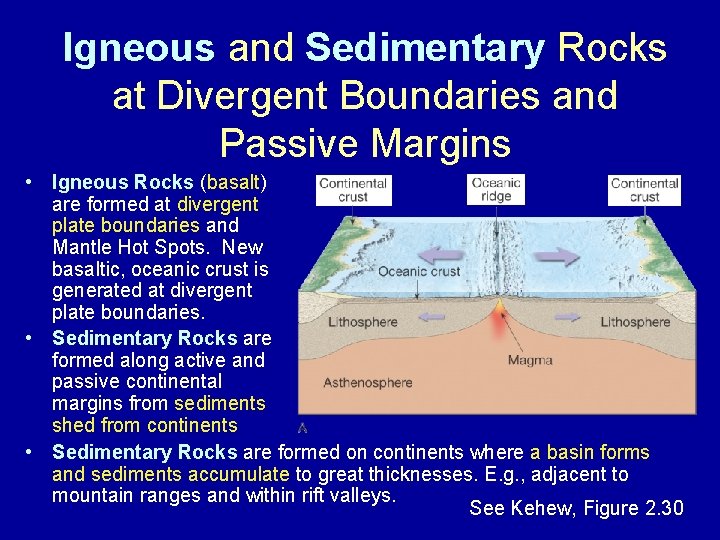
Igneous and Sedimentary Rocks at Divergent Boundaries and Passive Margins • Igneous Rocks (basalt) are formed at divergent plate boundaries and Mantle Hot Spots. New basaltic, oceanic crust is generated at divergent plate boundaries. • Sedimentary Rocks are formed along active and passive continental margins from sediments shed from continents • Sedimentary Rocks are formed on continents where a basin forms and sediments accumulate to great thicknesses. E. g. , adjacent to mountain ranges and within rift valleys. See Kehew, Figure 2. 30
- Slides: 38