
Learning outcomes 1 Outline the communication process and
- Slides: 26
Learning outcomes 1. Outline the communication process and recognise barriers to good communication 2. Discuss how to communicate with the dying person and how to address family/whānau concerns 3. Describe how to build partnerships with families/whānau 4. Advocate wisely for people and their families/whānau 5. Discuss the importance of good interprofessional team communication and strategies to build good team communication
Communication • Communication is the exchange of information whenever two or more individuals are together communication is taking place. • Communication means different things to different people and there are many methods of communication some of which are more effective than others.
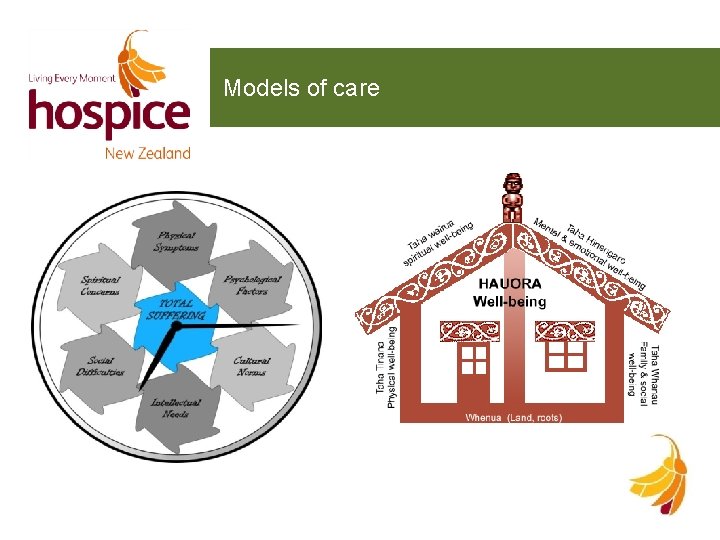
Models of care
Cultural considerations when communicating • What are the attitudes, values and beliefs you bring to your practice? • What are the rituals that are important to you when communicating with persons and other team members? • What is the organisational culture? • Discuss the important role of the family at this time Adapted from Waitemata Palliative Care Education Programme 2011
Culture race and ethnicity • Culture: the “learned and shared beliefs, values, and life ways of a designated or particular group which are generally transmitted intergenerationally and influence one's thinking and action modes. ” A particular society at a particular time and place • Ethnicity: people whose members identify with each other, through a common heritage, consisting of a common language, a common culture and a tradition of common ancestry • Race: A group of people united or classified together on the basis of common history, nationality, or geographic distribution
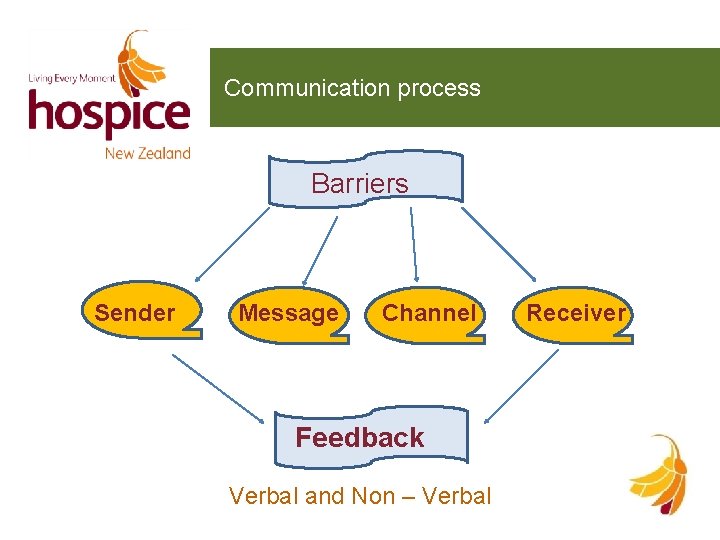
Communication process Barriers Sender Message Channel Feedback Verbal and Non – Verbal Receiver
The aims of communication • Relay and clarify information • Reduce uncertainty • Enhance relationships • Give the patient and the family a direction in which to move The most important message a patient wants to hear at a time of increasing uncertainty is: • ‘No matter what we will not desert you’ (acceptance) • ‘You may be dying, but you are still important to us’ (affirmation)
Body language • Being able to read body language is one of the most significant skills of good listening • Body language is a very important medium of communication • 7% of the impact of communication is verbal • 38% of the impact of communication involves the sounds of language: speed, volume, pitch, pause • 55% of the impact of communication involves body language
What is listening? Is Is not • A priceless gift • About advice • Visible in your body, gestures and eye contact • One liners and cliches • Willingness to be involved in another’s feelings Criticising what you have heard • Changing the subject • Being comfortable with silence • Minimising the event • Helping • Fixing the hurt or curing the grief •
Connecting • An important component of effective communication is to connect/engage with the person… try to understand what their experience might be • Empathy – walking in their shoes • This doesn’t mean you try to take on that person’s suffering as your own or actually experience what they are going through – you journey alongside the person in a supportive role • Personal boundaries are important
Maintaining boundaries • ‘Being with’ the person, not becoming the person or their family, whanau • Being friendly, not friends • Having a clear understanding of the limits and responsibilities of your role • Avoiding ‘burnout’ (compassion fatigue) • Maintaining personal physical and emotional safety • It’s about maintaining a healthy, open, communication with all the team Kelly Wolf 2008
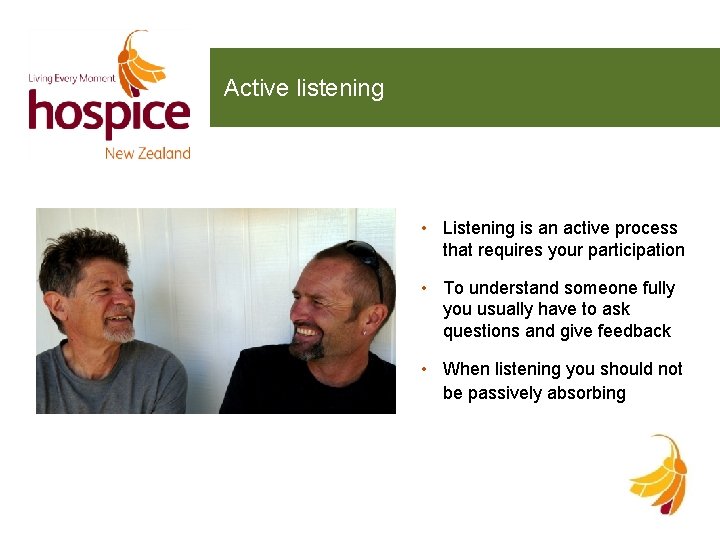
Active listening • Listening is an active process that requires your participation • To understand someone fully you usually have to ask questions and give feedback • When listening you should not be passively absorbing
How do we actively listen? • • Nod from time to time (minimal encourager) • • • Pick up on cues • Prioritise problems with the person If the person stops, repeat their last few words, this gives permission to continue Reflect questions back Ask about feelings Validate feelings Watch body language Summarise and check for accuracy of your understanding of what the patient has said
Open-ended questions allow the person/family/whānau to tell their story and express their needs and fears and shows them that you are interested in what they have to say; • • How…. ? Tell me about …? What do you think is happening …? Why …? Make sure you have the time to listen Give minimal encouragers to encourage them to continue
Stories are so important Stories move in circles. They don’t go in straight lines. So it helps if you listen in circles. There are stories inside stories, and stories between stories, and finding your way through them is as easy and as hard as finding your way home. And part of the finding is the getting lost. And when you’re lost, you start to look around and LISTEN
When people decline information • Don’t just respond with “it’s their right to know” and tell them anyway • Some people want to know everything they can about their health, results, prognosis, what to expect. Others don’t want to know very much at all or only want their family to know • Both scenarios are fine and therefore early on we need to establish just how much the person wants to know • Explore reason/concerns of the person, their family and whanau and how they communicate as a family • A trusting therapeutic relationship will enable this conversation to happen • It’s about partnership
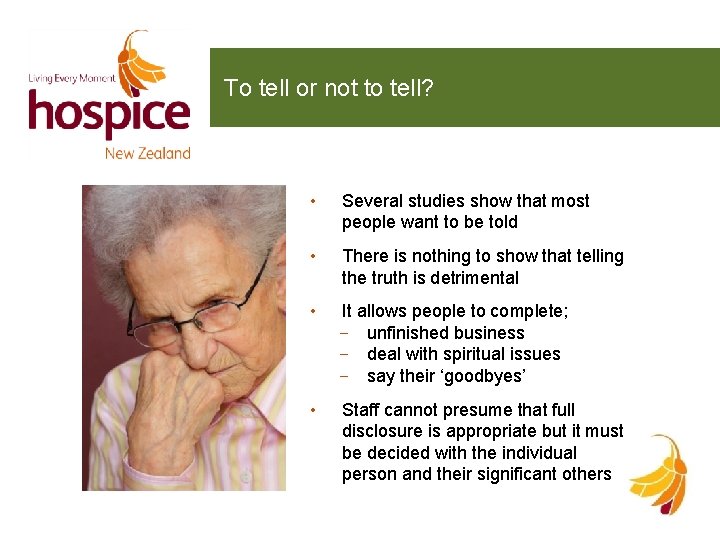
To tell or not to tell? • Several studies show that most people want to be told • There is nothing to show that telling the truth is detrimental • It allows people to complete; unfinished business deal with spiritual issues say their ‘goodbyes’ • Staff cannot presume that full disclosure is appropriate but it must be decided with the individual person and their significant others
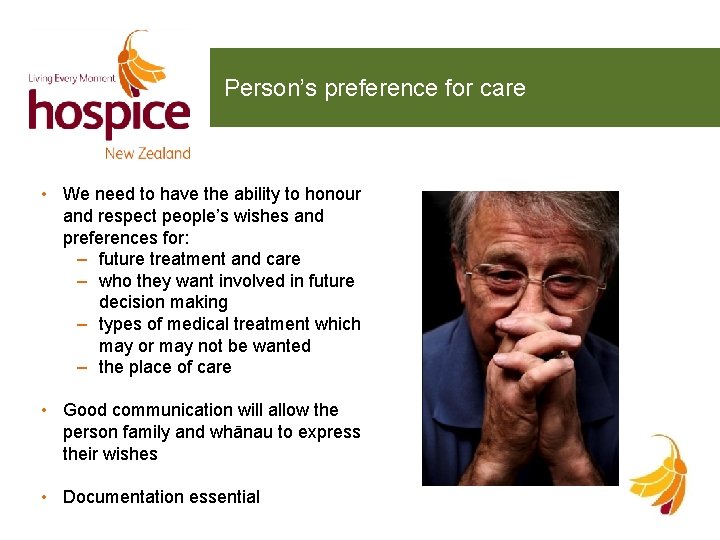
Person’s preference for care • We need to have the ability to honour and respect people’s wishes and preferences for: – future treatment and care – who they want involved in future decision making – types of medical treatment which may or may not be wanted – the place of care • Good communication will allow the person family and whānau to express their wishes • Documentation essential
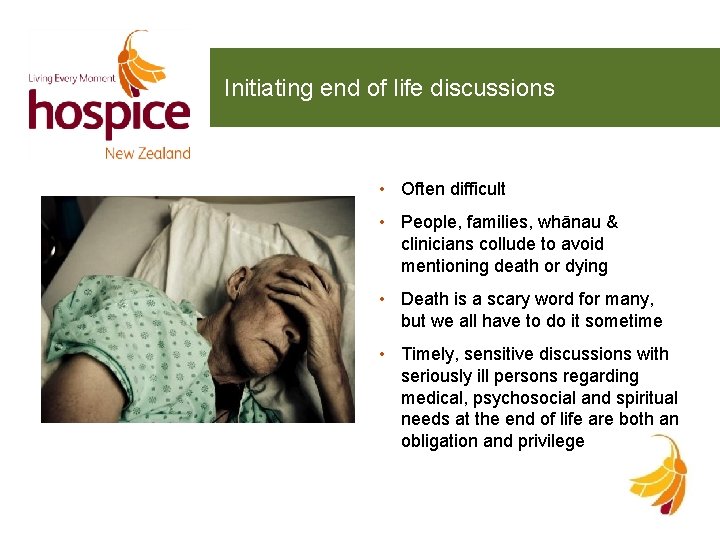
Initiating end of life discussions • Often difficult • People, families, whānau & clinicians collude to avoid mentioning death or dying • Death is a scary word for many, but we all have to do it sometime • Timely, sensitive discussions with seriously ill persons regarding medical, psychosocial and spiritual needs at the end of life are both an obligation and privilege
Indications for discussing end of life care • • • Imminent death Person talking about wanting to die Person, family or whānau inquiring about hospice or palliative care Severe progressive disease Suffering and poor prognosis In an effort to remain hopeful, doctors tend to focus on treatments and may inadvertently give people with life limiting illness a false sense of optimism and hope.
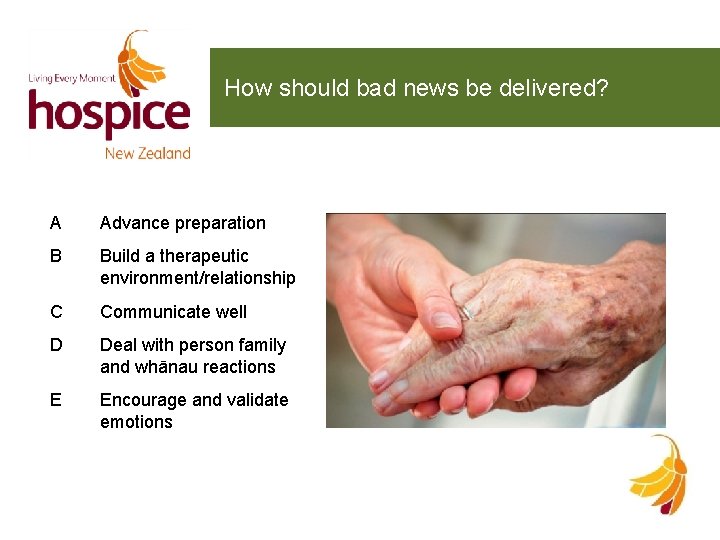
How should bad news be delivered? A Advance preparation B Build a therapeutic environment/relationship C Communicate well D Deal with person family and whānau reactions E Encourage and validate emotions
Responding to difficult questions • You may find it difficult when a person asks a very direct and difficult question: – – How long have I got? Am I dying? Why can’t you just give me something to end it right now? Am I going to get better? • Don’t rush in and try and answer the question but reframe the question and get more information and be sure you are both talking about the same thing – what has prompted you to ask this question? • Gently explore their thoughts by asking them to tell you more about what they are feeling • If you are unable to provide a satisfactory answer then be honest and tell them you will find someone who can discuss their concerns with them
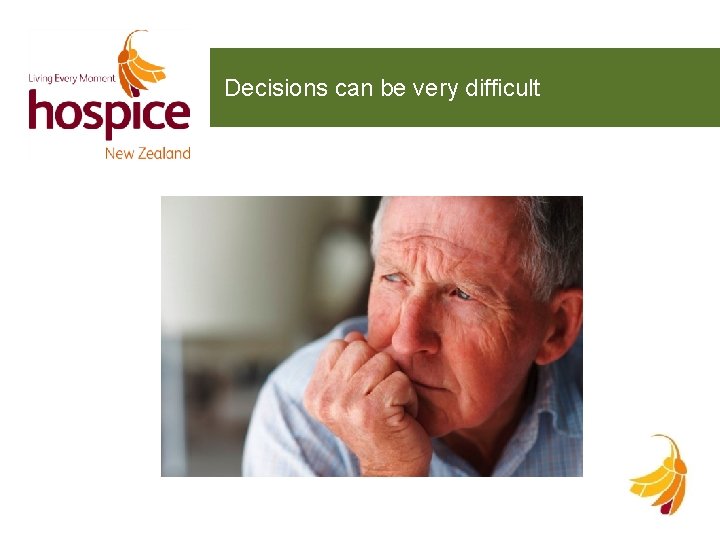
Decisions can be very difficult
Someone observed ‘Those who have the strength and the love to sit with a dying patient in the silence that goes beyond words will know that this moment is neither frightening nor painful, but a peaceful cessation of the functioning of the body. Watching a peaceful death of a human being reminds us of a falling star, one of the millions of lights in a vast sky that flares up for a brief moment only to disappear into the endless night forever’ Kubler Ross 1969
Conclusion Important communication strategies to remember; • Touch – shows connectedness and reduces isolation • Make time to communicate • Honesty and trust • Appropriate time and place • Sit down to show that you have time • Make eye contact if culturally appropriate • Avoid medical jargon • Enjoy communicating with the person – they have interesting stories to share • Be prepared to tackle the hard conversations