
Learning Objectives Write the Objective Teach Based on
Learning Objectives Write the Objective Teach Based on the Objective Test Over the Objective
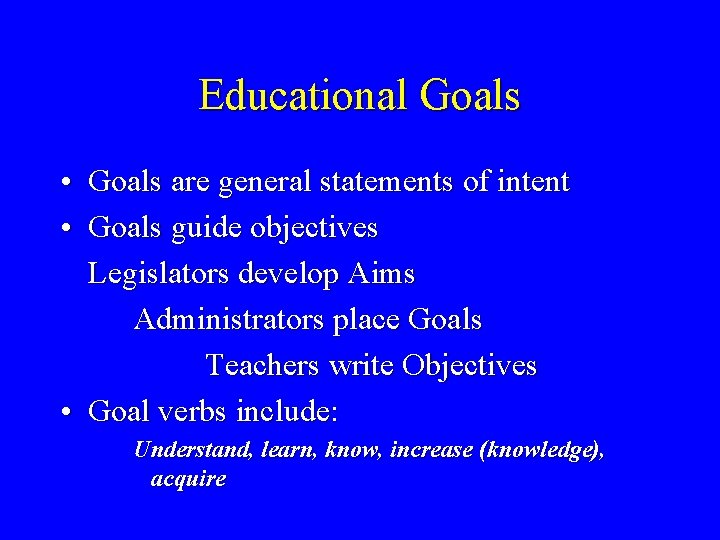
Educational Goals • Goals are general statements of intent • Goals guide objectives Legislators develop Aims Administrators place Goals Teachers write Objectives • Goal verbs include: Understand, learn, know, increase (knowledge), acquire
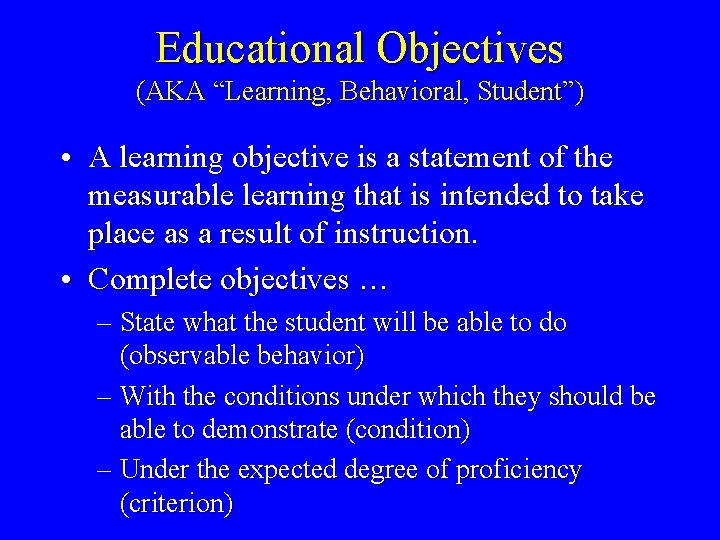
Educational Objectives (AKA “Learning, Behavioral, Student”) • A learning objective is a statement of the measurable learning that is intended to take place as a result of instruction. • Complete objectives … – State what the student will be able to do (observable behavior) – With the conditions under which they should be able to demonstrate (condition) – Under the expected degree of proficiency (criterion)
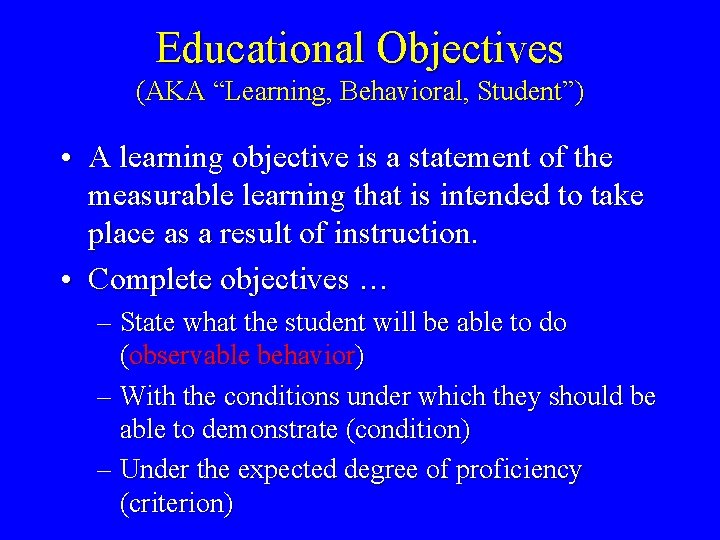
Educational Objectives (AKA “Learning, Behavioral, Student”) • A learning objective is a statement of the measurable learning that is intended to take place as a result of instruction. • Complete objectives … – State what the student will be able to do (observable behavior) – With the conditions under which they should be able to demonstrate (condition) – Under the expected degree of proficiency (criterion)
Educational Objectives (AKA “Learning, Behavioral, Student”) • A learning objective is a statement of the measurable learning that is intended to take place as a result of instruction. • Complete objectives … – State what the student will be able to do (observable behavior) – With the conditions under which they should be able to demonstrate (condition) – Under the expected degree of proficiency (criterion)
Educational Objectives (AKA “Learning, Behavioral, Student”) • A learning objective is a statement of the measurable learning that is intended to take place as a result of instruction. • Complete objectives … – State what the student will be able to do (observable behavior) – With the conditions under which they should be able to demonstrate (condition) – Under the expected degree of proficiency (criterion)
Objectives • Without notes or references, the students should be able to list in order the steps in troubleshooting a BASIC computer program with no mistakes. ? r o i v a h e B e l b a v Obser
Objectives • Without notes or references, the students should be able to list in order the steps in troubleshooting a BASIC computer program with no mistakes. ? r o i v a h e B e l b a v Obser
Objectives • Without notes or references, the students should be able to list in order the steps in troubleshooting a BASIC computer program with no mistakes. ? n o i t i d n Co
Objectives • Without notes or references, the students should be able to list in order the steps in troubleshooting a BASIC computer program with no mistakes. ? n o i t i d n Co
Objectives • Without notes or references, the students should be able to list in order the steps in troubleshooting a BASIC computer program with no mistakes. ? n o i r e t i Cr
Objectives • Without notes or references, the students should be able to list in order the steps in troubleshooting a BASIC computer program with no mistakes. ? n o i r e t i Cr
Objectives • Without notes or references, the students should be able to list in order the steps in troubleshooting a BASIC computer program with no mistakes. • Given the values of two of the three variables in Ohm’s law, the students should be able to calculate the value of the remaining variable 90% of the time.
Objectives • Without notes or references, the students should be able to list in order the steps in troubleshooting a BASIC computer program with no mistakes. • Given the values of two of the three variables in Ohm’s law, the students should be able to calculate the value of the remaining variable 90% of the time.
Objectives • Without notes or references, the students should be able to list in order the steps in troubleshooting a BASIC computer program with no mistakes. • Given the values of two of the three variables in Ohm’s law, the students should be able to calculate the value of the remaining variable 90% of the time.
Objectives • Without notes or references, the students should be able to list in order the steps in troubleshooting a BASIC computer program with no mistakes. • Given the values of two of the three variables in Ohm’s law, the students should be able to calculate the value of the remaining variable 90% of the time.
Types (domains) of learning objectives • Cognitive objectives – Describe the knowledge that learners are to acquire • Affective objectives – Describe the attitudes, feelings, and dispositions that learners are expected to develop • Psychomotor objectives – Relate to the manipulative and motor skills that learners are to master
Behavioral Domains • The Cognitive Domain (Bloom, 1956) • Intellectual skills – Knowledge – Remembering the information – Comprehension – Understanding the meaning – Application – Using the information – Analysis – Breaking down into parts – Synthesis – Producing a new whole – Evaluation – Judging the value
Behavioral Domains • The Affective Domain (Bloom, 1964) • Emotions, feelings & values – Receiving - Willing to listen or see – Responding - Active participation – Valuing - Internalize the worthiness – Organization - Ability to see the value – Characterization by a value - Behavior consistent with a value system
Behavioral Domains • The Psychomotor Domain • Muscular, motor skills, “hands-on” – Readiness - Willingness for an activity – Observation - Watches & is interested – Perception - Senses & becomes able – Response - Practices a skill – Adaptation - Develops and masters a skill
- Slides: 20