
LEARNING OBJECTIVES To understand explore different areas of
LEARNING OBJECTIVES • To understand explore different areas of Productivity Techniques and their applications in operations with the help of real life cases studies • Through the Industrial Visit and regular practice given to evolve solutions for case studies, the classroom knowledge will be put to application and at the same time their understanding will be put to evaluation • The students will acquire a new way of looking at the manufacturing sector in the entire supply chain journey
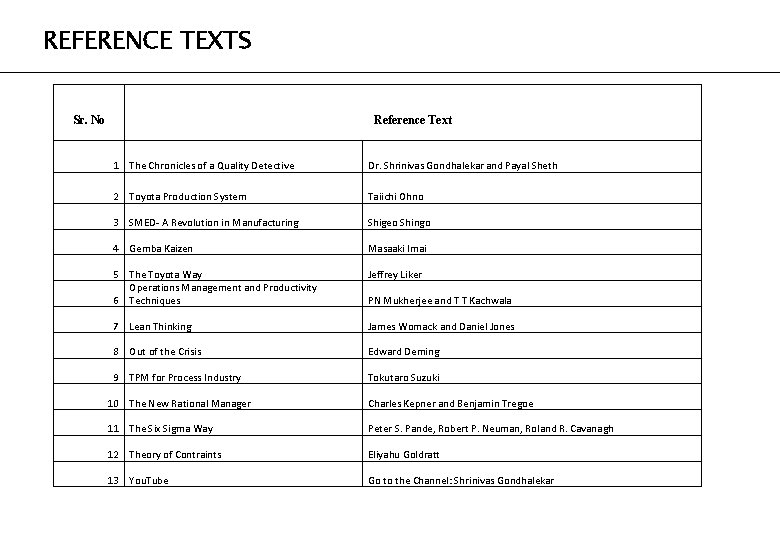
REFERENCE TEXTS Sr. No Reference Text 1 The Chronicles of a Quality Detective Dr. Shrinivas Gondhalekar and Payal Sheth 2 Toyota Production System Taiichi Ohno 3 SMED- A Revolution in Manufacturing Shigeo Shingo 4 Gemba Kaizen Masaaki Imai 5 The Toyota Way Operations Management and Productivity 6 Techniques Jeffrey Liker 7 Lean Thinking James Womack and Daniel Jones 8 Out of the Crisis Edward Deming 9 TPM for Process Industry Tokutaro Suzuki PN Mukherjee and T T Kachwala 10 The New Rational Manager Charles Kepner and Benjamin Tregoe 11 The Six Sigma Way Peter S. Pande, Robert P. Neuman, Roland R. Cavanagh 12 Theory of Contraints Eliyahu Goldratt 13 You. Tube Go to the Channel: Shrinivas Gondhalekar
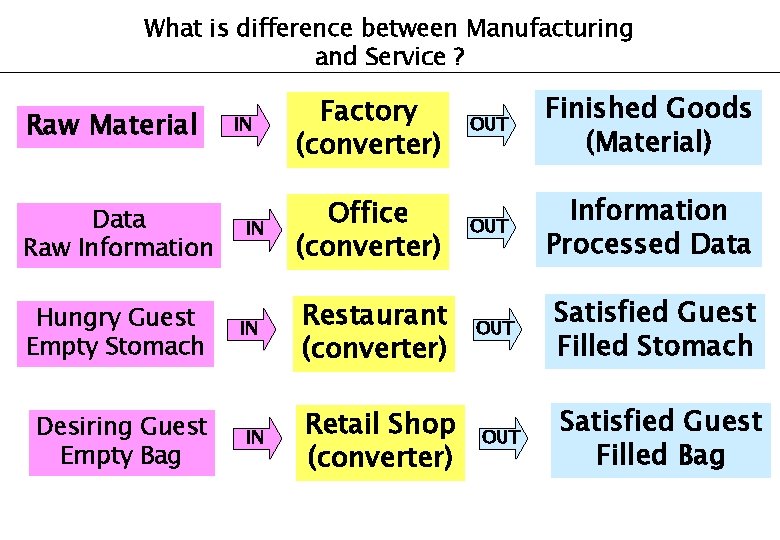
What is difference between Manufacturing and Service ? Raw Material Data Raw Information Hungry Guest Empty Stomach Desiring Guest Empty Bag IN IN Factory (converter) Office (converter) Restaurant (converter) Retail Shop (converter) OUT Finished Goods (Material) OUT Information Processed Data OUT Satisfied Guest Filled Stomach Satisfied Guest Filled Bag
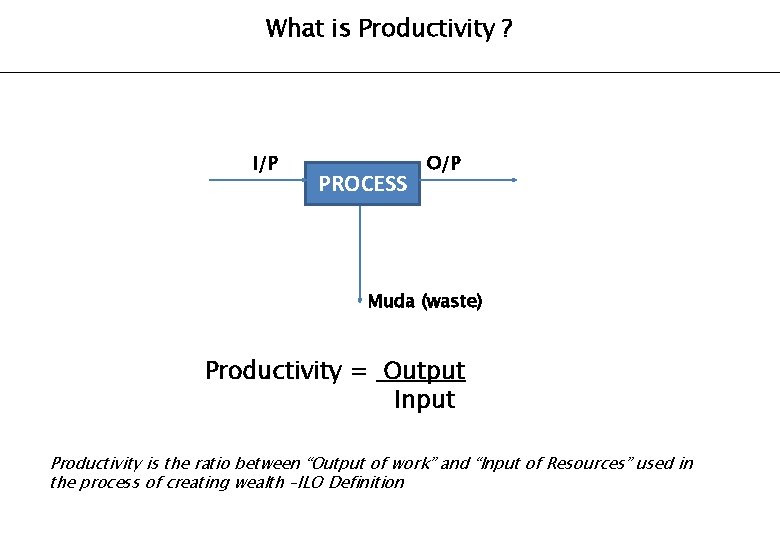
What is Productivity ? I/P PROCESS O/P Muda (waste) Productivity = Output Input Productivity is the ratio between “Output of work” and “Input of Resources” used in the process of creating wealth –ILO Definition
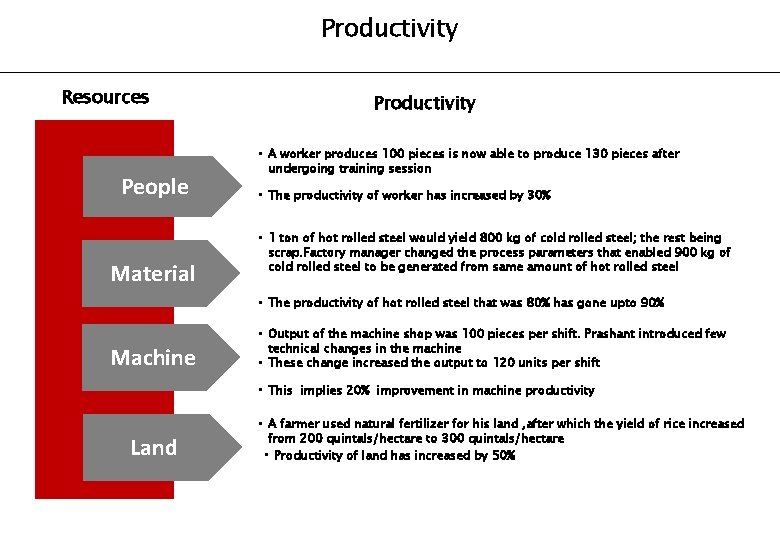
Productivity Resources People Material Productivity • A worker produces 100 pieces is now able to produce 130 pieces after undergoing training session • The productivity of worker has increased by 30% • 1 ton of hot rolled steel would yield 800 kg of cold rolled steel; the rest being scrap. Factory manager changed the process parameters that enabled 900 kg of cold rolled steel to be generated from same amount of hot rolled steel • The productivity of hot rolled steel that was 80% has gone upto 90% Machine • Output of the machine shop was 100 pieces per shift. Prashant introduced few technical changes in the machine • These change increased the output to 120 units per shift • This implies 20% improvement in machine productivity Land • A farmer used natural fertilizer for his land , after which the yield of rice increased from 200 quintals/hectare to 300 quintals/hectare • Productivity of land has increased by 50%
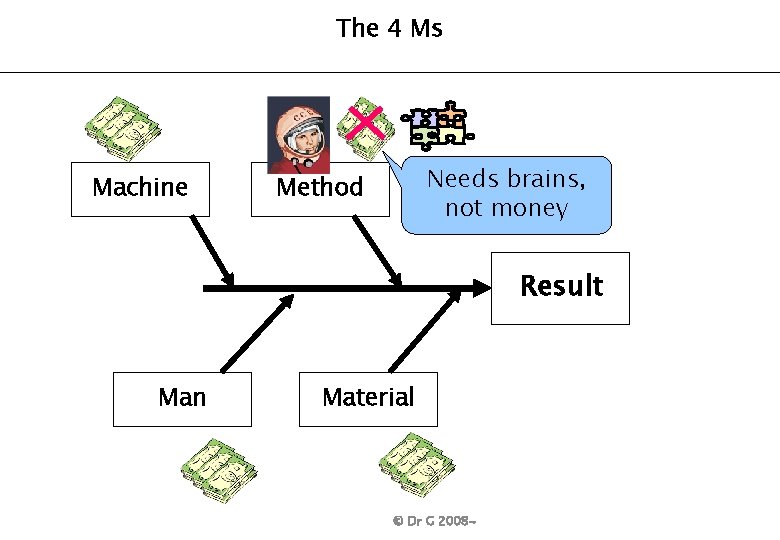
The 4 Ms Machine Needs brains, not money Method Result Man Material © Dr G 2008~
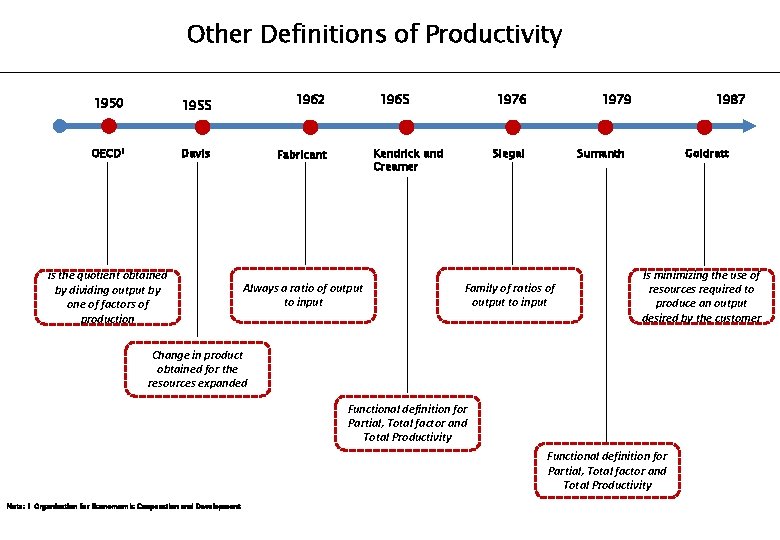
Other Definitions of Productivity 1950 1955 OECD 1 Davis is the quotient obtained by dividing output by one of factors of production 1962 1965 1976 Kendrick and Creamer Fabricant Always a ratio of output to input 1979 Siegal 1987 Sumanth Family of ratios of output to input Goldratt Is minimizing the use of resources required to produce an output desired by the customer Change in product obtained for the resources expanded Functional definition for Partial, Total factor and Total Productivity Note: 1 Organisation for Economomic Cooperation and Development
Productivity -Performance Is Productivity different from Performance?
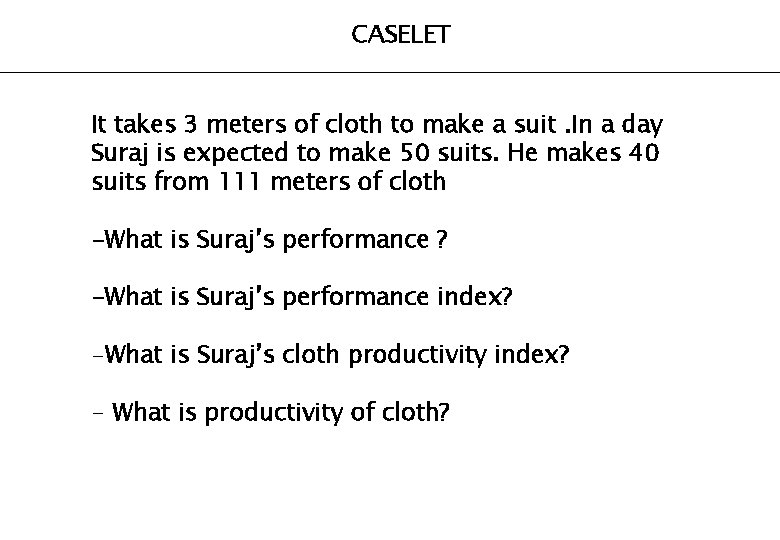
CASELET It takes 3 meters of cloth to make a suit. In a day Suraj is expected to make 50 suits. He makes 40 suits from 111 meters of cloth -What is Suraj’s performance ? -What is Suraj’s performance index? -What is Suraj’s cloth productivity index? - What is productivity of cloth?
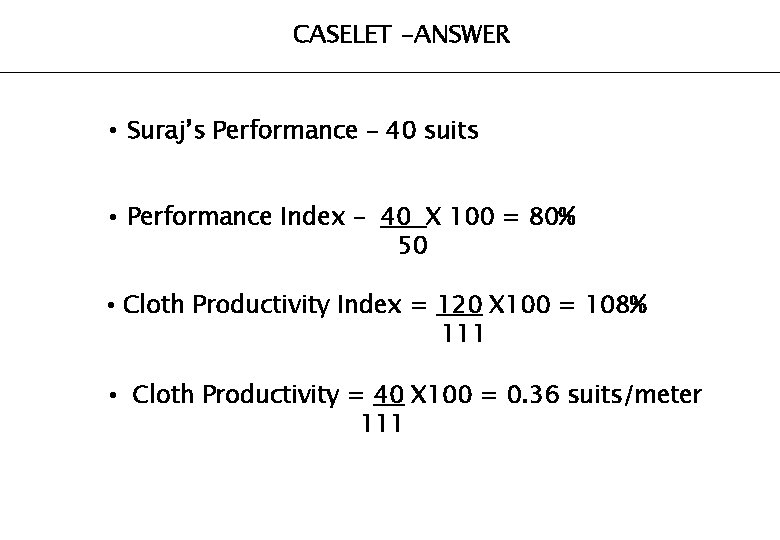
CASELET -ANSWER • Suraj’s Performance – 40 suits • Performance Index – 40 X 100 = 80% 50 • Cloth Productivity Index = 120 X 100 = 108% 111 • Cloth Productivity = 40 X 100 = 0. 36 suits/meter 111
Production-Productivity Is Production same as Productivity?
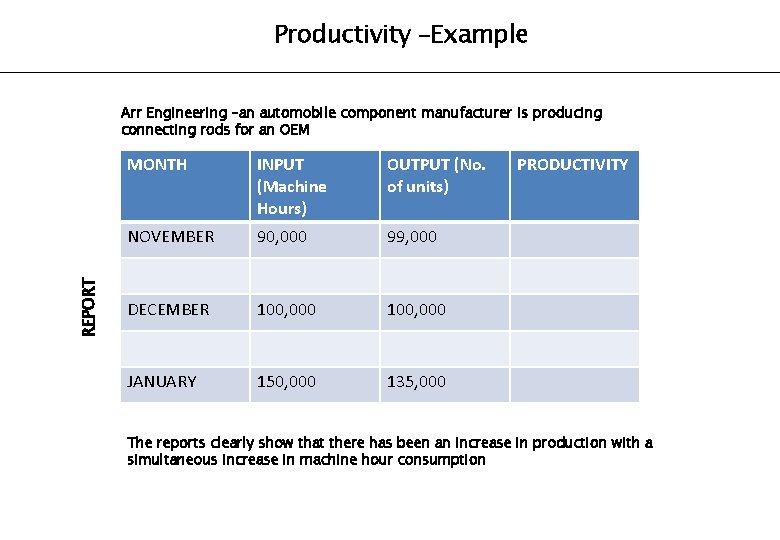
Productivity –Example REPORT Arr Engineering –an automobile component manufacturer is producing connecting rods for an OEM MONTH INPUT (Machine Hours) OUTPUT (No. of units) NOVEMBER 90, 000 99, 000 DECEMBER 100, 000 JANUARY 150, 000 135, 000 PRODUCTIVITY The reports clearly show that there has been an increase in production with a simultaneous increase in machine hour consumption
Partial Productivity Definition : Ratio of output to one class of input • At a given time it considers only one input and ignores all other inputs • It is important as it focuses utilization of one resource • Labour productivity is measured using utilization of labour-hours, whereas capital productivity is measured in Rupees
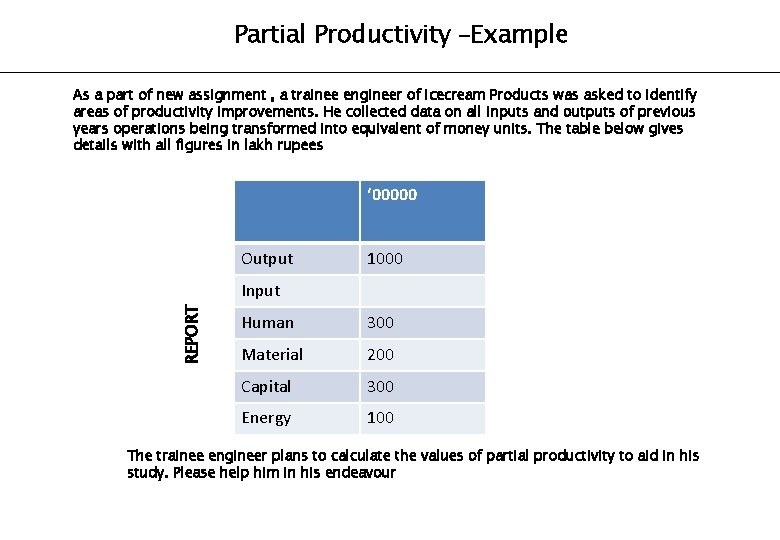
Partial Productivity –Example As a part of new assignment , a trainee engineer of Icecream Products was asked to identify areas of productivity improvements. He collected data on all inputs and outputs of previous years operations being transformed into equivalent of money units. The table below gives details with all figures in lakh rupees ‘ 00000 Output 1000 REPORT Input Human 300 Material 200 Capital 300 Energy 100 The trainee engineer plans to calculate the values of partial productivity to aid in his study. Please help him in his endeavour
Total Factor Productivity • In an effort to improve productivity of labour, company may install more machinery. Then productivity of labour will go up bringing down the capital productivity • Partial productivity that typically uses only one resource at a time fails to grasp this paradox • Historically labour and capital were considered to be the most significant contributors in the process of production • John Kendrick in 1951 emphasised labour and capital as only two input factors • Disadvantage of considering total productivity factors is that it does not consider impact of material and energy inputs (material typically forms 60% of the product cost
Multi-Factor Model of Productivity • Total Factor productivity model was further developed by Scott D Sink as Multi Factor Productivity Measurement Model in which he considered Labour, Material and Energy as major inputs • Capital was not considered in this model as it is the most difficult part to estimate how much of a capital is being consumed in a unit of time • Depreciation applied by accountants makes it further difficult to estimate actual capital being consumed
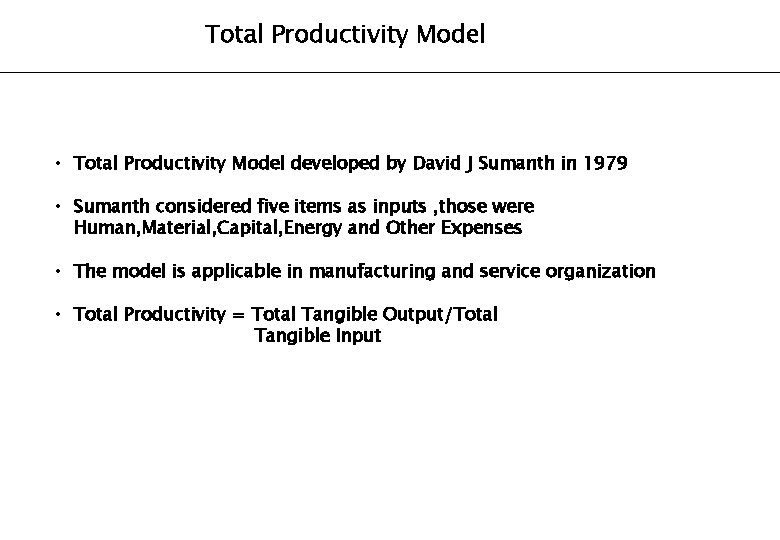
Total Productivity Model • Total Productivity Model developed by David J Sumanth in 1979 • Sumanth considered five items as inputs , those were Human, Material, Capital, Energy and Other Expenses • The model is applicable in manufacturing and service organization • Total Productivity = Total Tangible Output/Total Tangible Input
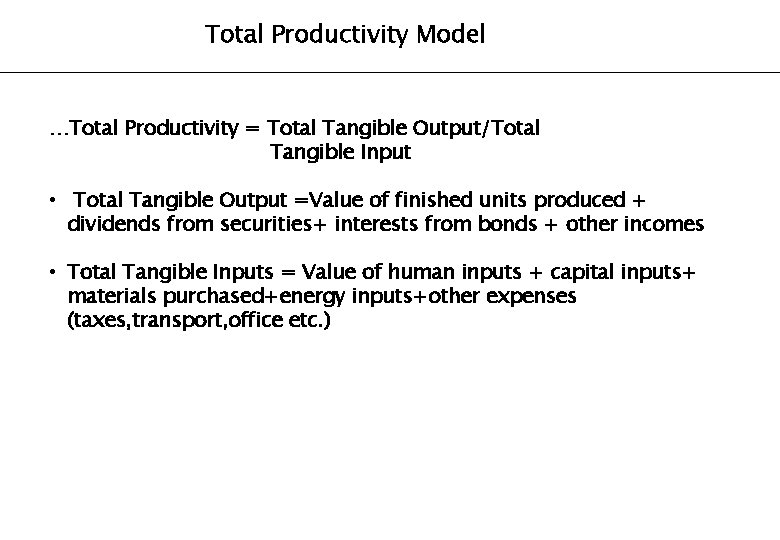
Total Productivity Model …Total Productivity = Total Tangible Output/Total Tangible Input • Total Tangible Output =Value of finished units produced + dividends from securities+ interests from bonds + other incomes • Total Tangible Inputs = Value of human inputs + capital inputs+ materials purchased+energy inputs+other expenses (taxes, transport, office etc. )
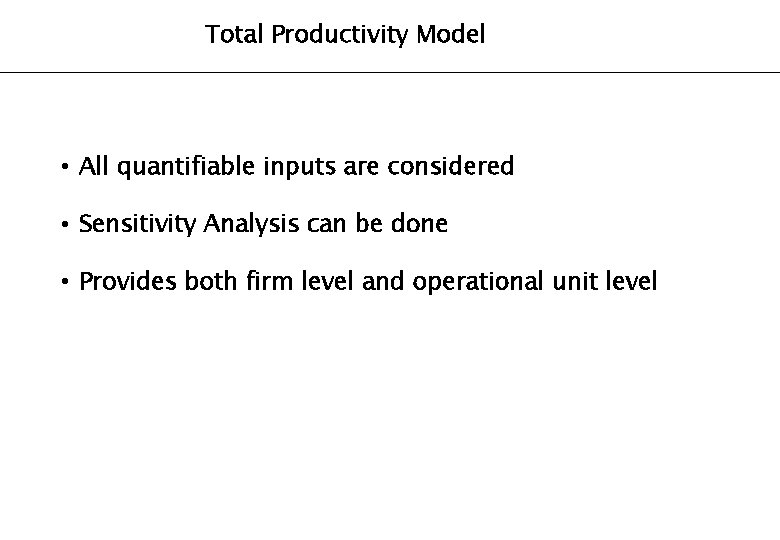
Total Productivity Model • All quantifiable inputs are considered • Sensitivity Analysis can be done • Provides both firm level and operational unit level
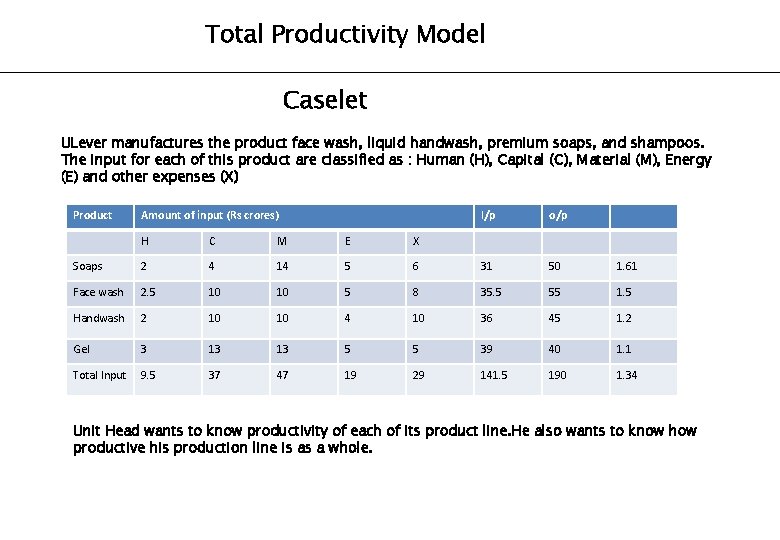
Total Productivity Model Caselet ULever manufactures the product face wash, liquid handwash, premium soaps, and shampoos. The input for each of this product are classified as : Human (H), Capital (C), Material (M), Energy (E) and other expenses (X) Product Amount of input (Rs crores) I/p o/p H C M E X Soaps 2 4 14 5 6 31 50 1. 61 Face wash 2. 5 10 10 5 8 35. 5 55 1. 5 Handwash 2 10 10 4 10 36 45 1. 2 Gel 3 13 13 5 5 39 40 1. 1 Total Input 9. 5 37 47 19 29 141. 5 190 1. 34 Unit Head wants to know productivity of each of its product line. He also wants to know how productive his production line is as a whole.
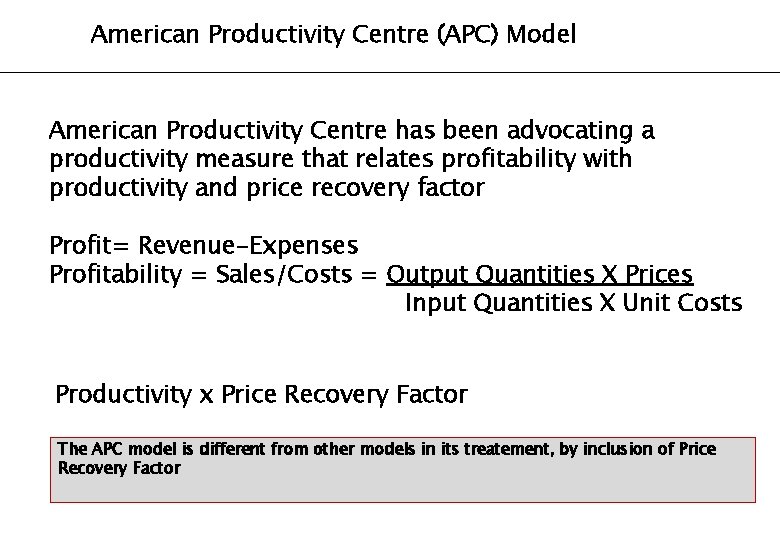
American Productivity Centre (APC) Model American Productivity Centre has been advocating a productivity measure that relates profitability with productivity and price recovery factor Profit= Revenue-Expenses Profitability = Sales/Costs = Output Quantities X Prices Input Quantities X Unit Costs Productivity x Price Recovery Factor The APC model is different from other models in its treatement, by inclusion of Price Recovery Factor

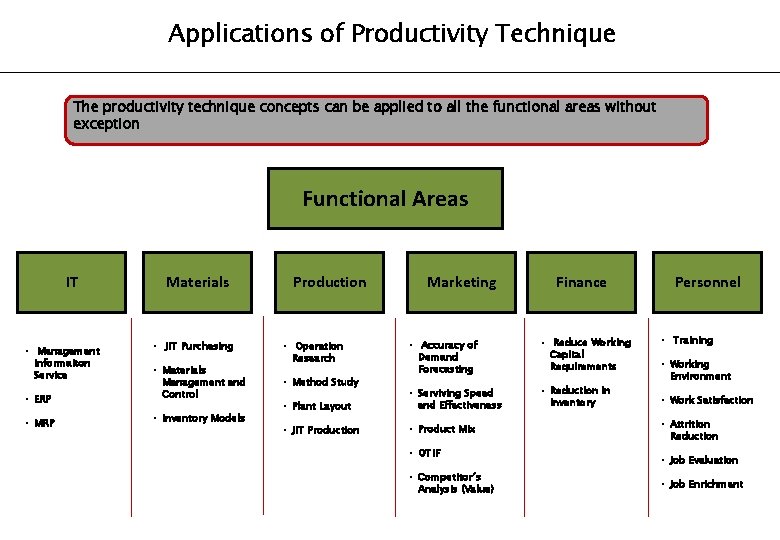
Applications of Productivity Technique The productivity technique concepts can be applied to all the functional areas without exception Functional Areas IT • Management Informaiton Service Materials • JIT Purchasing • ERP • Materials Management and Control • MRP • Inventory Models Production Marketing Finance • Accuracy of Demand Forecasting • Reduce Working Capital Requirements • Plant Layout • Serviving Speed and Effectiveness • Reduction in Inventory • JIT Production • Product Mix • Operation Research • Method Study • OTIF • Competitor’s Analysis (Value) Personnel • Training • Working Environment • Work Satisfaction • Attrition Reduction • Job Evaluation • Job Enrichment
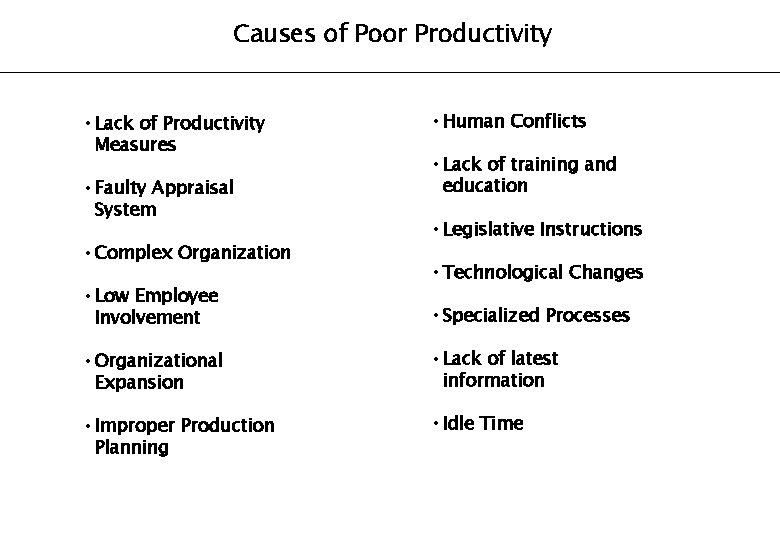
Causes of Poor Productivity • Lack of Productivity Measures • Faulty Appraisal System • Complex Organization • Low Employee Involvement • Human Conflicts • Lack of training and education • Legislative Instructions • Technological Changes • Specialized Processes • Organizational Expansion • Lack of latest information • Improper Production Planning • Idle Time
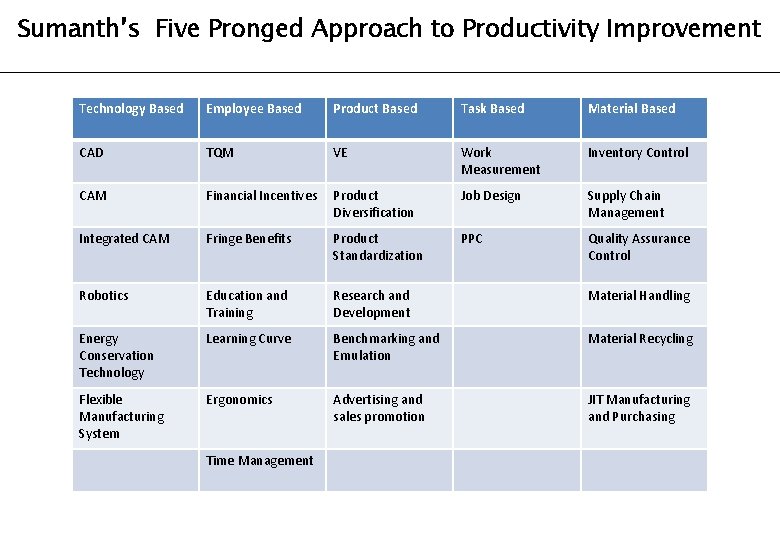
Sumanth’s Five Pronged Approach to Productivity Improvement Technology Based Employee Based Product Based Task Based Material Based CAD TQM VE Work Measurement Inventory Control CAM Financial Incentives Product Diversification Job Design Supply Chain Management Integrated CAM Fringe Benefits Product Standardization PPC Quality Assurance Control Robotics Education and Training Research and Development Material Handling Energy Conservation Technology Learning Curve Benchmarking and Emulation Material Recycling Flexible Manufacturing System Ergonomics Advertising and sales promotion JIT Manufacturing and Purchasing Time Management
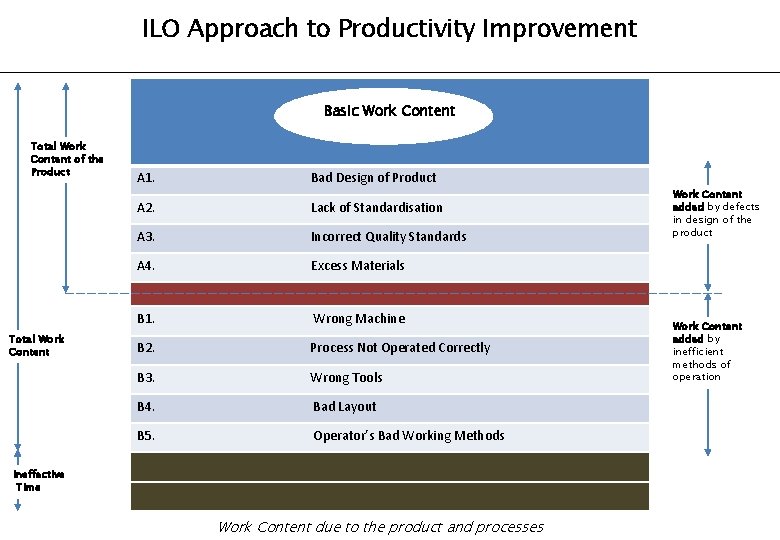
ILO Approach to Productivity Improvement Basic Work Content Total Work Content of the Product Total Work Content A 1. Bad Design of Product A 2. Lack of Standardisation A 3. Incorrect Quality Standards A 4. Excess Materials B 1. Wrong Machine B 2. Process Not Operated Correctly B 3. Wrong Tools B 4. Bad Layout B 5. Operator’s Bad Working Methods Ineffective Time Work Content due to the product and processes Work Content added by defects in design of the product Work Content added by inefficient methods of operation
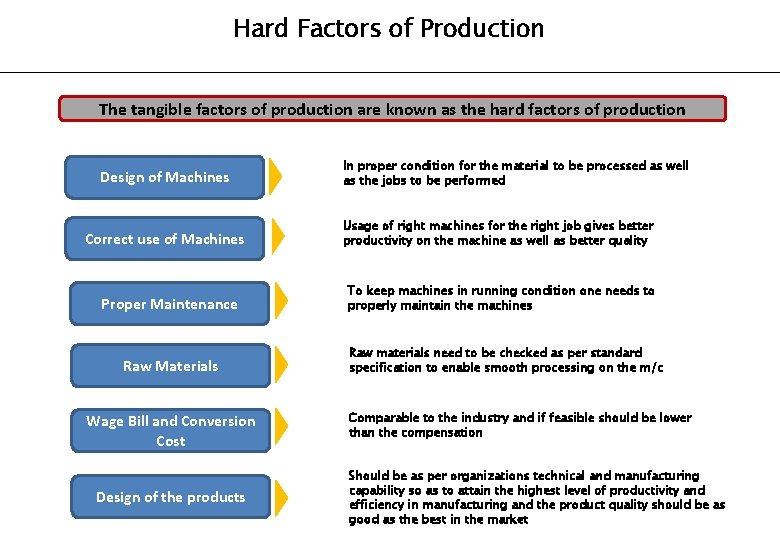
Hard Factors of Production The tangible factors of production are known as the hard factors of production Design of Machines Correct use of Machines Proper Maintenance Raw Materials Wage Bill and Conversion Cost Design of the products In proper condition for the material to be processed as well as the jobs to be performed Usage of right machines for the right job gives better productivity on the machine as well as better quality To keep machines in running condition one needs to properly maintain the machines Raw materials need to be checked as per standard specification to enable smooth processing on the m/c Comparable to the industry and if feasible should be lower than the compensation Should be as per organizations technical and manufacturing capability so as to attain the highest level of productivity and efficiency in manufacturing and the product quality should be as good as the best in the market
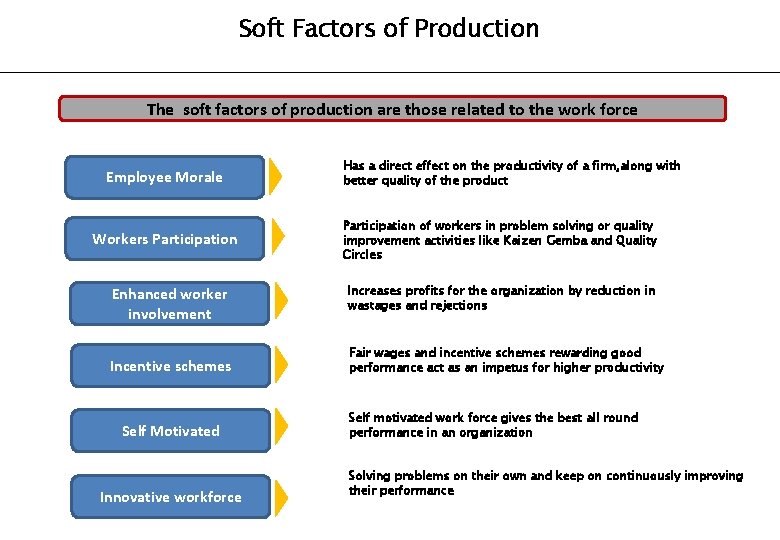
Soft Factors of Production The soft factors of production are those related to the work force Employee Morale Workers Participation Has a direct effect on the productivity of a firm, along with better quality of the product Participation of workers in problem solving or quality improvement activities like Kaizen Gemba and Quality Circles Enhanced worker involvement Increases profits for the organization by reduction in wastages and rejections Incentive schemes Fair wages and incentive schemes rewarding good performance act as an impetus for higher productivity Self Motivated Innovative workforce Self motivated work force gives the best all round performance in an organization Solving problems on their own and keep on continuously improving their performance
Value Analysis and Value Engineering
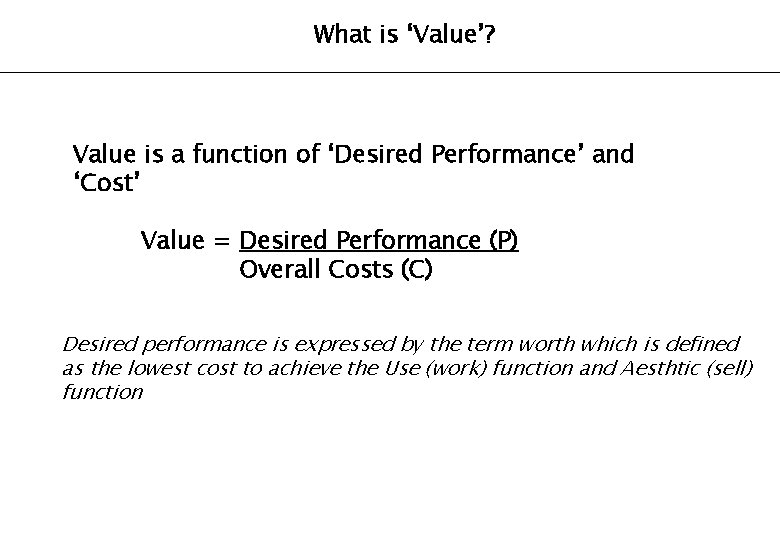
What is ‘Value’? Value is a function of ‘Desired Performance’ and ‘Cost’ Value = Desired Performance (P) Overall Costs (C) Desired performance is expressed by the term worth which is defined as the lowest cost to achieve the Use (work) function and Aesthtic (sell) function
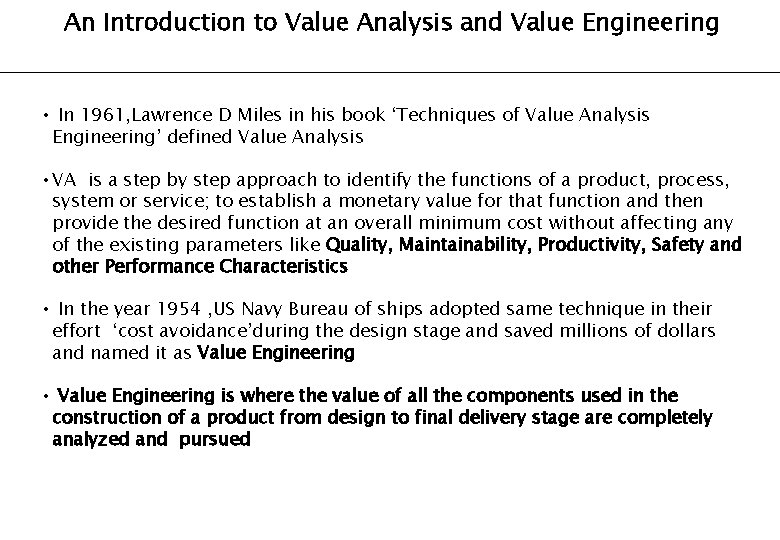
An Introduction to Value Analysis and Value Engineering • In 1961, Lawrence D Miles in his book ‘Techniques of Value Analysis Engineering’ defined Value Analysis • VA is a step by step approach to identify the functions of a product, process, system or service; to establish a monetary value for that function and then provide the desired function at an overall minimum cost without affecting any of the existing parameters like Quality, Maintainability, Productivity, Safety and other Performance Characteristics • In the year 1954 , US Navy Bureau of ships adopted same technique in their effort ‘cost avoidance’during the design stage and saved millions of dollars and named it as Value Engineering • Value Engineering is where the value of all the components used in the construction of a product from design to final delivery stage are completely analyzed and pursued
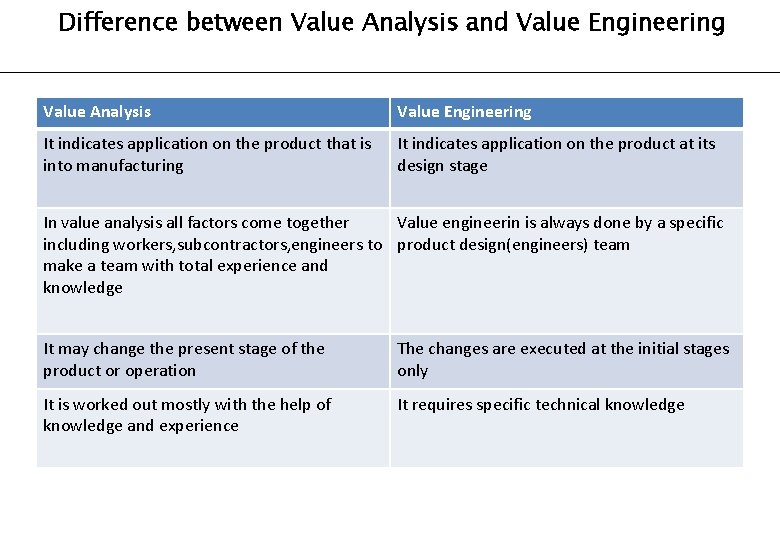
Difference between Value Analysis and Value Engineering Value Analysis Value Engineering It indicates application on the product that is into manufacturing It indicates application on the product at its design stage In value analysis all factors come together Value engineerin is always done by a specific including workers, subcontractors, engineers to product design(engineers) team make a team with total experience and knowledge It may change the present stage of the product or operation The changes are executed at the initial stages only It is worked out mostly with the help of knowledge and experience It requires specific technical knowledge
- Slides: 32