
Learning Objectives To improve performance on the March
Learning Objectives • To improve performance on the March mock examination (Remembering and Forgetting) What are the advantages and disadvantages of each type of experimental design? Write down one advantage and one disadvantage for each one.
Remember experimental design is all about the way in which participants are used in conditions within an experiment! • Repeated measures • (+) any differences are likely to be due to changes in the IV and not participant variables • (+) fewer participants need to be recruited as they are used twice (or more) • (-) order effects – practise effect, fatigue effect, demand characteristics because participants take part in all conditions
Remember experimental design is all about the way in which participants are used in conditions within an experiment! • Independent groups • (+) no order effects because participants take part in one condition • (+) task variables can be controlled e. g. participants can be given the same word list • (-) any differences could be due to individual differences, not because of the experiment itself but because of the motivation of the participants, for example
Remember experimental design is all about the way in which participants are used in conditions within an experiment! • Matched pairs • (+) no order effects, participants take part in one condition • (+) individual differences are reduced as participants have been matched up • (-) time consuming and expensive to match participants

Introduction • Similar to yesterday’s lesson we will go through each question, you will highlight the point at which you gained a mark and use a different coloured pen to make any improvements to your answer • This will be the last time we look at these particular questions, so make the most of it!
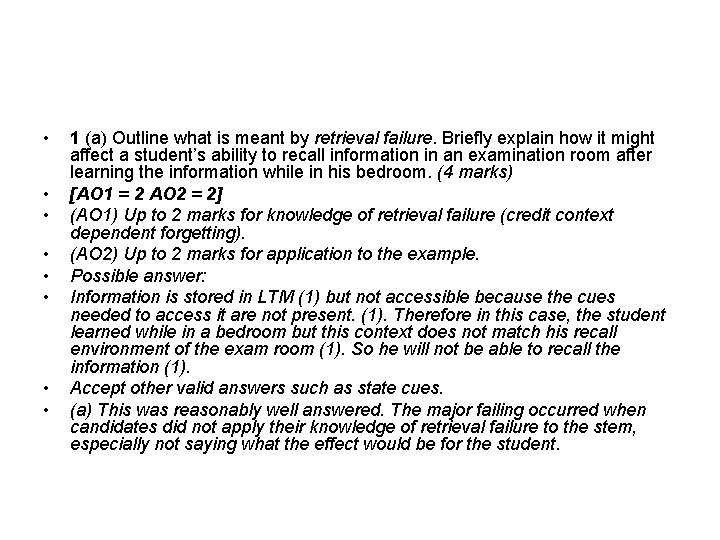
• • 1 (a) Outline what is meant by retrieval failure. Briefly explain how it might affect a student’s ability to recall information in an examination room after learning the information while in his bedroom. (4 marks) [AO 1 = 2 AO 2 = 2] (AO 1) Up to 2 marks for knowledge of retrieval failure (credit context dependent forgetting). (AO 2) Up to 2 marks for application to the example. Possible answer: Information is stored in LTM (1) but not accessible because the cues needed to access it are not present. (1). Therefore in this case, the student learned while in a bedroom but this context does not match his recall environment of the exam room (1). So he will not be able to recall the information (1). Accept other valid answers such as state cues. (a) This was reasonably well answered. The major failing occurred when candidates did not apply their knowledge of retrieval failure to the stem, especially not saying what the effect would be for the student.
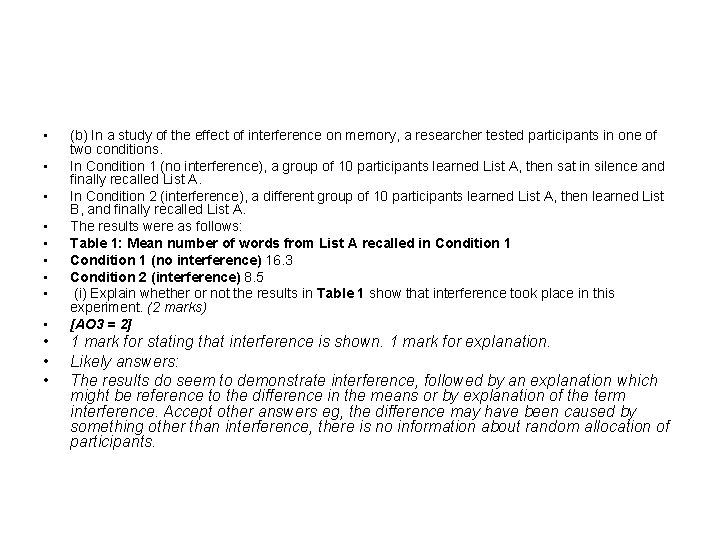
• • • (b) In a study of the effect of interference on memory, a researcher tested participants in one of two conditions. In Condition 1 (no interference), a group of 10 participants learned List A, then sat in silence and finally recalled List A. In Condition 2 (interference), a different group of 10 participants learned List A, then learned List B, and finally recalled List A. The results were as follows: Table 1: Mean number of words from List A recalled in Condition 1 (no interference) 16. 3 Condition 2 (interference) 8. 5 (i) Explain whether or not the results in Table 1 show that interference took place in this experiment. (2 marks) [AO 3 = 2] 1 mark for stating that interference is shown. 1 mark for explanation. Likely answers: The results do seem to demonstrate interference, followed by an explanation which might be reference to the difference in the means or by explanation of the term interference. Accept other answers eg, the difference may have been caused by something other than interference, there is no information about random allocation of participants.
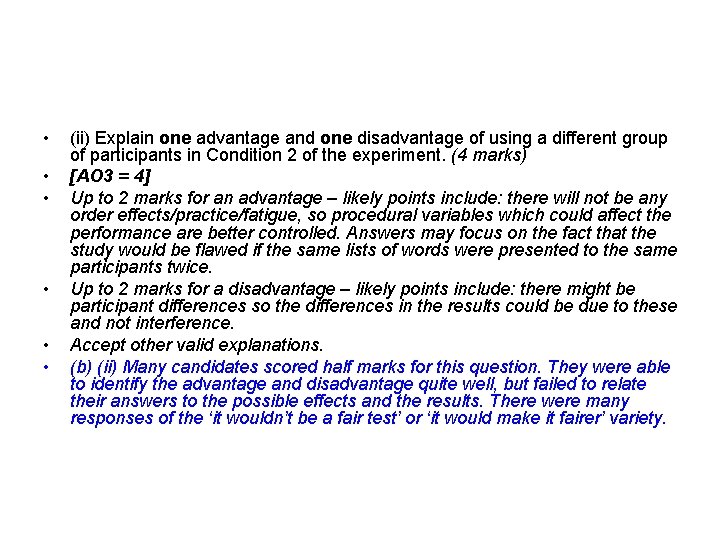
• • • (ii) Explain one advantage and one disadvantage of using a different group of participants in Condition 2 of the experiment. (4 marks) [AO 3 = 4] Up to 2 marks for an advantage – likely points include: there will not be any order effects/practice/fatigue, so procedural variables which could affect the performance are better controlled. Answers may focus on the fact that the study would be flawed if the same lists of words were presented to the same participants twice. Up to 2 marks for a disadvantage – likely points include: there might be participant differences so the differences in the results could be due to these and not interference. Accept other valid explanations. (b) (ii) Many candidates scored half marks for this question. They were able to identify the advantage and disadvantage quite well, but failed to relate their answers to the possible effects and the results. There were many responses of the ‘it wouldn’t be a fair test’ or ‘it would make it fairer’ variety.
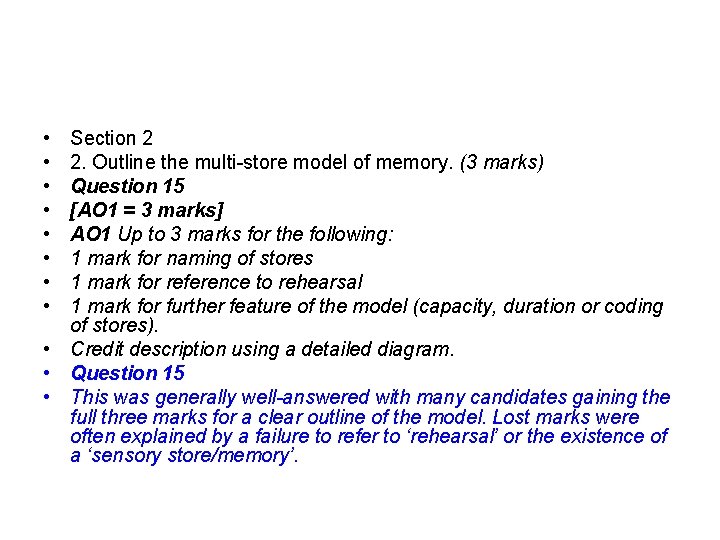
• • Section 2 2. Outline the multi-store model of memory. (3 marks) Question 15 [AO 1 = 3 marks] AO 1 Up to 3 marks for the following: 1 mark for naming of stores 1 mark for reference to rehearsal 1 mark for further feature of the model (capacity, duration or coding of stores). • Credit description using a detailed diagram. • Question 15 • This was generally well-answered with many candidates gaining the full three marks for a clear outline of the model. Lost marks were often explained by a failure to refer to ‘rehearsal’ or the existence of a ‘sensory store/memory’.
• 3. What is meant by lack of consolidation? Suggest one reason why lack of consolidation might occur. (2 marks) • [AO 1 = 1 mark, AO 2 = 1 mark] • AO 1 1 mark for reference to the memory not becoming permanently fixed due to some • physical disruption. Failure to modify neurons/cell assemblies. • AO 2 1 mark for a valid explanation such as: disruption of neurochemical activity, head trauma, ECT, drugs. • Question 16 • Although most candidates were able to access a mark for explaining why ‘lack of consolidation’ occurs (usually ‘head trauma/concussion’); very few made it clear that this particular theory of forgetting explains loss of information as being due to physical disruption. Often, the definitions offered were vague and did not adequately distinguish lack of consolidation from other forms of forgetting; most notably, trace decay.
• • • 4. Outline the interference explanation of forgetting and briefly discuss one limitation of this explanation. (5 marks) [AO 1 = 3 marks, AO 2 = 2 marks] AO 1 Up to 2 marks for a description of interference theory. Likely points: Events that take place between learning and recall can disrupt memory, proactive interference occurs when older learning/memories cause forgetting of newer information, retroactive interference occurs when newer learning causes forgetting of older memories, interference more likely if competing memories are similar. 1 mark for stating that interference can be proactive or retroactive. 1 mark for identifying an appropriate limitation of theory. Likely limitations: Most of the research uses artificial tasks/lacks ecological validity. There is a difficulty in separating the effects of interference and decay over time. The theory does not explain the possible cognitive processes involved. It does not adequately explain forgetting of semantic material. AO 2 Up to 2 marks for a brief discussion of the limitation identified. Possible answer for lack of ecological validity: Using tasks like learning unrelated words and in a laboratory/highly controlled environment means that the results may not reflect the processes that occur in everyday memory/ cannot be generalised to normal memory use. The discussion might be via use of evidence, for example: Jenkins and Dallenbach (1924) or counter argument. Question 17 Many candidates gave an accurate outline of interference, usually by explaining the two types: ‘proactive’ and ‘retroactive’. Some candidates confused interference with displacement or more general forms of ‘distraction’. Lots of candidates could state a limitation but very few developed this into a coherent discussion. As a consequence, there were very few five-mark responses. Those that did gain full marks tended to focus on the artificial nature of the evidence supporting the explanation: that studies are often designed to deliberately induce interference by pairing similar sorts of material within short time-frames. A surprisingly high number of candidates gave limitations that were based on the erroneous assumption that interference only explains forgetting in long-term memory.
What have we learnt? • Summarise your learning today in a tweet • @Miss Earl today I have learnt……………. .
- Slides: 12