
Learning Objectives LO 3 Demonstrate the process for
Learning Objectives LO 3 Demonstrate the process for determining federal income tax withholdings. LO 4 Demonstrate the process for calculating social security and Medicare taxes. LO 5 Explain the benefit of funding medical and retirement plans with pretax contributions. © 2014 Cengage Learning. All Rights Reserved.
Lesson 12 -2 Payroll Taxes LO 3 ● Taxes based on the payroll of a business are called payroll taxes. © 2014 Cengage Learning. All Rights Reserved. SLIDE 2
Lesson 12 -2 Employee’s Withholding Allowance Certificate LO 3 ● A deduction from total earnings for each person legally supported by a taxpayer, including the employee, is called a withholding allowance. ● Any amount withheld from an employee’s gross earnings is called a payroll deduction. © 2014 Cengage Learning. All Rights Reserved. SLIDE 3
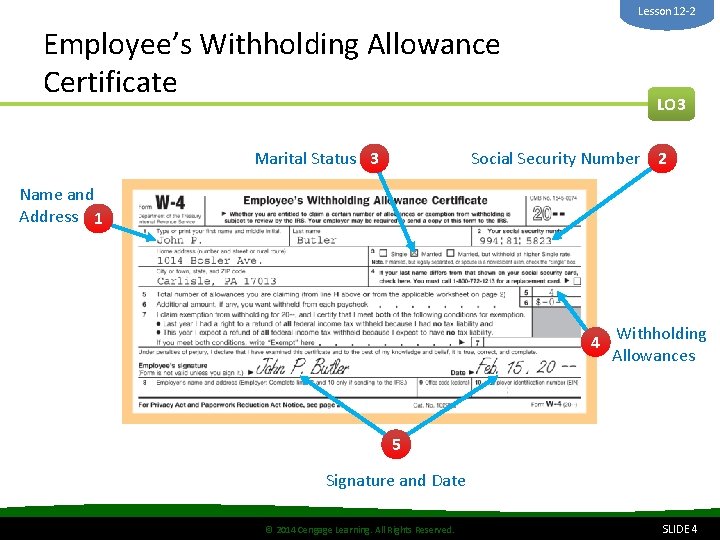
Lesson 12 -2 Employee’s Withholding Allowance Certificate Marital Status 3 LO 3 Social Security Number 2 Name and Address 1 4 Withholding Allowances 5 Signature and Date © 2014 Cengage Learning. All Rights Reserved. SLIDE 4
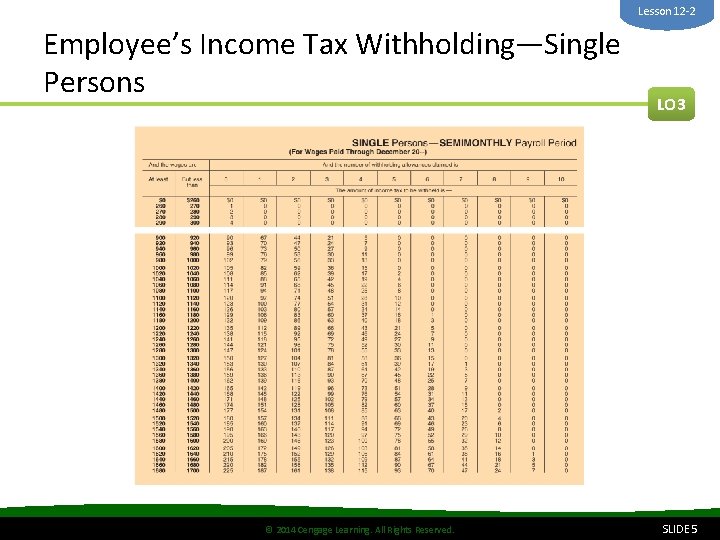
Lesson 12 -2 Employee’s Income Tax Withholding—Single Persons © 2014 Cengage Learning. All Rights Reserved. LO 3 SLIDE 5

Lesson 12 -2 Employee’s Income Tax Withholding— Married Persons LO 3 Select the appropriate table 1 2 Locate employee’s total earnings Intersection of earnings and withholding allowances © 2014 Cengage Learning. All Rights Reserved. 3 SLIDE 6
Lesson 12 -2 Employee Social Security and Medicare Tax LO 4 ● A federal tax paid for old-age, survivors, and disability insurance is called social security tax. ● A federal tax paid for hospital insurance is called Medicare tax. ● The total gross earnings year to date for an employee is called accumulated earnings. ● The maximum amount of earnings on which a tax is calculated is called a tax base. © 2014 Cengage Learning. All Rights Reserved. SLIDE 7
Lesson 12 -2 Voluntary Deductions from Earnings LO 5 ● A retirement savings plan approved by the Internal Revenue Service that provides individuals with a tax benefit is called a qualified retirement plan. ● A 401(k) is a qualified retirement plan sponsored by an employer. ● An individual retirement account (IRA) is a qualified retirement plan that provides most individuals with a deferred federal income tax benefit. ● A Roth individual retirement account (Roth IRA) is a qualified retirement plan that allows tax-free withdrawals from the account. © 2014 Cengage Learning. All Rights Reserved. SLIDE 8
Lesson 12 -2 Audit Your Understanding 1. Where does an employer get the information used to determine the amount of federal income tax to withhold from employees’ earnings? ANSWER Form W-4, Employee’s Withholding Allowance Certificate © 2014 Cengage Learning. All Rights Reserved. SLIDE 9
Lesson 12 -2 Audit Your Understanding 2. Employee federal income tax withholdings are based on what two factors? ANSWER Employee marital status and number of withholding allowances © 2014 Cengage Learning. All Rights Reserved. SLIDE 10
Lesson 12 -2 Audit Your Understanding 3. Does the employer or employee pay social security tax and Medicare tax? ANSWER Both the employee and employer pay. © 2014 Cengage Learning. All Rights Reserved. SLIDE 11
Lesson 12 -2 Audit Your Understanding 4. What is the difference in the tax impact of contributions between a 401(k), an IRA , and a Roth IRA? ANSWER Only the contributions to a 401(k) and an IRA are deducted from earnings before payroll taxes are calculated. © 2014 Cengage Learning. All Rights Reserved. SLIDE 12
Lesson 12 -2 Audit Your Understanding 5. Are the withdrawals from a 401(k), an IRA , and a Roth IRA subject to income taxes? ANSWER The withdrawals from the 401(k) and an IRA are subject to income taxes; withdrawals from a Roth IRA are tax free. © 2014 Cengage Learning. All Rights Reserved. SLIDE 13
- Slides: 13