
Learning Objectives LO 3 Classify accounts as assets
Learning Objectives LO 3 Classify accounts as assets, liabilities, or owner’s equity and demonstrate their relationship in the accounting equation. LO 4 Analyze the effects of transactions on the accounting equation. LO 5 Distinguish between cash and on account transactions. © 2014 Cengage Learning. All Rights Reserved.
Lesson 1 -2 The Business—Delgado Web Services ● A business that performs an activity for a fee is called a service business. ● A proprietorship is a business owned by one person. ● A proprietorship is sometimes referred to as a sole proprietorship. ● A business plan is a formal written document that describes the nature of a business and how it will operate. © 2014 Cengage Learning. All Rights Reserved. SLIDE 2
Lesson 1 -2 Accounting Standards and Rules ● The standards and rules that accountants follow while recording and reporting financial activities are commonly referred to as generally accepted accounting principles or GAAP. © 2014 Cengage Learning. All Rights Reserved. SLIDE 3
Lesson 1 -2 The Accounting Equation LO 3 ● Financial rights to the assets of a business are called equities. ● The amount remaining after the value of all liabilities is subtracted from the value of all assets is called owner’s equity. ● The equation showing the relationship among assets, liabilities, and owner’s equity is called the accounting equation. © 2014 Cengage Learning. All Rights Reserved. SLIDE 4
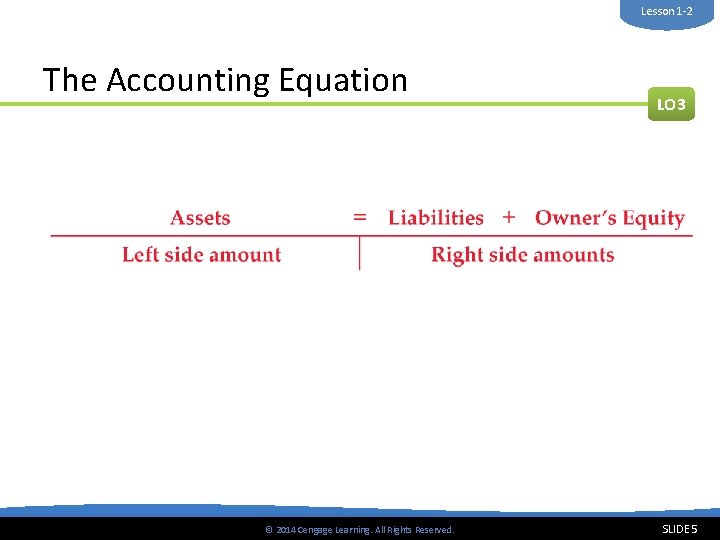
Lesson 1 -2 The Accounting Equation © 2014 Cengage Learning. All Rights Reserved. LO 3 SLIDE 5
Lesson 1 -2 Receiving Cash LO 4 ● Accountants call any business activity that changes assets, liabilities, or owner’s equity a transaction. ● A record that summarizes all the transactions pertaining to a single item in the accounting equation is called an account. ● The name given to an account is called an account title. ● The difference between the increases and decreases in an account is called the account balance. ● An account used to summarize the owner’s equity in a business is called a capital account. © 2014 Cengage Learning. All Rights Reserved. SLIDE 6
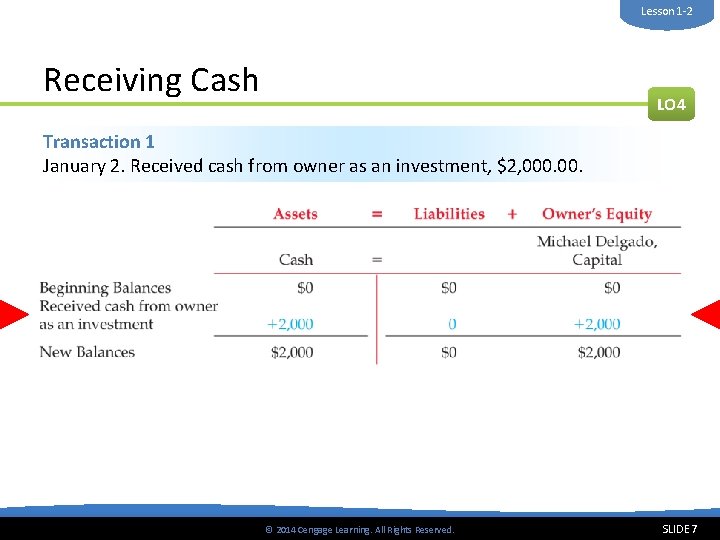
Lesson 1 -2 Receiving Cash LO 4 Transaction 1 January 2. Received cash from owner as an investment, $2, 000. © 2014 Cengage Learning. All Rights Reserved. SLIDE 7
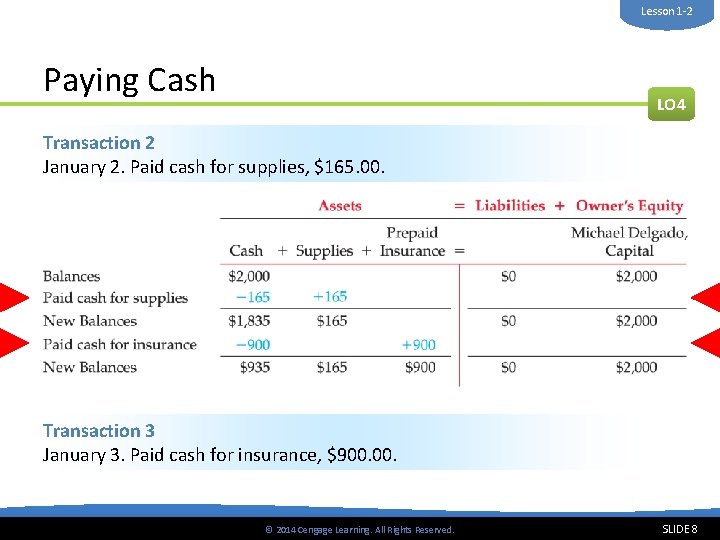
Lesson 1 -2 Paying Cash LO 4 Transaction 2 January 2. Paid cash for supplies, $165. 00. Transaction 3 January 3. Paid cash for insurance, $900. © 2014 Cengage Learning. All Rights Reserved. SLIDE 8
Lesson 1 -2 Transactions on Account LO 5 ● A person or business to whom a liability is owed is called a creditor. © 2014 Cengage Learning. All Rights Reserved. SLIDE 9
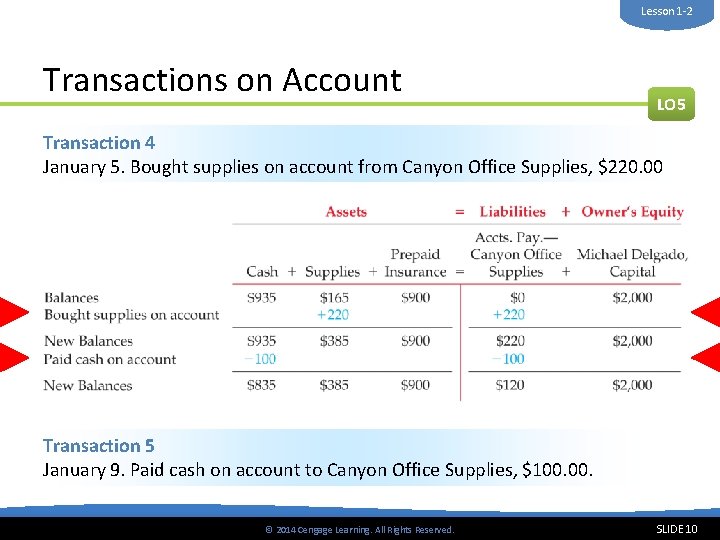
Lesson 1 -2 Transactions on Account LO 5 Transaction 4 January 5. Bought supplies on account from Canyon Office Supplies, $220. 00 Transaction 5 January 9. Paid cash on account to Canyon Office Supplies, $100. © 2014 Cengage Learning. All Rights Reserved. SLIDE 10
Lesson 1 -2 Audit Your Understanding 1. Give two examples of service businesses in your area. ANSWER Answers should include businesses that perform activities for a fee, such as dry cleaners, car washes, or landscapers. © 2014 Cengage Learning. All Rights Reserved. SLIDE 11
Lesson 1 -2 Audit Your Understanding 2. What must be done if a transaction increases the left side of the equation? ANSWER The right side must also be increased. © 2014 Cengage Learning. All Rights Reserved. SLIDE 12
Lesson 1 -2 Audit Your Understanding 3. How can a transaction affect only one side of the equation? ANSWER If one account is increased, another account on the same side of the equation must be decreased by the same amount. © 2014 Cengage Learning. All Rights Reserved. SLIDE 13
Lesson 1 -2 Audit Your Understanding 4. What does the term on account mean? ANSWER Purchasing on account means buying items or services and paying for them at a future date. © 2014 Cengage Learning. All Rights Reserved. SLIDE 14
- Slides: 14