
Learning Objectives LO 2 Calculate the cost of
Learning Objectives LO 2 Calculate the cost of merchandise inventory using the first-in, first-out (FIFO) inventory costing method. LO 3 Calculate the cost of merchandise inventory using the last-in, first-out (LIFO) inventory costing method. LO 4 Calculate the cost of merchandise inventory using the weighted-average inventory costing method. © 2014 Cengage Learning. All Rights Reserved.
Lesson 20 -2 First-In, First-Out Inventory Costing Method LO 2 ● Using the price of merchandise purchased first to calculate the cost of merchandise sold first is called the first-in, first-out inventory costing method. ● The first-in, first-out method is frequently abbreviated as FIFO. © 2014 Cengage Learning. All Rights Reserved. SLIDE 2
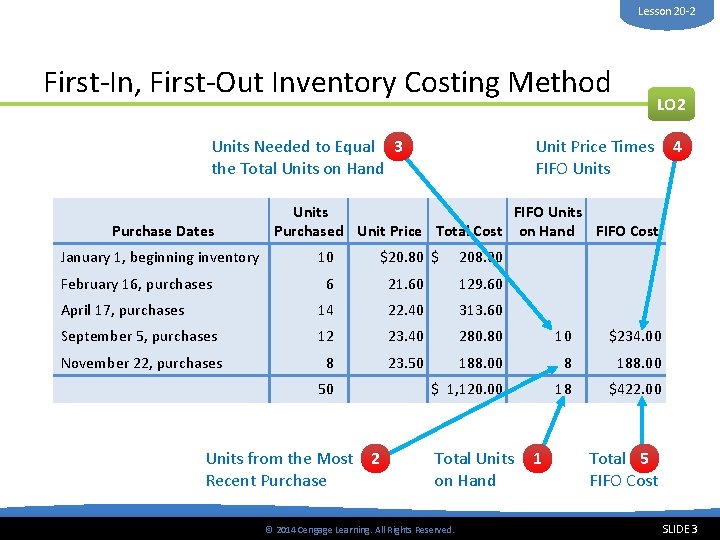
Lesson 20 -2 First-In, First-Out Inventory Costing Method Units Needed to Equal 3 the Total Units on Hand Purchase Dates January 1, beginning inventory LO 2 Unit Price Times FIFO Units Purchased Unit Price Total Cost on Hand FIFO Cost 10 $20. 80 $ 208. 00 6 21. 60 129. 60 April 17, purchases 14 22. 40 313. 60 September 5, purchases 12 23. 40 280. 80 10 $234. 00 November 22, purchases 8 23. 50 188. 00 8 188. 00 $ 1, 120. 00 18 $422. 00 February 16, purchases 4 50 Units from the Most 2 Recent Purchase Total Units on Hand © 2014 Cengage Learning. All Rights Reserved. 1 Total 5 FIFO Cost SLIDE 3
Lesson 20 -2 Last-In, First-Out Inventory Costing Method LO 3 ● Using the price of merchandise purchased last to calculate the cost of merchandise sold first is called the last-in, first-out inventory costing method. ● The last-in, first-out method is frequently abbreviated as LIFO. © 2014 Cengage Learning. All Rights Reserved. SLIDE 4

Lesson 20 -2 Last-In, First-Out Inventory Costing Method 2 Beginning Inventory Units Purchase Dates January 1, beginning inventory LO 3 Unit Price Times LIFO Units Purchased Unit Price Total Cost on Hand LIFO Cost 10 $20. 80 $ 208. 00 10 $208. 00 6 21. 60 129. 60 6 129. 60 April 17, purchases 14 22. 40 313. 60 2 44. 80 September 5, purchases 12 23. 40 280. 80 November 22, purchases 8 23. 50 188. 00 18 $382. 40 February 16, purchases 5 50 Units from the 3 Earliest Purchase Units Needed to Equal 4 the Total Units on Hand $ 1, 120. 00 Total Units on Hand © 2014 Cengage Learning. All Rights Reserved. 1 Total 6 LIFO Cost SLIDE 5
Lesson 20 -2 Weighted-Average Inventory Costing Method LO 4 ● Using the average cost of beginning inventory plus merchandise purchased during a fiscal period to calculate the cost of merchandise sold is called the weighted-average inventory costing method. ● The average unit price of the total inventory available is calculated. ● This average unit price is used to calculate both ending inventory and cost of merchandise sold. ● The average cost of merchandise is then charged against current revenue. © 2014 Cengage Learning. All Rights Reserved. SLIDE 6
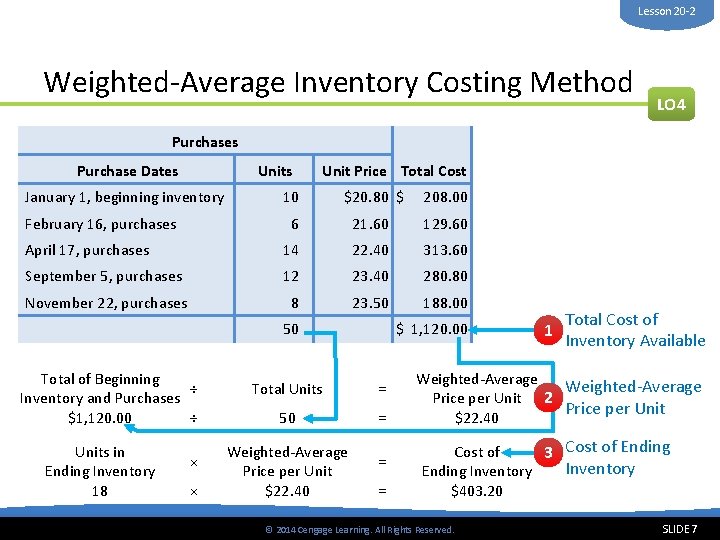
Lesson 20 -2 Weighted-Average Inventory Costing Method LO 4 Purchases Purchase Dates Units January 1, beginning inventory Unit Price Total Cost 10 $20. 80 $ 208. 00 6 21. 60 129. 60 April 17, purchases 14 22. 40 313. 60 September 5, purchases 12 23. 40 280. 80 November 22, purchases 8 23. 50 188. 00 February 16, purchases 50 Total of Beginning ÷ Inventory and Purchases $1, 120. 00 ÷ Units in Ending Inventory 18 × × $ 1, 120. 00 Total Units = 50 = Weighted-Average Price per Unit $22. 40 = = 1 Total Cost of Inventory Available Weighted-Average Price per Unit 2 Price per Unit $22. 40 Cost of 3 Cost of Ending Inventory $403. 20 © 2014 Cengage Learning. All Rights Reserved. SLIDE 7
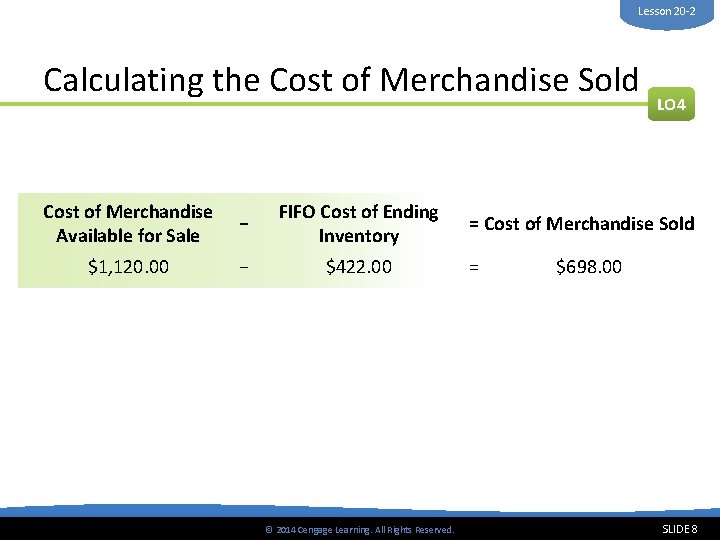
Lesson 20 -2 Calculating the Cost of Merchandise Sold Cost of Merchandise Available for Sale − FIFO Cost of Ending Inventory $1, 120. 00 − $422. 00 © 2014 Cengage Learning. All Rights Reserved. LO 4 = Cost of Merchandise Sold = $698. 00 SLIDE 8
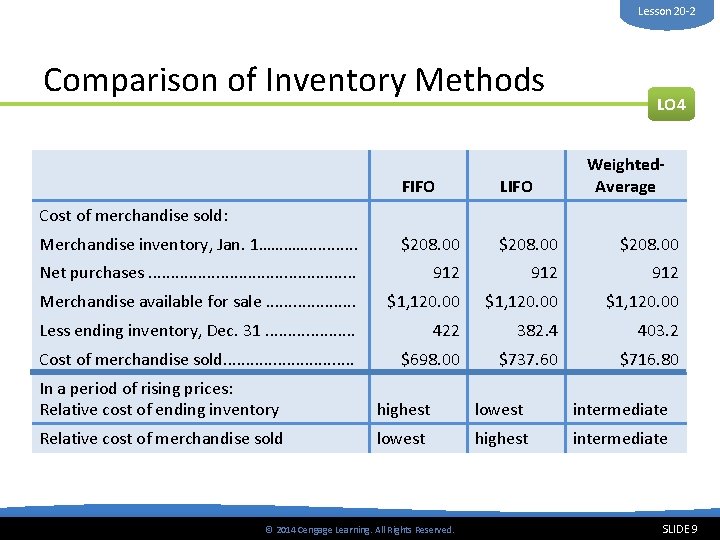
Lesson 20 -2 Comparison of Inventory Methods LO 4 Weighted. Average FIFO LIFO Merchandise inventory, Jan. 1…………. . . $208. 00 Net purchases. . . 912 912 Merchandise available for sale. . . . . $1, 120. 00 Less ending inventory, Dec. 31. . . . . 422 382. 4 403. 2 Cost of merchandise sold. . . . $698. 00 $737. 60 $716. 80 Cost of merchandise sold: In a period of rising prices: Relative cost of ending inventory highest lowest intermediate Relative cost of merchandise sold lowest highest intermediate © 2014 Cengage Learning. All Rights Reserved. SLIDE 9
Lesson 20 -2 Lower of Cost or Market Inventory Costing Method LO 4 ● The price that must be paid to replace an asset is called the market value. ● Using the lower of cost or market price to calculate the cost of ending merchandise inventory is called the lower of cost or market inventory costing method (LCM). ● In this context, cost refers to the actual amount paid for the unit of inventory on hand. ● Market refers to the amount that must be paid to replace the unit of inventory. © 2014 Cengage Learning. All Rights Reserved. SLIDE 10
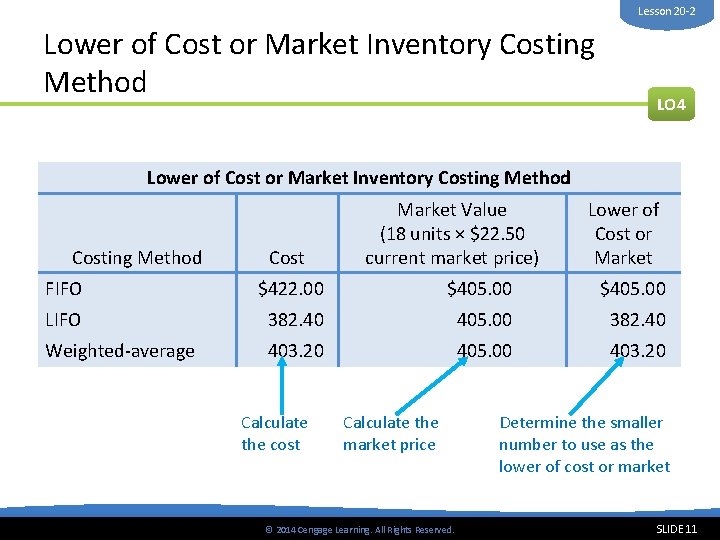
Lesson 20 -2 Lower of Cost or Market Inventory Costing Method LO 4 Lower of Cost or Market Inventory Costing Method Cost Market Value (18 units × $22. 50 current market price) Lower of Cost or Market FIFO $422. 00 $405. 00 LIFO 382. 40 405. 00 382. 40 Weighted-average 403. 20 405. 00 403. 20 Calculate the cost Calculate the market price © 2014 Cengage Learning. All Rights Reserved. Determine the smaller number to use as the lower of cost or market SLIDE 11
Lesson 20 -2 Audit Your Understanding 1. On what idea is the FIFO method based? ANSWER The price of merchandise purchased first should be charged against current revenue. © 2014 Cengage Learning. All Rights Reserved. SLIDE 12
Lesson 20 -2 Audit Your Understanding 2. When the LIFO method is used, at what price is each item in ending merchandise inventory recorded? ANSWER The prices of merchandise purchased last are used in recording prices for each item on the inventory record. © 2014 Cengage Learning. All Rights Reserved. SLIDE 13
Lesson 20 -2 Audit Your Understanding 3. In a period of rising prices, which inventory costing method gives the lowest cost of merchandise sold? ANSWER FIFO © 2014 Cengage Learning. All Rights Reserved. SLIDE 14
Lesson 20 -2 Audit Your Understanding 4. Why should a business select one inventory costing method and use that same method continuously for each fiscal period? ANSWER Using the same inventory costing method for all fiscal periods provides financial statements that can be compared with other fiscal period statements. If a business changes inventory cost methods, part of the difference in gross profit and net income may be caused by the change in methods. © 2014 Cengage Learning. All Rights Reserved. SLIDE 15
- Slides: 15