
Learning Objectives LO 1 Record the buying of

Learning Objectives LO 1 Record the buying of a plant asset. LO 2 Analyze the cost of individual assets bought as a bundle. LO 3 Calculate and record the payment of property tax. © 2014 Cengage Learning. All Rights Reserved.
Lesson 19 -1 Plant Assets LO 1 ● Accounting data can be used to predict the efficiency of an investment. ● The ratio of the money earned on an investment relative to the amount of the investment is called return on investment, or ROI. ● The more efficient the investment, the higher its ROI. ● These predictions will help company managers decide which assets to buy. © 2014 Cengage Learning. All Rights Reserved. SLIDE 2
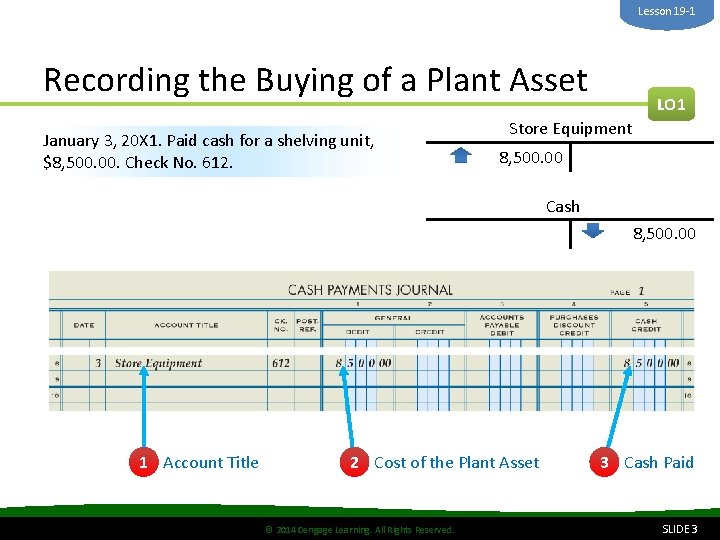
Lesson 19 -1 Recording the Buying of a Plant Asset January 3, 20 X 1. Paid cash for a shelving unit, $8, 500. Check No. 612. LO 1 Store Equipment 8, 500. 00 Cash 8, 500. 00 1 Account Title 2 Cost of the Plant Asset © 2014 Cengage Learning. All Rights Reserved. 3 Cash Paid SLIDE 3
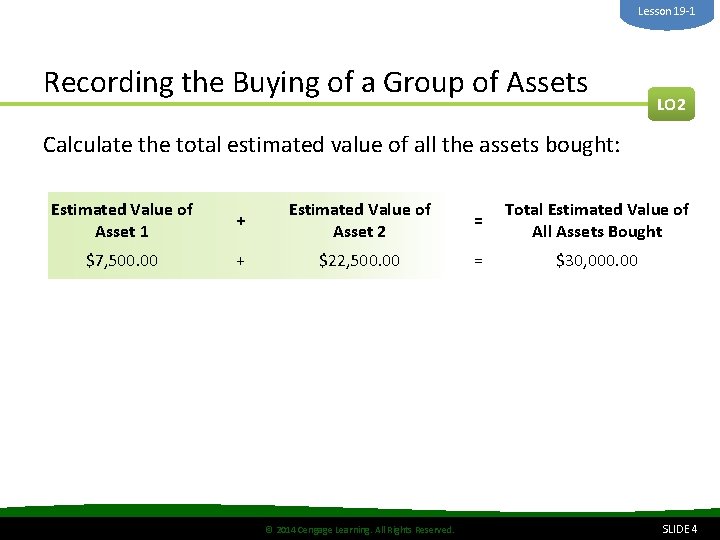
Lesson 19 -1 Recording the Buying of a Group of Assets LO 2 Calculate the total estimated value of all the assets bought: Estimated Value of Asset 1 + Estimated Value of Asset 2 = Total Estimated Value of All Assets Bought $7, 500. 00 + $22, 500. 00 = $30, 000. 00 © 2014 Cengage Learning. All Rights Reserved. SLIDE 4
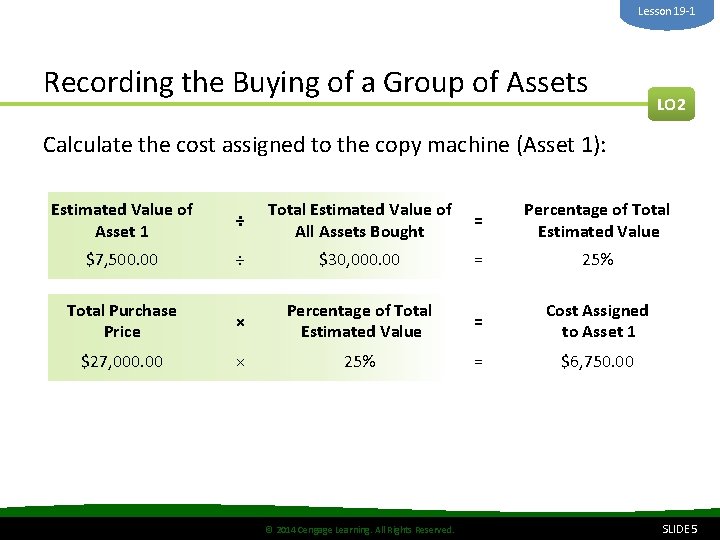
Lesson 19 -1 Recording the Buying of a Group of Assets LO 2 Calculate the cost assigned to the copy machine (Asset 1): Estimated Value of Asset 1 ÷ Total Estimated Value of All Assets Bought = Percentage of Total Estimated Value $7, 500. 00 ÷ $30, 000. 00 = 25% Total Purchase Price × Percentage of Total Estimated Value = Cost Assigned to Asset 1 $27, 000. 00 × 25% = $6, 750. 00 © 2014 Cengage Learning. All Rights Reserved. SLIDE 5
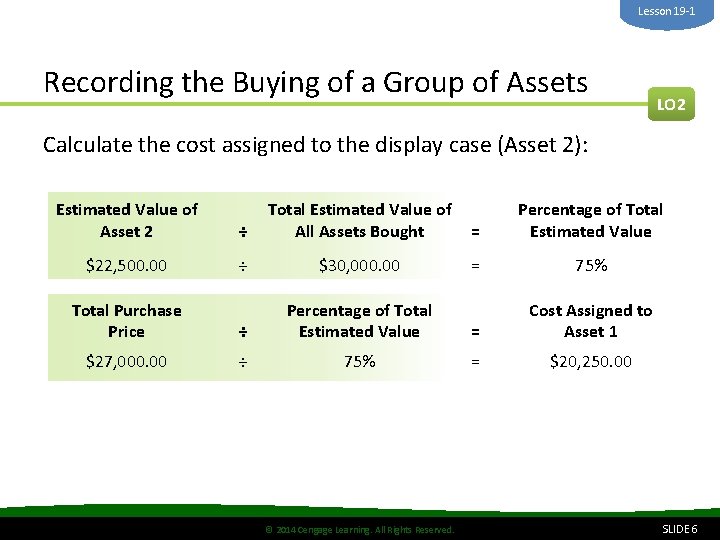
Lesson 19 -1 Recording the Buying of a Group of Assets LO 2 Calculate the cost assigned to the display case (Asset 2): Estimated Value of Asset 2 ÷ Total Estimated Value of All Assets Bought = Percentage of Total Estimated Value $22, 500. 00 ÷ $30, 000. 00 = 75% Total Purchase Price ÷ Percentage of Total Estimated Value = Cost Assigned to Asset 1 $27, 000. 00 ÷ 75% = $20, 250. 00 © 2014 Cengage Learning. All Rights Reserved. SLIDE 6
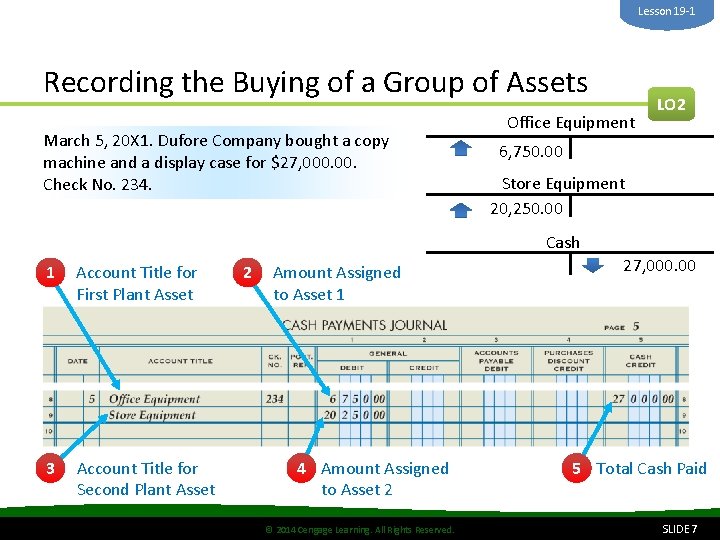
Lesson 19 -1 Recording the Buying of a Group of Assets March 5, 20 X 1. Dufore Company bought a copy machine and a display case for $27, 000. Check No. 234. Office Equipment LO 2 6, 750. 00 Store Equipment 20, 250. 00 Cash 1 Account Title for First Plant Asset 3 Account Title for Second Plant Asset 2 Amount Assigned to Asset 1 4 Amount Assigned to Asset 2 © 2014 Cengage Learning. All Rights Reserved. 27, 000. 00 5 Total Cash Paid SLIDE 7
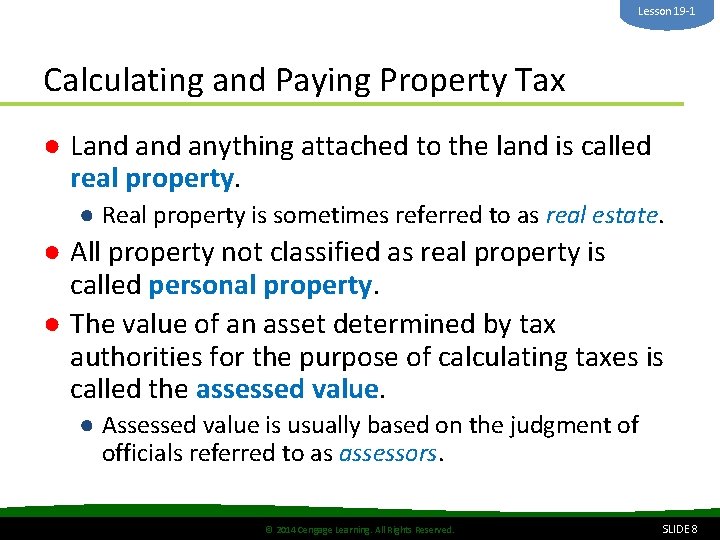
Lesson 19 -1 Calculating and Paying Property Tax ● Land anything attached to the land is called real property. ● Real property is sometimes referred to as real estate. ● All property not classified as real property is called personal property. ● The value of an asset determined by tax authorities for the purpose of calculating taxes is called the assessed value. ● Assessed value is usually based on the judgment of officials referred to as assessors. © 2014 Cengage Learning. All Rights Reserved. SLIDE 8
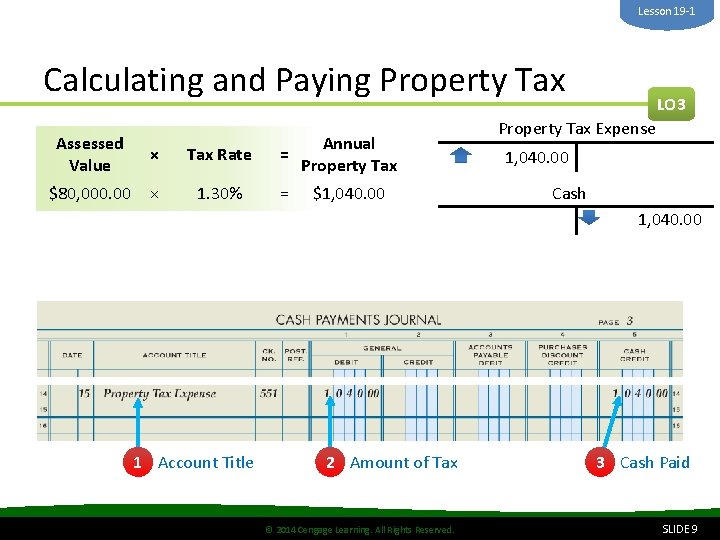
Lesson 19 -1 Calculating and Paying Property Tax Assessed Value × Tax Rate = Annual Property Tax $80, 000. 00 × 1. 30% = $1, 040. 00 LO 3 Property Tax Expense 1, 040. 00 Cash 1, 040. 00 1 Account Title 2 Amount of Tax © 2014 Cengage Learning. All Rights Reserved. 3 Cash Paid SLIDE 9
Lesson 19 -1 Audit Your Understanding 1. Which accounts are affected, and how, when cash is paid for office equipment? ANSWER Office Equipment is debited; Cash is credited. © 2014 Cengage Learning. All Rights Reserved. SLIDE 10
Lesson 19 -1 Audit Your Understanding 2. Why must a cost be allocated to each asset bought in a group? ANSWER So that each plant asset can be depreciated individually © 2014 Cengage Learning. All Rights Reserved. SLIDE 11
Lesson 19 -1 Audit Your Understanding 3. What items are included in real property? ANSWER Land anything attached to the land © 2014 Cengage Learning. All Rights Reserved. SLIDE 12
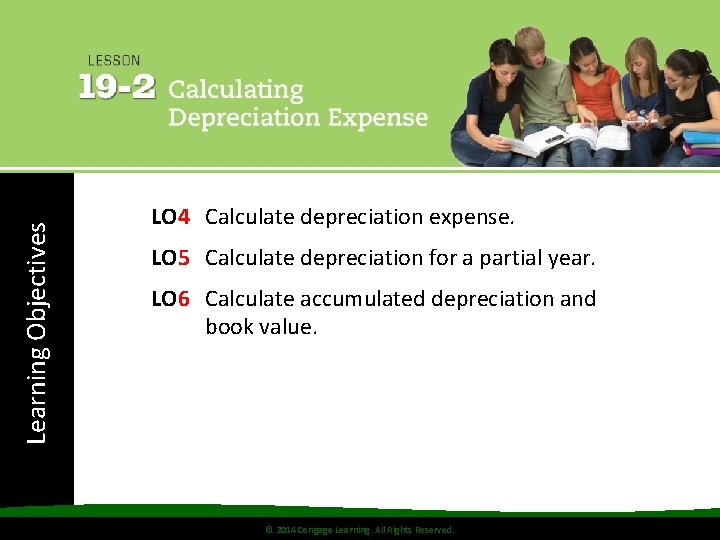
Learning Objectives LO 4 Calculate depreciation expense. LO 5 Calculate depreciation for a partial year. LO 6 Calculate accumulated depreciation and book value. © 2014 Cengage Learning. All Rights Reserved.
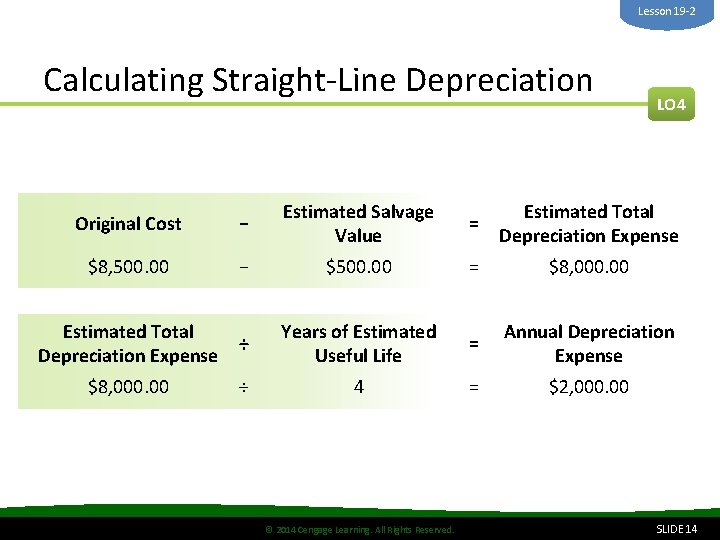
Lesson 19 -2 Calculating Straight-Line Depreciation LO 4 Original Cost − Estimated Salvage Value = Estimated Total Depreciation Expense $8, 500. 00 − $500. 00 = $8, 000. 00 Years of Estimated Useful Life = Annual Depreciation Expense 4 = $2, 000. 00 Estimated Total ÷ Depreciation Expense $8, 000. 00 ÷ © 2014 Cengage Learning. All Rights Reserved. SLIDE 14
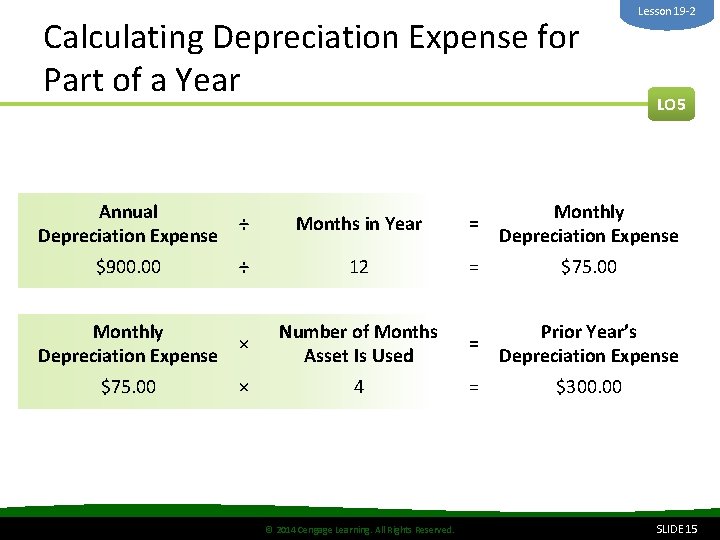
Calculating Depreciation Expense for Part of a Year Annual ÷ Depreciation Expense Lesson 19 -2 LO 5 Months in Year = Monthly Depreciation Expense $900. 00 ÷ 12 = $75. 00 Monthly Depreciation Expense × Number of Months Asset Is Used = Prior Year’s Depreciation Expense $75. 00 × 4 = $300. 00 © 2014 Cengage Learning. All Rights Reserved. SLIDE 15
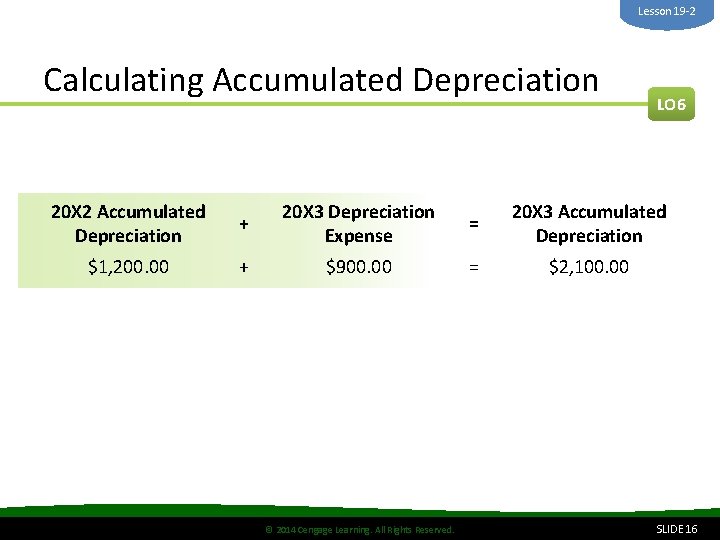
Lesson 19 -2 Calculating Accumulated Depreciation LO 6 20 X 2 Accumulated Depreciation + 20 X 3 Depreciation Expense = 20 X 3 Accumulated Depreciation $1, 200. 00 + $900. 00 = $2, 100. 00 © 2014 Cengage Learning. All Rights Reserved. SLIDE 16
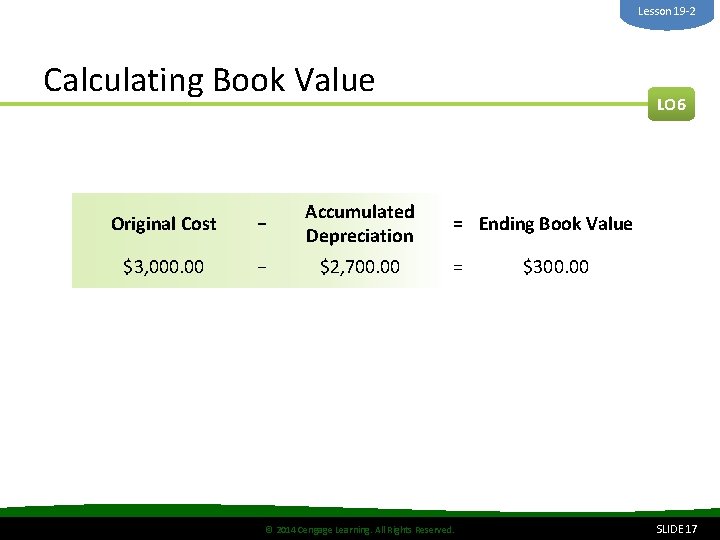
Lesson 19 -2 Calculating Book Value Original Cost − Accumulated Depreciation $3, 000. 00 − $2, 700. 00 LO 6 = Ending Book Value = © 2014 Cengage Learning. All Rights Reserved. $300. 00 SLIDE 17
Lesson 19 -2 Audit Your Understanding 1. Which accounting concept is being applied when depreciation expense is recorded for plant assets? ANSWER Matching Expenses with Revenue © 2014 Cengage Learning. All Rights Reserved. SLIDE 18
Lesson 19 -2 Audit Your Understanding 2. What three amounts are used to calculate a plant asset’s annual depreciation expense using the straight-line method of depreciation? ANSWER Original cost, estimated salvage value, and estimated useful life © 2014 Cengage Learning. All Rights Reserved. SLIDE 19
Learning Objectives LO 7 Prepare plant asset records. LO 8 Journalize annual depreciation expense. © 2014 Cengage Learning. All Rights Reserved.
Lesson 19 -3 Preparing Plant Asset Records LO 7 ● An accounting form on which a business records information about each plant asset is called a plant asset record. © 2014 Cengage Learning. All Rights Reserved. SLIDE 21
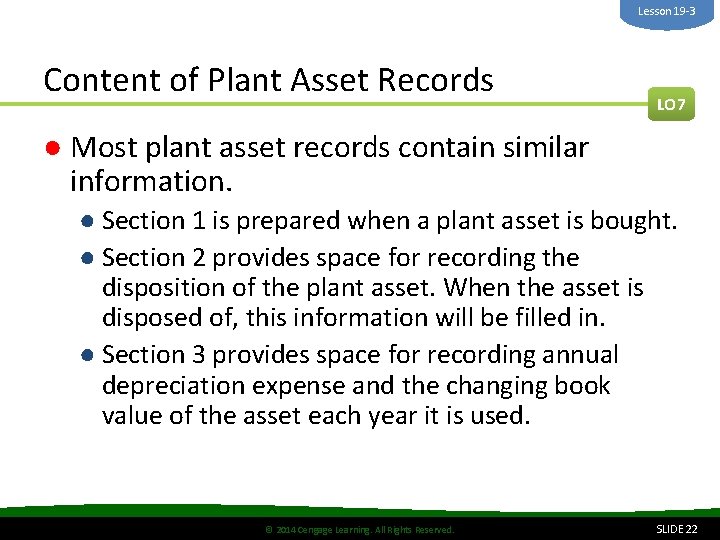
Lesson 19 -3 Content of Plant Asset Records LO 7 ● Most plant asset records contain similar information. ● Section 1 is prepared when a plant asset is bought. ● Section 2 provides space for recording the disposition of the plant asset. When the asset is disposed of, this information will be filled in. ● Section 3 provides space for recording annual depreciation expense and the changing book value of the asset each year it is used. © 2014 Cengage Learning. All Rights Reserved. SLIDE 22
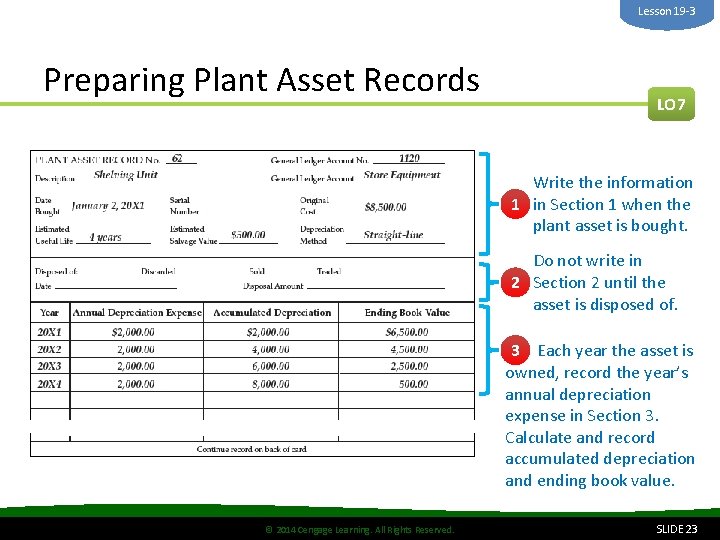
Lesson 19 -3 Preparing Plant Asset Records LO 7 Write the information 1 in Section 1 when the plant asset is bought. Do not write in 2 Section 2 until the asset is disposed of. 3 Each year the asset is owned, record the year’s annual depreciation expense in Section 3. Calculate and record accumulated depreciation and ending book value. © 2014 Cengage Learning. All Rights Reserved. SLIDE 23
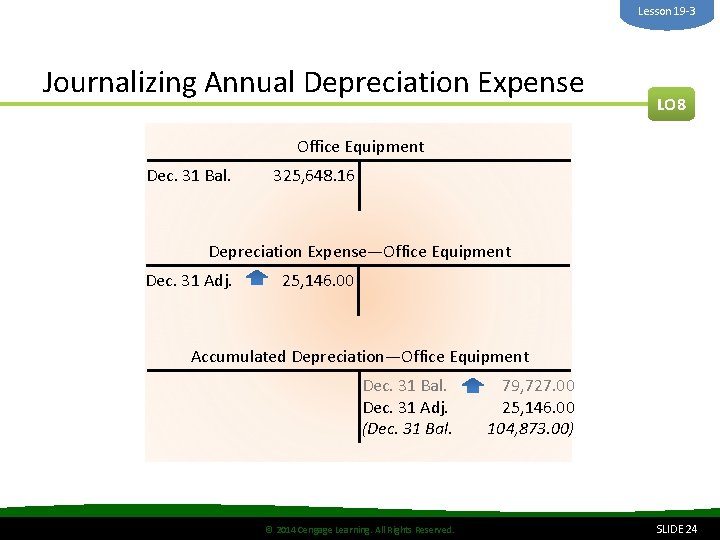
Lesson 19 -3 Journalizing Annual Depreciation Expense LO 8 Office Equipment Dec. 31 Bal. 325, 648. 16 Depreciation Expense—Office Equipment Dec. 31 Adj. 25, 146. 00 Accumulated Depreciation—Office Equipment Dec. 31 Bal. Dec. 31 Adj. (Dec. 31 Bal. © 2014 Cengage Learning. All Rights Reserved. 79, 727. 00 25, 146. 00 104, 873. 00) SLIDE 24
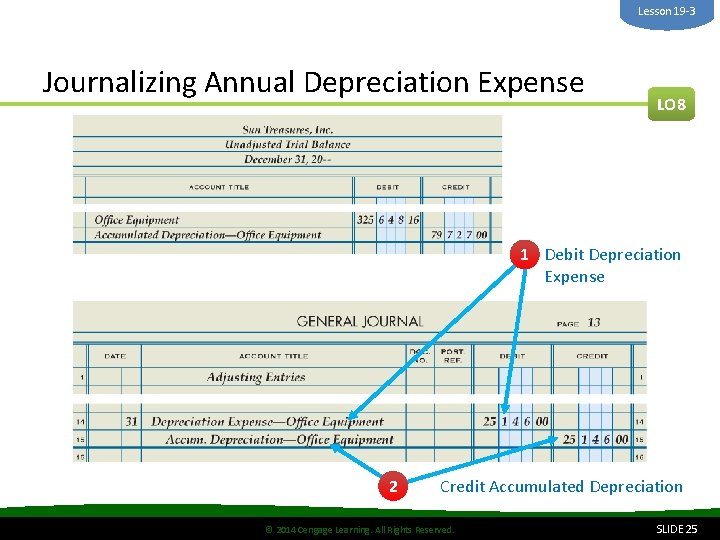
Lesson 19 -3 Journalizing Annual Depreciation Expense LO 8 1 Debit Depreciation Expense 2 Credit Accumulated Depreciation © 2014 Cengage Learning. All Rights Reserved. SLIDE 25
Lesson 19 -3 Audit Your Understanding 1. How is accumulated depreciation recorded so as to retain the original cost information for plant assets? ANSWER Depreciation is credited to the contra account, Accumulated Depreciation, rather than crediting the asset account. © 2014 Cengage Learning. All Rights Reserved. SLIDE 26
Lesson 19 -3 Audit Your Understanding 2. How does an adjusting entry for depreciation expense change the balance of the asset account? ANSWER The balance of the asset account is not changed. © 2014 Cengage Learning. All Rights Reserved. SLIDE 27
Learning Objectives LO 9 Record the sale of a plant asset for book value. LO 10 Record the sale of a plant asset for more/less than book value. © 2014 Cengage Learning. All Rights Reserved.
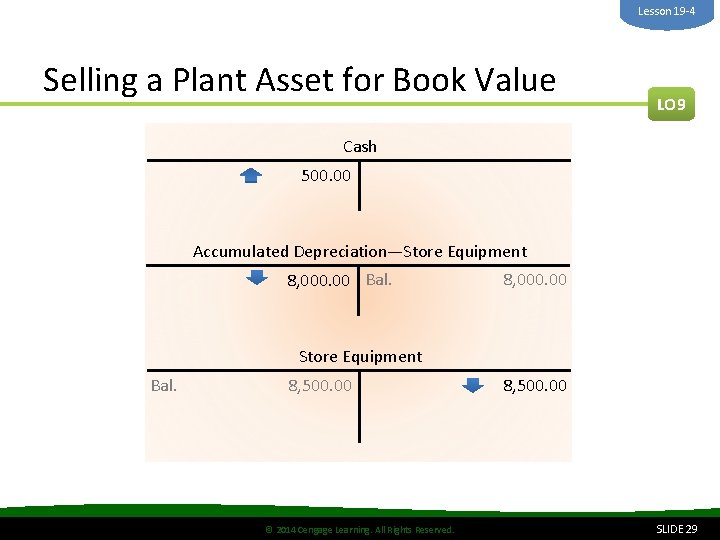
Lesson 19 -4 Selling a Plant Asset for Book Value LO 9 Cash 500. 00 Accumulated Depreciation—Store Equipment 8, 000. 00 Bal. 8, 000. 00 Store Equipment Bal. 8, 500. 00 © 2014 Cengage Learning. All Rights Reserved. 8, 500. 00 SLIDE 29
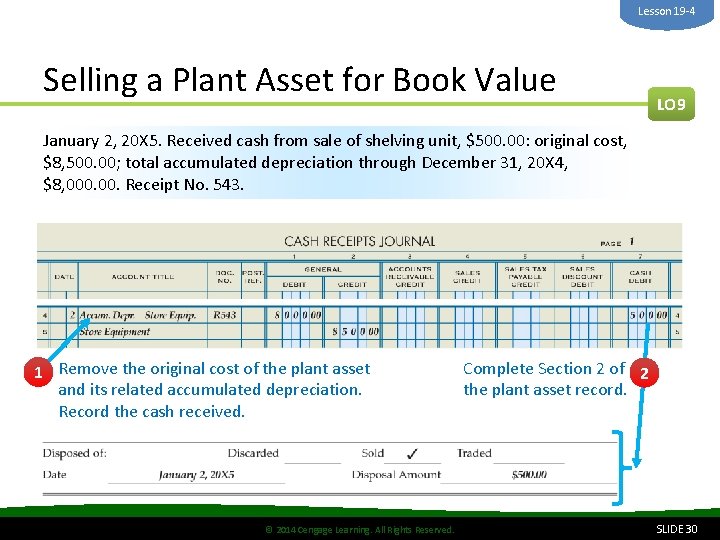
Lesson 19 -4 Selling a Plant Asset for Book Value LO 9 January 2, 20 X 5. Received cash from sale of shelving unit, $500. 00: original cost, $8, 500. 00; total accumulated depreciation through December 31, 20 X 4, $8, 000. Receipt No. 543. 1 Remove the original cost of the plant asset and its related accumulated depreciation. Record the cash received. © 2014 Cengage Learning. All Rights Reserved. Complete Section 2 of 2 the plant asset record. SLIDE 30
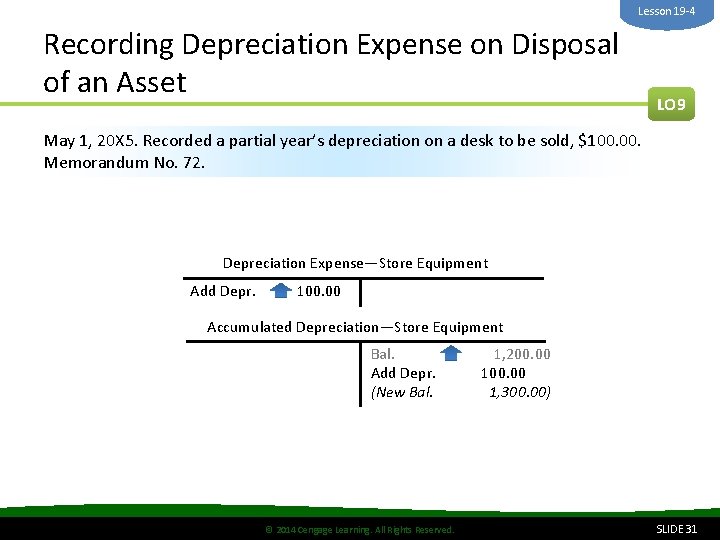
Lesson 19 -4 Recording Depreciation Expense on Disposal of an Asset LO 9 May 1, 20 X 5. Recorded a partial year’s depreciation on a desk to be sold, $100. Memorandum No. 72. Depreciation Expense—Store Equipment Add Depr. 100. 00 Accumulated Depreciation—Store Equipment Bal. Add Depr. (New Bal. © 2014 Cengage Learning. All Rights Reserved. 1, 200. 00 1, 300. 00) SLIDE 31
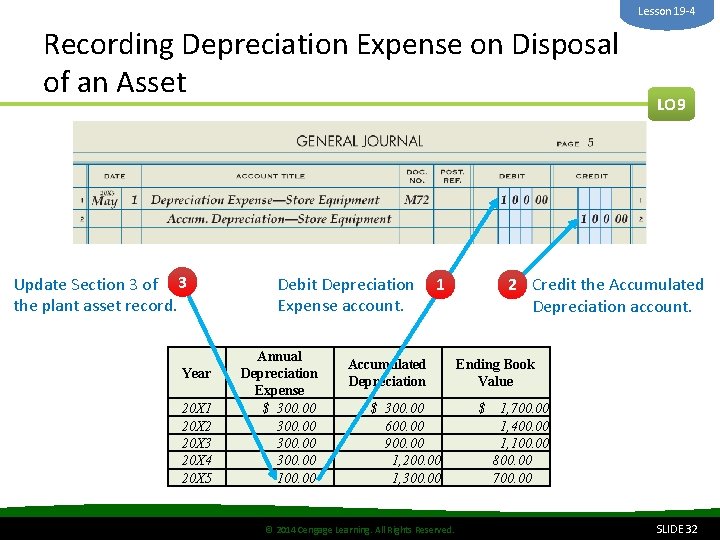
Lesson 19 -4 Recording Depreciation Expense on Disposal of an Asset Update Section 3 of 3 the plant asset record. Year 20 X 1 20 X 2 20 X 3 20 X 4 20 X 5 Debit Depreciation Expense account. Annual Depreciation Expense $ 300. 00 100. 00 2 Credit the Accumulated Depreciation account. 1 Accumulated Depreciation $ 300. 00 600. 00 900. 00 1, 200. 00 1, 300. 00 © 2014 Cengage Learning. All Rights Reserved. LO 9 Ending Book Value $ 1, 700. 00 1, 400. 00 1, 100. 00 800. 00 700. 00 SLIDE 32
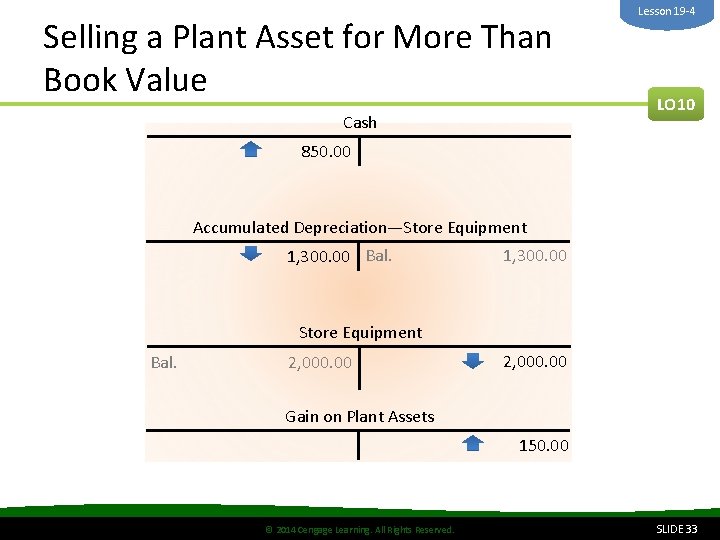
Selling a Plant Asset for More Than Book Value Cash Lesson 19 -4 LO 10 850. 00 Accumulated Depreciation—Store Equipment 1, 300. 00 Bal. 1, 300. 00 Store Equipment Bal. 2, 000. 00 Gain on Plant Assets 150. 00 © 2014 Cengage Learning. All Rights Reserved. SLIDE 33
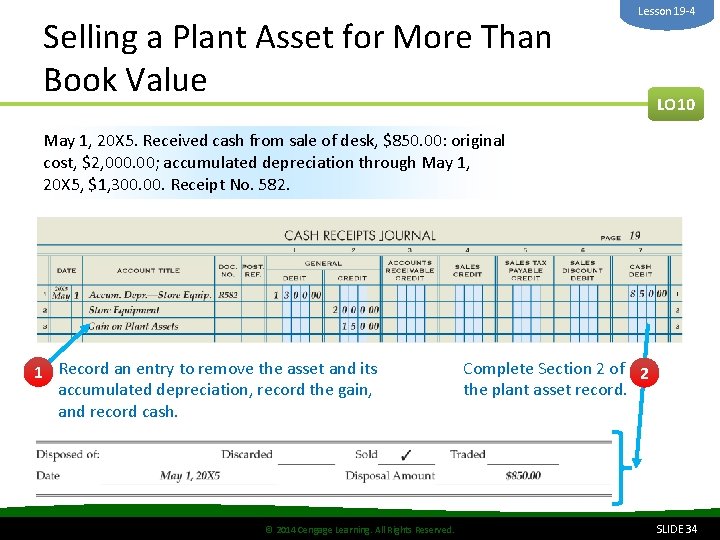
Selling a Plant Asset for More Than Book Value Lesson 19 -4 LO 10 May 1, 20 X 5. Received cash from sale of desk, $850. 00: original cost, $2, 000. 00; accumulated depreciation through May 1, 20 X 5, $1, 300. Receipt No. 582. 1 Record an entry to remove the asset and its accumulated depreciation, record the gain, and record cash. © 2014 Cengage Learning. All Rights Reserved. Complete Section 2 of 2 the plant asset record. SLIDE 34
Lesson 19 -4 Selling a Plant Asset for Less Than Book Value LO 10 ● The decrease in equity that results when a plant asset is sold for less than book value is called loss on plant assets. © 2014 Cengage Learning. All Rights Reserved. SLIDE 35
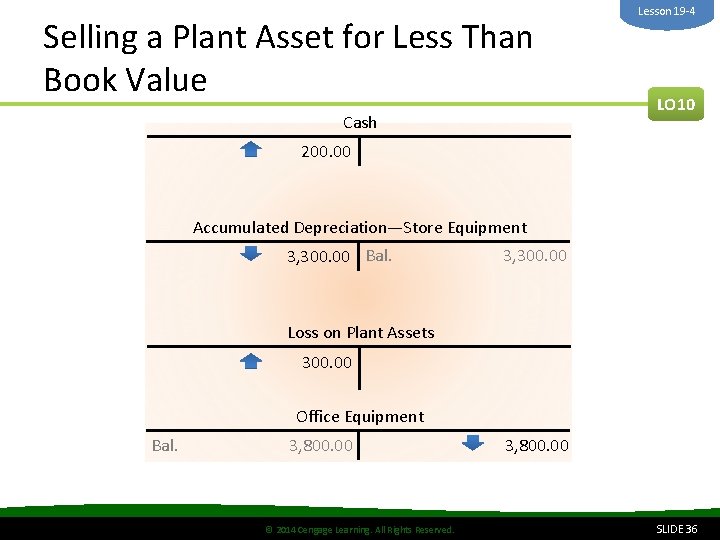
Selling a Plant Asset for Less Than Book Value Cash Lesson 19 -4 LO 10 200. 00 Accumulated Depreciation—Store Equipment 3, 300. 00 Bal. 3, 300. 00 Loss on Plant Assets 300. 00 Office Equipment Bal. 3, 800. 00 © 2014 Cengage Learning. All Rights Reserved. 3, 800. 00 SLIDE 36
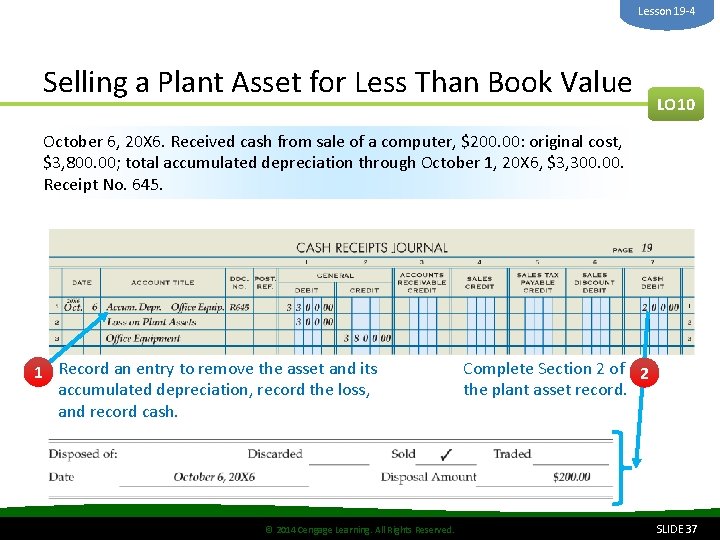
Lesson 19 -4 Selling a Plant Asset for Less Than Book Value LO 10 October 6, 20 X 6. Received cash from sale of a computer, $200. 00: original cost, $3, 800. 00; total accumulated depreciation through October 1, 20 X 6, $3, 300. Receipt No. 645. 1 Record an entry to remove the asset and its accumulated depreciation, record the loss, and record cash. © 2014 Cengage Learning. All Rights Reserved. Complete Section 2 of 2 the plant asset record. SLIDE 37
Lesson 19 -4 Audit Your Understanding 1. What is recorded on plant asset records for plant assets that have been disposed of? ANSWER Disposal date, disposal method, and disposal amount © 2014 Cengage Learning. All Rights Reserved. SLIDE 38
Lesson 19 -4 Audit Your Understanding 2. When an asset is disposed of after the beginning of the fiscal year, what entry may need to be recorded before an entry is made for the discarding of a plant asset? ANSWER Partial year’s depreciation © 2014 Cengage Learning. All Rights Reserved. SLIDE 39
Lesson 19 -4 Audit Your Understanding 3. What is the formula to calculate the gain or loss on the sale of a plant asset? ANSWER Cash received less the book value of the asset sold © 2014 Cengage Learning. All Rights Reserved. SLIDE 40
Lesson 19 -4 Audit Your Understanding 4. In which account classification is Loss on Plant Assets listed? ANSWER Other Expenses © 2014 Cengage Learning. All Rights Reserved. SLIDE 41
Learning Objective LO 11 Calculate depreciation using the double declining-balance method. © 2014 Cengage Learning. All Rights Reserved.
Lesson 19 -5 Calculating Depreciation Using the Double Declining-Balance Method LO 11 ● Any method of depreciation that records greater depreciation expense in the early years and less depreciation expense in the later years is called accelerated depreciation. ● The declining-balance method of depreciation is a type of accelerated depreciation that multiplies the book value of an asset by a constant depreciation rate to determine annual depreciation. ● A declining-balance rate that is two times the straightline rate is called the double declining-balance method of depreciation. © 2014 Cengage Learning. All Rights Reserved. SLIDE 43
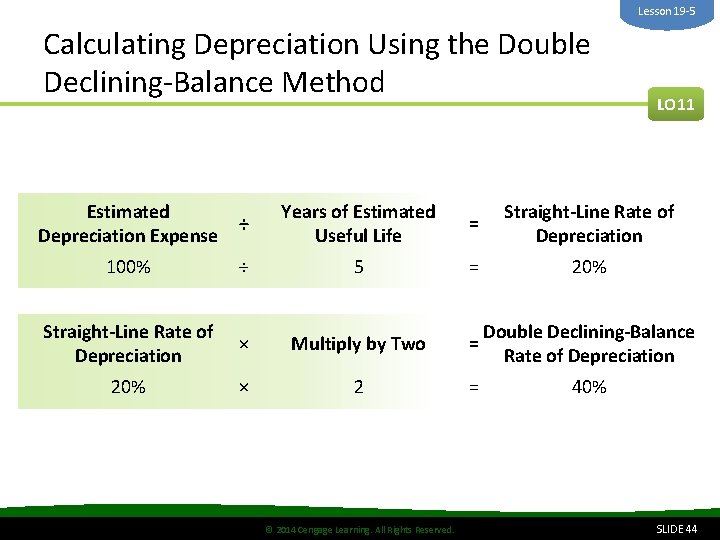
Lesson 19 -5 Calculating Depreciation Using the Double Declining-Balance Method Estimated ÷ Depreciation Expense LO 11 Years of Estimated Useful Life = Straight-Line Rate of Depreciation 100% ÷ 5 = 20% Straight-Line Rate of Depreciation × Multiply by Two = Double Declining-Balance Rate of Depreciation 20% × 2 = 40% © 2014 Cengage Learning. All Rights Reserved. SLIDE 44
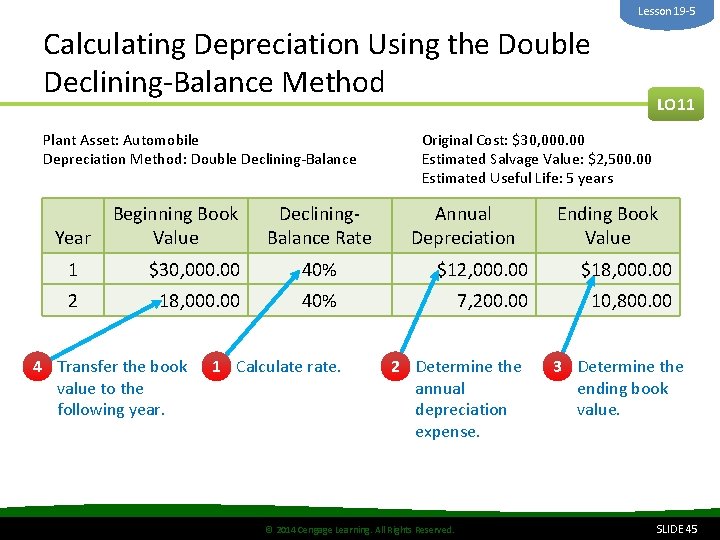
Lesson 19 -5 Calculating Depreciation Using the Double Declining-Balance Method Plant Asset: Automobile Depreciation Method: Double Declining-Balance Year Beginning Book Value Declining. Balance Rate LO 11 Original Cost: $30, 000. 00 Estimated Salvage Value: $2, 500. 00 Estimated Useful Life: 5 years Annual Depreciation Ending Book Value 1 $30, 000. 00 40% $12, 000. 00 $18, 000. 00 2 18, 000. 00 40% 7, 200. 00 10, 800. 00 4 Transfer the book value to the following year. 1 Calculate rate. 2 Determine the annual depreciation expense. © 2014 Cengage Learning. All Rights Reserved. 3 Determine the ending book value. SLIDE 45
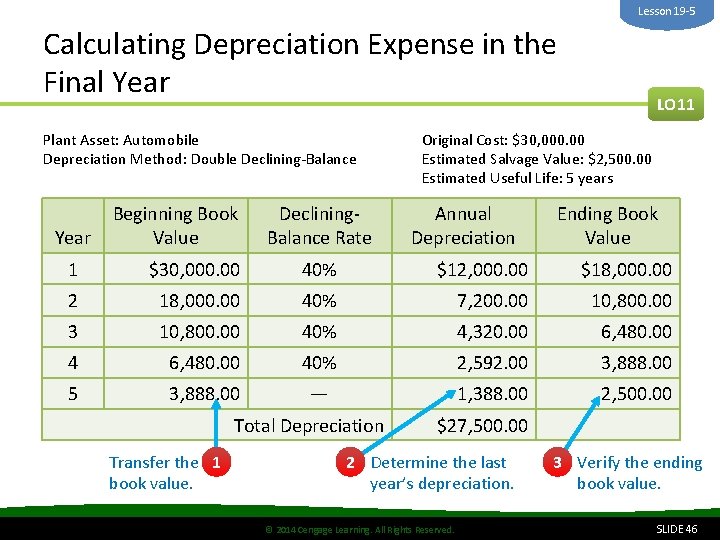
Lesson 19 -5 Calculating Depreciation Expense in the Final Year Plant Asset: Automobile Depreciation Method: Double Declining-Balance Year Beginning Book Value Declining. Balance Rate LO 11 Original Cost: $30, 000. 00 Estimated Salvage Value: $2, 500. 00 Estimated Useful Life: 5 years Annual Depreciation Ending Book Value 1 $30, 000. 00 40% $12, 000. 00 $18, 000. 00 2 18, 000. 00 40% 7, 200. 00 10, 800. 00 3 10, 800. 00 40% 4, 320. 00 6, 480. 00 40% 2, 592. 00 3, 888. 00 5 3, 888. 00 — 1, 388. 00 2, 500. 00 Total Depreciation Transfer the 1 book value. $27, 500. 00 2 Determine the last year’s depreciation. © 2014 Cengage Learning. All Rights Reserved. 3 Verify the ending book value. SLIDE 46
Lesson 19 -5 Accelerated Depreciation Methods LO 11 ● The double declining-balance method of depreciation is one method of accelerated depreciation. ● All accelerated methods have one thing in common— more depreciation is charged in the first year than in the later years. ● GAAP allows each business to choose either straight-line or accelerated depreciation for financial reporting. ● But, once chosen, the business should use the same method from year to year. © 2014 Cengage Learning. All Rights Reserved. SLIDE 47
Lesson 19 -5 Modified Accelerated Cost Recovery System (MACRS) LO 11 ● The U. S. Internal Revenue Service has published rules that must be applied when calculating the amount of depreciation expense that is used to compute a business’s federal income tax obligation. ● Those rules are called the Modified Accelerated Cost Recovery System (MACRS). ● MACRS is an accelerated depreciation method. © 2014 Cengage Learning. All Rights Reserved. SLIDE 48
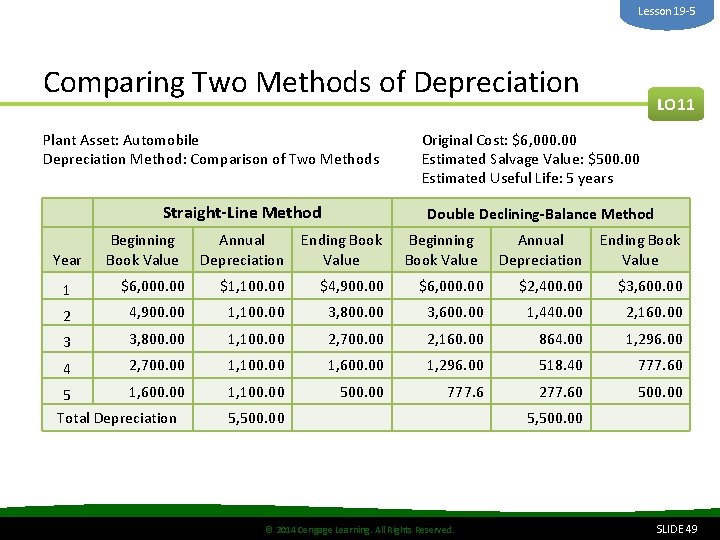
Lesson 19 -5 Comparing Two Methods of Depreciation Plant Asset: Automobile Depreciation Method: Comparison of Two Methods Straight-Line Method Year Beginning Book Value LO 11 Original Cost: $6, 000. 00 Estimated Salvage Value: $500. 00 Estimated Useful Life: 5 years Double Declining-Balance Method Annual Depreciation Ending Book Value Beginning Book Value Annual Depreciation Ending Book Value 1 $6, 000. 00 $1, 100. 00 $4, 900. 00 $6, 000. 00 $2, 400. 00 $3, 600. 00 2 4, 900. 00 1, 100. 00 3, 800. 00 3, 600. 00 1, 440. 00 2, 160. 00 3 3, 800. 00 1, 100. 00 2, 700. 00 2, 160. 00 864. 00 1, 296. 00 4 2, 700. 00 1, 100. 00 1, 600. 00 1, 296. 00 518. 40 777. 60 1, 600. 00 5 Total Depreciation 1, 100. 00 500. 00 777. 6 277. 60 500. 00 5, 500. 00 © 2014 Cengage Learning. All Rights Reserved. 5, 500. 00 SLIDE 49
Lesson 19 -5 Audit Your Understanding 1. When calculating depreciation expense using the declining-balance method, what number stays constant each fiscal period? ANSWER Depreciation rate © 2014 Cengage Learning. All Rights Reserved. SLIDE 50
Lesson 19 -5 Audit Your Understanding 2. What is the declining-balance method that uses twice the straight-line rate? ANSWER Double declining-balance method © 2014 Cengage Learning. All Rights Reserved. SLIDE 51
Lesson 19 -5 Audit Your Understanding 3. What change occurs in the annual depreciation expense calculated using the declining-balance method? ANSWER Depreciation expense declines each year © 2014 Cengage Learning. All Rights Reserved. SLIDE 52
Lesson 19 -5 Audit Your Understanding 4. An asset is never depreciated below what amount? ANSWER Its estimated salvage value © 2014 Cengage Learning. All Rights Reserved. SLIDE 53
Learning Objectives LO 12 Record the buying of an intangible asset. LO 13 Calculate and record amortization expense. © 2014 Cengage Learning. All Rights Reserved.
Lesson 19 -6 Recording the Buying of an Intangible Asset LO 12 ● An asset that does not have physical substance is called an intangible asset. ● Intangible assets include patents, copyrights, trademarks, and other similar items. ● The value of an intangible asset such as a patent comes from the rights it gives to the patent holder, not from the piece of paper that ensures those rights. © 2014 Cengage Learning. All Rights Reserved. SLIDE 55
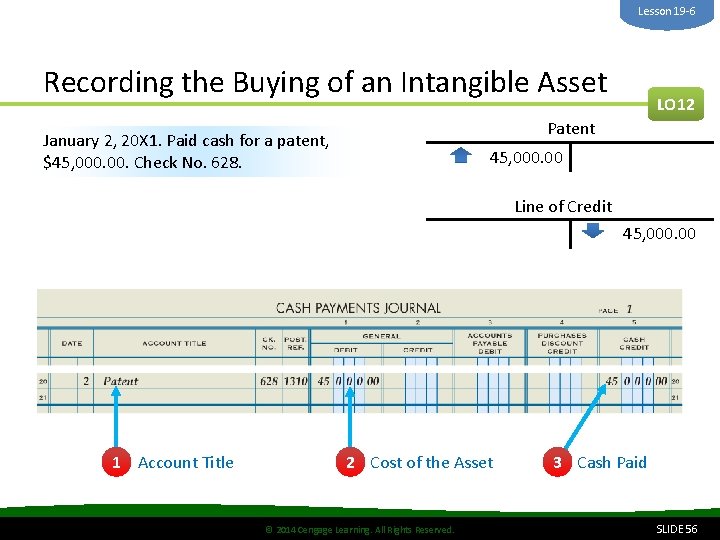
Lesson 19 -6 Recording the Buying of an Intangible Asset LO 12 Patent January 2, 20 X 1. Paid cash for a patent, $45, 000. Check No. 628. 45, 000. 00 Line of Credit 45, 000. 00 1 Account Title 2 Cost of the Asset © 2014 Cengage Learning. All Rights Reserved. 3 Cash Paid SLIDE 56
Lesson 19 -6 Calculating and Recording Amortization Expense LO 13 ● Amortization is the spreading of the cost of an intangible asset over its useful life. ● Amortization is similar to depreciation, which applies only to physical assets. ● Some intangible assets have a legal life, such as a patent. © 2014 Cengage Learning. All Rights Reserved. SLIDE 57
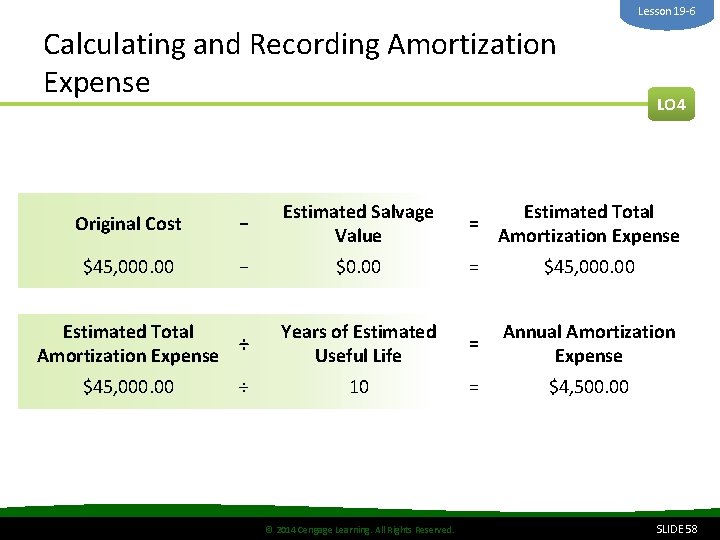
Lesson 19 -6 Calculating and Recording Amortization Expense LO 4 Original Cost − Estimated Salvage Value = Estimated Total Amortization Expense $45, 000. 00 − $0. 00 = $45, 000. 00 Years of Estimated Useful Life = Annual Amortization Expense 10 = $4, 500. 00 Estimated Total ÷ Amortization Expense $45, 000. 00 ÷ © 2014 Cengage Learning. All Rights Reserved. SLIDE 58
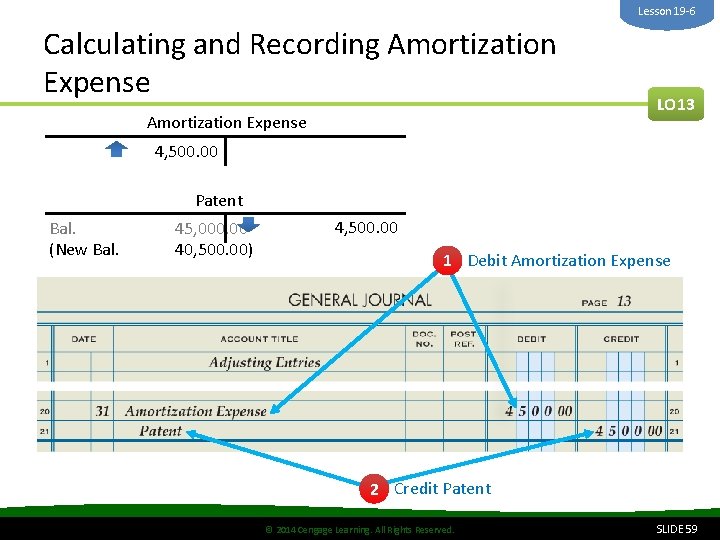
Lesson 19 -6 Calculating and Recording Amortization Expense LO 13 4, 500. 00 Patent Bal. (New Bal. 45, 000. 00 40, 500. 00) 4, 500. 00 1 Debit Amortization Expense 2 Credit Patent © 2014 Cengage Learning. All Rights Reserved. SLIDE 59
Lesson 19 -6 Audit Your Understanding 1. Which account is debited when recording amortization on a patent? ANSWER Amortization Expense © 2014 Cengage Learning. All Rights Reserved. SLIDE 60
Lesson 19 -6 Audit Your Understanding 2. Which account is credited when recording amortization on a patent? ANSWER Patent © 2014 Cengage Learning. All Rights Reserved. SLIDE 61
- Slides: 61