
Learning Objectives LO 1 Prepare the heading of
Learning Objectives LO 1 Prepare the heading of a work sheet. LO 2 Prepare the trial balance section of a work sheet. © 2014 Cengage Learning. All Rights Reserved.
Lesson 6 -1 Consistent Reporting LO 1 ● The accounting concept Consistent Reporting is applied when the same accounting procedures are followed in the same way in each accounting period. © 2014 Cengage Learning. All Rights Reserved. SLIDE 2
Lesson 6 -1 Fiscal Periods LO 1 ● The length of time for which a business summarizes its financial information and reports its financial performance is called a fiscal period. ● A fiscal period is also known as an accounting period. ● A fiscal period consisting of twelve consecutive months is called a fiscal year. ● Usually a fiscal period end during a low business activity. ● (ski areas, amusement park, retail story, school & costume shop) © 2014 Cengage Learning. All Rights Reserved. SLIDE 3
Lesson 6 -1 Work Sheet LO 1 ● A columnar accounting form used to summarize the general ledger information needed to prepare financial statements is called a work sheet. © 2014 Cengage Learning. All Rights Reserved. SLIDE 4
Lesson 6 -1 Reasons Accountants Use a Work Sheet LO 3 ● Summarize general ledger account balances to prove that debits equal credits ● Plan needed changes to general ledger accounts to bring account balances up to date ● Separate general ledger account balances according to the financial statements to be prepared ● Calculate the amount of net income or net loss for a fiscal period © 2014 Cengage Learning. All Rights Reserved. SLIDE 5
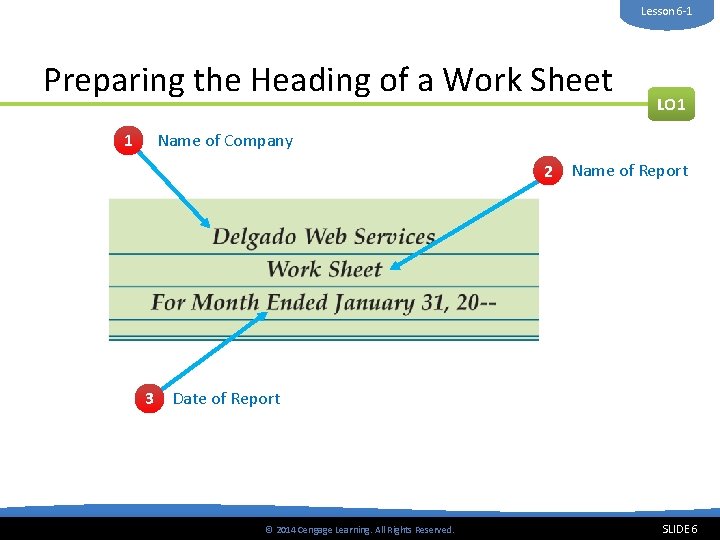
Lesson 6 -1 Preparing the Heading of a Work Sheet 1 LO 1 Name of Company 2 3 Name of Report Date of Report © 2014 Cengage Learning. All Rights Reserved. SLIDE 6
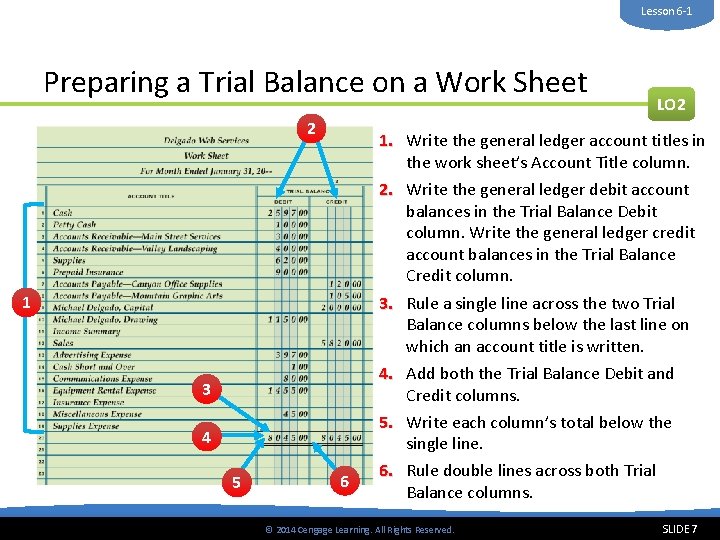
Lesson 6 -1 Preparing a Trial Balance on a Work Sheet 2 LO 2 1. Write the general ledger account titles in the work sheet’s Account Title column. 2. Write the general ledger debit account balances in the Trial Balance Debit column. Write the general ledger credit account balances in the Trial Balance Credit column. 1 3. Rule a single line across the two Trial Balance columns below the last line on which an account title is written. 3 4 5 6 4. Add both the Trial Balance Debit and Credit columns. 5. Write each column’s total below the single line. 6. Rule double lines across both Trial Balance columns. © 2014 Cengage Learning. All Rights Reserved. SLIDE 7

Lesson 6 -1 Audit Your Understanding 1. What is written on the three-line heading on a work sheet? ANSWER Name of the business, name of report, and date of report © 2014 Cengage Learning. All Rights Reserved. SLIDE 8
Lesson 6 -1 Audit Your Understanding 2. Which general ledger accounts are listed in the Trial Balance columns of a work sheet? ANSWER All general ledger accounts are listed in the Trial Balance columns of a work sheet, even if some accounts do not have balances. © 2014 Cengage Learning. All Rights Reserved. SLIDE 9
Lesson 6 -1 ● Aplia © 2014 Cengage Learning. All Rights Reserved. SLIDE 10
Lesson 6 -1 ● Aplia © 2014 Cengage Learning. All Rights Reserved. SLIDE 11
Learning Objectives LO 3 Analyze and explain the adjustments for supplies and prepaid insurance. LO 4 Complete the Adjustments columns of a work sheet. © 2014 Cengage Learning. All Rights Reserved.
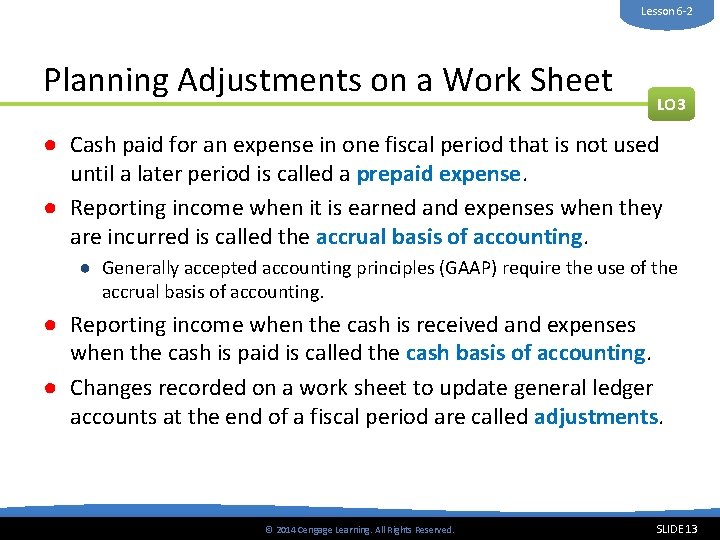
Lesson 6 -2 Planning Adjustments on a Work Sheet LO 3 ● Cash paid for an expense in one fiscal period that is not used until a later period is called a prepaid expense. ● Reporting income when it is earned and expenses when they are incurred is called the accrual basis of accounting. ● Generally accepted accounting principles (GAAP) require the use of the accrual basis of accounting. ● Reporting income when the cash is received and expenses when the cash is paid is called the cash basis of accounting. ● Changes recorded on a work sheet to update general ledger accounts at the end of a fiscal period are called adjustments. © 2014 Cengage Learning. All Rights Reserved. SLIDE 13
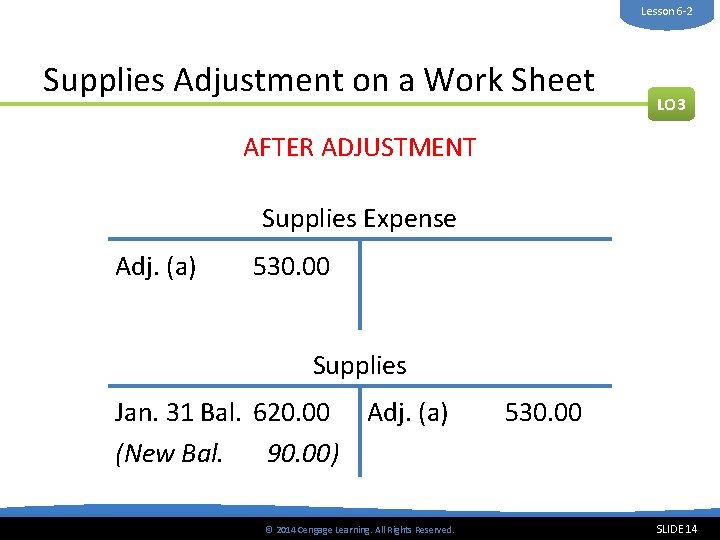
Lesson 6 -2 Supplies Adjustment on a Work Sheet LO 3 BEFORE AFTER ADJUSTMENT Supplies Expense Adj. (a) 530. 00 Supplies Jan. 31 Bal. 620. 00 (New Bal. 90. 00) Adj. (a) © 2014 Cengage Learning. All Rights Reserved. 530. 00 SLIDE 14

Lesson 6 -2 Supplies Adjustment on a Work Sheet 2 Credit 3 Label LO 3 1 Debit 1. Write the debit amount in the Adjustments Debit column on the line with the account title Supplies Expense. 2. Write the credit amount in the Credit column on the line with the account title Supplies. 3. Label the two parts of this adjustment with a small letter a in parentheses. © 2014 Cengage Learning. All Rights Reserved. SLIDE 15
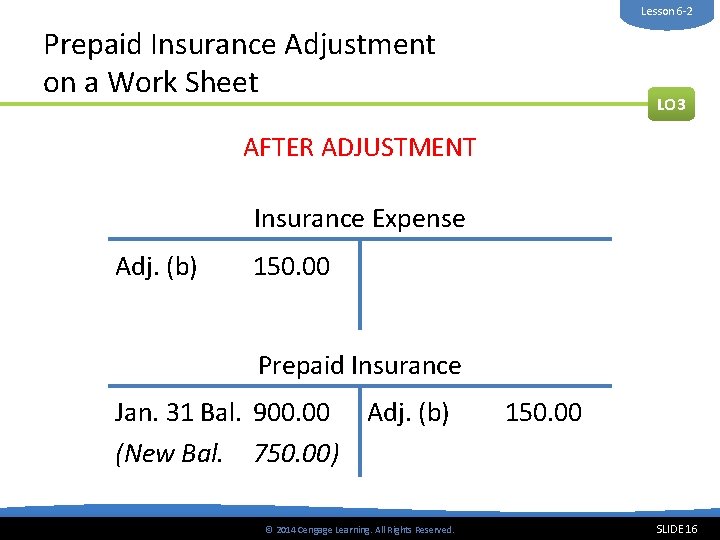
Lesson 6 -2 Prepaid Insurance Adjustment on a Work Sheet LO 3 BEFORE AFTER ADJUSTMENT Insurance Expense Adj. (b) 150. 00 Prepaid Insurance Jan. 31 Bal. 900. 00 (New Bal. 750. 00) Adj. (b) © 2014 Cengage Learning. All Rights Reserved. 150. 00 SLIDE 16
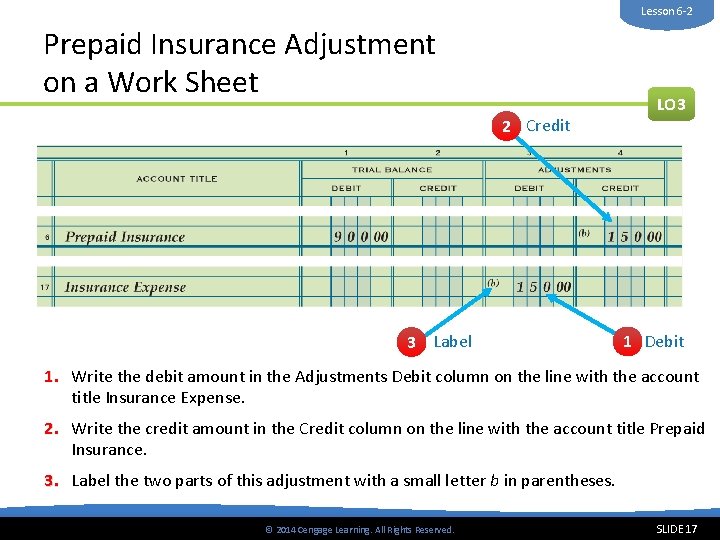
Lesson 6 -2 Prepaid Insurance Adjustment on a Work Sheet 2 Credit 3 Label LO 3 1 Debit 1. Write the debit amount in the Adjustments Debit column on the line with the account title Insurance Expense. 2. Write the credit amount in the Credit column on the line with the account title Prepaid Insurance. 3. Label the two parts of this adjustment with a small letter b in parentheses. © 2014 Cengage Learning. All Rights Reserved. SLIDE 17
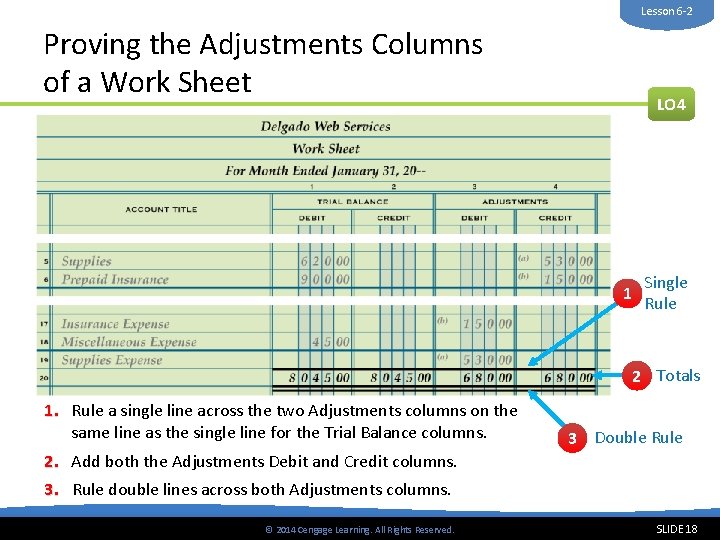
Lesson 6 -2 Proving the Adjustments Columns of a Work Sheet LO 4 1 Single Rule 2 Totals 1. Rule a single line across the two Adjustments columns on the same line as the single line for the Trial Balance columns. 3 Double Rule 2. Add both the Adjustments Debit and Credit columns. 3. Rule double lines across both Adjustments columns. © 2014 Cengage Learning. All Rights Reserved. SLIDE 18
Lesson 6 -2 Audit Your Understanding 1. Explain how the concept of Matching Expenses with Revenue relates to adjustments. ANSWER An expense should be reported in the same fiscal period that it is used to produce revenue. © 2014 Cengage Learning. All Rights Reserved. SLIDE 19
Lesson 6 -2 Audit Your Understanding 2. List the four questions asked in analyzing an adjustment on a work sheet. ANSWER 1. What is the balance of the account to be adjusted? 2. What should the balance be for this account? 3. What must be done to correct the account balance? 4. What adjustment is made? © 2014 Cengage Learning. All Rights Reserved. SLIDE 20
Lesson 6 -2 ● Aplia © 2014 Cengage Learning. All Rights Reserved. SLIDE 21
Learning Objectives LO 5 Prepare the Balance Sheet and Income Statement columns of a work sheet. LO 6 Total and rule the work sheet. LO 7 Apply the steps for finding errors on a work sheet. © 2014 Cengage Learning. All Rights Reserved.
Lesson 6 -3 Extending Balance Sheet Account Balances on a Work Sheet LO 5 ● A financial statement that reports the value of a business’ assets, liabilities, and owner’s equity on a specific date is called a balance sheet. © 2014 Cengage Learning. All Rights Reserved. SLIDE 23
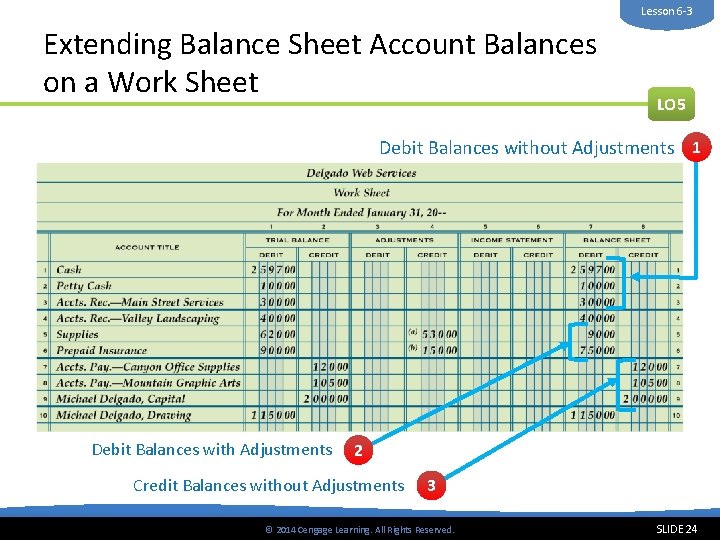
Lesson 6 -3 Extending Balance Sheet Account Balances on a Work Sheet LO 5 Debit Balances without Adjustments 1 Debit Balances with Adjustments 2 Credit Balances without Adjustments 3 © 2014 Cengage Learning. All Rights Reserved. SLIDE 24
Lesson 6 -3 Extending Income Statement Account Balances on a Work Sheet LO 5 ● A financial statement showing the revenue and expenses for a fiscal period is called an income statement. © 2014 Cengage Learning. All Rights Reserved. SLIDE 25
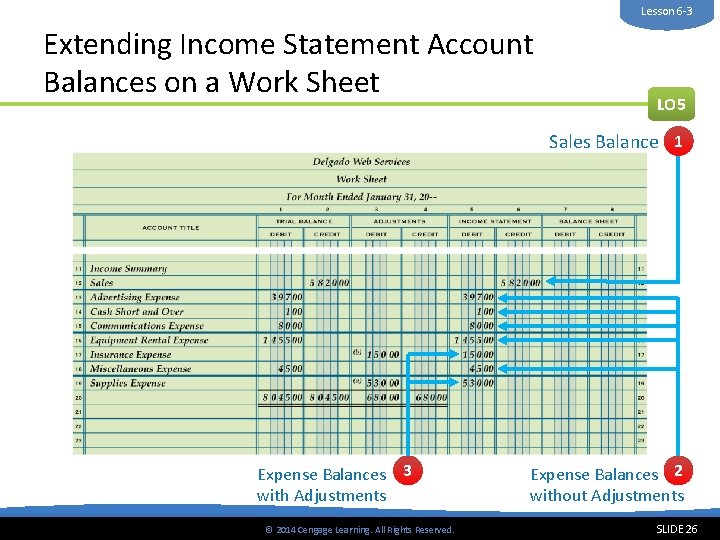
Lesson 6 -3 Extending Income Statement Account Balances on a Work Sheet LO 5 Sales Balance 1 Expense Balances 3 with Adjustments © 2014 Cengage Learning. All Rights Reserved. Expense Balances 2 without Adjustments SLIDE 26
Lesson 6 -3 Recording Net Income and Totaling and Ruling a Work Sheet LO 6 ● The difference between total revenue and total expenses when total revenue is greater is called net income. © 2014 Cengage Learning. All Rights Reserved. SLIDE 27
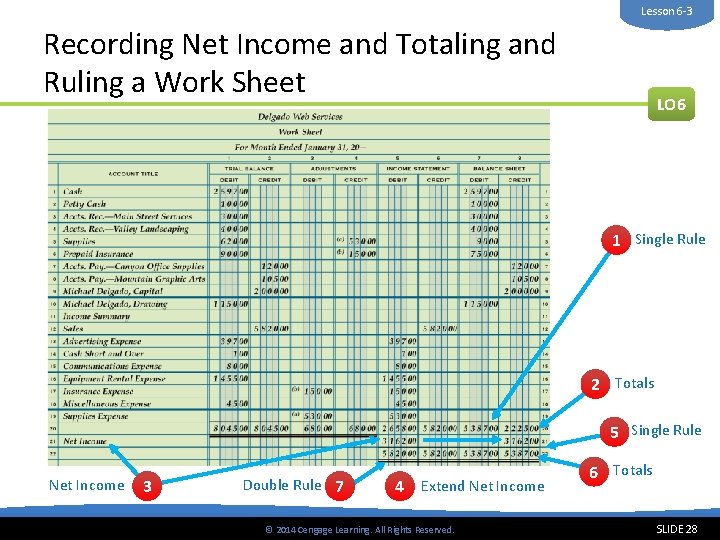
Lesson 6 -3 Recording Net Income and Totaling and Ruling a Work Sheet LO 6 1 Single Rule 2 Totals 5 Single Rule Net Income 3 Double Rule 7 4 Extend Net Income © 2014 Cengage Learning. All Rights Reserved. 6 Totals SLIDE 28
Lesson 6 -3 Calculating and Recording a Net Loss on a Work Sheet LO 6 ● The difference between total revenue and total expenses when total expenses are greater is called a net loss. © 2014 Cengage Learning. All Rights Reserved. SLIDE 29
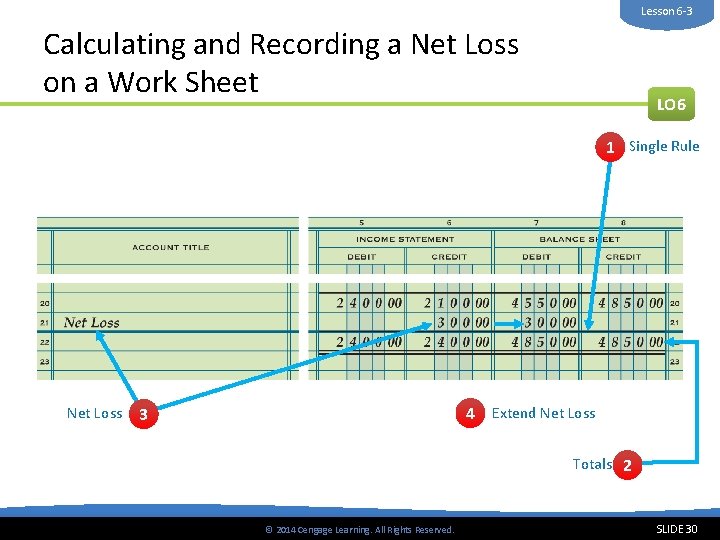
Lesson 6 -3 Calculating and Recording a Net Loss on a Work Sheet LO 6 1 Single Rule Net Loss 4 Extend Net Loss 3 Totals 2 © 2014 Cengage Learning. All Rights Reserved. SLIDE 30
Lesson 6 -3 Finding and Correcting Errors on the Work Sheet LO 7 ● Several different kinds of errors may be made when preparing a work sheet. ● Three examples ● There may be errors in the accounting records. ● There may be errors in calculations. ● An amount may be entered in the wrong column © 2014 Cengage Learning. All Rights Reserved. SLIDE 31
Lesson 6 -3 Audit Your Understanding 1. In which Balance Sheet column is net income recorded on the work sheet? ANSWER Balance Sheet Credit column © 2014 Cengage Learning. All Rights Reserved. SLIDE 32
Lesson 6 -3 Audit Your Understanding 2. In which Balance Sheet column is net loss recorded on the work sheet? ANSWER Balance Sheet Debit column © 2014 Cengage Learning. All Rights Reserved. SLIDE 33
Lesson 6 -3 Audit Your Understanding 3. What is the first step in checking for arithmetic errors when two column totals are not in balance? ANSWER Subtract the smaller total from the larger total to find the difference. © 2014 Cengage Learning. All Rights Reserved. SLIDE 34
Lesson 6 -3 Audit Your Understanding 4. What is one way to check for an error caused by transposed numbers? ANSWER The difference between two column totals can be divided evenly by 9. © 2014 Cengage Learning. All Rights Reserved. SLIDE 35
Lesson 6 -3 Audit Your Understanding 5. What term is used to describe an error that occurs when numbers are moved to the right or left in an amount column? ANSWER Slide © 2014 Cengage Learning. All Rights Reserved. SLIDE 36
Lesson 6 -3 ● Aplia © 2014 Cengage Learning. All Rights Reserved. SLIDE 37
Learning Objectives LO 8 Journalize and post the adjusting entries for supplies and prepaid insurance. © 2014 Cengage Learning. All Rights Reserved.
Lesson 6 -4 Adjusting Entry for Supplies LO 8 ● Journal entries recorded to update general ledger accounts at the end of a fiscal period are called adjusting entries. © 2014 Cengage Learning. All Rights Reserved. SLIDE 39
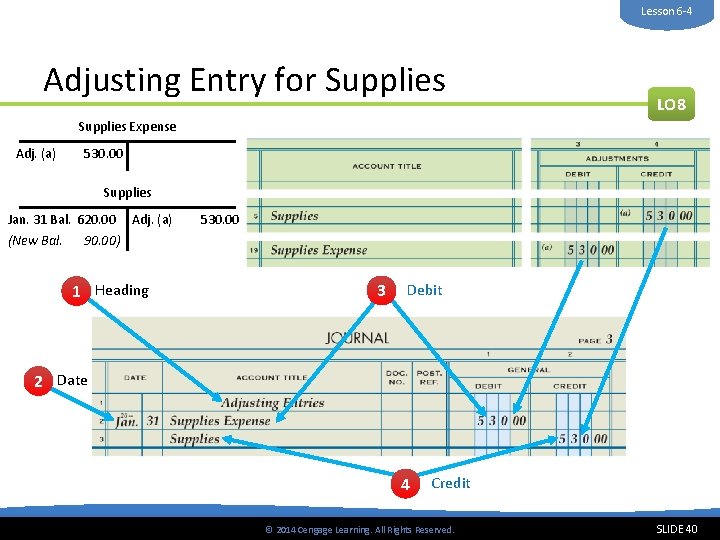
Lesson 6 -4 Adjusting Entry for Supplies LO 8 Supplies Expense Adj. (a) 530. 00 Supplies Jan. 31 Bal. 620. 00 Adj. (a) (New Bal. 90. 00) 1 Heading 530. 00 3 Debit 2 Date 4 Credit © 2014 Cengage Learning. All Rights Reserved. SLIDE 40
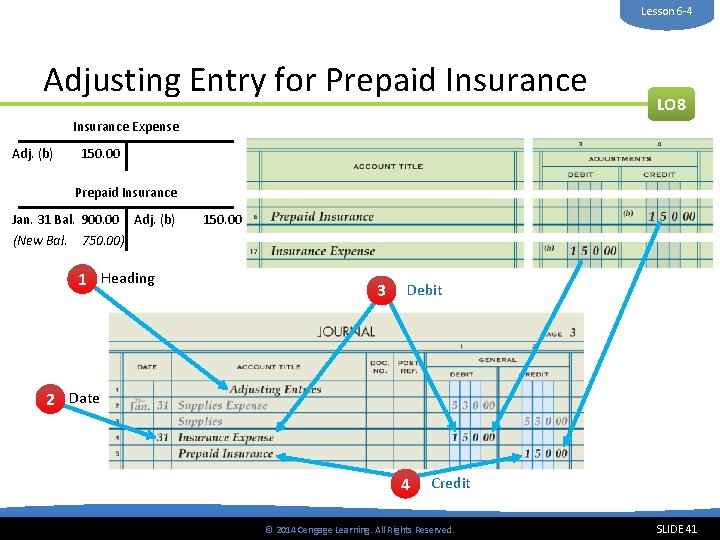
Lesson 6 -4 Adjusting Entry for Prepaid Insurance LO 8 Insurance Expense Adj. (b) 150. 00 Prepaid Insurance Jan. 31 Bal. 900. 00 Adj. (b) (New Bal. 750. 00) 1 Heading 150. 00 3 Debit 2 Date 4 Credit © 2014 Cengage Learning. All Rights Reserved. SLIDE 41
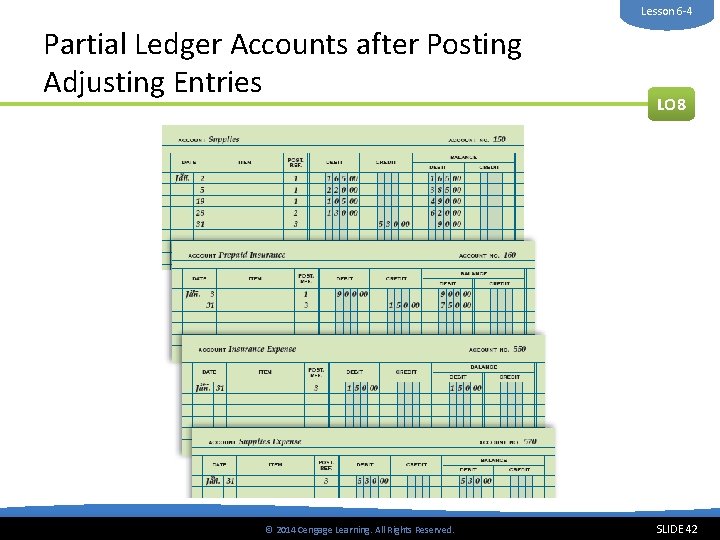
Lesson 6 -4 Partial Ledger Accounts after Posting Adjusting Entries © 2014 Cengage Learning. All Rights Reserved. LO 8 SLIDE 42
Lesson 6 -4 Audit Your Understanding 1. Why are adjusting entries journalized? ANSWER To update general ledger accounts at the end of a fiscal period © 2014 Cengage Learning. All Rights Reserved. SLIDE 43
Lesson 6 -4 Audit Your Understanding 3. Which accounts are increased from zero balances after adjusting entries for supplies and prepaid insurance are journalized and posted? ANSWER Supplies Expense Insurance Expense © 2014 Cengage Learning. All Rights Reserved. SLIDE 44
Lesson 6 -4 ● Aplia © 2014 Cengage Learning. All Rights Reserved. SLIDE 45

Impossible Quick Change Artists (Click to Play) © 2014 Cengage Learning. All Rights Reserved.
- Slides: 46