
Learning Objectives In this class you will u

Learning Objectives In this class, you will u learn how to identify and analyse the forms and meanings of the future progressive tense; u use the future progressive tense to describe an ongoing activity in the future. 高中英语

Jason has a pair of magic glasses through which he can look into the future… 高中英语
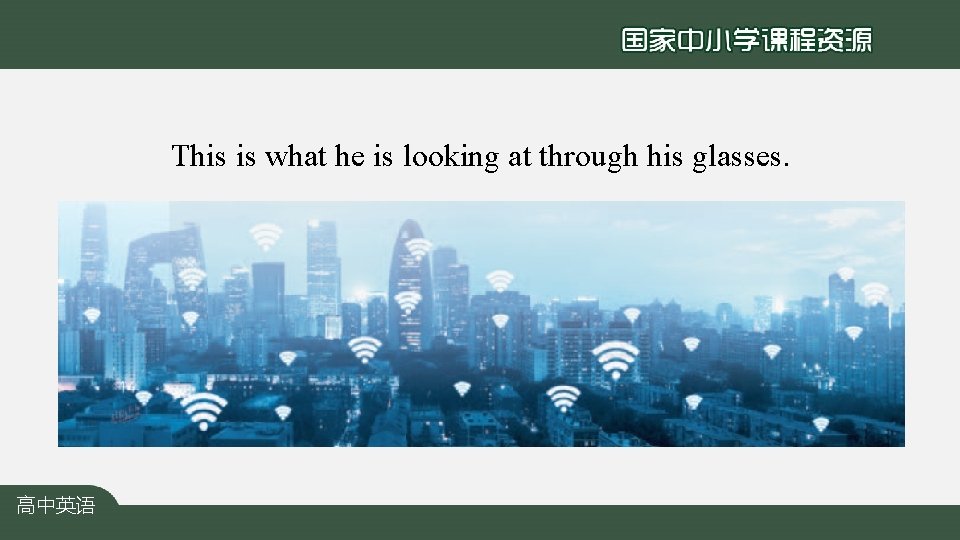
This is what he is looking at through his glasses. 高中英语
Jason is amazed at what he’s looking at and says… A. “In the future, we will use advanced technology every day for automatic control of just about everything in our home. ” B. “In the future, we will be using advanced technology every day for automatic control of just about everything in our home. ” 高中英语
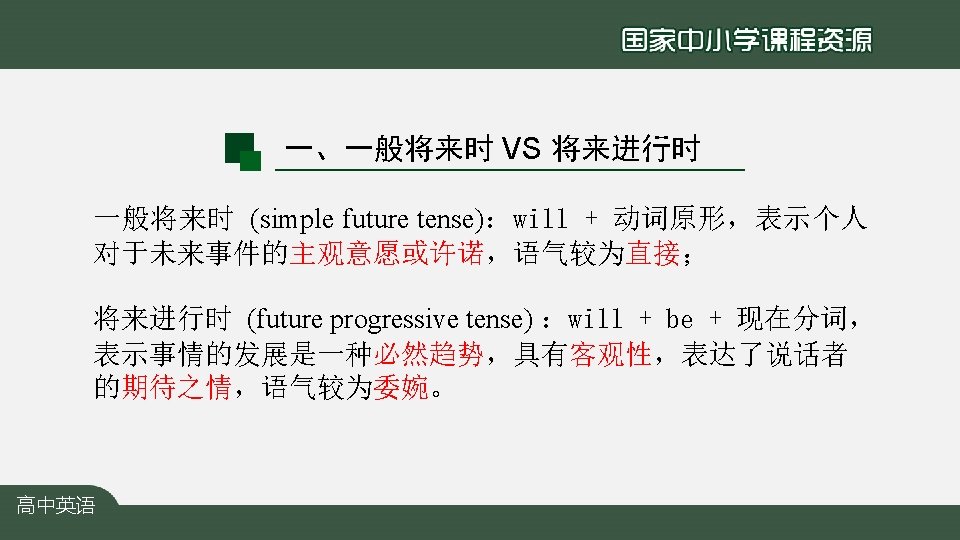
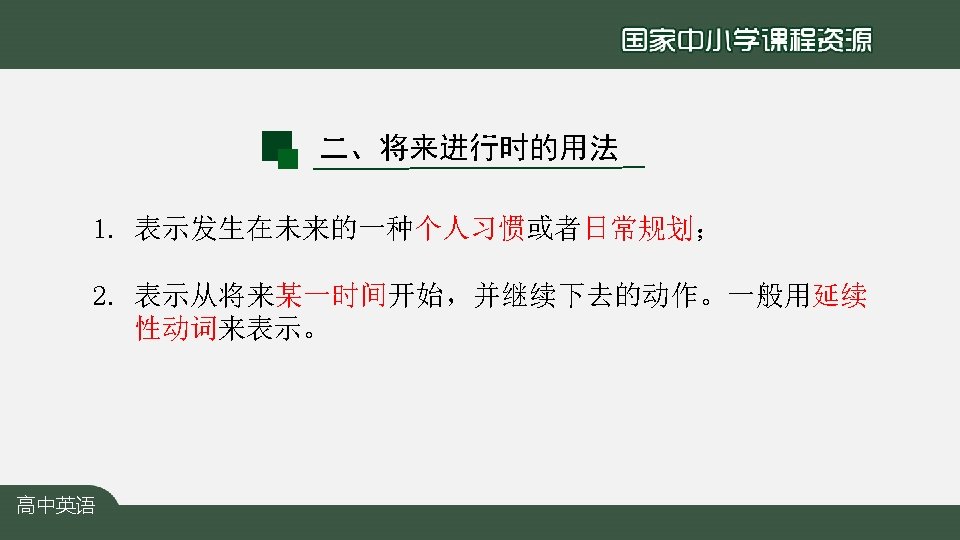
A. “In the future, we will use advanced technology every day for automatic control of just about everything in our home. ” B. “In the future, we will be using advanced technology every day for automatic control of just about everything in our home. ” 将来进行时(Future Progressive Tense) 高中英语
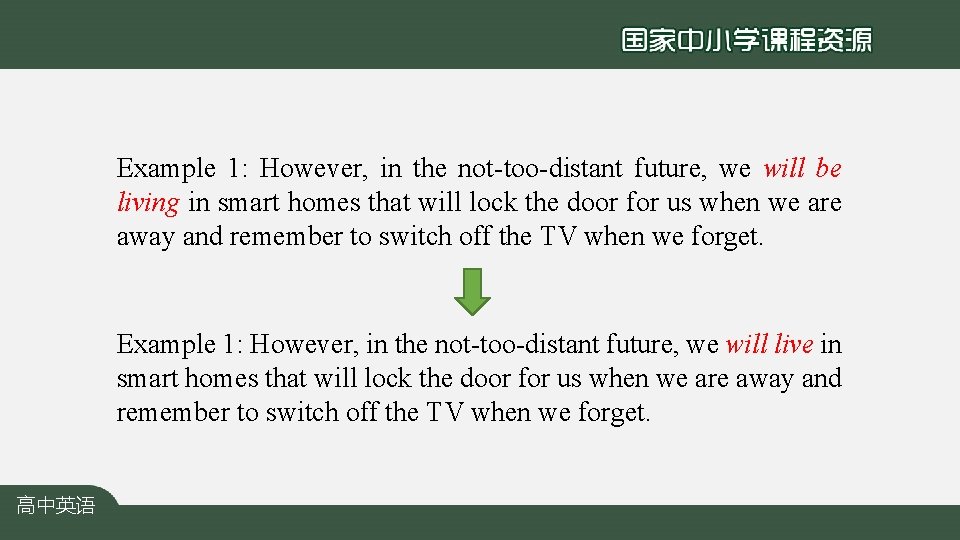
Example 1: However, in the not-too-distant future, we will be living in smart homes that will lock the door for us when we are away and remember to switch off the TV when we forget. Example 1: However, in the not-too-distant future, we will live in smart homes that will lock the door for us when we are away and remember to switch off the TV when we forget. 高中英语
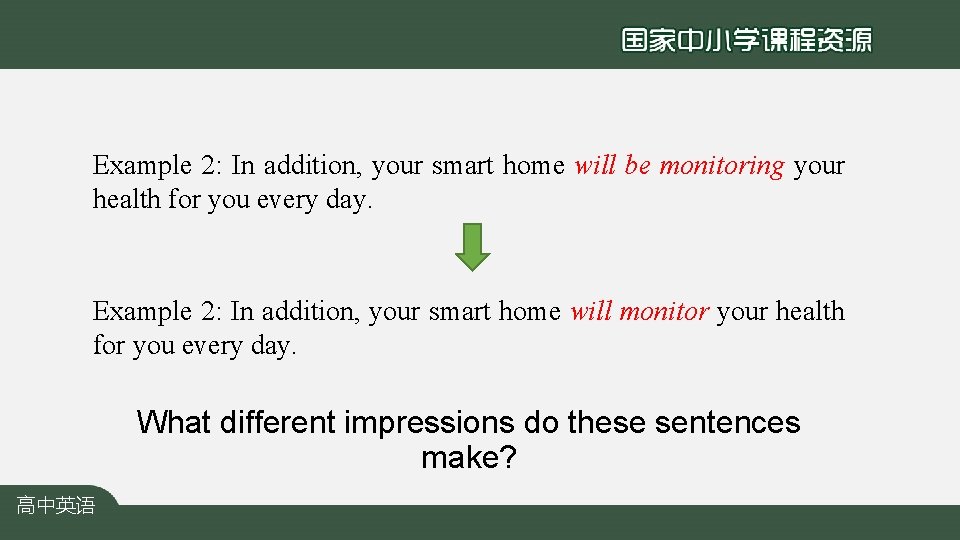
Example 2: In addition, your smart home will be monitoring your health for you every day. Example 2: In addition, your smart home will monitor your health for you every day. What different impressions do these sentences make? 高中英语
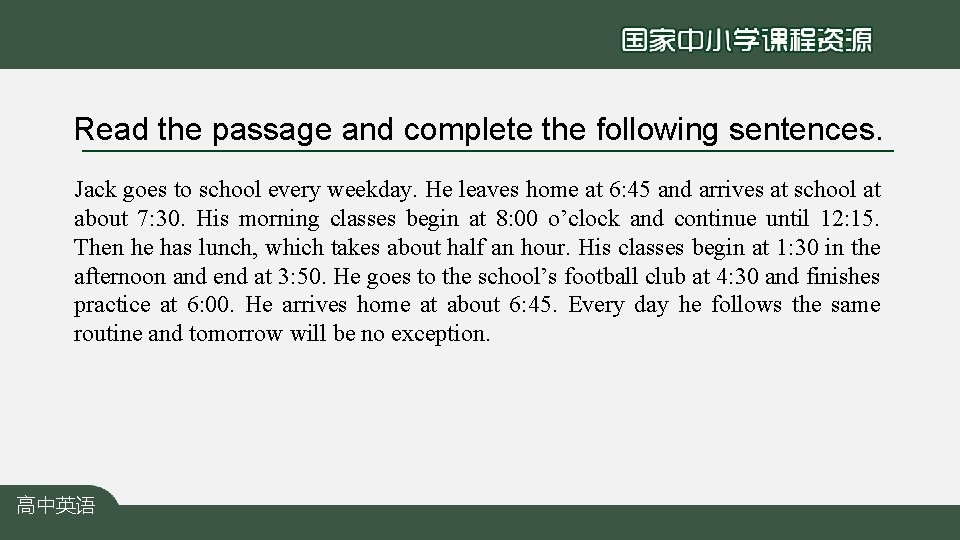
Read the passage and complete the following sentences. Jack goes to school every weekday. He leaves home at 6: 45 and arrives at school at about 7: 30. His morning classes begin at 8: 00 o’clock and continue until 12: 15. Then he has lunch, which takes about half an hour. His classes begin at 1: 30 in the afternoon and end at 3: 50. He goes to the school’s football club at 4: 30 and finishes practice at 6: 00. He arrives home at about 6: 45. Every day he follows the same routine and tomorrow will be no exception. 高中英语
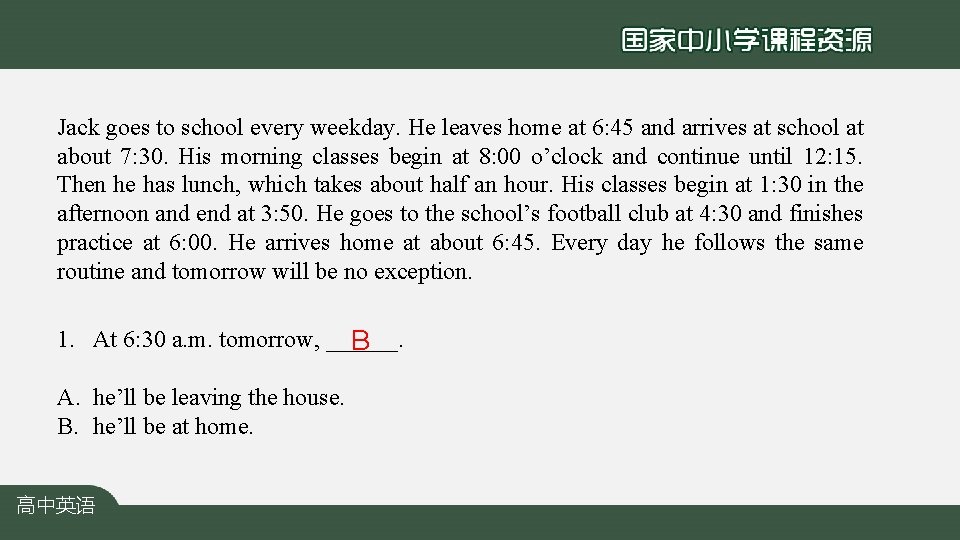
Jack goes to school every weekday. He leaves home at 6: 45 and arrives at school at about 7: 30. His morning classes begin at 8: 00 o’clock and continue until 12: 15. Then he has lunch, which takes about half an hour. His classes begin at 1: 30 in the afternoon and end at 3: 50. He goes to the school’s football club at 4: 30 and finishes practice at 6: 00. He arrives home at about 6: 45. Every day he follows the same routine and tomorrow will be no exception. 1. At 6: 30 a. m. tomorrow, ______. B A. he’ll be leaving the house. B. he’ll be at home. 高中英语
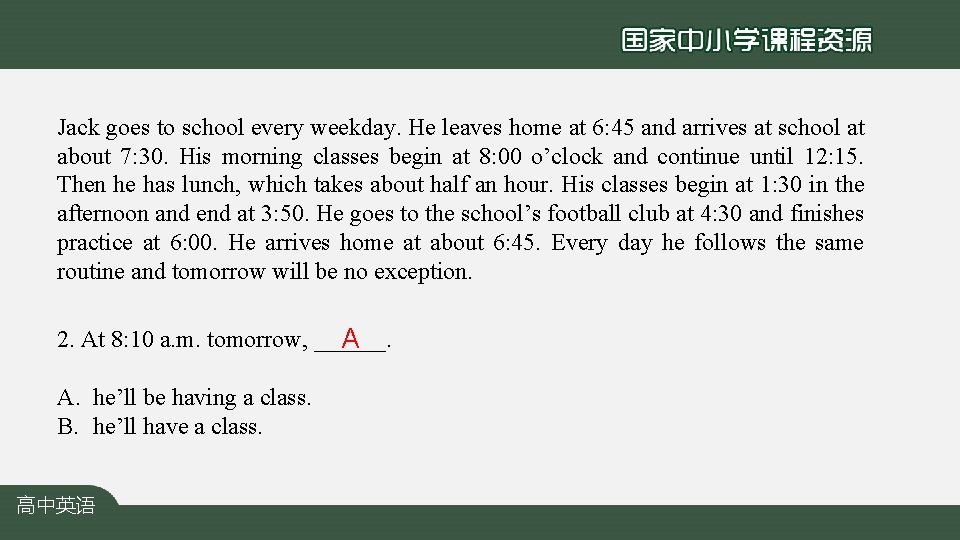
Jack goes to school every weekday. He leaves home at 6: 45 and arrives at school at about 7: 30. His morning classes begin at 8: 00 o’clock and continue until 12: 15. Then he has lunch, which takes about half an hour. His classes begin at 1: 30 in the afternoon and end at 3: 50. He goes to the school’s football club at 4: 30 and finishes practice at 6: 00. He arrives home at about 6: 45. Every day he follows the same routine and tomorrow will be no exception. 2. At 8: 10 a. m. tomorrow, ______. A A. he’ll be having a class. B. he’ll have a class. 高中英语
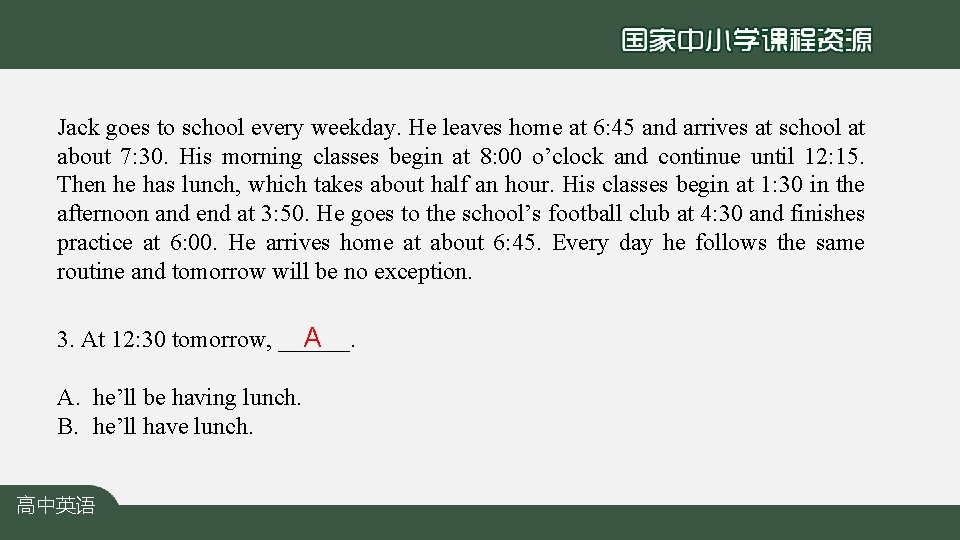
Jack goes to school every weekday. He leaves home at 6: 45 and arrives at school at about 7: 30. His morning classes begin at 8: 00 o’clock and continue until 12: 15. Then he has lunch, which takes about half an hour. His classes begin at 1: 30 in the afternoon and end at 3: 50. He goes to the school’s football club at 4: 30 and finishes practice at 6: 00. He arrives home at about 6: 45. Every day he follows the same routine and tomorrow will be no exception. 3. At 12: 30 tomorrow, ______. A A. he’ll be having lunch. B. he’ll have lunch. 高中英语
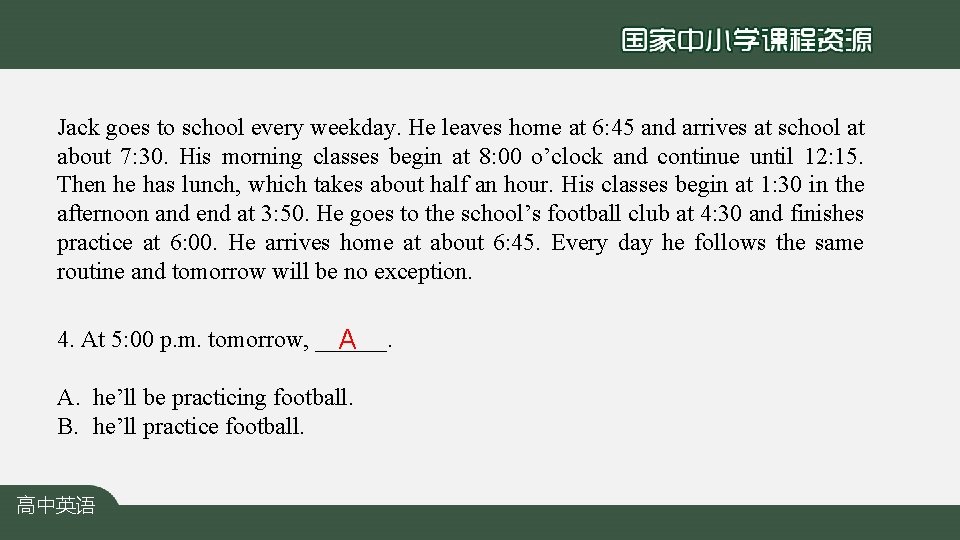
Jack goes to school every weekday. He leaves home at 6: 45 and arrives at school at about 7: 30. His morning classes begin at 8: 00 o’clock and continue until 12: 15. Then he has lunch, which takes about half an hour. His classes begin at 1: 30 in the afternoon and end at 3: 50. He goes to the school’s football club at 4: 30 and finishes practice at 6: 00. He arrives home at about 6: 45. Every day he follows the same routine and tomorrow will be no exception. 4. At 5: 00 p. m. tomorrow, ______. A A. he’ll be practicing football. B. he’ll practice football. 高中英语
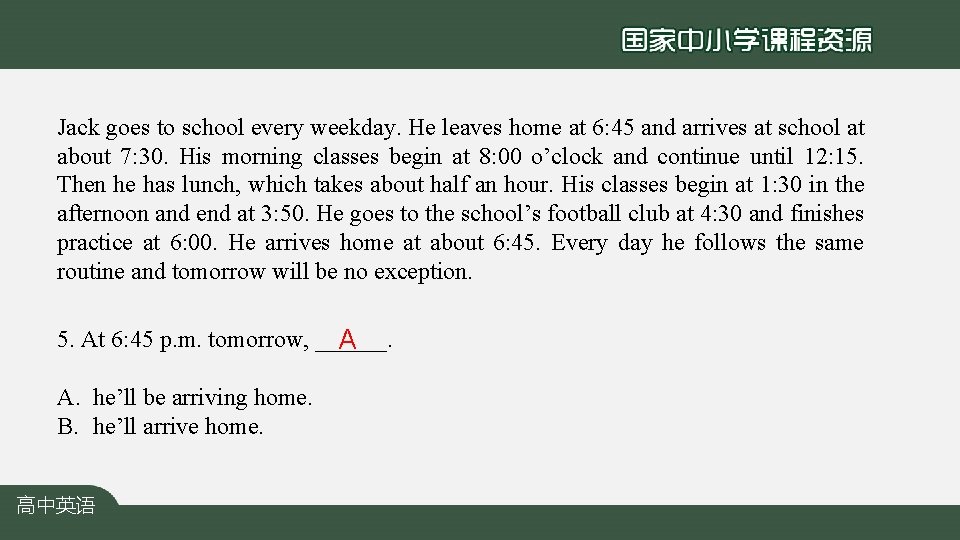
Jack goes to school every weekday. He leaves home at 6: 45 and arrives at school at about 7: 30. His morning classes begin at 8: 00 o’clock and continue until 12: 15. Then he has lunch, which takes about half an hour. His classes begin at 1: 30 in the afternoon and end at 3: 50. He goes to the school’s football club at 4: 30 and finishes practice at 6: 00. He arrives home at about 6: 45. Every day he follows the same routine and tomorrow will be no exception. 5. At 6: 45 p. m. tomorrow, ______. A A. he’ll be arriving home. B. he’ll arrive home. 高中英语
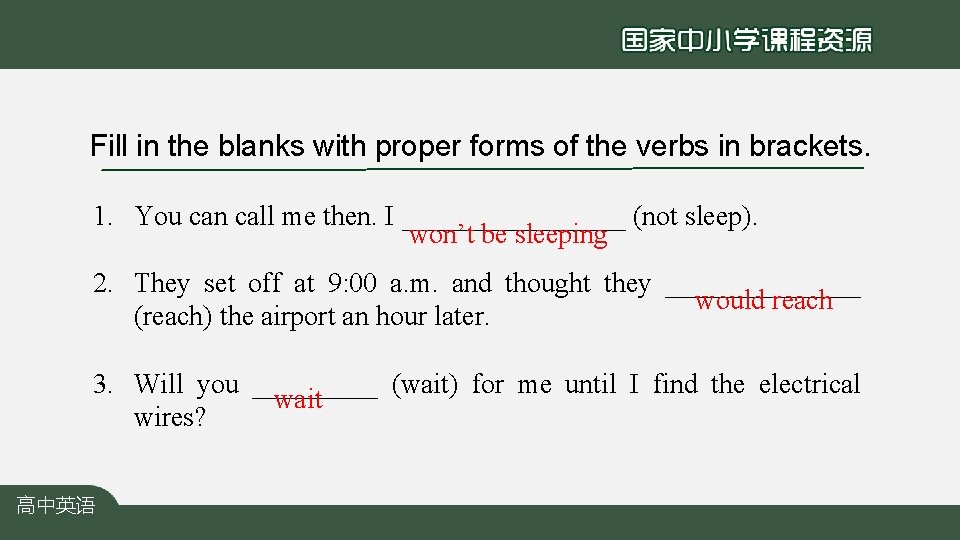
Fill in the blanks with proper forms of the verbs in brackets. 1. You can call me then. I ________ (not sleep). won’t be sleeping 2. They set off at 9: 00 a. m. and thought they _______ would reach (reach) the airport an hour later. 3. Will you _____ (wait) for me until I find the electrical wait wires? 高中英语
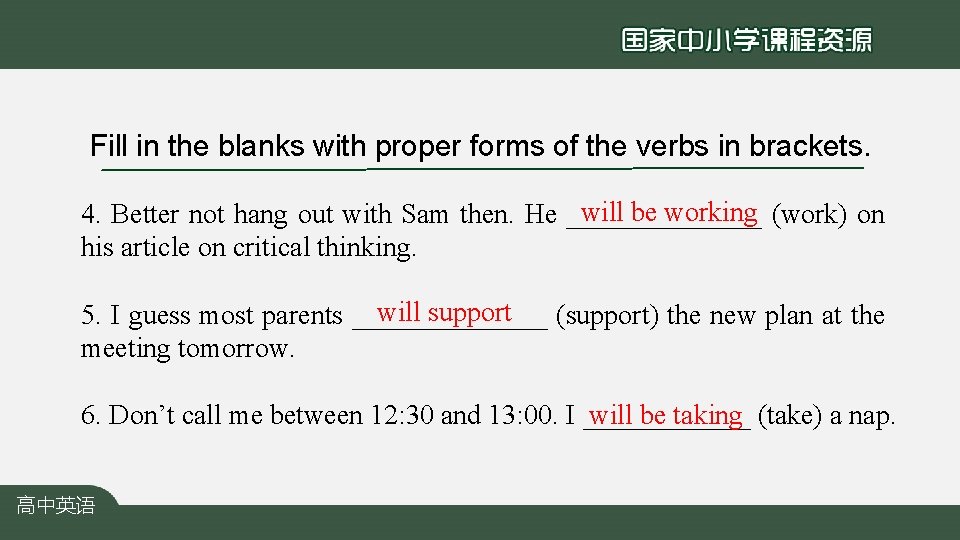
Fill in the blanks with proper forms of the verbs in brackets. will be working (work) on 4. Better not hang out with Sam then. He _______ his article on critical thinking. will support 5. I guess most parents _______ (support) the new plan at the meeting tomorrow. will be taking (take) a nap. 6. Don’t call me between 12: 30 and 13: 00. I ______ 高中英语
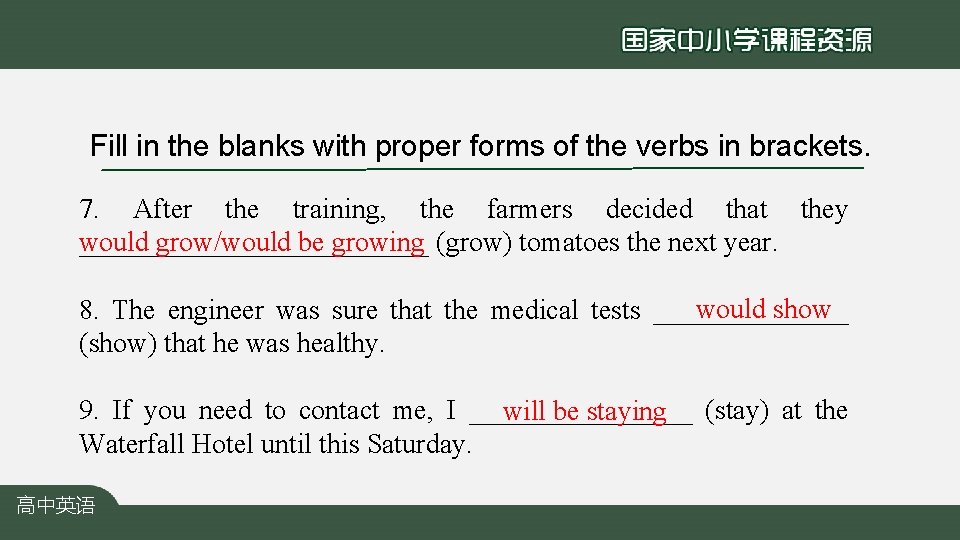
Fill in the blanks with proper forms of the verbs in brackets. 7. After the training, the farmers decided that they would grow/would be growing (grow) tomatoes the next year. _____________ would show 8. The engineer was sure that the medical tests _______ (show) that he was healthy. 9. If you need to contact me, I ________ will be staying (stay) at the Waterfall Hotel until this Saturday. 高中英语
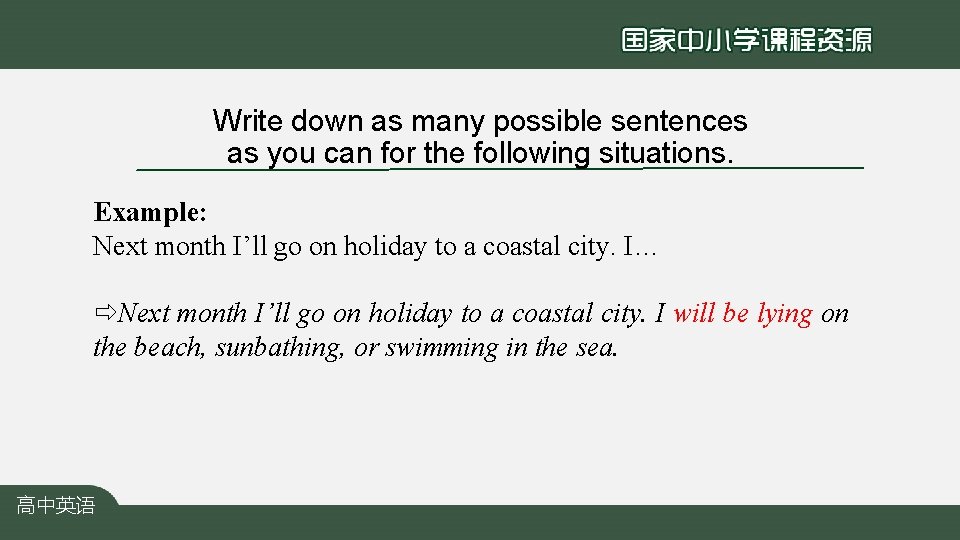
Write down as many possible sentences as you can for the following situations. Example: Next month I’ll go on holiday to a coastal city. I… Next month I’ll go on holiday to a coastal city. I will be lying on the beach, sunbathing, or swimming in the sea. 高中英语
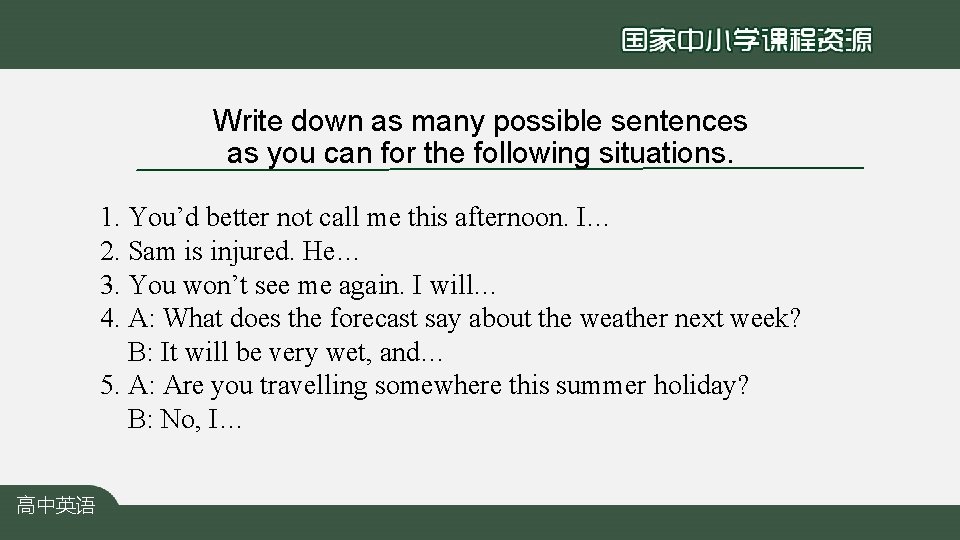
Write down as many possible sentences as you can for the following situations. 1. You’d better not call me this afternoon. I… 2. Sam is injured. He… 3. You won’t see me again. I will… 4. A: What does the forecast say about the weather next week? B: It will be very wet, and… 5. A: Are you travelling somewhere this summer holiday? B: No, I… 高中英语
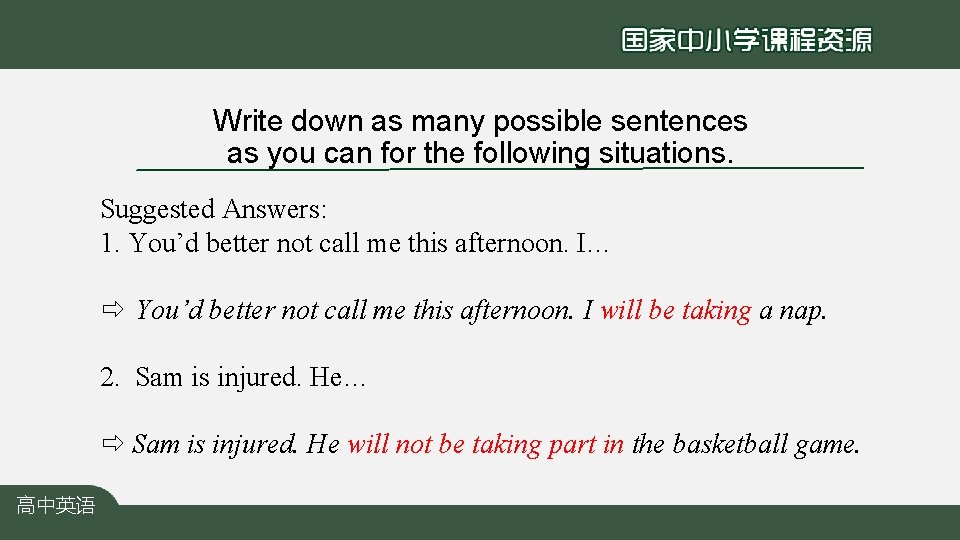
Write down as many possible sentences as you can for the following situations. Suggested Answers: 1. You’d better not call me this afternoon. I… You’d better not call me this afternoon. I will be taking a nap. 2. Sam is injured. He… Sam is injured. He will not be taking part in the basketball game. 高中英语
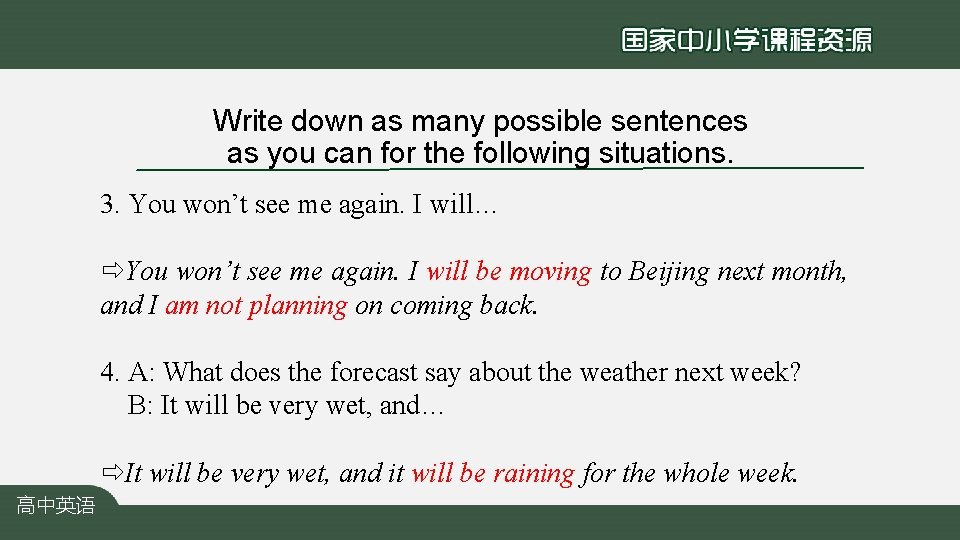
Write down as many possible sentences as you can for the following situations. 3. You won’t see me again. I will… You won’t see me again. I will be moving to Beijing next month, and I am not planning on coming back. 4. A: What does the forecast say about the weather next week? B: It will be very wet, and… It will be very wet, and it will be raining for the whole week. 高中英语
Write down as many possible sentences as you can for the following situations. 5. A: Are you travelling somewhere this summer holiday? B: No, I… No, I’ll be staying home and working. 高中英语
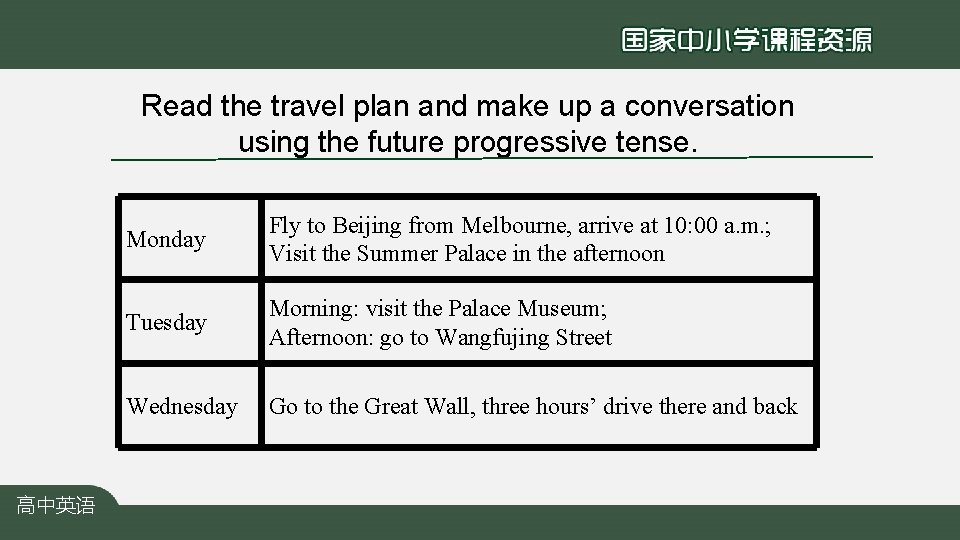
Read the travel plan and make up a conversation using the future progressive tense. 高中英语 Monday Fly to Beijing from Melbourne, arrive at 10: 00 a. m. ; Visit the Summer Palace in the afternoon Tuesday Morning: visit the Palace Museum; Afternoon: go to Wangfujing Street Wednesday Go to the Great Wall, three hours’ drive there and back
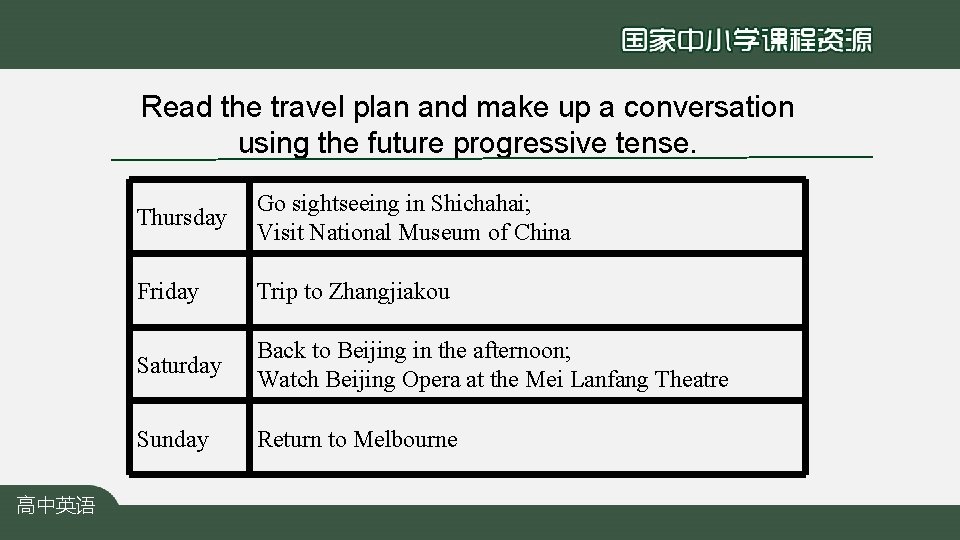
Read the travel plan and make up a conversation using the future progressive tense. 高中英语 Thursday Go sightseeing in Shichahai; Visit National Museum of China Friday Trip to Zhangjiakou Saturday Back to Beijing in the afternoon; Watch Beijing Opera at the Mei Lanfang Theatre Sunday Return to Melbourne
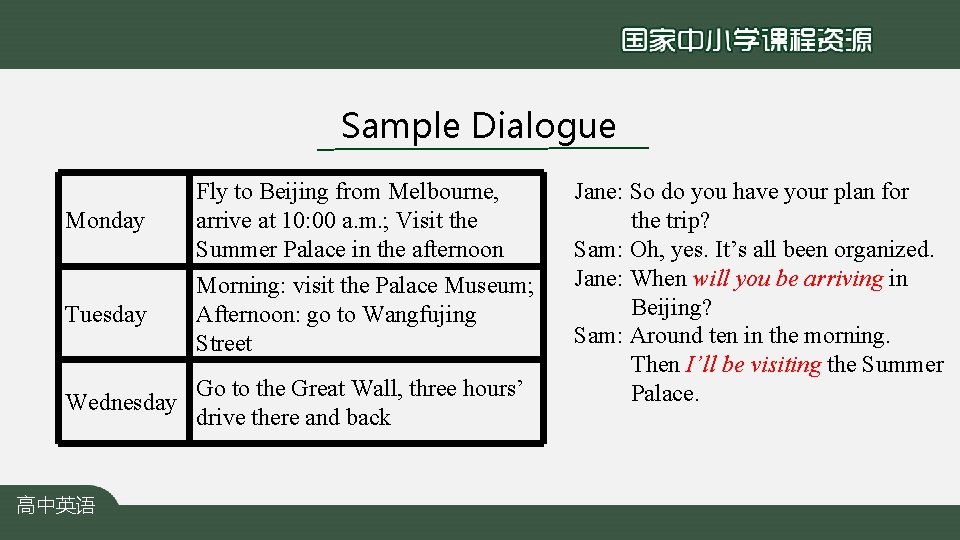
Sample Dialogue Monday Tuesday Fly to Beijing from Melbourne, arrive at 10: 00 a. m. ; Visit the Summer Palace in the afternoon Morning: visit the Palace Museum; Afternoon: go to Wangfujing Street Go to the Great Wall, three hours’ Wednesday drive there and back 高中英语 Jane: So do you have your plan for the trip? Sam: Oh, yes. It’s all been organized. Jane: When will you be arriving in Beijing? Sam: Around ten in the morning. Then I’ll be visiting the Summer Palace.
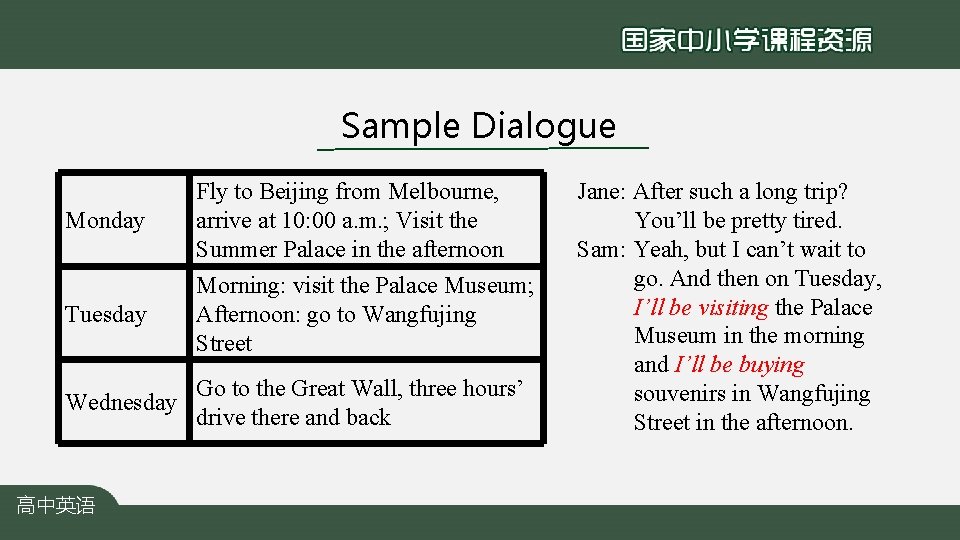
Sample Dialogue Monday Tuesday Fly to Beijing from Melbourne, arrive at 10: 00 a. m. ; Visit the Summer Palace in the afternoon Morning: visit the Palace Museum; Afternoon: go to Wangfujing Street Go to the Great Wall, three hours’ Wednesday drive there and back 高中英语 Jane: After such a long trip? You’ll be pretty tired. Sam: Yeah, but I can’t wait to go. And then on Tuesday, I’ll be visiting the Palace Museum in the morning and I’ll be buying souvenirs in Wangfujing Street in the afternoon.
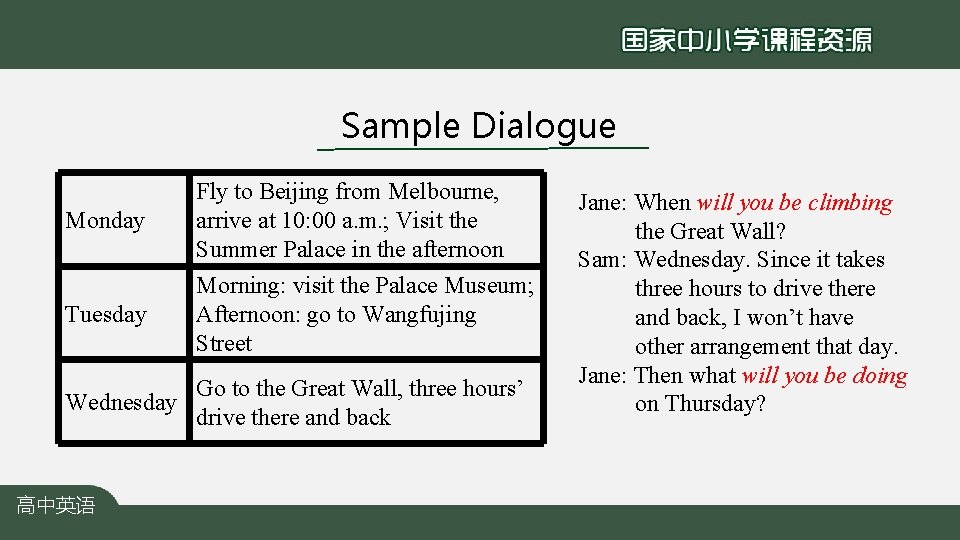
Sample Dialogue Monday Tuesday Fly to Beijing from Melbourne, arrive at 10: 00 a. m. ; Visit the Summer Palace in the afternoon Morning: visit the Palace Museum; Afternoon: go to Wangfujing Street Go to the Great Wall, three hours’ Wednesday drive there and back 高中英语 Jane: When will you be climbing the Great Wall? Sam: Wednesday. Since it takes three hours to drive there and back, I won’t have other arrangement that day. Jane: Then what will you be doing on Thursday?
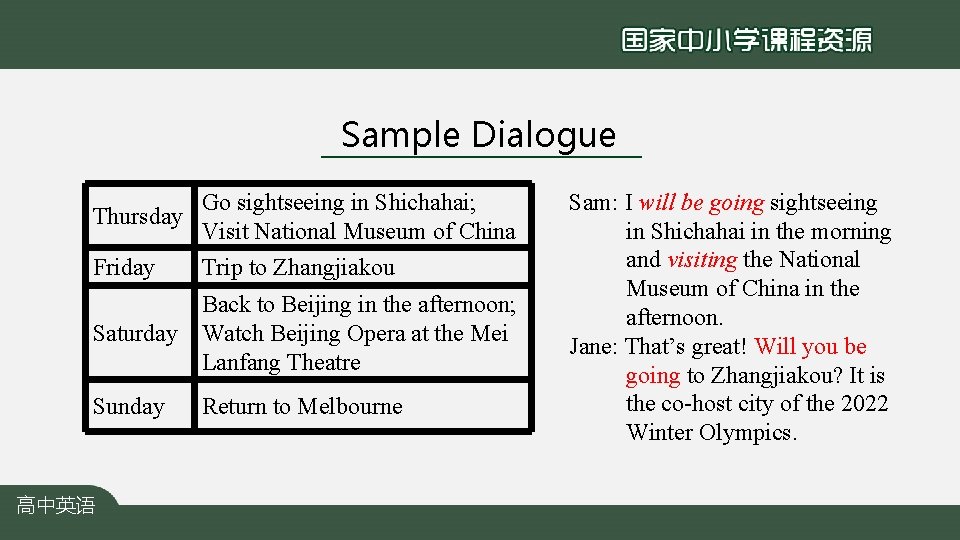
Sample Dialogue Go sightseeing in Shichahai; Thursday Visit National Museum of China Friday Trip to Zhangjiakou Back to Beijing in the afternoon; Saturday Watch Beijing Opera at the Mei Lanfang Theatre Sunday 高中英语 Return to Melbourne Sam: I will be going sightseeing in Shichahai in the morning and visiting the National Museum of China in the afternoon. Jane: That’s great! Will you be going to Zhangjiakou? It is the co-host city of the 2022 Winter Olympics.
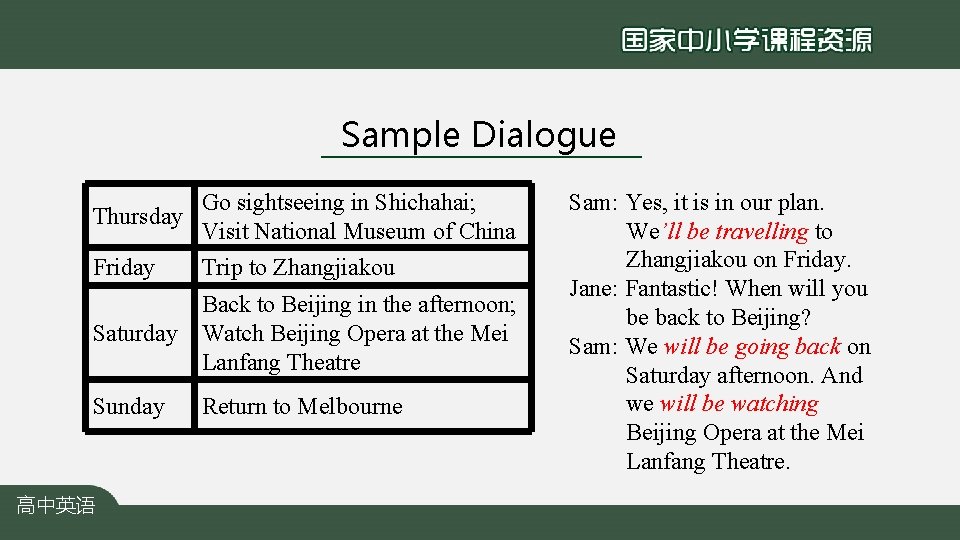
Sample Dialogue Go sightseeing in Shichahai; Thursday Visit National Museum of China Friday Trip to Zhangjiakou Back to Beijing in the afternoon; Saturday Watch Beijing Opera at the Mei Lanfang Theatre Sunday 高中英语 Return to Melbourne Sam: Yes, it is in our plan. We’ll be travelling to Zhangjiakou on Friday. Jane: Fantastic! When will you be back to Beijing? Sam: We will be going back on Saturday afternoon. And we will be watching Beijing Opera at the Mei Lanfang Theatre.
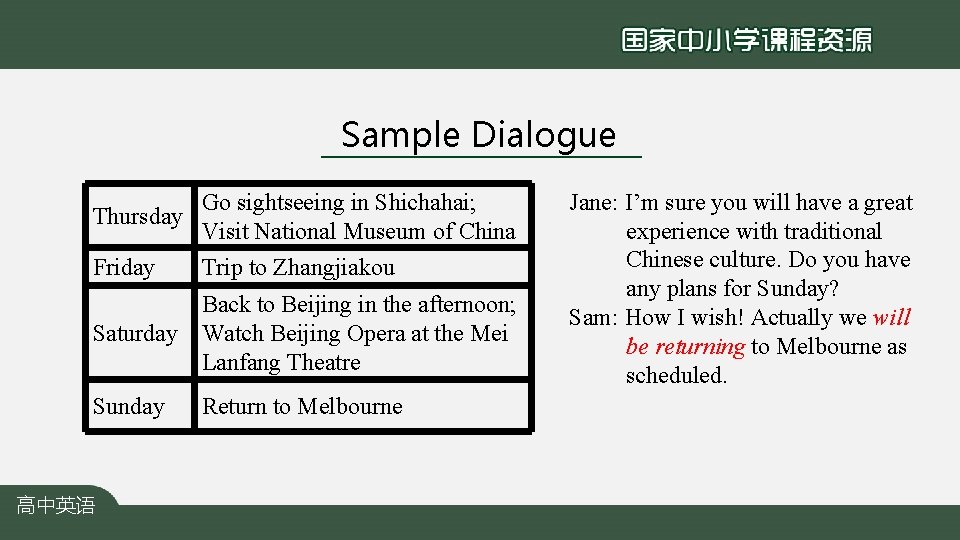
Sample Dialogue Go sightseeing in Shichahai; Thursday Visit National Museum of China Friday Trip to Zhangjiakou Back to Beijing in the afternoon; Saturday Watch Beijing Opera at the Mei Lanfang Theatre Sunday 高中英语 Return to Melbourne Jane: I’m sure you will have a great experience with traditional Chinese culture. Do you have any plans for Sunday? Sam: How I wish! Actually we will be returning to Melbourne as scheduled.
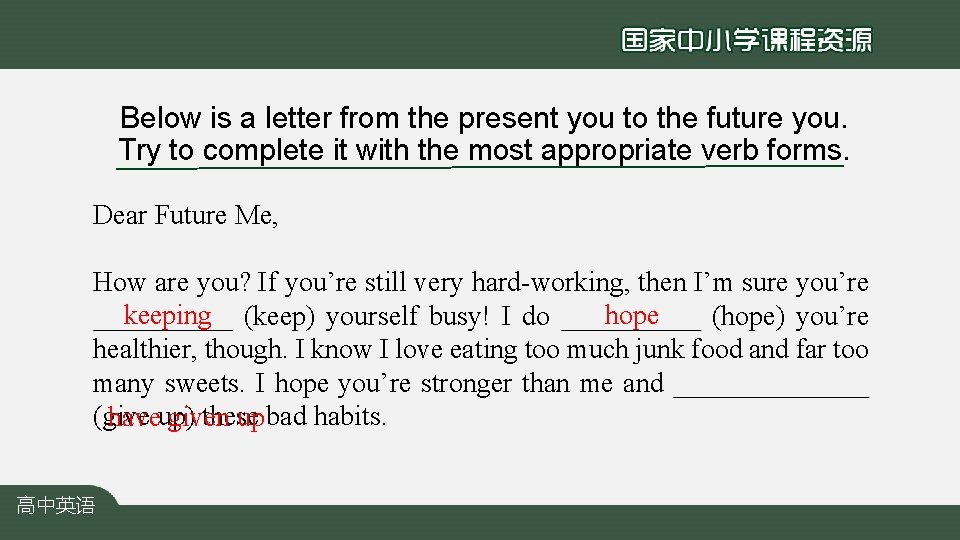
Below is a letter from the present you to the future you. Try to complete it with the most appropriate verb forms. Dear Future Me, How are you? If you’re still very hard-working, then I’m sure you’re keeping (keep) yourself busy! I do _____ hope _____ (hope) you’re healthier, though. I know I love eating too much junk food and far too many sweets. I hope you’re stronger than me and _______ (give these haveup) given up bad habits. 高中英语
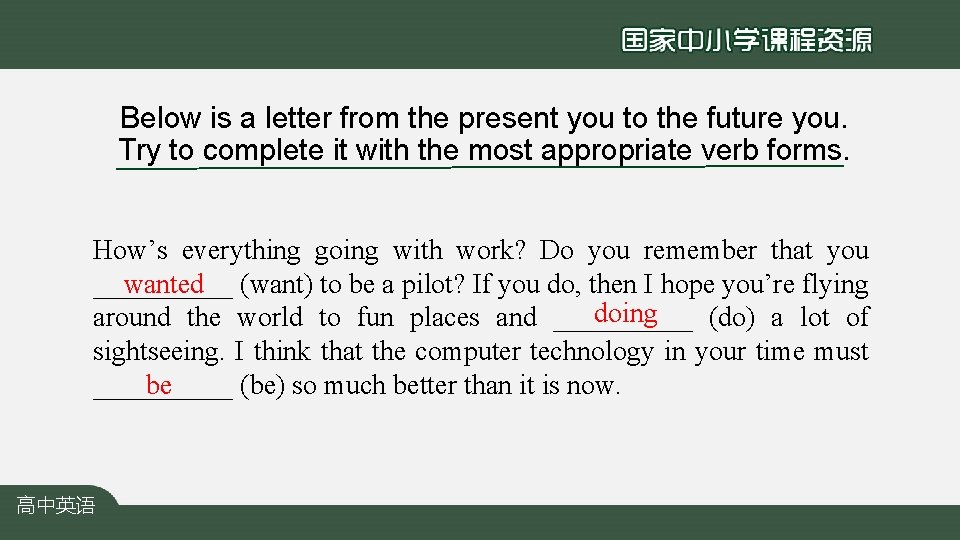
Below is a letter from the present you to the future you. Try to complete it with the most appropriate verb forms. How’s everything going with work? Do you remember that you wanted (want) to be a pilot? If you do, then I hope you’re flying _____ doing around the world to fun places and _____ (do) a lot of sightseeing. I think that the computer technology in your time must _____ (be) so much better than it is now. be 高中英语
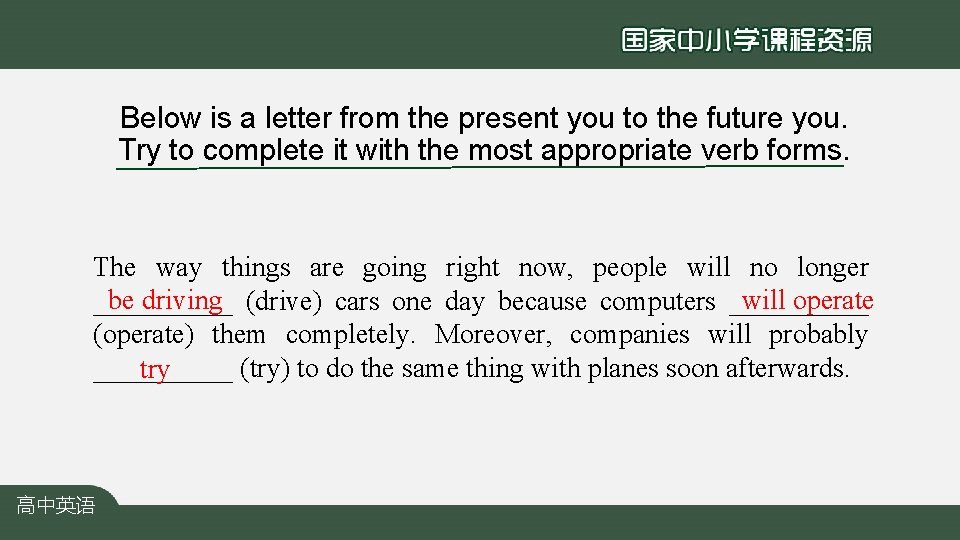
Below is a letter from the present you to the future you. Try to complete it with the most appropriate verb forms. The way things are going right now, people will no longer be driving (drive) cars one day because computers _____ will operate _____ (operate) them completely. Moreover, companies will probably _____ (try) to do the same thing with planes soon afterwards. try 高中英语
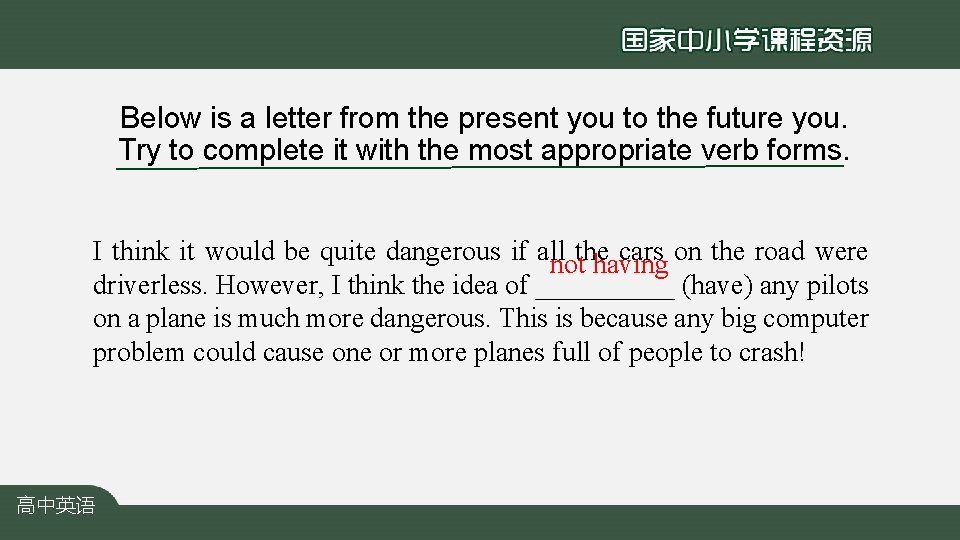
Below is a letter from the present you to the future you. Try to complete it with the most appropriate verb forms. I think it would be quite dangerous if all the cars on the road were not having driverless. However, I think the idea of _____ (have) any pilots on a plane is much more dangerous. This is because any big computer problem could cause one or more planes full of people to crash! 高中英语
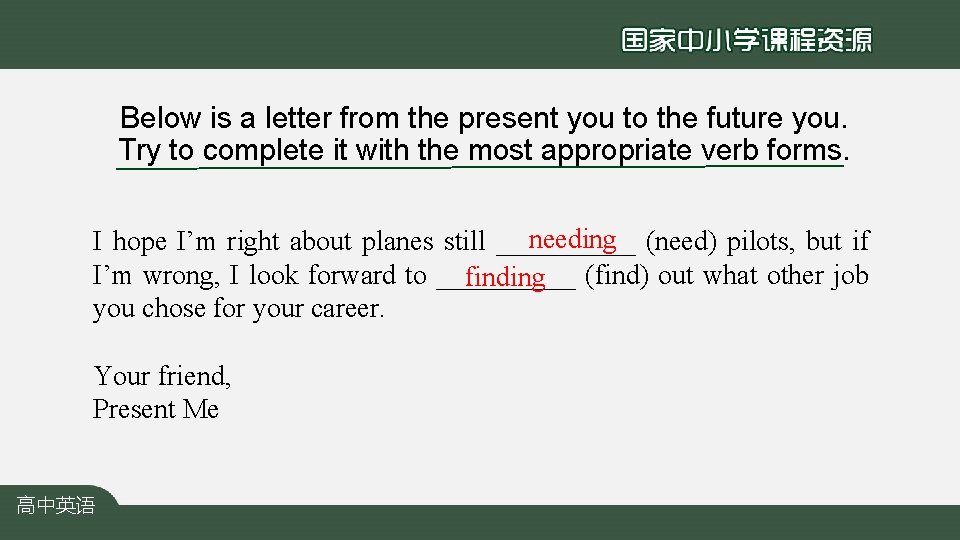
Below is a letter from the present you to the future you. Try to complete it with the most appropriate verb forms. needing (need) pilots, but if I hope I’m right about planes still _____ I’m wrong, I look forward to _____ finding (find) out what other job you chose for your career. Your friend, Present Me 高中英语
Homework 完成下面的写作任务,要求如下: Write a letter from the present you to the future you, presenting a potential problem in your future career that might be caused by future advances in technology. You are required to include: l the name of your possible future career; l the potential problem that is caused by future advances in technology; l the possible effect(s) of the problem. 高中英语
Thanks for your attention! 高中英语
- Slides: 40