
Learning Objectives for Section 11 5 Implicit Differentiation
Learning Objectives for Section 11. 5 Implicit Differentiation The student will be able to ■ Use special functional notation, and ■ Carry out implicit differentiation. Barnett/Ziegler/Byleen Business Calculus 11 e
Function Review and New Notation So far, the equation of a curve has been specified in the form y = x 2 – 5 x or f (x) = x 2 – 5 x (for example). This is called the explicit form. y is given as a function of x. However, graphs can also be specified by equations of the form F(x, y) = 0, such as F(x, y) = x 2 + 4 xy - 3 y 2 +7. This is called the implicit form. You may or may not be able to solve for y. Barnett/Ziegler/Byleen Business Calculus 11 e

Explicit and Implicit Differentiation Consider the equation y = x 2 – 5 x. To compute the equation of a tangent line, we can use the derivative y’ = 2 x – 5. This is called explicit differentiation. We can also rewrite the original equation as F(x, y) = x 2 – 5 x – y = 0 and calculate the derivative of y from that. This is called implicit differentiation. Barnett/Ziegler/Byleen Business Calculus 11 e
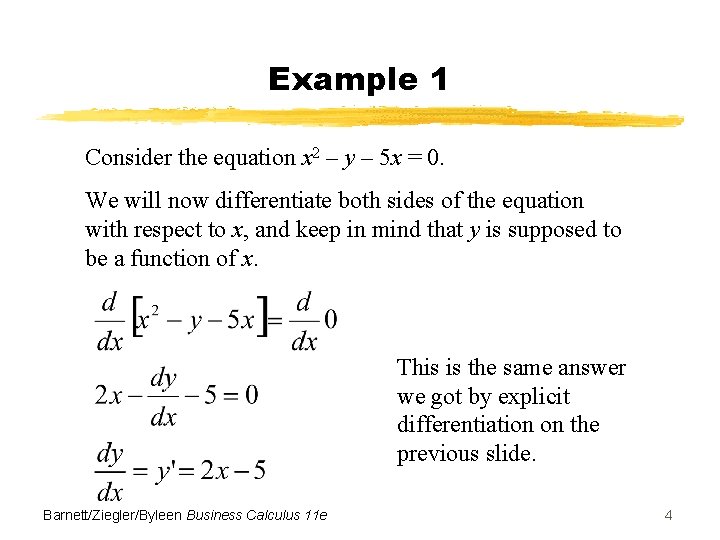
Example 1 Consider the equation x 2 – y – 5 x = 0. We will now differentiate both sides of the equation with respect to x, and keep in mind that y is supposed to be a function of x. This is the same answer we got by explicit differentiation on the previous slide. Barnett/Ziegler/Byleen Business Calculus 11 e 4
Example 2 Consider x 2 – 3 xy + 4 y = 0 and differentiate implicitly. Barnett/Ziegler/Byleen Business Calculus 11 e 5
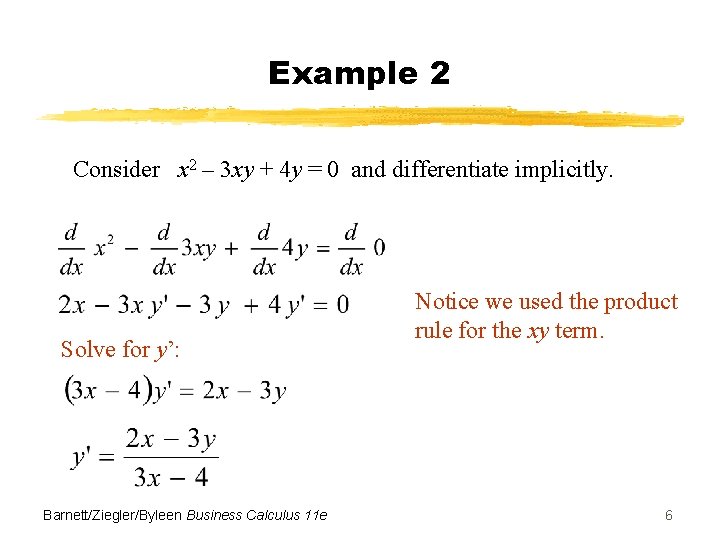
Example 2 Consider x 2 – 3 xy + 4 y = 0 and differentiate implicitly. Solve for y’: Barnett/Ziegler/Byleen Business Calculus 11 e Notice we used the product rule for the xy term. 6
Example 3 Consider x 2 – 3 xy + 4 y = 0. Find the equation of the tangent at (1, -1). Solution: 1. Confirm that (1, -1) is a point on the graph. 2. Use the derivative from example 2 to find the slope of the tangent. 3. Use the point slope formula for the tangent. Barnett/Ziegler/Byleen Business Calculus 11 e 7
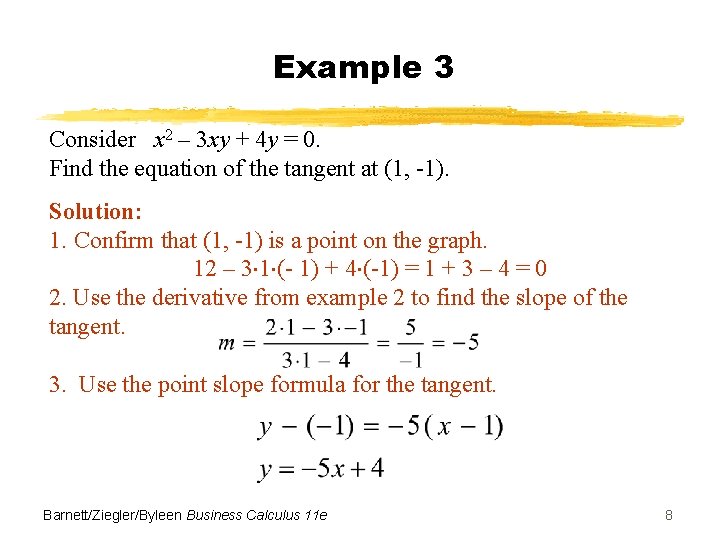
Example 3 Consider x 2 – 3 xy + 4 y = 0. Find the equation of the tangent at (1, -1). Solution: 1. Confirm that (1, -1) is a point on the graph. 12 – 3 1 (- 1) + 4 (-1) = 1 + 3 – 4 = 0 2. Use the derivative from example 2 to find the slope of the tangent. 3. Use the point slope formula for the tangent. Barnett/Ziegler/Byleen Business Calculus 11 e 8
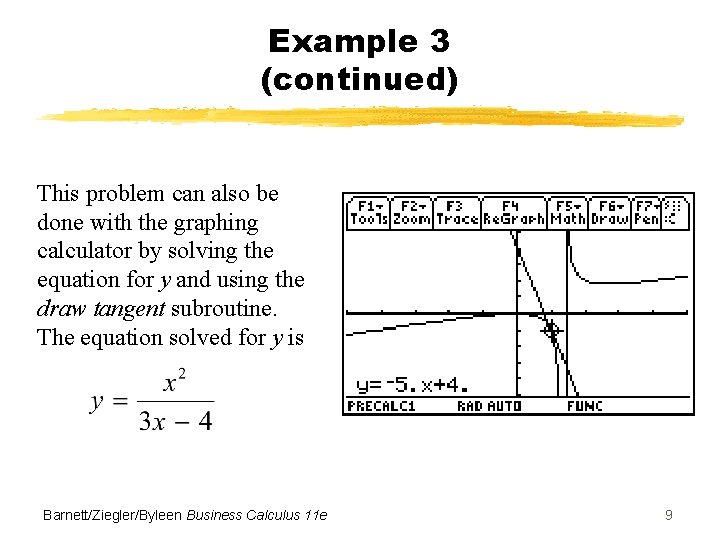
Example 3 (continued) This problem can also be done with the graphing calculator by solving the equation for y and using the draw tangent subroutine. The equation solved for y is Barnett/Ziegler/Byleen Business Calculus 11 e 9
Example 4 Consider xex + ln y – 3 y = 0 and differentiate implicitly. Barnett/Ziegler/Byleen Business Calculus 11 e 10
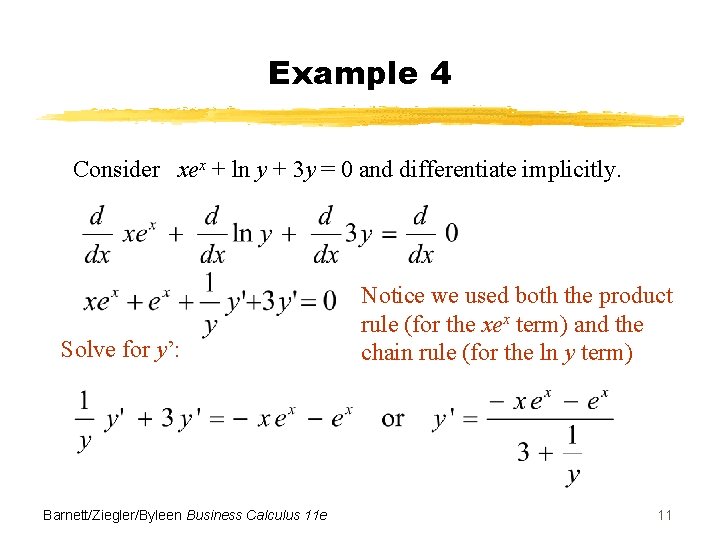
Example 4 Consider xex + ln y + 3 y = 0 and differentiate implicitly. Solve for y’: Barnett/Ziegler/Byleen Business Calculus 11 e Notice we used both the product rule (for the xex term) and the chain rule (for the ln y term) 11
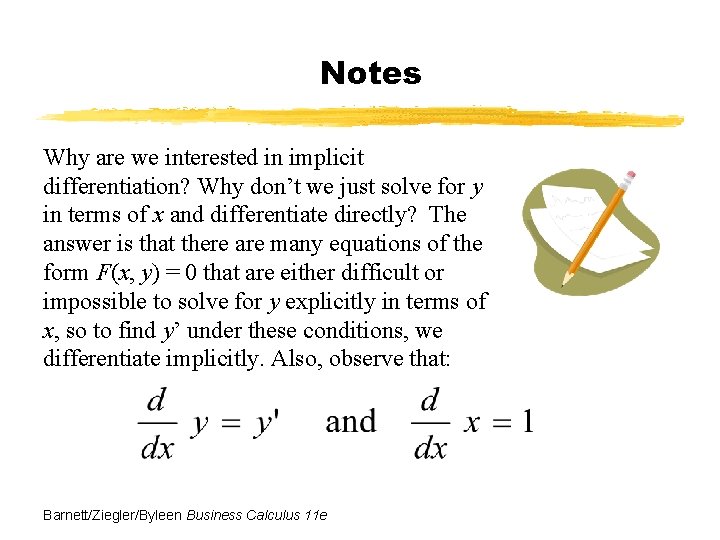
Notes Why are we interested in implicit differentiation? Why don’t we just solve for y in terms of x and differentiate directly? The answer is that there are many equations of the form F(x, y) = 0 that are either difficult or impossible to solve for y explicitly in terms of x, so to find y’ under these conditions, we differentiate implicitly. Also, observe that: Barnett/Ziegler/Byleen Business Calculus 11 e
- Slides: 12