
Learning Objectives Develop a basic understanding of risk



Learning Objectives • Develop a basic understanding of risk assessment and its role within the risk management process. • Differentiate between risk assessment and risk management. • Develop a basic understanding of how to conduct and evaluate an uncertainty analysis for a risk assessment.
Risk Assessment • Ecological Risk Assessment (ERA). • Human Health Risk Assessment.
Ecological Risk Assessment • Ecotoxicology – The study of the ways in which polluting agents disturb biological populations and communities. • Ecological risk assessment. – Ecological field surveys in terrestrial and aquatic environments. – Fate and transport modeling. – Toxicity testing. – Bioaccumulation studies. – Risk characterization. • Population, community and ecosystem levels.
Fundamentals of HHRA • Human health risk assessment: predictive modeling of the threat to human health posed by the exposure to environmental constituents. • For constituents that are systemic toxicants, the threat is expressed in terms of a hazard quotient. • Hazard Quotient = Dose ÷ Toxicity Factor. – A hazard quotient 1. 0 is typically regarded as acceptable
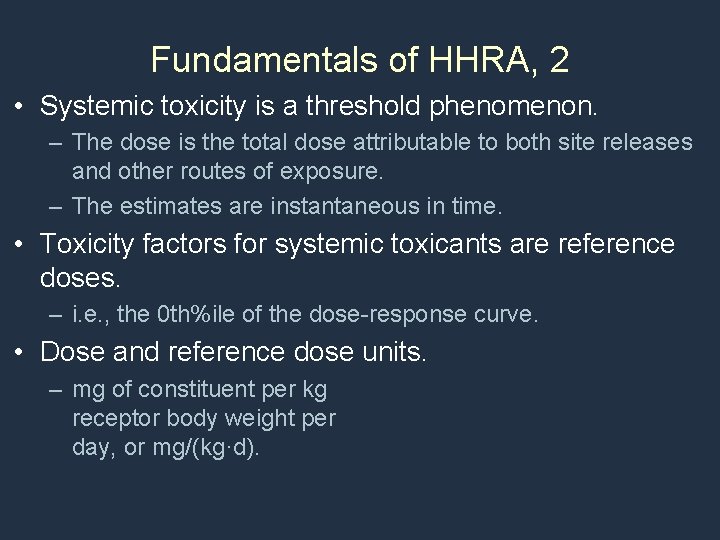
Fundamentals of HHRA, 2 • Systemic toxicity is a threshold phenomenon. – The dose is the total dose attributable to both site releases and other routes of exposure. – The estimates are instantaneous in time. • Toxicity factors for systemic toxicants are reference doses. – i. e. , the 0 th%ile of the dose-response curve. • Dose and reference dose units. – mg of constituent per kg receptor body weight per day, or mg/(kg·d).
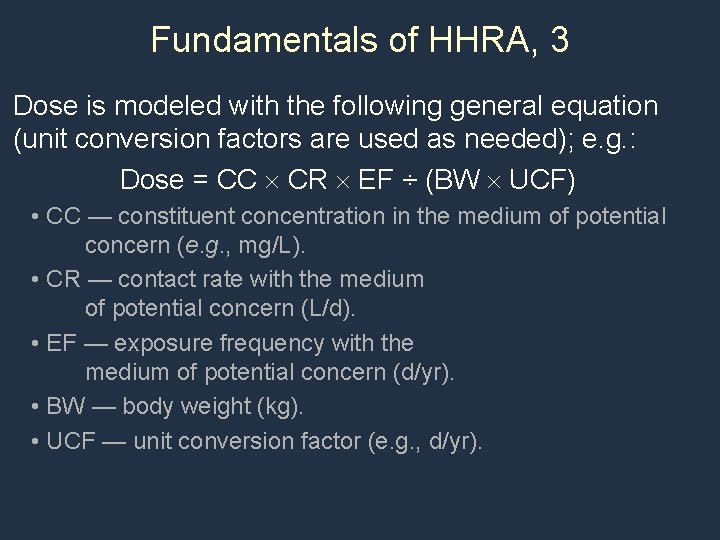
Fundamentals of HHRA, 3 Dose is modeled with the following general equation (unit conversion factors are used as needed); e. g. : Dose = CC CR EF ÷ (BW UCF) • CC — constituent concentration in the medium of potential concern (e. g. , mg/L). • CR — contact rate with the medium of potential concern (L/d). • EF — exposure frequency with the medium of potential concern (d/yr). • BW — body weight (kg). • UCF — unit conversion factor (e. g. , d/yr).
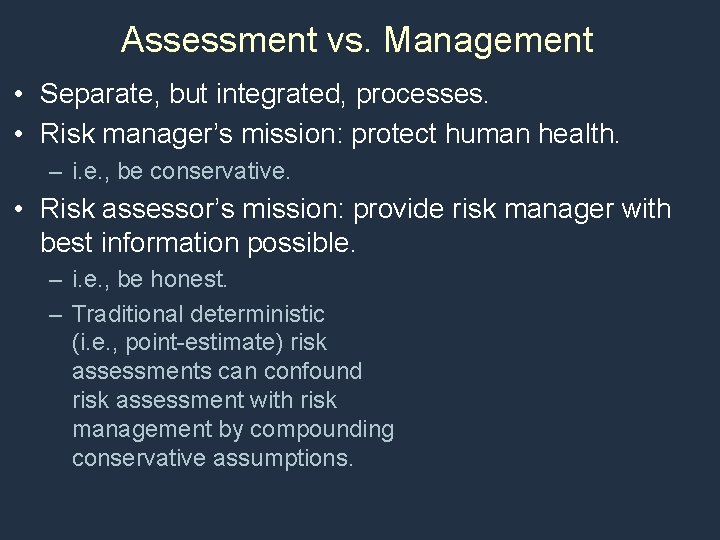
Assessment vs. Management • Separate, but integrated, processes. • Risk manager’s mission: protect human health. – i. e. , be conservative. • Risk assessor’s mission: provide risk manager with best information possible. – i. e. , be honest. – Traditional deterministic (i. e. , point-estimate) risk assessments can confound risk assessment with risk management by compounding conservative assumptions.
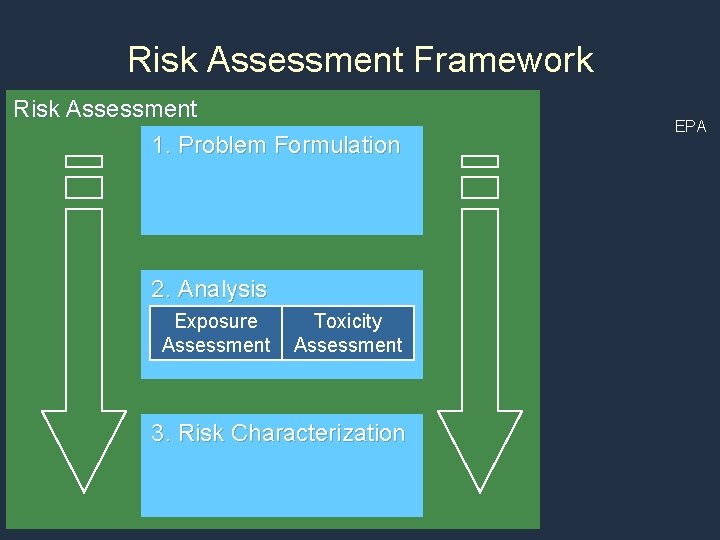
Risk Assessment Framework Risk Assessment 1. Problem Formulation 2. Analysis Exposure Assessment Toxicity Assessment 3. Risk Characterization EPA

Problem Formulation Constituent Screening Receptor Screening Conceptual Model Analysis EPA Exposure Screening
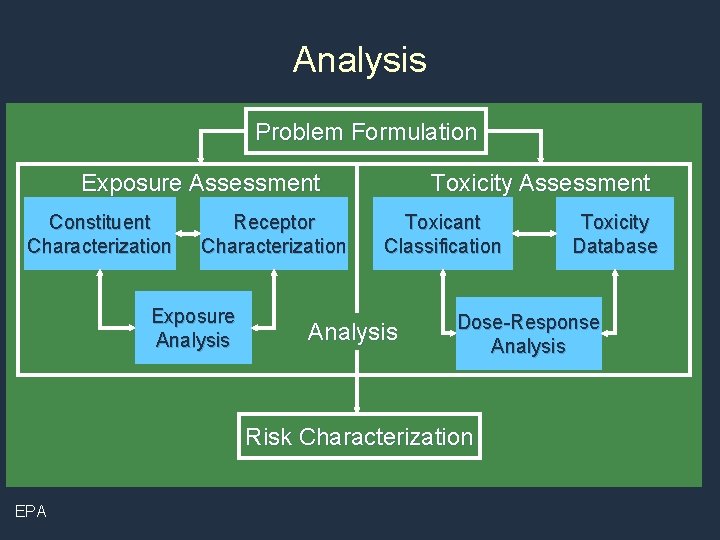
Analysis Problem Formulation Exposure Assessment Constituent Characterization Receptor Characterization Exposure Analysis Toxicity Assessment Toxicant Classification Analysis Dose-Response Analysis Risk Characterization EPA Toxicity Database
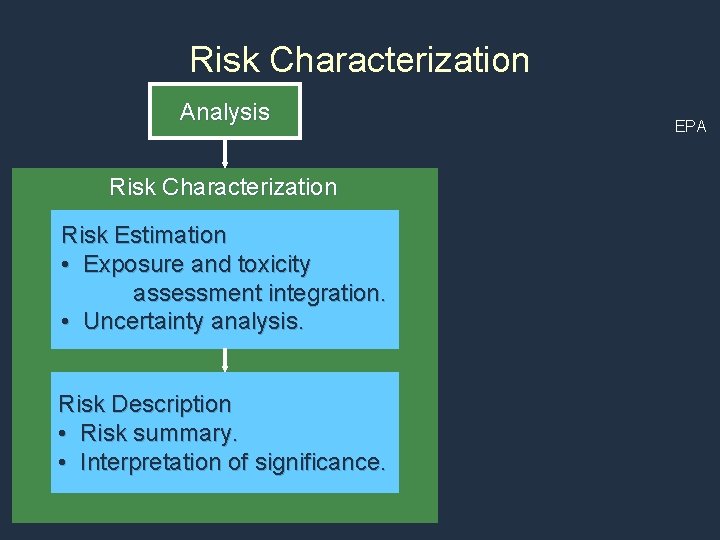
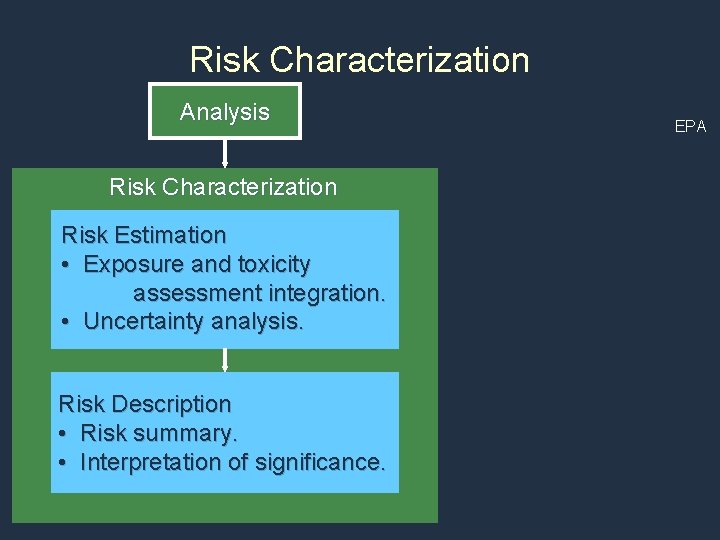
Risk Characterization Analysis Risk Characterization Risk Estimation • Exposure and toxicity assessment integration. • Uncertainty analysis. Risk Description • Risk summary. • Interpretation of significance. EPA

RA Framework Summary • Risk assessment: predictive modeling of potential human health threats. • Risk assessment vs. risk management: distinct, but integrated processes. • Risk assessment framework. – Problem formulation. – Analysis. – Risk characterization. • An iterative process.
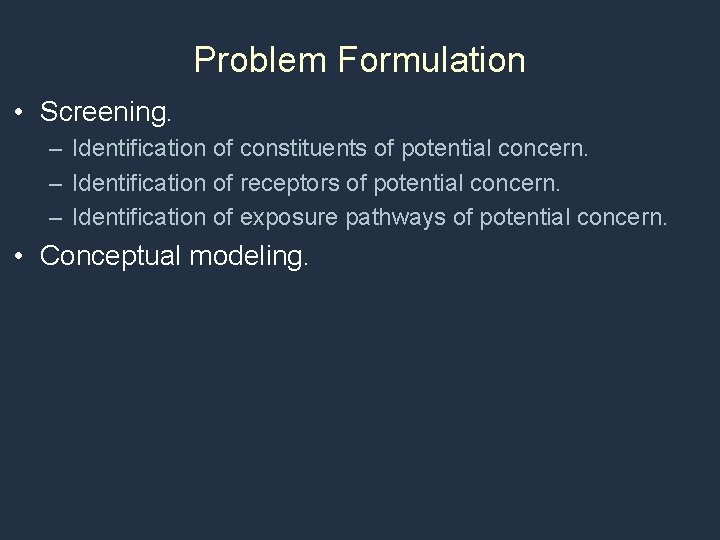
Problem Formulation • Screening. – Identification of constituents of potential concern. – Identification of receptors of potential concern. – Identification of exposure pathways of potential concern. • Conceptual modeling.
![Constituent Screening • Determine if [X] is a constituent of potential concern. – [X]](http://slidetodoc.com/presentation_image_h/7567023b49fcdcab2b73263526e4374a/image-18.jpg "Constituent Screening • Determine if [X] is a constituent of potential concern. – [X]")
Constituent Screening • Determine if [X] is a constituent of potential concern. – [X] Applicable regulatory criterion? – [X] Site-specific background distribution? – [X] Conservative site specific objective?
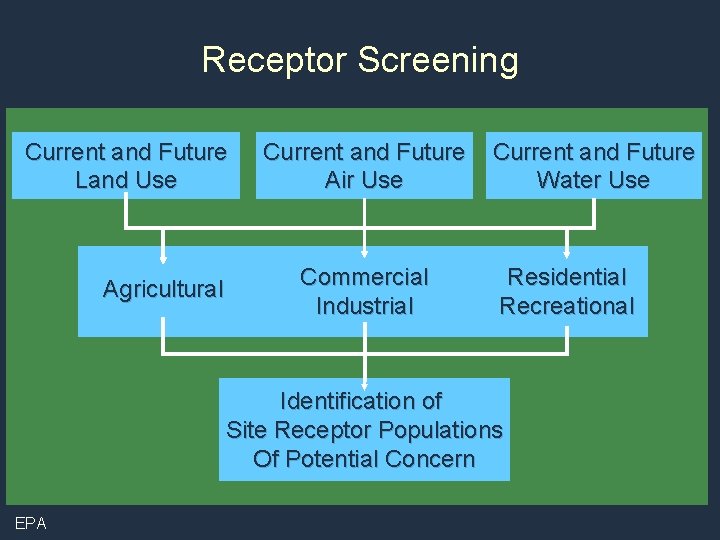
Receptor Screening Current and Future Land Use Agricultural Current and Future Air Use Commercial Industrial Current and Future Water Use Residential Recreational Identification of Site Receptor Populations Of Potential Concern EPA
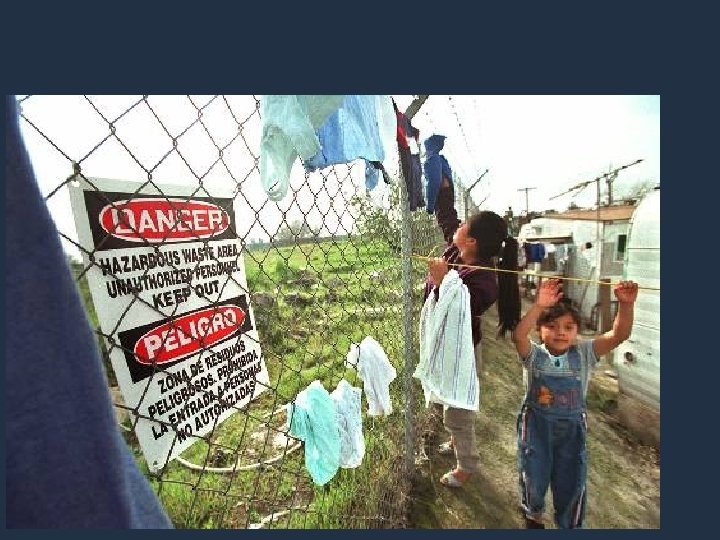
Exposure Pathway Screening • Volatilization? • Dust, Particulates? – Settling to water, populations? • Release to surface water, sediments? – Drinking water, aquatic wildlife, groundwater, irrigation. • Release to soils? – Groundwater, wells, agriculture, food chain biota.
Conceptual Modeling • Summarizes and documents results of constituent, receptor, and exposure pathway screening. • Forms the basis for subsequent quantitative modeling. • Effective tool for communication and management.
Problem Formulation Summary • Primarily a screening exercise. • An exercise in conceptual model development assisted by rapid and simple quantitative modeling. • Used to focus subsequent, intensive efforts, if any, on those variables and sub-processes which are likely to contribute most to the risk estimate.
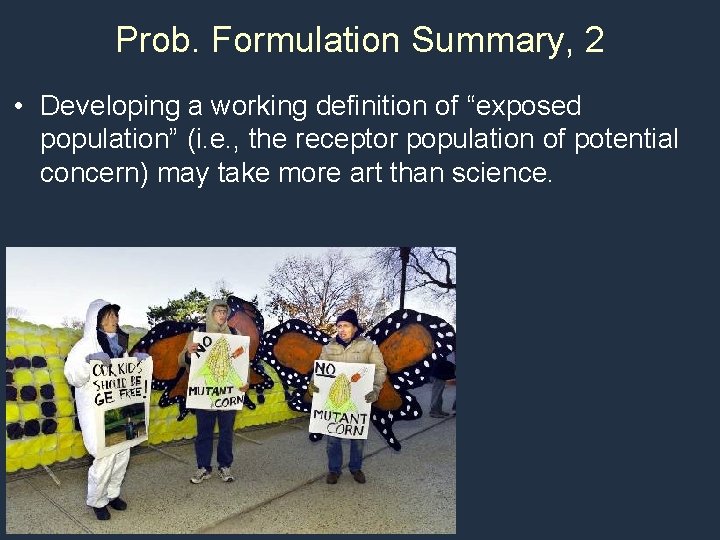
Prob. Formulation Summary, 2 • Developing a working definition of “exposed population” (i. e. , the receptor population of potential concern) may take more art than science.
Prob. Formulation Summary, 3 • Quantitative aspects of screening constituents, pathways, and receptors are generally carried out deterministically. • Future site use assumptions are important. • Excellent process for project planning, not just as the first phase of a risk assessment carried out at the end of a site investigation. • Really an ongoing process.
Analysis • Exposure assessment. – Constituent characterization. – Receptor characterization. – Exposure analysis. • Toxicity assessment. – Toxicant classification. – Toxicity databases. – Dose-response analysis.
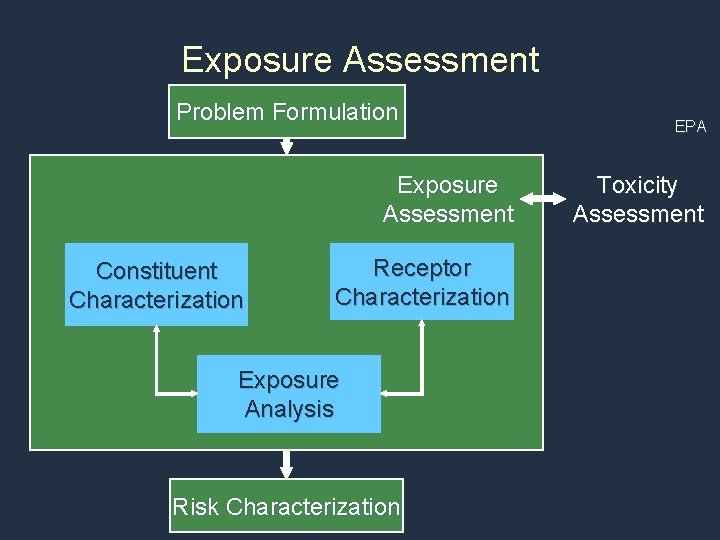
Exposure Assessment Problem Formulation Exposure Assessment Constituent Characterization Receptor Characterization Exposure Analysis Risk Characterization EPA Toxicity Assessment
Exposure Assessment, 2 • Best opportunity to introduce site specificity. • Usually the most intensive aspect of quantitative risk modeling. • Substantial amount of information available, and much of it is readily available. • Need to consider bioavailability adjustment. • For carcinogens, need to focus on incremental cancer risk.
Exposure Assessment, 3 • For systemic toxins, need to consider dietary intake. – Qualitative consideration may suffice. • Need to consider correlations. • Need to consider spatial and temporal variability. • Need to include likelihood of scenario occurrence in exposure quantifications.
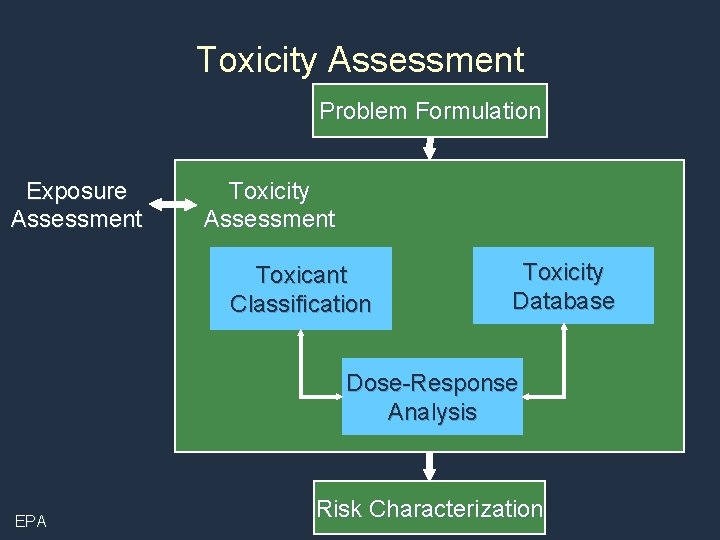
Toxicity Assessment Problem Formulation Exposure Assessment Toxicity Assessment Toxicant Classification Toxicity Database Dose-Response Analysis EPA Risk Characterization
Toxicity Assessment, 2 • Usually the most over-rated aspect of risk modeling, but often the most uncertain component. • Good databases available. • Most toxicity factors have enormous amount of lack of knowledge that is hard to reduce. – Expense of toxicological studies. – Inherent ignorance in extrapolating from animals to humans. • Bioavailability adjustments.
Risk Characterization • Risk estimation. – Exposure and toxicity assessment integration. – Uncertainty analysis. • Risk description. – Risk summary. – Risk interpretation.
Risk Characterization Analysis Risk Characterization Risk Estimation • Exposure and toxicity assessment integration. • Uncertainty analysis. Risk Description • Risk summary. • Interpretation of significance. EPA
Risk Description • Summarization – Give a picture of the risk estimate. – Focus on the 95 th percentile estimate. – Acknowledge the uncertainty. • Interpretation – Put the estimated risk into a regulatory perspective. – Put the estimated risk into a real-world perspective.
Risk Characterization Summary • Explain uncertainty of risk estimate. – Descriptive statistics, sensitivity to independent variables, and contributions of major model components; conduct value-of-information analysis and provide recommendations, if any, for further work. • Focus on the 95 th percentile of the risk estimate. • Put the risk into regulatory and real-world contexts.
Assessment vs. Management • Integrated, but separate, processes. • Different missions. – Risk manager—be protective. – Risk assessor—be unbiased. • Precaution required so as to not confuse the two missions and processes.
Overview of Statistics • Statistical descriptors. • Spatial and temporal analyses.
Measures of Central Tendency • Mean, m • Median, p 0. 50 • Mode, m
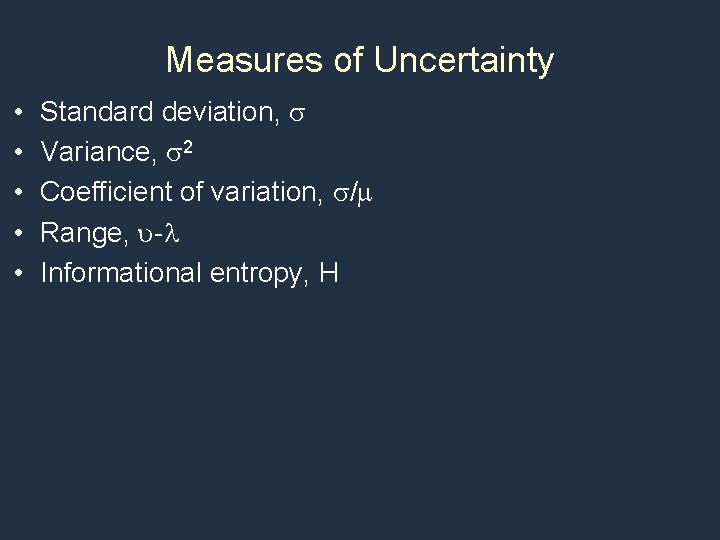
Measures of Uncertainty • • • Standard deviation, s Variance, s 2 Coefficient of variation, s/m Range, u-l Informational entropy, H
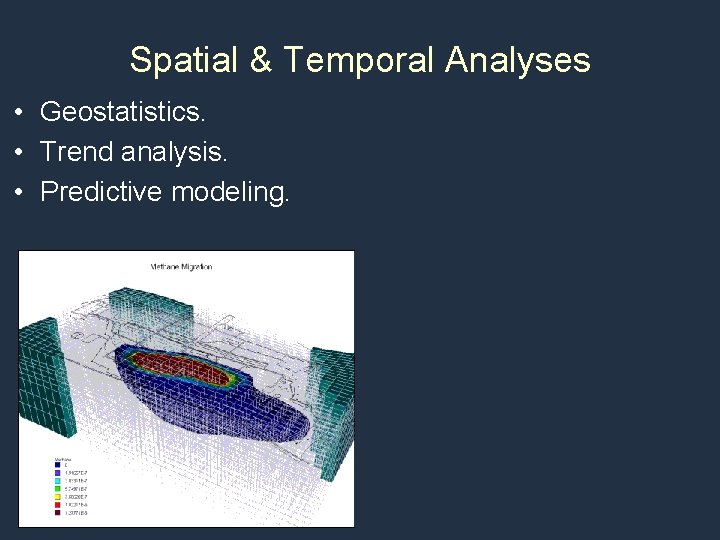
Spatial & Temporal Analyses • Geostatistics. • Trend analysis. • Predictive modeling.
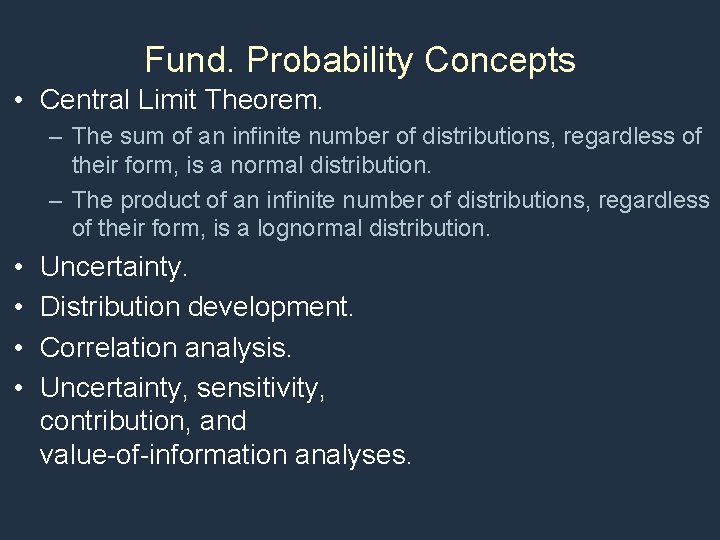
Fund. Probability Concepts • Central Limit Theorem. – The sum of an infinite number of distributions, regardless of their form, is a normal distribution. – The product of an infinite number of distributions, regardless of their form, is a lognormal distribution. • • Uncertainty. Distribution development. Correlation analysis. Uncertainty, sensitivity, contribution, and value-of-information analyses.
- Slides: 45