
Learning Objectives Chemical Kinetics To represent and analyze
Learning Objectives Chemical Kinetics To represent and analyze rates of reaction graphically and mathematically To determine rate and order of reaction by calculation and experimentally, and relate these variables to reaction mechanism 1. 2. 3. 4. Key Words – Reactants Products Rate Law Reaction Order What to remember? • Difference between average rate and instantaneous rate • Empirical determination of rate laws
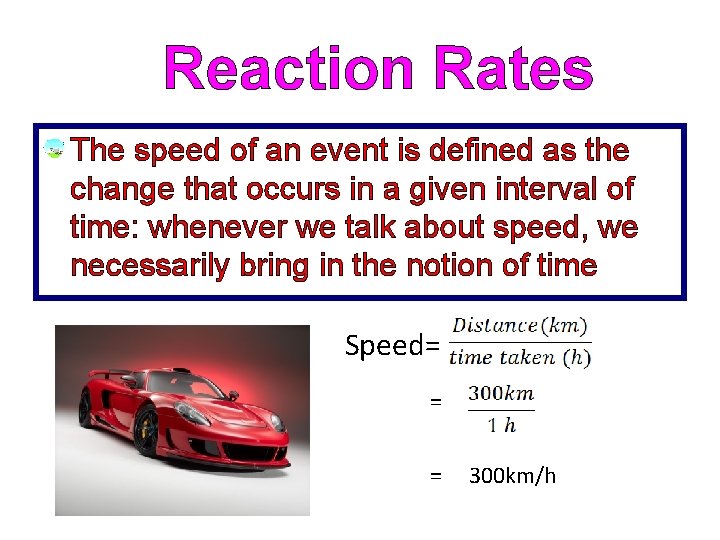
Reaction Rates The speed of an event is defined as the change that occurs in a given interval of time: whenever we talk about speed, we necessarily bring in the notion of time Speed= = = 300 km/h
Reaction Rates • Similarly, we can speak about the speed of a chemical reaction, or its reaction rate • The rate of a chemical reaction is the rate of change in the concentration per unit time. • It is expressed as the number of moles per liter that react each second, and the units, in abbreviated form, are mol L— 1 s— 1 • Reaction rates are determined by measuring the concentration of one or more of the chemicals involved in the reaction at different times during the course of the reaction
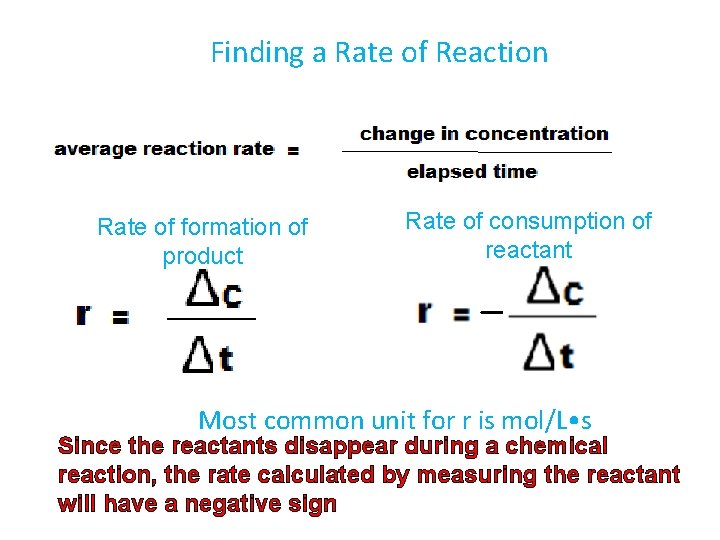
Finding a Rate of Reaction Rate of formation of product Rate of consumption of reactant Most common unit for r is mol/L • s Since the reactants disappear during a chemical reaction, the rate calculated by measuring the reactant will have a negative sign
![A B time rate = - rate = D[A] Dt D[B] Dt 13. 1](http://slidetodoc.com/presentation_image_h2/84729fbc0aedd53d7910ce810ae95658/image-5.jpg "A B time rate = - rate = D[A] Dt D[B] Dt 13. 1")
A B time rate = - rate = D[A] Dt D[B] Dt 13. 1
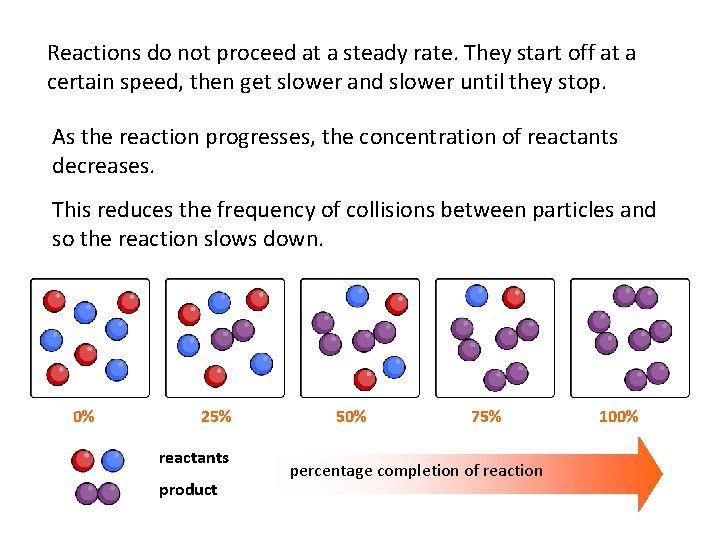
Reactions do not proceed at a steady rate. They start off at a certain speed, then get slower and slower until they stop. As the reaction progresses, the concentration of reactants decreases. This reduces the frequency of collisions between particles and so the reaction slows down. 0% 25% reactants product 50% 75% percentage completion of reaction 100%
The Five Factors Affecting Rate • There are five things that we can change to make the reaction go faster. They are: • Temperature • Surface area • Concentration • Presence of a Catalyst • Chemical nature of reactants
Temperature • When we increase the temperature we give the particles energy • This makes them move faster • This means they collide with other particles more often • So the reaction goes faster.
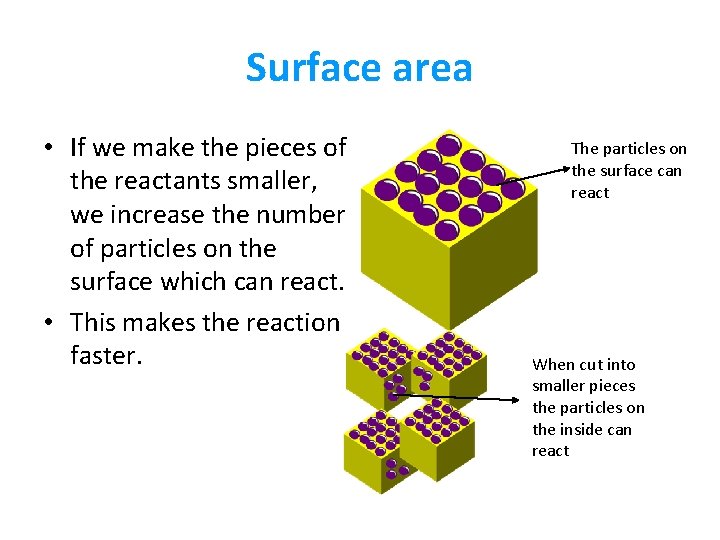
Surface area • If we make the pieces of the reactants smaller, we increase the number of particles on the surface which can react. • This makes the reaction faster. The particles on the surface can react When cut into smaller pieces the particles on the inside can react
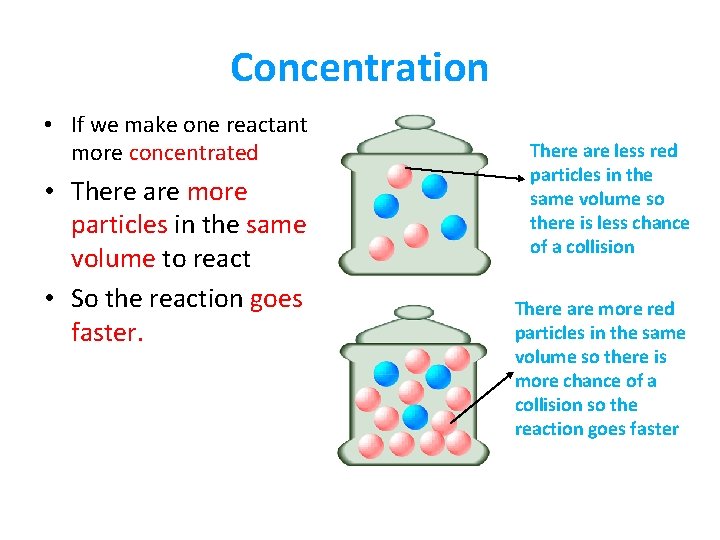
Concentration • If we make one reactant more concentrated • There are more particles in the same volume to react • So the reaction goes faster. There are less red particles in the same volume so there is less chance of a collision There are more red particles in the same volume so there is more chance of a collision so the reaction goes faster
Using a catalyst • A catalyst is a chemical which is added to a reaction. • It makes the reaction go faster. • The catalyst does not get used up in the reaction. • It gives the reaction the energy to get started
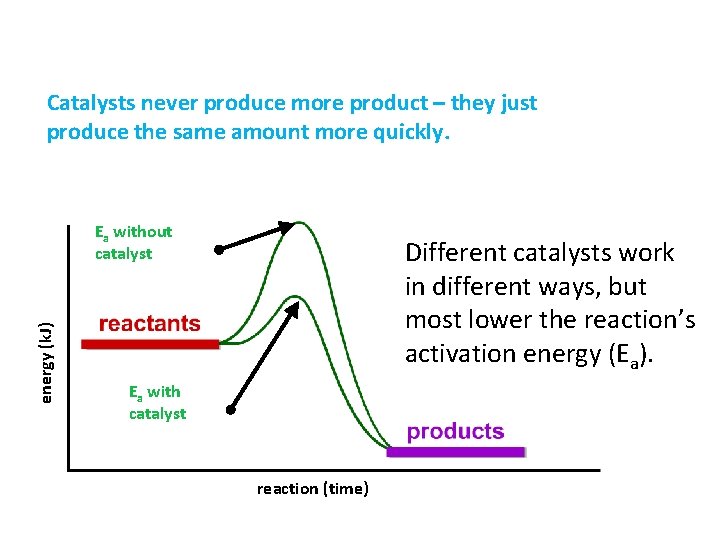
Catalysts never produce more product – they just produce the same amount more quickly. energy (k. J) Ea without catalyst Different catalysts work in different ways, but most lower the reaction’s activation energy (Ea). Ea with catalyst reaction (time)
Chemical Nature of reactants • different chemicals will react with the same reactant similarly but at different rates. • activity series of metals, some metals are more reactive than others • reaction of monatomic ions (Ag+, F-) are extremely fast, while molecular substances (C 6 H 12 O 6) are often slower
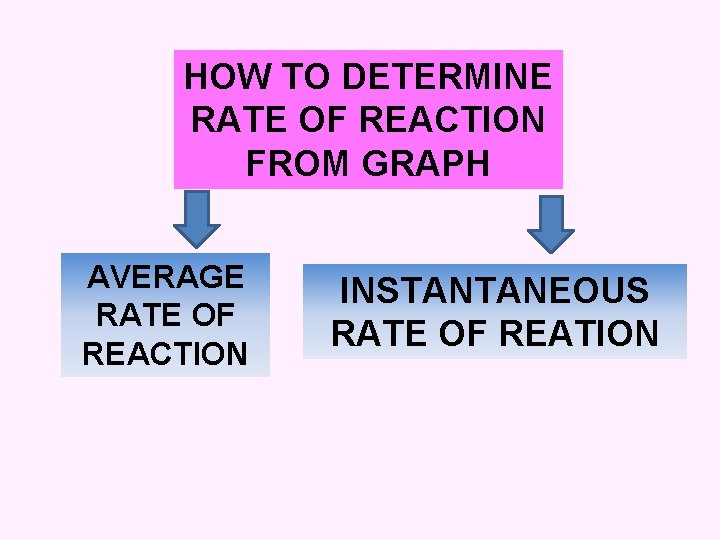
HOW TO DETERMINE RATE OF REACTION FROM GRAPH AVERAGE RATE OF REACTION INSTANTANEOUS RATE OF REATION
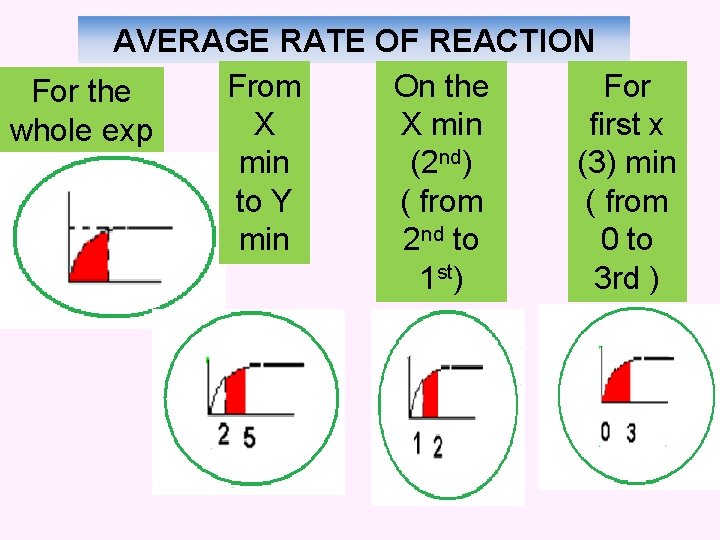
AVERAGE RATE OF REACTION From On the For the X X min first x whole exp min (2 nd) (3) min to Y ( from min 2 nd to 0 to 1 st) 3 rd )
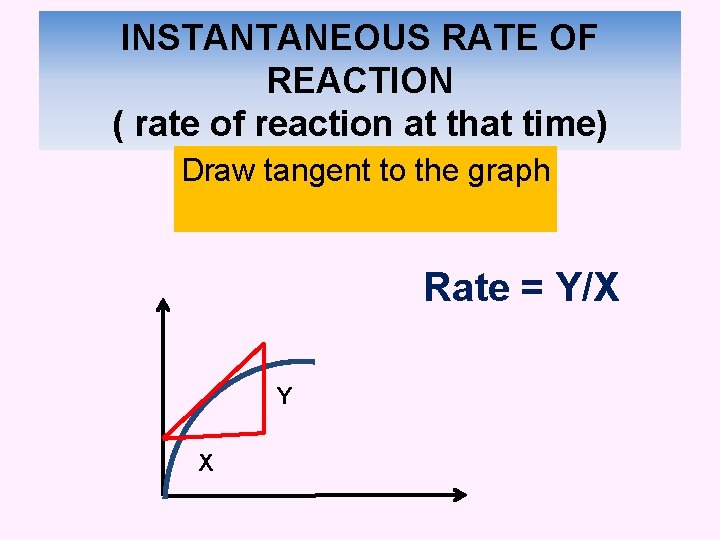
INSTANTANEOUS RATE OF REACTION ( rate of reaction at that time) Draw tangent to the graph Rate = Y/X Y X
b) Example from the graph, determine: i) The rate of reaction at 120 s Instantaneous rate of reaction = Draw tangent to the graph
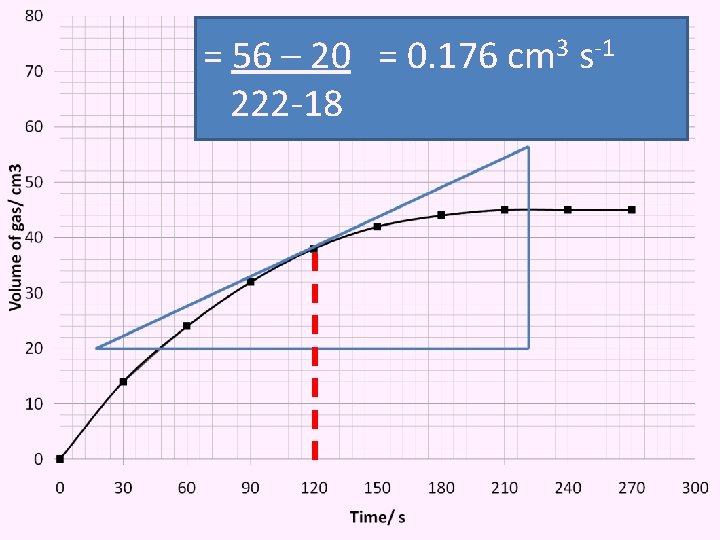
= 56 – 20 = 0. 176 cm 3 s-1 222 -18
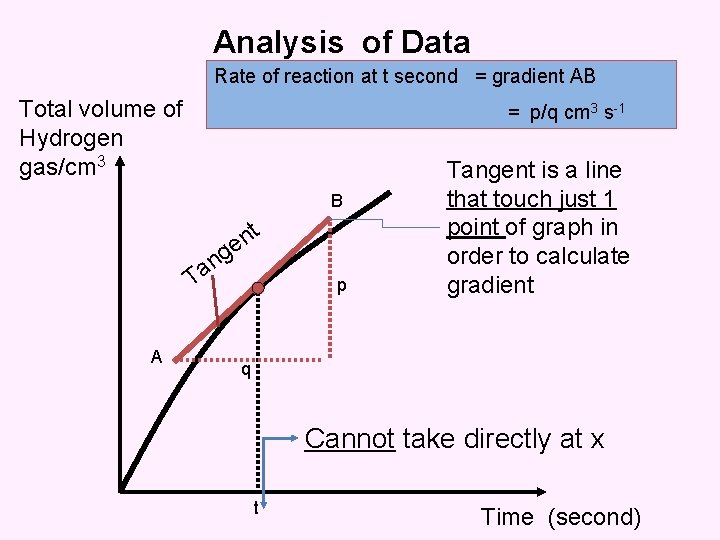
Analysis of Data Rate of reaction at t second = gradient AB Total volume of Hydrogen gas/cm 3 = p/q cm 3 s-1 B t n e T A g n a p Tangent is a line that touch just 1 point of graph in order to calculate gradient q Cannot take directly at x t Time (second)
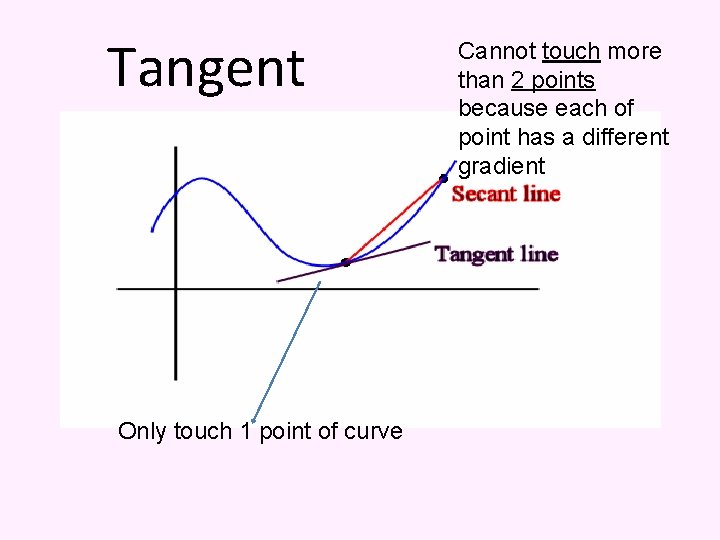
Tangent Only touch 1 point of curve Cannot touch more than 2 points because each of point has a different gradient
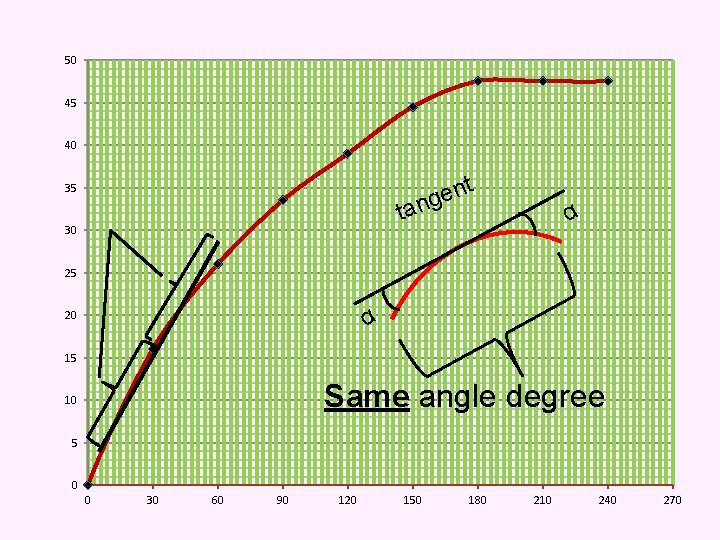
50 45 40 35 ta 30 t n e ng α 25 S 20 α 15 Same angle degree 10 5 0 0 30 60 90 120 150 180 210 240 270
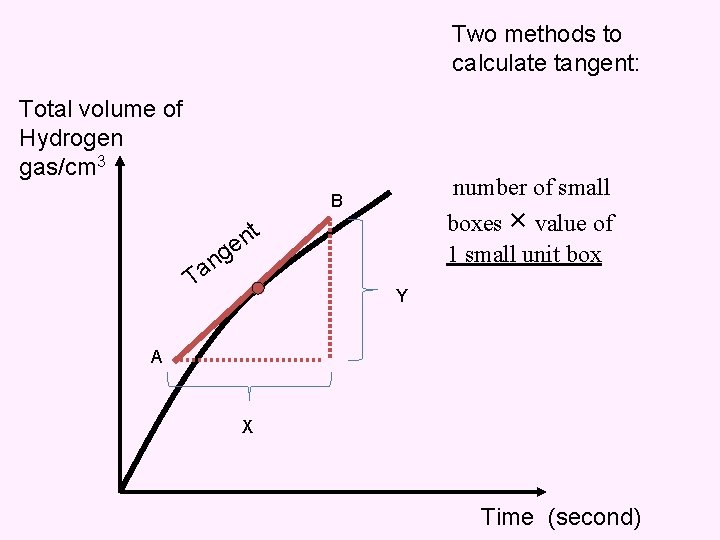
Two methods to calculate tangent: Total volume of Hydrogen gas/cm 3 number of small B boxes × value of 1 small unit box nt e g n Ta Y A X Time (second)
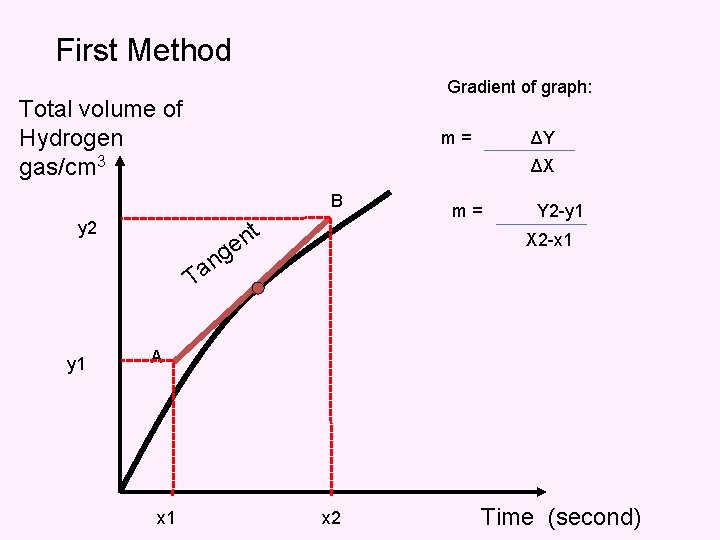
First Method Gradient of graph: Total volume of Hydrogen gas/cm 3 m= ΔX B t n e y 2 T y 1 ΔY m= Y 2 -y 1 X 2 -x 1 g n a A x 1 x 2 Time (second)
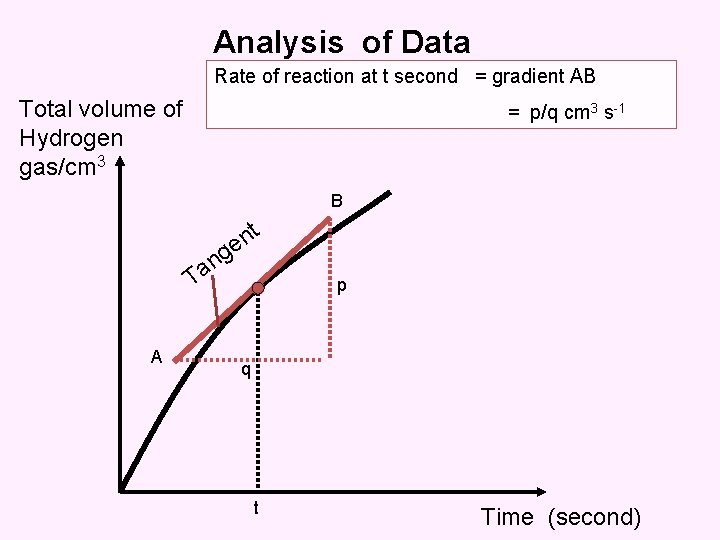
Analysis of Data Rate of reaction at t second = gradient AB Total volume of Hydrogen gas/cm 3 = p/q cm 3 s-1 B t n e T A g n a p q t Time (second)
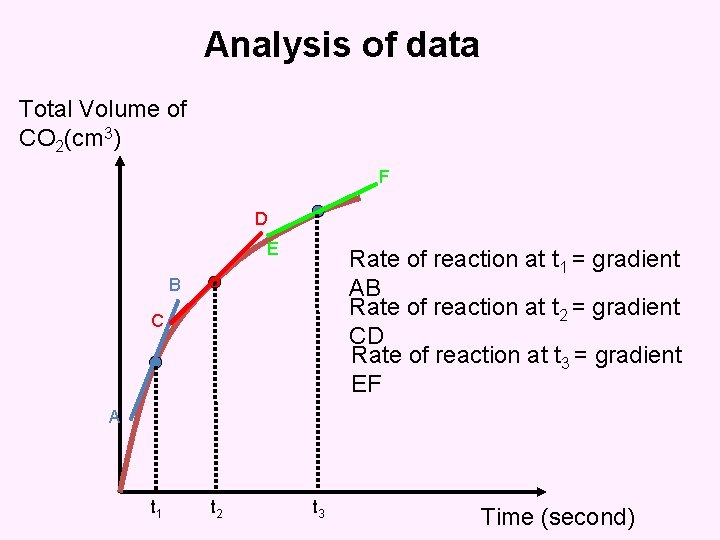
Analysis of data Total Volume of CO 2(cm 3) F D E Rate of reaction at t 1 = gradient AB Rate of reaction at t 2 = gradient CD Rate of reaction at t 3 = gradient EF B C A t 1 t 2 t 3 Time (second)
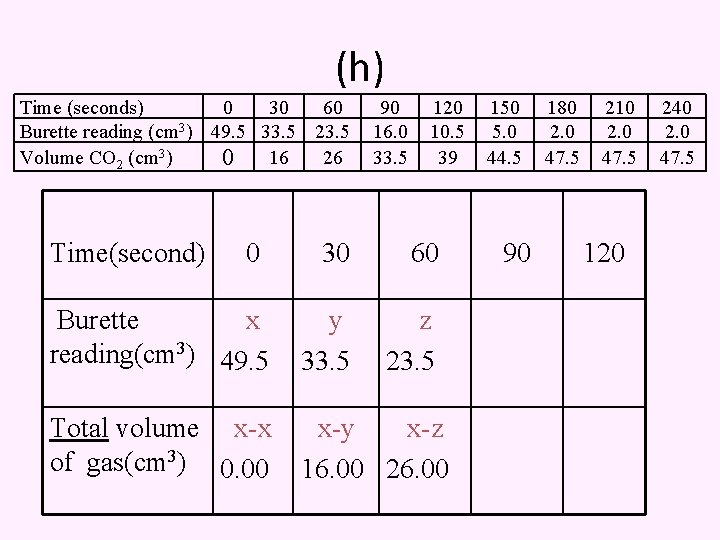
(h) Time (seconds) 0 30 60 Burette reading (cm 3) 49. 5 33. 5 23. 5 Volume CO 2 (cm 3) 0 16 26 Time(second) 0 90 16. 0 33. 5 120 10. 5 39 30 60 Burette x reading(cm 3) 49. 5 y 33. 5 z 23. 5 Total volume x-x of gas(cm 3) 0. 00 x-y x-z 16. 00 26. 00 150 5. 0 44. 5 90 180 2. 0 47. 5 210 2. 0 47. 5 120 240 2. 0 47. 5
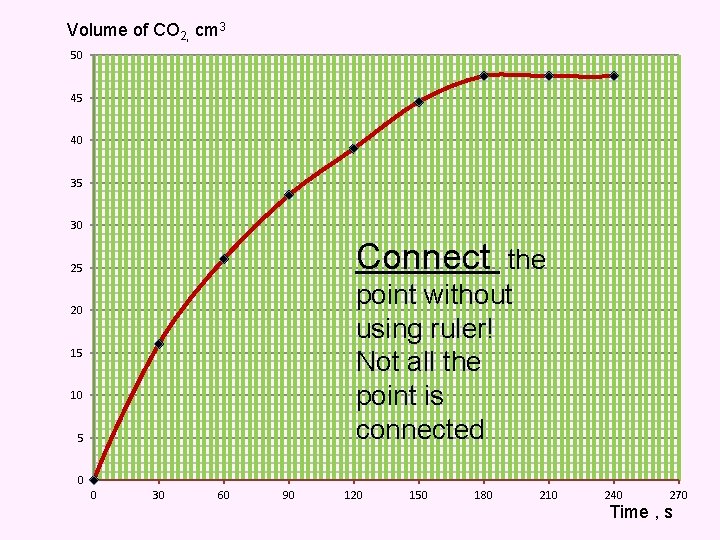
Volume of CO 2, cm 3 50 45 40 35 30 Connect the point without using ruler! Not all the point is connected 25 20 15 10 5 0 0 30 60 90 120 150 180 210 240 270 Time , s
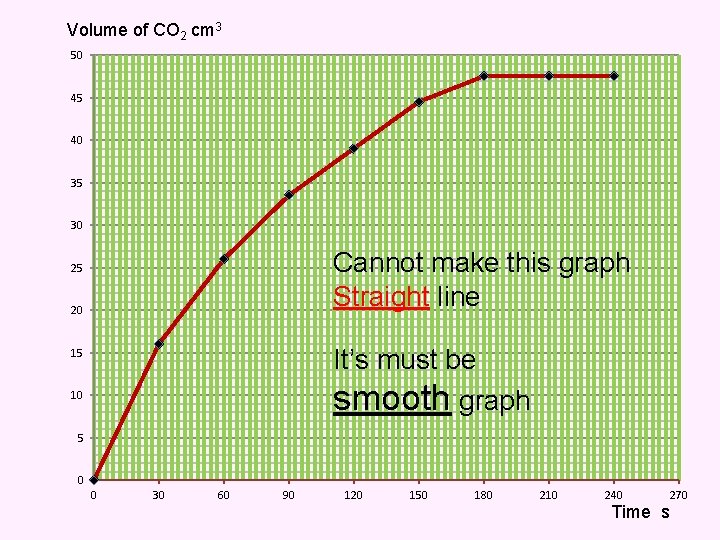
Volume of CO 2 cm 3 50 45 40 35 30 Cannot make this graph Straight line 25 20 It’s must be smooth graph 15 10 5 0 0 30 60 90 120 150 180 210 240 270 Time s
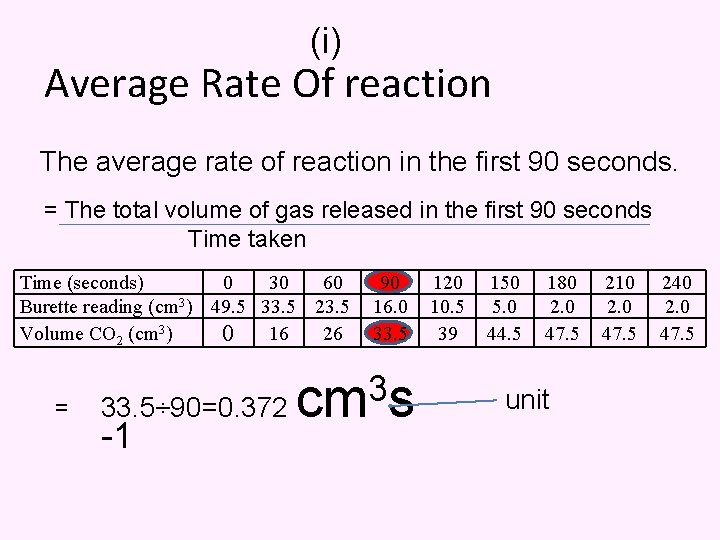
(i) Average Rate Of reaction The average rate of reaction in the first 90 seconds. = The total volume of gas released in the first 90 seconds Time taken Time (seconds) 0 30 60 Burette reading (cm 3) 49. 5 33. 5 23. 5 Volume CO 2 (cm 3) 0 16 26 = 90 16. 0 33. 5 3 33. 5÷ 90=0. 372 cm s -1 120 10. 5 39 150 5. 0 44. 5 180 2. 0 47. 5 unit 210 2. 0 47. 5 240 2. 0 47. 5
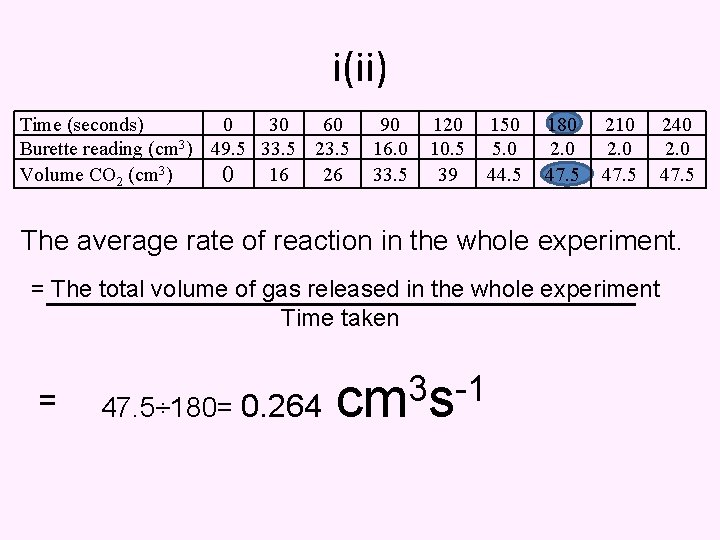
i(ii) Time (seconds) 0 30 60 Burette reading (cm 3) 49. 5 33. 5 23. 5 Volume CO 2 (cm 3) 0 16 26 90 16. 0 33. 5 120 10. 5 39 150 5. 0 44. 5 180 2. 0 47. 5 210 2. 0 47. 5 240 2. 0 47. 5 The average rate of reaction in the whole experiment. = The total volume of gas released in the whole experiment Time taken = 3 -1 47. 5÷ 180= 0. 264 cm s
THE RATE EQUATION • RATE ~ CONCENTRATION • PROPORTIONALITIES CAN BE MADE INTO EQUALITIES BY USING A CONSTANT • FOR EXAMPLE: FEET CAN ALWAYS BE CONVERTED TO INCHES BY USING THE NUMBER 12. (INCHES = FEET x 12) • RATE = A CONSTANT x CONCENTRATION • HOWEVER, ALL EQUATIONS ARE NOT LINEAR (FIRST POWER), SOME ARE SQUARES OR CUBES OR ETC.
• THEREFORE OUR EQUATION MAY BE WRITTEN AS: RATE = CONSTANT x CONCENTRATIN RAISED TO SOME POWER OR RATE = k x [A]n • k = A CONSTANT CALLED THE SPECIFIC RATE CONSTANT (IT IS CONSTANT FOR A SPECIFIC REACTION AT A SPECIFIC TEMPERATURE) • [A] = THE CONCENTRATION OF REACTANT A IN MOLES PER LITER (BRACKETS MEAN IN MOLES PER LITER) • n = THE POWER TO WHICH CONCENTRATION MUST BE RAISED (ALSO CALLED REACTION ORDER)
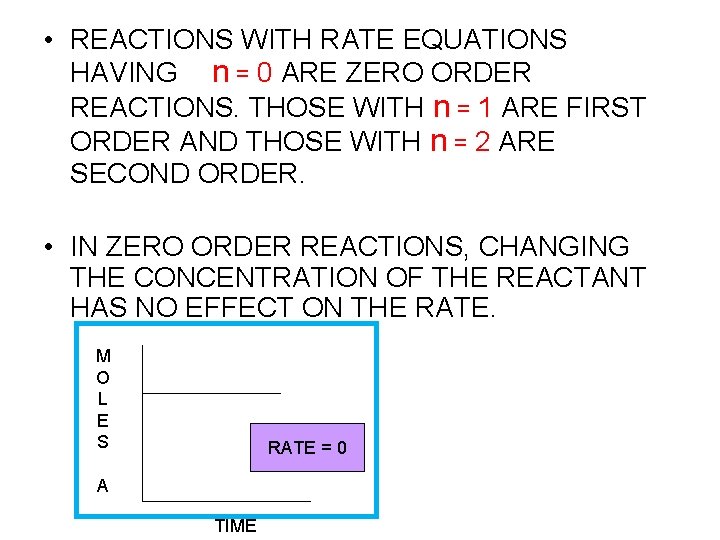
• REACTIONS WITH RATE EQUATIONS HAVING n = 0 ARE ZERO ORDER REACTIONS. THOSE WITH n = 1 ARE FIRST ORDER AND THOSE WITH n = 2 ARE SECOND ORDER. • IN ZERO ORDER REACTIONS, CHANGING THE CONCENTRATION OF THE REACTANT HAS NO EFFECT ON THE RATE. M O L E S RXN RATE? =0 A TIME
Using Initial Rates to Determine Rate Laws • The rate law for any chemical reaction must be determined experimentally • We observe the effect of changing the initial concentration of the reactants on the initial rate of the reaction • If the reaction is zero order in a particular reactant, changing its concentration will have no influence on rate
• If the reaction is first order in a reactant, changes in the concentration of that substance will double the rate and so forth When the rate law is second order in a particular reactant, doubling its concentration increases the rate by a factor of 22 = 4, tripling its concentration causes the rate to increase by a factor 32 = 9, and so forth
It is important to note that whereas the rate of a reaction depends on concentration, the rate constant does not. The rate constant (and hence the reaction rate ) is affected by temperature and the presence of a catalyst
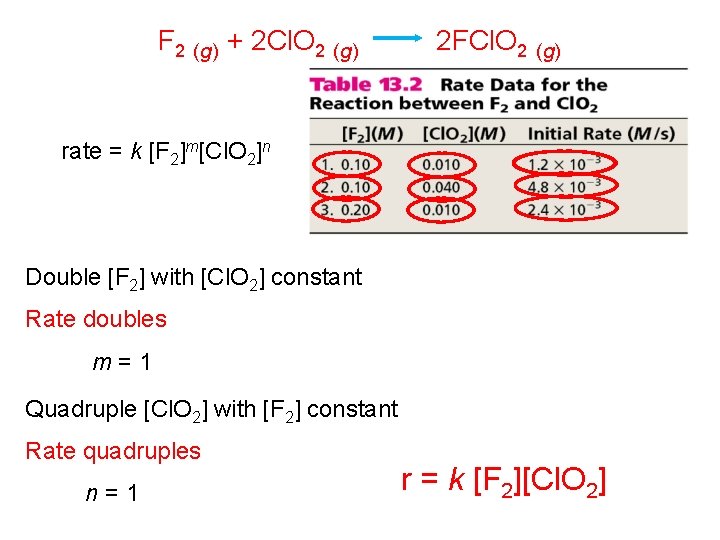
F 2 (g) + 2 Cl. O 2 (g) 2 FCl. O 2 (g) rate = k [F 2]m[Cl. O 2]n Double [F 2] with [Cl. O 2] constant Rate doubles m=1 Quadruple [Cl. O 2] with [F 2] constant Rate quadruples n=1 r = k [F 2][Cl. O 2]
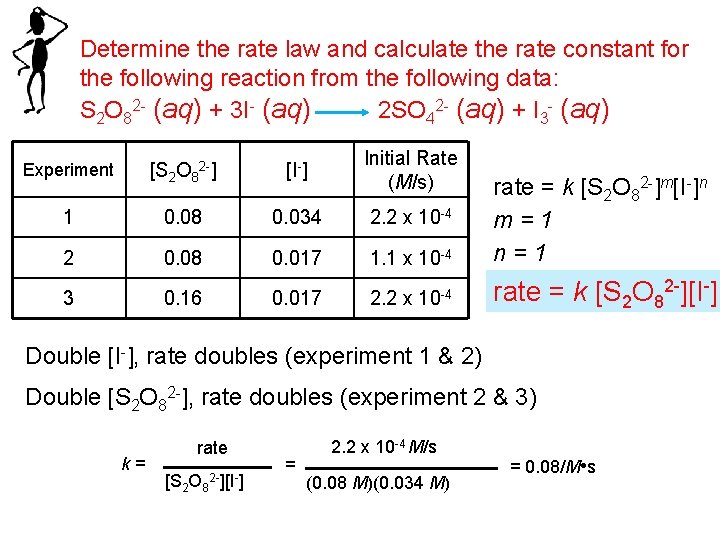
Determine the rate law and calculate the rate constant for the following reaction from the following data: S 2 O 82 - (aq) + 3 I- (aq) 2 SO 42 - (aq) + I 3 - (aq) Experiment [S 2 O 82 -] [I-] Initial Rate (M/s) 1 0. 08 0. 034 2. 2 x 10 -4 2 0. 08 0. 017 1. 1 x 10 -4 rate = k [S 2 O 82 -]m[I-]n m=1 n=1 3 0. 16 0. 017 2. 2 x 10 -4 rate = k [S 2 O 82 -][I-] Double [I-], rate doubles (experiment 1 & 2) Double [S 2 O 82 -], rate doubles (experiment 2 & 3) k= rate [S 2 O 8 2 -][I-] = 2. 2 x 10 -4 M/s (0. 08 M)(0. 034 M) = 0. 08/M • s
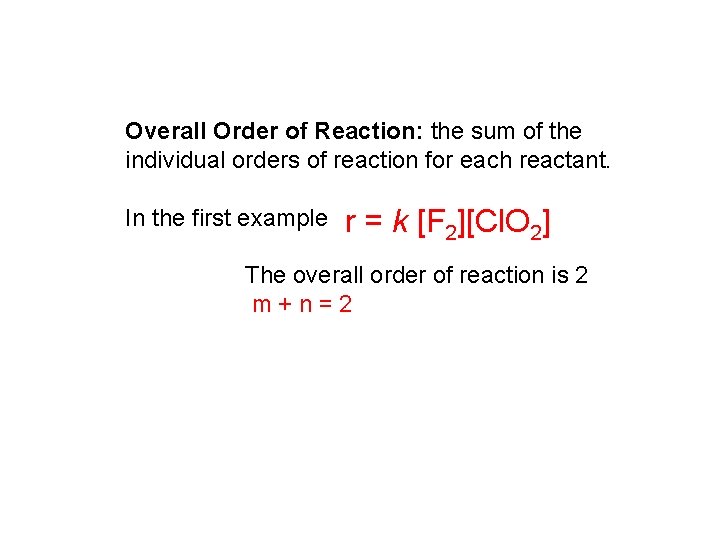
Overall Order of Reaction: the sum of the individual orders of reaction for each reactant. In the first example r = k [F 2][Cl. O 2] The overall order of reaction is 2 m+n=2
![Zero Order First Order Second Order Third Order Rate = k[A]2 Rate = K[A]3](http://slidetodoc.com/presentation_image_h2/84729fbc0aedd53d7910ce810ae95658/image-40.jpg "Zero Order First Order Second Order Third Order Rate = k[A]2 Rate = K[A]3")
Zero Order First Order Second Order Third Order Rate = k[A]2 Rate = K[A]3 K= units of rate/ Units of concentration K= units of rate/ (units concentration)2 K= units of rate/ (units concentration)3 =mol dm-3 s-1/mol dm-3 ==mol dm-3 s 1/(mol dm-3 )2 ==mol dm-3 s 1/(mol dm-3 )3 =mol/dm 3 s = s-1 = mol-1 dm 3 s-1 = mol-2 dm 6 s-1 K can be calculated from rate expression when the concentrations of reactants and corresponding rate are know
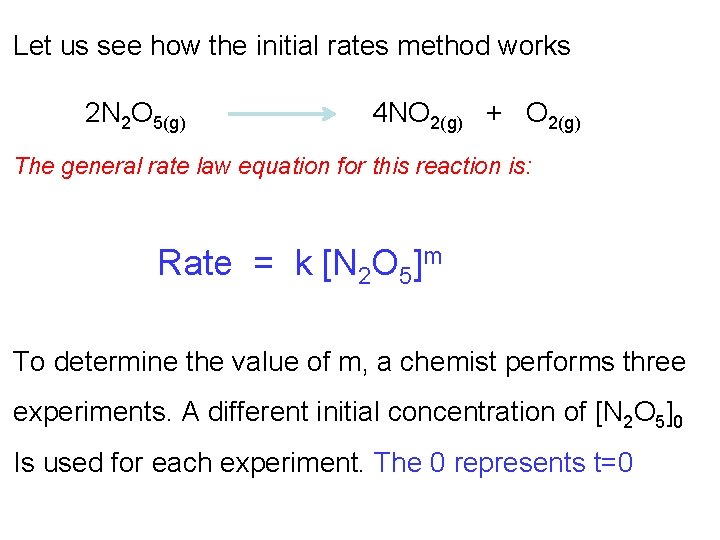
Let us see how the initial rates method works 2 N 2 O 5(g) 4 NO 2(g) + O 2(g) The general rate law equation for this reaction is: Rate = k [N 2 O 5]m To determine the value of m, a chemist performs three experiments. A different initial concentration of [N 2 O 5]0 Is used for each experiment. The 0 represents t=0
![Experiment Initial [N 2 O 5]0 (mol/L) Initial rate (mol/(L. s)) 1 0. 010](http://slidetodoc.com/presentation_image_h2/84729fbc0aedd53d7910ce810ae95658/image-42.jpg "Experiment Initial [N 2 O 5]0 (mol/L) Initial rate (mol/(L. s)) 1 0. 010")
Experiment Initial [N 2 O 5]0 (mol/L) Initial rate (mol/(L. s)) 1 0. 010 4. 8 x 10 -6 2 0. 020 9. 6 x 10 -6 3 0. 030 1. 5 x 10 -5 Value of m can be determined with at least two different methods ü by inspection ü rate law equation
![1. By inspection § When the [N 2 O 5] is doubled expts 1](http://slidetodoc.com/presentation_image_h2/84729fbc0aedd53d7910ce810ae95658/image-43.jpg "1. By inspection § When the [N 2 O 5] is doubled expts 1")
1. By inspection § When the [N 2 O 5] is doubled expts 1 and 2 doubles § the rate also doubles § when [N 2 O 5] is tripled, (expts 1 and 3) the rate triples this indicates a first-order relationship as follows Rate = [N 2 O 5]1
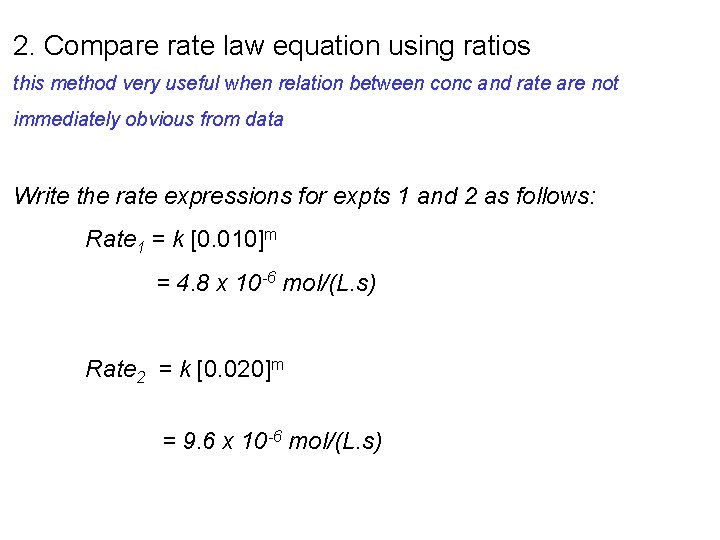
2. Compare rate law equation using ratios this method very useful when relation between conc and rate are not immediately obvious from data Write the rate expressions for expts 1 and 2 as follows: Rate 1 = k [0. 010]m = 4. 8 x 10 -6 mol/(L. s) Rate 2 = k [0. 020]m = 9. 6 x 10 -6 mol/(L. s)
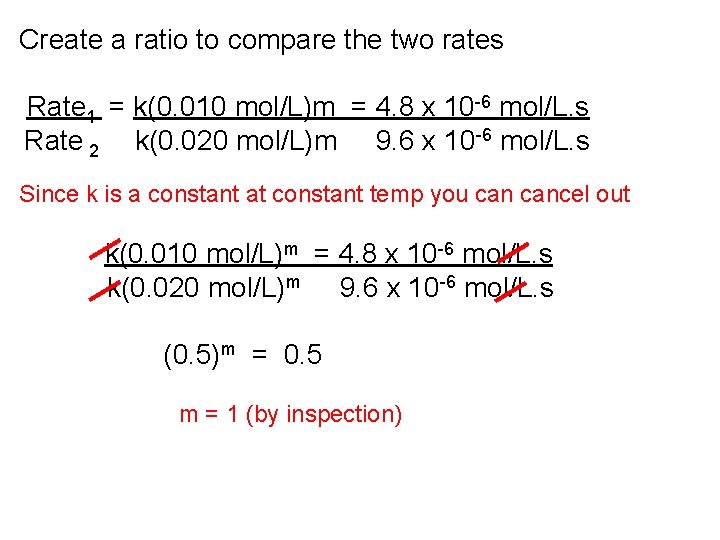
Create a ratio to compare the two rates Rate 1 = k(0. 010 mol/L)m = 4. 8 x 10 -6 mol/L. s Rate 2 k(0. 020 mol/L)m 9. 6 x 10 -6 mol/L. s Since k is a constant at constant temp you cancel out k(0. 010 mol/L)m = 4. 8 x 10 -6 mol/L. s k(0. 020 mol/L)m 9. 6 x 10 -6 mol/L. s (0. 5)m = 0. 5 m = 1 (by inspection)
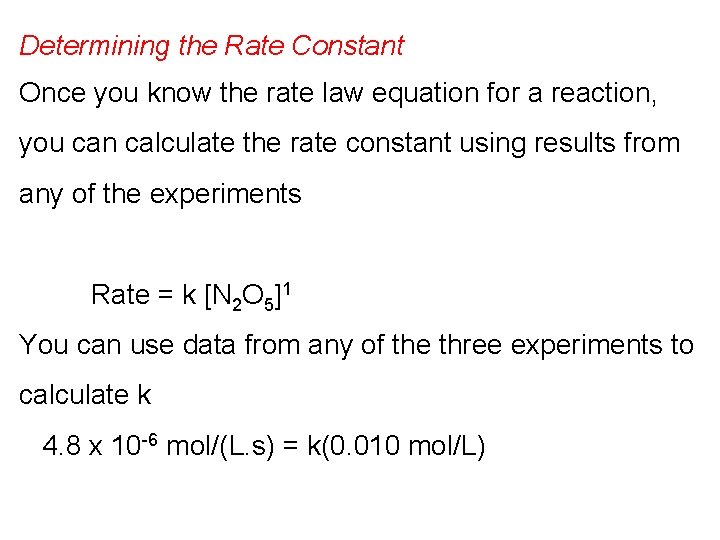
Determining the Rate Constant Once you know the rate law equation for a reaction, you can calculate the rate constant using results from any of the experiments Rate = k [N 2 O 5]1 You can use data from any of the three experiments to calculate k 4. 8 x 10 -6 mol/(L. s) = k(0. 010 mol/L)
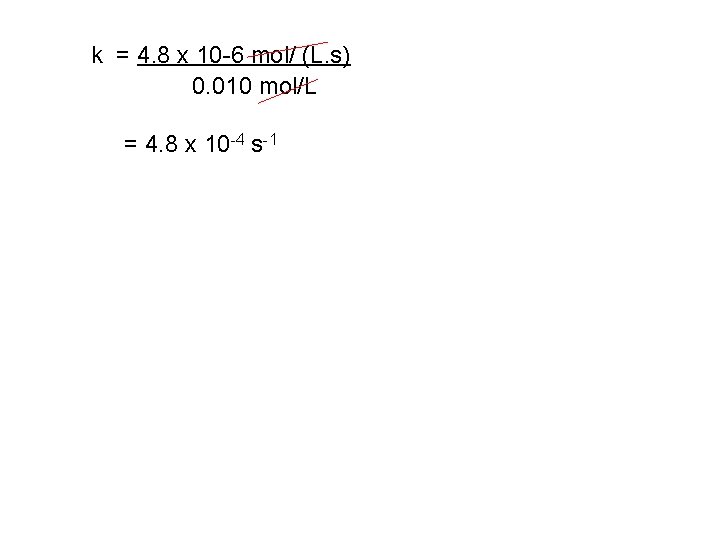
k = 4. 8 x 10 -6 mol/ (L. s) 0. 010 mol/L = 4. 8 x 10 -4 s-1
![First-Order Reactions rate = - ln[A]0 = - kt D[A] Dt rate = k](http://slidetodoc.com/presentation_image_h2/84729fbc0aedd53d7910ce810ae95658/image-48.jpg "First-Order Reactions rate = - ln[A]0 = - kt D[A] Dt rate = k")
First-Order Reactions rate = - ln[A]0 = - kt D[A] Dt rate = k [A] = [A]0 e-kt [A] is the concentration of A at any time t [A]0 is the concentration of A at time t=0
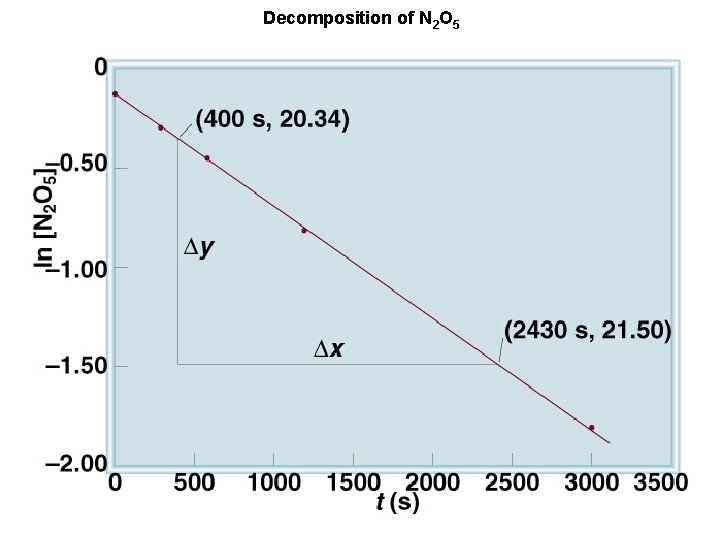
Decomposition of N 2 O 5
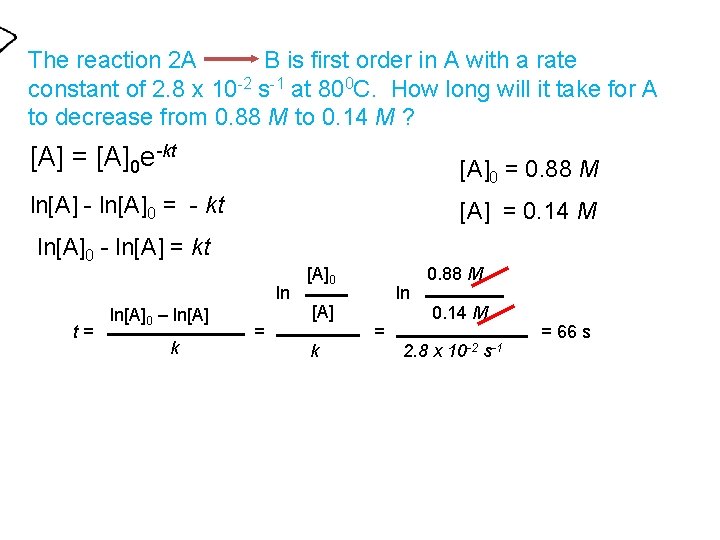
The reaction 2 A B is first order in A with a rate constant of 2. 8 x 10 -2 s-1 at 800 C. How long will it take for A to decrease from 0. 88 M to 0. 14 M ? [A] = [A]0 e-kt [A]0 = 0. 88 M ln[A] - ln[A]0 = - kt [A] = 0. 14 M ln[A]0 - ln[A] = kt ln t= ln[A]0 – ln[A] k = [A]0 [A] k ln = 0. 88 M 0. 14 M 2. 8 x 10 -2 s-1 = 66 s
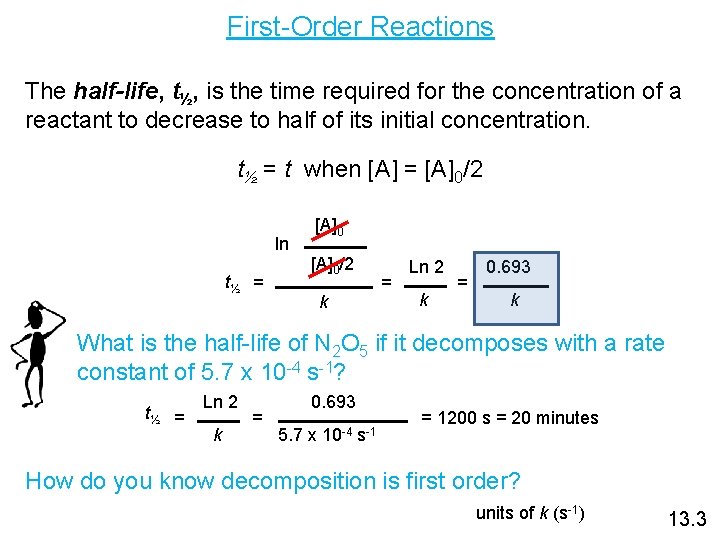
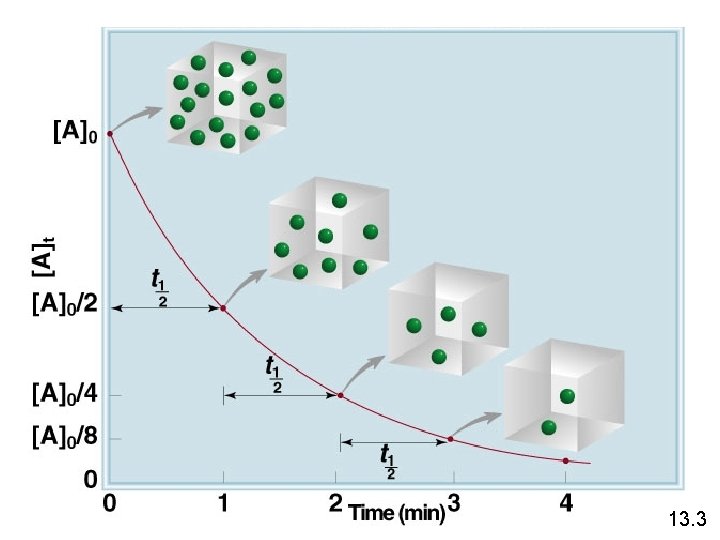
First-Order Reactions The half-life, t½, is the time required for the concentration of a reactant to decrease to half of its initial concentration. t½ = t when [A] = [A]0/2 ln t½ = [A]0/2 = k Ln 2 k = 0. 693 k What is the half-life of N 2 O 5 if it decomposes with a rate constant of 5. 7 x 10 -4 s-1? t½ = Ln 2 k = 0. 693 5. 7 x 10 -4 s-1 = 1200 s = 20 minutes How do you know decomposition is first order? units of k (s-1) 13. 3
![First-order reaction A # of half-lives product [A] = [A]0/n 1 2 2 4](http://slidetodoc.com/presentation_image_h2/84729fbc0aedd53d7910ce810ae95658/image-52.jpg "First-order reaction A # of half-lives product [A] = [A]0/n 1 2 2 4")
First-order reaction A # of half-lives product [A] = [A]0/n 1 2 2 4 3 8 4 16 13. 3
13. 3
- Slides: 53