
Learning Objectives By the end of this case
Learning Objectives • By the end of this case discussions, participants will be able to: -Identify patients at very high-risk of ASCVD events -Decide on what lipid lowering therapies to use in patients at very high -risk of ASCVD events
Case Presentation • 70 year old male with history of hypertension, stage 3 CKD, MI 12 months ago and coronary artery bypass grafting 6 months ago presents for follow-up. • He is currently on aspirin 81 mg po daily, clopidogrel 75 mg po daily, lisinopril 10 mg po daily, carvedilol 12. 5 mg po bid, and atorvastatin 80 mg po daily. • Patient is interested in lowering his future risk of ASCVD.
• Patient’s lipids performed in the clinic are as follows: Total cholesterol 150 mg/dl , LDL-C of 78 mg/dl, triglycerides 170 mg/dl, HDL-C 38 mg/dl. Non-HDL cholesterol (TC- HDL-C) = 112 mg/dl • Patient states that he is adherent to his lipid lowering regimen and you confirm this with his medication refill records.
Question 1 Is this patient considered a very high-risk ASCVD patient by the 2018 guideline? 1) Yes 2) No 3) I am not sure
Question 1 Is this patient considered a very high-risk ASCVD patient by the 2018 guideline? 1) Yes 2) No 3) I am not sure

Very High-Risk ASCVD Patients Major ASCVD Events Recent ACS (within the past 12 mo) History of MI (other than recent ACS event listed above) History of ischemic stroke Symptomatic peripheral arterial disease (history of claudication with ABI <0. 85, or previous revascularization or amputation) High-Risk Conditions Age ≥ 65 y Heterozygous familial hypercholesterolemia History of prior coronary artery bypass surgery or percutaneous coronary intervention outside of the major ASCVD event(s) Diabetes mellitus Hypertension CKD (e. GFR 15 -59 m. L/min/1. 73 m 2) Current smoking Persistently elevated LDL-C (LDL-C ≥ 100 mg/d. L [≥ 2. 6 mmol/L]) despite maximally tolerated statin therapy and ezetimibe History of congestive HF *Very high risk includes a history of multiple major ASCVD events or 1 major ASCVD event and multiple high-risk conditions. Grundy SM, et al. J Am Coll Cardiol. 2018 Nov 8. pii: S 0735 -1097(18)39034 -X. ; Grundy SM et al. Circulation. 2018 Nov 10: CIR 0000000625.
What will you do next? 1) Add ezetimibe 2) Add a PCSK 9 inhibitor 3) Reinforce diet and lifestyle 4) Switch to rosuvastatin 40 mg po daily
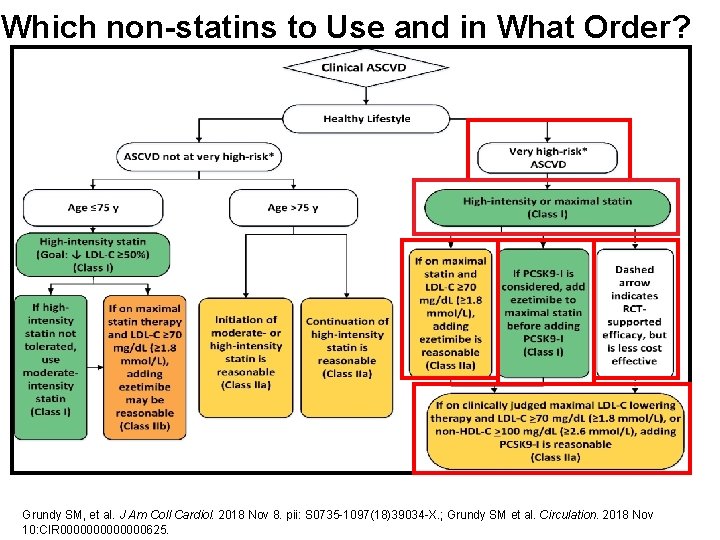
Which non-statins to Use and in What Order? Grundy SM, et al. J Am Coll Cardiol. 2018 Nov 8. pii: S 0735 -1097(18)39034 -X. ; Grundy SM et al. Circulation. 2018 Nov 10: CIR 0000000625.
Learning Objectives • By the end of this case discussions, participants will be able to: -Identify patients at very high-risk of ASCVD events -Decide on what lipid lowering therapies to use in patients at very high -risk of ASCVD events
- Slides: 9