
Learning Objectives Application of logic diagrams and truth
Learning Objectives Application of logic diagrams and truth tables using binary Learning Outcomes All – will recognise symbols Further binary, Logic diagrams and truth tables All - will be able to apply truth tables to questions Most - will correctly work through tables. Some – will be able to recognise and create real world examples.
Learning Objectives Application of logic diagrams and truth tables using binary Learning Outcomes All – will recognise symbols All - will be able to apply truth tables to questions Most - will correctly work through tables. Some – will be able to recognise and create real world examples. Starter In pairs answer these questions • What does Boolean mean? • Can you think of different sensors? • Why would use a not gate with a light sensor? • What is a transistor?
Learning Objectives Application of logic diagrams and truth tables using binary Learning Outcomes All – will recognise symbols All - will be able to apply truth tables to questions Most - will correctly work through tables. Some – will be able to recognise and create real world examples. What is a transistor? Transistors are tiny electronic switches and amplifiers. Several thousand transistors can be put on a piece of silicon with a surface area of just 1 mm 2. Transistors have three main uses: – as an electronic switch within a circuit – to switch on another part of a circuit when a change in resistance of a sensor device is detected – as an interface device, to receive signals from low current devices (such as ICs) and use these to turn on high current devices (such as motors)
Learning Objectives Application of logic diagrams and truth tables using binary Learning Outcomes All – will recognise symbols All - will be able to apply truth tables to questions Most - will correctly work through tables. Some – will be able to recognise and create real world examples. Learning Objectives • Application of logic circuits and truth tables using binary. Learning Outcomes • All – will recognise symbols • All - will be able to apply truth tables to questions • Most - will correctly work through tables. • Some – will be able to recognise and create real world examples.
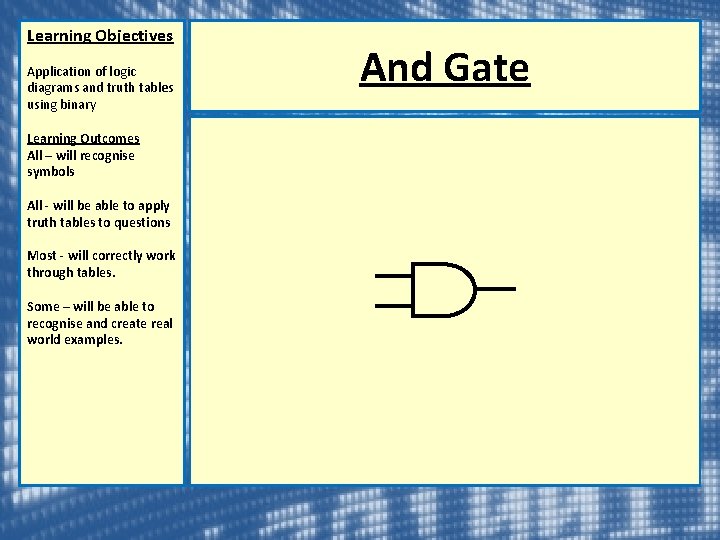
Learning Objectives Application of logic diagrams and truth tables using binary Learning Outcomes All – will recognise symbols All - will be able to apply truth tables to questions Most - will correctly work through tables. Some – will be able to recognise and create real world examples. And Gate
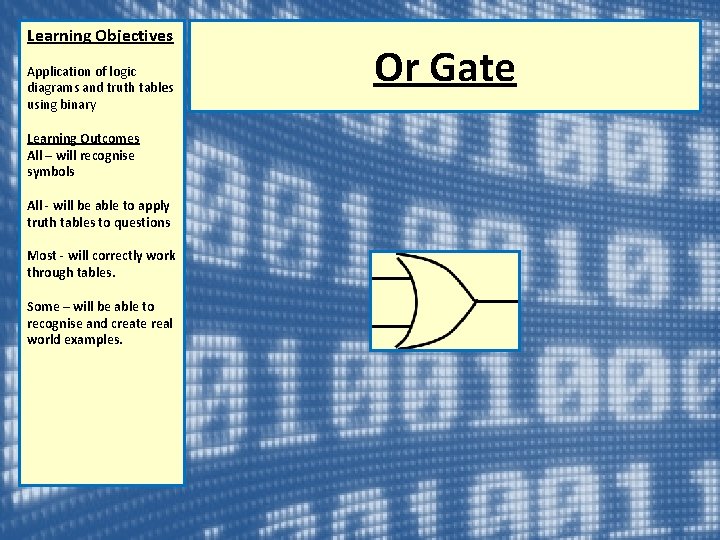
Learning Objectives Application of logic diagrams and truth tables using binary Learning Outcomes All – will recognise symbols All - will be able to apply truth tables to questions Most - will correctly work through tables. Some – will be able to recognise and create real world examples. Or Gate
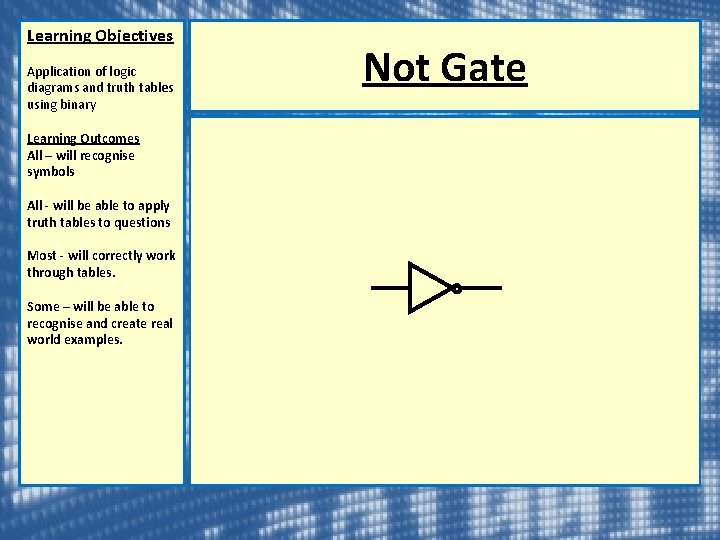
Learning Objectives Application of logic diagrams and truth tables using binary Learning Outcomes All – will recognise symbols All - will be able to apply truth tables to questions Most - will correctly work through tables. Some – will be able to recognise and create real world examples. Not Gate
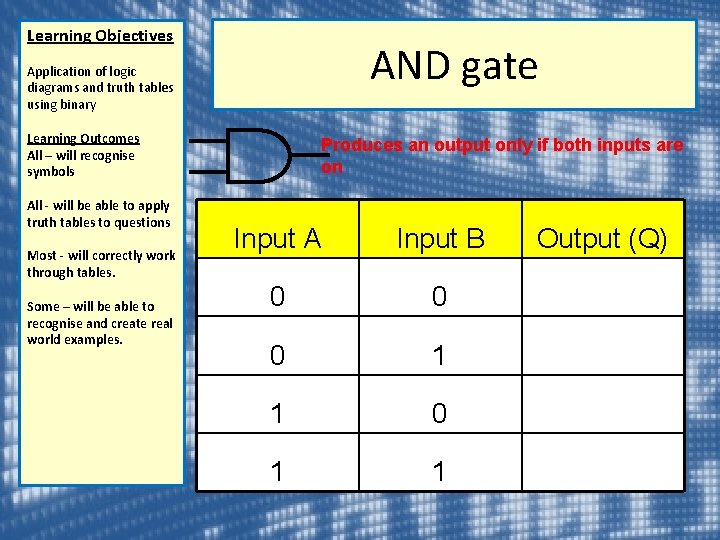
Learning Objectives AND gate Application of logic diagrams and truth tables using binary Learning Outcomes All – will recognise symbols All - will be able to apply truth tables to questions Most - will correctly work through tables. Some – will be able to recognise and create real world examples. Produces an output only if both inputs are on Input A Input B 0 0 0 1 1 Output (Q)
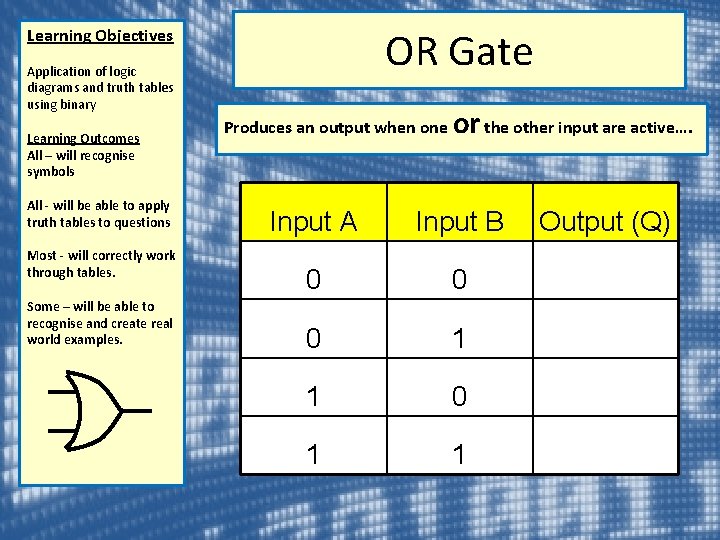
OR Gate Learning Objectives Application of logic diagrams and truth tables using binary Learning Outcomes All – will recognise symbols All - will be able to apply truth tables to questions Most - will correctly work through tables. Some – will be able to recognise and create real world examples. Produces an output when one or the other input are active…. Input A Input B 0 0 0 1 1 Output (Q)
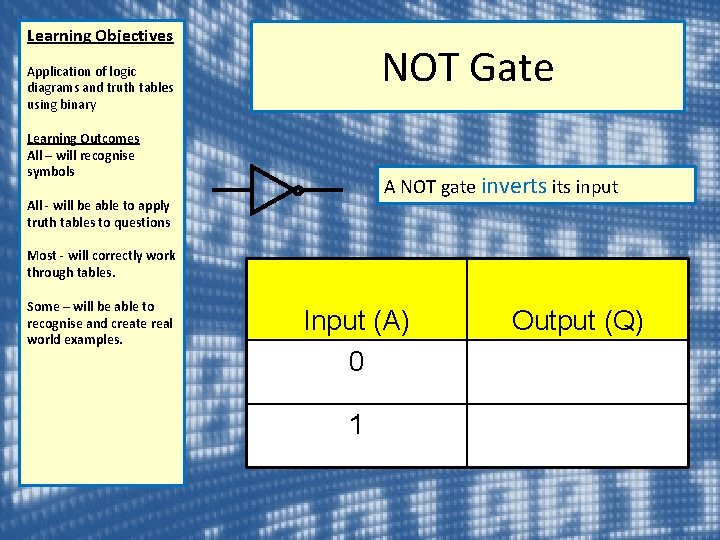
Learning Objectives NOT Gate Application of logic diagrams and truth tables using binary Learning Outcomes All – will recognise symbols A NOT gate inverts input All - will be able to apply truth tables to questions Most - will correctly work through tables. Some – will be able to recognise and create real world examples. Input (A) 0 1 Output (Q)
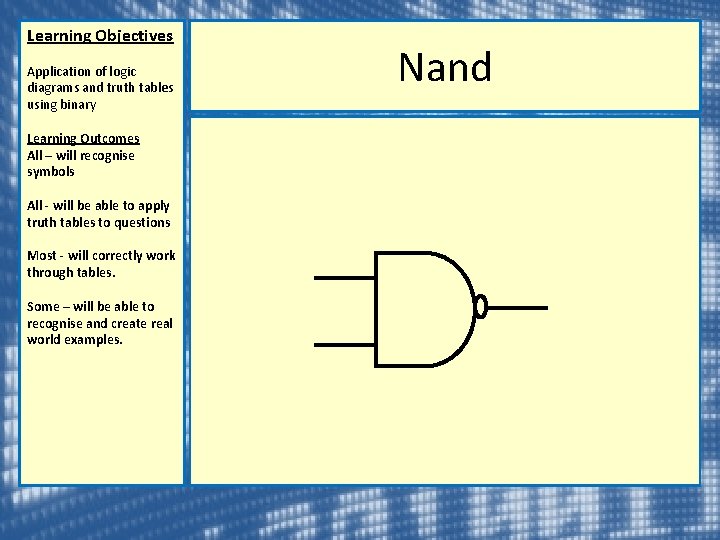
Learning Objectives Application of logic diagrams and truth tables using binary Learning Outcomes All – will recognise symbols All - will be able to apply truth tables to questions Most - will correctly work through tables. Some – will be able to recognise and create real world examples. Nand
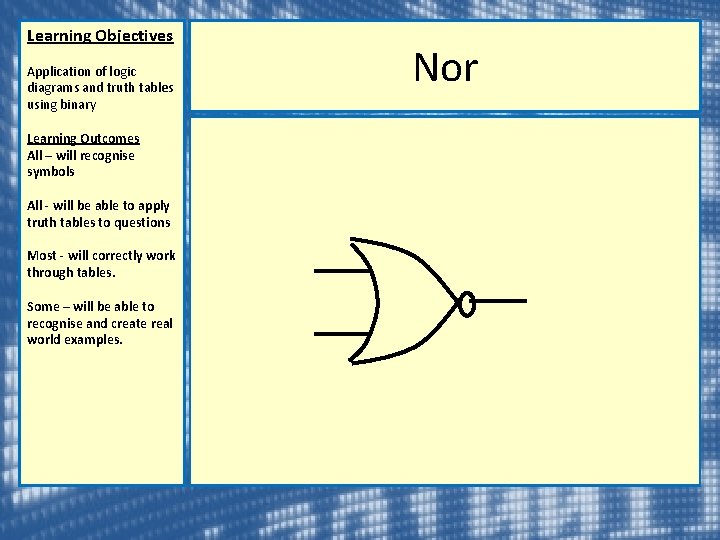
Learning Objectives Application of logic diagrams and truth tables using binary Learning Outcomes All – will recognise symbols All - will be able to apply truth tables to questions Most - will correctly work through tables. Some – will be able to recognise and create real world examples. Nor
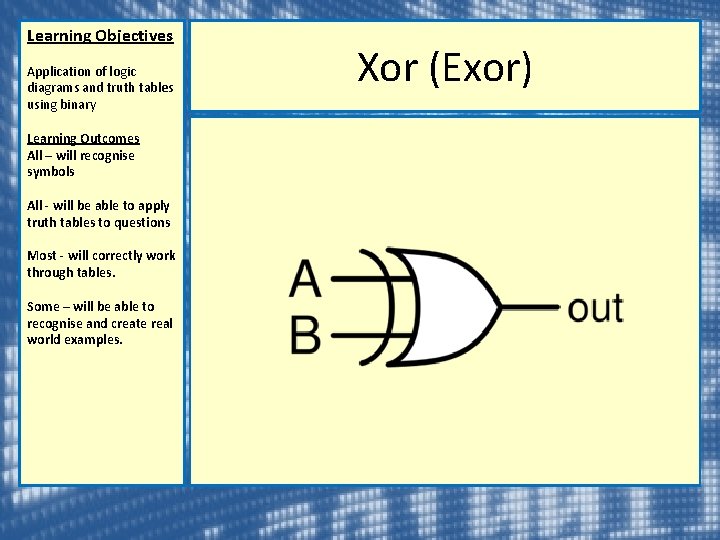
Learning Objectives Application of logic diagrams and truth tables using binary Learning Outcomes All – will recognise symbols All - will be able to apply truth tables to questions Most - will correctly work through tables. Some – will be able to recognise and create real world examples. Xor (Exor)
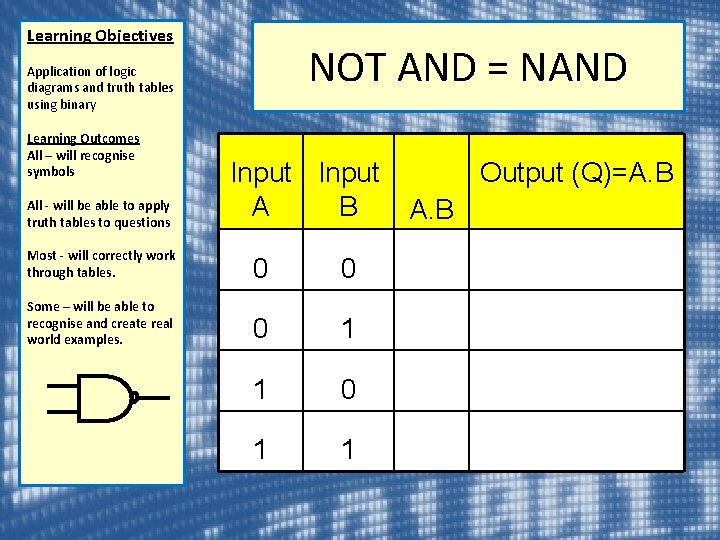
Learning Objectives NOT AND = NAND Application of logic diagrams and truth tables using binary Learning Outcomes All – will recognise symbols All - will be able to apply truth tables to questions Input A B Most - will correctly work through tables. 0 0 Some – will be able to recognise and create real world examples. 0 1 1 Output (Q)=A. B
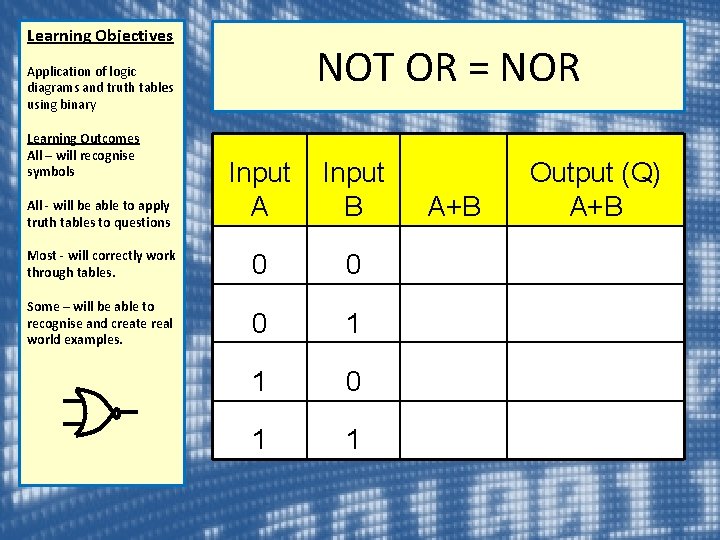
Learning Objectives NOT OR = NOR Application of logic diagrams and truth tables using binary Learning Outcomes All – will recognise symbols Input A Input B Most - will correctly work through tables. 0 0 Some – will be able to recognise and create real world examples. 0 1 1 All - will be able to apply truth tables to questions A+B Output (Q) A+B
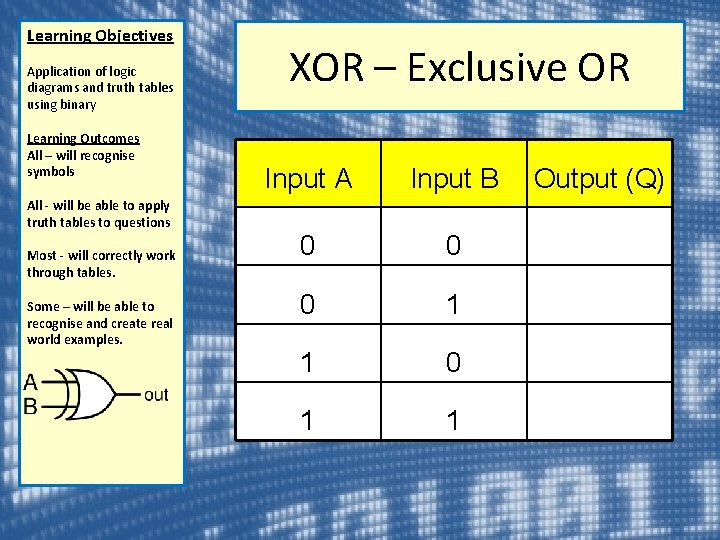
Learning Objectives Application of logic diagrams and truth tables using binary Learning Outcomes All – will recognise symbols All - will be able to apply truth tables to questions Most - will correctly work through tables. Some – will be able to recognise and create real world examples. XOR – Exclusive OR Input A Input B 0 0 0 1 1 Output (Q)
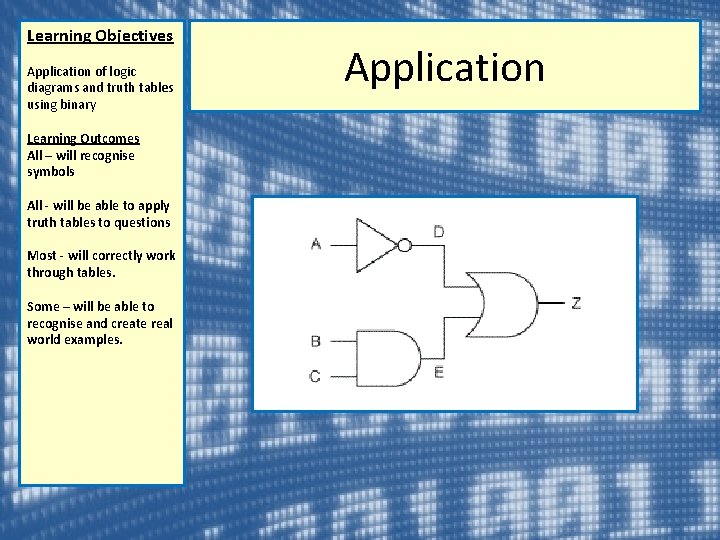
Learning Objectives Application of logic diagrams and truth tables using binary Learning Outcomes All – will recognise symbols All - will be able to apply truth tables to questions Most - will correctly work through tables. Some – will be able to recognise and create real world examples. Application
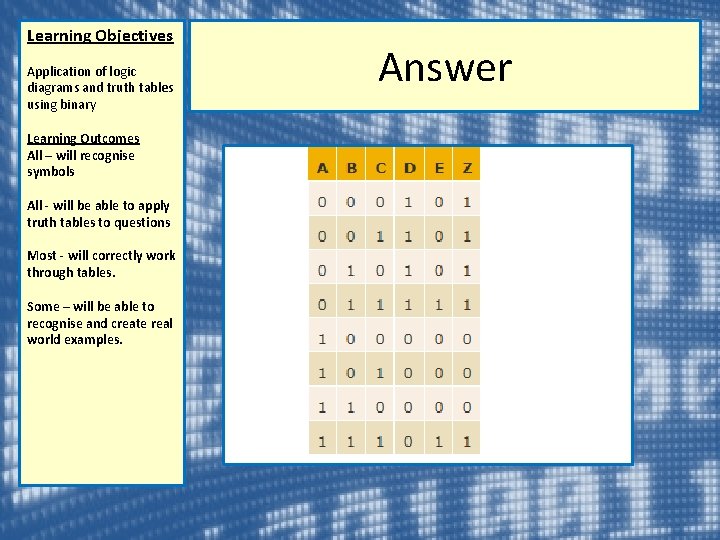
Learning Objectives Application of logic diagrams and truth tables using binary Learning Outcomes All – will recognise symbols All - will be able to apply truth tables to questions Most - will correctly work through tables. Some – will be able to recognise and create real world examples. Answer
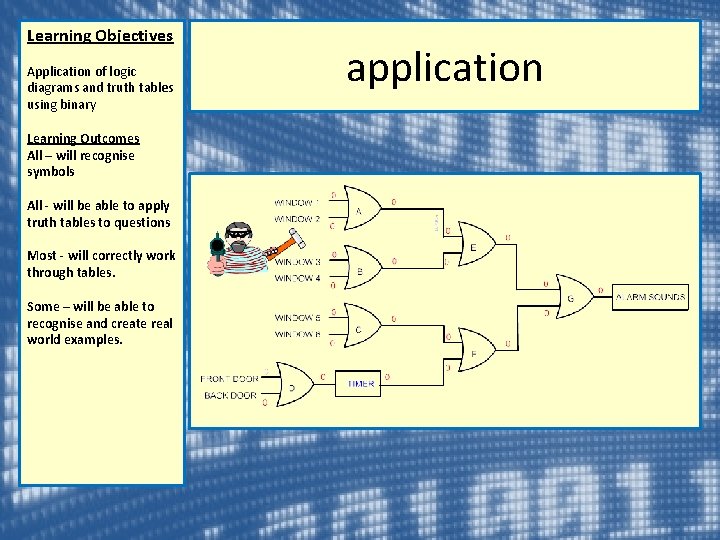
Learning Objectives Application of logic diagrams and truth tables using binary Learning Outcomes All – will recognise symbols All - will be able to apply truth tables to questions Most - will correctly work through tables. Some – will be able to recognise and create real world examples. application
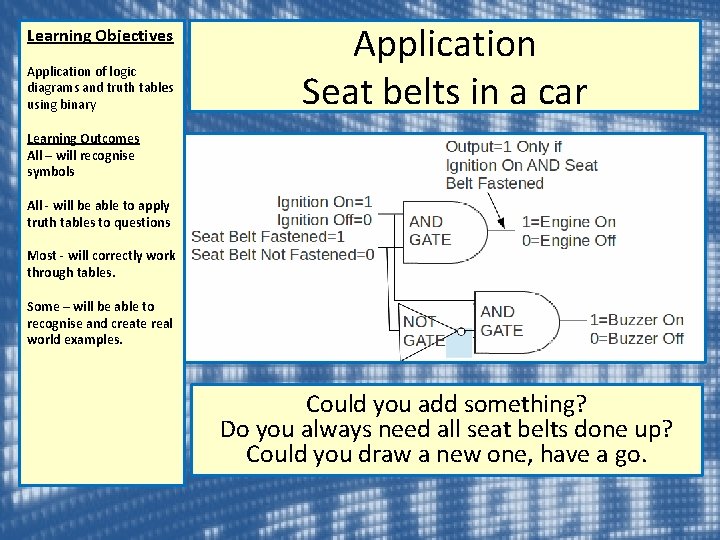
Learning Objectives Application of logic diagrams and truth tables using binary Application Seat belts in a car Learning Outcomes All – will recognise symbols All - will be able to apply truth tables to questions Most - will correctly work through tables. Some – will be able to recognise and create real world examples. Could you add something? Do you always need all seat belts done up? Could you draw a new one, have a go.
Learning Objectives Application of logic diagrams and truth tables using binary Learning Outcomes All – will recognise symbols All - will be able to apply truth tables to questions Most - will correctly work through tables. Some – will be able to recognise and create real world examples. Problems • Number of seats. • Not gates on switch going to Or gates perhaps?
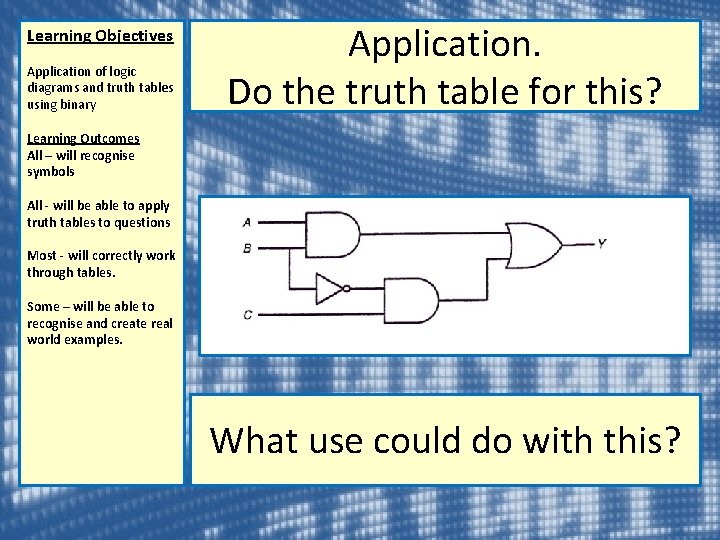
Learning Objectives Application of logic diagrams and truth tables using binary Application. Do the truth table for this? Learning Outcomes All – will recognise symbols All - will be able to apply truth tables to questions Most - will correctly work through tables. Some – will be able to recognise and create real world examples. What use could do with this?
Learning Objectives Application of logic diagrams and truth tables using binary Learning Outcomes All – will recognise symbols All - will be able to apply truth tables to questions Most - will correctly work through tables. Some – will be able to recognise and create real world examples. Mark each others • Are they correct.
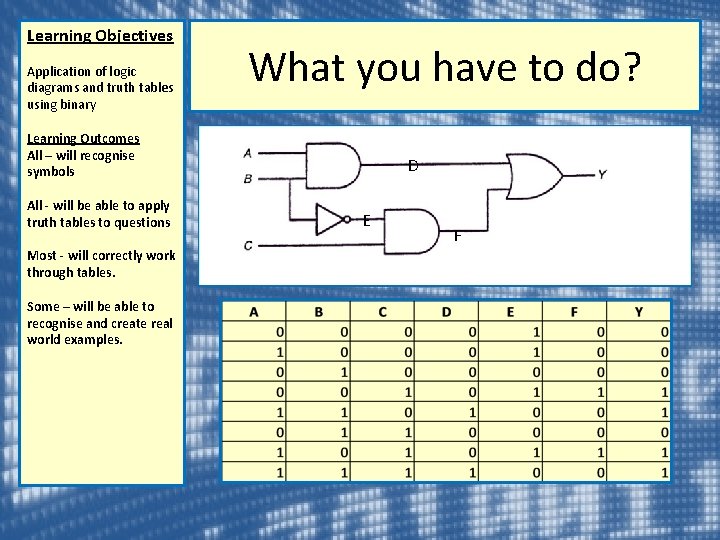
Learning Objectives Application of logic diagrams and truth tables using binary What you have to do? Learning Outcomes All – will recognise symbols All - will be able to apply truth tables to questions Most - will correctly work through tables. Some – will be able to recognise and create real world examples. D E F
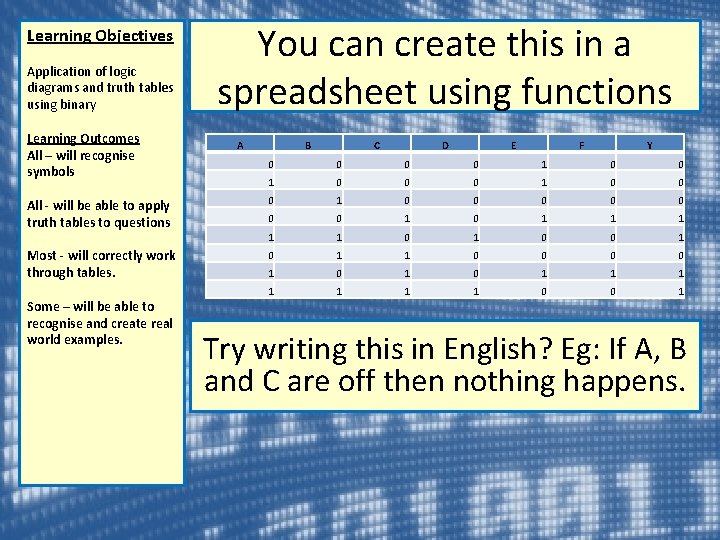
Learning Objectives Application of logic diagrams and truth tables using binary Learning Outcomes All – will recognise symbols You can create this in a spreadsheet using functions A B C D E F Y 0 0 1 0 0 All - will be able to apply truth tables to questions 0 1 0 0 0 0 1 1 1 0 1 0 0 1 Most - will correctly work through tables. 0 1 1 0 0 1 0 1 1 1 1 0 0 1 Some – will be able to recognise and create real world examples. Try writing this in English? Eg: If A, B and C are off then nothing happens.
Learning Objectives Application of logic diagrams and truth tables using binary Learning Outcomes All – will recognise symbols All - will be able to apply truth tables to questions Most - will correctly work through tables. Some – will be able to recognise and create real world examples. Plenary Finally: Logic gates: Not, And, Or, Nand, Nor and Xor. Truth tables. Binary (binary addition) Addition using logic gates i. e. how a computer works.
Learning Objectives Prep Application of logic diagrams and truth tables using binary Learning Outcomes All – will recognise symbols All - will be able to apply truth tables to questions Most - will correctly work through tables. Some – will be able to recognise and create real world examples. • Revision
- Slides: 27