
Learning Objectives 1 You will construct a circle
Learning Objectives 1. You will construct a circle using a compass. 2. You will draw the following parts of a circle: center, radius, diameter, and chord. 3. You will construct a circle without using a compass.
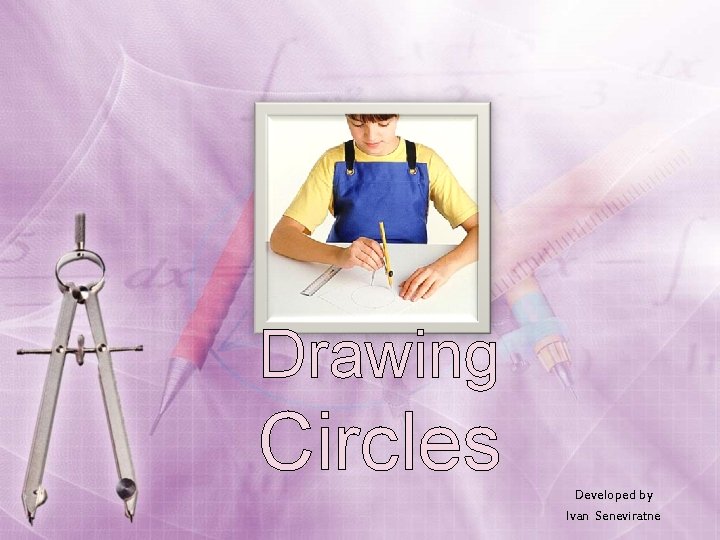
Drawing Circles Developed by Ivan Seneviratne
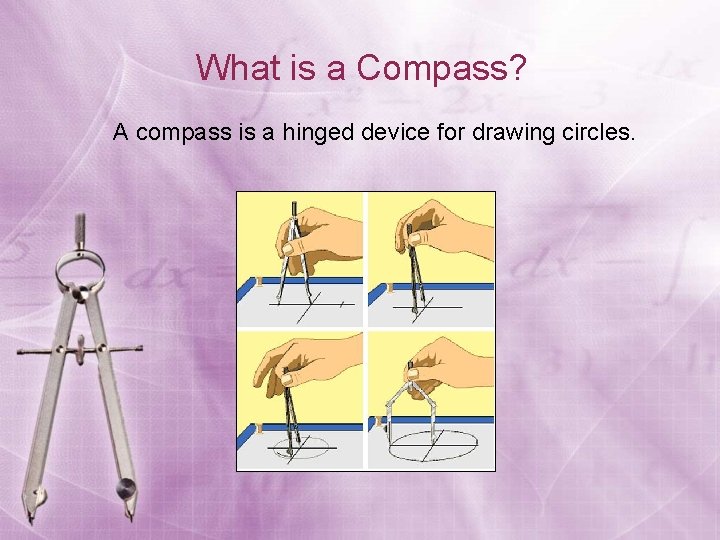
What is a Compass? A compass is a hinged device for drawing circles.
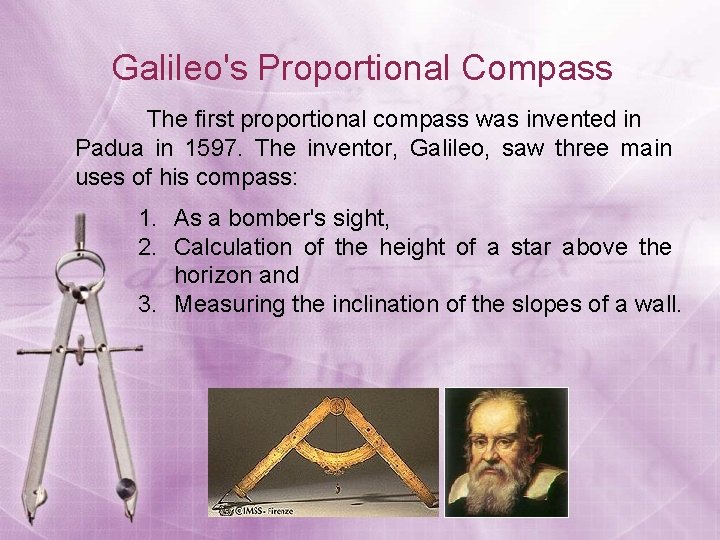
Galileo's Proportional Compass The first proportional compass was invented in Padua in 1597. The inventor, Galileo, saw three main uses of his compass: 1. As a bomber's sight, 2. Calculation of the height of a star above the horizon and 3. Measuring the inclination of the slopes of a wall.

Preparing the Compass 1. Sharpen the lead. 2. Adjust the needle and the lead so that the tip of the needle extends slightly more than the lead. needle lead
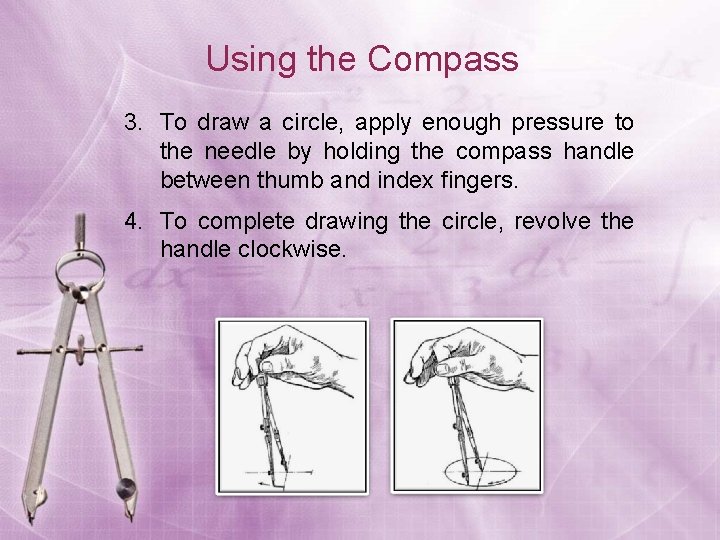
Using the Compass 3. To draw a circle, apply enough pressure to the needle by holding the compass handle between thumb and index fingers. 4. To complete drawing the circle, revolve the handle clockwise.

rip a Drawing without Compass Here's a way to draw a circle using something normally already on hand. . 1. cut Simply 1. , ne in hole Punch a 2. 3. than the radius of the circle needed. pencil could be placed through for drawing. distance from the pencil hole which represents the radius of the circle.

Drawing without Compass To draw a circle, stick the pin into your drawing surface, put a pencil in the hole and rotate around the pin 360 degrees.
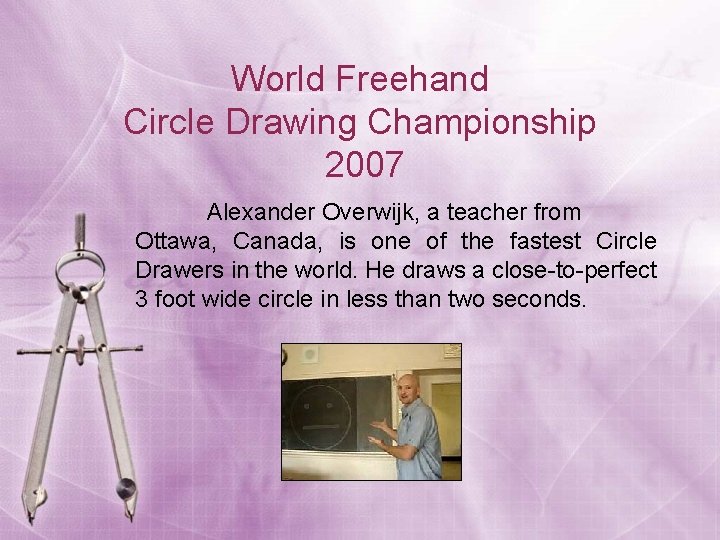
World Freehand Circle Drawing Championship 2007 Alexander Overwijk, a teacher from Ottawa, Canada, is one of the fastest Circle Drawers in the world. He draws a close-to-perfect 3 foot wide circle in less than two seconds.
Your Turn 1. Draw a circle that has a radius of 4 cm on the given origami paper. 2. Cut the circle into a semi circle and a quarter circle. 3. Paste the quarter circle and the semi circle on a Journal Writing sheet. 4. Find the perimeter of each shape. 5. Show clearly how you derived the answers.
Acknowledgments Images - http: //apod. nasa. gov http: //www. britannica. com This presentation is developed by Ivan Seneviratne © 2007 purely for personal use. ivanthexplorer@yahoo. co. uk
- Slides: 11