
Learning Objectives 1 To understand how altitude affects
Learning Objectives 1. To understand how altitude affects the cardiovascular and respiratory systems. 2. To explain the effects of altitude on the body. 3. To be able to discuss the effects that altitude has on performance. 4. To explain why altitude training can be beneficial to performers.
What do you already know? • How do gases move? • What is the partial pressure of oxygen arriving back at the alveoli from the muscle? • Where are the 2 sites of diffusion? • What is a diffusion gradient? • What happens when the diffusion gradient increases?
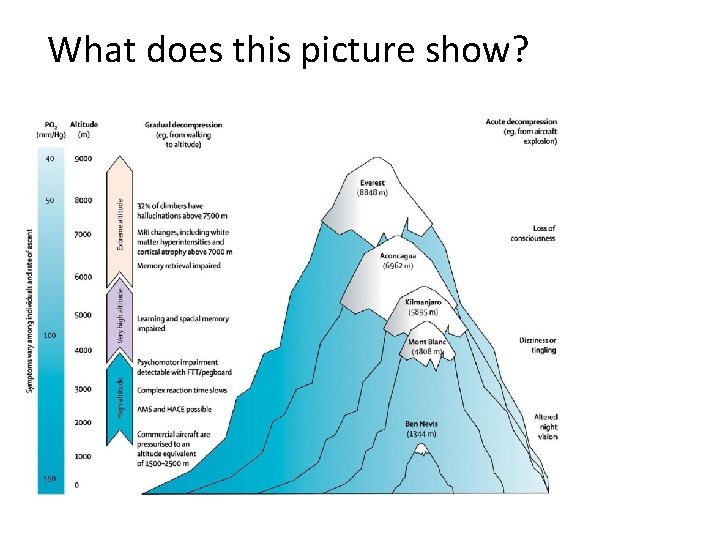
What does this picture show?
The facts • At sea level PO 2 is 159 mm. HG 1. What does this make the diffusion gradient to the blood capillary? • At 3, 600 m above sea level, PO 2 is 105 mm. HG 2. What does this make the diffusion gradient to the blood capillary? 3. How much has this reduced by? • At 8, 800 m above sea level the PO 2 is around 43 mm. Hg 4. What does this make the diffusion gradient? 5. What affect would this have on oxygen diffusion into the blood capillaries?
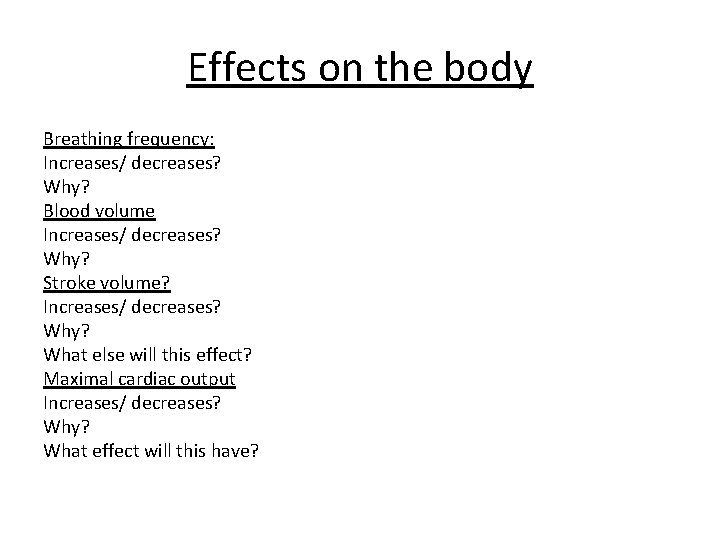
Effects on the body Breathing frequency: Increases/ decreases? Why? Blood volume Increases/ decreases? Why? Stroke volume? Increases/ decreases? Why? What else will this effect? Maximal cardiac output Increases/ decreases? Why? What effect will this have?
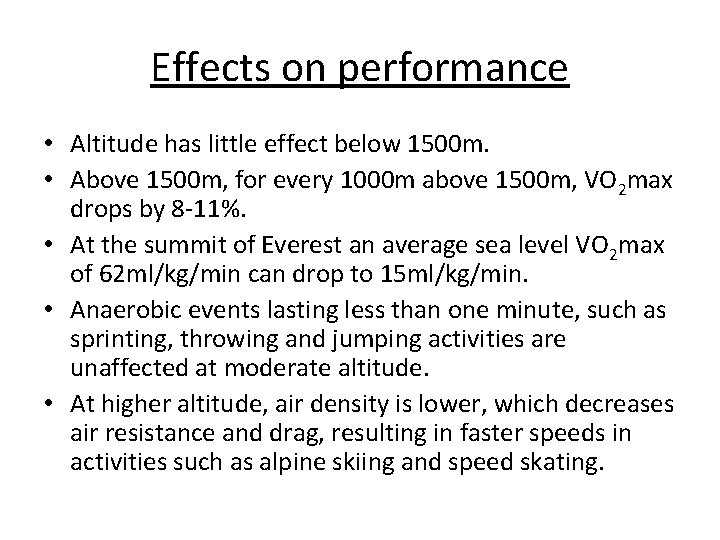
Effects on performance • Altitude has little effect below 1500 m. • Above 1500 m, for every 1000 m above 1500 m, VO 2 max drops by 8 -11%. • At the summit of Everest an average sea level VO 2 max of 62 ml/kg/min can drop to 15 ml/kg/min. • Anaerobic events lasting less than one minute, such as sprinting, throwing and jumping activities are unaffected at moderate altitude. • At higher altitude, air density is lower, which decreases air resistance and drag, resulting in faster speeds in activities such as alpine skiing and speed skating.
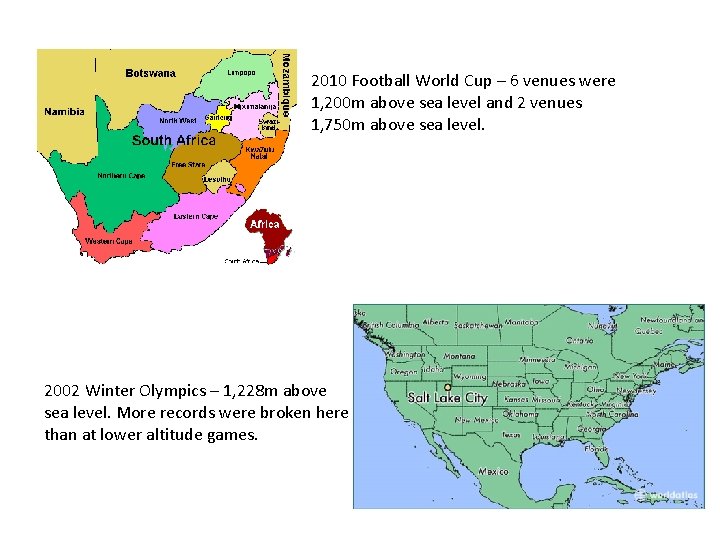
2010 Football World Cup – 6 venues were 1, 200 m above sea level and 2 venues 1, 750 m above sea level. 2002 Winter Olympics – 1, 228 m above sea level. More records were broken here than at lower altitude games.
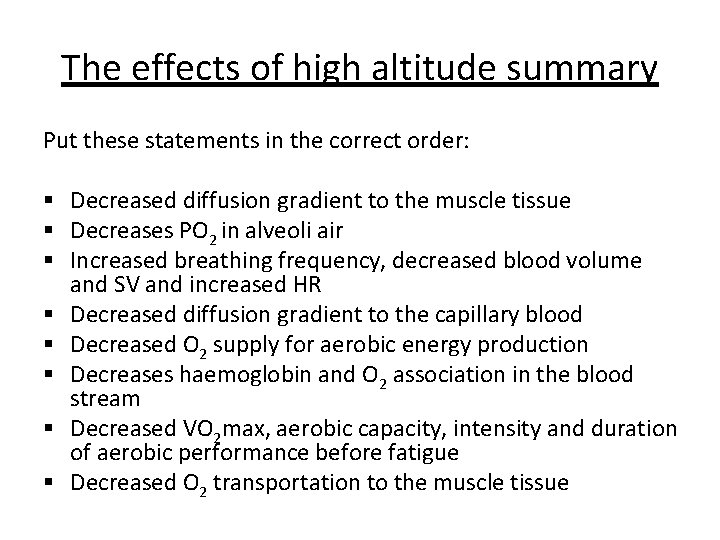
The effects of high altitude summary Put these statements in the correct order: § Decreased diffusion gradient to the muscle tissue § Decreases PO 2 in alveoli air § Increased breathing frequency, decreased blood volume and SV and increased HR § Decreased diffusion gradient to the capillary blood § Decreased O 2 supply for aerobic energy production § Decreases haemoglobin and O 2 association in the blood stream § Decreased VO 2 max, aerobic capacity, intensity and duration of aerobic performance before fatigue § Decreased O 2 transportation to the muscle tissue
What can be done to prepare athletes for this? From reading the article and watching the videos, can you get the answers to the following questions: 1. What is acclimatisation? 2. What advantages does it have? 3. How far above sea level should altitude training be done? 4. For how long? 5. What is LH+TL? 6. How long do the benefits of altitude training last?
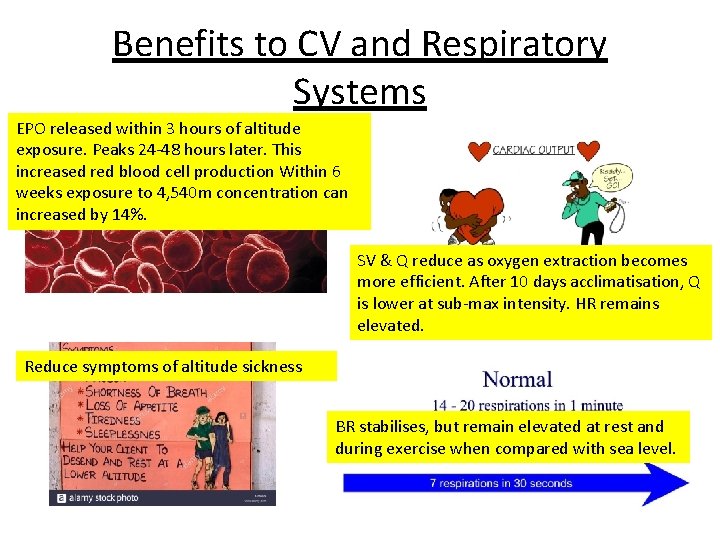
Benefits to CV and Respiratory Systems EPO released within 3 hours of altitude exposure. Peaks 24 -48 hours later. This increased red blood cell production Within 6 weeks exposure to 4, 540 m concentration can increased by 14%. SV & Q reduce as oxygen extraction becomes more efficient. After 10 days acclimatisation, Q is lower at sub-max intensity. HR remains elevated. Reduce symptoms of altitude sickness BR stabilises, but remain elevated at rest and during exercise when compared with sea level.
Home Study 1. Discuss the importance of acclimatisation and the timing of arrival for an aerobic event at an altitude over 2, 400 m. (10 marks) REMEMBER: P – point E – explain (say why & how) E – Example (be specific to a sport/ situation) You need to write at least 6 paragraphs to answer this question. Example paragraph At altitude over 1, 500 m VO 2 max decreases significantly. This means that for an aerobic event a athlete’s performance would decrease because the cardiovascular and respiratory systems have to work harder to deliver oxygen to the muscles. In an event such as the 3, 000 m an athlete would find that their time would increase due to the altitude and the effect this is having on their body.
- Slides: 11