
Learning objective To be able to use partitioning
Learning objective: To be able to use partitioning to double or halve numbers.
Place value l Numbers are categorised as being either units/ones, tens, hundreds or thousands etc. l The position of the digit within an number shows its value according to its ‘place’. l In whole numbers the number on the far right is always the units/ones column, next on the left comes the tens, then the thousands etc.
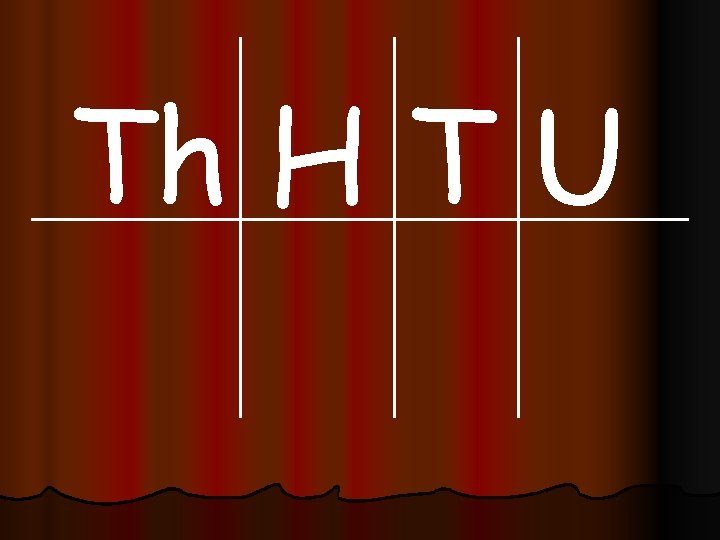
Th H T U

Partitioning l Partitioning is the breaking down of a number into several components according to its place value. l E. g. 485 = 400 + 80 + 5 The zeros represent a place holder of the other digits ( e. g. tens and units) and without them the number would simply look like a single unit of 4. l. . DesktopMaths ITPplacevalue_pc. EXE l
Partitioning and doubling l Why do we need to partition when doubling? l By partitioning a number we can use known doubles of smaller numbers and then add these together to calculate the answer. l E. g. double 47 is not a double that most people know of by heart.
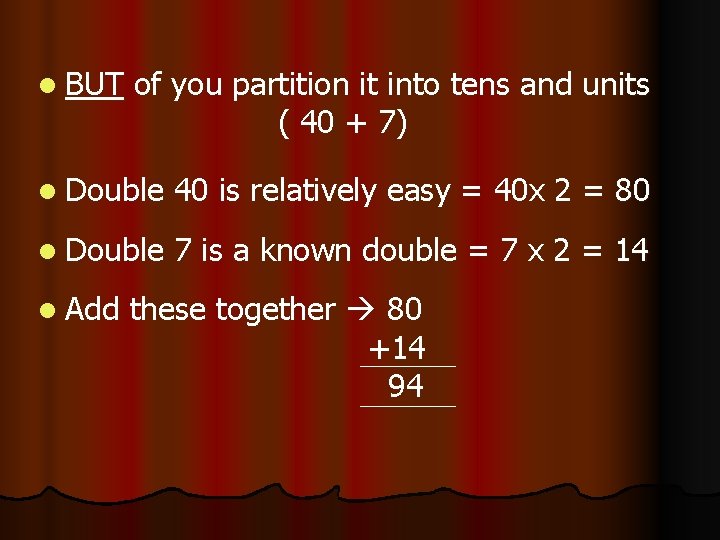
l BUT of you partition it into tens and units ( 40 + 7) l Double 40 is relatively easy = 40 x 2 = 80 l Double 7 is a known double = 7 x 2 = 14 l Add these together 80 +14 94
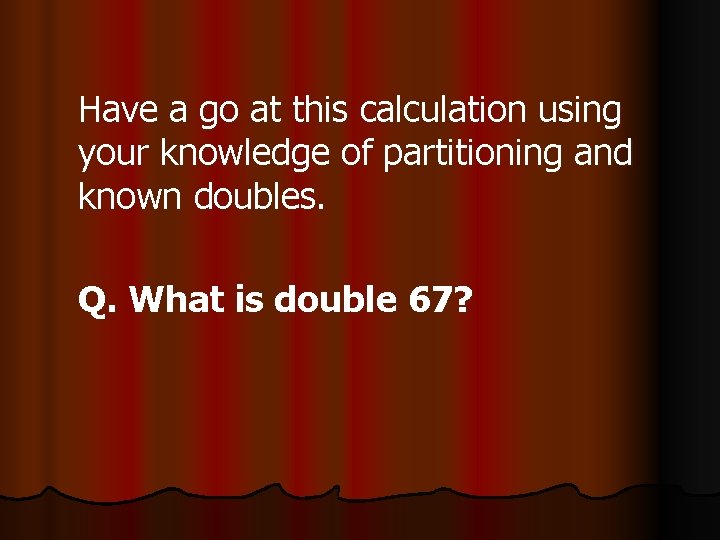
Have a go at this calculation using your knowledge of partitioning and known doubles. Q. What is double 67?

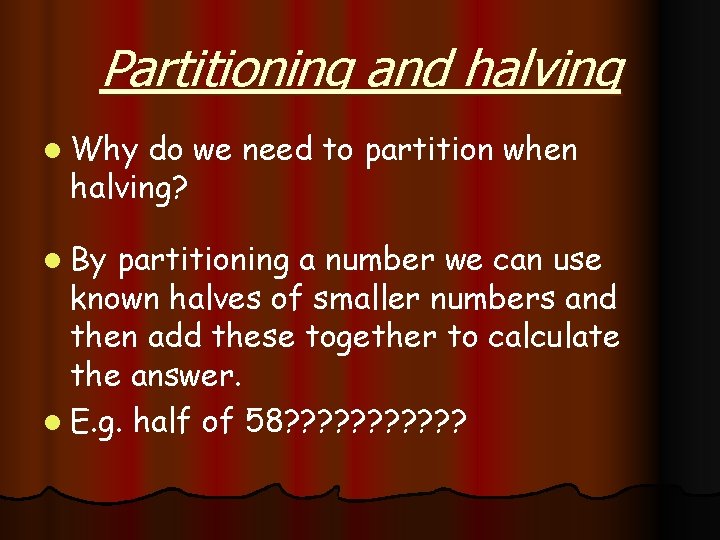
Partitioning and halving l Why do we need to partition when halving? l By partitioning a number we can use known halves of smaller numbers and then add these together to calculate the answer. l E. g. half of 58? ? ?
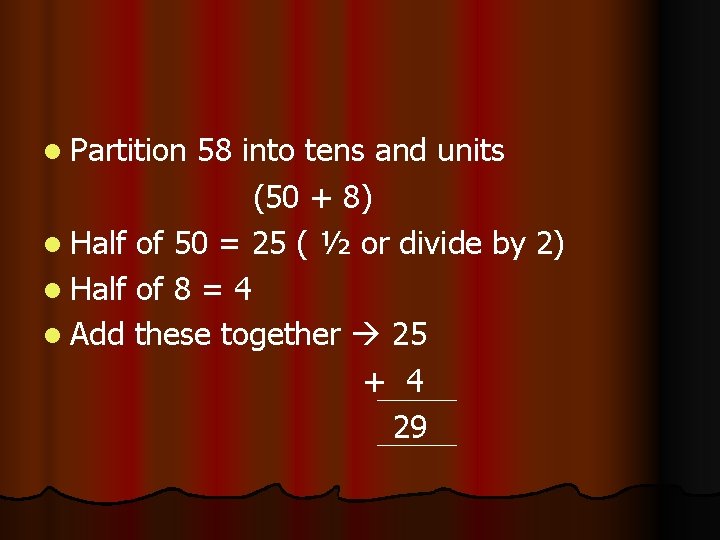
l Partition 58 into tens and units (50 + 8) l Half of 50 = 25 ( ½ or divide by 2) l Half of 8 = 4 l Add these together 25 + 4 29
l Have a go at this calculation using your knowledge of partitioning and known halves. l Q. What is half of 38?

l Remember if the number you are halving is an even number it will always halve exactly. l Whereas if the number is an odd number the answer will always have the fraction of a half in it ( e. g. half of 13 = 6 ½ ) l The easiest way to halve odd numbers is to half the even number just before it and then add on a half to that number (e. g. 13 half of 12 is 6 + ½ = 6 ½ )
Well done you can now partition numbers to find doubles and halves! ☺
Main activity: l With your partner, roll 2 dice to find 2 -digit numbers. Then partition them into tens/units and find the doubles/halves and record in your exercise books. l l E. g. 34 30 + 4 30 = 60 = 15 4=8=2 Therefore 34 = 68 (60 + 8) = 17 (15 + 2) l Please remember to write the long date along with the title. LO: To be able to use partitioning to double or halve numbers. l Year 3’s to work on numbers between 1 -50 first (x 10) then go onto numbers 50 -100. ( x 5) l Year 4’s to work on numbers between 1 -100. (x 10) l Extension: roll dice 3 times to create 3 -digit numbers and find doubles/halves by partitioning into hundreds/tens/units (x 5)
- Slides: 15