
Learning Objective o To identify the grammatical features
Learning Objective o To identify the grammatical features of early speech o To understand what a morpheme is and how it is used to measure the complexity of a child’s utterance
Key Words o Morpheme: the smallest units of language that carry meaning. A simple word is a morpheme, for example: book. o Free Morpheme: a morpheme that can stand alone as an independent word, for example: cat. o Bound Morpheme: A morpheme that can only occur when bound to a root morpheme, for example: -ed, -ing, -ly
Syntax is another name for word order. When we talk about a child’s syntax, we are referring to how he or she starts to put words together in patterns, and how he or she develops an understanding of the ways in which word order can control meaning.
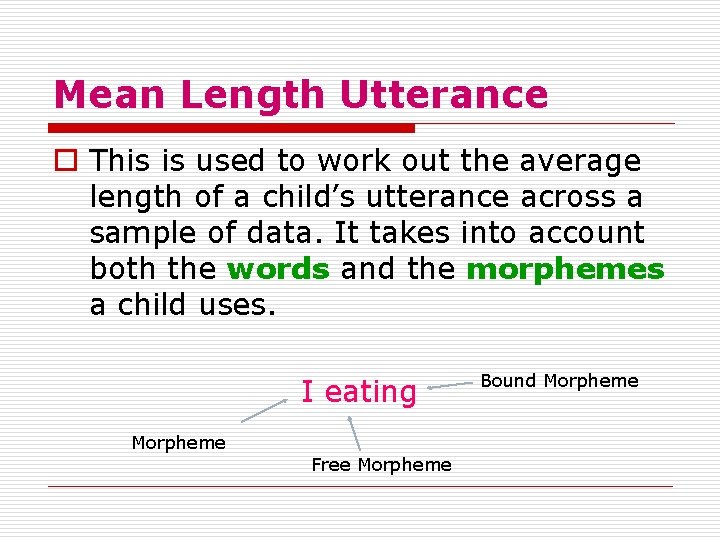
Mean Length Utterance o This is used to work out the average length of a child’s utterance across a sample of data. It takes into account both the words and the morphemes a child uses. I eating Morpheme Free Morpheme Bound Morpheme
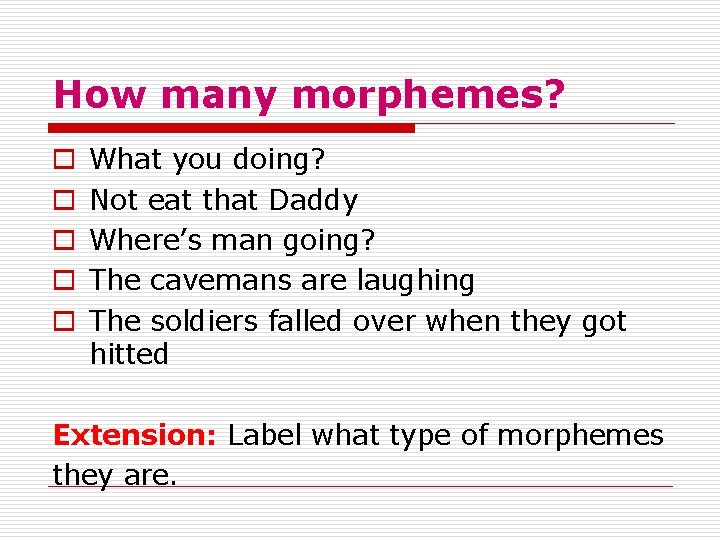
How many morphemes? o o o What you doing? Not eat that Daddy Where’s man going? The cavemans are laughing The soldiers falled over when they got hitted Extension: Label what type of morphemes they are.
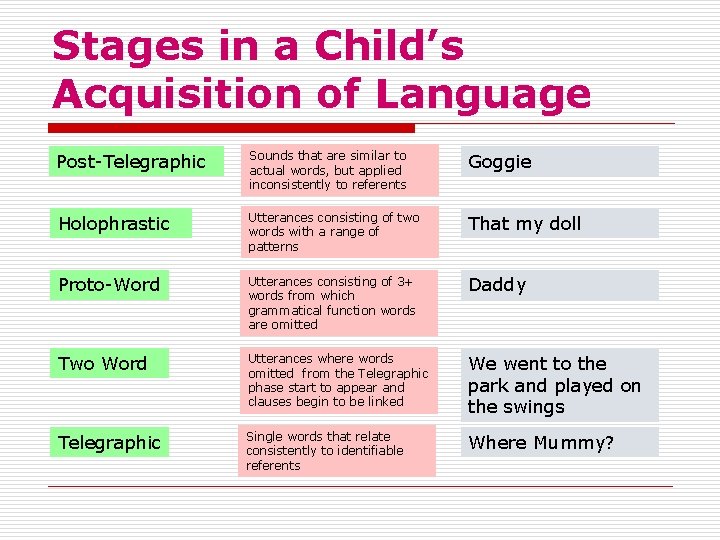
Stages in a Child’s Acquisition of Language Post-Telegraphic Sounds that are similar to actual words, but applied inconsistently to referents Goggie Holophrastic Utterances consisting of two words with a range of patterns That my doll Proto-Word Utterances consisting of 3+ words from which grammatical function words are omitted Daddy Two Word Utterances where words omitted from the Telegraphic phase start to appear and clauses begin to be linked We went to the park and played on the swings Telegraphic Single words that relate consistently to identifiable referents Where Mummy?
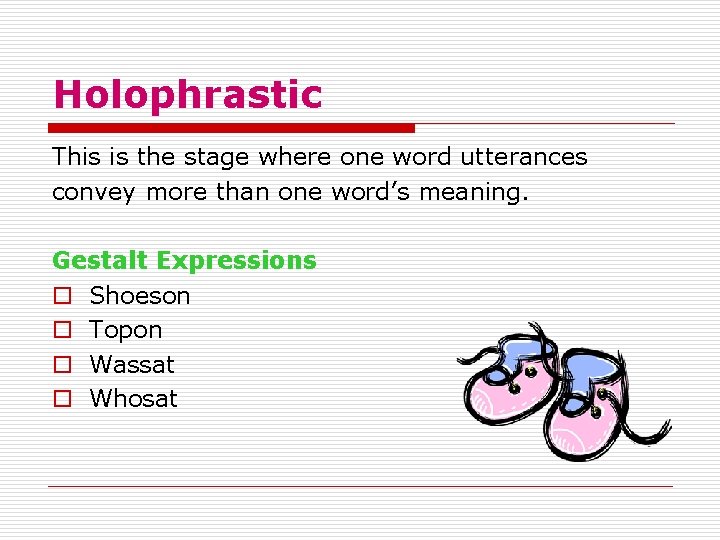
Holophrastic This is the stage where one word utterances convey more than one word’s meaning. Gestalt Expressions o Shoeson o Topon o Wassat o Whosat
Two-Word Stage The stage at which Syntax comes into play as children start to form mini-sentences, with Syntax starting to resemble that of adults. Roger Brown noted that many of the patterns these expressions fall into are linked to the semantic relationships between the words.
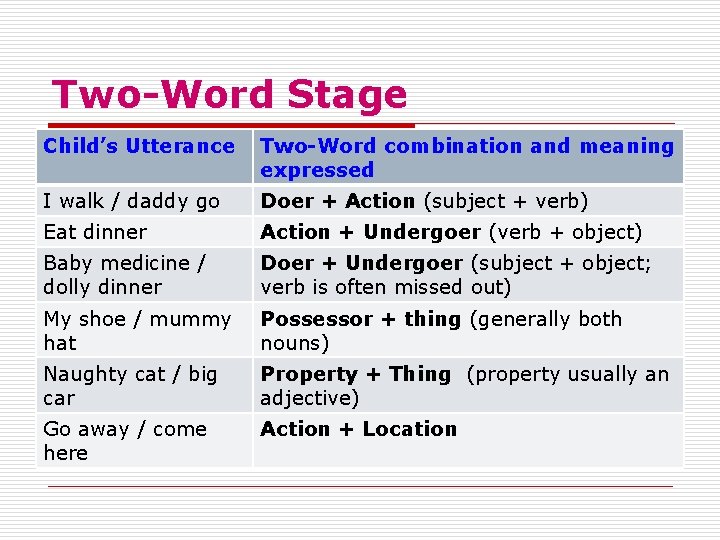
Two-Word Stage Child’s Utterance Two-Word combination and meaning expressed I walk / daddy go Doer + Action (subject + verb) Eat dinner Action + Undergoer (verb + object) Baby medicine / dolly dinner Doer + Undergoer (subject + object; verb is often missed out) My shoe / mummy hat Possessor + thing (generally both nouns) Naughty cat / big car Property + Thing (property usually an adjective) Go away / come here Action + Location
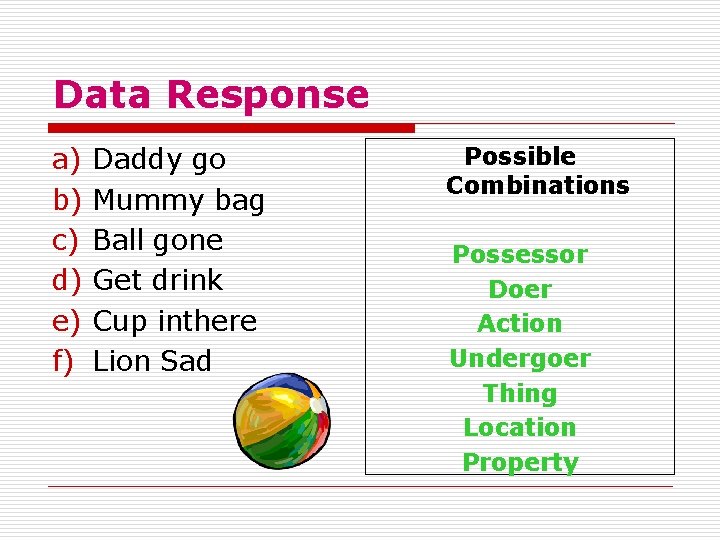
Data Response a) b) c) d) e) f) Daddy go Mummy bag Ball gone Get drink Cup inthere Lion Sad Possible Combinations Possessor Doer Action Undergoer Thing Location Property
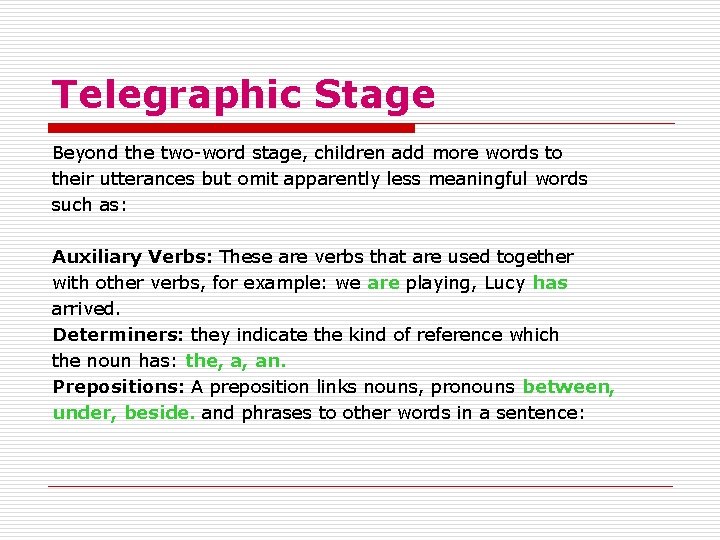
Telegraphic Stage Beyond the two-word stage, children add more words to their utterances but omit apparently less meaningful words such as: Auxiliary Verbs: These are verbs that are used together with other verbs, for example: we are playing, Lucy has arrived. Determiners: they indicate the kind of reference which the noun has: the, a, an. Prepositions: A preposition links nouns, pronouns between, under, beside. and phrases to other words in a sentence:
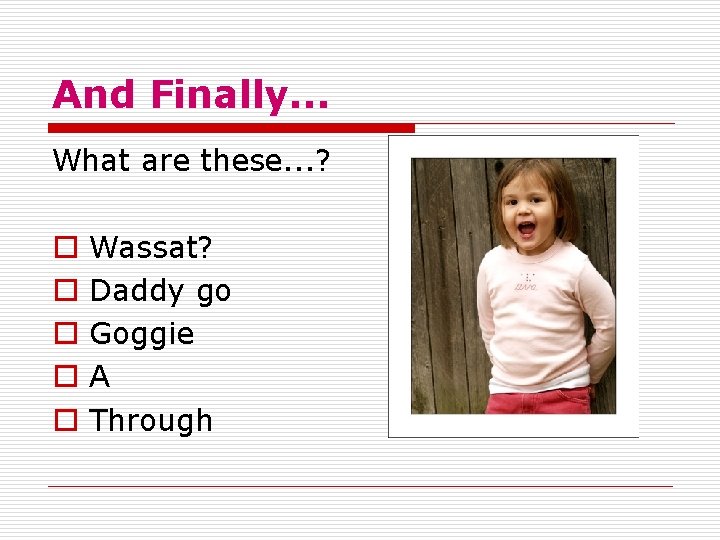
And Finally. . . What are these. . . ? o o o Wassat? Daddy go Goggie A Through
- Slides: 13