
Learning Objective LO 1 Prepare a stock record
Learning Objective LO 1 Prepare a stock record. © 2014 Cengage Learning. All Rights Reserved.
Lesson 20 -1 Why Merchandise Inventory Is Important LO 1 ● Helps managers to maintain a merchandise inventory of sufficient quantity, variety, and price ● Allows current assets and retained earnings to be correctly reported on the balance sheet ● Ensures that gross profit and net income are reported correctly on the income statement © 2014 Cengage Learning. All Rights Reserved. SLIDE 2
Lesson 20 -1 The Most Efficient Quantity of Inventory LO 1 ● Larger than needed ● Requires a business to spend money for store and warehouse space ● Uses capital that could be invested in other assets ● Requires a business to spend money for expenses, such as taxes and insurance premiums, which increase with the cost of the merchandise inventory ● May become obsolete and unsalable © 2014 Cengage Learning. All Rights Reserved. SLIDE 3
Lesson 20 -1 The Most Efficient Quantity of Inventory LO 1 ● Smaller than needed ● Sales may be lost ● Per unit cost of merchandise may be higher for small quantities © 2014 Cengage Learning. All Rights Reserved. SLIDE 4
Lesson 20 -1 Methods Used to Determine the Quantity of Merchandise Inventory LO 1 ● A merchandise inventory evaluated at the end of a fiscal period is known as a periodic inventory. ● A merchandise inventory determined by keeping a continuous record of increases, decreases, and the balance on hand of each item of merchandise is known as a perpetual inventory. ● A perpetual inventory is also referred to as a book inventory. © 2014 Cengage Learning. All Rights Reserved. SLIDE 5
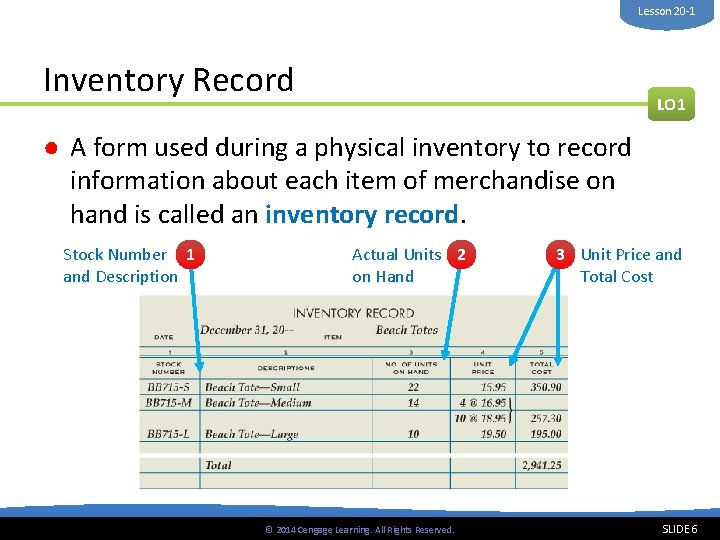
Lesson 20 -1 Inventory Record LO 1 ● A form used during a physical inventory to record information about each item of merchandise on hand is called an inventory record. Stock Number 1 and Description Actual Units 2 on Hand © 2014 Cengage Learning. All Rights Reserved. 3 Unit Price and Total Cost SLIDE 6
Lesson 20 -1 Stock Record LO 1 ● Some businesses keep inventory records that show continuously the quantity on hand for each kind of merchandise. ● A form used to show the kind of merchandise, quantity received, quantity sold, and balance on hand is called a stock record. ● A separate stock record is prepared for each kind of merchandise on hand. ● A file of stock records for all merchandise on hand is called a stock ledger. © 2014 Cengage Learning. All Rights Reserved. SLIDE 7

Lesson 20 -1 Stock Record Purchase Information LO 1 Sales Information © 2014 Cengage Learning. All Rights Reserved. New Balance on Hand SLIDE 8
Lesson 20 -1 Perpetual Inventory Using a Computer LO 1 ● Point-of-sales terminals ● Universal Product Codes (UPC) ● Computerized stock ledger © 2014 Cengage Learning. All Rights Reserved. SLIDE 9
Lesson 20 -1 Audit Your Understanding 1. Identify four reasons why a merchandise inventory that is larger than needed may decrease the net income of a business. ANSWER 1. Excess inventory requires that a business spend money for expensive store and warehouse space. 2. Excess inventory uses capital that could be invested in other assets to earn a profit for the business. 3. Excess inventory requires that a business spend money for expenses, such as taxes and insurance premiums, which increase with the cost of the merchandise inventory. 4. Excess inventory may become obsolete and unsalable. © 2014 Cengage Learning. All Rights Reserved. SLIDE 10
Lesson 20 -1 Audit Your Understanding 2. When are physical inventories normally taken? ANSWER At the end of a fiscal period © 2014 Cengage Learning. All Rights Reserved. SLIDE 11
Lesson 20 -1 Audit Your Understanding 3. How do inventory levels affect the period a business selects for its fiscal year? Why? ANSWER A business frequently establishes its fiscal period to end when inventory normally is at a minimum because it takes less time to count a smaller inventory. © 2014 Cengage Learning. All Rights Reserved. SLIDE 12
Lesson 20 -1 Audit Your Understanding 4. How is the accuracy of a perpetual inventory checked? ANSWER A customary practice is to take a physical inventory at least once a fiscal period. The physical inventory results are then compared with the perpetual inventory records. © 2014 Cengage Learning. All Rights Reserved. SLIDE 13
- Slides: 13