
Learning Objective 7 Describe the types of vertical

Learning Objective 7 Describe the types of vertical ventilation. 13– 2

Vertical ventilation occurs after the Incident Commander considers several factors. Need for ventilation Escape routes Location for ventilation If it can be done safely, effectively Safety precautions Personnel, tools moved Age, type of structure involved Location, duration, extent of fire 13– 3
Vertical ventilation presents several risks the IC must assess. Risks Determine if offensive or defensive • Personnel working above ground level on peaked, flat surfaces • Working above fire, on weakened roofs • Offensive – Aids in reaching, extinguishing fire • Defensive – Stop spread of fire, contains in one area 13– 4
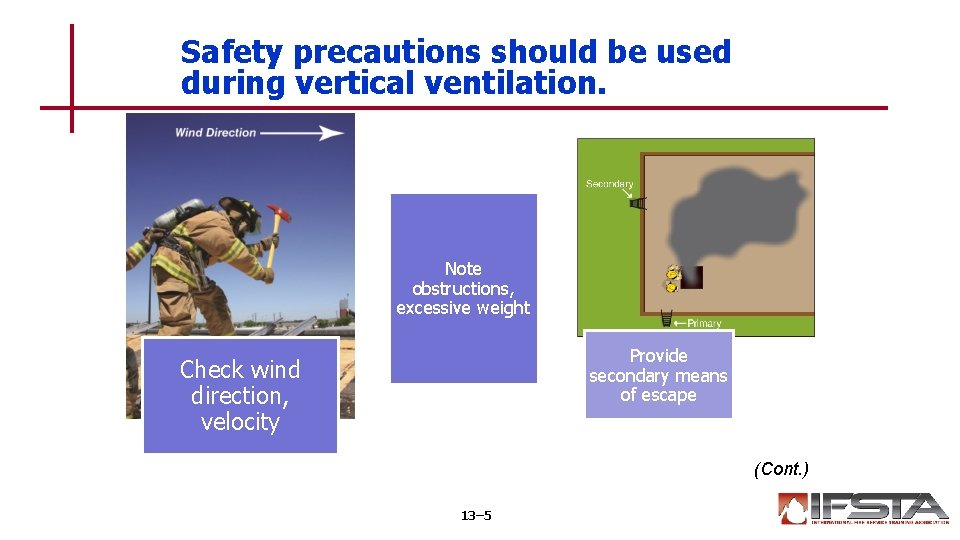
Safety precautions should be used during vertical ventilation. Note obstructions, excessive weight Provide secondary means of escape Check wind direction, velocity (Cont. ) 13– 5
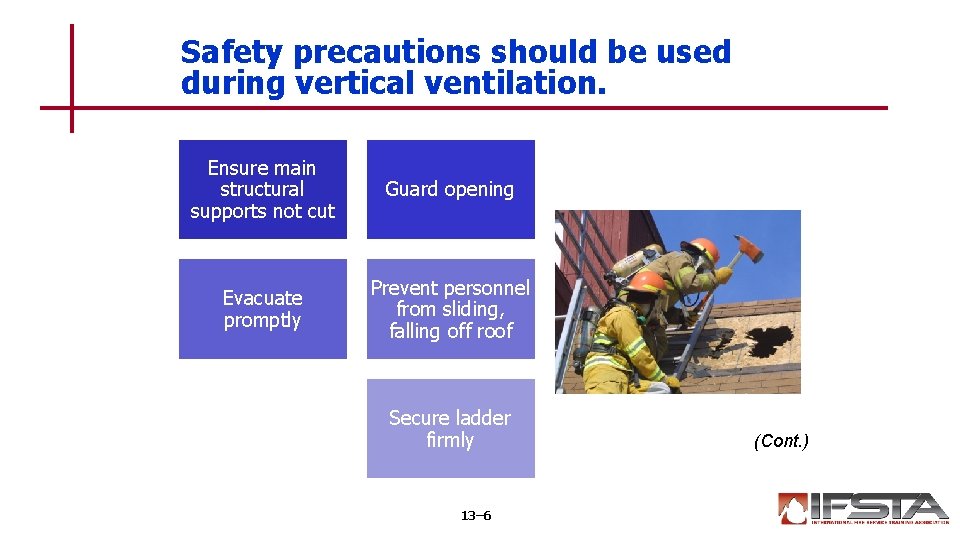
Safety precautions should be used during vertical ventilation. Ensure main structural supports not cut Guard opening Evacuate promptly Prevent personnel from sliding, falling off roof Secure ladder firmly 13– 6 (Cont. )
CAUTION Roof ladders are only meant to prevent slipping and are not intended to be used on fire-weakened roofs. 13– 7
Safety precautions should be used during vertical ventilation. Caution when around electric wires, solar panels, guy wires Remain aware of overhead obstructions Wear full PPE Keep out of range of swinging axes, power saws Power tool cautions Extend ground ladders above edge of roof or top of wall (Cont. ) 13– 8
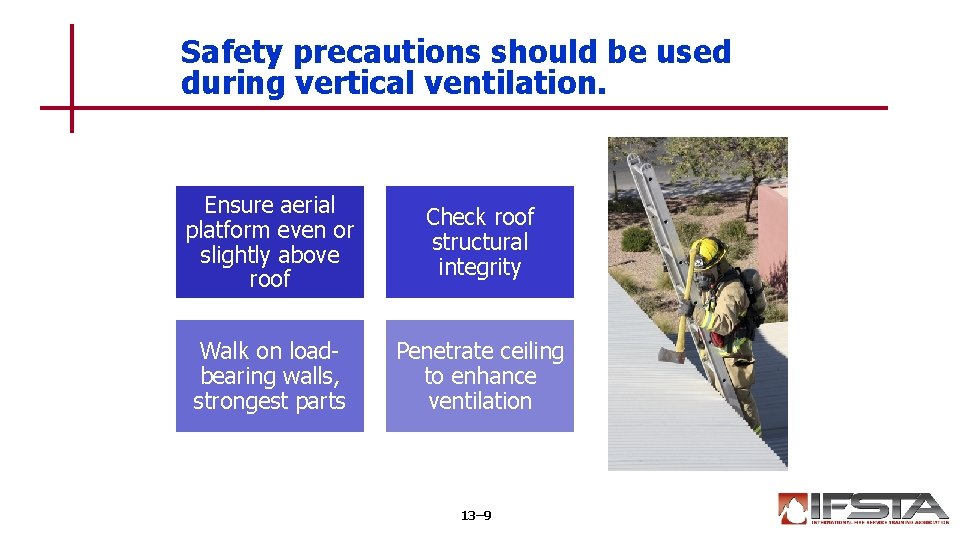
Safety precautions should be used during vertical ventilation. Ensure aerial platform even or slightly above roof Check roof structural integrity Walk on loadbearing walls, strongest parts Penetrate ceiling to enhance ventilation 13– 9
WARNING! Never direct a fire stream into a vertical exhaust opening when interior attack crews are inside the structure because it will force smoke, heat, and steam down on them. 13– 10
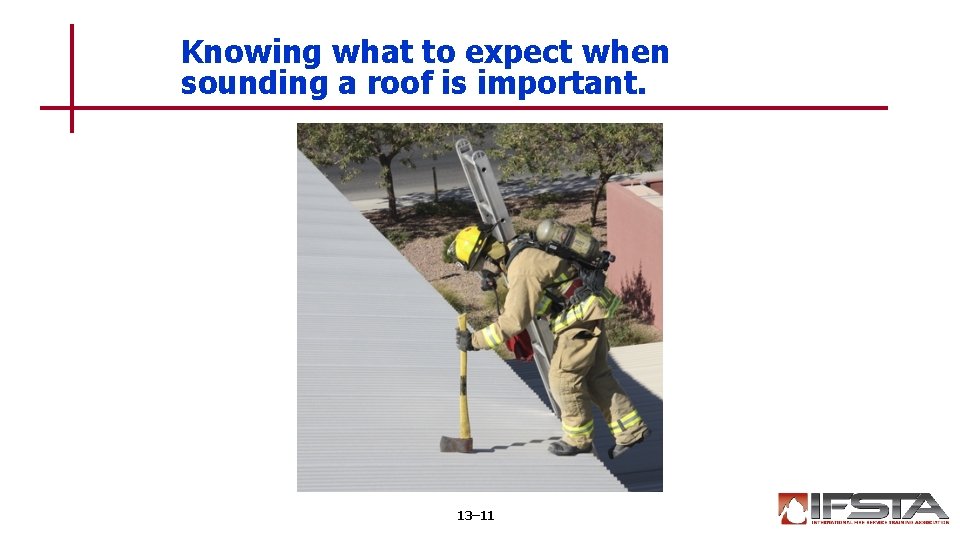
Knowing what to expect when sounding a roof is important. 13– 11
CAUTION Work in groups of at least two, but with no more personnel than absolutely necessary to perform the assigned task. 13– 12
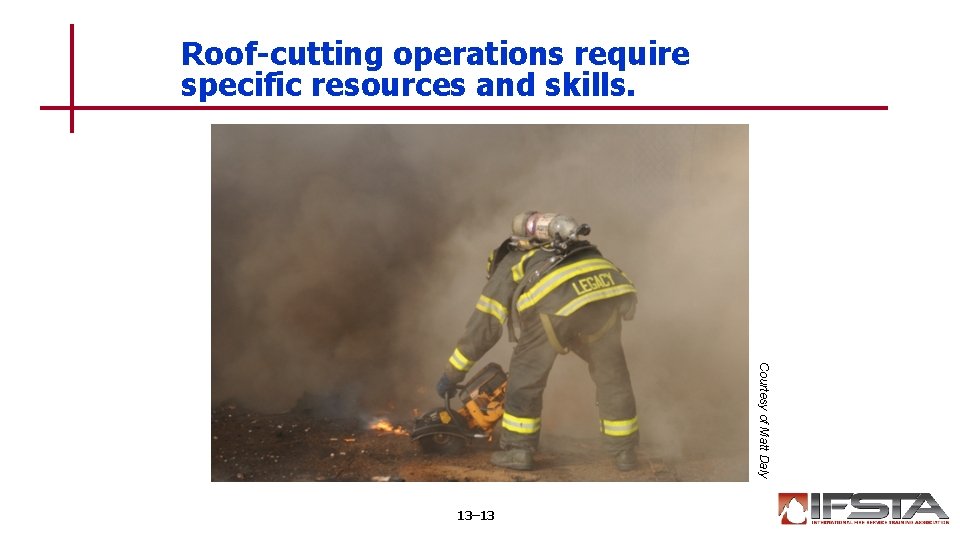
Roof-cutting operations require specific resources and skills. Courtesy of Matt Daly 13– 13
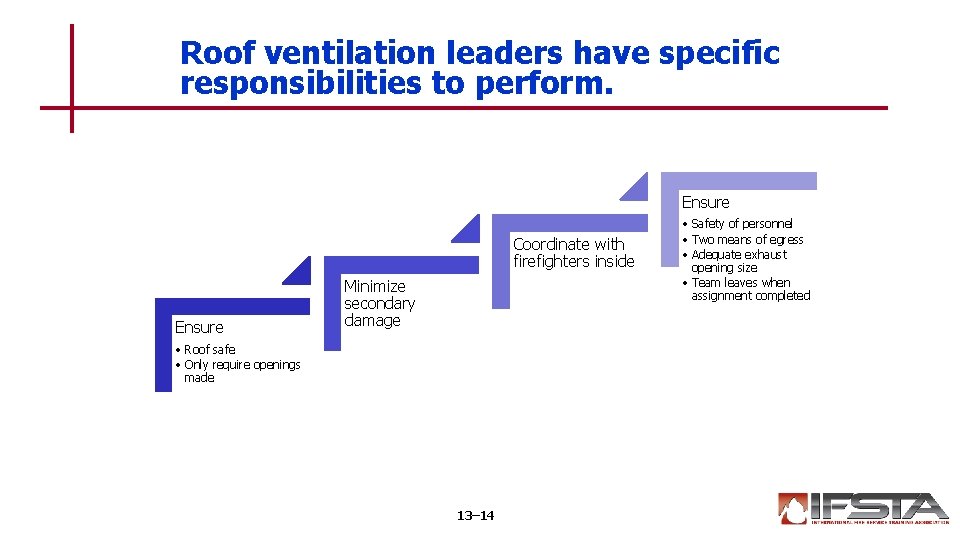
Roof ventilation leaders have specific responsibilities to perform. Ensure Coordinate with firefighters inside Ensure Minimize secondary damage • Roof safe • Only require openings made 13– 14 • Safety of personnel • Two means of egress • Adequate exhaust opening size • Team leaves when assignment completed
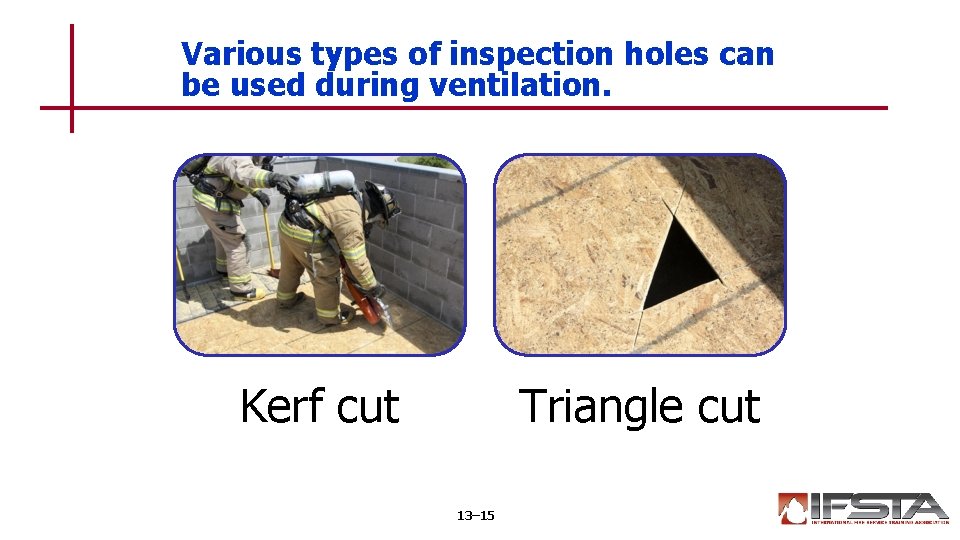
Various types of inspection holes can be used during ventilation. Kerf cut Triangle cut 13– 15
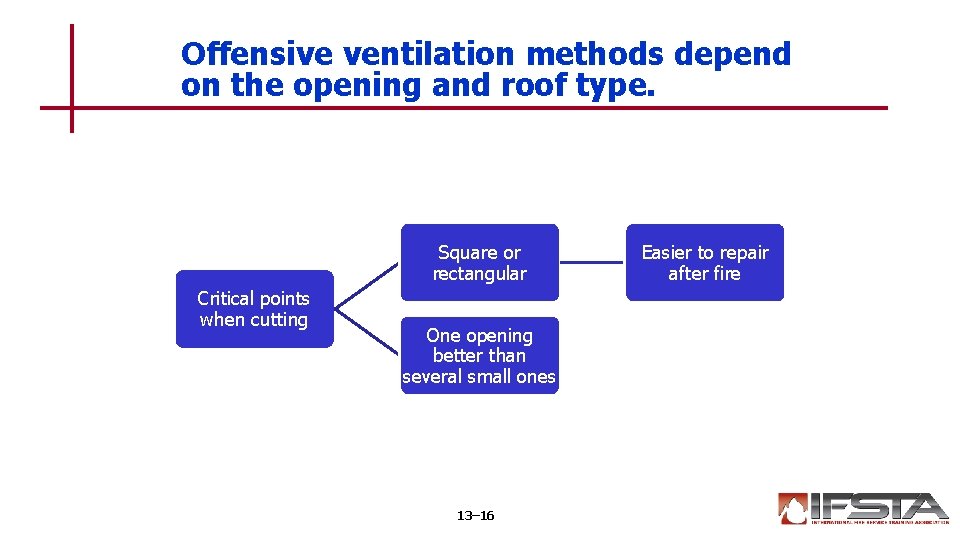
Offensive ventilation methods depend on the opening and roof type. Square or rectangular Critical points when cutting One opening better than several small ones 13– 16 Easier to repair after fire
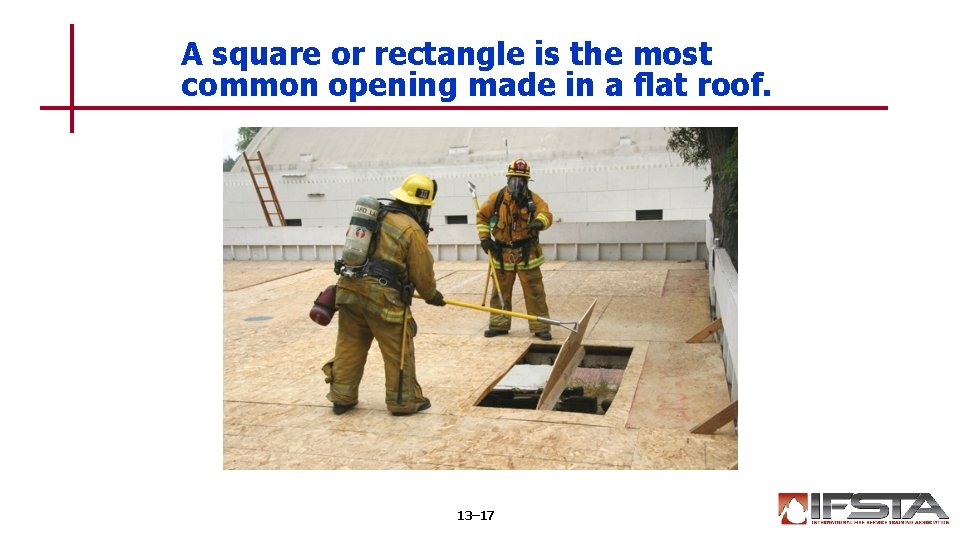
A square or rectangle is the most common opening made in a flat roof. 13– 17
Different types of roofs require different ventilation tactics. Pitched roof, shingle-covered Pitched roof, slate or tile-covered Arched roofs Metal roofs 13– 18
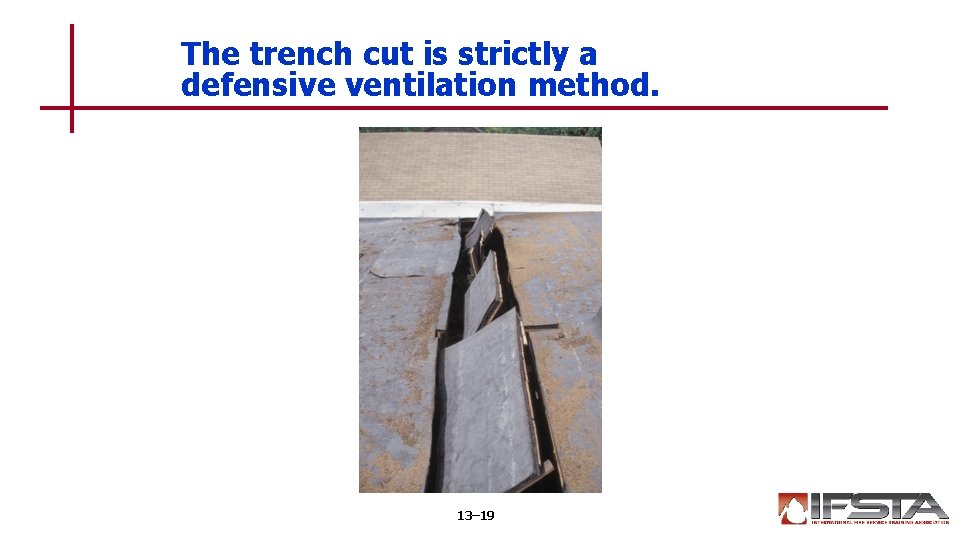
The trench cut is strictly a defensive ventilation method. 13– 19
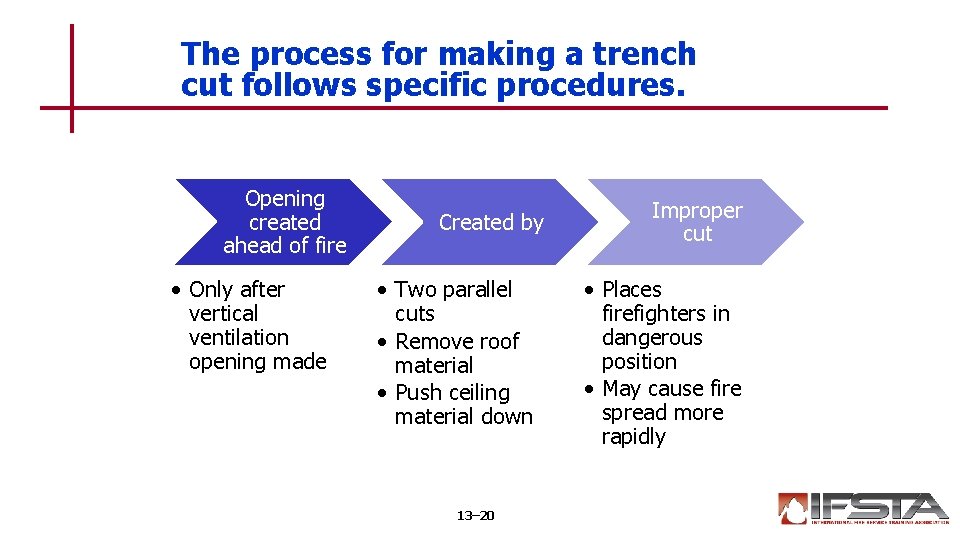
The process for making a trench cut follows specific procedures. Opening created ahead of fire • Only after vertical ventilation opening made Created by • Two parallel cuts • Remove roof material • Push ceiling material down 13– 20 Improper cut • Places firefighters in dangerous position • May cause fire spread more rapidly
REVIEW QUESTION What are the types of vertical ventilation? 13– 21
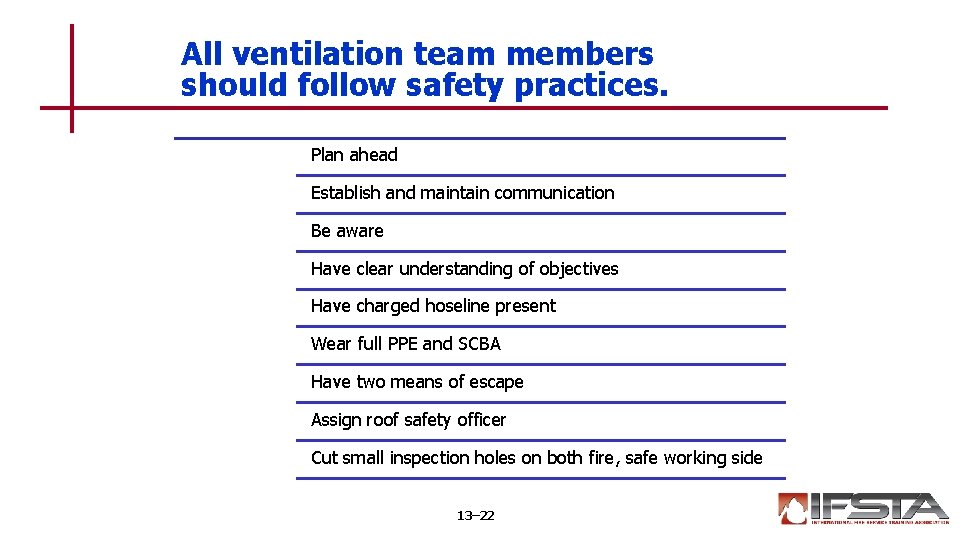
All ventilation team members should follow safety practices. Plan ahead Establish and maintain communication Be aware Have clear understanding of objectives Have charged hoseline present Wear full PPE and SCBA Have two means of escape Assign roof safety officer Cut small inspection holes on both fire, safe working side 13– 22
You should know the precautions against upsetting vertical ventilation. Factors that can reduce effectiveness Not a solution to all ventilation problems 13– 23
WARNING! Do not direct a fire stream into a ventilation opening during offensive interior operations. 13– 24
REVIEW QUESTION What differences are there between and vertical ventilation? 13– 25 horizontal
Learning Objective 8 Recognize other types of ventilation 13– 26 situations.
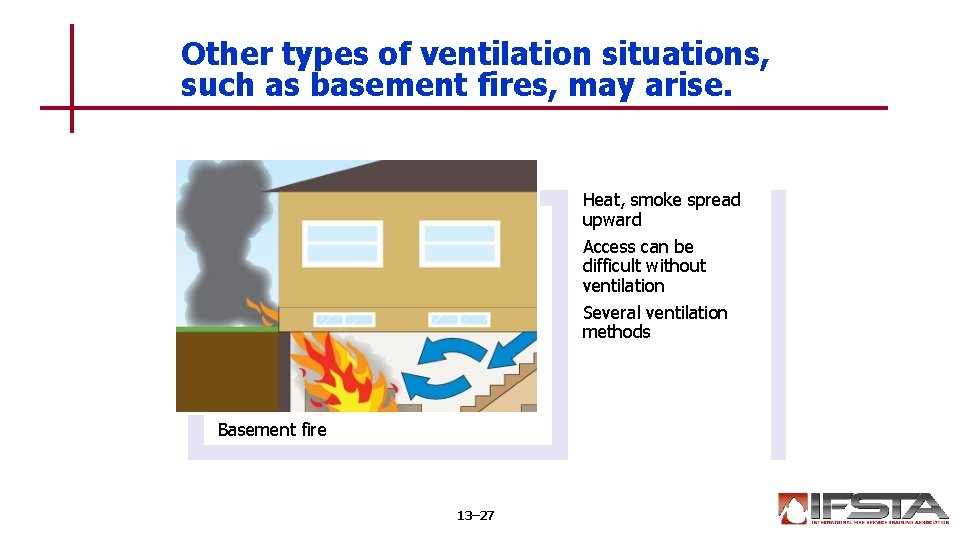
Other types of ventilation situations, such as basement fires, may arise. Heat, smoke spread upward Access can be difficult without ventilation Several ventilation methods Basement fire 13– 27
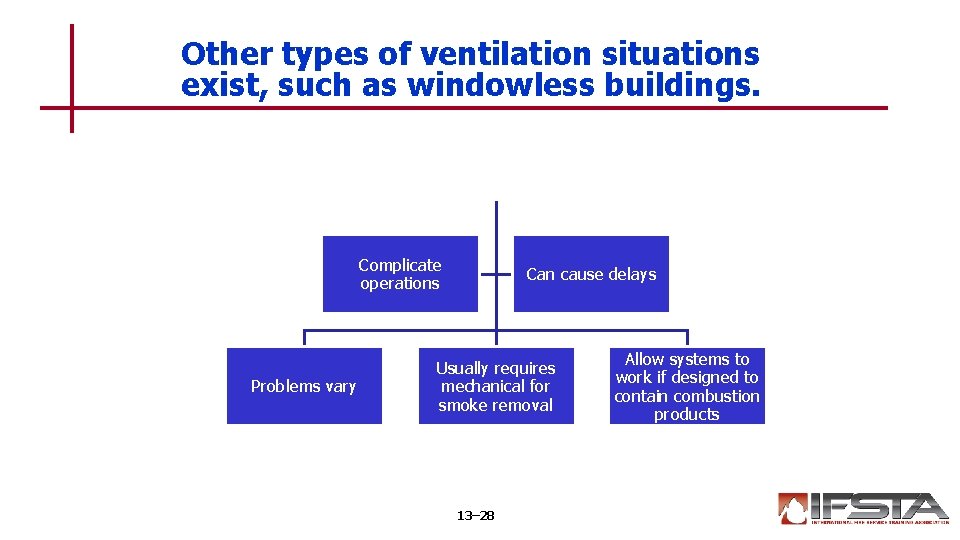
Other types of ventilation situations exist, such as windowless buildings. Windowless buildings Complicate operations Problems vary Can cause delays Usually requires mechanical for smoke removal 13– 28 Allow systems to work if designed to contain combustion products
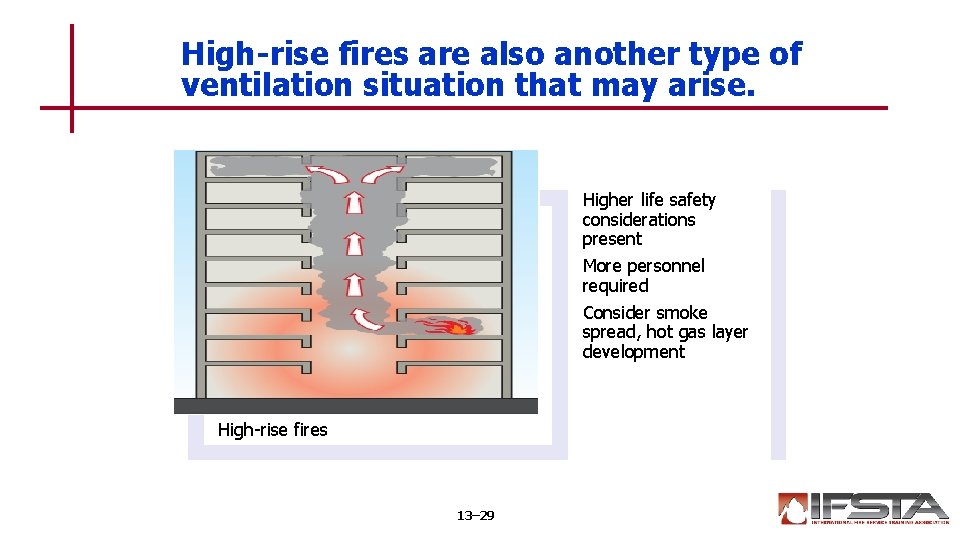
High-rise fires are also another type of ventilation situation that may arise. Higher life safety considerations present More personnel required Consider smoke spread, hot gas layer development High-rise fires 13– 29
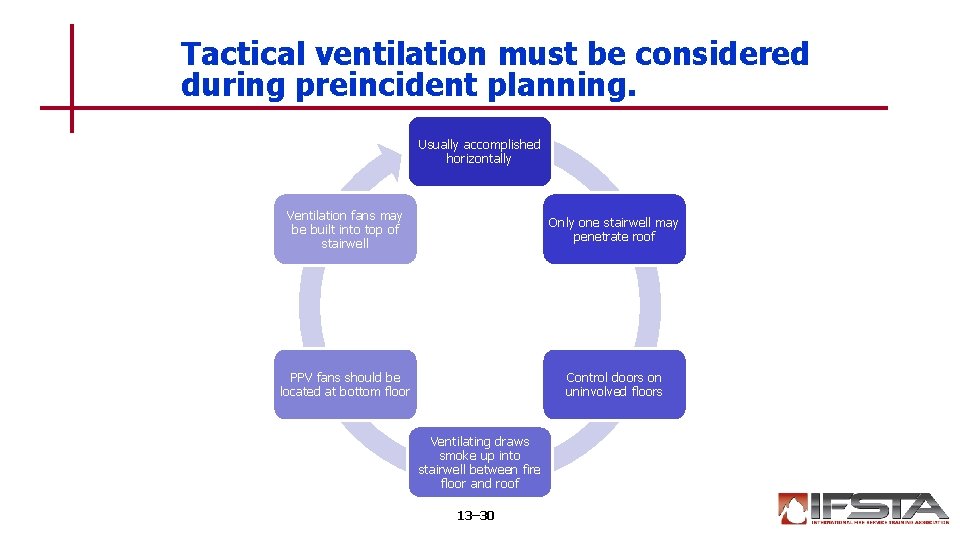
Tactical ventilation must be considered during preincident planning. Usually accomplished horizontally Ventilation fans may be built into top of stairwell Only one stairwell may penetrate roof PPV fans should be located at bottom floor Control doors on uninvolved floors Ventilating draws smoke up into stairwell between fire floor and roof 13– 30
WARNING! Do not use stairwells or elevator shafts simultaneously for both evacuation and ventilation. 13– 31
REVIEW QUESTION What other types of ventilation firefighters encounter? 13– 32 situations might
Learning Objective 9 Explain the effects of building systems on tactical ventilation. 13– 33
Ventilation will have several effects on building systems. Modern HVAC may contribute to fire spread Systems usually controlled from panel in basement, ground level Restoring system responsibility of building staff Ductwork may create additional fire damage 13– 34
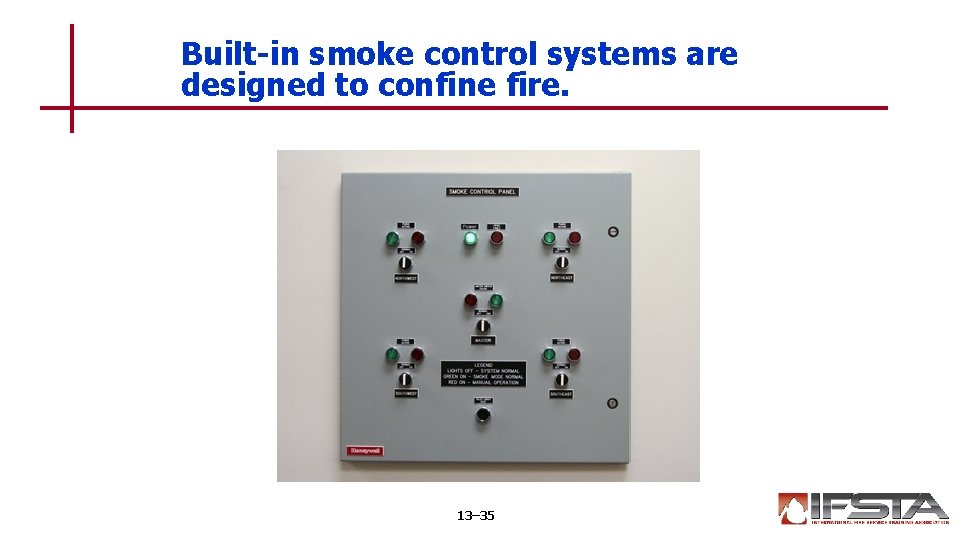
Built-in smoke control systems are designed to confine fire. 13– 35
WARNING! Do not attempt to operate building systems that assist in ventilation. 13– 36
REVIEW QUESTION How can a built-in heating ventilation and air conditioning (HVAC) system affect tactical ventilation? 13– 37
Summary • Tactical ventilation of a burning building allows heat, smoke, and fire gases to escape to the atmosphere and also draws fresh air into the building. • Properly applied tactical ventilation allows firefighters to see better, locate victims more easily, and find the seat of the fire sooner. (Cont. ) 13– 38
Summary • Tactical ventilation limits fire spread and channels heat and smoke away from trapped victims; but must be correctly coordinated. (Cont. ) 13– 39
Summary • Firefighters must understand fire behavior, know various ventilation methods and have knowledge of roof construction and know how to create exhaust openings in all types of roofs that have a variety of openings in order to perform ventilation correctly. 13– 40
- Slides: 40