
Learning Object Repositories a learner centered perspective Juli

Learning Object Repositories: a learner centered perspective Julià Minguillón Universitat Oberta de Catalunya Ed. Re. Ne – 4 th Strategic Seminar, March 24 th - March 26 th 2010, Barcelona, Spain
Table of contents • • Learning Objects and Repositories LOR for Statistical resources Virtual Learning Environments Idealizing a LOR Our reality: DSpace Improving learner’s experience Open issues J. Minguillón Ed. Re. Ne – 4 th Strategic Seminar, March 24 th - March 26 th 2010, Barcelona, Spain
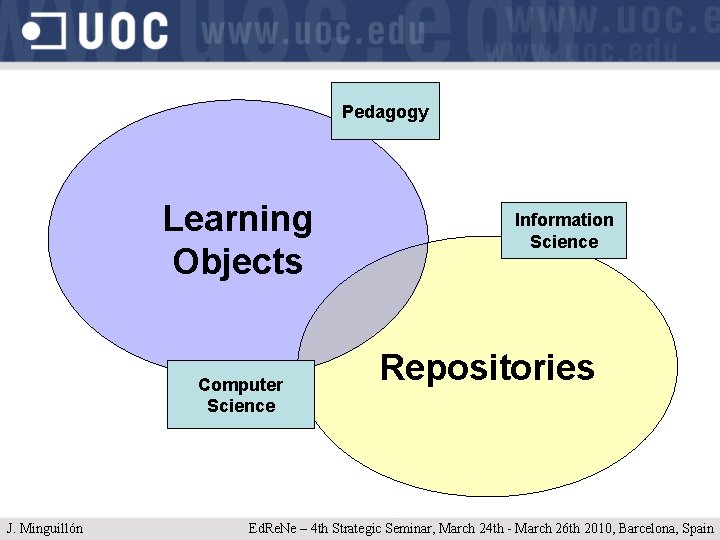
Pedagogy Learning Objects Computer Science J. Minguillón Information Science Repositories Ed. Re. Ne – 4 th Strategic Seminar, March 24 th - March 26 th 2010, Barcelona, Spain
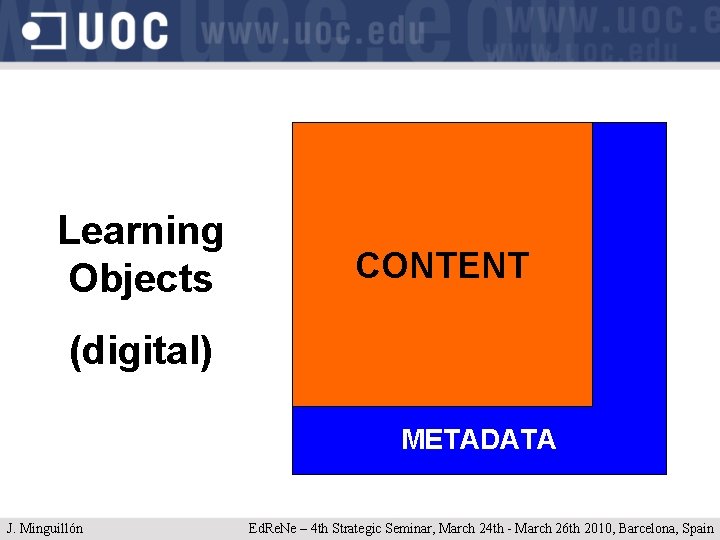
Learning Objects CONTENT (digital) METADATA J. Minguillón Ed. Re. Ne – 4 th Strategic Seminar, March 24 th - March 26 th 2010, Barcelona, Spain
Learning Objects • Main goals: – Help learners to acquire and develop a competence, skill, ability, … – Help teachers (and learners) to create new LOs • Desired characteristics: – Small to medium granularity – Described according to educational purposes – High level of connections between LOs J. Minguillón Ed. Re. Ne – 4 th Strategic Seminar, March 24 th - March 26 th 2010, Barcelona, Spain
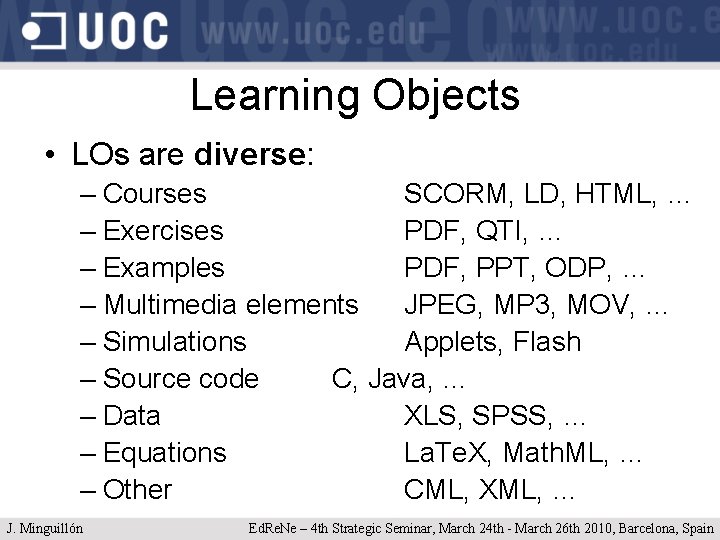
Learning Objects • LOs are diverse: – Courses SCORM, LD, HTML, … – Exercises PDF, QTI, … – Examples PDF, PPT, ODP, … – Multimedia elements JPEG, MP 3, MOV, … – Simulations Applets, Flash – Source code C, Java, … – Data XLS, SPSS, … – Equations La. Te. X, Math. ML, … – Other CML, XML, … J. Minguillón Ed. Re. Ne – 4 th Strategic Seminar, March 24 th - March 26 th 2010, Barcelona, Spain

Learning Object Metadata • Proposed metadata scheme: IEEE LOM – 9 categories including Technical, Educational, Relation and Classification – No required fields but plenty of them (> 70) – Can be “reduced” to unqualified Dublin Core • But, what the □ □ is “ 5. 4 Semantic density”? • Who will fill out over 70 fields? • What is the title of an exercise? J. Minguillón Ed. Re. Ne – 4 th Strategic Seminar, March 24 th - March 26 th 2010, Barcelona, Spain
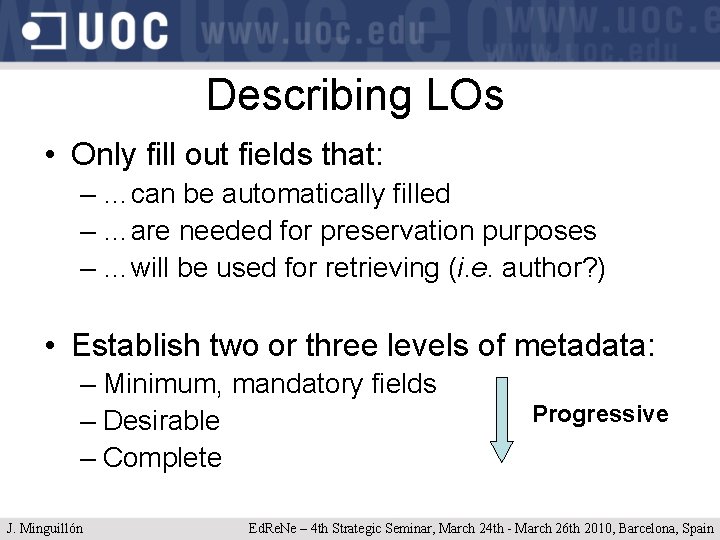
Describing LOs • Only fill out fields that: – …can be automatically filled – …are needed for preservation purposes – …will be used for retrieving (i. e. author? ) • Establish two or three levels of metadata: – Minimum, mandatory fields – Desirable – Complete J. Minguillón Progressive Ed. Re. Ne – 4 th Strategic Seminar, March 24 th - March 26 th 2010, Barcelona, Spain
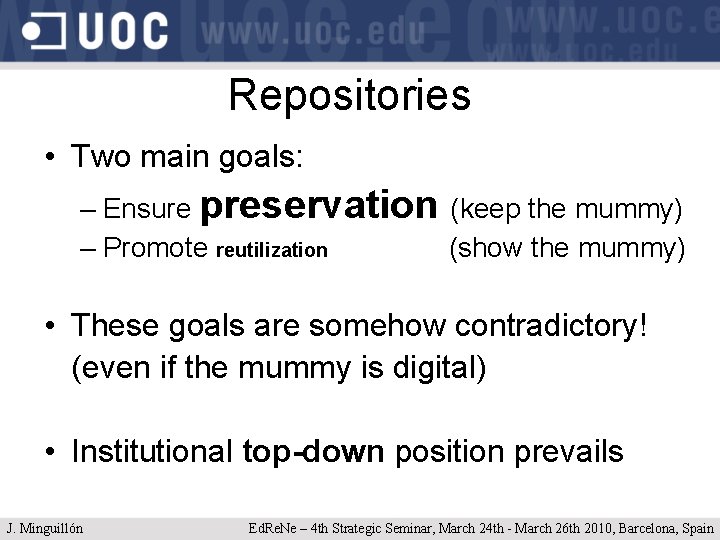
Repositories • Two main goals: – Ensure preservation (keep the mummy) – Promote reutilization (show the mummy) • These goals are somehow contradictory! (even if the mummy is digital) • Institutional top-down position prevails J. Minguillón Ed. Re. Ne – 4 th Strategic Seminar, March 24 th - March 26 th 2010, Barcelona, Spain
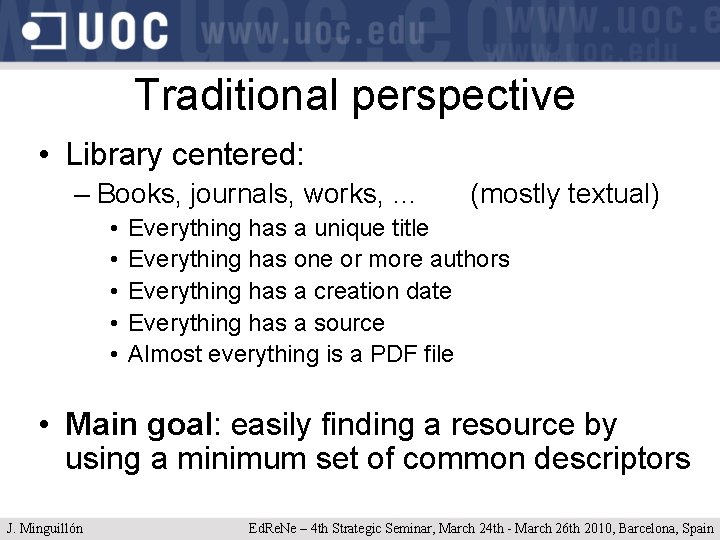
Traditional perspective • Library centered: – Books, journals, works, … • • • (mostly textual) Everything has a unique title Everything has one or more authors Everything has a creation date Everything has a source Almost everything is a PDF file • Main goal: easily finding a resource by using a minimum set of common descriptors J. Minguillón Ed. Re. Ne – 4 th Strategic Seminar, March 24 th - March 26 th 2010, Barcelona, Spain
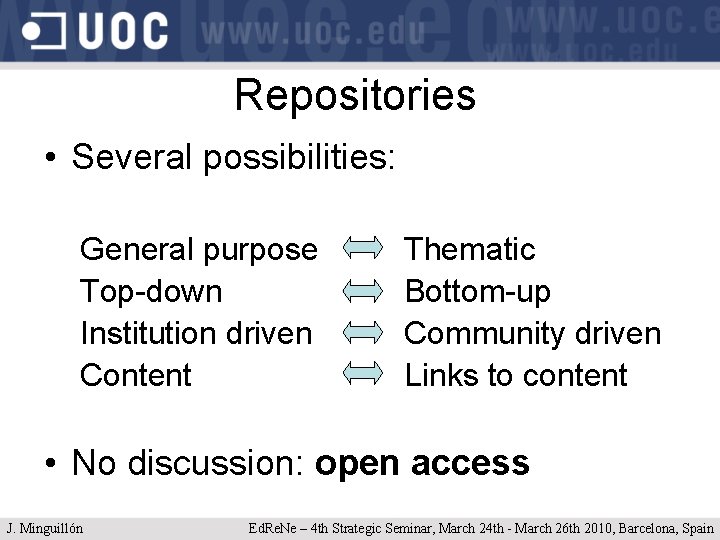
Repositories • Several possibilities: General purpose Top-down Institution driven Content Thematic Bottom-up Community driven Links to content • No discussion: open access J. Minguillón Ed. Re. Ne – 4 th Strategic Seminar, March 24 th - March 26 th 2010, Barcelona, Spain
Case of study: LOR on Statistics • Why Statistics? – Basic competences for the Information Society – Compulsory course for several degrees – Thousands of students each semester (≈ 4000) – Large collection of heterogeneous resources • Known problems: – “There are too many resources” – “I don’t know how to start” – “I can’t link concepts and tools” J. Minguillón Ed. Re. Ne – 4 th Strategic Seminar, March 24 th - March 26 th 2010, Barcelona, Spain
Our proposal • From a teaching perspective: – Build a thematic open LOR on Statistics – Bottom-up approach (teachers) – Integrate the LOR into the learning process – Engage learners into using the LOR • From a research perspective: – Learning by doing – Create better user interfaces for LORs – Analyze user behavior J. Minguillón Ed. Re. Ne – 4 th Strategic Seminar, March 24 th - March 26 th 2010, Barcelona, Spain
Key factors for LOR success • Three dimensions (Mc. Naught, 2006): – Resources: what? – Actions: how? – Users: who? • Why? (Margaryan and Littlejohn, 2008) • User Centered Design methodology J. Minguillón Ed. Re. Ne – 4 th Strategic Seminar, March 24 th - March 26 th 2010, Barcelona, Spain
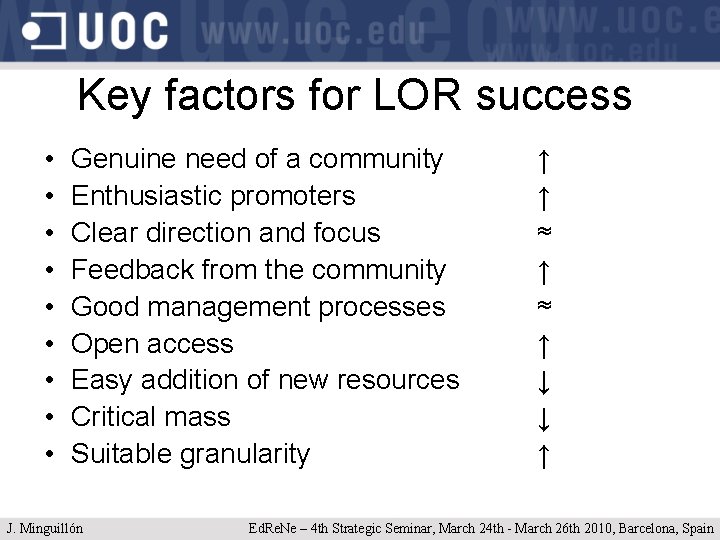
Key factors for LOR success • • • Genuine need of a community Enthusiastic promoters Clear direction and focus Feedback from the community Good management processes Open access Easy addition of new resources Critical mass Suitable granularity J. Minguillón ↑ ↑ ≈ ↑ ↓ ↓ ↑ Ed. Re. Ne – 4 th Strategic Seminar, March 24 th - March 26 th 2010, Barcelona, Spain
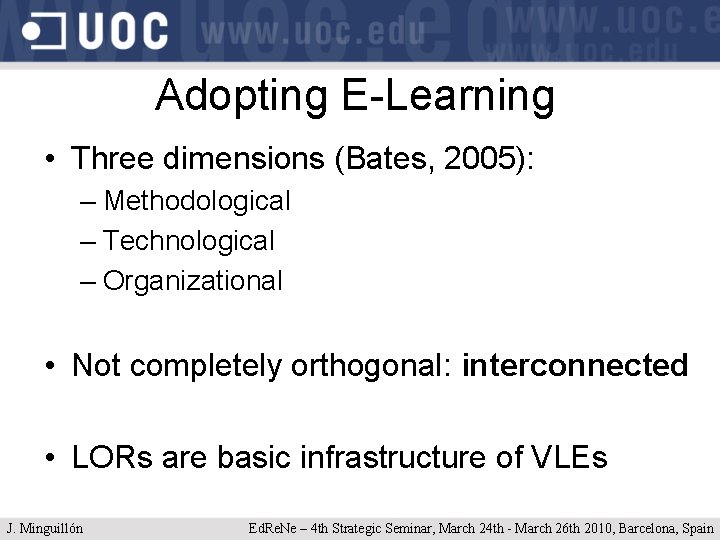
Adopting E-Learning • Three dimensions (Bates, 2005): – Methodological – Technological – Organizational • Not completely orthogonal: interconnected • LORs are basic infrastructure of VLEs J. Minguillón Ed. Re. Ne – 4 th Strategic Seminar, March 24 th - March 26 th 2010, Barcelona, Spain
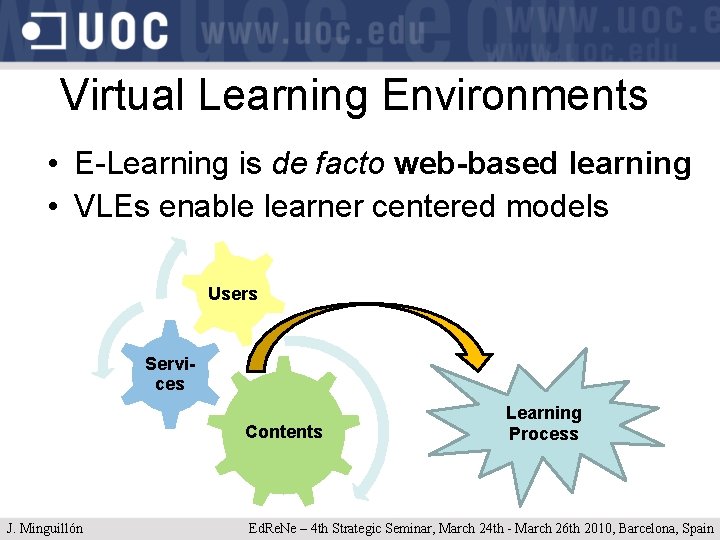
Virtual Learning Environments • E-Learning is de facto web-based learning • VLEs enable learner centered models Users Services Contents J. Minguillón Learning Process Ed. Re. Ne – 4 th Strategic Seminar, March 24 th - March 26 th 2010, Barcelona, Spain
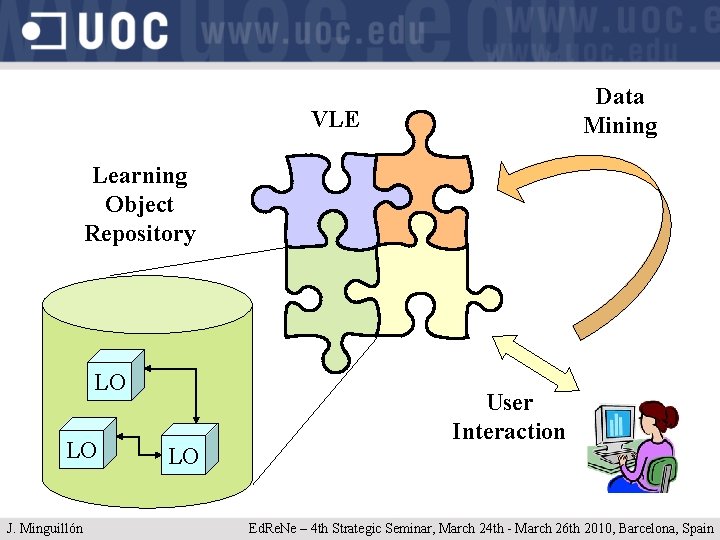
Data Mining VLE Learning Object Repository LO LO J. Minguillón LO User Interaction Ed. Re. Ne – 4 th Strategic Seminar, March 24 th - March 26 th 2010, Barcelona, Spain
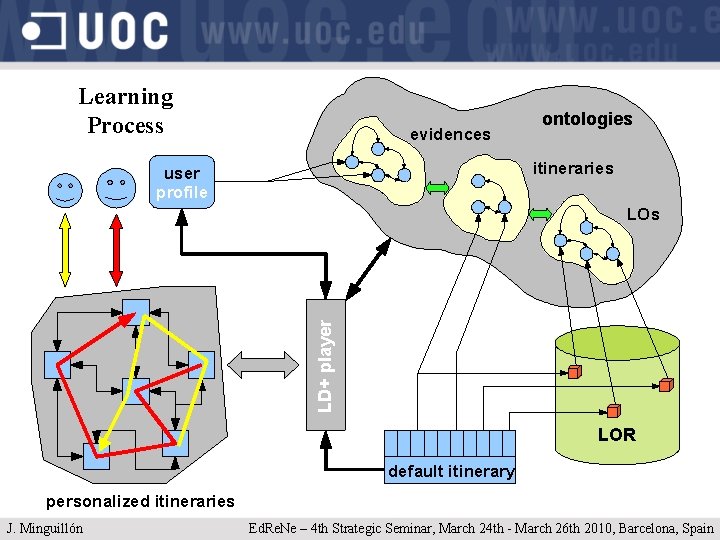
Learning Process evidences ontologies itineraries user profile LD+ player LOs LOR default itinerary personalized itineraries J. Minguillón Ed. Re. Ne – 4 th Strategic Seminar, March 24 th - March 26 th 2010, Barcelona, Spain
Critical issues in LOR design • Methodological: (Wiley, 2007) – Learning is more than just content • Technological (back-end + user interface): – Learning is more than just browsing and searching LOs • Organizational: – Workflow, licenses, metadata, policies, … J. Minguillón Ed. Re. Ne – 4 th Strategic Seminar, March 24 th - March 26 th 2010, Barcelona, Spain
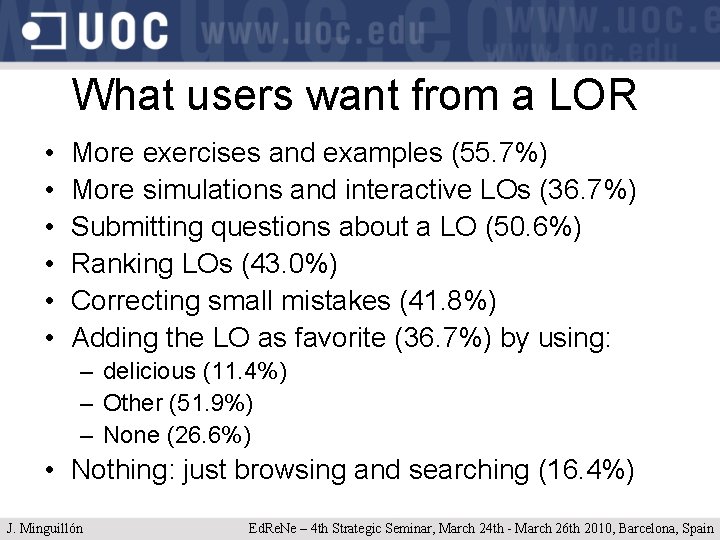
What users want from a LOR • • • More exercises and examples (55. 7%) More simulations and interactive LOs (36. 7%) Submitting questions about a LO (50. 6%) Ranking LOs (43. 0%) Correcting small mistakes (41. 8%) Adding the LO as favorite (36. 7%) by using: – delicious (11. 4%) – Other (51. 9%) – None (26. 6%) • Nothing: just browsing and searching (16. 4%) J. Minguillón Ed. Re. Ne – 4 th Strategic Seminar, March 24 th - March 26 th 2010, Barcelona, Spain
Ideal LOR • Basic premise: the act of browsing and/or searching for resources should be a learning experience in itself – LOs are not isolated pieces – “Developing” requires knowing “from” and “to” – Users should be able to organize LOs – Connectivism (Siemens, 2005) • Ideal UI: conceptual map + “social layer” J. Minguillón Ed. Re. Ne – 4 th Strategic Seminar, March 24 th - March 26 th 2010, Barcelona, Spain
Ideal LOR • Basic premise: once a LO has been found, learners should be able to – Rate – Make comments / questions – Make favorite – Share – Subscribe • The LO becomes part of learner’s context J. Minguillón Ed. Re. Ne – 4 th Strategic Seminar, March 24 th - March 26 th 2010, Barcelona, Spain
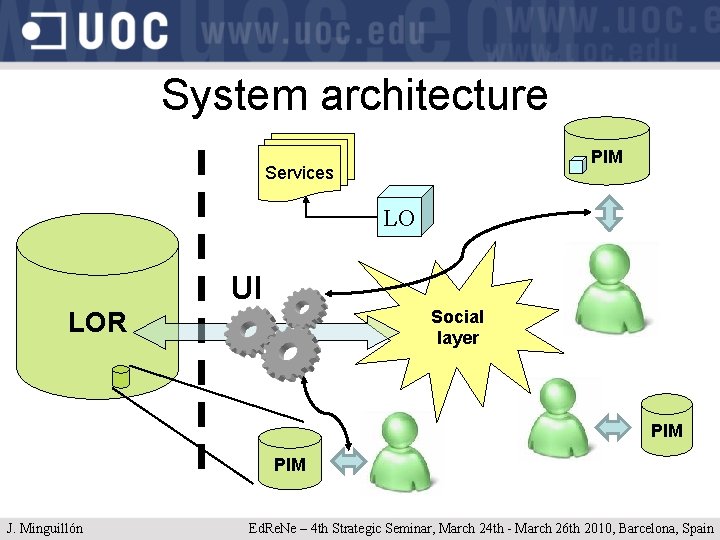
System architecture PIM Services LO UI Social layer LOR PIM J. Minguillón Ed. Re. Ne – 4 th Strategic Seminar, March 24 th - March 26 th 2010, Barcelona, Spain
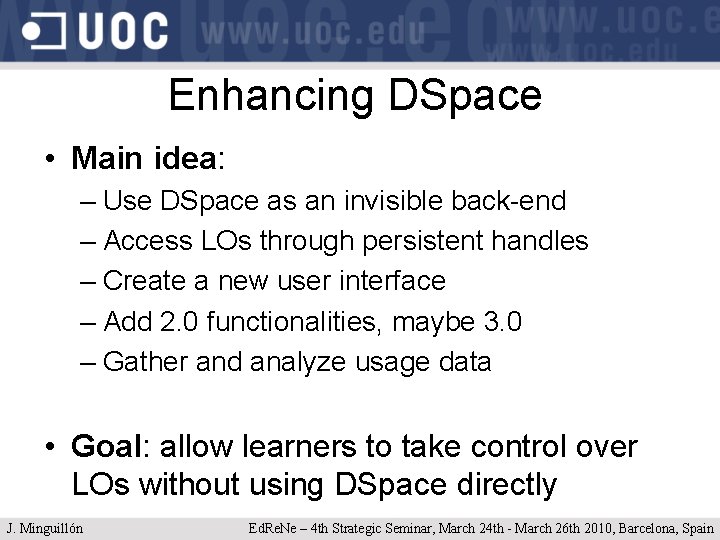
Enhancing DSpace • Main idea: – Use DSpace as an invisible back-end – Access LOs through persistent handles – Create a new user interface – Add 2. 0 functionalities, maybe 3. 0 – Gather and analyze usage data • Goal: allow learners to take control over LOs without using DSpace directly J. Minguillón Ed. Re. Ne – 4 th Strategic Seminar, March 24 th - March 26 th 2010, Barcelona, Spain
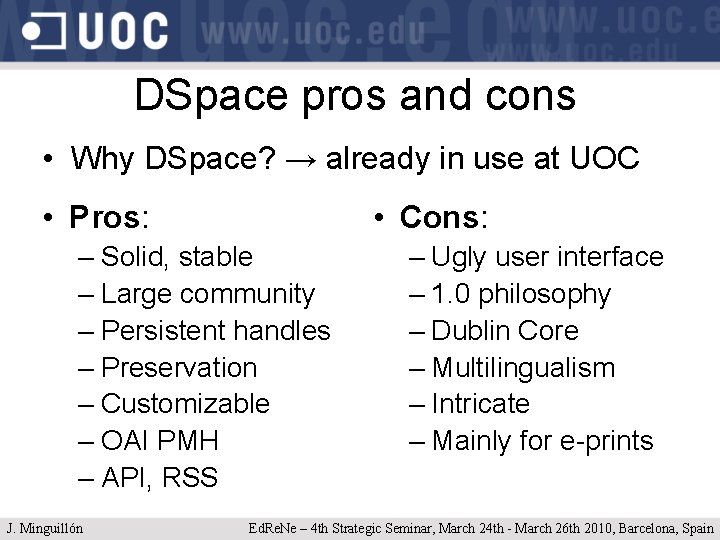
DSpace pros and cons • Why DSpace? → already in use at UOC • Pros: • Cons: – Solid, stable – Large community – Persistent handles – Preservation – Customizable – OAI PMH – API, RSS J. Minguillón – Ugly user interface – 1. 0 philosophy – Dublin Core – Multilingualism – Intricate – Mainly for e-prints Ed. Re. Ne – 4 th Strategic Seminar, March 24 th - March 26 th 2010, Barcelona, Spain
Improving interaction • • Avoid Google-like searches Contextualized browsing Refine search results while being built Return only a few relevant LOs Visualize related LOs Allow learners to use web 2. 0 services Widget-ize available services J. Minguillón Ed. Re. Ne – 4 th Strategic Seminar, March 24 th - March 26 th 2010, Barcelona, Spain
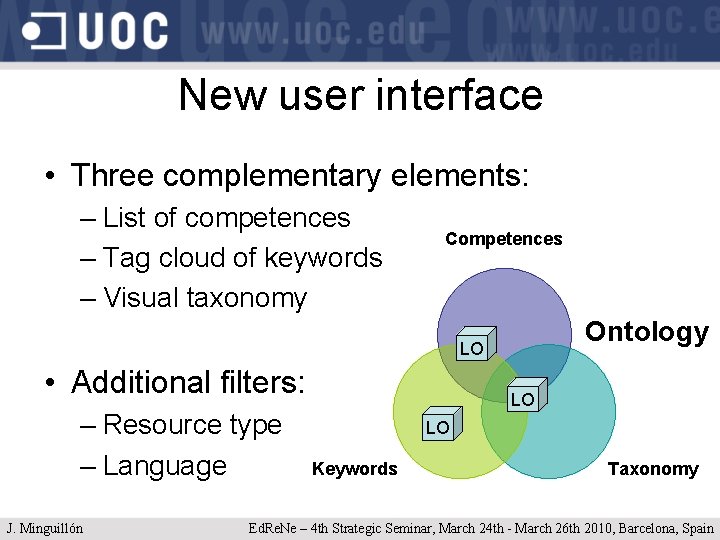
New user interface • Three complementary elements: – List of competences – Tag cloud of keywords – Visual taxonomy Competences Ontology LO • Additional filters: – Resource type – Language J. Minguillón LO LO Keywords Taxonomy Ed. Re. Ne – 4 th Strategic Seminar, March 24 th - March 26 th 2010, Barcelona, Spain
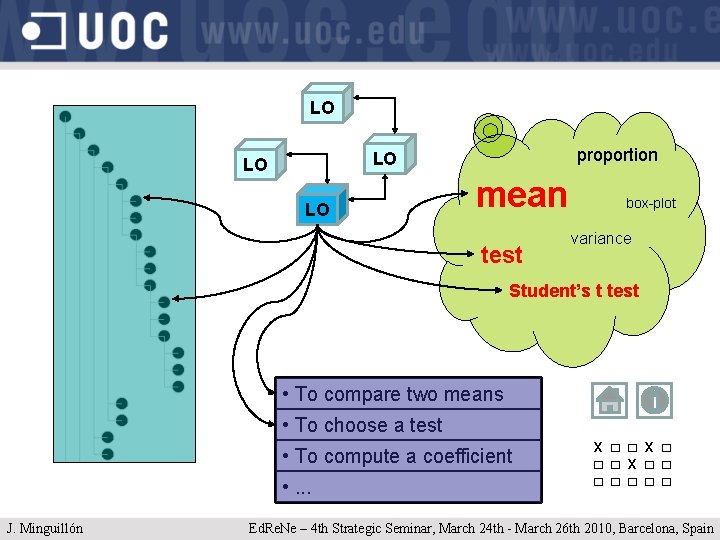
LO proportion LO LO LO mean test box-plot variance Student’s t test • To compare two means • To choose a test • To compute a coefficient • . . . J. Minguillón x□□ x□□ □□□□□ Ed. Re. Ne – 4 th Strategic Seminar, March 24 th - March 26 th 2010, Barcelona, Spain
Open issues • • • IEEE LOM vs Dublin Core and OAI PMH Filter and then find vs find and then filter Use of upper ontologies for describing LOs Combining thematic repositories Multilingualism: UI, content and metadata Usability, accessibility and mobility issues • Ideas, people and funding are welcome!!! J. Minguillón Ed. Re. Ne – 4 th Strategic Seminar, March 24 th - March 26 th 2010, Barcelona, Spain
References and bibliography • • Bates, A. W. (2005). Technology, E-learning and Distance Education, Routledge. Margaryan, A. and Littlejohn, A. (2008). Repositories and communities at cross-purposes: issues in sharing and reuse of digital learning resources. Journal of Computer Assisted Learning, 24, 333 -347. Mc. Naught, C. (2006). Are Learning Repositories Likely To Become Mainstream In Education? In: Proceedings of the 2 nd International Conference on Web Information Systems and Technologies, Setubal, Portugal, 11 -13 April, IS 9 -IS 17. Siemens, G. (2005). Connectivism: A learning theory for the digital age. International Journal of Instructional Technology and Distance Learning. 2(1), 3– 10. Wiley, D. (2007). Content is infrastructure. Terra incognita. Available at http: //blog. worldcampus. psu. edu/index. php/2007/10/03/content-is-infrastructure/ Mc. Greal, R. (2004). Learning Objects: A Practical definition. International Journal of Instructional Technology and Distance Learning, 1(9). Monge, S. ; Ovelar, R. ; Azpeitia, I. (2008). “Repository 2. 0: Social Dynamics to Support Community Building in Learning Object Repositories“. Interdisciplinary Journal of E-Learning and Learning Objects (formerly IJKLO), 4. Thomas, A. and Rothery, A. (2005). Online repositories for learning materials: the user perspective. Ariadne, 45. Available at: http: //www. ariadne. ac. uk/issue 45/thomas-rothery/ J. Minguillón Ed. Re. Ne – 4 th Strategic Seminar, March 24 th - March 26 th 2010, Barcelona, Spain
Thank you! • Contact information: Julià Minguillón jminguillona@uoc. edu CC-BY-NC-SA http: //www. slideshare. net/jminguillona J. Minguillón Ed. Re. Ne – 4 th Strategic Seminar, March 24 th - March 26 th 2010, Barcelona, Spain
- Slides: 32