
Learning Needs Assessment What is the value of
- Slides: 14
Learning Needs Assessment
What is the value of conducting a learning needs assessment? � Primary use is to identify and prioritize information for the purpose of setting goals and objectives, planning instruction, and evaluating learning � What are other values?
What is the value of conducting a learning needs assessment? � Ensure that optimal learning can occur with least amount of learner stress and anxiety � Prevent needless repetition of known material � Save time and energy on the part of the learner and teacher � Increase motivation to learn
PSA--DSA � The gap between PSA and DSA is the learning need (cognitive, affective, psychomotor) � The learner may perceive the gap or may need to be shown the gap � The gap can be broken into segments so as not to overwhelm the learner � The learner may not relate to the teacher’s DSA but will learn based on a personal DSA
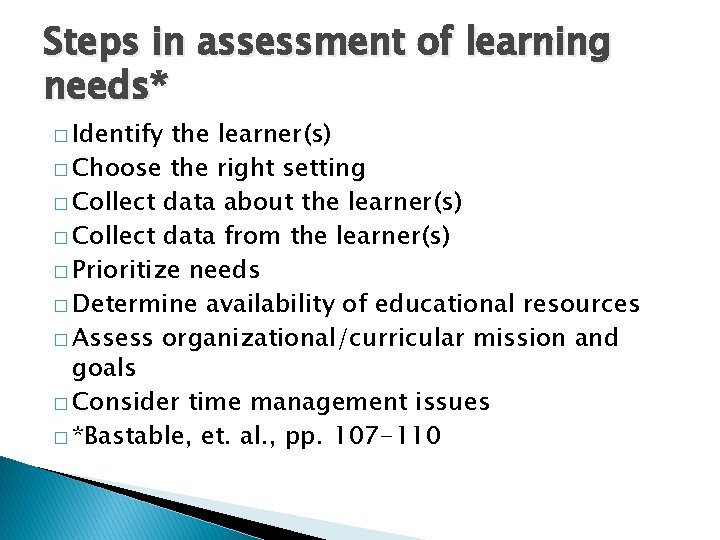
Steps in assessment of learning needs* � Identify the learner(s) � Choose the right setting � Collect data about the learner(s) � Collect data from the learner(s) � Prioritize needs � Determine availability of educational resources � Assess organizational/curricular mission and goals � Consider time management issues � *Bastable, et. al. , pp. 107 -110
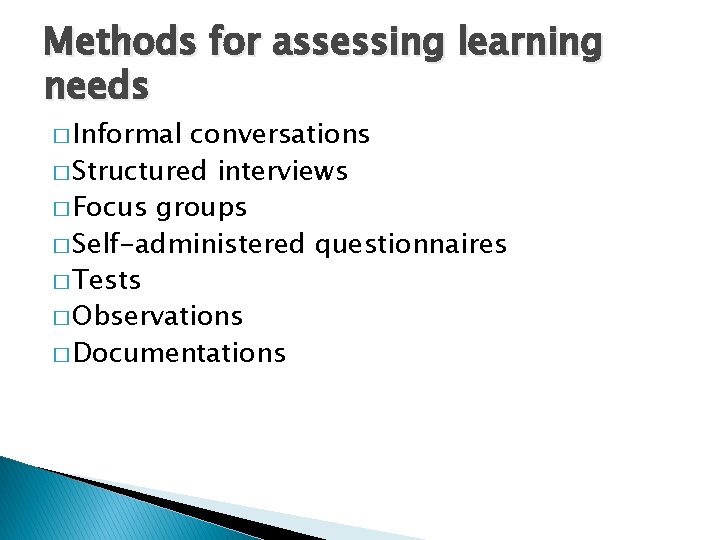
Methods for assessing learning needs � Informal conversations � Structured interviews � Focus groups � Self-administered questionnaires � Tests � Observations � Documentations
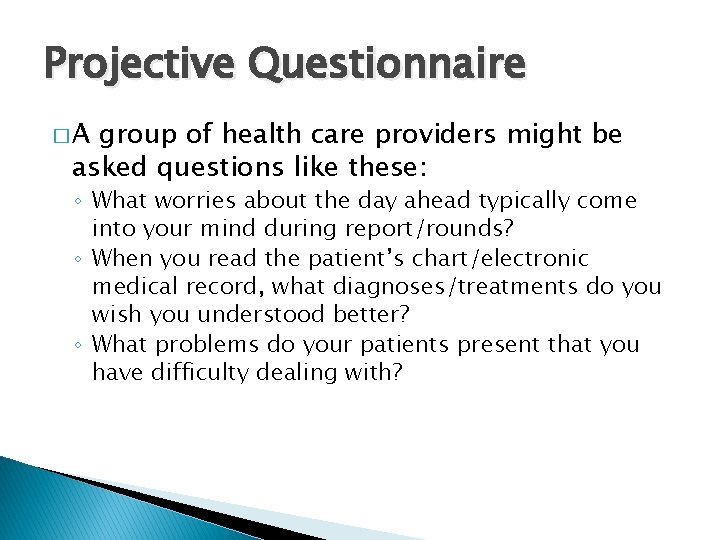
Projective Questionnaire �A group of health care providers might be asked questions like these: ◦ What worries about the day ahead typically come into your mind during report/rounds? ◦ When you read the patient’s chart/electronic medical record, what diagnoses/treatments do you wish you understood better? ◦ What problems do your patients present that you have difficulty dealing with?
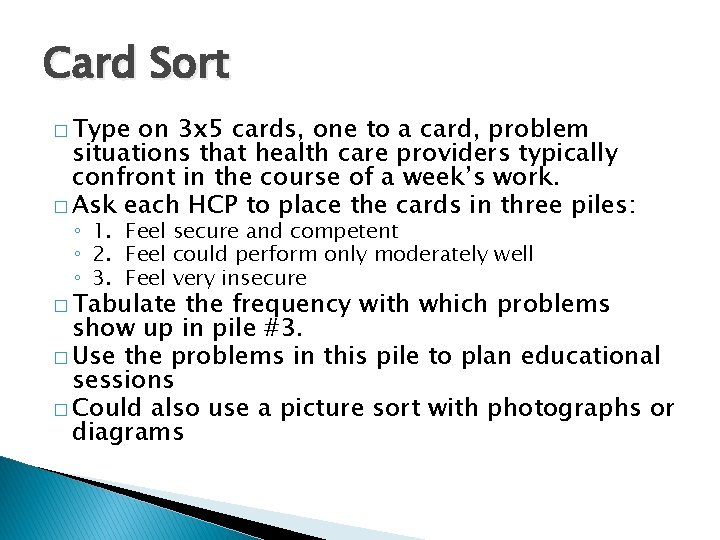
Card Sort � Type on 3 x 5 cards, one to a card, problem situations that health care providers typically confront in the course of a week’s work. � Ask each HCP to place the cards in three piles: ◦ 1. Feel secure and competent ◦ 2. Feel could perform only moderately well ◦ 3. Feel very insecure � Tabulate the frequency with which problems show up in pile #3. � Use the problems in this pile to plan educational sessions � Could also use a picture sort with photographs or diagrams
Sentence-completion Questionnaire � Ask the HCP to complete sentences with such beginnings as: ◦ When I hear morning report/attend rounds I think about… ◦ As a HCP(fill in the specific role/specialty), I wish I… ◦ When I think about the future of health care, I…
Readiness to learn
PEEK Model for Readiness to Learn � P=Physical readiness ◦ Measures of ability (fine and/or gross motor movements, sensory acuity, adequate strength, flexibility, coordination, endurance) ◦ Complexity of task (will affect the extent to which behavioral changes in the domains can be mastered by the learner; also comes into play when unlearning/new learning is required) ◦ Environmental effects (distraction, including noise or frequent interruptions; value of self-pacing) ◦ Health status (energy available, comfort level) ◦ Gender (much of the difference is socially induced)
PEEK Model for Readiness to Learn � E=Emotional readiness ◦ Anxiety level (impacts on learner’s ability to concentrate and retain information; fear is a major contributor) ◦ Support system (important in buffering effects of stressful events; teacher can create reachable moment by supporting leaner; this sets the stage for the teachable moment) ◦ Risk-taking behavior (need to help learner to develop strategies for minimizing risk) ◦ Frame of mind (concern about the “here and now” versus the future) ◦ Developmental stage (each developmental task produces a teachable moment)
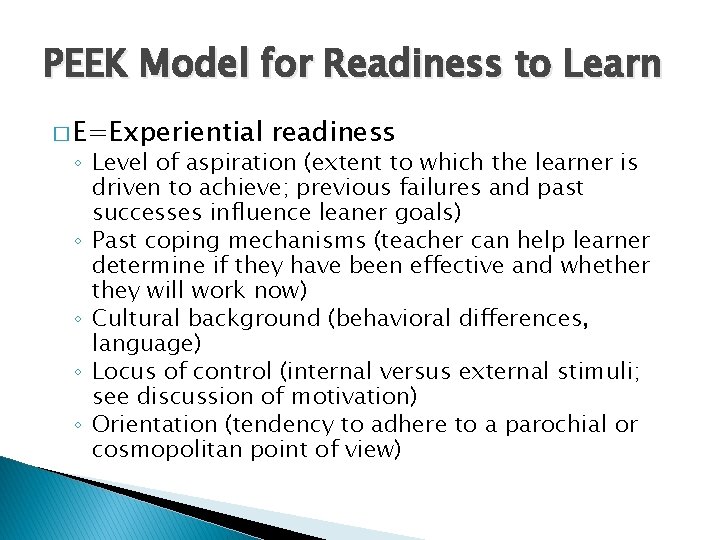
PEEK Model for Readiness to Learn � E=Experiential readiness ◦ Level of aspiration (extent to which the learner is driven to achieve; previous failures and past successes influence leaner goals) ◦ Past coping mechanisms (teacher can help learner determine if they have been effective and whether they will work now) ◦ Cultural background (behavioral differences, language) ◦ Locus of control (internal versus external stimuli; see discussion of motivation) ◦ Orientation (tendency to adhere to a parochial or cosmopolitan point of view)
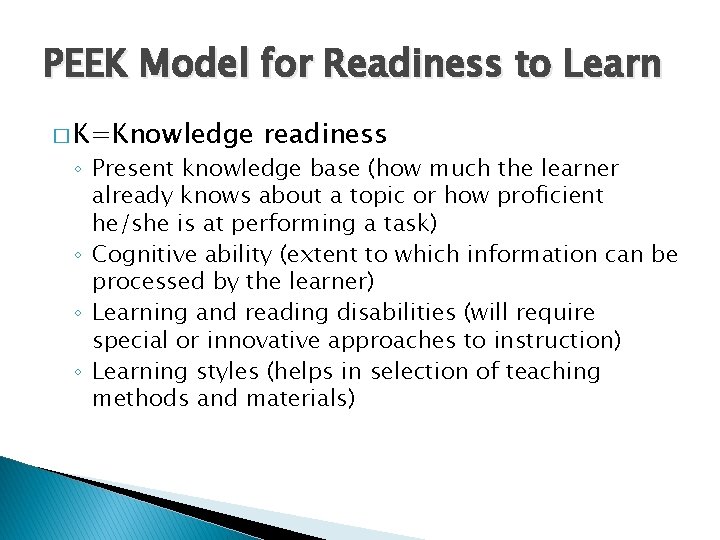
PEEK Model for Readiness to Learn � K=Knowledge readiness ◦ Present knowledge base (how much the learner already knows about a topic or how proficient he/she is at performing a task) ◦ Cognitive ability (extent to which information can be processed by the learner) ◦ Learning and reading disabilities (will require special or innovative approaches to instruction) ◦ Learning styles (helps in selection of teaching methods and materials)