
Learning Module I Developmental Milestones and Recognizing Delays


- Slides: 64
Learning Module I: Developmental Milestones and Recognizing Delays
Learning Objectives • Become familiar with four primary domains of development • Understand developmental milestones for children from birth to age 5 • Identify “red flags”, or delays to watch for in children who are not meeting developmental milestones Carmen Jamis and Alyssa Stiver, 2014 2
This Presentation • 4 main areas of development are broken down by age groups • Developmental milestones are presented in each development area • Red flags, or delays to watch for, are then presented • Steps to take if delays are recognized are included at conclusion of presentation Carmen Jamis and Alyssa Stiver, 2014 3
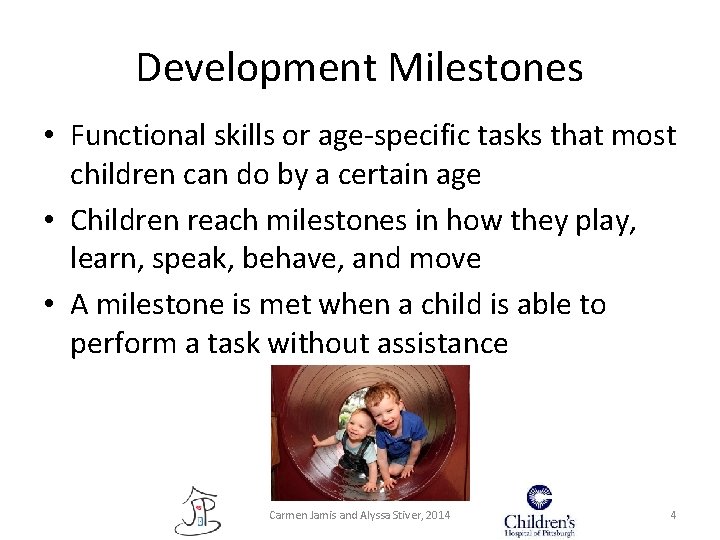
Development Milestones • Functional skills or age-specific tasks that most children can do by a certain age • Children reach milestones in how they play, learn, speak, behave, and move • A milestone is met when a child is able to perform a task without assistance Carmen Jamis and Alyssa Stiver, 2014 4
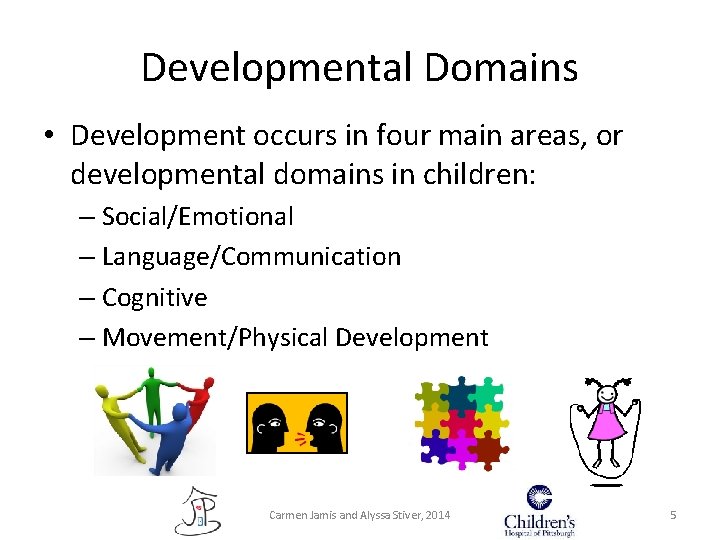
Developmental Domains • Development occurs in four main areas, or developmental domains in children: – Social/Emotional – Language/Communication – Cognitive – Movement/Physical Development Carmen Jamis and Alyssa Stiver, 2014 5
Social/Emotional • Loving relationships give young children a sense of comfort, safety, confidence, and encouragement • They teach young children how to form friendships, communicate emotions, and to deal with challenges • Strong, positive relationships also help children develop trust, empathy, compassion, and a sense of right and wrong Carmen Jamis and Alyssa Stiver, 2014 6
Language/ Communication • The capacity to communicate is the ability and desire to connect with others by exchanging ideas and feelings, both verbally and nonverbally • Most children learn to communicate to get a need met or to establish and maintain interaction with a loved adult Carmen Jamis and Alyssa Stiver, 2014 7
Cognitive • Development of the ability to think, understand, and reason • Cognitive abilities such as memory, information processing , and problem-solving emerge throughout childhood Carmen Jamis and Alyssa Stiver, 2014 8
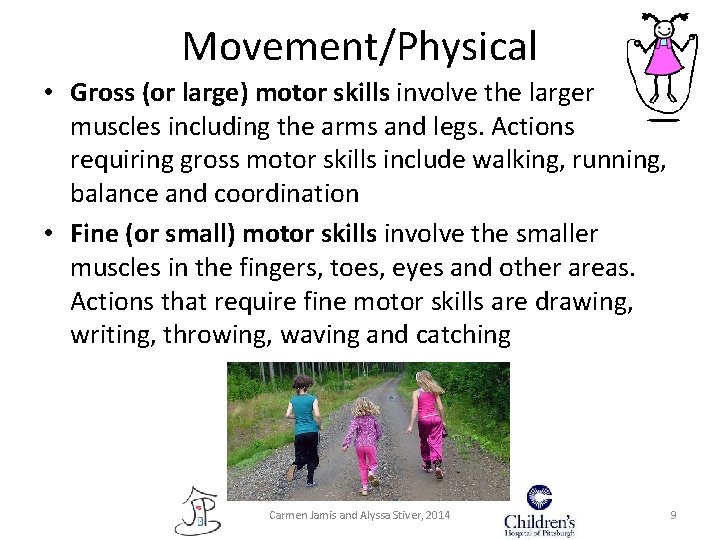
Movement/Physical • Gross (or large) motor skills involve the larger muscles including the arms and legs. Actions requiring gross motor skills include walking, running, balance and coordination • Fine (or small) motor skills involve the smaller muscles in the fingers, toes, eyes and other areas. Actions that require fine motor skills are drawing, writing, throwing, waving and catching Carmen Jamis and Alyssa Stiver, 2014 9
Birth-Five Years • What does typical development look like? • When should certain developmental milestones be met? • What delays should be watched for? Carmen Jamis and Alyssa Stiver, 2014 10
Red Flags • Titled “Delays to Watch For” throughout presentation • Behaviors or delays that signal a possible problem with development and suggest that an evaluation should be performed Carmen Jamis and Alyssa Stiver, 2014 11
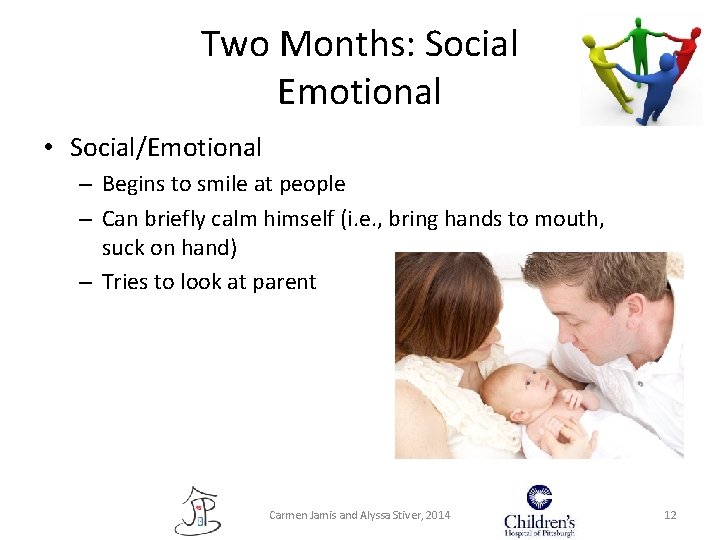
Two Months: Social Emotional • Social/Emotional – Begins to smile at people – Can briefly calm himself (i. e. , bring hands to mouth, suck on hand) – Tries to look at parent Carmen Jamis and Alyssa Stiver, 2014 12
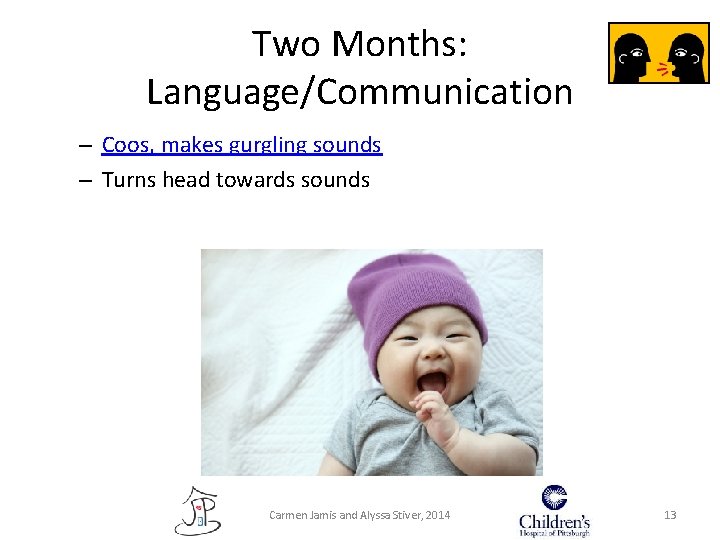
Two Months: Language/Communication – Coos, makes gurgling sounds – Turns head towards sounds Carmen Jamis and Alyssa Stiver, 2014 13
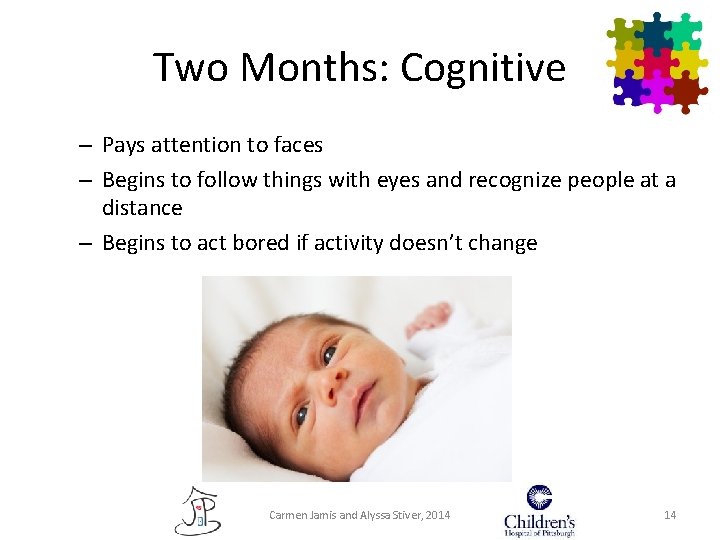
Two Months: Cognitive – Pays attention to faces – Begins to follow things with eyes and recognize people at a distance – Begins to act bored if activity doesn’t change Carmen Jamis and Alyssa Stiver, 2014 14
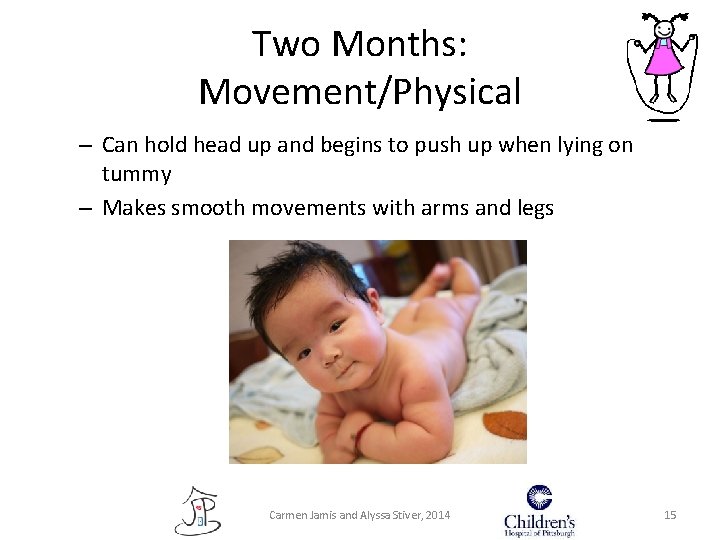
Two Months: Movement/Physical – Can hold head up and begins to push up when lying on tummy – Makes smooth movements with arms and legs Carmen Jamis and Alyssa Stiver, 2014 15
Delays to Watch For at Two Months • • • Doesn’t respond to loud sounds Doesn’t watch things as they move Doesn’t smile at people Doesn’t bring hands to mouth Can’t hold head up when on tummy Typical and atypical development at two months Carmen Jamis and Alyssa Stiver, 2014 16
Four Months: Social Emotional – Smiles spontaneously, especially at people – Likes to play with people and might cry when playing stops – Copies some movements and facial expressions Carmen Jamis and Alyssa Stiver, 2014 17
Four Months: Language/Communication – Begins to babble – Babbles with expression and copies sounds he hears – Cries in different ways to show hunger, pain, or being tired Carmen Jamis and Alyssa Stiver, 2014 18
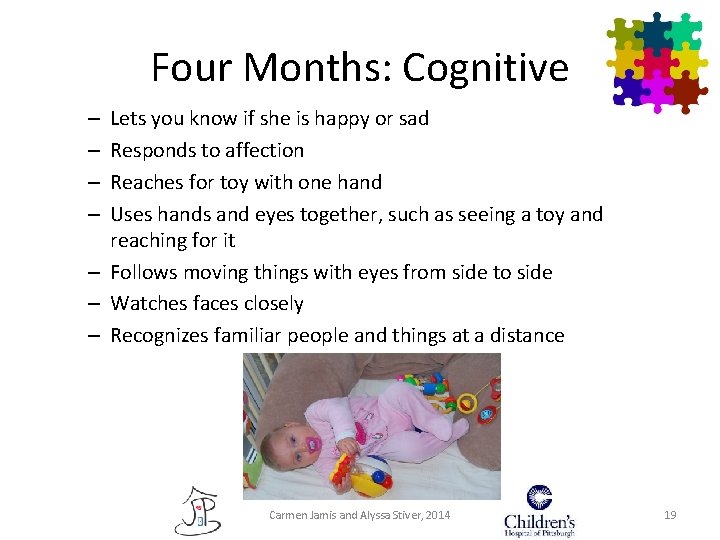
Four Months: Cognitive Lets you know if she is happy or sad Responds to affection Reaches for toy with one hand Uses hands and eyes together, such as seeing a toy and reaching for it – Follows moving things with eyes from side to side – Watches faces closely – Recognizes familiar people and things at a distance – – Carmen Jamis and Alyssa Stiver, 2014 19
Four Months: Movement/Physical Development – Holds head steady, unsupported – Pushes down on legs when feet are on a hard surface – May be able to roll over from tummy to back – Can hold a toy and shake it and swing at dangling toys – Brings hands to mouth – When lying on stomach, pushes up to elbows Carmen Jamis and Alyssa Stiver, 2014 20
Delays to Watch For at Four Months Doesn’t watch things as they move Doesn’t smile at people Can’t hold head steady Doesn’t coo or make sounds Doesn’t bring things to mouth Doesn’t push down with legs when feet are placed on a hard surface • Has trouble moving one or both eyes in all directions • Typical and atypical development at four months • • • Carmen Jamis and Alyssa Stiver, 2014 21
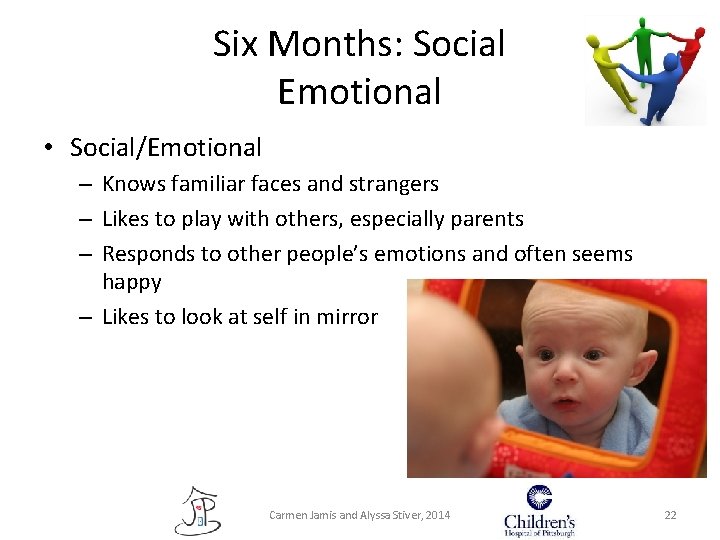
Six Months: Social Emotional • Social/Emotional – Knows familiar faces and strangers – Likes to play with others, especially parents – Responds to other people’s emotions and often seems happy – Likes to look at self in mirror Carmen Jamis and Alyssa Stiver, 2014 22
Six Months: Language/ Communication – Responds to sounds by making sounds – Strings vowels together when babbling and likes making sounds – Responds to own name – Makes sounds to show joy and displeasure – Begins to say consonant sounds Carmen Jamis and Alyssa Stiver, 2014 23
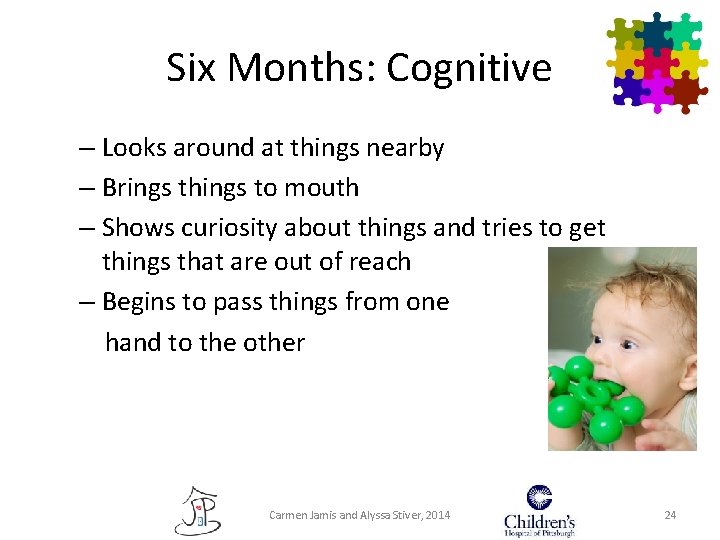
Six Months: Cognitive – Looks around at things nearby – Brings things to mouth – Shows curiosity about things and tries to get things that are out of reach – Begins to pass things from one hand to the other Carmen Jamis and Alyssa Stiver, 2014 24
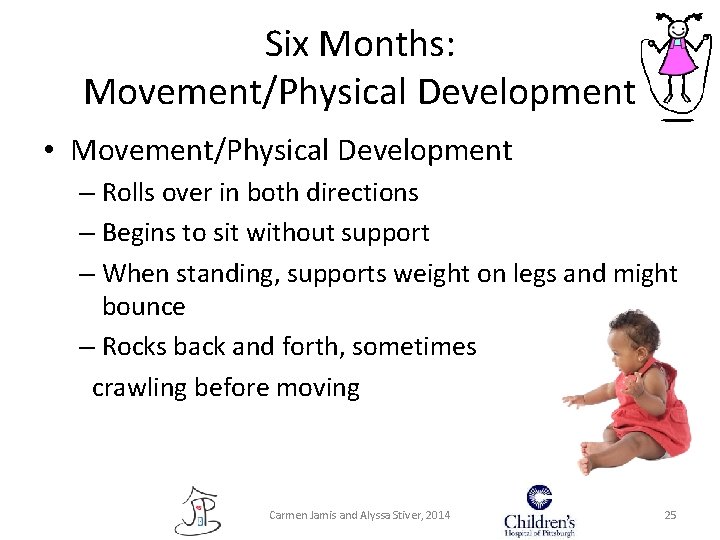
Six Months: Movement/Physical Development • Movement/Physical Development – Rolls over in both directions – Begins to sit without support – When standing, supports weight on legs and might bounce – Rocks back and forth, sometimes crawling before moving Carmen Jamis and Alyssa Stiver, 2014 25
Delays to Watch For at Six Months • • • Doesn’t try to get things that are in reach Shows no affection for caregivers Doesn’t respond to sounds around him Has difficulty getting things to mouth Doesn’t make vowel sounds (“ah”, “ee”, “oo”) Doesn’t roll over in either direction Doesn’t laugh or make squealing sounds Seems very stiff, with tight muscles Seems very floppy, like a rag doll Typical and atypical development at 6 months Carmen Jamis and Alyssa Stiver, 2014 26
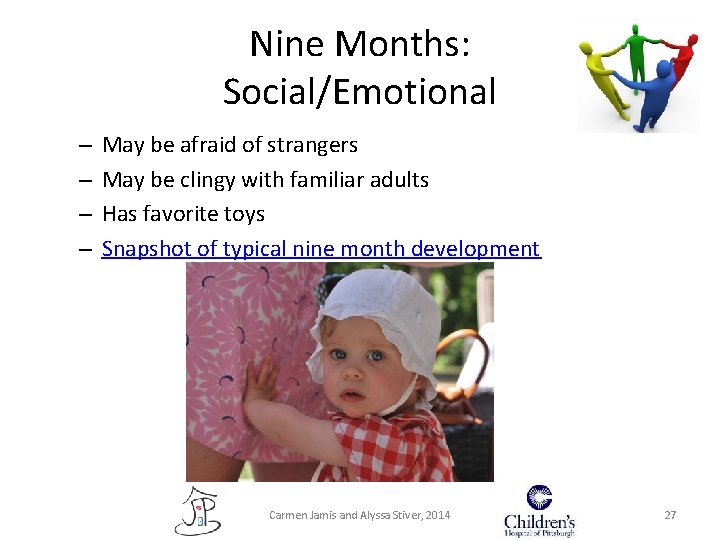
Nine Months: Social/Emotional – – May be afraid of strangers May be clingy with familiar adults Has favorite toys Snapshot of typical nine month development Carmen Jamis and Alyssa Stiver, 2014 27
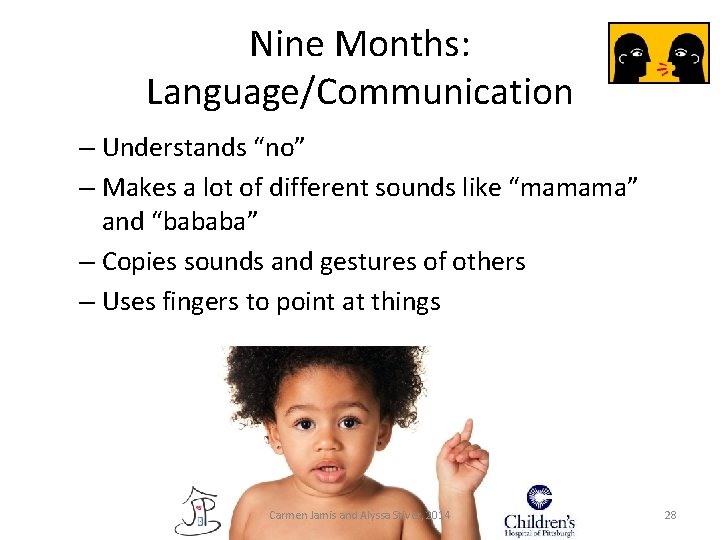
Nine Months: Language/Communication – Understands “no” – Makes a lot of different sounds like “mamama” and “bababa” – Copies sounds and gestures of others – Uses fingers to point at things Carmen Jamis and Alyssa Stiver, 2014 28
Nine Months: Cognitive – Watches the path of something as it falls – Looks for things he sees you hide – Plays peek-a-boo – Puts things in her mouth – Moves things smoothly from one hand to another – Picks things like cereal up between thumb and index finger Carmen Jamis and Alyssa Stiver, 2014 29
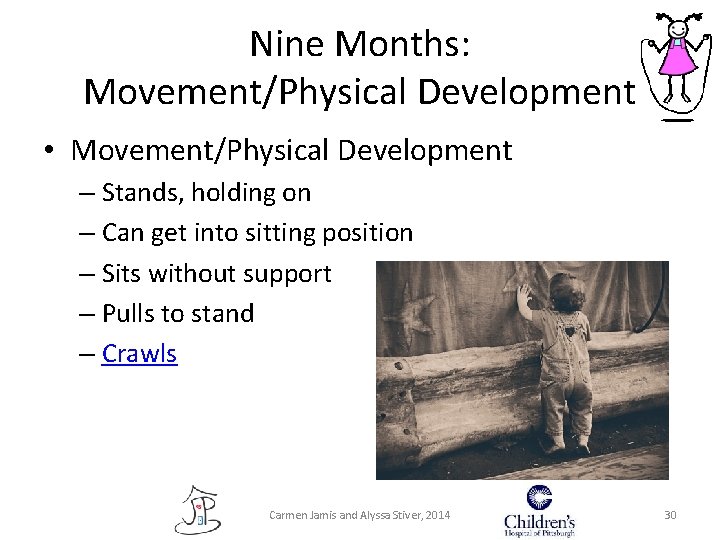
Nine Months: Movement/Physical Development • Movement/Physical Development – Stands, holding on – Can get into sitting position – Sits without support – Pulls to stand – Crawls Carmen Jamis and Alyssa Stiver, 2014 30
Delays to Watch For at Nine Months • • • Doesn’t bear weight on legs with support Doesn’t sit with help Doesn’t babble (“mama”, “baba”, “dada”) Doesn’t play any games involving back and forth play Doesn’t respond to own name Doesn’t seem to recognize familiar people Doesn’t look where you point Doesn’t transfer toys from one hand to the other Early signs of autism in 10 month-old Carmen Jamis and Alyssa Stiver, 2014 31
One Year: Social/Emotional • Social/Emotional – – – – Shy or nervous with strangers Cries when parent leaves Has favorite things and people Shows fear in some situations Hands you a book when they want to hear a story Puts out arm or leg to help with dressing Plays games such as “peek-a-boo” and “patty cake Carmen Jamis and Alyssa Stiver, 2014 32
One Year: Language/ Communication – Responds to simple spoken requests – Uses simple gestures like shaking head “no” – Makes sounds with changes in tone – Repeats sounds or actions to get attention – Says “mama” and “dada” and exclamations like “uh oh!” – Tries to say words you say – Copies gestures Carmen Jamis and Alyssa Stiver, 2014 33
One Year: Cognitive – Explores in different ways: shaking, banging, throwing – Finds hidden things easily – Looks at the right picture or thing when it’s named – Starts to use things correctly (i. e. , brush, cup) – Bangs two things together – Puts things in a container, takes things out of container – Lets things go without help – Pokes with index finger – Follows simple directions – Typical one year development Carmen Jamis and Alyssa Stiver, 2014 34
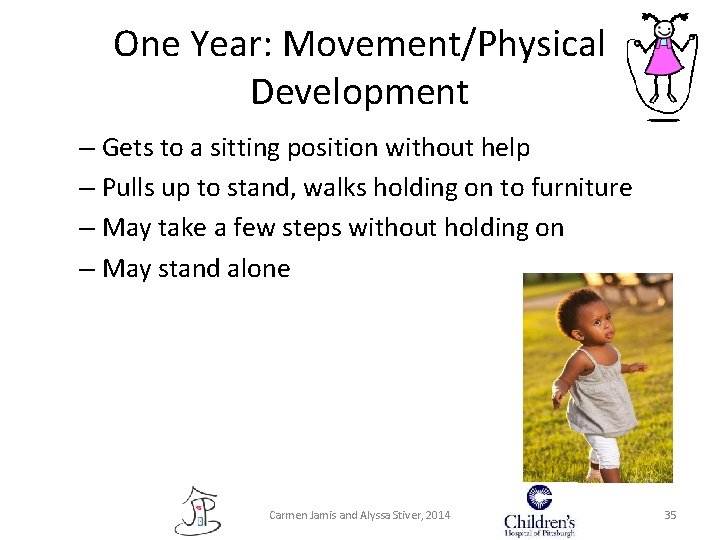
One Year: Movement/Physical Development – Gets to a sitting position without help – Pulls up to stand, walks holding on to furniture – May take a few steps without holding on – May stand alone Carmen Jamis and Alyssa Stiver, 2014 35
Delays to Watch For at One Year Can’t stand when supported Doesn’t search for things that she sees you hide Doesn’t say single words like “mama” or “dada” Doesn’t learn gestures like waving or shaking head • Doesn’t point to things • Loses skills he once had • • Carmen Jamis and Alyssa Stiver, 2014 36
Eighteen Months: Social/Emotional • Social/Emotional – – – – Likes to hand things to others as play May have temper tantrums May be afraid of strangers Shows affection to familiar people Plays simple pretend, such as feeding a doll May cling to caregivers in new situations Points to show others something interesting Explores alone but with parent close by Carmen Jamis and Alyssa Stiver, 2014 37
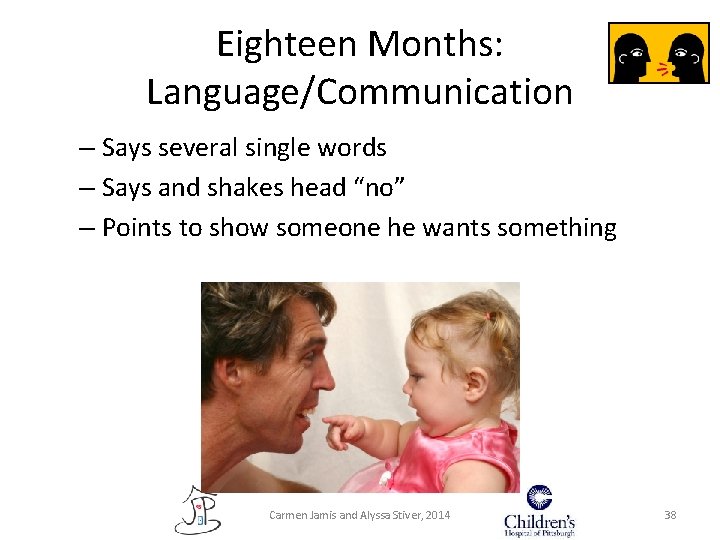
Eighteen Months: Language/Communication – Says several single words – Says and shakes head “no” – Points to show someone he wants something Carmen Jamis and Alyssa Stiver, 2014 38
Eighteen Months: Cognitive – Knows what ordinary things are for (i. e. , telephone, brush, spoon) – Points to get attention of others – Shows interest in a doll or stuffed animal by pretending to feed – Scribbles on his own – Can follow 1 -step verbal commands without any gestures (i. e. , follows command to sit down) Carmen Jamis and Alyssa Stiver, 2014 39
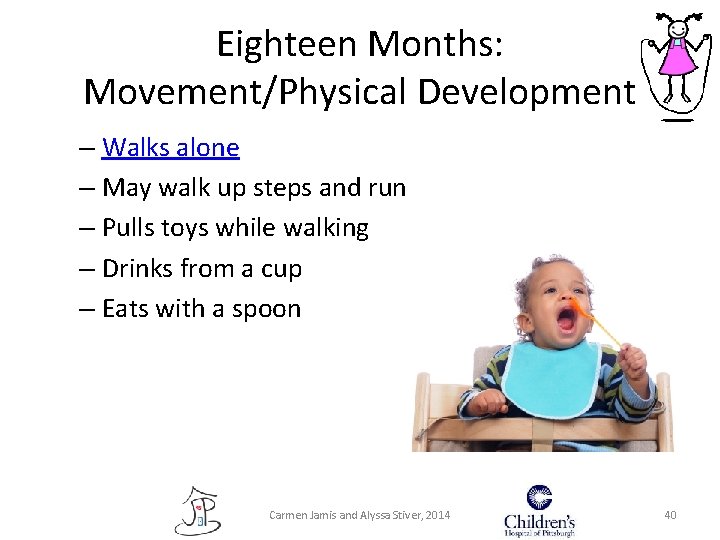
Eighteen Months: Movement/Physical Development – Walks alone – May walk up steps and run – Pulls toys while walking – Drinks from a cup – Eats with a spoon Carmen Jamis and Alyssa Stiver, 2014 40
Delays to Watch For at Eighteen Months Doesn’t point to show things to others Can’t walk Doesn’t know what familiar things are for Doesn’t copy others Doesn’t gain new words Doesn’t have at least 6 words Doesn’t notice or mind when a caregiver leaves or returns • Loses skills he once had • • Carmen Jamis and Alyssa Stiver, 2014 41
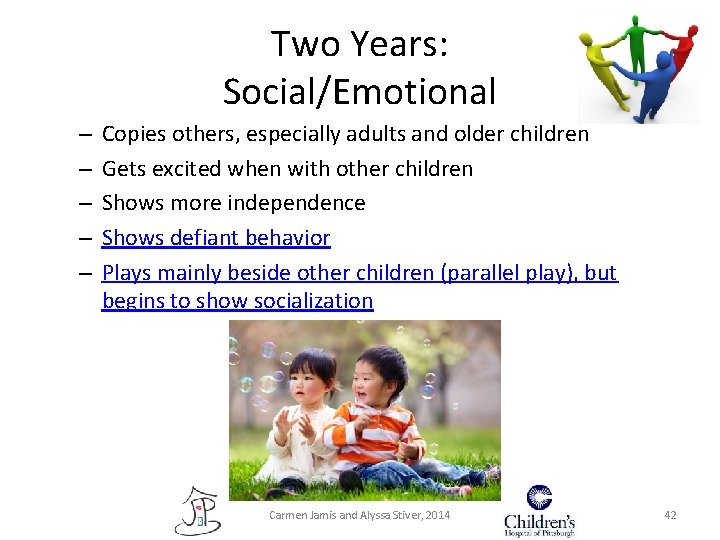
Two Years: Social/Emotional – – – Copies others, especially adults and older children Gets excited when with other children Shows more independence Shows defiant behavior Plays mainly beside other children (parallel play), but begins to show socialization Carmen Jamis and Alyssa Stiver, 2014 42
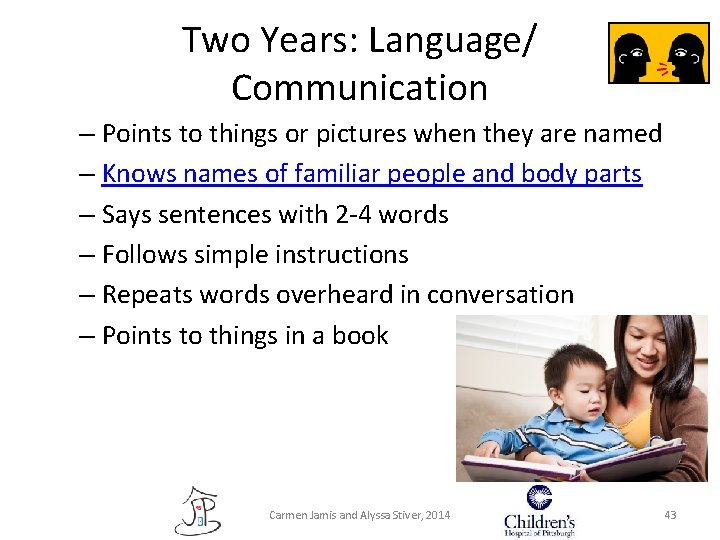
Two Years: Language/ Communication – Points to things or pictures when they are named – Knows names of familiar people and body parts – Says sentences with 2 -4 words – Follows simple instructions – Repeats words overheard in conversation – Points to things in a book Carmen Jamis and Alyssa Stiver, 2014 43
Two Years: Cognitive – Finds things, even when hidden – Begins to sort shapes and colors – Completes sentences and rhymes in familiar books – Plays simple make-believe games – Builds towers of 4 or more blocks – Might use one hand more than the other – Follows two-step instructions such as “pick up your shoes and put them in the closet” – Names items in a picture book Carmen Jamis and Alyssa Stiver, 2014 44
Two Years: Movement/Physical Development – Stands on tiptoes – Kicks a ball – Begins to run – Climbs onto and down from furniture without help – Walks up and down stairs holding on – Throws ball overhand – Makes or copies straight lines and circles Carmen Jamis and Alyssa Stiver, 2014 45
Delays to Watch For at Two Years • Doesn’t use 2 -word phrases (i. e. , “drink milk”) • Doesn’t know what to do with common things like a brush, phone, fork, or spoon • Doesn’t copy actions and words • Doesn’t follow simple instructions • Doesn’t walk steadily • Loses skills she once had • Signs of developmental delay at two years Carmen Jamis and Alyssa Stiver, 2014 46
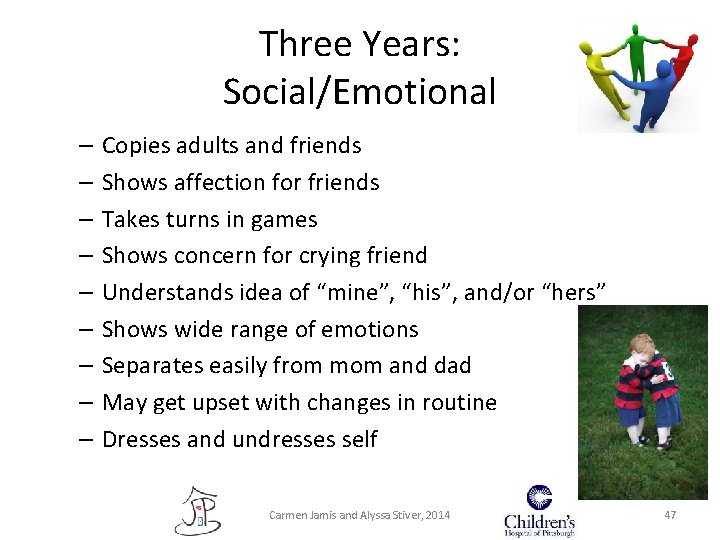
Three Years: Social/Emotional – – – – – Copies adults and friends Shows affection for friends Takes turns in games Shows concern for crying friend Understands idea of “mine”, “his”, and/or “hers” Shows wide range of emotions Separates easily from mom and dad May get upset with changes in routine Dresses and undresses self Carmen Jamis and Alyssa Stiver, 2014 47
Three Years: Language/Communication Follows 2 -3 step instructions Can name most familiar things Understands words like “in”, “on”, and “under” Says first name, age, and sex Names a friend Says words like “I”, “me”, “we”, and “you” and names some objects – Talks well enough for strangers to understand – Carries on conversation using 2 to 3 sentences – Language sample of a three year old – – – Carmen Jamis and Alyssa Stiver, 2014 48
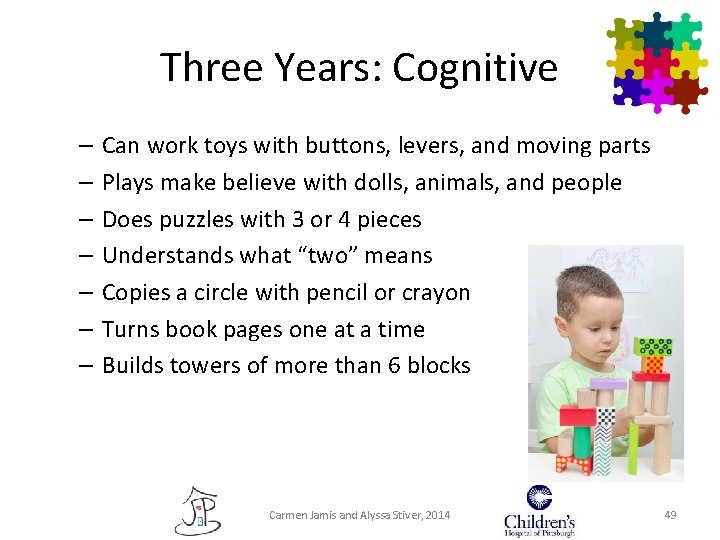
Three Years: Cognitive – – – – Can work toys with buttons, levers, and moving parts Plays make believe with dolls, animals, and people Does puzzles with 3 or 4 pieces Understands what “two” means Copies a circle with pencil or crayon Turns book pages one at a time Builds towers of more than 6 blocks Carmen Jamis and Alyssa Stiver, 2014 49
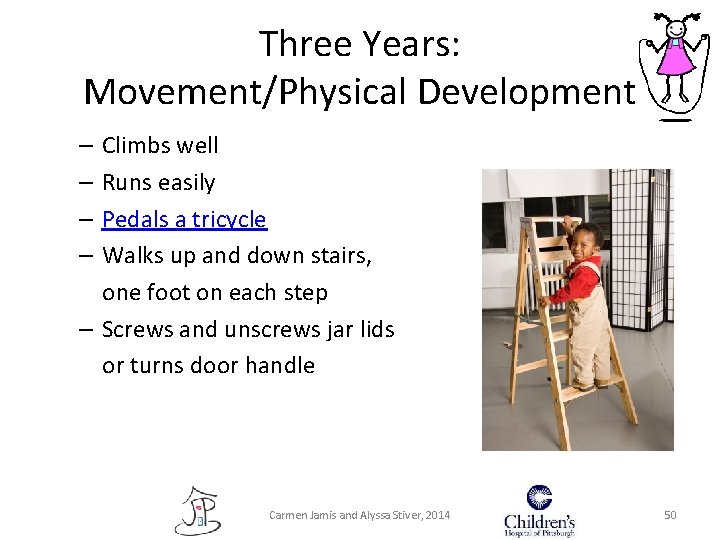
Three Years: Movement/Physical Development – Climbs well – Runs easily – Pedals a tricycle – Walks up and down stairs, one foot on each step – Screws and unscrews jar lids or turns door handle Carmen Jamis and Alyssa Stiver, 2014 50
Delays to Watch For at Three Years • Falls down often or has trouble with stairs • Drools or has very unclear speech • Can’t work simple toys such as peg boards, simple puzzles, turning handles • Doesn’t speak in sentences • Doesn’t understand simple instructions • Doesn’t play pretend or make-believe • Doesn’t want to play with other children or with toys • Doesn’t make eye contact • Loses skills he once had • Signs of developmental delay at three years Carmen Jamis and Alyssa Stiver, 2014 51
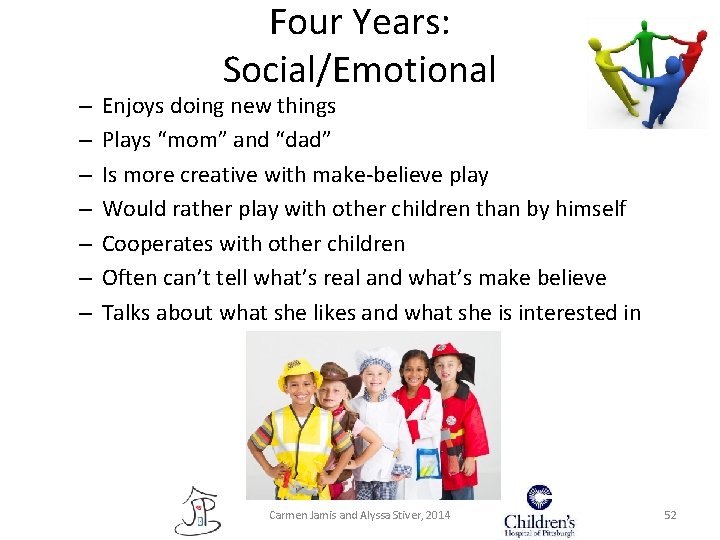
– – – – Four Years: Social/Emotional Enjoys doing new things Plays “mom” and “dad” Is more creative with make-believe play Would rather play with other children than by himself Cooperates with other children Often can’t tell what’s real and what’s make believe Talks about what she likes and what she is interested in Carmen Jamis and Alyssa Stiver, 2014 52
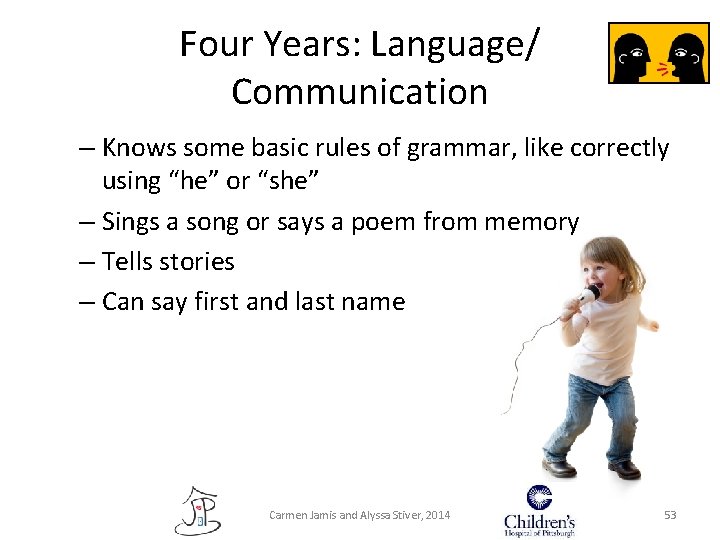
Four Years: Language/ Communication – Knows some basic rules of grammar, like correctly using “he” or “she” – Sings a song or says a poem from memory – Tells stories – Can say first and last name Carmen Jamis and Alyssa Stiver, 2014 53
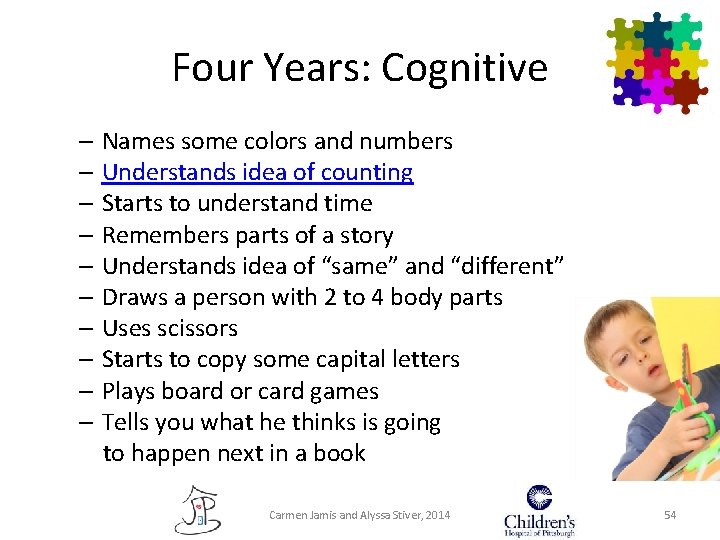
Four Years: Cognitive – Names some colors and numbers – Understands idea of counting – Starts to understand time – Remembers parts of a story – Understands idea of “same” and “different” – Draws a person with 2 to 4 body parts – Uses scissors – Starts to copy some capital letters – Plays board or card games – Tells you what he thinks is going to happen next in a book Carmen Jamis and Alyssa Stiver, 2014 54
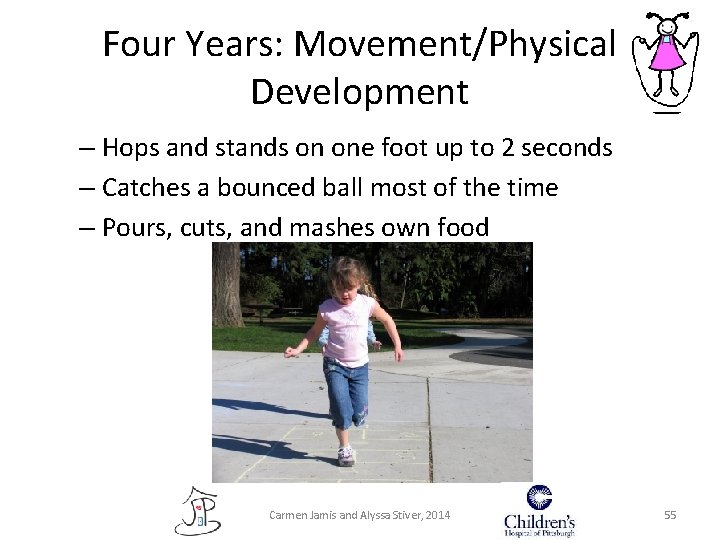
Four Years: Movement/Physical Development – Hops and stands on one foot up to 2 seconds – Catches a bounced ball most of the time – Pours, cuts, and mashes own food Carmen Jamis and Alyssa Stiver, 2014 55
Delays to Watch For at Four Years • • • Can’t jump in place Has trouble scribbling Shows no interest in interactive games or make-believe Ignores other children or doesn’t respond to people outside the family Resists dressing, sleeping, and using the toilet Can’t retell a favorite story Doesn’t follow 3 -part commands Doesn’t understand “same” and “different” Doesn’t use “me” and “you” correctly Speaks unclearly Loses skills he once had Signs of developmental delay at age 4 Carmen Jamis and Alyssa Stiver, 2014 56
Five Years: Social/Emotional Wants to please friends Wants to be like friends More likely to agree with rules Likes to sing, dance, and act Shows concern and sympathy for others Is aware of gender Can tell what’s real and what’s make-believe Shows more independence Is sometimes demanding and sometimes very cooperative – Developmental milestones at five years – – – – – Carmen Jamis and Alyssa Stiver, 2014 57
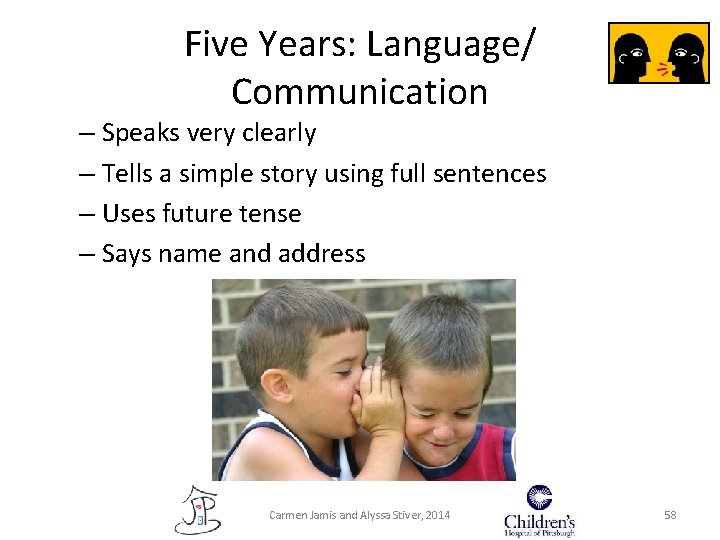
Five Years: Language/ Communication – Speaks very clearly – Tells a simple story using full sentences – Uses future tense – Says name and address Carmen Jamis and Alyssa Stiver, 2014 58
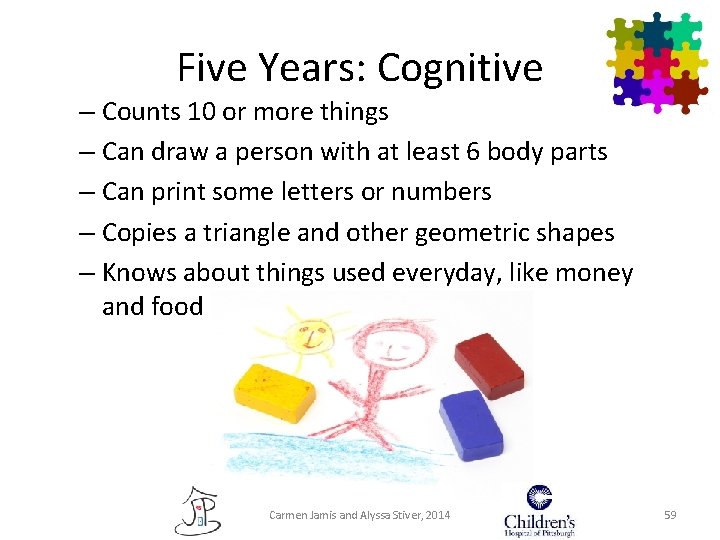
Five Years: Cognitive – Counts 10 or more things – Can draw a person with at least 6 body parts – Can print some letters or numbers – Copies a triangle and other geometric shapes – Knows about things used everyday, like money and food Carmen Jamis and Alyssa Stiver, 2014 59
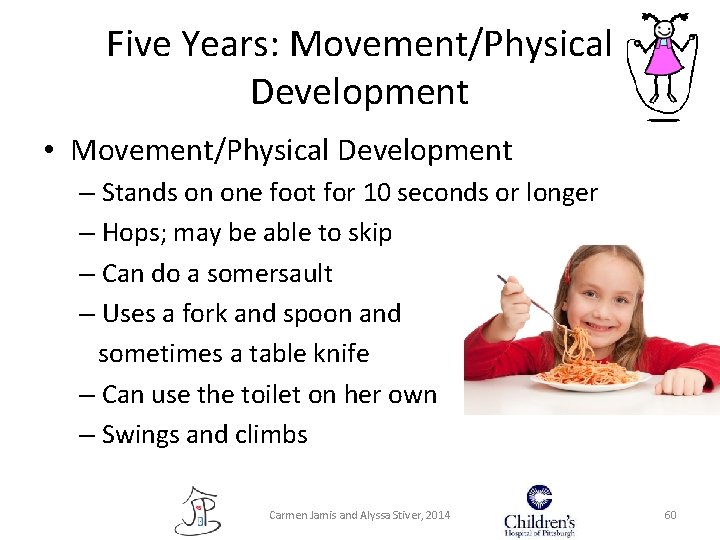
Five Years: Movement/Physical Development • Movement/Physical Development – Stands on one foot for 10 seconds or longer – Hops; may be able to skip – Can do a somersault – Uses a fork and spoon and sometimes a table knife – Can use the toilet on her own – Swings and climbs Carmen Jamis and Alyssa Stiver, 2014 60
Delays to Watch For at Five Years • Doesn’t show a wide range of emotions • Shows extreme behavior (fearful, aggressive, shy, or sad) • Unusually withdrawn and not active • Is easily distracted, has trouble focusing on one activity for more than 5 minutes • Doesn’t respond to people or only responds superficially • Doesn’t play a variety of games and activities • Can’t give first and last name Carmen Jamis and Alyssa Stiver, 2014 61
Delays, continued • Doesn’t use plurals or past tense properly • Doesn’t talk about daily activities or experiences • Doesn’t draw pictures • Can’t brush teeth, wash and dry hands, or get undressed without help • Loses skills he once had • Developmental Delays at five years Carmen Jamis and Alyssa Stiver, 2014 62
What To Do If You Recognize Delays • Call United Way #211 • Refer to pediatrician • Refer to Allegheny Intermediate Unit (412)394 -5700 • Refer to Child Development Unit (412)-6925560 Carmen Jamis and Alyssa Stiver, 2014 63
• Content source: Division of Birth Defects, National Center on Birth Defects and Developmental Disabilities, Centers for Disease Control and Prevention • Presentation developed by Carmen Jamis, M. S. and Alyssa Newberry, M. Ed. representing the LEND Center of Pittsburgh, University of Pittsburgh, and Children’s Hospital of Pittsburgh Carmen Jamis and Alyssa Stiver, 2014 64