
Learning Memory Consciousness Intelligence Unit III Cognitive Domain







- Slides: 72
Learning, Memory, Consciousness, Intelligence Unit III Cognitive Domain
Classical Conditioning Part I
Classic �Learning is a relatively permanent change in behavior �Classical Conditioning occurs when a stimulus gains the power to cause a response Like in the Shower �Ivan Pavlov’s Dog Experiment
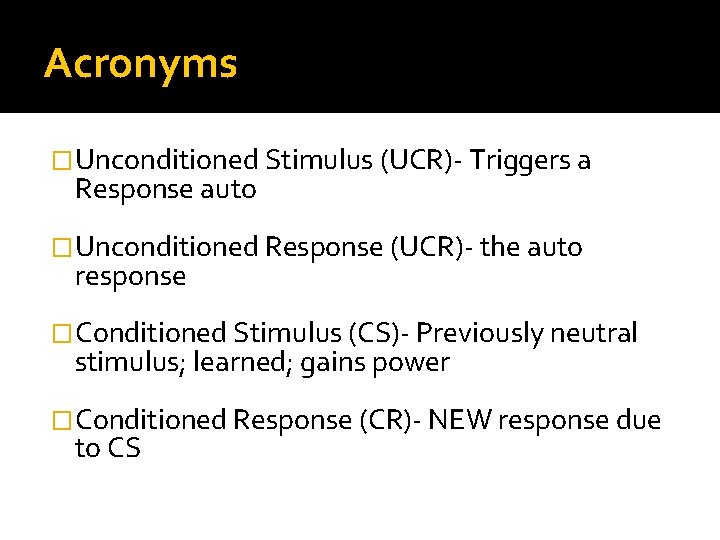
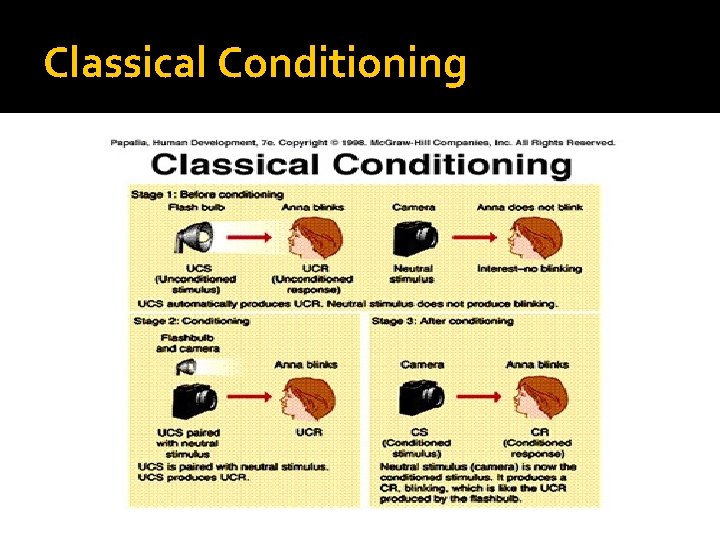
Acronyms �Unconditioned Stimulus (UCR)- Triggers a Response auto �Unconditioned Response (UCR)- the auto response �Conditioned Stimulus (CS)- Previously neutral stimulus; learned; gains power �Conditioned Response (CR)- NEW response due to CS
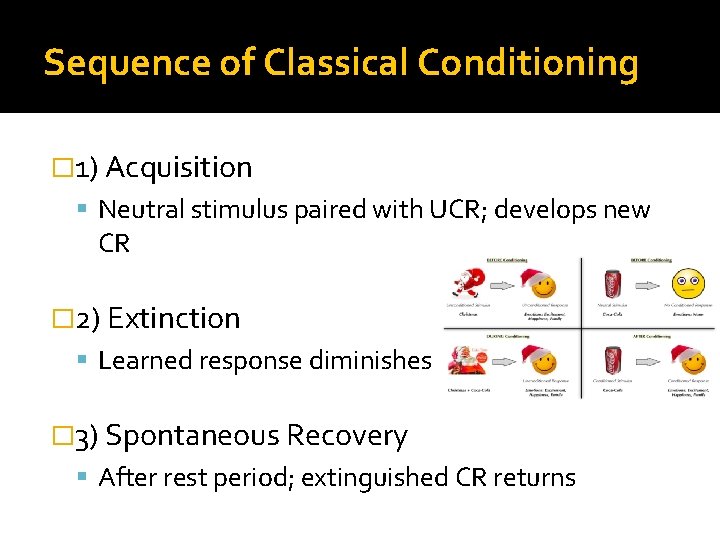
Sequence of Classical Conditioning � 1) Acquisition Neutral stimulus paired with UCR; develops new CR � 2) Extinction Learned response diminishes � 3) Spontaneous Recovery After rest period; extinguished CR returns
Classical Conditioning
Affect on Stimuli �The same response produced to two similar stimuli is GENERALIZATION Like a similar sound or noise can produce the same results �Different responses is DISCRIMINATION If you can tell the difference, it won’t produce a response
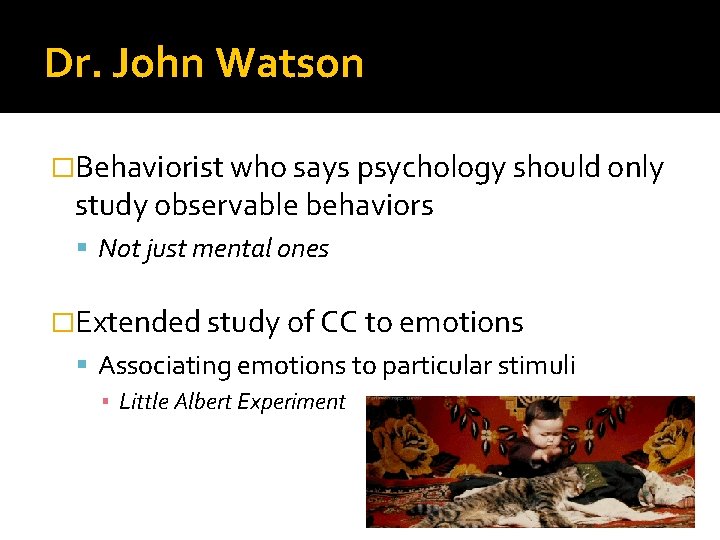
Dr. John Watson �Behaviorist who says psychology should only study observable behaviors Not just mental ones �Extended study of CC to emotions Associating emotions to particular stimuli ▪ Little Albert Experiment
Challenges to Behaviorism �Behaviorists focus on stimuli & responses but cognition & biology must be considered with CC Predictability causes issues Taste Aversion is biological
Paragraph � NC State is NCAA tournament bound for the fourth consecutive season, and the fourth time in four tries under Mark Gottfried. The Wolfpack drew a No. 8 seed this year and will be up against No. 9 LSU in the East Region. Let the madness begin, y'all.
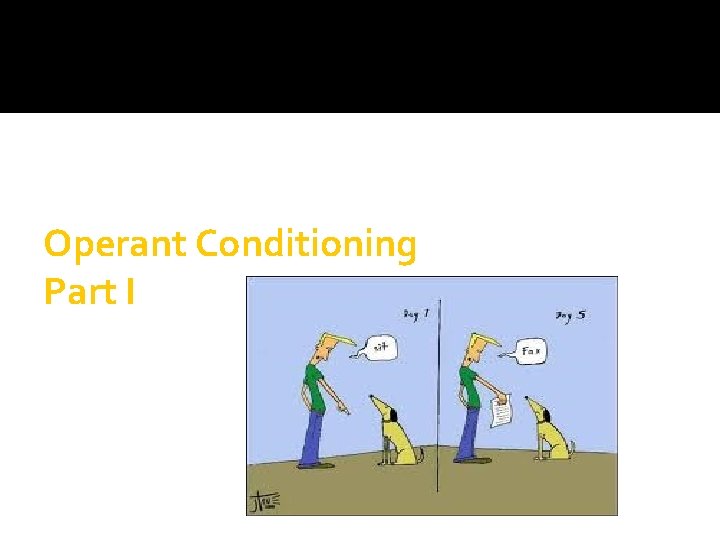
Operant Conditioning Part I
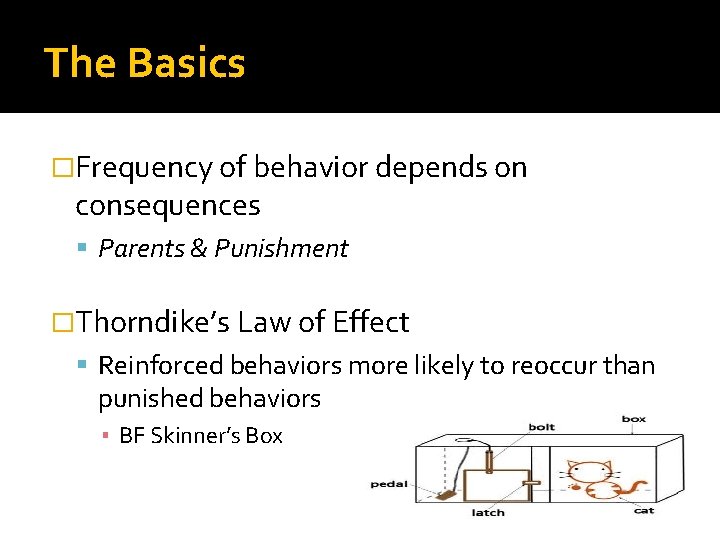
The Basics �Frequency of behavior depends on consequences Parents & Punishment �Thorndike’s Law of Effect Reinforced behaviors more likely to reoccur than punished behaviors ▪ BF Skinner’s Box
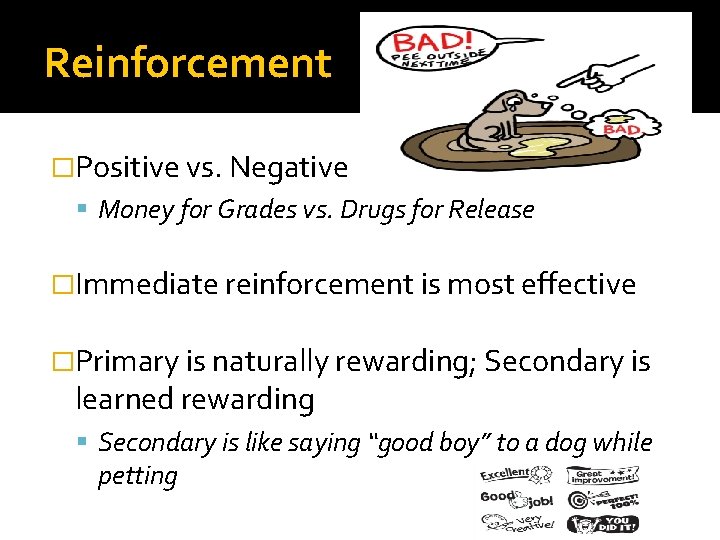
Reinforcement �Positive vs. Negative Money for Grades vs. Drugs for Release �Immediate reinforcement is most effective �Primary is naturally rewarding; Secondary is learned rewarding Secondary is like saying “good boy” to a dog while petting
Punishment �You can cause it or take something away Hand on a Stove vs Time Out �Effective if used immediately & occasionally; ineffective b/c it doesn’t stop desire for bad behavior & leads to anxiety
Molding Behavior �Behaviors can be shaped by reinforcing behaviors similar to desirable acts Learning to ride a bike �Behaving differently toward similar stimuli is discrimination Fire Alarms vs Class Bells �Extinction occurs when a learned behavior is lost b/c consequence is gone Flirting unsuccessfully
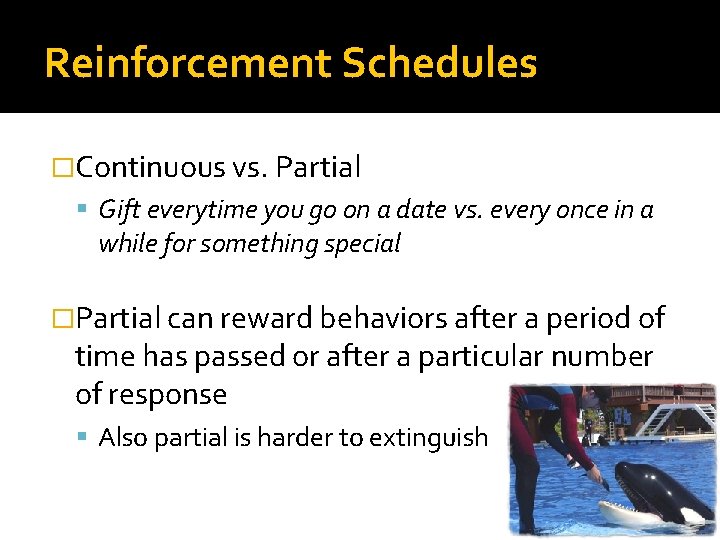
Reinforcement Schedules �Continuous vs. Partial Gift everytime you go on a date vs. every once in a while for something special �Partial can reward behaviors after a period of time has passed or after a particular number of response Also partial is harder to extinguish
Effects of Cognition/Biology �Latent learning; mental representations; & over-justification affect Operant Conditioning Latent is learning that isn’t apparent until an incentive Overjustification is a reward for what we like to do �Biology also causes some species to learn behaviors more easily or more difficultly
Operant Conditioning � Identify 2 behaviors you want to change about yourself or someone close to you � Identify the steps of the behavior you are shaping. � Identify 2 -3 rewards and punishments that could be used (reasonably) Identify whether they are positive reinforcements, negative reinforcements, positive punishments, or negative punishments � Identify one issue in application � Apply and discuss one of thing that makes it more complex/complicated
Observational Behavior �Learning By Observing Others (Albert Bandura) Also Biological, Mirror Neurons �Can lead children to imitate antisocial & positive prosocial behaviors �Violence in media IS correlated with aggressive behaviors and attitudes
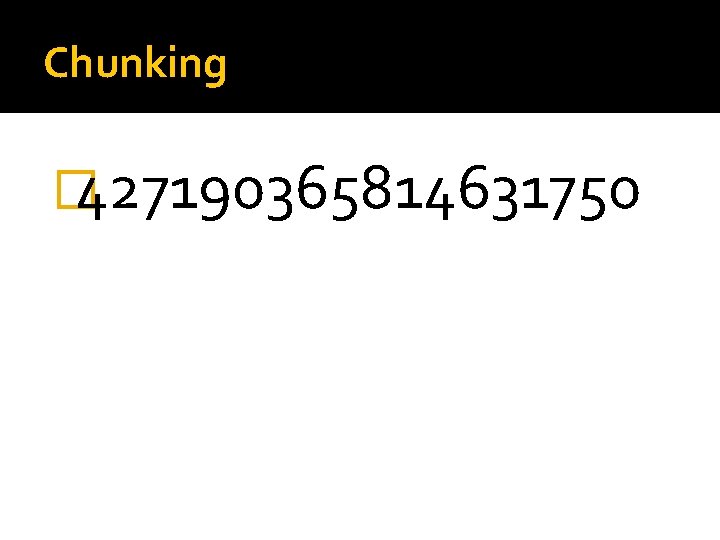
Chunking � 427190365814631750
Part III Memory
Encoding Information �Encoding is moving info into memory system �It can be processed automatically (unconscious) or with effort (conscious) Automatically: Where your classroom Effort: What You Studied Yesterday �Serial Position Tend to remember FIRST & LAST ▪ Study the MIDDLE more than the first and last
How We Encode �Rehearsal Distributed BETTER than Mass ▪ Studying over time vs cramming �Semantics & Mnemonics Semantics makes meaningful; Mnemonic memory tricks to remember ▪ Like finding rhymes OR acronyms �Chunking �Visuals (auto)
Memory Stages �Sensory memory= BRIEF Memory in the moment �Short-term is consciously aware of before it’s stored or forgotten Working memory �Long-term is relatively permanent energy
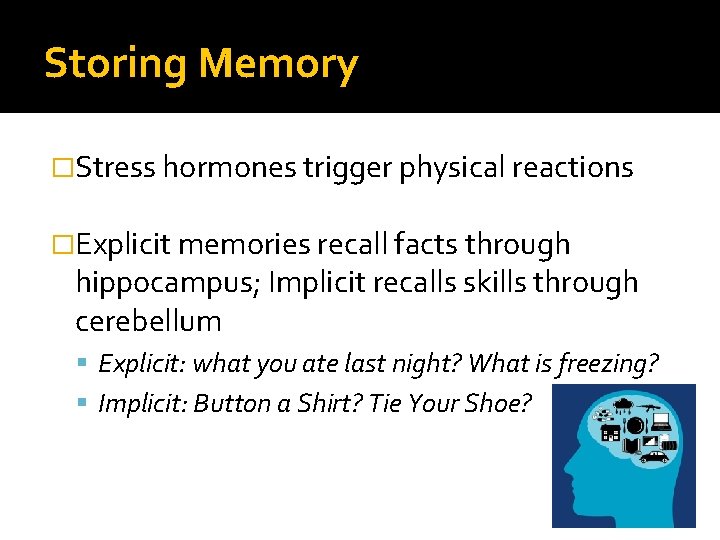
Storing Memory �Stress hormones trigger physical reactions �Explicit memories recall facts through hippocampus; Implicit recalls skills through cerebellum Explicit: what you ate last night? What is freezing? Implicit: Button a Shirt? Tie Your Shoe?
Total Recall �Recall is searching for stored memories & recognition is identifying them �When you retrieve info more effectively in similar environments that is called context State-Dependent= Emotional memory
Apples to Apples & Psychology �As We Play The Game Consider: What can you tell about a person from the choices they make? Who seems competitive? Who seems indifferent? What could that tell us about who they are? Is anyone willing to break the rules to win? Are you? Why, in a game with low stakes? What kind of psychological study could this be?
Part IV Forgetting
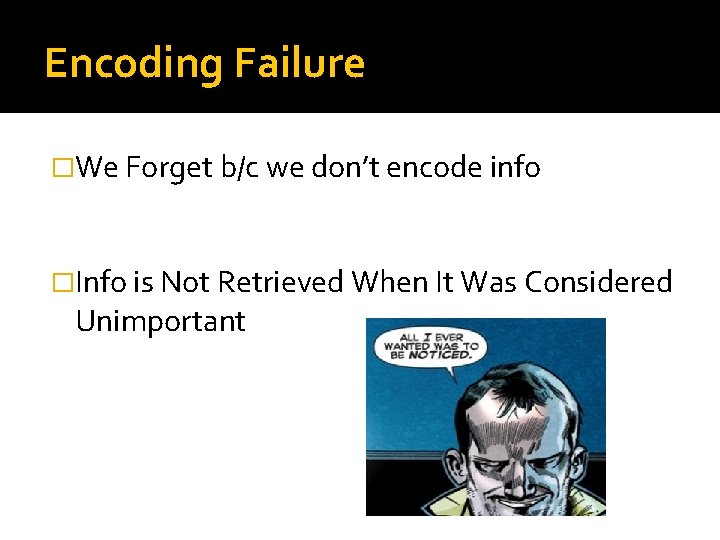
Encoding Failure �We Forget b/c we don’t encode info �Info is Not Retrieved When It Was Considered Unimportant
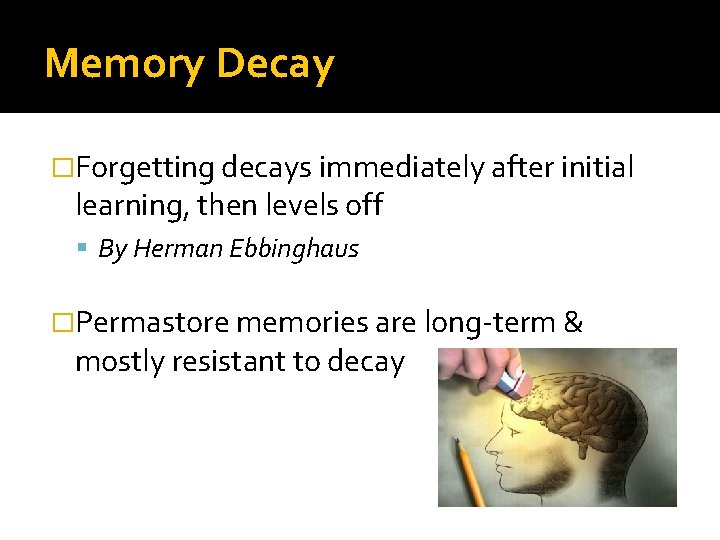
Memory Decay �Forgetting decays immediately after initial learning, then levels off By Herman Ebbinghaus �Permastore memories are long-term & mostly resistant to decay
Failure to Retrieve �Interference of info learned in the past with recent info recall or vice versa �Sometimes we subconsciously motivate ourselves to forget anxious/distressing info Sigmund Frued & Therapy Sessions
Misinformation �We incorporate misleading info into our memories (we construct memories) As in finding something that belongs just b/c it belongs Or Because we WANT it to be right �Children are MOST likely to construct memories & add misinformation �Recovered memories of trauma are controversial Why would they be?
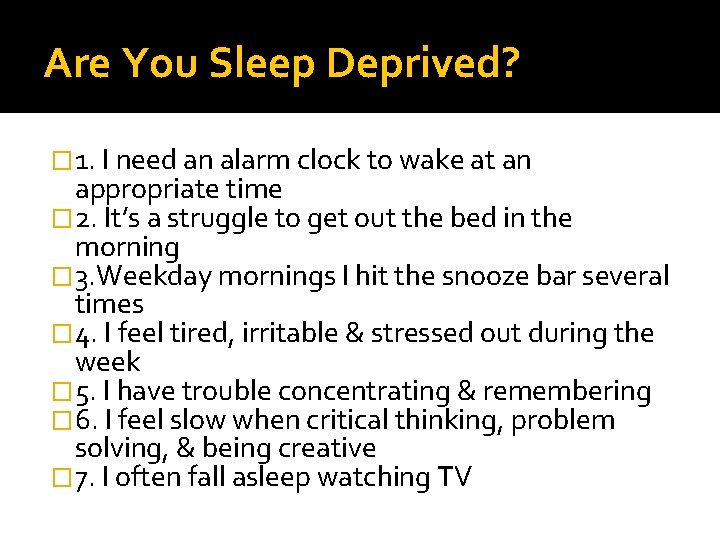
Are You Sleep Deprived? � 1. I need an alarm clock to wake at an appropriate time � 2. It’s a struggle to get out the bed in the morning � 3. Weekday mornings I hit the snooze bar several times � 4. I feel tired, irritable & stressed out during the week � 5. I have trouble concentrating & remembering � 6. I feel slow when critical thinking, problem solving, & being creative � 7. I often fall asleep watching TV
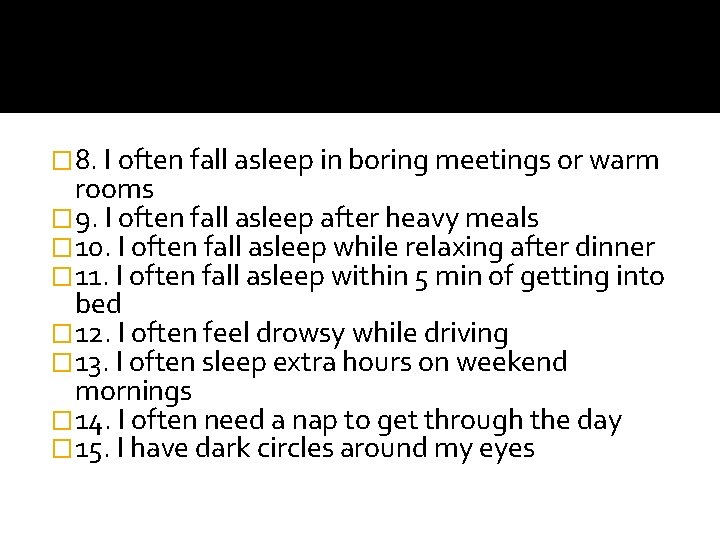
� 8. I often fall asleep in boring meetings or warm rooms � 9. I often fall asleep after heavy meals � 10. I often fall asleep while relaxing after dinner � 11. I often fall asleep within 5 min of getting into bed � 12. I often feel drowsy while driving � 13. I often sleep extra hours on weekend mornings � 14. I often need a nap to get through the day � 15. I have dark circles around my eyes
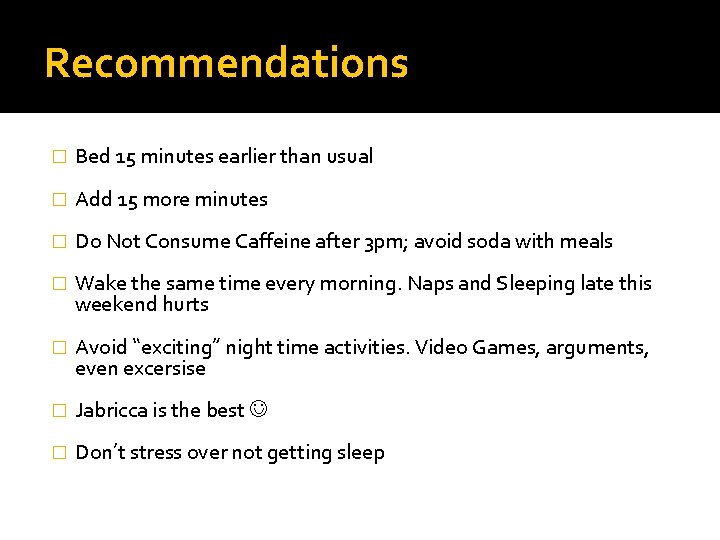
Recommendations � Bed 15 minutes earlier than usual � Add 15 more minutes � Do Not Consume Caffeine after 3 pm; avoid soda with meals � Wake the same time every morning. Naps and Sleeping late this weekend hurts � Avoid “exciting” night time activities. Video Games, arguments, even excersise � Jabricca is the best � Don’t stress over not getting sleep
Part V Consciousness & Dreaming
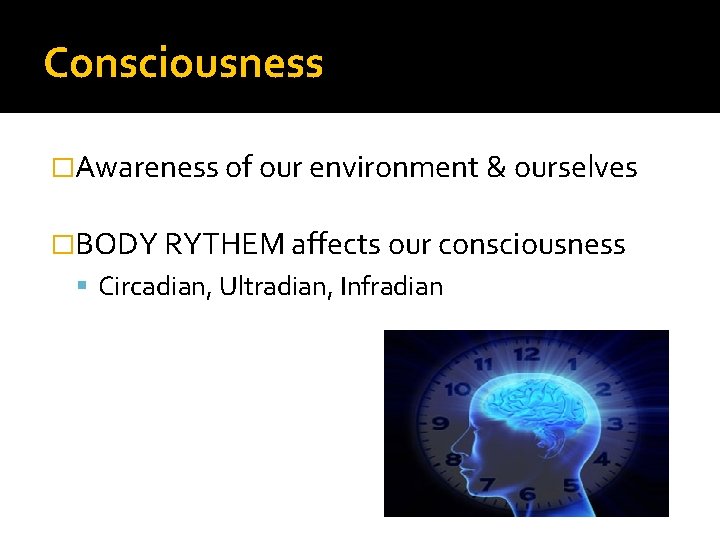
Consciousness �Awareness of our environment & ourselves �BODY RYTHEM affects our consciousness Circadian, Ultradian, Infradian
Why We Sleep �Restores body physically � Lack of sleep affects our mood, performance, and health
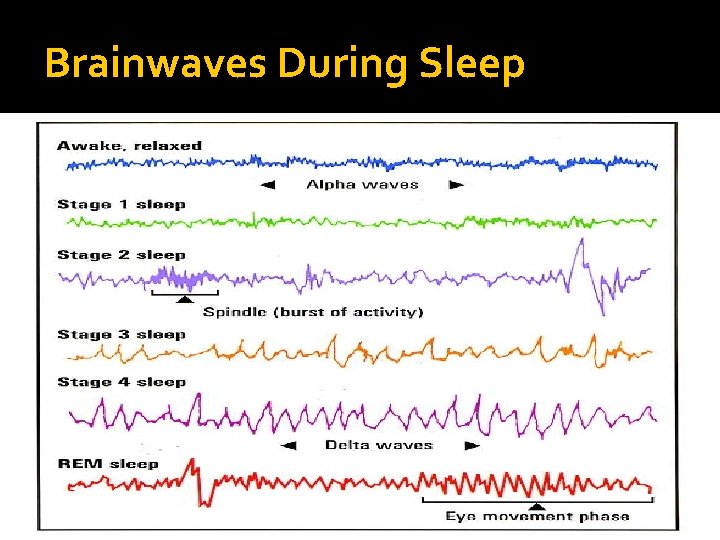
Brainwaves During Sleep
Stages of Sleep �Circadian Cycle; 4 stages of non-REM sleep REM = Rapid Eye Movement �REM shows brain ways at HIGH levels but body is calm during this stage (DREAM) Alternate Btwn Stage 2/REM Last 4 hours of sleep
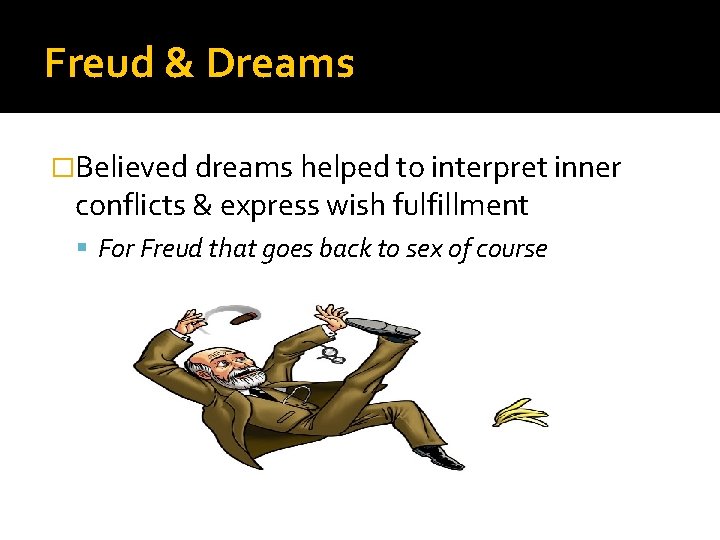
Freud & Dreams �Believed dreams helped to interpret inner conflicts & express wish fulfillment For Freud that goes back to sex of course
Why We Dream Theories �Info Processing Uses daily experiences to tie up loose ends �Physiological Helps important hormone development �Activation-Synthesis Mind tries making sense of random events �Cognitive Help mental growth through processing
Sleep Disorders �Insomnia is the inability to sleep while Apena prevents you from a restful sleep �Narcolepsy cause you to fall asleep a random times �Sleepwalking & Night Terrors Physical problems like Teeth Grinding, Bed Wetting etc
Part VI Changing the Brain
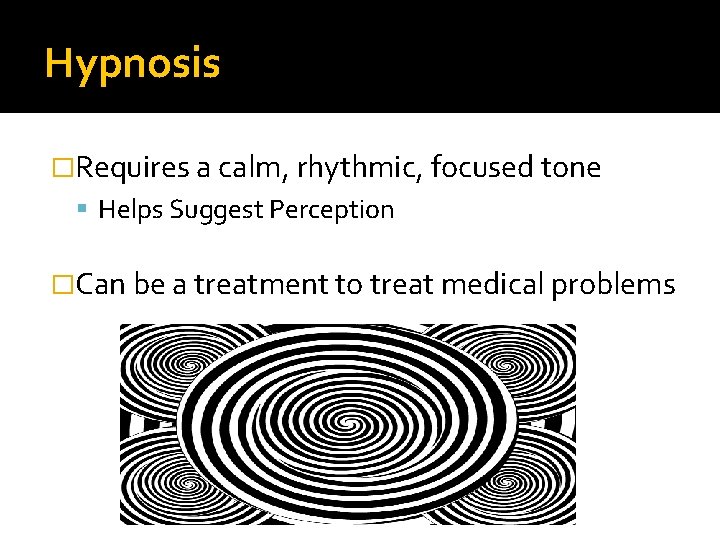
Hypnosis �Requires a calm, rhythmic, focused tone Helps Suggest Perception �Can be a treatment to treat medical problems
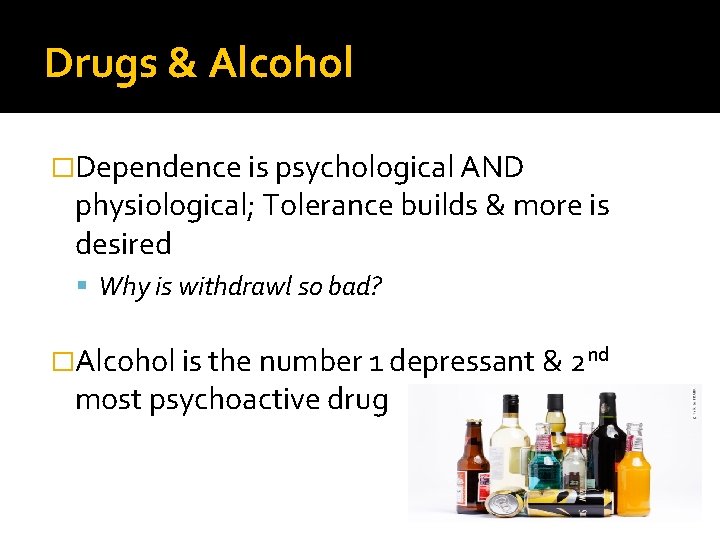
Drugs & Alcohol �Dependence is psychological AND physiological; Tolerance builds & more is desired Why is withdrawl so bad? �Alcohol is the number 1 depressant & 2 nd most psychoactive drug
Stimulants �Excite Neural Activity & Speed Up �Caffeine & Nicotine are most commonly used & are addictive �Cocaine is a heck of a drug; dependency occurs INSTANTLY
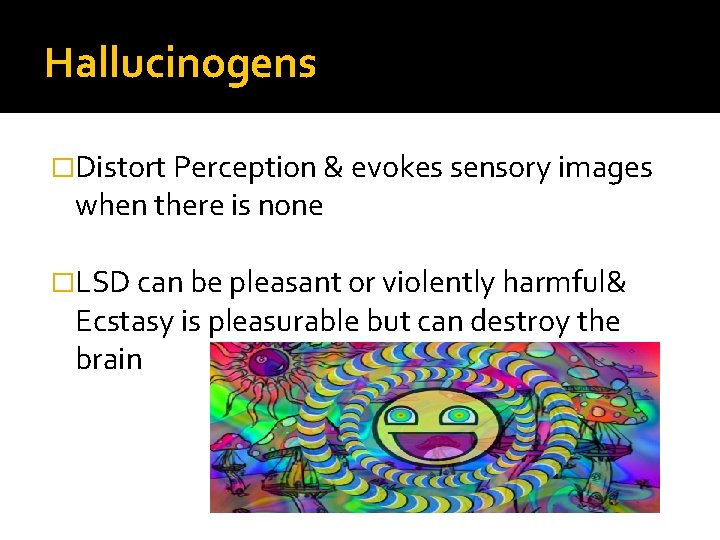
Hallucinogens �Distort Perception & evokes sensory images when there is none �LSD can be pleasant or violently harmful& Ecstasy is pleasurable but can destroy the brain
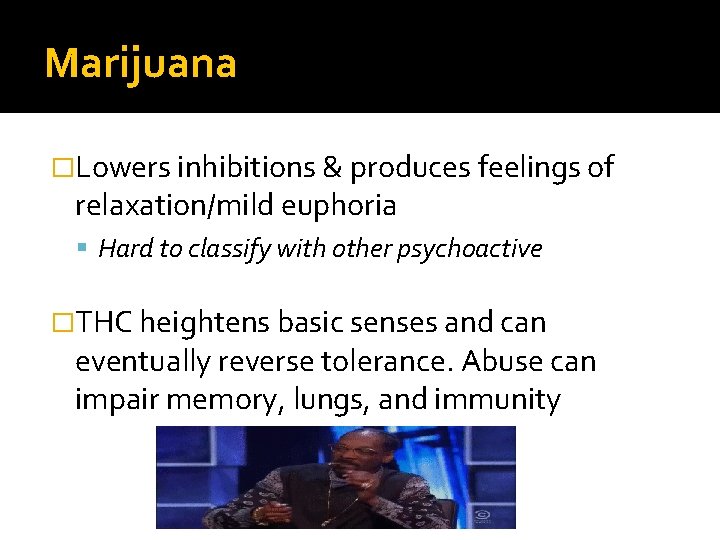
Marijuana �Lowers inhibitions & produces feelings of relaxation/mild euphoria Hard to classify with other psychoactive �THC heightens basic senses and can eventually reverse tolerance. Abuse can impair memory, lungs, and immunity
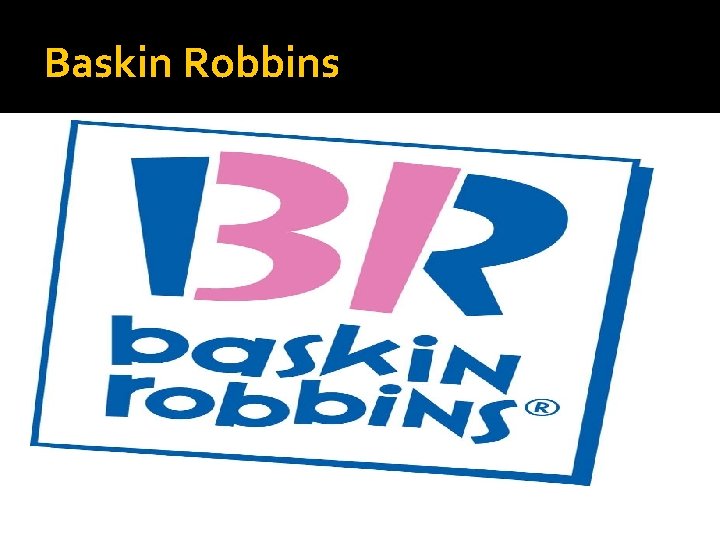
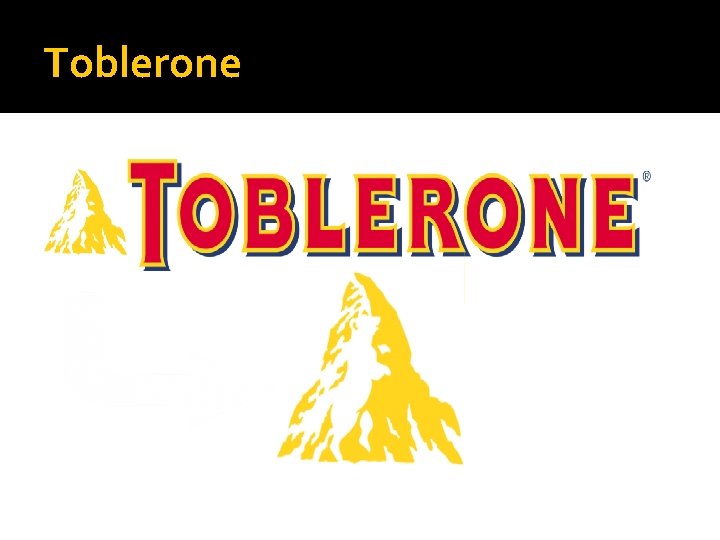
Subliminal Messages �I will give you 2 min to figure out what the subliminal messages
Fed. Ex
VAIO
Baskin Robbins
Tour De France
Toblerone
Jack In The Box
Milwauke Brewers
Amazon
Tostitos
Eighty 20
NBC
Sun Microsystems
LG
Coca Cola (Den. Mark)
Part VII Intelligence
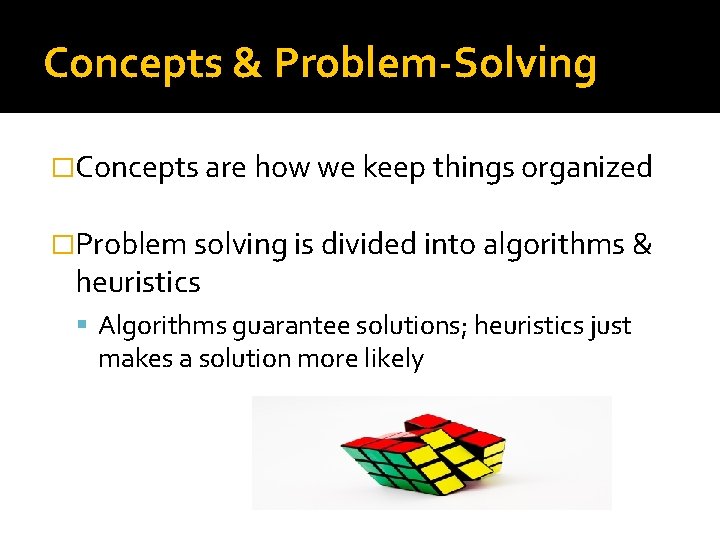
Concepts & Problem-Solving �Concepts are how we keep things organized �Problem solving is divided into algorithms & heuristics Algorithms guarantee solutions; heuristics just makes a solution more likely
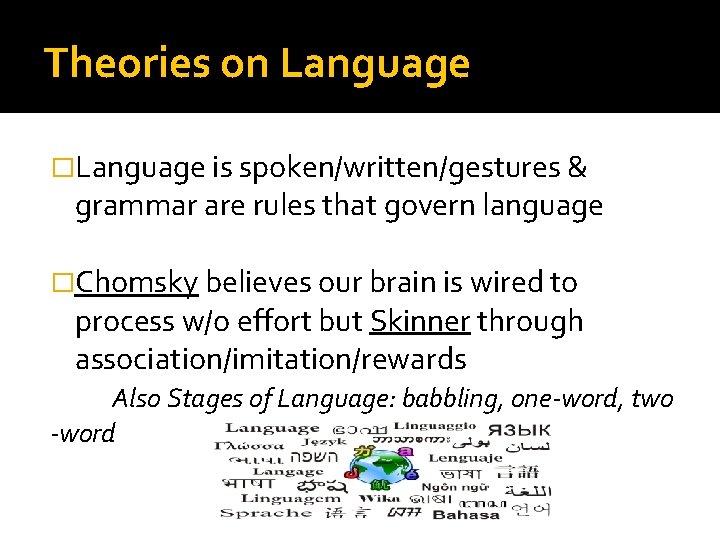
Theories on Language �Language is spoken/written/gestures & grammar are rules that govern language �Chomsky believes our brain is wired to process w/o effort but Skinner through association/imitation/rewards Also Stages of Language: babbling, one-word, two -word
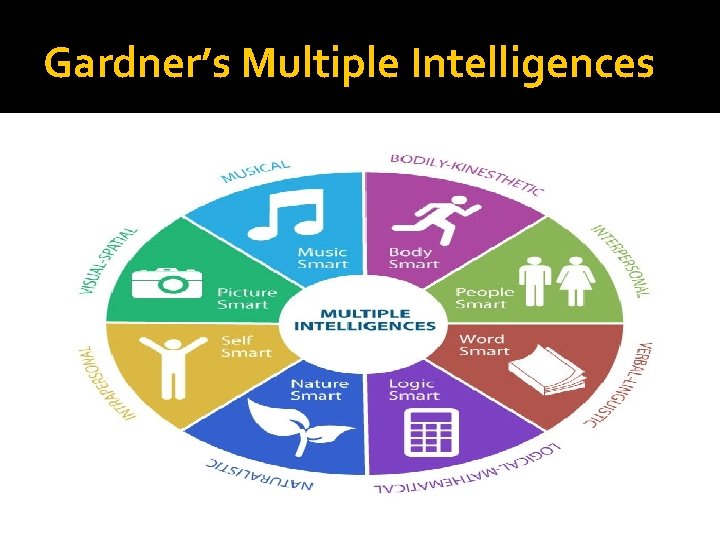
Multiple Intelligences �Intelligence is learning from experience and using that to solve problems & adapt �Gardner argues for 8 different types of intelligence Very Popular Theory; How does this impact education? �Others look at academic vs emotional & a general intelligence
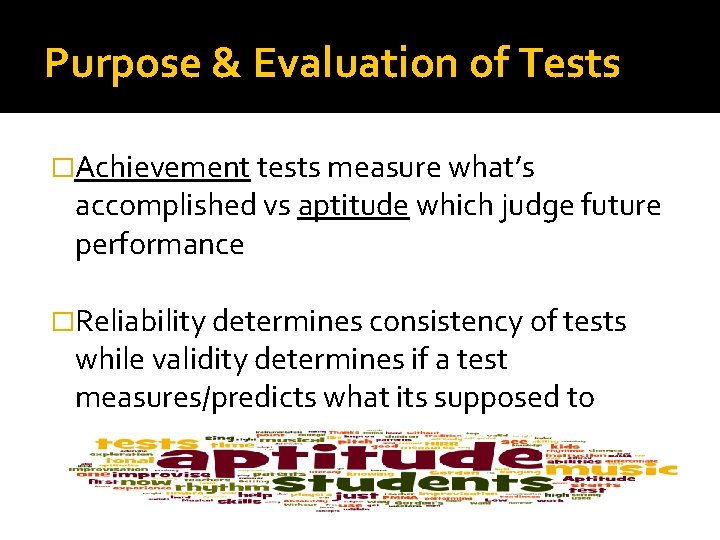
Purpose & Evaluation of Tests �Achievement tests measure what’s accomplished vs aptitude which judge future performance �Reliability determines consistency of tests while validity determines if a test measures/predicts what its supposed to
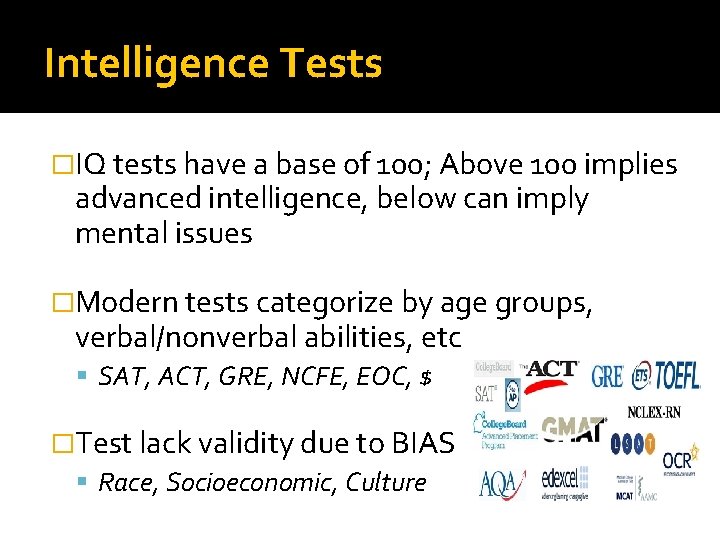
Intelligence Tests �IQ tests have a base of 100; Above 100 implies advanced intelligence, below can imply mental issues �Modern tests categorize by age groups, verbal/nonverbal abilities, etc SAT, ACT, GRE, NCFE, EOC, $ �Test lack validity due to BIAS Race, Socioeconomic, Culture
Gardner’s Multiple Intelligences
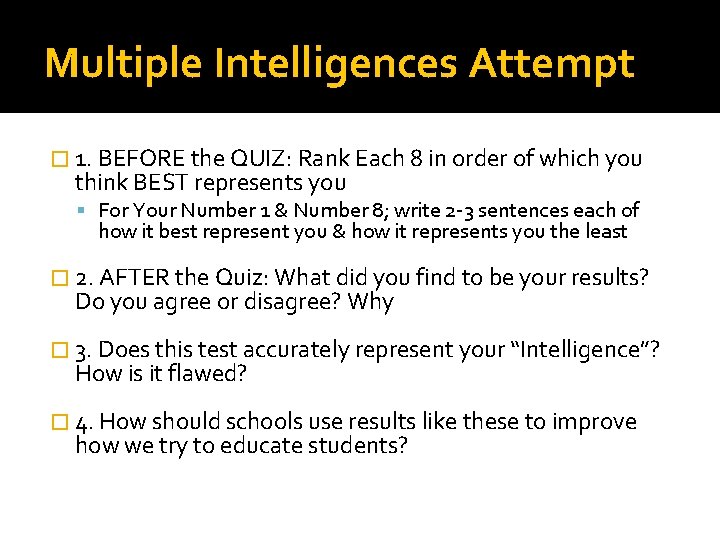
Multiple Intelligences Attempt � 1. BEFORE the QUIZ: Rank Each 8 in order of which you think BEST represents you For Your Number 1 & Number 8; write 2 -3 sentences each of how it best represent you & how it represents you the least � 2. AFTER the Quiz: What did you find to be your results? Do you agree or disagree? Why � 3. Does this test accurately represent your “Intelligence”? How is it flawed? � 4. How should schools use results like these to improve how we try to educate students?