
Learning means the acquisition of knowledge or skills















- Slides: 25
• Learning means the acquisition of knowledge or skills through study or experience. • It may be defined as the field of computer science, more specifically an application of artificial intelligence, which provides computer systems the ability to learn with data and improve from experience without being explicitly programmed.
• Machine learning algorithms can be broadly classified into two types – Supervised and Unsupervised.
Supervised Learning This algorithm consists of a target or outcome or dependent variable which is predicted from a given set of predictor or independent variables. Using these set of variables, we generate a function that maps input variables to desired output variables. The training process continues until the model achieves a desired level of accuracy on the training data. Examples of Supervised Learning - Regression, Decision Tree, Random Forest, KNN, Logistic Regression etc. This is the most commonly used machine learning algorithm. It is called supervised because the process of algorithm learning from the training dataset can be thought of as a teacher supervising the learning process. In this kind of ML algorithm, the possible outcomes are already known and training data is also labeled with correct answers. • Suppose we have input variables x and an output variable y and we applied an algorithm to learn the mapping function from the input to output such as − • Y = f(x)
Mainly supervised leaning problems can be divided into the following two kinds of problems − • Classification − A problem is called classification problem when we have the categorized output such as “black”, “teaching”, “non-teaching”, etc. • Regression − A problem is called regression problem when we have the real value output such as “distance”, “kilogram”, etc. • Decision tree, Naïve Bayes Classifier, SVM, llinear regression, ogistic regression are the examples of supervised machine learning algorithms.
Unsupervised Learning In this algorithm, there is no target or outcome or dependent variable to predict or estimate. It is used for clustering a given data set into different groups, which is widely used for segmenting customers into different groups for specific intervention. As the name suggests, these kinds of machine learning algorithms do not have any supervisor to provide any sort of guidance. That is why unsupervised machine learning algorithms are closely aligned with what some call true artificial intelligence. • Suppose we have input variable x, then there will be no corresponding output variables as there is in supervised learning algorithms. • In simple words, we can say that in unsupervised learning there will be no correct answer and no teacher for the guidance. Algorithms help to discover interesting patterns in data.
Unsupervised learning problems can be divided into the following two kinds of problem − Clustering − In clustering problems, we need to discover the inherent groupings in the data. For example, grouping customers by their purchasing behavior. Examples: - K-Means, Agglomerative Hierarchical Clustering Association − A problem is called association problem because such kinds of problem require discovering the rules that describe large portions of our data. For example, finding the customers who buy both x and y.
Reinforcement Learning • These kinds of machine learning algorithms are used very less. These algorithms train the systems to make specific decisions. Basically, the machine is exposed to an environment where it trains itself continually using the trial and error method. These algorithms learn from past experience and tries to capture the best possible knowledge to make accurate decisions. • Using this algorithm, the machine is trained to make specific decisions. Here, the algorithm trains itself continually by using trial and error methods and feedback methods. This machine learns from past experiences and tries to capture the best possible knowledge to make accurate business decisions.
Decision Tree • It is a supervised learning algorithm that is mostly used for classification problems. It works for both discrete and continuous dependent variables. In this algorithm, we split the population into two or more homogeneous sets. This is done based on most significant attributes to make as distinct groups as possible. • Decision trees are used widely in machine learning, covering both classification and regression. In decision analysis, a decision tree is used to visually and explicitly represent decisions and decision making. It uses a tree-like model of decisions.
• A decision tree is a support tool that uses a treelike graph or model of decisions and their possible consequences. It is one way to display an algorithm that contains only conditional control statements. • A decision tree is drawn with its root at the top and branches at the bottom. In the image, the bold text represents a condition/internal node, based on which the tree splits into branches/ edges. The branch end that doesn’t split anymore is the decision/leaf.
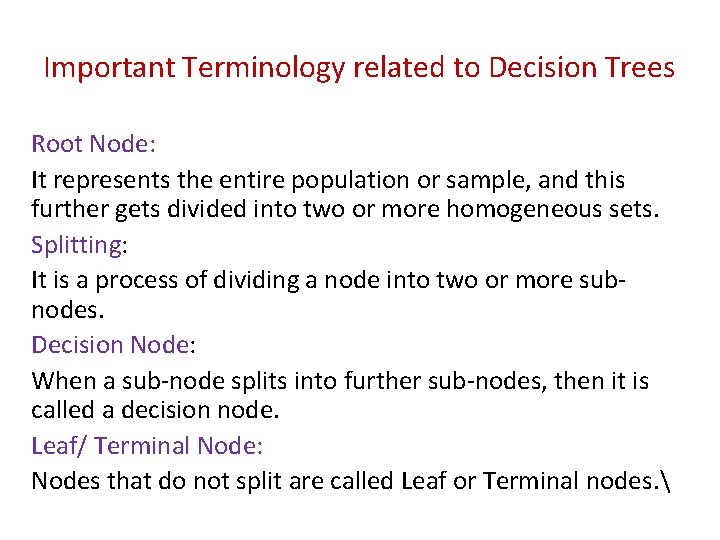
Important Terminology related to Decision Trees Root Node: It represents the entire population or sample, and this further gets divided into two or more homogeneous sets. Splitting: It is a process of dividing a node into two or more subnodes. Decision Node: When a sub-node splits into further sub-nodes, then it is called a decision node. Leaf/ Terminal Node: Nodes that do not split are called Leaf or Terminal nodes.
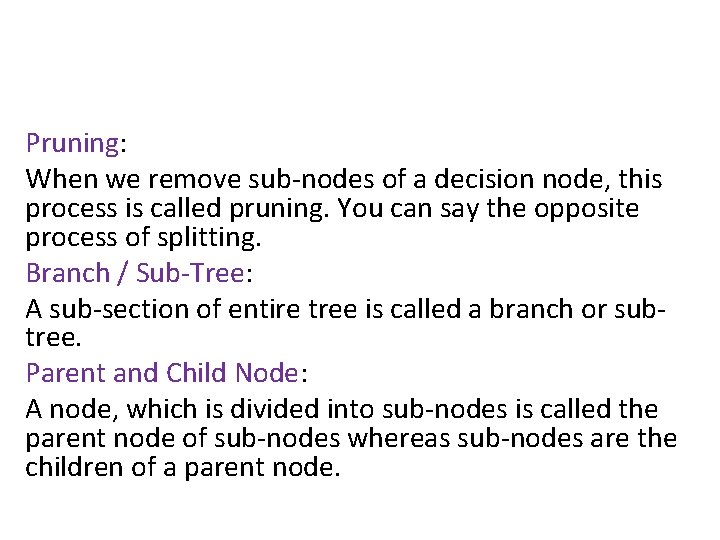
Pruning: When we remove sub-nodes of a decision node, this process is called pruning. You can say the opposite process of splitting. Branch / Sub-Tree: A sub-section of entire tree is called a branch or subtree. Parent and Child Node: A node, which is divided into sub-nodes is called the parent node of sub-nodes whereas sub-nodes are the children of a parent node.