
Learning Markov Network Structure with Decision Trees Daniel

![Markov Networks: Structure Learning [Della Pietra et al. , 1997] • Given: Set of](https://slidetodoc.com/presentation_image_h2/c670898a5a084559e5c9531df95bb584/image-8.jpg "Markov Networks: Structure Learning [Della Pietra et al. , 1997] • Given: Set of")
![Bottom-up Learning of Markov Networks (BLM) [Davis and Domingos, 2010] 1. Initialization with one](https://slidetodoc.com/presentation_image_h2/c670898a5a084559e5c9531df95bb584/image-9.jpg "Bottom-up Learning of Markov Networks (BLM) [Davis and Domingos, 2010] 1. Initialization with one")
![L 1 Structure Learning [Ravikumar et al. , 2009] Given: Set of variables= {F,](https://slidetodoc.com/presentation_image_h2/c670898a5a084559e5c9531df95bb584/image-10.jpg "L 1 Structure Learning [Ravikumar et al. , 2009] Given: Set of variables= {F,")
![DTSL: Decision Tree Structure Learning [Lowd and Davis, ICDM 2010] Given: Set of variables=](https://slidetodoc.com/presentation_image_h2/c670898a5a084559e5c9531df95bb584/image-12.jpg "DTSL: Decision Tree Structure Learning [Lowd and Davis, ICDM 2010] Given: Set of variables=")
![DTSL Feature Pruning [Lowd and Davis, ICDM 2010] e F=? lse tru e S=?](https://slidetodoc.com/presentation_image_h2/c670898a5a084559e5c9531df95bb584/image-13.jpg "DTSL Feature Pruning [Lowd and Davis, ICDM 2010] e F=? lse tru e S=?")
![Empirical Evaluation • Algorithms – DSTL [Lowd and Davis, ICDM 2010] – DP [Della](https://slidetodoc.com/presentation_image_h2/c670898a5a084559e5c9531df95bb584/image-14.jpg "Empirical Evaluation • Algorithms – DSTL [Lowd and Davis, ICDM 2010] – DP [Della")
![Conditional Marginal Log Likelihood [Lee et al. , 2007] • Measures ability to predict](https://slidetodoc.com/presentation_image_h2/c670898a5a084559e5c9531df95bb584/image-15.jpg "Conditional Marginal Log Likelihood [Lee et al. , 2007] • Measures ability to predict")
- Slides: 23
Learning Markov Network Structure with Decision Trees Daniel Lowd University of Oregon <lowd@cs. uoregon. edu> Joint work with: Jesse Davis Katholieke Universiteit Leuven <jesse. davis@cs. kuleuven. be>
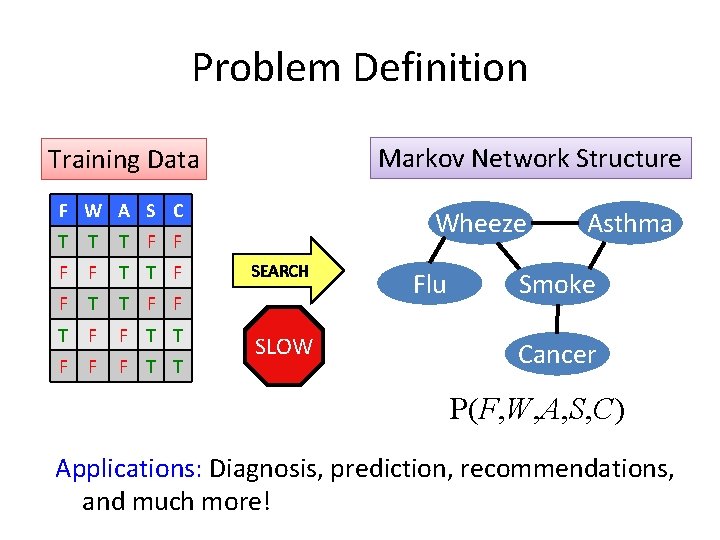
Problem Definition Markov Network Structure Training Data F W A S C T T T F F T F F T T F F F T T Wheeze SEARCH SLOW Flu Asthma Smoke Cancer P(F, W, A, S, C) Applications: Diagnosis, prediction, recommendations, and much more!
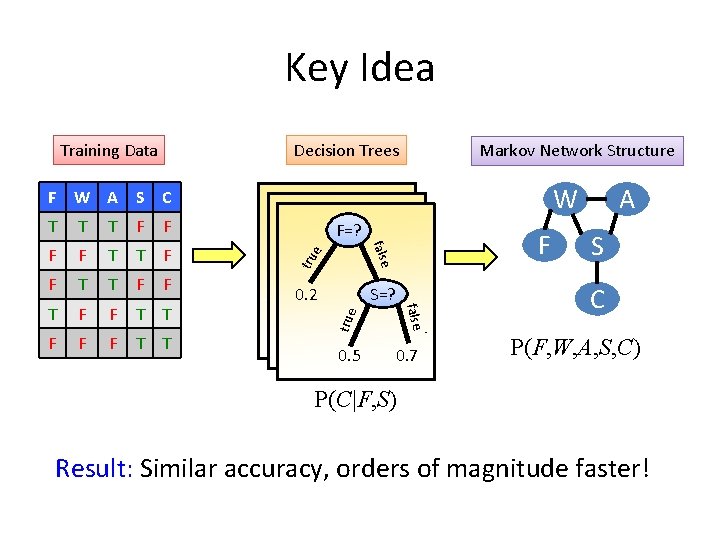
Key Idea Training Data Decision Trees Markov Network Structure W F W A S C F F T T F F F T T F=? F 0. 2 S=? true F tru T false T 0. 5 0. 7 A S C P(F, W, A, S, C) P(C|F, S) Result: Similar accuracy, orders of magnitude faster!
Outline • Background – Markov networks – Weight learning – Structure learning • DTSL: Decision Tree Structure Learning • Experiments
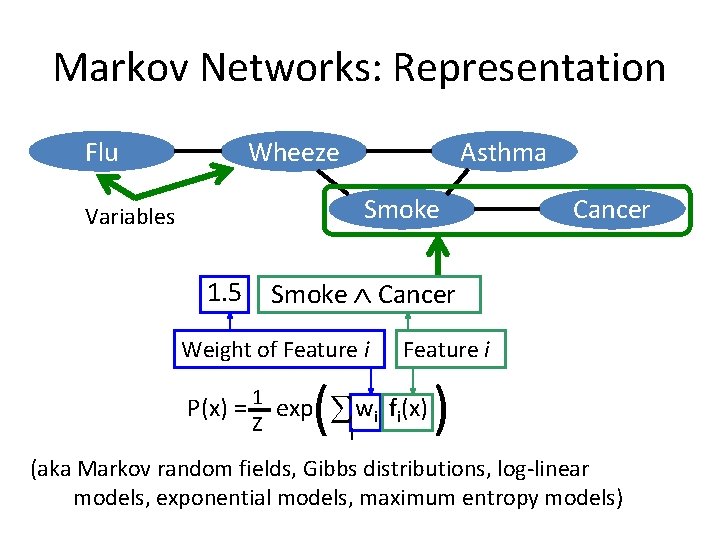
Markov Networks: Representation Wheeze Flu Asthma Smoke Variables 1. 5 Cancer Smoke Cancer Weight of Feature i ( w f (x) ) P(x) = 1 exp Z Feature i i (aka Markov random fields, Gibbs distributions, log-linear models, exponential models, maximum entropy models)
Markov Networks: Learning 1. 5 Smoke Cancer Weight of Feature i ( w f (x) ) P(x) = 1 exp Z Feature i i Two Learning Tasks Weight Learning � Given: Features, Data � Learn: Weights Structure Learning � Given: Data � Learn: Features
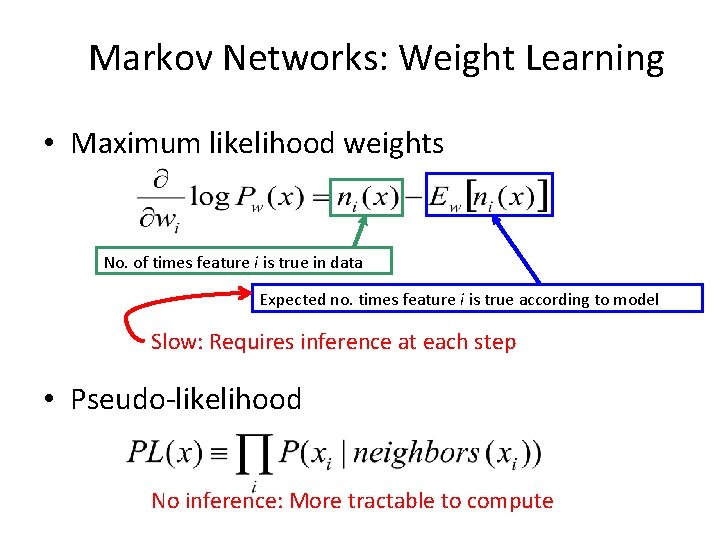
Markov Networks: Weight Learning • Maximum likelihood weights No. of times feature i is true in data Expected no. times feature i is true according to model Slow: Requires inference at each step • Pseudo-likelihood No inference: More tractable to compute
Markov Networks: Structure Learning [Della Pietra et al. , 1997] • Given: Set of variables = {F, W, A, S, C} • At each step Current model = {F, W, A, S, C, S C} Candidate features: Conjoin variables to features in model {F W, F A, …, A C, F S C, …, A S C} Select best candidate New model = {F, W, A, S, C, S C, F W} Iterate until no feature improves score Downside: Weight learning at each step – very slow!
Bottom-up Learning of Markov Networks (BLM) [Davis and Domingos, 2010] 1. Initialization with one feature per example 2. Greedily generalize features to cover more examples 3. Continue until no improvement in score F W A S C Initial Model Revised Model T T T F F F 1: F W A F 1: W A F F T T F F 2: A S F T T F F F 3: W A T F F T T F 4: F S C F F F T T F 5: S C Downside: Weight learning at each step – very slow!
L 1 Structure Learning [Ravikumar et al. , 2009] Given: Set of variables= {F, W, A, S, C} Do: L 1 logistic regression to predict each variable 0. 0 C 0. 0 F 0. 0 W 0. 0 A 1. 5 S C … 1. 0 W 0. 0 A 0. 0 S Construct pairwise features between target and each variable with non-zero weight Model = {S C, … , W F} Downside: Algorithm restricted to pairwise features F
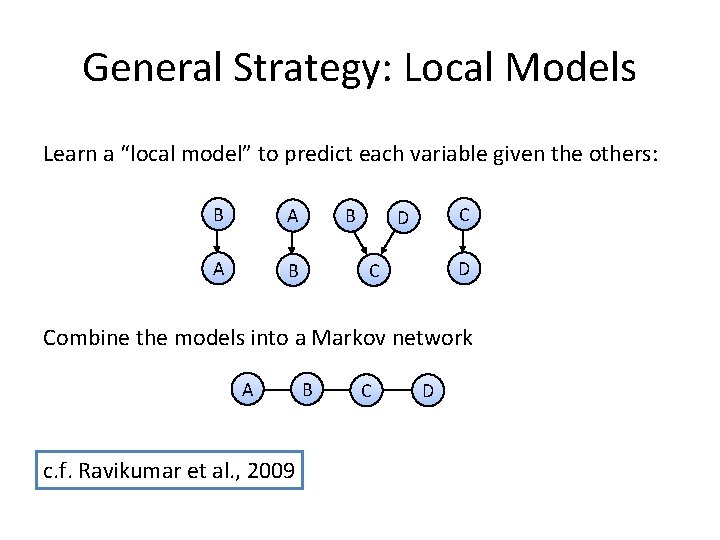
General Strategy: Local Models Learn a “local model” to predict each variable given the others: B A A B B C D D C Combine the models into a Markov network A c. f. Ravikumar et al. , 2009 B C D
DTSL: Decision Tree Structure Learning [Lowd and Davis, ICDM 2010] Given: Set of variables= {F, W, A, S, C} Do: Learn a decision tree to predict each variable P(F|C, S) = e F=? 0. 5 lse tru e S=? fa 0. 2 lse tru fa P(C|F, S) = 0. 7 Construct a feature for each leaf in each tree: F C ¬F S C ¬F ¬S C F ¬C ¬F S ¬C ¬F ¬S ¬C …
DTSL Feature Pruning [Lowd and Davis, ICDM 2010] e F=? lse tru e S=? fa 0. 2 lse tru fa P(C|F, S) = 0. 5 ¬F S C ¬F S ¬C 0. 7 Original: F C F ¬C Pruned: All of the above plus F, ¬F S, ¬F ¬S, ¬F Nonzero: F, S, C, F C, S C ¬F ¬S ¬C
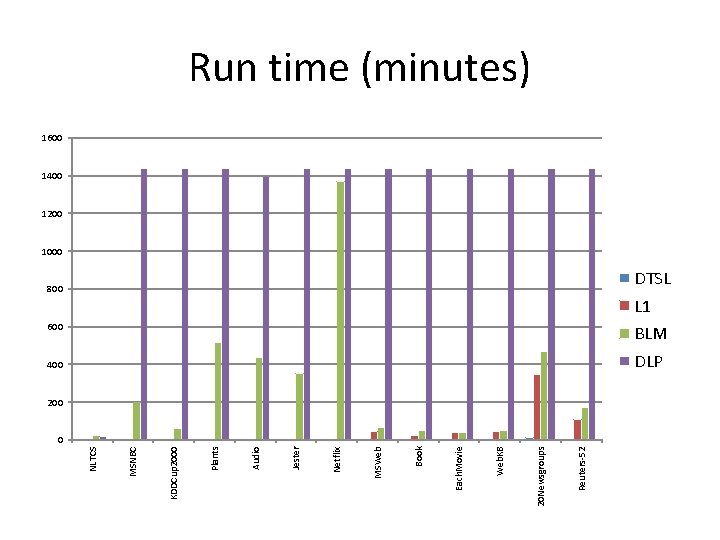
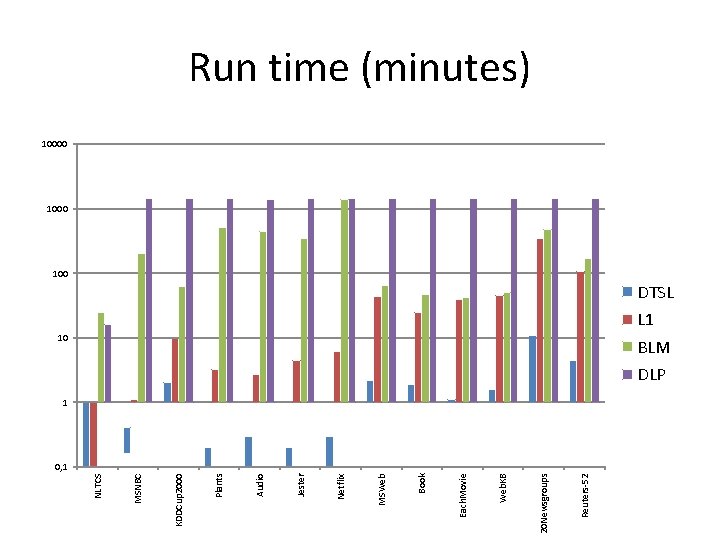
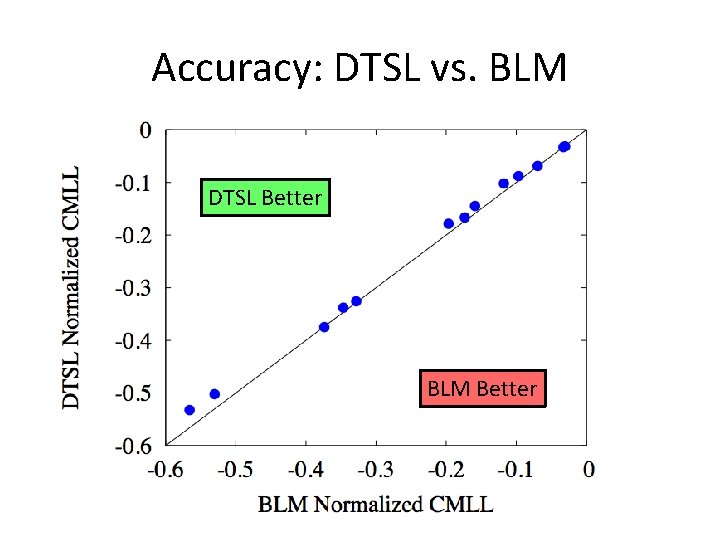
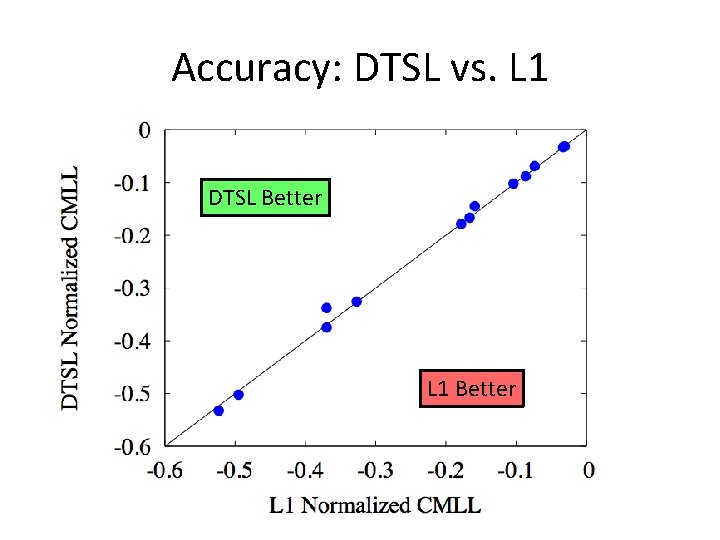
Empirical Evaluation • Algorithms – DSTL [Lowd and Davis, ICDM 2010] – DP [Della Pietra et al. , 1997] – BLM [Davis and Domingos, 2010] – L 1 [Ravikumar et al. , 2009] – All parameters were tuned on held-out data • Metrics – Running time (structure learning only) – Per variable conditional marginal log-likelihood (CMLL)
Conditional Marginal Log Likelihood [Lee et al. , 2007] • Measures ability to predict each variable separately, given evidence. • Split variables into 4 sets: Use 3 as evidence (E), 1 as query (Q) Rotate through all variables appear in queries • Probabilities estimated using MCMC (specifically MC-SAT [Poon and Domingos, 2006])
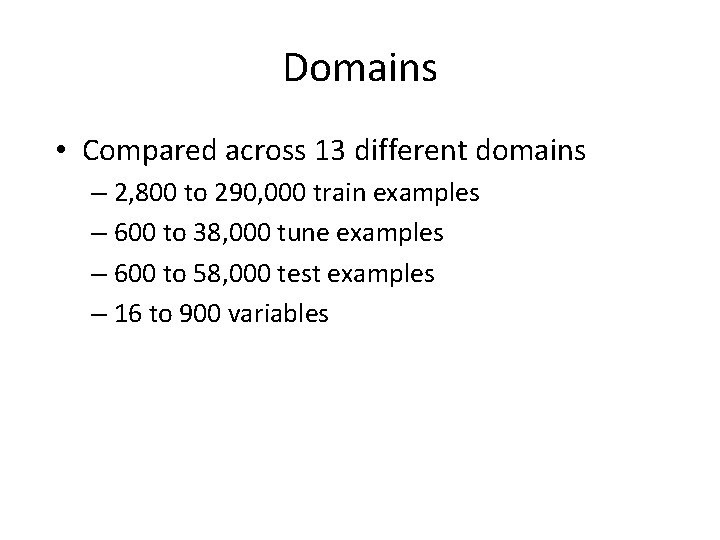
Domains • Compared across 13 different domains – 2, 800 to 290, 000 train examples – 600 to 38, 000 tune examples – 600 to 58, 000 test examples – 16 to 900 variables
Reuters-52 20 Newsgroups Web. KB Each. Movie Book MSWeb Netflix Jester Audio Plants KDDCup 2000 MSNBC NLTCS Run time (minutes) 1600 1400 1200 1000 800 DTSL L 1 600 BLM 400 DLP 200 0
Reuters-52 20 Newsgroups Web. KB Each. Movie Book MSWeb Netflix Jester Audio Plants KDDCup 2000 MSNBC NLTCS Run time (minutes) 10000 100 DTSL L 1 10 BLM DLP 1 0, 1
Accuracy: DTSL vs. BLM DTSL Better BLM Better
Accuracy: DTSL vs. L 1 DTSL Better L 1 Better
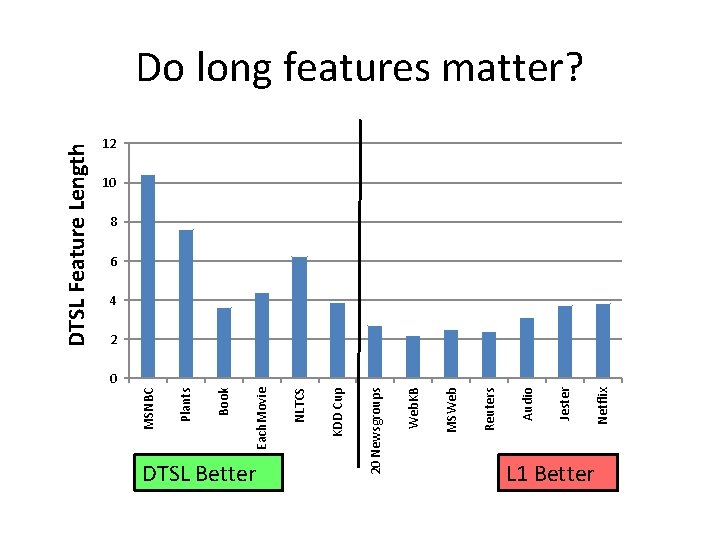
KDD Cup Netflix Jester Audio Reuters MSWeb Web. KB 20 Newsgroups DTSL Better NLTCS Each. Movie Book Plants MSNBC DTSL Feature Length Do long features matter? 12 10 8 6 4 2 0 L 1 Better
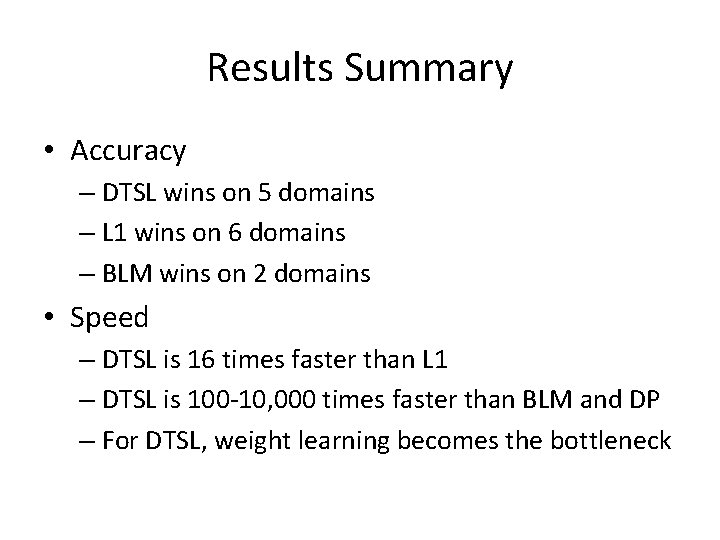
Results Summary • Accuracy – DTSL wins on 5 domains – L 1 wins on 6 domains – BLM wins on 2 domains • Speed – DTSL is 16 times faster than L 1 – DTSL is 100 -10, 000 times faster than BLM and DP – For DTSL, weight learning becomes the bottleneck
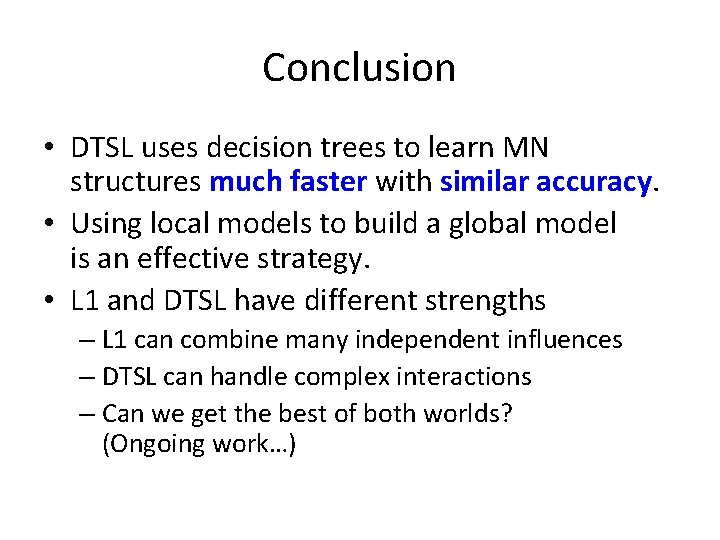
Conclusion • DTSL uses decision trees to learn MN structures much faster with similar accuracy. • Using local models to build a global model is an effective strategy. • L 1 and DTSL have different strengths – L 1 can combine many independent influences – DTSL can handle complex interactions – Can we get the best of both worlds? (Ongoing work…)